
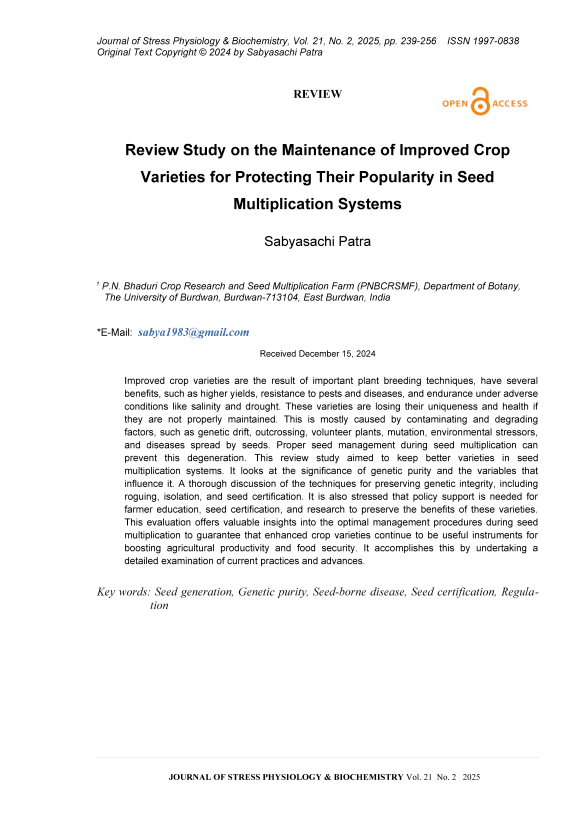
Review study on the maintenance of improved crop varieties for protecting their popularity in seed multiplication systems
Journal: Journal of Stress Physiology and Biochemistry @jspb
Article in issue: 2 т.21, 2025.
Free access
Improved crop varieties are the result of important plant breeding techniques, have several benefits, such as higher yields, resistance to pests and diseases, and endurance under adverse conditions like salinity and drought. These varieties are losing their uniqueness and health if they are not properly maintained. This is mostly caused by contaminating and degrading factors, such as genetic drift, outcrossing, volunteer plants, mutation, environmental stressors, and diseases spread by seeds. Proper seed management during seed multiplication can prevent this degeneration. This review study aimed to keep better varieties in seed multiplication systems. It looks at the significance of genetic purity and the variables that influence it. A thorough discussion of the techniques for preserving genetic integrity, including roguing, isolation, and seed certification. It is also stressed that policy support is needed for farmer education, seed certification, and research to preserve the benefits of these varieties. This evaluation offers valuable insights into the optimal management procedures during seed multiplication to guarantee that enhanced crop varieties continue to be useful instruments for boosting agricultural productivity and food security. It accomplishes this by undertaking a detailed examination of current practices and advances.
Similar articles in the section Field crops and their production
Short address: https://sciup.org/143184715
IDS: 143184715
Text of the review article Review study on the maintenance of improved crop varieties for protecting their popularity in seed multiplication systems
To address these issues, many developing-country seed companies generally partner with small-scale seed producers who either NGOs/GOs or farmer associations support. This strategy is increasingly being used in several countries, including Ethiopia, Malawi, Kenya and Uganda ( ean et al ., 2007).
Reasons for the Maintenance of Improved Crop Varieties
The resistance of improved varieties of crops to diseases and pests is one of their main benefits. This resilience lowers production costs and the environmental effect by reducing the demand for chemical pesticides. It is crucial to safeguard these resistance genes through rigorous seed multiplication to stop disease and insect infestations that could destroy crops and cause large financial losses. Technological and scientific developments between the 1940s and 1970s brought about a new wave of agricultural practices that allowed farmers to significantly boost crop yields. The movement became recognized as the "Green Revolution (GR; Borlaug and Dowswell., 2005). The first significant breakthrough of the Green Revolution was the development of new semi-dwarf wheat cultivars that were high-yielding, resistant to disease (mostly stem rust), and spread to other crops (Dubin and Brennan, 2009). The practice of monoculture and the substitution of contemporary techniques and technologies for conventional agricultural methods, such as the widespread application of agrochemicals (chemical fertilizers, herbicides, and pesticides), labour mechanization, and a significant expansion around irrigated cropland, were other important aspects of the Green Revolution (Evans, 1998).
There is a close correlation between market demand and crop attributes including taste, size, and shelf life. Higher prices and greater profits for farmers can be obtained via improved varieties that cater to customer tastes. By retaining these characteristics, farmers can continue to produce crops that live up to market demands, promoting both customer happiness and economic viability. Accordingly, A portion of the first selection criteria in varietal development projects is based on the visual qualities of rice grains, which are important screening attributes that influence customers' purchasing decisions (Adair et al., 1966; Tomlins et al. 2007). The length is the primary determinant of grain size. However, the length-to-width ratio determines the grain shape (Graham, 2002). There is no standard method for classifying rice samples according to their shape and size in different markets and countries (Codex Alimentarius Commission, 1995; Dela Cruz & Khush, 2002). The breeding system of International Rice Research Institute (IRRI) employ the following routine classification system: short rice grain (5.50 mm) medium/intermediate rice grain (5.51–6.60 mm), long rice grain (6.61–7.50 mm), and very long rice grain (> 7.50 mm). The percentage of chalky grain determines the grain's classification: none (0%), tiny (< 10%) medium (10–20%), and large (> 20%). (Ikehashi & Khush, 1979; Dela Cruz & Khush, 2000]. The effects of rice's intrinsic and extrinsic quality attributes on market prices have also been studied using the hedonic pricing model (Abansi et al., 1992; Unnevehr, 1986); the findings suggest that varietal improvement programs shouldn't be restricted to yield-enhancing traits alone. More sustainable agricultural methods are frequently facilitated by improved crop varieties. For example cultivators can use less water and fertilizer when using varieties with higher nutrient use efficiency and drought tolerance. Considering resource constraint and climate change, maintaining these characteristics is crucial for advancing environmentally sustainable agriculture. Given its capacity to meet the goals of reducing the yield-scaled impacts of farming and increasing the yield gap, high-yielding rice varieties have attracted increasing attention from researchers in developing nations (Chen et al., 2014; Yamano et al., 2016; Yuan et al., 2021; 2022).
To get a greater predicted yield, however, the replacement of traditional rice cultivars with high-yielding varieties may raise the requirement for production inputs (such as fertilizers and machinery) (Chen et al., 2021; Darzi-Naftchali et al., 2017). To highlight potential successes and compromises between the goals of overall sustainability and food security, more data from actual farms is required regarding the comparison of variety substitution's effects on the environment (e.g. traditional vs. high-yielding rice cultivars), based on a life cycle assessment of all production inputs and outcomes (Alhashim et al., 2021; Garnett, 2014; Guinée & Heijungs, 2011, Heijungs et al., 2009).To keep the lines intact and retain their desired traits and original genetic makeup for future generations, maintenance breeding is crucial. The study of the significance of two techniques inside and the ability to spot slow or dramatic changes are made possible by maintenance through sib mating and selfing (year to row) throughout generations. According to Nally et al. (2016), it aids in boosting rice crops against biotic and abiotic stress; maintenance breeding for disease resistance is one method to increase food supply without raising production potential. Significant time, financial, and scientific resources must be committed to the breeding of improved cultivars. By keeping these cultivars alive, we can make sure that the money and resources used to develop them are not lost. Additionally, it maintains the genetic progress accomplished, which can serve as a basis for further breeding initiatives. Maintaining PGR diversity is essential for both genetic improvement and crop variety development.
Challenges for the Maintenance of Improved Varieties of Crops
Several major obstacles must be overcome to maintain improved varieties of crops across consecutive generations of seed multiplication. In the end, these difficulties may have an impact on the varieties' acceptance and efficiency in farming systems by compromising their genetic purity, general health, and overall performance. The key challenges include:
Genetic Drift :
Random variations in allele frequency between generations within a population are referred to as genetic drift. Genetic drift can cause the gradual loss of certain features that characterize an enhanced variety during the seed-multiplying process. Plant populations having unique genetic constitutions are known as crosspollinated crop species and multi-line variants. Therefore, in the process of maintaining these varieties the generation that results will not accurately represent the whole range of gene combinations found in the original variety's genotype if a small number of gene combinations are excluded owing to incorrect sampling. Such a population abruptly loses the genetic equilibrium that was expected to exist (Nagel et al. 2019). Crops can naturally undergo small genetic changes over time, even in isolated fields. The crop's purity may be compromised by this slow genetic drift if it results in changes to its traits (Gereziher Teame et al., 2017). To find any changes, ongoing genetic testing and observation are necessary. Genetic drift can also be resisted by regulated breeding programs that preserve a diversified genetic pool. Crop kinds that contain contaminants can be identified with the aid of genetic testing methods. DNA sequencing and polymerase chain reaction are two methods for confirming genetic purity (Ratna et al. 2015). rigorous measures, such as keeping foundation and breeder seeds under rigorous supervision and guaranteeing modest effective population sizes during seed multiplication, are necessary to reduce genetic drift.
Outcrossing :
When pollen from a different variety or species fertilizes the flowers of an improved variety, this process is known as outcrossing or cross-pollination. Multiple environmental stresses acting in together are endangering animal pollination of both wild and farmed plant species (Schweiger et al . 2010). Plant-pollinator interactions have been demonstrated to be adversely affected by invasive species (Memmott and Waser 2002; Bjerknes et al . 2007), pesticide use (Kremen et al . 2002), changes in land-use, such as habitat fragmentation (Mustajarvi et al . 2001; Aguilar et al . 2006), and agricultural intensification (Ricketts et al . 2008). Pollination control approaches, such as bagging flowers or adopting male-sterile lines, are effective strategies. Other strategies include temporal isolation (planting at various times to minimize overlapping flowering periods) and physical isolation of seed multiplication fields. To lessen the chance of crosspollination, farmers can establish buffer zones or isolation zones between various crop species. This entails keeping a physical distance between crops whose genetic characteristics are incompatible.
Seed-Borne Diseases :
"Seed-borne diseases" are infections caused by pathogens that transmit through seeds, heavily impairing plant quality and yield. Some strategies to manage seed-borne infections include using disease-free seed stock, treating seeds with fungicides or hot water, and implementing stringent field hygiene protocols to minimize contamination. When genes from different species are included to introduce disease or pest resistance, genetic purity may be compromised (Tewodros Mesfin et al., 2009). Researchers are looking into alternatives like traditional breeding techniques that preserve genetic integrity to produce resistance, or the use of biocontrols, which are naturally occurring enemies of pests. It is possible to identify externally transmitted seed-borne fungus by using the washing approach (Verma and Lahori, 2004). Such example are flag smut of wheat Urocystis tritici), downy mildew of soyabean Peronospora manshurica), blast of paddy Pyricularia oryzae), smut of pearl millet (Tolyposporium penicillarie).
Environmental Stress:
Modifications to the soil, temperature, precipitation patterns, and other environmental factors can have an impact on the stability and performance of enhanced cultivars. In a climate change scenario, producing and using high-quality seeds can be crucial to generating high yields. However, because these pressures have a negative impact on plants, producing high-quality seeds under different abiotic stresses requires extra attention. Abiotic stressors impact crop plants at all levels, from morphology to the molecular (Fahad et al ., 2017) limiting yield and quality. Nonetheless, plants exhibit a few strategies, such as stress avoidance, escape, and stress tolerance, in response to the pressures. Plants experience molecular, cellular, and physiological alterations in response to stressors and learn to adapt to them. To ensure food security, one of the essential elements of plant studies is an insight view of such changes. A deeper comprehension of how plants react to stressors can aid in the development of numerous stress-reduction tactics. To lessen these impacts cultivators can use stress-tolerant rootstocks, controlled environment agriculture (CEA) for seed production, and variety development with increased environmental adaptability.
Regulatory and Certification Challenges :
Variations in seed quality and genetic purity standards might result from inconsistent or insufficient regulatory frameworks and certification procedures. It was noted in the 20th century that mechanical mixing and genetic contamination caused newly created crops cultivars or varieties to lose their uniqueness. In order to solve this issue, a group of breeders and agronomists started going to progressive producers' fields to advise them on safety measures to take in order to prevent mechanical mixes and maintain the seed's genetic purity, or true to type. Field inspections became commonplace as a result of this campaign. Field inspection was considered by crop scientists and growers/farmers as a potentially helpful method for preserving the genetic purity of crop varieties/cultivars. Though there are some restrictions on producing seeds or crops in ecosystems that are impossible to completely regulate, thinking has evolved about the appropriate limits for mechanical mixes and genetic contamination among other things. The International Crop Improvement Association (ICIA) was founded in 1919 when officials from the USA and Canada convened in Chicago, Illinois, to address these real-world issues brought on by nature. The contemporary era of seed certification began with the ICIA, which changed its name to the Association of Official Seed Certification Agency (AOSCA) in 1969 (Agarwal, 1996).To guarantee that high requirements are fulfilled globally, it is imperative to harmonize seed certification standards improve regulatory monitoring, and foster international cooperation in seed quality management. Preserving the suitablecharacteristics of improved cultivars requires addressing genetic drift, outcrossing, seed-borne diseases, environmental stress, and inconsistent regulations. The agricultural community can guarantee that improved crop varieties continue to yield the desired results and maintain their popularity and efficacy in seed multiplication systems by putting strong and creative solutions into place.
Strategies for the Maintenance of Improved Crop Varieties
Effective maintenance of improved crop varieties in seed multiplication systems requires a combination of traditional and modern strategies to preserve genetic purity, health, and performance. These strategies ensure that the desirable traits of improved varieties are retained across successive generations. Key strategies include:
Genetic Purity:
Since it guarantees that the plants that comprise the crop have the intended traits, Kelly (1988) asserts that the genetic purity of the seed is the most crucial component of its quality. the rigorous elimination of unwanted plants from a seed crop based on distinctive morphological traits is known as roguing (Laverack and Turner, 1995). Off-types, diseased plants, undesirable weeds, and other crop plants are all considered rogues. This process improves one or more factors (genetic purity, free from diseases and noxious weeds) of seed quality (Parimala et al ., 2013).
Rouging must be done correctly and on time to produce seeds. This means that in fields where seeds are produced, undesirable or off-type plants must be regularly removed. Fields used for seed production are physically or chronologically isolated to avoid crosspollination with other cultivars or wild relatives. Physical isolation can be achieved by keeping a sufficient distance between fields, whereas temporal isolation requires planting at various times to avoid overlapping flowering seasons. Molecular markers ensure the genetic legitimacy of seeds and can be used to detect and eliminate contamination early in the multiplication phase. This method allows for the precise monitoring of genetic purity.
i Use of only approved seed in seed multiplication ii Inspection and approval of seed plots prior to planting iii Growing crops should be inspected and approved in the field at all important growth phases to ensure genetic purity, detect admixtures and weeds, and be free of noxious weeds and seed-borne diseases.
iv Sampling and sealing of cleaned lots.
v Growing samples of potentially authorized stocks to compare with real stocks.
vi Provision of adequate isolation to prevent contamination by natural crossing or mechanical mixture.
vii Routing seed plots before stages of growth when contaminated seed crop occurs.
viii Regular testing of cultivars to ensure their genetic purity ix Preserving genetic diversity by growing crops only where they are adapted.
x Seed crop certification ensures genetic purity and quality of seed.
xi Adoption of generation system.
Seed Certification:
Strict seed certification procedures ensure that growers only obtain premium, genetically pure seeds. Certification involves multiple stages of quality control, field inspection, and seed testing to maintain standards. According to Douglas (1972), a successful seed certification system should strive for the subsequent three goals:
a A steady increase in superior varieties.
b Identification of fresh varieties and their rapid propagation under appropriate and well-known names.
c . Ensuring regular access to the identical seed material through careful maintenance
India and the other SAARC countries adopt a three-generation seed multiplication approach (Huda and Saiyed, 2011). Only the original breeder or a supported institution produces breeder seed in India. Any of the State seed corporations, National seed corporations, seed cooperatives, public sector initiatives, nongovernmental organizations, private seed firms, and farmers' producer groups produce the foundation and certified seed. Only three generations beyond the breeder seed are permitted by the Indian Minimum Seed Certification Standards (IMSCS) (Trivedi and Gunasekaran, 2013).
Following processing, the seed samples are forwarded to the state seed testing lab under ISTA regulations to ensure they meet the requirements for certified seed in vegetable crops.
The seed standards are given below in the table 2.
Seed certification aims to maintain appropriate standards of additional quality parameters, such as freedom from weeds and diseases, seed viability mechanical purity, and grading, in addition to varietal purity and identification ( .E. Douglas (ed.), 1980). It is essential to regularly test seeds for genetic purity, germination rate, and seed health. To confirm the quality of seeds, advanced techniques like DNA fingerprinting and electrophoresis can be employed.
Breeder and Foundation Seed Maintenance :
Nucleus seed is used to make breeder seed. It needs to have pure genetic makeup. As foundation seed, it is employed. The ICAR's mandate is to produce breeder seed, which is being done with assistance from the State Agricultural University, All India Co-ordinated Research Projects, the ICAR Research Institute, and other organizations. Genetic drift and contamination are reduced when foundation and breeder seeds are kept under carefully monitored conditions. The main source of genetic material for additional proliferation is these seeds. The process for maintaining the nucleus seed of prerelease or recently released varieties of crops was described by Harrington in 1952. Self-fertilized species should have entirely homogenous variations. Nonetheless, in recently released cultivars, a significant degree of variation may still happen throughout the seed production cycle. Therefore, purification of such varieties during the nucleus/breeder's seed care may be required (Agarwal, 1980). At several growth phases especially flowering and maturity, the breeder seed crop should be examined for genetic purity. The method currently used for producing breeder seeds of pure lines showed a lower genotypic coefficient of variability and more deviation for most traits in progenies derived on a panicle basis from selected bagged plants than in progenies generated on a whole plant basis from selected unbagged plants (Pandey and Seshu, 1998). Breeder seed undergoes inspection and roguing for various traits at various stages (Agrawal and Dadlani, 1987). Maintaining the genetic integrity of the enhanced variety can be achieved by periodically renewing foundation and breeder seeds through backcrossing with the original parent lines. A specific class of seed is produced from a specific class up to a certified seed stage in the generation system of seed multiplication (Agarwal 2008).
Only certified and foundation seeds are subject to the seed certification regulations in India. There exist two distinct categories of standards: field standards and seed standards. The field standards are relevant to standing crops and seed production plots, while the seed standards are specific to seeds. Field requirements include land, isolation, maximum amount of off-type that can be tolerated, inseparable other agricultural plants, pollen shedders (in male sterile line), plants contaminated with illnesses spread by seeds, etc. Standards for seeds include moisture content, germination, other crop seeds, physical and genetic purity, and more. (Tunwar and Singh, 1988)
Protection of Seed-Borne Diseases Using Quarantine Guidelines
A parliamentary measure known as "plant quarantine" restricts plant imports and exports, planting materials, grafts, and seeds, and equipment to prevent plant diseases from spreading to locations where they do not currently exist. This prevents the transmission of pathogens and pests from these sources. Thus, "Rules and Regulations" issued by the government(s) to control the introduction of plants, planting materials plant products, soil, live organisms, etc. from one area to another can be used to characterize plant quarantine. The purpose of this is to prohibit the establishment and further spread of exotic pests weeds, and diseases that are detrimental to agriculture and the environment in a country or region, as well as to avoid their unintended introduction without adversely affecting trade (Gupta and Khetarpal 2004).
Therefore, quarantine aims to stop the spread of harmful infections, not to prevent the flow of additional biological material. Timely interventions are made possible by routine monitoring and early disease identification, which help stop the spread of pathogens through seeds.
Hot water treatment was mainly used to sterilize contaminated cereal seeds, but Nega et al. (2003) reported that it was effective in controlling seed-borne pathogens, such as Alternaria spp. and Xanthomonas spp., in carrots, celery, lettuce etc.(Gilbert et al., 2005). Koch et al. (2010) discovered that hot air treatment of carrot seeds was just as effective as chemical treatment in controlling the seed-borne infection of Alternaria dauci and A. radicina. Manyhost-pathogen systems have demonstrated the excellent efficacy of aerated steam treatment (Forsberg et al., 2002; Tinivella et al., 2009; Schaerer, 2012). Additionally, it has proven effective in treating seed-borne illnesses brought on by F. moniliforme in sweet corn, C. michiganensis subsp. michiganensis in tomatoes, X. campestris in cauliflower, and Septoria apiicola in celery (Groot et al. 2006, 2008). In India, the following 18 crops are approved for use with fungicides that contain benzimidazole: cereals viz. rice, wheat, barley, fibres viz. cotton, jute, fruits viz. mango, apples, grapes, vegetables viz. beans, eggplants, cucurbits, peas, sugar beets, tapioca, flower viz. roses and peanut. For many horticultural and agricultural crops worldwide, systemic fungicide seed treatment is thought to be an economically viable disease management strategy (Bhushan et al. 2013; Lamichhane et al. 2020). According to Zeun et al. 2013, many additional fungicide groups, such as strobilurins, triazoles, phenylpyrroles, and phenylamides, are also used to treat seeds for some diseases that are transmitted by seeds. Both seeds and seedlings are protected against pathogens when treated with microbial antagonists. Eighty-four percent of microbial antagonists are bacteria., followed by fungi (16%). In recent decades, numerous bacterial biocontrol agents have been identified and used to treat diseases propagated via seeds. Many bacteria have been thoroughly studied and successfully marketed as biological control agents, such as Burkholderia cepacia, B. subtilis, S. marcescens, P. fluorescens, and Streptomyces griseoviridis (Singh 2014; Bisen et al., 2015; Keswani et al., 2016; Gouda et al., 2018).
To control a variety of phytopathogens, including seed-borne diseases, the most often employed bacterial biocontrol agents are species of Pseudomonas and Bacillus (Abhilash et al., 2016; Bhat et al., 2019; Khan et al., 2020). Likewise, the potential of a variety of fungi to act as biocontrol agents against seed-borne diseases has also been investigated. The species of Phomosis, Ectomycorrhizae, Trichoderma Cladosporium, Gliocladium, and other fungi are significant fungal biocontrol agents. Trichoderma spp. is a well-researched and extensively utilized biopesticide worldwide, among other fungal biocontrol agents (Singh 2006; Keswani et al., 2013; Bisen et al. 2016; Singh et al., 2016). Trichoderma spp. have been shown to have antagonistic action against a variety of soil- and seed-borne fungi, making them suitable plant symbionts. The market share of trichoderma formulation in the global biopesticide industry is greater than 60% (Keswani et al., 2013).
Community-Based Seed Production :
Policy Support and Regulation :
Policymakers, practitioners, and researchers all agree that seed provisioning is crucial for agrobiodiversity and germplasm conservation, food security and nutrition, rural livelihoods, and agricultural development (Coomes et al ., 2015). Although there has been a greater advancement in seed system technology, it is still a constant process that must adhere to several internal and external elements, with plant breeders and biotechnologists playing a crucial role. October 18–19, 2014, in Kathmandu, Nepal, POD "Cooperation among Bangladesh, India, Nepal, and IRRI in seed sector Protocol of Discussion" was made by the SAARC Member States, specifically Bangladesh, India, Nepal, and IRRI, to achieve the goals of the SAARC Seed Bank (SAARC, 2014). The POD was expected to directly help the farmers of all three areas by circulating the rice varieties that are released in one region for use by farmers in other countries.
The following laws, policies, and rules for advancing the Farmers' Right have been approved by the SAARC Member States:
Afghanistan: National Seed Policy 2005; Seed Act 2009.
Bangladesh: Plant Varieties Act of Bangladesh 1998; Biodiversity and Community Knowledge Protection Act of Bangladesh; Seed Act 2018;
Seed Rules 1998; National Seed Policy 1993; and Hybrid Rice Variety Evaluation and Registration Procedures, 2016.
Bhutan: Biodiversity Act 2003 with provisions for breeders and farmers’ rights; Seed Act 2000; Seed Rules and Regulation 2006, 2017 (revised).
India: Protection of Plant Varieties and Farmers’ Rights Act 2001 (PVA); Biodiversity Bill 2002; Seed Development, 1988; National Seed Policy 2002; National Seed Plan 2005-06 and Seed Act 1966/Seed Rules.
Nepal: The Seed Act 1988 (with amendment in 2008); Protection of Plant Varieties and Farmers’ Right draft Bill (2005); Agrobiodiversity Policy 2006 (revised in 2014); Agriculture Development Strategy (ADS) 2014; Inclusion of seed/food sovereignty in Constitution 2015 (Seeds Act 1988 amendment in 2008 and Seeds Rules 2013; National Seed Policy, 1999 and Seed vision 2013-2025).
Pakistan: Plant Breeders’ Rights Ordinance 2000; Seed (Amendment) Act 2015; National Seed Policy 2016; Seed (Truth-in-Labeling) Rules 1991; Plant Breeder Act 2016
Sri Lanka: Protection of New Plant Varieties (Breeders Rights) 2001; National Seed Policy 1996; Seed Law 2003.
Sustaining improved varieties requires government policies that encourage research, seed certification and farmer education. Fair trade principles and easier access to premium seeds should also be priorities for policymakers. Maintaining the genetic integrity and health of enhanced varieties is aided by harmonizing seed laws and regulations to guarantee uniform quality requirements across geographical areas.
Technological Innovations :
Biotechnology achievements like CRISPR and other gene-editing methods can be utilized to generate more resilient and easier-to-maintain variations while also enhancing desired features. Only a few species have been researched thus far using this strategy (Zhou et al ., 2020). The speed at which agricultural enhancement transitions has accelerated because to the precise and targeted genetic alteration of crops made feasible by recent developments in CRISPR/Cas9 technologies (Chen et al ., 2019).
Since 2013, the application of CRISPR/Cas9 and its variations has taken center stage. A DNA fragment known as CRISPR is made up of tiny, non-contiguous DNA repeats separated apart by spacers or variable sequence pieces. Accordingly, this research suggested that prokaryotes' elicitation of adaptive immunity may be caused by CRISPR/Cas9 (Bolotin et al., 2005; Pourcel et al., 2005). According to Leibowitz et al. (2021), ISPR/Cas9 could treat diseases, and its application significantly influences plant biology (Zhan et al., 2021). In an experiment conducted in 2007, researchers thought the bacterial phenotypic was phage-resistant and that the bacterial phenotype could be changed by adding or removing particular spacers. This was the first documented application of CRISPR/Cas9. (Barrangou et al., 2007). Genetically modifying plants to improve agriculture will be simple in the future (Sharma et al., 2021). Cas9, a protein referred to as "biological scissors," is being used to modify genomes in a way that redefines standards and opens new possibilities for agricultural crop enhancement (Sharma et al., 2021). Cas9 has been used to address several abiotic stressors in important crops, including rice, wheat, maize, cotton, and potatoes. By creating crops that are resistant to abiotic stressors or climate change, plant breeding has updated plant breeding. Any sequence can be changed, and any character can be introduced into crops using CRISPR/Cas9. Numerous genes linked to abiotic stress tolerance were found by molecular breeders, who then incorporated them into crops (Razzaq et al., 2021). Mutants of the slmapk3 protein gene produced by CRISPR/Cas9 enhanced tomatoes' defense response to drought stress (Wang et al. 2017). Two genes, TaDREB3 and TaDREB2, linked to abiotic stress resistance in wheat protoplasts, have been studied using Cas9. Using the T7 endonuclease test, mutant gene expression was found in about 70% of the transfected wheat protoplasts.In contrast to plants of the wild type, all mutant plants demonstrated drought tolerance (Kim et al., 2018). A thorough analysis on how to use Cas9 to improve plants' resistance to drought stress ( oshi et al., 2020). The function of the rice OsAnn3 gene, which was altered to withstand cold stress, was investigated in plants with altered genomes (Shen et al., 2017). To investigate the stress mechanism in rice, the gene SAPK2 was modified. This gene improved rice's resistance to salinity and drought, according to a prior study (Lou et al., 2017). Targeting the ARGOS8 gene to produce novel variations has led to the development of drought tolerance, and this is incredibly significant for maize (Shi et al., 2017). Liao et al. (2019) reported that the Cas9-induced mutation of Leaf1,2 in rice resulted in drought resistance by modifying the pattern of protein production and scavenging of reactive oxygen species. In 2019, Zhang et al. increased rice's resistance to salt by targeted mutation of the OsRR22 gene.
In view of Digital Agriculture, leveraging digital tools for monitoring and managing seed production can enhance precision and reduce human error. Technologies like drones, remote sensing, and data analytics can provide valuable insights into field conditions and crop health.
Table 1: India's minimum isolation standards for certified seed of some vegetable crops
|
Name of Vegetable crops |
Scientific name |
Open Pollinated seeds |
Hybrid seeds |
|
Bottle gourd |
Lagenaria siceraria |
500 |
1000 |
|
Snake gourd, |
Trichosanthes cucumerina |
500 |
1000 |
|
Sponge gourd |
Luffa aegyptiaca . |
500 |
1000 |
|
Bitter gourd |
Momordica charantia |
500 |
1000 |
|
Muskmelon |
Cucumis melo |
500 |
1000 |
|
Cucumber |
Cucumis sativus |
500 |
1000 |
|
Tomato |
Lycopersicon esculentum (Mill.) |
25 |
100 |
|
Carrot |
Daucus carota |
800 |
800 |
|
Onion |
Allium cepa |
500 |
600 |
|
Bringal |
Solanum melongena |
100 |
200 |
|
Amaranth |
Amaranthus spp. |
200 |
- |
|
Spinach |
Spinach oleracea |
1000 |
- |
|
Radish |
Raphanus sativus |
1000 |
|
|
Beetroot |
Beta vulgaris. |
1000 |
|
|
Cowpea |
Vigna unguiculata |
25 |
- |
|
Garden pea |
Pisum sativum |
5 |
- |
|
Capsicum |
Capsicum frutescens |
200 |
- |
|
Chilli |
Capsicum annuum |
200 |
|
|
Okra |
Abelmoschus esculentus |
200 |
|
|
Cabbage |
Brassica oleracea var. capitata |
1000 |
- |
|
Cauliflower |
Brassica oleracea var. botrytis |
1000 |
- |
Source: IMSCS, 2013
Table 2: Minimum seed standard of vegetable crops
|
Name of vegetable crops |
Percentage of Germination (%) |
Percentage of inert matter (%) |
Percentage of Purity (%) |
|
Cole crops |
70 |
2 |
98 |
|
Gourds |
60 |
2 |
98 |
|
Chilli, radish |
60 |
2 |
98 |
|
Tomato |
80 |
2 |
98 |
|
Brinjal |
70 |
2 |
98 |
|
Bhindi/Okra |
65 |
1 |
99 |
|
Amaranth |
70 |
5 |
95 |
|
Celery |
70 |
3 |
97 |
|
Lettuce |
70 |
2 |
98 |
|
Fenugreek |
70 |
2 |
98 |
|
Asparagus |
70 |
4 |
96 |
Source: IMSCS,2013
Table 3: Some Important agri-horti seed crops in India have specified diseases that can be spread by seeds as well as acceptable limits for certified seed :
|
Name of crop |
Name of Disease |
Causal organisms |
Seedstandard (%) |
|
Sorghum |
Ergot, Sclerotia |
Claviceps sorghi |
0.04 |
|
Common wheat |
Karnal bunt |
Tilletia tritici |
0.25 |
|
Triticale |
Karnal bunt |
T. indica /Tilletia tritici |
0.25 |
|
Sweet potato |
Scurf |
Monilochaetes infuscans |
1.0 |
|
Common wheat |
Loose smut |
Ustilago tritici |
0.50 |
|
Barley |
Loose smut |
Ustilago nuda / Ustilago segetum var. nuda |
0.50 |
|
Green gram |
Halo blight |
Pseudomonas phaseoli = P. savastanoi pv. phaseolicola |
0.20 |
|
Sesame |
Leaf spot |
Cercospora sesami |
1.0 |
|
Chilli |
Leaf blight |
Alternaria solani |
0.50 |
|
Anthracnose |
Colletotrichum capsica |
0.50 |
Source: IMSCS 2013
CONCLUSION
The yield and otheryield-attributing characters of improved varieties may be changed or loosened byimproper management practices during seed multiplication systems. The designated characteristics of improved varieties must be maintained through several kinds of strategies, including strict seed certification, community involvement, legislative support, genetic purity maintenance, and technological developments. Farmers can obtain improved varieties of crops that are still in demand and productive by successfully implementing all of these tactics, which will raise the yields of crops and ensure food security.
ACKNOWLEDGMENTS
The author is grateful to the staff of P.N. Bhaduri Crop Research and Seed Multiplication Farm, University of Burdwan, for providing internet facilities includinga computer, and laptop for necessary searching information.
CONFLICTS OF INTEREST
The authors declare that they have no potential conflicts of interest.
