
Risk Management in Planning and Implementation of Oil and Gas Field Development Projects in the Northern Seas
Journal: Arctic and North @arctic-and-north
Section: Social and economic development
Article in issue: 62, 2026.
Free access
Onshore hydrocarbon reserves are becoming less significant every day due to their depletion and the increasing complexity of extraction. In this regard, more and more attention is being paid to offshore projects, which are becoming a key area of oil and gas industry development. Despite the complexities of offshore hydrocarbon field development, including high costs, environmental risks and technological challenges, oil and gas companies continue to actively invest in the development of offshore extraction techniques and technologies. All stages of offshore field development involve a number of risks, such as harsh climatic conditions, technical accidents and environmental threats. Experts are trying to identify the most effective options for development, further field exploitation and the design of production gathering and processing systems. This is especially true in northern regions, where the harsh climate and remoteness of infrastructure require a special approach. In such conditions, the probability of error should be minimized, which is why it is essential to analyze the potential risks of a shelf development project. This paper presents an assessment of existing global practices for evaluating and identifying the risks faced by oil and gas companies when selecting onshore and offshore field development projects.
Similar articles in the section Economic policy. Control of the economy. Management of the economy. Economic planning
Short address: https://sciup.org/148333280
IDS: 148333280 | UDC: [338.28:622.276.04](985)(045) | DOI: 10.37482/issn2221-2698.2026.62.14
Text of the scientific article Risk Management in Planning and Implementation of Oil and Gas Field Development Projects in the Northern Seas
DOI:
Currently, proven hydrocarbon reserves worldwide are depleting every year. Renewable energy sources and hydrogen energy are growing in popularity, but interest in offshore deposits remains at the same level. The global trend is towards the gradual shift of hydrocarbon production from the continent to the shelf, where large quantities of hydrocarbons are located [1, Avilova V.V., Gusarova I.A., Sagdeeva A.A. et al., pp. 328–330]. Offshore fields are characterized by excellent geological and filtration-capacity characteristics of reservoir rocks, as well as the physical and chemical properties of the fluids that saturate them, but the development and operation of such fields requires large capital investments due to the specific location and the peculiarities of the technologies involved. Despite these drawbacks, oil and gas companies are increasingly investing in the development of technologies for the operation of offshore fields.
∗ © Korchagin S.P., Korchagin M.P., Kruk M.N., 2026
This work is licensed under a CC BY-SA License
The goal of the study is to conduct a comprehensive analysis of risk management methods in the planning and implementation of oil and gas field development projects in the northern seas, taking into account technological, economic and environmental factors. The study aims to identify and systematize factors that could negatively affect the efficiency of field development, as well as to justify the need to develop and implement measures to minimize potential threats.
Within the framework of the defined objective, the following research objectives have been formulated:
-
• identify and classify the key risks arising during the development of oil and gas fields in the northern seas, including socio-environmental, production-technological, economic, and geological aspects;
-
• analyze methods of risk assessment and management in the oil and gas industry with a focus on the specifics of offshore projects, as well as identify the most effective methods and technologies for minimizing negative factors;
-
• substantiate the need to integrate a risk management system into the process of planning and implementing field development projects, thereby increasing the reliability and sustainability of capital-intensive offshore projects.
Research methodology
Offshore field development projects are more costly than onshore ones. Thus, there is increasing attention to potential risks, particularly during the exploration and construction phases, as the slightest oversight can significantly affect the project’s profitability. In most cases, oil and gas industry projects are divided into smaller ones, which in turn consist of smaller tasks. By solving these tasks, companies are able to minimize or completely avoid most of the risks and increase the efficiency of the entire project [2, Mojarad A.A.S., Atashbari V., Tantau A., pp. 626–638].
The main methodological approach used in this work is system analysis, which makes it possible to consider the processes of developing offshore oil and gas fields in the northern seas as a complex system comprising technical, economic and environmental components. This approach allows for the identification of interrelations between various risk factors and the determination of the most significant ones.
Comparative analysis was used to evaluate global and domestic risk management practices in oil and gas field development, as well as to identify the optimal tools and strategies for minimizing risks in the northern seas.
In addition, the study relied on expert assessments and scenario analysis, which allowed for the modeling of potential risks and forecasting their impact on the economic and technological parameters of field development.
In order to describe the research methodology, the work process was divided into seven main stages:
-
• Stage 1 — the research goal and objectives were defined;
-
• Stage 2 — in order to define the scope of the study, a search for sources was conducted to examine risk management methods arising during the creation of oil and gas projects. The criteria for selecting articles during stage 2 are presented in Table 1;
Table 1
Criteria for selecting articles during stage 2
|
Search query criteria |
Content |
|
Database |
Scopus |
|
Article types |
Scientific articles, conference proceedings, books |
|
Search string |
“Risk management” AND (“Oil” AND “Gas”) |
|
Search time limits |
The criterion for most of the literature searched was the period from 2020 to 2025. Sources published before 2020 were also analyzed. |
|
Selection procedure |
Relevance was determined on the basis of keyword matching |
-
• Stage 3 — based on the results of the literature search and analysis conducted in Stage 2, sources with the most frequently mentioned risk management methodologies in the oil and gas industry were identified;
-
• Stage 4 — a list of sources with information on existing risk management methods for oil and gas projects, identified in the literature in Stage 3, was compiled. Table 2 shows the criteria for selecting publications during stage 4;
Table 2
Criteria for selecting articles during stage 4
|
Search query criteria |
Content |
|
Database |
Scopus |
|
Article types |
Scientific articles, conference proceedings, books |
|
Search string |
(“Risk assessment” OR “Risk Analysis” OR “Risk management”) AND “Offshore” AND (“Oil” AND “Gas”) |
|
Search time limits |
The criterion for most of the literature searched was the period from 2020 to 2025. Sources published before 2020 were also analyzed. |
|
Selection procedure |
The highest number of citations |
-
• Stage 5 — the main risk management methods for offshore oil and gas projects in the northern seas were identified. The most common risks faced by companies during project design were also identified;
-
• Stage 6 — the risk management methods used and the risks themselves were summarized (Table 3);
-
• Stage 7 — the experience of applying risk management methods was annotated, and ways to minimize the risks of offshore projects in the northern seas were proposed.
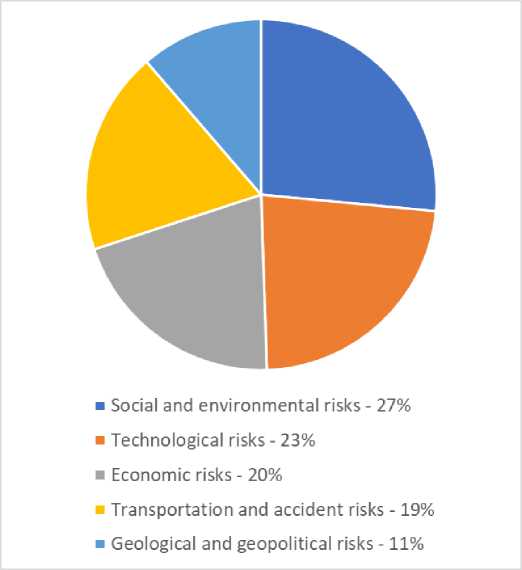
The analysis shows that the predominant group of risks is focused on the socio-environmental and technical aspects of offshore oil and gas field development. The frequency of risk mentions by category is shown in Figure 1.
■ Social and environmental risks - 27%
■ Technological risks - 23%
■ Economic risks - 20%
। Transportation and accident risks -19%
■ Geological and geopolitical risks -11%
Fig. 1. Frequency of risk mentions in descriptions of offshore oil and gas projects.
As a result of the research, the main potential risks were divided into seven key groups.
The results are presented in Table 3.
Table 3
Potential risks of offshore oil and gas field development
|
Area of risk occurrence |
Potential risks |
|
Social and environmental |
posed site of production facilities;
|
|
Production and technological |
ment;
system reliability;
earthquakes, weather conditions, etc.);
tech underwater equipment modules |
|
Collection and preparation |
or exposure of pipelines due to erosion;
cesses |
|
Economic |
sis of factors affecting the project;
project implementation;
|
|
Pipeline transport of |
• Risk of technogenic disaster due to damage of pipelines; |
|
products |
intentional);
|
|
Water transport of products |
gestion or blockage of sea routes, ice conditions, etc.;
climate |
|
Geological |
reserves;
promising deposits;
about hazardous external factors |
Risk analysis
Social and environmental risks
Environmental risks can arise at any stage of a project, from continental shelf exploration to industrial hydrocarbon production. The threat of disrupting the ecological balance of the Arctic ecosystem includes a variety of effects that can be observed in the following areas:
-
• impact on the atmosphere, the main causes of which are exhaust emissions from ship engines and other equipment, gas burned in flare units, excessive heat release from technological installations, and oil vapor emissions during extraction and tanker loading [3, Årstad I., Aven T., pp. 114–121];
-
• impact on the hydrosphere is manifested in the risk of water pollution with fuel and lubricants during the installation and operation of equipment, field development and drilling of wells, as well as in emergency situations caused by pipeline leaks, or during the loading or unloading of hydrocarbon raw materials on tankers [4, Grubesic T.H., Nelson J.R., Wei R.];
-
• impact on marine flora and fauna: during the development of offshore fields, human intervention may cause disruption to the terrain due to the installation of fixed platforms with concrete foundations or any other hydraulic structures on the seabed; the discharge of waste, drilling fluids or other technical fluids into the water, leading to the death of marine life; physical impacts, such as temperature conditions unusual for these places, industrial noise and vibration [5, Barker V.A., Cowan J.H., pp. 153–166].
Potential sites for onshore facilities, such as coastal processing complexes or product preparation facilities, may be occupied by indigenous communities or their sacred sites. This could lead to conflicts of interest. In addition, emissions of pollutants into the environment could have a negative impact on the health and lives of indigenous peoples.
Thus, it can be concluded that any actions to develop and exploit offshore fields alter the natural state of the environment, which increases the likelihood of risks of unnatural socio-ecological conditions [6, Krausmann E., Girgin S., Necci A.].
Technological risks
Today, Russia’s oil and gas industry is a technical complex with a high degree of risk. Raw materials are developed using modern and expensive technologies, in which oil and gas companies invest billions. This is especially true for offshore projects, where innovative solutions are required to meet all safety and efficiency standards for development and further production. That is why offshore projects are closely associated with significant technological risks [7, Zhang Y., Zheng M., An C. et al., pp. 789–803].
Various marine hydraulic structures are used to develop and equip offshore projects, such as fill areas and trestles, various types of platforms, and subsea production complexes (hereinafter referred to as SPC), which are capable of performing all necessary operations [8, Bondarenko L.A., Apollonskiy A.O., Tsunevskiy A.Ya.], as well as withstanding external weather and natural conditions.
In the current reality, the development of offshore fields located in the northern seas is complicated without the use of foreign equipment, since Russian companies do not have as much experience in the design and development of SPC as their Norwegian and American colleagues [9, Ilinova A., Solovyova V., Yudin S., pp. 1349–1355], or in the construction of platforms, compared to their Korean counterparts [10, Kim Y.H., Park J.S., Shin H.C. et al., pp. 208–216].
It is worth mentioning that during the development of fields whose operation involves the construction of offshore platforms, such as the Prirazlomnoe oil field or the Shtokman gas condensate field, foreign companies such as Baker Hughes, Halliburton, Schlumberger, and Aker Solutions participated in the supply of equipment [11, Baranov D.N., pp. 908–910; 12, Monokin E.N., pp. 451–464]. Currently, the only field in Russia that is being developed using the SPC is the Kirinskoe gas condensate field, which is located about 30 km from the coast and at a depth of about 100 m below the seabed. However, it should be noted that the main equipment for the development of the Kirinskoe field was supplied by the foreign company Food Machinery and Chemical Technologies (FMC Technologies, now TechnipFMC). The Yuzhno-Kirinskoe field, located about 60–70 km from the coast and at a depth of about 200 m, is also currently under development. The exploitation of this field similarly involves the use of SPC, but the introduction of sanctions against the Russian Federation and the departure of foreign companies complicated the development of the field. Extremely low temperatures, strong winds, snowfalls, fogs, frosts, polar nights — all these factors hinder the work of the oil and gas industry in the region and lead to problems in overcoming the impact of these harmful conditions [13, Kudelkin N.S., pp. 74–84].
Collection and preparation system
The design of hydrocarbon collection and preparation systems is an important part of oil and gas projects.
Offshore fields in the northern seas are located in areas with unfavorable weather and hydrometeorological conditions, which requires careful selection of the site at the planning stage of the collection and preparation system. Swampy areas, permafrost, and high seismic activity in the area under consideration significantly increase the cost of construction.
It is also important to note the high risk of disasters, which requires oil and gas companies to make additional plans for road communications, air transport infrastructure, etc.
Another significant factor is the risk of accidents due to human error. Low employee qualifications, disregard for safety procedures and rules for various types of work in production can lead to equipment failure or more serious consequences.
Economic risks
The development and exploitation of fields on the Russian Arctic shelf require significant investments due to the high capital intensity of the project, which is several times higher than similar costs for developing onshore fields. For example, the Prirazlomnoe field project, according to its technical and economic feasibility study, may require capital investments of up to 42% of the total cost of field development [14, Shkatov M.Yu., pp. 170–174].
Investing in such capital-intensive projects is associated with certain risks, which may be due to both natural factors and the specifics of geological exploration [15, Shigapova R.R., pp. 68– 74]. The conditions for developing and constructing fields on the northern sea shelf also play a role. These risk factors influence various investment assessment elements: the amount of investment, the expected revenue, the project implementation timeframe, and the discount rate [16, Voronina E.P., p. 159–168].
Transportation risks
Transporting hydrocarbon raw materials from offshore fields is a significant challenge, as the considerable distance from populated areas, ice conditions (in the case of northern seas), and other weather and natural conditions create additional difficulties. It is also worth noting the insufficient armament of the Russian fleet, the lack or complete absence of tankers, as well as poorly developed transport routes and undeveloped ports. All of this is due to a lack of experience in this area of the industry.
When it comes to pipeline transportation of products, the main factors to consider are the terrain, depth of deposits, volume of expected product transportation, and other technological parameters determined at the field design stage [17, Sotoodeh K., pp. 210–219; 18, Seyyedattar M., Zendehboudi S., Butt S., pp. 2147–2189].
When exploiting northern offshore fields, pipeline transportation of extracted raw materials depends on another issue: the presence of thick ice at the interface between the water and land, which exerts varying compressive loads. The average duration of ice presence on the water surface in the Sakhalin shelf area is 160 to 210 days, and the maximum ice thickness reaches 314 cm [19, Bai Y., Bai Q., pp. 299–313]. Ice formation challenges are driving designers to improve strength and operational reliability by applying or creating innovative technologies and structural materials [20, Adumene S., Ikue-John H., pp. 153–168].
Geological risks
Currently, the geological and geophysical results of studies of Russia’s Arctic shelf remain relatively low and very uneven. The oil and gas potential of the Arctic shelf can be divided into two groups: the first group includes hydrocarbon reserves and resources on the Western Arctic shelf (the Barents and Pechora seas, as well as the southern Kara seas), which are fairly well studied. The second group includes hydrocarbon resources in the northern Kara Sea and the East Arctic seas (the Laptev, East Siberian, and Chukchi seas), which are poorly studied [21, Grigorenko Yu.N., Margulis L.S., Novikov Yu.N. et al., p. 19].
Geological exploration of the region where the deposit is expected to be located is the basis for starting to design the development of the deposit. Insufficient geological research may be caused by complex natural and climatic conditions, as well as the high cost of work carried out in this area. These reasons explain the emergence of risks at one of the most important stages of offshore oil and gas project development [22, Longxin M.U., Zhifeng J.I.].
New deposits are most often discovered in regions that have already been well studied. In such areas, the characteristic sizes and features of the deposits are already known, a quantitative assessment of resources has been carried out, and the first commercial discoveries have been made. However, the necessary research is associated with increased labor costs and geological risks at all stages of exploration [23, Berdnik M.M., pp. 46–49].
Table 4 lists the potential causes and consequences of potential risks in oil and gas projects in the northern seas. These risks are primarily related to the environment or weather, which are beyond human control. However, a mitigation plan can be developed to reduce the damage from these risks.
-
Table 4
Potential causes and consequences of risks in oil and gas projects in the northern seas
|
Area of risk occurrence |
Cause |
Consequences |
|
Social and environmental |
the atmosphere;
result of mass deforestation or landscape changes;
nous communities in the territory under consideration |
quences, such as ecosystem destruction;
opment area;
water pollution); |
|
• Cultural and social changes in communities |
||
|
Production and technological |
logical conditions for equipment operation in northern sea areas;
capabilities;
unified approach to equipment design |
cess due to equipment failure;
process due to external factors (fish migration, earthquakes, etc.);
stoppages in work due to the presence of ice on the surface of the water area;
equipment maintenance |
|
Collection and preparation |
area;
meteorological conditions;
tear;
and technical solutions |
earthquakes;
for infrastructure construction contracts;
repair and accident prevention;
repair and modernisation;
|
|
Economic |
legislation;
conditions;
cy;
credit;
|
vestments;
|
|
Pipeline transport of products |
pipeline construction;
conditions;
areas;
pipeline maintenance and repair in remote areas |
during freezing and thawing;
by fishing vessels or ice floes;
seismic activity;
ronment in the event of an accident;
struction of main pipelines |
|
Water transport of products |
cost of developing offshore shipping infrastructure for hydrocarbon transport, including shortage of vessels;
ports and shipping routes |
due to ice impact;
and delivery within the specified time frame;
waterways;
ported products |
|
Geological |
research;
results;
|
the development of economically promising fields;
ficient data on hazardous external |
geological exploration;
Inability to conduct detailed surveys due to difficult climatic conditions
conditions;
Delays in the design and implementation of development
Risk management methods
After identifying the most probable risks, a search was conducted for suitable preventive measures, management methods, and ways to eliminate and minimize the consequences. The results of the analysis of management methods are presented in Tables 5 and 6.
-
Table 5
Risk management methods that address the cause
|
Area |
Cause |
Management methods |
|
Social and environmental |
atmosphere;
result of mass deforestation or landscape changes;
nous communities |
insurance;
safety and corporate responsibility;
friendly technologies;
tally safe waste disposal;
mental changes |
|
Production and technological |
ical conditions for equipment operation in northern sea areas;
capabilities;
unified approach to equipment design |
accidents and disasters in areas such as construction and installation, equipment malfunctions and breakdowns, electronic equipment, mobile equipment (including drilling equipment), engineering structures (piers, dams);
external loads;
partners |
|
Collection and preparation |
teorological conditions;
and technical solutions |
third parties and environment;
and warning systems;
staff training |
|
Economic |
legislation;
conditions;
credit;
|
depreciation;
areas;
cy fluctuations and inflation;
account economic risks |
|
Pipeline transport of products |
pipeline construction;
ditions; |
• Introduction of innovative tech nologies to improve the reliability and durability of pipelines, taking into account high seismic activity |
areas;
pipeline maintenance and repair in remote areas |
and other natural hazards;
to work in difficult conditions;
condition monitoring systems |
|
|
Water transport of products |
cost of developing offshore shipping infrastructure for hydrocarbon transport, including shortage of vessels;
ports and shipping routes |
to cover losses from accidents and damage to vessels;
port and shipping infrastructure;
contractors for the operation of transport infrastructure |
|
Geological |
results;
geological exploration;
surveys due to difficult climatic conditions |
amount spent on geological exploration;
for geological exploration under the PSA regime;
ration and setting the cost of licences for deposits;
for geological exploration;
international level |
Table 6
Risk management methods that address the consequence
|
Area |
Consequences |
Management methods |
|
Social and environmental |
|
restoration of contaminated areas;
of ecosystem restoration programs;
the public and employees;
with indigenous communities |
|
Production and technological |
|
of systems to monitor the condition of equipment and operating conditions;
equipment;
grades and modernization of equipment |
|
Collection and preparation |
|
ity for infrastructure restoration;
tures and technologies;
trol and diagnostic systems |
|
repair and accident prevention;
|
||
|
Economic |
|
plans in response to changes in the economic situation |
|
Pipeline transport of products |
|
and response systems;
rapid restoration of damaged areas;
minimize environmental risks |
|
Water transport of products |
|
the development of an oil transportation scheme (from the field to the port);
work in difficult climatic conditions;
ice conditions |
|
Geological |
Delays in the design and implementation of development |
ties to diversify risks;
tors to spread risk;
ternative plans |
The risk management methods described above are applicable in the oil and gas industry, but their effectiveness depends on a variety of factors: companies’ financial capabilities, technological level, regulatory environment, and staff training.
Insurance against environmental and technogenic risks, for example, is faced with high costs and a limited supply of insurance products for Arctic projects. Sanctions exacerbate the problem by narrowing the range of international insurers. Domestic alternatives are not yet able to fully replace imported counterparts, which slows down the implementation of innovations.
Environmental monitoring is technically feasible, but in remote areas it requires reliable communications and power supply. Programs for engaging with indigenous communities are often formal, which provokes conflicts.
Technological methods, including seismic-resistant structures or automatic equipment control, require expensive infrastructure. The icebreaker fleet and ports of the Northern Sea Route are developing, but they are insufficient for year-round operation.
Thus, most methods are applicable, but require adaptation. The key issues are dependence on imports, insufficient infrastructure funding, and a formal approach to social aspects.
Current situation
Today, Russian companies involved in the development of offshore fields in the northern seas face a number of specific problems and risks. The most obvious group of risks is environmental one, since offshore fields are located in special ecosystems, and the negative impact of production facilities can cause irreparable damage to the entire planet.
Russia has adopted a federal law regulating the liability of companies engaged in the exploration, production and transportation of oil and gas. It aims to reduce the risks of environmental pollution in the oil and gas industry. According to the law, offshore operators are required to develop plans to prevent and eliminate oil and petroleum product spills, as well as the necessary measures mitigate any negative impact on the environment [24, Sobol A.V., Gorodnichnaya A.N., Yumaguzina S.R., pp. 51–53]. This law stimulated companies to analyze potential environmental risks more thoroughly and to minimize the possibility of disasters.
It is also important to highlight the technological and operational areas of risk, as they are fundamental to the implementation of the enterprise’s work process. The development of deposits in the northern seas requires the use of modern technologies and equipment designed to operate in the harsh conditions of the northern seas. Furthermore, operations involving transportation, equipment maintenance, personnel delivery to the work site, etc., are complicated by short ice-free period, as well as harsh weather and hydrometeorological conditions.
The withdrawal of foreign companies supplying and servicing SPCs, as well as those willing to cooperate in the creation or transfer of other hydraulic structures, has led Russian oil and gas companies to develop their own SPCs. It is currently known that Almaz-Antey Concern has prototypes of production subsea head and supplies some subsea equipment to Gazprom 1.
The current political situation, coupled with Russia’s energy strategy until 2035 2, necessitates integrating a risk management system into offshore field development projects in the northern seas. Correctly identified risks and methods of managing them will allow oil and gas companies to mitigate the impact of these risks on the economic performance of the project.
Conclusion
The industrial development of offshore hydrocarbon deposits is associated with a number of specific risks, which, in turn, require comprehensive methods for their assessment, minimization and control. These risks range from technological and environmental to human factors, each with its own characteristics and consequences. One of the most challenging aspects is the impact of human factor, which remains one of the main causes of accidents, despite advances in automation and technology.
Based on the analysis of risks and their management methods in the context of offshore field development in the northern seas, the following conclusions can be drawn:
-
• Increased sanctions pressure and dependence on imported technologies require the accelerated development of domestic innovative solutions, including the creation of Arctic-resistant SPCs;
-
• Environmental risks, such as oil spills and biodiversity disruption, justify the need to integrate automated monitoring systems and expand programs for interaction with indigenous communities;
-
• Challenging climate conditions and transport restrictions highlight the importance of developing Arctic shelf infrastructure, including icebreaker fleets and port facilities. These measures will increase the reliability of projects in the face of growing geopolitical and natural challenges.
Reducing risks in offshore field development requires not only highly qualified specialists, but also the implementation of innovative technologies that will enable more accurate prediction and control of potential hazards. The most important risk management tools include a systematic approach to design, the use of modern modeling and analysis methods, and the continuous improvement of control and emergency response systems.
