Single Voting Day 2025: Another test passed, but public trust in the political elite causes great concern
Journal: Economic and Social Changes: Facts, Trends, Forecast @volnc-esc-en
Section: Editorial
Article in issue: 5 т.18, 2025.
Free access
From September 12 to 14, 2025, Russia held its annual Single Voting Day, featuring elections at regional and municipal levels. This electoral campaign was widely seen as a “dress rehearsal” for the 2026 State Duma elections, and many experts concluded that this “test was passed successfully”. However, for several years now, some analysts have pointed out that local elections are increasingly becoming a formality, losing their potential as a tool for diagnosing the relationship between society and the authorities. This article presents the key findings of a long-term monitoring project of regional election campaigns, conducted since 2018 as part of the Editorial column, which includes a comparative analysis of sociological data on public attitudes towards the country's main political parties. As a stage in this monitoring, an in-depth analysis of the 2025 Single Voting Day results is provided: using official data from the Russian Central Election Commission, voter turnout and support for United Russia across regions and regional capitals are analyzed; a review of expert opinions on the concluded campaign is presented; and its specific features in 2025 are examined, including in the context of the geopolitical and civilizational challenges Russia has faced throughout the 21st century and especially since the start of the special military operation. Furthermore, the article continues its monitoring of key managerial decisions made by the President, the State Duma, and the Government. Particular attention is paid to analyzing expert opinions, criminal statistics, and actual instances of detentions of representatives of the ruling “elites”, which indicates a persistent and growing problem of their disconnect from the publicly declared, nationally-oriented development agenda of the Russian Federation, as articulated by the head of state. The authors highlight expert views that public trust in the political elite continues to raise significant and substantial questions. Despite the importance of internal political stability amid a tense international situation and ongoing hostilities within the framework of the SMO, the political system is not yet effective enough in fulfilling its role to meet the public demand for forming a Vision of Russia's Future and a new Social Contract that aligns with the President's stated goals of strengthening traditional values and the core principles of a genuine social state.
Similar articles in the section High level, top level of administration. Central, national government
Short address: https://sciup.org/147252459
IDS: 147252459 | UDC: 354 | DOI: 10.15838/esc.2025.5.101.1
Text of the scientific article Single Voting Day 2025: Another test passed, but public trust in the political elite causes great concern
On September 14, 2025, Russia concluded another Single Voting Day – widely regarded as the “year’s largest electoral campaign” 1 and a “genuinely significant political event” 2 .
The nationwide electoral process encompassed over five thousand campaigns, engaging nearly 55 million voters. Direct elections for top executive officials were held in 20 regions, while residents of 11 additional federal subjects voted for candidates to regional legislative bodies. Elections for deputies to representative bodies in regional administrative centers took place in 25 federal subjects.
The tradition of Single Voting Day in Russia now spans nearly two decades. The inaugural regional and municipal elections under this framework were held in 2006 on March 12 and October 8. During those elections, United Russia fielded party lists in all 17 federal subjects holding regional parliamentary elections, securing first place in every contest 3 .
On July 21, 2005, Russian President Vladimir Putin signed the law “On Amendments to Legislative Acts of the Russian Federation Concerning Elections and Referendums and Other Legislative Acts of the Russian Federation”. This document established two equal Single Voting Days for regional and local elections: the second Sunday of March and the second Sunday of October in the final year of the corresponding government body’s term. If regional elections coincided with a federal election year (presidential or State Duma), they were held on the same day4.
On October 2, 2012, the head of state signed amendments to the laws on political parties and on the basic guarantees of the electoral rights of Russian citizens. According to these amendments, the Single Voting Day became the second Sunday of September in the year when the terms of local and municipal government bodies expire, while during State Duma election years, it would coincide with the voting day for those elections.
Since 2018 (marking the beginning of a new political cycle and Vladimir Putin’s fourth presidential term), monitoring Single Voting Day outcomes has become an integral component of government effectiveness research featured in the “From the Editor-in-Chief” section 5 . Annually, the fifth issue of the journal “Economic and Social Changes: Facts, Trends, Forecast” publishes official election results from the Central
Election Commission of the Russian Federation, complemented by expert analysis evaluating both the voting outcomes and their broader significance within Russia’s contemporary political landscape.
The monitoring methodology provides particularly comprehensive insights through extensive empirical data presentation that surpasses standard media coverage and official CEC statements. This includes detailed breakdowns by region and regional capitals, covering voter turnout and support for winning candidates through both relative (%) and absolute (number of people) metrics. The analysis further examines these figures as percentages of both total turnout and the overall electorate, while maintaining comparative continuity with previous electoral results from the same territories.
Fundamentally, we proceed from the understanding that regional and municipal elections serve not only as a tool for assessing the effectiveness of the national development course implemented by the President of the Russian Federation and the direct performance of the Head of State as the guarantor of the Russian Constitution – which states that “the supreme direct expression of the power of the people shall be referenda and free elections” (Article 3, Paragraph 3) – but also as a barometer of public opinion regarding the effectiveness of the “grassroots,” local level of the power vertical, which is closest to people’s everyday concerns. Consequently, voter motivation in local elections operates differently than in presidential
-
4 The history of the Single Voting Day in Russia. Available at: https://tass.ru/info/18683417
-
5 The main monitoring results are published in the following articles:
elections: people vote less for a particular national development course in abstract terms, and more for its practical implementation; they evaluate the authorities based on tangible changes in their region, municipality, and personal lives.
That said, it would be incorrect to claim that federal and international agendas have no bearing on local election outcomes. In essence, the Single Voting Day represents an assessment of the effectiveness of those local officials who implement the overarching national development course. The key tenets of this course are formulated at the highest level of power (by the President of Russia), taking into account numerous factors: history, national mentality, culture, vision for the country’s future, and the current geopolitical landscape, among others.
For instance, the 2018 local elections were held against the backdrop of the pension reform. This reform, which contrasted with the “breakthrough agenda in preserving the people of Russia and ensuring the well-being of our citizens”6), previously outlined by the President in his Address to the Federal Assembly, sparked significant public debate and, as we noted in a previous article, “brought the question of the government’s legitimacy to the forefront”7.891011
“There are no reasonable demographic arguments for immediately raising the retirement age for men”8.
“The thesis that increasing the retirement age will improve pensioners’ welfare seems questionable. The situation for those who would have retired soon will worsen. These generations will be deprived of nearly 200 thousand rubles for each postponed year”9.
“No reasons for implementing such a strictly timed reform of the retirement age are currently visible. Our analysis, which appears impartial, shows that the economy may not only gain nothing in this case but could even lose”10.
“Usually, it is believed that in regional elections, it’s important to discuss local issues. However, the discussion of the federal pension reform has raised a number of questions about the quality of life ‘on the ground’: what is the state of healthcare accessibility after its ‘optimization,’ conditions and the legal labor market, social benefits, real household incomes in the provinces, where the perhaps modest but guaranteed pension of the older generation serves as an important source of cash and benefits (it’s no coincidence that banks report an increase in loans taken by pensioners). In the advertising campaign for the pension law during its first month, these pressing societal questions seemed non-existent. From this perspective, it’s understandable why discontent in the regions overshadowed the agenda of constructive changes for regional infrastructure, which United Russia traditionally proposed”11.
Consequently, in the 2018 elections : in the gubernatorial elections held across 22 federal subjects, candidates from United Russia received 4.3 million fewer votes compared to the previous elections in 2013. In the elections for regional legislative bodies (held in 16 federal subjects), the party received 1.2 million fewer votes ( Tab. 1 ).
A second round of voting was required to determine the winner in four regions (Khabarovsk Territory, Primorye Territory, Republic of Khakassia, Vladimir Region). As experts noted at the time, it was precisely the “public debate surrounding the federal pension reform that raised fundamental questions about the quality of life at the local level’” 12 .
In 2019 , no second round was required in any of the gubernatorial elections; in all federal subjects, victory went either to representatives of United Russia (in 10 regions) or to self-nominated candidates actively supported by the party (in 6 federal subjects).
However, the underlying negative trends persisted. In the gubernatorial elections held across 16 federal subjects, United Russia candidates received 2.9 million fewer votes than in 2018. Similarly, in the elections for regional legislative bodies held in 13 regions, the party received 1.7 million fewer votes compared to the previous year ( Tab. 2 ).
Table 1. Results of the Single Voting Day, 2018
|
Party, turnout |
Elections of the region’s head* |
|||||
|
million people |
% |
|||||
|
Fact |
Dynamics 2018 to 2013 |
Fact |
Dynamics 2018 to 2013 |
|||
|
2013 |
2018 |
2013 |
2018 |
|||
|
United Russia |
11.82 |
7.54 |
-4.28 |
74.88 |
62.99 |
-16.53 |
|
CPRF |
1.55 |
1.75 |
+0.20 |
16.29 |
19.58 |
+5.11 |
|
LDPR |
0.77 |
1.82 |
+1.05 |
6.77 |
14.82 |
+9.28 |
|
Just Russia |
0.49 |
0.88 |
+0.39 |
4.33 |
7.45 |
+2.89 |
|
Other parties |
0.56 |
0.79 |
+0.23 |
7.96 |
5.70 |
+0.53 |
|
Self-nomination |
0.00 |
0.42 |
+0.42 |
0 |
61.88 |
+61.88 |
|
Turnout |
17.35 |
15.73 |
-1.62 |
44.79 |
42.95 |
-1.84 |
|
Legislative elections** |
||||||
|
Party, turnout |
million people |
% |
||||
|
Fact |
Dynamics 2018 to 2013 |
Fact |
Dynamics 2018 to 2013 |
|||
|
2013 |
2018 |
2013 |
2018 |
|||
|
United Russia |
4.96 |
3.74 |
-1.22 |
51.62 |
41.54 |
-10.07 |
|
CPRF |
0.93 |
1.54 |
+0.62 |
13.78 |
23.14 |
+9.36 |
|
LDPR |
0.58 |
0.96 |
+0.39 |
8.40 |
15.04 |
+6.64 |
|
Just Russia |
0.44 |
0.60 |
+0.16 |
6.67 |
8.66 |
+1.99 |
|
Other parties |
0.88 |
0.48 |
-0.40 |
16.27 |
7.79 |
-8.47 |
|
Turnout |
7.90 |
7.62 |
-0.28 |
39.25 |
38.73 |
-0.85 |
Source: own calculations based on official data from the Central Election Commission of the Russian Federation. More detailed results are presented in the article: Ilyin V.A., Morev M.V. (2018). Revisiting the issue concerning the future of Russian statehood. Economic and Social Changes: Facts, Trends, Forecast, 11(5), 9–29. |
||||||
12 Skorobogaty P. (2018). The landmark is 2021. Ekspert, 41, October 8-14, p. 53.
Table 2. Results of the Single Voting Day, 2019
|
Party, turnout |
Elections of the region’s head* |
|||||
|
million people |
% |
|||||
|
Fact |
Dynamics 2019 to 2014 |
Fact |
Dynamics 2019 to 2014 |
|||
|
2014 |
2019 |
2014 |
2019 |
|||
|
United Russia |
7.78 |
4.88 |
-2.90 |
74.53 |
71.50 |
-3.04 |
|
CPRF |
0.77 |
0.89 |
+0.12 |
11.47 |
14.79 |
+3.33 |
|
LDPR |
0.36 |
0.50 |
+0.13 |
5.02 |
8.21 |
+3.19 |
|
Just Russia |
0.12 |
0.38 |
+0.27 |
5.45 |
5.27 |
-0.18 |
|
Other parties |
0.43 |
0.47 |
+0.04 |
5.31 |
3.91 |
-1.41 |
|
Self-nomination |
0.06 |
2.30 |
+2.24 |
9.78 |
72.33 |
+62.55 |
|
Turnout |
9.82 |
9.71 |
-0.11 |
43.97 |
44.58 |
+0.60 |
|
Legislative elections** |
||||||
|
Party, turnout |
million people |
% |
||||
|
Fact |
Dynamics 2019 to 2014 |
Fact |
Dynamics 2019 to 2014 |
|||
|
2014 |
2019 |
2014 |
2019 |
|||
|
United Russia |
5.01 |
3.31 |
-1.69 |
66.57 |
51.91 |
-14.65 |
|
CPRF |
0.83 |
1.26 |
+0.43 |
10.29 |
17.06 |
+6.76 |
|
LDPR |
0.46 |
0.81 |
+0.35 |
6.77 |
14.48 |
+8.17 |
|
Just Russia |
0.41 |
0.50 |
+0.09 |
5.12 |
6.80 |
+1.57 |
|
Other parties |
0.84 |
1.16 |
+0.32 |
9.13 |
9.34 |
+0.20 |
|
Turnout |
7.82 |
7.28 |
-0.54 |
52.01 |
47.45 |
-4.56 |
Source: own calculations based on the official data of the Central Election Commission of the Russian Federation. More detailed calculation results are presented in the article: Ilyin V.A., Morev M.V. (2019). The 2018–2019 regional election: Voters’ trust in the authorities continues to decline. Economic and Social Changes: Facts, Trends, Forecast, 12(5), 9–24. |
||||||
The elections held during the Single Voting Day from September 11 to 13, 2020 , marked the first electoral campaign following the adoption of amendments to the Russian Constitution. The 2020 monitoring focused on territories hosting large, systemically important industrial enterprises 13 .
According to calculations based on official CEC data, support for the authorities in these territories decreased by 77 thousand people at the regional level (from 1.63 to 1.55 million) and by 27 thousand people in major cities (from 0.12 to 0.09 million). Concurrently, voter turnout (as a percentage of the total electorate) decreased by 5 percentage points in the regions (from 30 to 25%) and by 3 percentage points in the cities (from 15 to 12%; Tab. 3).
Table 3. Number of votes for United Russia representatives in regional and municipal elections of 2015 and 2020 in selected federal subjects of Russia
|
Indicator |
Single Voting Day |
Dynamics, 2020 to 2015 |
|
|
15 Sept. 2015 |
13 Sept. 2020 |
||
|
Average for 7 regions* |
|||
|
Turnout, million people |
3.38 |
2.75 |
-0.63 |
|
Turnout, % |
44.4 |
36.7 |
-7.7 |
|
Support for United Russia, million people |
1.63 |
1.55 |
-0.08 |
|
% of turnout |
48.2 |
56.5 |
+8.3 |
|
% of voters |
21.4 |
20.7 |
-0.7 |
|
Average for 3 cities** |
|||
|
Turnout, million people |
0.24 |
0.20 |
-0.04 |
|
Turnout, % |
30.4 |
25.6 |
-4.8 |
|
Support for United Russia, million people |
0.12 |
0.09 |
-0.03 |
|
% of turnout |
49.0 |
46.1 |
-2.9 |
|
% of voters |
14.9 |
11.8 |
-3.1 |
|
* Belgorod Region, Lipetsk Region, Arkhangelsk Region, Yamal-Nenets Autonomous Area, Chelyabinsk Region, Irkutsk Region, Magadan Region ** Lipetsk, Magnitogorsk, Magadan. Source: own calculations using the data of the Central Election Commission of the Russian Federation. |
|||
“Compared to the ‘constitutional’ vote ofJune 25 – July 1, voter turnout decreased significantly, despite the introduction of the ‘three-day voting’ period, allowing for early voting on Friday and Saturday, September 11–12, in addition to the ‘main’ Sunday vote on September 13. This can be partly explained by the ‘local’ nature of the elections, which traditionally generate much less interest among our citizens. However, the difference is so pronounced that the following conclusion suggests itself: Russian society as a whole, and especially in certain regions of our country, is displaying growing political passivity, though this is less applicable to the ‘national’ republics within the Federation. This picture indicates not only a fundamental difference in the systems of governance between ‘ordinary’ regions and republics within the Russian Federation but also a process of, if not confrontation, then alienation, a distancing of our society from the current system of domestic political power ”14.
As experts noted while analyzing the 2020 Single Voting Day results, “Russian society as a whole, and particularly in certain regions of our country, demonstrates growing political passivity”. The voting outcomes indicate “a process of, if not confrontation, then alienation – a distancing of our society from the current system of domestic political power”. 14
Summarizing the September 2020 Single Voting Day, Valery F. Fedorov, Director General of the Russian Public Opinion Research Center (VCIOM), emphasized that “the scenario for the upcoming federal campaign [the 2021 State Duma elections] is turning out to be exceptionally pessimistic for the authorities and their party”15.
It should be noted that this prediction proved largely accurate. On the one hand, in 2021, voter turnout for the State Duma elections increased by 4 percentage points nationwide compared to 2016 (from 48% to 52%), representing an additional 3.8 million people. Furthermore, while turnout growth in 2016 was observed in only four Russian regions, by 2021 it had expanded to 60 regions16. However, over the past 14 years (from 2007 to 2021), the number of Russians participating in elections has decreased by 12 million people (turnout dropped from 64% to 52%; Tab. 4).
Support for the ruling party decreased nationwide from 54% to 50% between 2016 and 2021 (a loss of 0.5 million people), with United Russia’s position weakening compared to previous State Duma elections in 70 federal subjects. Overall, from 2007 to 2021, the share of votes cast for the ruling party fell from 64 to 50%, meaning a loss of nearly 17 million voters . It is difficult to disagree with expert assessments noting that “if the ruling party gains 50% of votes with a 50% turnout, this means that only a quarter of citizens actually support the authorities” 17 .
Thus, a brief analysis of the monitoring results of local (regional and municipal) elections from 2018 to 2020, as well as the 2021 State Duma elections, demonstrated that despite maintaining dominant superiority on the political stage (specifically, a constitutional majority in the State Duma), United Russia’s support dynamics showed consistently negative trends. This is primarily evidenced by the ruling party’s loss of 17 million votes in parliamentary elections between 2007 and 2021.
Based on the empirical data from conducted research and expert assessments of all analyzed electoral campaigns from 2018 to 2021, a logical conclusion was that “the past elections to the 8th State Duma, on the one hand, demonstrated the growing dissatisfaction of Russians with how the current ruling party and the President are handling key issues concerning the population. On the other hand, society granted the head of state another ‘credit of trust,’ hoping that through gradual reforms and personal initiatives he would be able to bring the system of state governance to order...” 18
The special military operation and the sharp escalation of national security threats that Russia faced after February 2022 gave these “gradual reforms and personal initiatives” by the head of state a qualitatively different, higher level of urgency.
Primarily, the SMO significantly influenced voter motivation. All electoral campaigns after February 2022 took place “amid unprecedented societal consolidation, unification around the president and the flag ” 19 , which inevitably affected voting outcomes. Furthermore, after the start of the SMO, many experts began arguing that under the force majeure circumstances, where the country is effectively waging a full-scale war with the Collective West and must reorganize according to the principle
Table 4. Changes in voting results in the elections to the State Duma of the 5th and 8th convocations (2007–2021)
|
Indicator |
Year |
Dynamics (+/-) |
||||||
|
2007 |
2011 |
2016 |
2021 |
2021 to 2016 |
2021 to 2011 |
2021 to 2007 |
||
|
Turnount |
Million people |
69.61 |
65.77 |
52.70 |
56.48 |
+3.78 |
-9.28 |
-13.12 |
|
% |
63.78 |
60.21 |
47.88 |
51.72 |
+3.84 |
–8.49 |
–12.06 |
|
|
Support for United Russia |
Million people |
44.71 |
32.37 |
28.53 |
28.06 |
-0.46 |
-4.31 |
-16.65 |
|
% |
64.30 |
49.31 |
54.20 |
49.82 |
–4.38 |
+0.51 |
–14.48 |
|
Source: own calculations using the data of the Central Election Commission of the Russian Federation.
M. Delyagin (Deputy of the State Duma of the Russian Federation): “Under the conditions of the special military operation, the regime should not be ‘Live as usual, pay no mind,’ but rather ‘Everything for the front, everything for victory.’ And in this context, holding such elections looks somewhat strange”20.
-
I. Grashchenkov (Political Analyst): “The idea of abolishing elections for regional heads is not new. Rumors about their cancellation circulated throughout the spring of this [2022] year. Back then, the argument was that under the conditions of the SMO, it would be wise to demonstrate domestic political unity and, at the same time, save budgetary funds”21.
-
S. Mironov: “Why spend all this time and money on [gubernatorial elections] when it’s already clear that an absolute majority supports the conduct of the special military operation and, in particular, the decisions of the President of Russia?”22
A. Gallyamov (Political Analyst): “People don’t like to give up their right to choose their own leaders. It turns out that with one hand the authorities reassure the population – saying, everything is fine with us – while with the other they introduce a force majeure situation. This will reinforce the feeling that something is going wrong in the country”23.
“everything for the front, everything for Victory”, regional elections are essentially unnecessary. 20212223 Analyzing the results of the Single Voting Day held on September 11, 2022 , K. Kostin, Chairman of the Board of the Civil Society Development Foundation, noted: “All incumbent governors won in the first round with good results, and United Russia achieved one of the best results in its history (if not the best) – 80 percent of all mandates. This indicates support for the president and the forces implementing his policy at various levels” 24 . 25
“Incumbent governors who reconfirmed their mandates achieved higher results than last time. And this is the outcome of the consensus surrounding the president”25.
However, it should be noted that compared to previous analogous elections (i.e., over the period from 2017 to 2022), the number of people who came to the polls decreased in many regions and regional capitals. According to some experts, this suggested that “the authorities have problems or lack full confidence” 26 .
Specifically, in the elections for regional heads from 2017 to 2022, average voter turnout across the regions decreased by 4 p.p. (from 40 to 36%, or from 6.2 to 5.5 million people; Tab. 5 ). Support for the ruling party decreased by 2 p.p. (from 29 to 27% of the total electorate), meaning United Russia lost 270 thousand votes.
Table 5. Results of the 2022 Single Voting Day for elections of regional heads in regions and regional capitals
|
Indicator |
Single Voting Day |
Dynamics, 2022 to 2017 |
|
|
10 Sept. 2017 |
11 Sept. 2022 |
||
|
Average for 14 regions* |
|||
|
Turnout, million people |
6.20 |
5.46 |
-0.74 |
|
Turnout, % |
40.23 |
35.95 |
-4.3 |
|
Support for United Russia, million people |
4.40 |
4.13 |
-0.27 |
|
% of turnout |
71.07 |
75.65 |
+4.6 |
|
% of voters |
28.60 |
27.20 |
-1.4 |
|
Average for 14 regional capitals** |
|||
|
Turnout, million people |
1.75 |
1.58 |
-0.17 |
|
Turnout, % |
30.53 |
27.51 |
-3.0 |
|
Support for United Russia, million people |
1.15 |
1.09 |
-0.06 |
|
% of turnout |
65.80 |
68.70 |
+2.9 |
|
% of voters |
20.09 |
18.90 |
-1.2 |
|
* Republic of Buryatia, Republic of Karelia, Republic of Mari El, Udmurt Republic, Vladimir Region, Kaliningrad Region, Kirov Region, Novgorod Region, Ryazan Region, Saratov Region, Sverdlovsk Region, Tambov Region Tomsk Region, Yaroslavl Region. ** Ulan-Ude, Petrozavodsk, Yoshkar-Ola, Izhevsk, Vladimir, Kaliningrad, Kirov, Veliky Novgorod, Ryazan, Saratov, Yekaterinburg, Tambov, Tomsk, Yaroslavl. Source: own calculations using the data of the Central Election Commission of the Russian Federation. |
|||
In regional capitals, turnout decreased by 3 p.p. (from 30 to 27%, or from 1.8 to 1.6 million people), while support for the ruling party fell by 1.2 p.p. (from 20 to 19%, representing a loss of 60 thousand votes)27.
The next Single Voting Day in Russia took place on September 10, 2023. Electoral campaigns and local referendums at various levels were held “in 85 out of 89 federal subjects” 28 .
A key feature of the September 2023 elections was, firstly, that they were the “last before the 2024 presidential campaign” 29 . Secondly, they were conducted not only amidst ongoing military operations, as well as terrorist attacks and sabotage on Russian territory, but also following the armed mutiny attempt led by Wagner PMC head Yevgeny Prigozhin on June 24, 2023.
Against this backdrop, as noted by CEC Chairperson E. Pamfilova, “turnout reached a record high in ten years... All incumbent governors, as well as acting heads, retained their posts” 30 .
However, an in-depth analysis of the CEC data revealed that a substantial increase in turnout compared to previous elections occurred in only a minor number of territories.
For example, in the elections for top regional officials, the proportion of voters participating increased significantly (by 10 p.p. or more) in only 4 out of 21 federal subjects (on average by 16 p.p., from 44 to 60%, or by 3.2 million people). Meanwhile, turnout decreased in 9 regions (by 4 p.p., from 47 to 43%, or by 360 thousand people; Tab. 6 ).
In the elections for regional legislative bodies, a noticeable increase in turnout in 2023 compared to 2018 was observed in only two regions – Kemerovo and Smolensk regions (by 12 p.p., from 45 to 57%, or by 0.3 million people). A decrease in turnout was recorded in 10 federal subjects (by 4 p.p., from 39 to 35%, or by 0.4 million people; Tab. 7 ).
Table 6. Dynamics of voter turnout in elections for top regional officials on September 10, 2023, compared to September 9, 2018, by federal subject
|
Federal subject |
2018 |
2023 |
Dynamics (+/-) |
|||
|
thousand people |
% of voters |
thousand people |
% of voters |
thousand people |
% of voters |
|
|
Increase in turnout by 10 percentage points or more |
||||||
|
Moscow Region |
2144.96 |
38.59 |
3682.45 |
60.53 |
+1537.49 |
+22 |
|
Nizhny Novgorod Region |
1046.59 |
40.51 |
1401.66 |
56.01 |
+355.08 |
+16 |
|
Kemerovo Region – Kuzbass |
1337.42 |
66.47 |
1549.24 |
81.01 |
+211.82 |
+15 |
|
City of Moscow |
2259.08 |
30.94 |
3325.12 |
43.18 |
+1066.04 |
+12 |
|
TOTAL |
6788.05 |
44.13 |
9958.47 |
60.18 |
+3170.43 |
+16 |
|
Increase in turnout by 1–9 percentage points / no changes |
||||||
|
Krasnoyarsk Region |
593.49 |
28.94 |
730.88 |
35.55 |
+137.39 |
+7 |
|
Amur Region |
194.75 |
31.25 |
233.42 |
38.74 |
+38.66 |
+7 |
|
Voronezh Region |
831.09 |
44.83 |
928.81 |
51.08 |
+97.71 |
+6 |
|
Samara Region |
1143.20 |
48 |
1296.99 |
53.79 |
+153.79 |
+6 |
|
Smolensk Region* |
225.61 |
29.67 |
250.38 |
33.71 |
+24.77 |
+4 |
|
Novosibirsk Region |
628.95 |
29.52 |
695.49 |
31.86 |
+66.55 |
+2 |
|
Tyumen Region |
1241.45 |
49.09 |
1359.02 |
50.76 |
+117.57 |
+2 |
|
Ivanovo Region |
265.77 |
32.9 |
261.61 |
33.92 |
-4.16 |
+1 |
|
Pskov Region |
195.41 |
36.91 |
194.08 |
37.8 |
-1.33 |
+1 |
|
TOTAL |
5319.71 |
36.79 |
5950.67 |
40.80 |
+630.96 |
+4 |
|
Decrease in turnout |
||||||
|
Primorye Territory** |
680.10 |
46.35 |
655.23 |
45.58 |
-24.87 |
-1 |
|
Republic of Sakha (Yakutia) |
321.54 |
50.69 |
314.93 |
48.41 |
-6.61 |
-2 |
|
Republic of Khakassia |
160.09 |
41.88 |
155.82 |
39.54 |
-4.27 |
-2 |
|
Oryol Region |
364.85 |
57.77 |
337.27 |
55.98 |
-27.58 |
-2 |
|
Magadan Region |
38.74 |
39.58 |
33.95 |
35.09 |
-4.78 |
-4 |
|
Altai Territory |
683.34 |
37.28 |
547.93 |
31.04 |
-135.41 |
-6 |
|
Chukotka Autonomous Area |
17.99 |
60.19 |
15.97 |
53.48 |
-2.02 |
-7 |
|
Omsk Region |
666.63 |
43.6 |
510.51 |
34.51 |
-156.11 |
-9 |
|
TOTAL |
2933.26 |
47.17 |
2571.61 |
42.95 |
-361.65 |
-4 |
|
* The previous elections were held on September 13, 2020. ** The previous elections were held on December 16, 2018. Source: own calculations using the data of the Central Election Commission of the Russian Federation. |
||||||
Table 7. Dynamics of voter turnout in elections for regional legislative bodies on September 10, 2023, compared to September 9, 2018, by federal subject
|
Federal subject |
2018 г. |
2023 г. |
Dynamics (+/-) |
|||
|
thousand people |
% of voters |
thousand people |
% of voters |
thousand people |
% of voters |
|
|
Increase in turnout by 10 percentage points or more |
||||||
|
Kemerovo Region – Kuzbass |
1335.56 |
66.39 |
1549.10 |
81.01 |
+213.54 |
+15 |
|
Smolensk Region |
182.06 |
23.67 |
250.32 |
33.70 |
+68.26 |
+10 |
|
TOTAL |
1517.62 |
45.03 |
1799.42 |
57.36 |
+281.80 |
+13 |
|
Increase in turnout by 1–9 percentage points / no changes |
||||||
|
Trans-Baikal Territory |
176.01 |
22.04 |
205.18 |
26.62 |
+29.17 |
+5 |
|
Republic of Bashkortostan |
1498.02 |
49.08 |
1545.91 |
51.72 |
+47.89 |
+3 |
|
Nenets Autonomous Area |
12.17 |
35.96 |
12.87 |
37.69 |
+0.70 |
+2 |
|
Ivanovo Region |
265.80 |
32.91 |
261.56 |
33.92 |
-4.24 |
+1 |
|
TOTAL |
1951.99 |
35.00 |
2025.52 |
37.49 |
+73.53 |
+2 |
|
Decrease in turnout |
||||||
|
Arkhangelsk Region |
276.88 |
29.34 |
250.52 |
28.08 |
-26.35 |
-1 |
|
Republic of Khakassia |
159.97 |
41.85 |
155.85 |
39.57 |
-4.12 |
-2 |
|
Republic of Sakha (Yakutia) |
321.45 |
50.69 |
314.58 |
48.36 |
-6.87 |
-2 |
|
Irkutsk Region |
491.58 |
26.33 |
443.84 |
24.22 |
-47.74 |
-2 |
|
Yaroslavl Region |
296.69 |
29.27 |
271.96 |
27.41 |
-24.73 |
-2 |
|
Republic of Buryatia |
270.19 |
39.55 |
254.76 |
36.3 |
-15.44 |
-3 |
|
Rostov Region |
1447.33 |
45.43 |
1357.36 |
42.83 |
-89.97 |
-3 |
|
Ulyanovsk Region |
404.48 |
40.31 |
330.84 |
34.68 |
-73.64 |
-6 |
|
Vladimir Region |
372.65 |
32.92 |
268.45 |
24.77 |
-104.20 |
-8 |
|
Republic of Kalmykia |
111.80 |
54.03 |
84.29 |
42.04 |
-27.51 |
-12 |
|
TOTAL |
4153.02 |
38.97 |
3732.47 |
34.83 |
-420.56 |
-4 |
|
Source: own calculations using the data of the Central Election Commission of the Russian Federation. |
||||||
Table 8. Comparison of election results on September 10, 2023, in the new regions and other federal subjects of Russia
Indicator For new RF subjects For other RF subjects Dynamics (+/-) for new subjects of the Russian Federation in comparison with other regions Legislative elections Turnout, % of voters 71.14 38.31 +33 Share of votes cast for United Russia, % of turnout 77.52 56.52 +21 Elections to representative bodies of municipalities of regional centers of RF subjects Turnout, % of voters 63.54 33.14 +30 Share of votes cast for United Russia, % of turnout 77,46 50,68 +27 Source: own calculations using the data of the Central Election Commission of the Russian Federation .
A similar situation was characteristic of regional capitals:
^ in the elections for top regional officials, turnout increased substantially in only five municipal formations (from 36 to 48%, or by 1.4 million people), while it decreased in 9 regional capitals (by 5 p.p., from 35 to 30%, or by 1 million people).
^ in the elections for legislative bodies, a noticeable turnout increase was observed in only three cities – Ufa, Kemerovo, and Smolensk (by 12 p.p., from 33 to 45%, or by 0.1 million people), while it decreased in 10 cities (by 5 p.p., from 33 to 28%, or by 0.2 million people) 31 .
Furthermore, the 2023 regional elections marked the first participation of new Russian regions – the DPR, LPR, Kherson, and Zaporozhye regions – which demonstrated higher levels of turnout and support for United Russia compared to the average across other federal subjects and municipal formations of Russia ( Tab. 8 ).
Thus, analyzing the results of the 2023 Single Voting Day, experts noted that it was a “far more complex phenomenon” 32 , than simply a “rally-
’round-the-flag” effect: “In a country that, within a single year, underwent mobilization, experienced high-profile failures at the front, saw a military mutiny collapse, and witnessed sharply rising prices for essential goods and food in the rear. There were many positive developments too, but it is precisely the listed phenomena that most often weigh on the voter and provoke a reassessment of the command-political echelon”. 33 34
“The results of the Single Voting Day on September 10, 2023, signal that against the backdrop of the general consolidation of the majority of the population (quite naturally prompted by the urgency of the external and internal threats Russia faced after the start of the SMO), a demand continues to accumulate in society for the authorities to align the behavior and concrete actions of the elites with the state’s publicly declared rhetoric ”34.
On September 8, 2024 , the Single Voting Day took place against a backdrop not only of the increasing likelihood of missile strikes deep into Russian territory using NATO-produced long-range weapons but also, and more importantly, following the incursion of the Ukrainian Armed Forces into the Kursk Region (August 6, 2024).
Naturally, the persistence of the general context of a worsening external political situation globally and around Russia influenced the continuation of trends observed in the results of the 2024 Single Voting Day.
E. Pamfilova “rated the results of the 2024 Single Voting Day as maximally positive”35: as before, in all subjects where elections for regional heads were held, victory went either to acting heads appointed by the President or to incumbent governors. Furthermore, on average across the 21 regions holding direct elections for regional heads, turnout increased by 3.72% (from 46.8 to 50.5% of the total electorate), and support for representatives of the ruling party or acting heads appointed by the President increased by 3.64% (from 73.36 to 77.0%; Tab. 9).
An increase in turnout was recorded in the majority of federal subjects where voting took place (in 15 out of 21 subjects), although it should be noted that support for the ruling party in 2024 increased compared to the previous 2019 elections in only half of the regions (in 11 out of 21) 36 .
Table 9. Results of the 2024 Single Voting Day for elections of regional heads in regions and regional capitals
|
Indicator |
Single Voting Day |
Dynamics, 2024 to 2019 |
|
|
8 Sept. 2019 |
8 Sept. 2024 |
||
|
Average for 21 federal subjects* |
|||
|
Turnout, million people |
13.90 |
14.63 |
+0.73 |
|
Turnout, % |
46.82 |
50.54 |
+3.72 |
|
Support for United Russia, million people |
10.59 |
11.20 |
+0.61 |
|
% of turnout |
73.36 |
77.00 |
+3.64 |
|
% of voters |
34.87 |
38.98 |
+4.11 |
|
Average for 20 regional capitals** |
|||
|
Turnout, million people |
3.56 |
3.52 |
-0.04 |
|
Turnout, % |
41.97 |
42.01 |
+0.04 |
|
Support for United Russia, million people |
2.59 |
2.67 |
+0.08 |
|
% of turnout |
69.59 |
73.96 |
+4.37 |
|
% of voters |
29.62 |
31.41 |
+1.79 |
|
* Republic of Altai, Republic of Bashkortostan, Republic of Kalmykia, Trans-Baikal Territory, Stavropol Territory, Khabarovsk Territory, Astrakhan Region, Volgograd Region, Vologda Region, Kaliningrad Region, Kemerovo Region - Kuzbass, Kurgan Region, Kursk Region, Lipetsk Region, Murmansk Region, Orenburg Region, Samara Region, Sakhalin Region, Tula Region, Chelyabinsk Region, Saint Petersburg. ** Gorno-Altaysk, Ufa, Elista, Chita, Stavropol, Khabarovsk, Astrakhan, Volgograd, Vologda, Kaliningrad, Kemerovo, Kurgan, Kursk, Lipetsk, Murmansk, Orenburg, Samara, Yuzhno-Sakhalinsk, Tula, Chelyabinsk. Source: own calculations using the data of the Central Election Commission of the Russian Federation. |
|||
-
1. “Against the backdrop of progress in electoral technology, the political system is degrading into archaism... [opposition parties] have finally turned into objects of the political process. Its subjects are the regional authorities, linked into a single network through political deputy governors, which is centralized in the relevant departments of the presidential administration”37.
-
2. “ In such a construct, one cannot expect elections to be a process of collective search for solutions to the most pressing problems of regions/cities/districts/the country. Because a demand of metaphysical/existential importance is pushed to the forefront – the preservation of Russian statehood itself. And people’s current problems seem minor, insignificant, selfish, philistine...”38
-
3. “ Elections are increasingly perceived as a political ritual that one is expected to participate in ... This might be sufficient here and now. But it is hardly sufficient to effectively govern a large country in the long term, to sense the mood of the people ” 39 .
-
4. “ The ‘freezing’ of political and public activity will continue. It can be assumed that under such conditions, the ruling party will continue its course of turning elections into a farce and maintaining legitimacy purely formally . As experts are already saying, the real political content of the elections does not relate to the will of the masses...” 40
-
5. “The 2024 Single Voting Day, in its formal characteristics, turned out to be a copy of last year’s elections, with the main competition compressed to the five parliamentary parties ”41 .
Analyzing the results of the 2024 Single Voting Day, many experts concluded that a significant portion of the population increasingly perceives elections as a “political ritual”, whose “real political content does not relate to the will of the masses”. They argue that Russia’s political system is “regressing into archaism” due to the “constriction of political competition”, where opposition parties are “turning into objects of the political process”, thus leading to a “freezing of political and social activity”.
In other words, experts pointed out that alongside the “rally-’round-the-flag” process, a “routinization” and a de facto “atrophy” of the election institution itself is occurring . The continuation of this trend was noted by them during the next local-level electoral campaign held on September 14, 2025 . 3738394041
“In the elections for the leadership of 20 Russian regions, 19 nominees from United Russia and one self-nominated candidate – the incumbent head of the Chuvash Republic, Oleg Nikolayev – emerged victorious. None of the winners received less than 60% of the votes. Eight newly elected regional leaders, including the new governor of the Kursk Region, Alexander Khinshtein, secured over 80% of the votes…
All this indicates that while the elections for regional heads featured formal competition, there was no real contest or any element of suspense. In the sterilized domestic political landscape, this is both expected and normal…
The overwhelming victories of pro-government candidates ostensibly suggest that the regions are entirely stable, with no cause for public discontent, let alone protest sentiments. Alternatively, it may indicate that the authorities are effectively monitoring the situation on the ground, promptly removing discredited leaders and replacing them with more effective ones (as seen in the Kursk Region). In other words, everything is orchestrated to ensure that elections remain little more than a ritualistic practice of endorsing the pre-approved candidate.
This is an opaque environment… This is politics in the shadows, which elections fail to illuminate in any way” 42.
The 2025 electoral campaign had several distinctive features worth noting separately.
-
42 First, the 2025 Single Voting Day served as a “dress rehearsal for the political system ahead of the 2026 State Duma elections ” 43 . This meant that for political parties, these were “model” elections... Their performance in this upcoming Single Voting Day would determine the balance of power ahead of the State Duma elections” 44 . For society, it meant a test of “demonstrating the stability” 45 of both the electoral process and the political system as a whole.
Second, the past elections showed that “the process of forming a new elite is already underway” 46 . As noted by CEC Chairperson E. Pamfilova, “the most significant distinction this year is the wave of participants in the special military operation running in the elections” 47 . 48
-
E. Pamfilova: “…the most significant distinction is that this year we have seen a wave of participants in the special military operation running in elections, and with very strong results...
A total of 1,663 candidates were SMO participants, of whom 1,035 were elected… United Russia – 882 individuals, the Communist Party (CPRF) – 23, the Liberal Democratic Party (LDPR) – 20, A Just Russia — For Truth – 20, New People – six, Party of Pensioners – three. The Republican public movement ‘Tatarstan – New Century’ – two, Party of Growth – one, Civic Platform – one, and 77 self-nominated candidates.
This trend [emerged] also considering that You [the President], and this is very important, essentially set this direction, stating that a new wave in politics is needed” 48.
According to State Duma Deputy O. Matvey-chev’s estimates, “ over 1.6 thousand individuals connected to the special military operation participated in elections at various levels this year… We must not forget those who provided various forms of assistance to the front. These people were also represented in the elections, having earned the trust of citizens… the spirit of the SMO will be felt in the upcoming 2026 State Duma elections as well” 49 .
Third, the “voting demonstrated Russia’s ability to maintain the independence and resilience of its electoral system under external pressure” 50 . As political analyst N. Lyakhovetsky emphasized, “electoral sovereignty is one of the foundations of Russia’s independence. This refers to the protection of the electoral system from any forms of external interference, including information attacks and the spread of fakes and disinformation designed to undermine citizens’ trust in elections… Particular effort was required from election commissions in border regions under constant shelling – such as the Bryansk, Kursk, and Rostov regions, and Krasnodar Territory” 51 . 5253
Regarding the direct changes in the partypolitical configuration, shortly before the elections, many experts predicted that the LDPR would, for the first time, overtake the CPRF and assume the status of the “main opposition party” in the country. 54
E. Pamfilova: “For the first time, we launched our own digital platform, as promised – an analogue of the State Automated System ‘Elections’... it operated at 100 percent capacity without any backup, without failures, without any issues... This is entirely our own software, domestically produced”.
K. Kostin: “The concluded campaign essentially marked the beginning of AI application in the electoral process. On one hand, this will make it more creative and interesting in the future, but on the other hand, it will also make it more complex and become a source of new challenges and threats to the transparency and legitimacy of electoral procedures” 52 .
-
N. Lyakhovetsky: “During the voting days, the CEC portal was subjected to 290 thousand hacking attacks, with over 300 additional attacks targeting the remote electronic voting system”.
-
O. Garmonenko: “The LDPR is openly referred to as the second state party...”53
K. Kalachev: “The situation is objectively developing in the LDPR’s favor. The party is known and remembered in the regions, its ratings are growing, and it enjoys a regime of complete favorability. Apparently, the LDPR can count on support from the authorities, and in some places – even administrative support... The authorities clearly intend to assist it as United Russia’s junior partner; apparently, the party is being elevated to second place this very year in preparation for the major federal campaign. It would have been suspicious if the LDPR was consistently third in 2025, and then suddenly became second in the State Duma elections”54.
However, this prediction ultimately did not materialize. As experts noted after the voting, “the fate of second place remains undetermined… While communists more confidently secured second places in gubernatorial elections, the Liberal Democratic Party performed better in parliamentary campaigns” 55 . 56
K. Kostin: “We all said the Single Voting Day would determine the leader of this competition, but it hasn’t. There is a leader – United Russia, while the situation in the middle of the ‘tournament table’ is becoming more crowded”56.
Thus, the 2025 Single Voting Day had its distinctive features, but the fundamentals remained unchanged:
-
1. “Voter demands are shaped by the general political agenda and the information streams broadcast across the entire country”57.
-
2. “Societal consolidation, the maximum ‘rallying around the flag’ – this is the contemporary political reality that determines the outcomes of all elections”58.
-
3. “Most importantly, citizens have, in effect, as if in a referendum, approved of Vladimir Putin’s policies, placing their trust in all his endorsed candidates for regional leadership positions and representatives of the United Russia party, which serves as the political instrument for the country’s development course implemented by the president. The 2025 Single Voting Day once again confirmed and strengthened the trend of Russian society consolidating around the head of state”59.
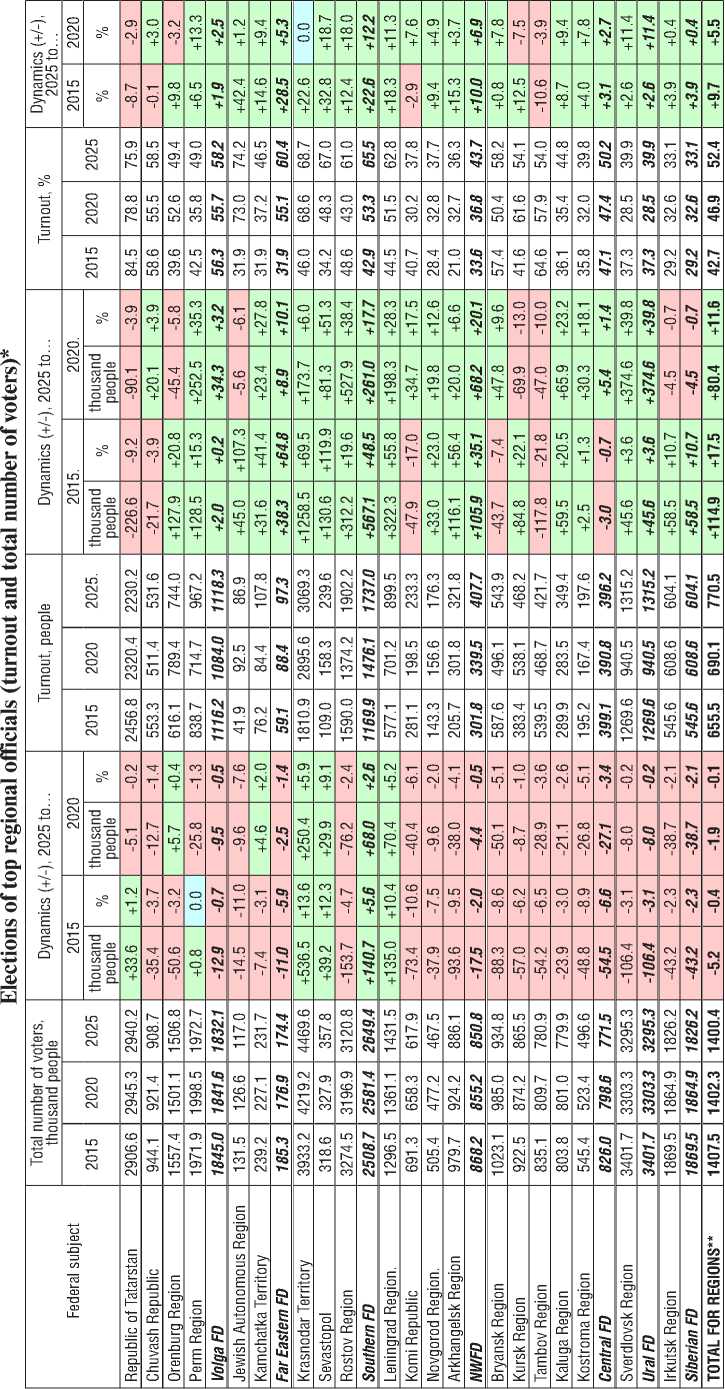
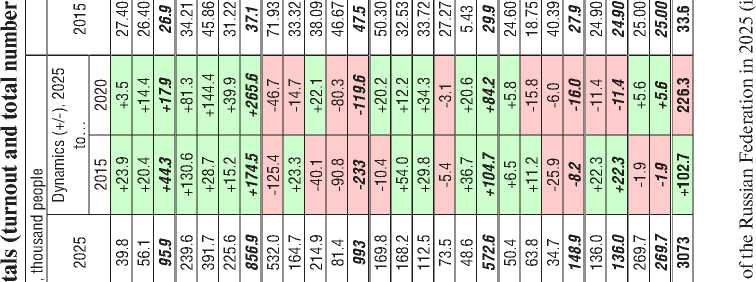
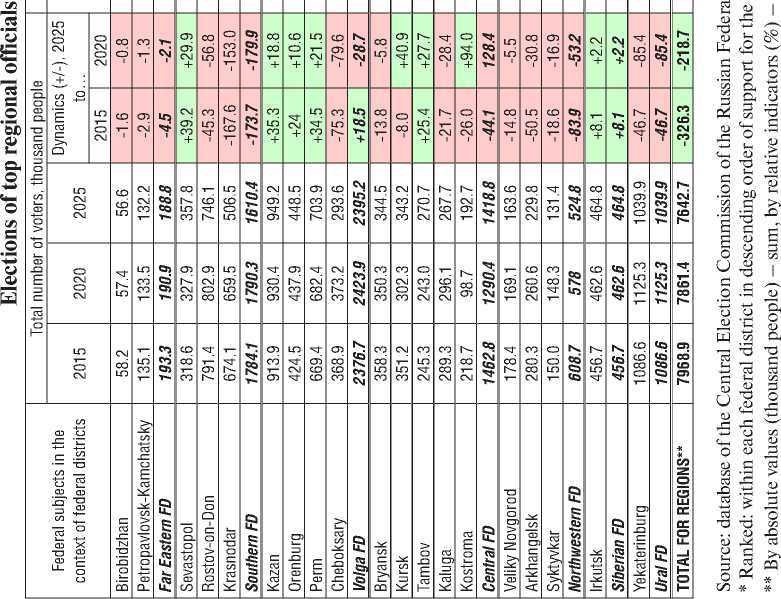
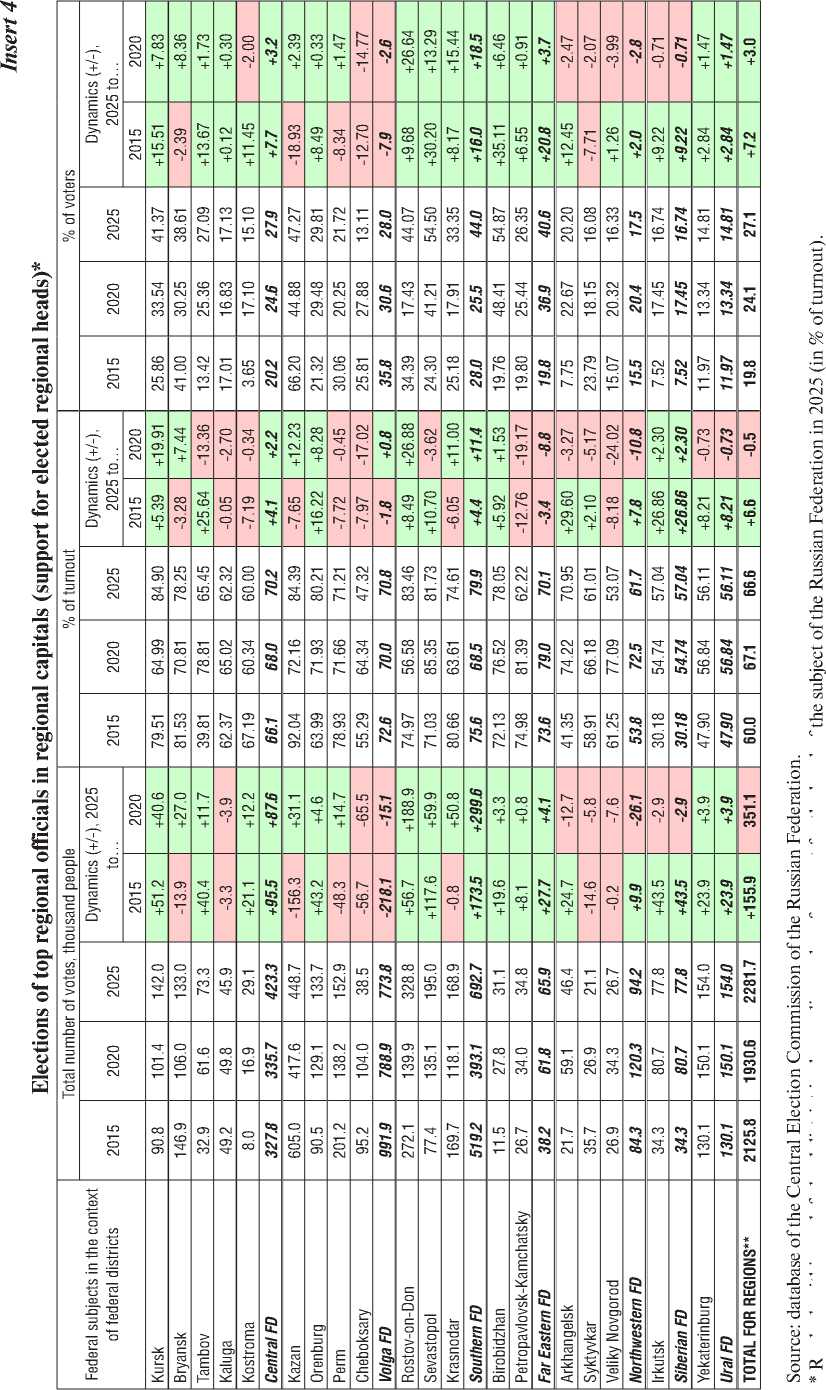
The specific results of the concluded electoral campaign (for elections of regional heads and deputies to legislative bodies) compared to previous elections held in 2020 and 2015 are presented in Inserts 1–5 .
Here, we note the most general trends from the results of the regional head elections compared to previous analogous elections held in the same territories in 2020–2022 60 :
^ firstly, aggregate voter turnout across all federal subjects and their regional capitals increased (by 1.6 million people in the regions and by 0.2 million people in the cities; Tab. 10, Inserts 1, 3 );
^ secondly, in aggregate across the regions, 1.5 million more people voted for the United Russia party compared to 2020, and 0.4 million more in the regional capitals. However, it can be said that the level of support for the ruling party remained virtually unchanged compared to past elections: on average across the federal subjects, it constituted 74% of the votes cast by participating voters; in the cities, it was 69% ( Tab. 10, Inserts 2, 4 );
^ thirdly, it is important to note that the 69–75% of votes received by United Russia in the elections represents the will only of those who participated. As a percentage of the total number of registered voters residing in these territories (according to official CEC data), the level of support for the ruling party is significantly (almost halved) lower – averaging 40% in the regions and 29% in the regional capitals ( Tab. 10, Inserts 2, 4 ).
Table 10. Results of the 2025 Single Voting Day for elections of regional heads in regions and regional capitals
|
Indicator |
2015 |
2020 |
2025 |
Dynamics (+/-), 2025 to… |
|
|
2015 |
2020 |
||||
|
Average for 20 federal subjects* |
|||||
|
Turnout, million people |
13.11 |
13.80 |
15.41 |
+2.30 |
+1.61 |
|
Turnout, % |
42.72 |
46.91 |
52.43 |
+9.71 |
+5.52 |
|
Support for United Russia, million people |
10.14 |
10.52 |
12.01 |
+1.87 |
+1.49 |
|
% of turnout |
72.32 |
74.89 |
74.37 |
+2.05 |
-0.52 |
|
% of voters |
31.85 |
35.74 |
39.87 |
+8.02 |
+4.13 |
|
Average for 20 regional capitals** |
|||||
|
Turnout, million people |
2.97 |
2.85 |
3.07 |
+0.10 |
+0.23 |
|
Turnout, % |
33.58 |
36.68 |
40.02 |
+6.44 |
+3.34 |
|
Support for United Russia, million people |
2.13 |
1.93 |
2.28 |
+0.16 |
+0.35 |
|
% of turnout |
64.95 |
69.08 |
69.07 |
+4.12 |
-0.01 |
|
% of voters |
22.83 |
25.68 |
28.87 |
+6.03 |
+3.19 |
|
* Republic of Tatarstan, Jewish Autonomous Region, Krasnodar Territory, Sevastopol, Leningrad Region, Rostov Region, Chuvash Republic – Chuvashia, Bryansk Region, Kursk Region, Tambov Region, Orenburg Region, Perm Territory, Kamchatka Territory, Kaluga Region, Sverdlovsk Region, Kostroma Region, Komi Republic, Novgorod Region, Arkhangelsk Region, Irkutsk Region. ** Birobidzhan, Sevastopol, Kazan, Rostov-on-Don, Bryansk, Kursk, Krasnodar, Petropavlovsk-Kamchatsky, Tambov, Orenburg, Veliky Novgorod, Perm, Irkutsk, Arkhangelsk, Cheboksary, Kaluga, Syktyvkar, Yekaterinburg, Kostroma. Source: own calculations using the data of the Central Election Commission of the Russian Federation. |
|||||
We also note that compared to previous elections, turnout in the elections for top regional officials, as well as the share of votes for United Russia candidates, increased in 16 out of 20 regions ( Inserts 1, 2) .
The situation looks slightly less pronounced (though still convincing for the ruling party) in the regional capitals: here, turnout in the elections for regional heads increased in 11 out of 20 administrative centers ( Insert 3 ), and support for United Russia representatives increased in 13 out of 20 cities ( Insert 4 ).
Regarding the elections of deputies to regional legislative bodies, both voter turnout and support for the ruling party representatives increased in all 11 regions compared to the previous elections. Turnout rose from 4 to 5 million people (on average from 36.5 to 44%) , and support for the ruling party increased from 2 to 3 million people (on average from 47.7 to 60.5%; Insert 5) .
Thus, summarizing the course and results of the 2025 Single Voting Day, experts once again concluded that “the system of political representation has demonstrated its maturity and functionality, having developed the capacity to respond to threats and the ability to operate in crisis situations, evolving towards greater thoroughness and ‘maturity,’ responding to the demands of citizens and the country’s development trajectory. The test has been passed with dignity ” 61 . 6263
“In essence, we witnessed an informal ‘referendum of trust’ on the president’s policies – all acting regional heads supported by him and incumbent candidates won in the first round with respectable results”62.
“The excellent result of United Russia, which serves as the instrument for implementing the president’s policy, is the main outcome”63.
|
^ : ел о •— ЮЗ Е £i! О С Ой |
Ой Ой |
а? |
+ |
Ой + |
Ой |
<4 ъ |
05 |
со со |
S |
со |
05 ой СО ^ |
СО ф Ой + |
<4 т— |
со со 05 + |
LO Ф + |
05 Ф Ф |
Ой Ф |
Ln СП |
СО + |
г^ 05 + |
со со ф |
СО |
со Ой «5 + |
Ой юз + |
ф Lri |
ф + |
ф Оз |
^ + |
||
|
ЮЗ Ой |
а? |
Q ЮЗ Ой |
Ой ЮЗ + |
О |
05 |
со Q |
° СО + |
Ой ЮЗ + |
g |
2 со |
ой со + |
со юз |
Ф g |
со LO СО |
Ф СО |
со |
со ф со ф |
ф |
ф |
S СО + |
со + |
СО ф + |
се ф |
со ф юз + |
ел Оз ^ |
о со + |
||||
|
а? О |
ЮЗ Ой Ой |
г? со со |
со w |
LO со |
05 со |
Ln Lri |
Ой со S |
Ой 05 Ой |
ri |
о LT5 |
S юз |
05 05 |
ел Ln |
со Ой юз |
05 СО СО Ой |
Ой S |
со Ой |
°Ч со |
LO 05 СО |
Ф LO |
со со 05 со |
со ф Ой со |
05 со СО Ой |
«6 со |
юз S |
Si |
Ой |
сэ Оз ф |
||
|
Ой Ой |
юз ЮЗ СО |
О |
Ой |
03 |
05 ел |
со w СО |
05 05 Ой |
ri |
05 СО ЮЗ |
Ой |
СО СО Ой |
Ф |
со |
Ой Ой |
й Ой Ой |
СО ф LO Ой |
со со ф |
СО |
О СО со |
СО 05 |
103 Ой |
со ф Ё |
ф |
г2 со |
гЗ со т— |
со со оз |
£2 Со о> т— |
in со |
||
|
ЮЗ Ой |
со Q |
о СО Ой |
05 со со |
со со со со |
5 |
о S |
о Si |
сэ Si |
ЮЗ СО со |
Ср S |
03 со |
Со ел Со |
S СО со |
LO Ф LO Ой |
со |
Ой 05 |
Q ей ф |
ф со СО |
со ф LO |
Ш |
Ой 105 Ой |
со Ой |
сэ <о со |
оз со Ой |
05 ей ф |
со |
||||
|
о ЮЗ ОЙ Ой о Ё ей с |
Ой Ой |
а? |
со ЮЗ + |
+ |
со со |
°? |
*-' |
+ |
°? юз |
со ф |
с4! + |
S + |
Ln g |
+ |
Ф |
Ф °? |
СО 05 |
Ln ф |
СО со + |
05 05 + |
СО |
105 ф |
ф + |
ф |
со ф |
со |
О |
сэ |
Ф СТ + |
|
|
Ё CD ей = ° ° Ё |
Ой со + |
ЮЗ + |
юз |
ЮЗ ЮЗ °? |
Ф |
Ой ЮЗ + |
ЮЗ |
ф |
с4! + |
05 °? |
Ой ЮЗ |
ф + |
°? |
Ф Ф |
Ф |
ф |
ф Ой + |
О |
о ф |
со ф Ой + |
ф |
со |
О |
сэ |
’Ct сч + |
|||||
|
ЮЗ Ой |
а? |
со |
Ой Ой + |
со со |
Ой + |
со ф |
со со |
•N |
со |
ЮЗ ^ |
ф со + |
g |
ф ОЙ + |
ОЙ |
СО Ой + |
LO °? |
ел со |
ф + |
LO |
05 Ф |
ф |
со + |
со сэ |
ф ОЙ Ой + |
Оз ф |
СП + |
||||
|
Ё CD ей 74 ° Ё |
со со |
Ой |
Ой ЮЗ |
Ln g |
° + |
ЮЗ ОЙ |
Ln Ф |
о |
СО со |
со + |
3 |
ОЙ + |
ф |
Ф Ф |
ф |
LO ф ш + |
СО |
со Ф |
ф ф |
Ой + |
СО ф |
о со сэ |
03 ^+ |
03 1* т— |
ст + |
|||||
|
OJ о CD о |
ЮЗ Ой Ой |
о со со |
LO со со со |
03 |
о со |
Ln |
О со со |
05 Ой СО |
СЭ g |
со со |
со со |
LO Ой оо |
ф Со |
ф аз |
о |
Ой ф СО |
05 Ой СО |
о g |
Ой 05 СО СО |
г? со |
Ф со |
ф ОЙ |
со ф со |
05 К? |
ф S |
ф «3 |
03 § |
N? § |
’е |
|
|
Ой Ой |
Ой со со |
со |
05 со ЮЗ |
^ ЮЗ |
Ф g |
S Ой со |
LO со |
Ф со |
05 Ой со |
Ой ЮЗ СО |
со LO ЮЗ СО |
g |
со со со |
со со |
со СО 05 СО |
о |
05 к? |
со ф LO СО |
05 ф |
LO Ф со |
05 |
юз ф со |
ф |
со юз СО |
ь? Lri <е |
03 § |
N? § |
|||
|
ЮЗ Ой |
05 |
03 ЮЗ СО |
о Ой со |
юз ЮЗ СО |
сэ |
Ой ЮЗ |
со ЮЗ |
1П fs |
ср со со |
о |
Ой со |
ф |
Ой со |
Ой СО |
LO Ф со ш |
05 Ф со |
<о <о |
со |
СО 05 05 |
со 05 |
со |
Ой ф юз со |
Ln fs |
СО Ой СО |
«3 ф се |
оз |
§ |
со сч |
||
|
о ЮЗ Ой Ой о Ё ей с |
Ой Ой |
а? |
+ |
°? |
05 СО Ой + |
°? |
5 |
ЮЭ ЮЭ |
О |
со СО + |
со + |
ф |
со ф |
Ой 05 Ой + |
ОЙ |
со + |
Ф |
о |
ф ш ф |
LO Ой + |
Ф Ф |
105 Ой + |
ш со Ой + |
<о ф т— |
ф со + |
ел Оз |
О |
Оз |
ф со + |
|
|
Ё CD ей 74 ° Ё |
Ой со со + |
ЮЗ + |
ЮЗ |
СП |
со ел |
Ой |
О |
ф g |
юз |
05 05 ЮЗ + |
ф in со + |
сч Lri со сч |
со |
со СО + |
Ф |
ф LO ш + |
Ф Ой + |
Ф |
ф Ln + |
юз Ой + |
ел + |
ф со |
ф со 1— |
ф |
ф |
ф ст + |
||||
|
ЮЗ Ой |
а? |
°? |
со LO + |
Г- |
сэ g |
Ой со Ой |
сэ g |
со со + |
Ф юз |
+ |
ф ЮЭ + |
§ + |
со Ф |
ф 05 + |
ш Ой ф |
со ’е + |
ф со + |
со ф |
Ф Ф |
Ой Ой + |
ф + |
сэ |
ОЙ + |
+ |
юз со + |
ел |
ф сч СП + |
|||
|
Ё CD = ° О Ё |
ой со °? |
со ЮЗ Ой + |
Ой |
со со |
сэ g |
ЮЗ + |
Ln g |
05 о |
ф |
Ой со со + |
Ф |
ф ЮЗ со Ой + |
LO |
05 g |
ф Ой ф |
05 |
LO 05 + |
^ |
СО СО |
ш in + |
ш юз + |
ф |
03 СО |
С35 Оз 1— |
юз СО 03 + |
Ln 55 о> |
4“ со + |
|||
|
ел ° "о. > о ° Ё CD "О Ё 03 — 00 "ей £ |
ЮЗ Ой Ой |
со со со 05 |
Ой Ой СО |
со ЮЗ со СО |
СО LO со |
ф еч <с Со |
Ой |
Ср со |
Ф g |
со LO юз Ой |
ЮЗ 05 |
юз юз |
8 |
05 СО юз |
со СО |
СО Ой |
СО § |
Ф со |
со о |
со со Ой |
со |
ф Ой ш Ой |
юз со со |
со <о сэ со |
ф юз со |
С35 Lri сэ со |
со со |
T- ел |
ф со ст ст сч 4“ |
|
|
Ой Ой |
со 05 |
СО СО S |
°? юз |
СО со со |
Ln $ со <о со |
со СО |
°? со |
g |
°? S |
ЮЗ СО |
Ой 05 05 со |
ф ф ъ |
ф ЮЗ со юз |
LO |
Ой |
ш Ой |
1П со Ф |
ш со |
LO LO ш со |
со 05 со |
ф Ой |
о |
05 Со ф |
СО со S |
Оз со 05 |
со оз СО со |
со Ф Оз ел |
LO ст 4“ |
||
|
ЮЗ Ой |
со СО со Ой |
Ой § |
°? со СО |
°? Ой СО со |
со Ф о» |
0 со |
LO ЮЗ |
'Я |
ой Ой юз |
ф S |
со со § |
Ф |
ш |
05 |
Ф ей ф |
ф со |
05 СО |
ф Ой |
СО Ой |
со Ой |
со сэ со |
03 со со |
о> со ь? |
юз Ой |
Ln g |
ф СП ст 4“ |
||||
|
ел Ё CD |
ей "ел ей 'о Ё |
о О) CD О) CD о |
о 'ст cd Е CD |
ш ел ей Ё |
g § |
о ’ст CD ел о Е о о ел в CD |
О ей и Е ей ЬЕ |
g £ •SB ел щ |
о ей О ел |
"о о "ел ей CD ОО |
о ’ст 05 о "ел о |
g £ i |
о ’ст 05 ё СТ С CD _1 |
Ё Ё о |
о ’ст 05 Ё О СТ О S |
о ’ст 05 ^ CD СТ ей -С |
g 5 |
о ’ст и Ё |
о ’ст Ё "ел ей m |
о ’ст 05 о Е 03 |
о ’ст 05 СО ф 73 |
о ’ст CD СО Е о 7л о |
g 2 1 |
о ’ст Ё "ел о CD ОО |
g 2 S |
о ’ст Ё "ел |
g «5 со |
со Z о CD LU СЕ СЕ о о 1— |
||
Insert 3




о

anked: within each federal district in descending order of support for the head of By absolute values (thousand people) – sum, by relative indicators (%) – average.
Insert 5
*
ф
ф л S =
=
с
|
а? Ё |
сл 2 ю Е ^ 03 см o' |
см |
CD |
CD CD 4- |
03 4- |
CO CD 4- |
oq |
CD 4- |
LO |
D oo 4- |
st LO cd |
d |
|
CO |
co CO St |
ID |
||||
|
Ю |
CD т— т— CD СО _ СМ ^Г CD UD CD LO ^Г СО СО ^Г |
a |
CD |
LO St |
CD OO 4- |
co co |
co |
st co CM |
||||||||||||
|
LO cd LO |
OO LO |
LO |
ST |
аз |
co cd ’St |
LO CD |
OO °? 03 |
oo |
to $ |
T-st |
CD |
co tq co |
LO co cd co |
о ^T |
||||||
|
см |
СО LO |
CD |
CD LO |
03 |
cd co |
ST |
CO |
S |
eq co |
co |
cd co |
st cd co |
LO oo |
LO Co CM |
LO cd co |
|||||
|
LO |
LO |
LO |
CM |
LO CD |
LO |
5 |
CD CD |
co |
co |
co ’St |
cd |
CM co cd co |
аз LO |
co co cd LO |
s |
1^ cd co |
CM ^ |
|||
|
ш с/> |
сл 2 ю Е ^ 03 см o' |
см |
ОО |
4- |
4- |
LO CD 4- |
o to co st |
LO |
4- |
E 1— |
oq |
eq |
st St |
4- |
4 St 1— |
d 4- |
||||
|
Ю |
LO CD LO 4- |
" + |
CO cd LO 4- |
co s CM |
°? |
St LO |
oq |
co cd |
CD |
st cd T- |
CD 4- |
T— co |
cd CM 4- |
|||||||
|
см |
ю |
°? LO CO CD |
CO аз |
id cd |
03 |
^ co co CM |
id |
oo |
LO |
st St T- |
a |
£ St |
CM |
co CM |
CO |
co cd g |
L^ CO О LO |
|||
|
см |
CD CD CD |
ID CO |
Й |
oo |
CD |
cd cm |
q |
OO OO |
CM |
co cd co cm T- |
Й |
st co |
oo CD |
co cd co T- |
*4 CD CD |
co cd co co |
^ co co ^ |
|||
|
Ю |
cd CD |
LO CD |
CO |
CD CM |
LO CD |
ld co St CM |
°? |
°? |
nJ LO T- |
CD |
st cd co |
LO |
N LO co |
CD LO CD |
cd LO co |
co CD ^T о id |
||||
|
ш га оэ с/Г CD CD g оз |
~+ : ОО о ю Е см 03 см o' |
см |
^ |
а |
s |
°? |
a |
cd co T- |
°? co |
cd °? |
sr |
st |
a |
cd st |
g co |
CD о co CM |
||||
|
Ю |
id |
CD |
co |
co |
LO |
St co |
4- |
CM |
ID °? |
co E |
T^ |
co |
st nJ |
°? LO 4- |
°? LO |
CD id co Tt |
||||
|
см |
CD CD |
cd CD |
CD CD CO |
CD |
CD CD |
cd co К |
CD |
id Я |
CD CD |
S LO co |
CD |
st td co |
°? CD |
°? E |
°? CD OO |
co cd co CM |
v; о co 1“ |
|||
|
см |
CD |
LO CO |
03 |
°? oo |
LO |
eq E co LO |
LO CO |
S |
CD CO CD |
co N LO co co |
CO CD |
eq co |
OO LO CD |
co cd LO co |
CO LO |
eq LO CM |
co co 1“ |
|||
|
Ю |
Я |
co LO co |
co 03 |
co oo |
id CD LO |
g co LO |
CD CM |
*4 |
CM LO g co |
S |
cd co T- |
CD CD |
eq £ co |
oo |
co cd co CM |
CM о CM 1“ |
||||
|
CD О CZ 00 CD Ш -О CD |
а? ОС "ф CD |
a? ОС _£D CD |
a? DC Ш 03 DC |
Ф DC oo "co |
CD* DC 03 E CD |
g s |
CD CD CD CD S E $ £ < |
a? DC ~CD "CD |
Ф DC 5 |
g a |
Ф DC оз 03 s |
g g Uj |
DC Ё |
g € 1 |
DC "cd |
g t ^ to |
co z о CD Ш CD CD О U_ —1 < О 1— |
|||
Support for the United Russia Party*
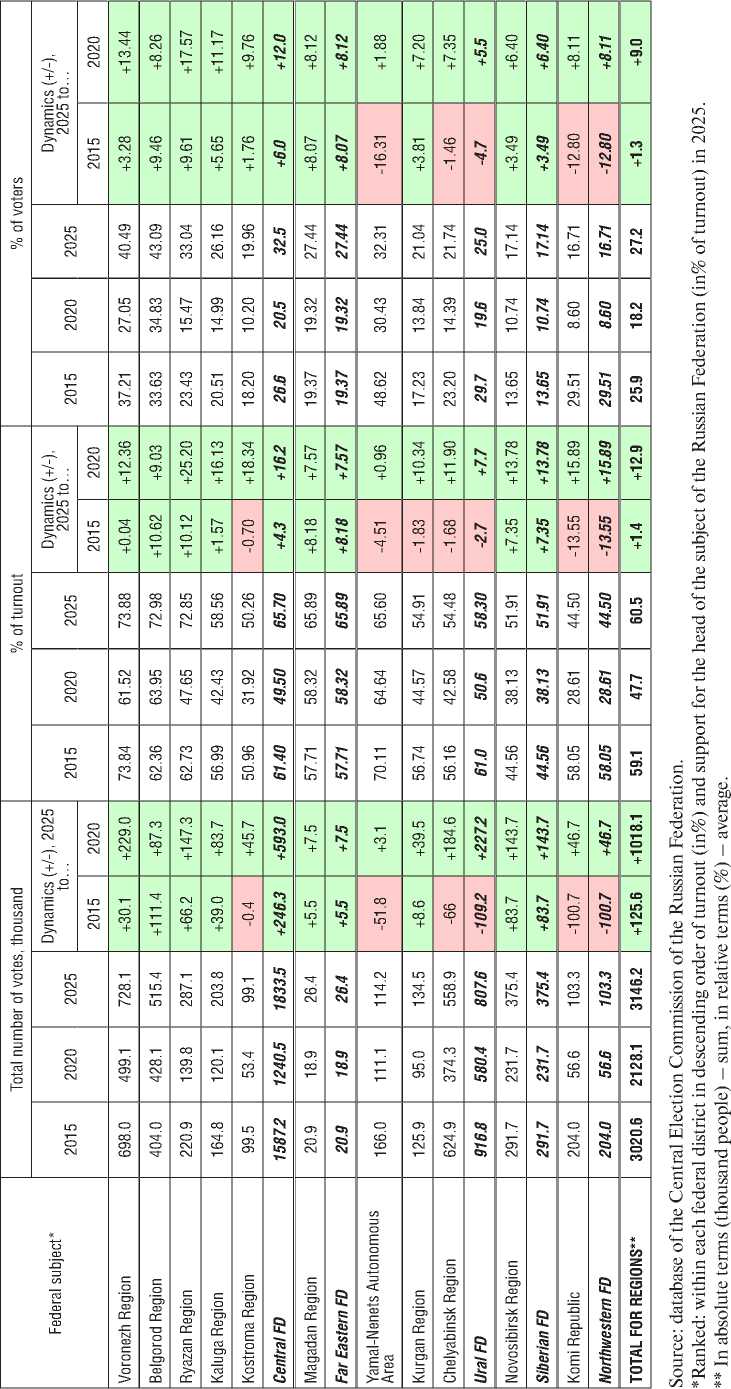
Of course, it is essential to acknowledge that the very fact of another calmly conducted electoral campaign is of key importance given the external political conditions the country has faced since the start of the SMO. However, as the analysis of all monitoring data on regional and municipal elections from 2018 to 2025 shows, behind the facade of relatively smooth local electoral campaigns (expressed primarily in the non-alternative support for the ruling party by voters) lie latent and rather concerning trends.
These trends, in particular, have already led to a tangible decline in support for United Russia at the federal level, where it lost nearly 17 million voters over 14 years (from 45 to 28 million; Figure ) in State Duma elections. This essentially signifies a decrease in society’s level of trust in the authorities.
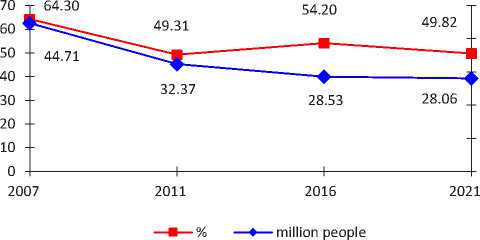
Dynamics of Support for the United Russia Party in State Duma Elections, 2007–2021
Source: Calculated by the authors based on CEC of the
Russian Federation data.
Both empirical data and expert assessments from elections at both local and federal levels indicate that simultaneously with the repeated credit of trust granted annually by Russian voters to the President, the ruling party, and the entire national development course implemented by the head of state, society demonstrates a growing demand for a qualitative increase in the effectiveness of state governance.
This is confirmed not only by official election results (for instance, when United Russia’s convincing victory occurs against a backdrop of declining turnout; or when an overall increase in national turnout is achieved due to a small number of regions, while turnout decreases in most federal subjects; or when the ruling party wins across all territories but loses votes in many of them compared to previous elections...) but also by the results of long-term sociological surveys of the population.
The results of mass public opinion polls (both nationwide and regional) show that they objectively reflect the structure of citizens’ party-political preferences, as demonstrated by the distribution of votes in elections: United Russia consistently holds first place in this structure, second and third are shared by the CPRF and the LDPR, with A Just Russia – For Truth and New People parties lagging significantly behind ( Insert 6 ). At the same time, over the past 25 years (from 2000 to 2025), the share of people who believe that United Russia shares their interests has increased substantially:
S nationwide — by 20 p.p. (from 14 to 34%) 64 ;
S in the Vologda Region — by 24 p.p. (from 18 to 42%; Insert 6) 65 .
However, the results of sociological research also indicate that the level of support for the ruling party is only 30–40% (which corresponds more closely to the election results as a percentage of the total electorate, rather than just those who actually participated). This is an indicator that allows United Russia to feel comfortable in electoral competition, but it is not an indicator that would suggest the ruling party expresses the viewpoint of the majority of the country’s citizens.
Furthermore, a significant portion of Russians does not see any political party in parliament that reflects their interests. On average over the past months of V. Putin’s fifth presidential term (from 2024 to the present):
^ according to nationwide surveys by FCTAS RAS, their share is 53%;
^ according to surveys conducted by VolRC RAS in the Vologda Region, it is 36%.
That is, in essence, there are three substantial groups (according to VolRC RAS data for 2024– 2025; Insert 6 ):
^ 42% supporting United Russia,
^ 23% supporting other parties,
^ and 36% of people who do not see any political forces in parliament expressing their interests at all. 66
“We live in a society of three thirds. Where one is always for the authorities, another is politicized and protest-oriented, and the final third wavers... although the politicized and protest-oriented third has shrunk in size, it always remains a qualitative group .. .”66.
Thus, the data presented in Insert 6 indicate that from the standpoint of the electoral structure of the political system, United Russia’s “lead” over other parties is colossal. However, from the perspective of the tasks facing United Russia as the ruling party, the party of the majority, there are as yet no signs that it is consolidating Russian society.
Moreover, there are specific facts pointing not merely to a growing public need for improved government effectiveness, but to an objective historical necessity for it. Indeed, since February 2022, relatively calm elections and the nonalternative public support for the authorities have largely been determined by the fact that electoral campaigns occur under force majeure conditions, under the influence of “black swan” events:
^ in 2022, the SMO itself (the start of hostilities) and the retreat of Russian troops from the Kharkov Region served as such a “black swan” 67 ;
^ in 2023 — the armed mutiny by the Wagner PMC;
^ in 2024 — the incursion of the Ukrainian Armed Forces into the territory of the Kursk Region, as well as the exposure of massive corruption facts in the Russian Ministry of Defense 68 ;
^ in 2025 — the exposure of a corruption scheme related to the activities of the Kursk Region “Development Corporation” (including the arrest of former Governor A. Smirnov on April 15, 2025), which became a cause for the incursion of the Ukrainian Armed Forces into the territory of the Russian Federation...
Each of these factors created a direct threat to national security, increasing voter anxiety and strengthening distrust towards the government bodies that allowed these “black swans” to emerge. As experts note, “society’s trust in the political elite, which is supposed to be a moral compass, the entity responsible for protecting sovereignty and consolidating society, raises serious questions...”
Insert 6
|
О , га .2 2 о ? | й “ 7 ?: » ё ?: я S ■= 03 03 ^ •= 03 о .Ь а 1 .= q N ^ ОМ CXj сл Р > ^ 8,> ^ “ |
а см 4- |
см 4- |
см 4- |
in |
" + |
см 4- |
о < <с 5 о ел о ^ _Е "аз m LO СМ см га' ^ О) о о Е "га '5) о о сл .2 ел ел аз о аз О) га СО ЮЗ юз о "га Е о ел ел аз 'ел сл о аз га 5 о I Ю3~ СМ n "га "аз 2 га о га ел СО 2 ± га га "аз g ел га аз _1 S о СО |
|||
|
га § Я Ё « 8 j I | 7 '5 Ео Е ™ о Ъ £ Е -> о аз о ^ аз |
СО 4- |
lo |
+ |
оо 4- |
" + |
см 4- |
СО 4- |
N |
см 4- |
|
|
. £ "га _ ~ ~ 1 £ -S | 3 |
ш об ОО |
со |
ш об |
об |
ш |
О СО Ч— |
LO |
со |
in см in |
|
|
- f § я Е ° га ей Я “ ~ “ ОТ |
со Ч— |
ОО со |
со |
00 об |
°? |
о см |
°? об |
О |
со см in |
|
|
« ^ га 2 7 > g |
■чаем |
00 03 |
°? |
со об |
со ч— |
см СО оо |
со 03 |
о со ча- |
||
|
Е -g га 2 § 1—1 аз аз g |
ОО |
СО 03 |
ш |
2 |
о см см |
ш со см |
со 03 |
°? со со |
||
|
~ га тз g .Е о “ Е 7 ' 03 СЛ ч— СЛ 03 g |
ча; со Ч— |
^ |
03 СО |
со |
со о см |
00 ю оо |
СО |
in |
||
|
га о 1 7 « .Е й -2 2 £2- |
об Ч— |
со об |
°? |
Г" |
оо |
юз СО |
А о in |
|||
|
03 оз 03 |
о in |
й |
об |
о со см |
оо |
о со |
||||
|
.2 СЛ СЛ СЕ ■а аз = |
5 |
аз .2 'ел ел "2 |
аз o' аз 5 аз S |
аз о аз of 5 аз Z .2 СЛ СЛ СЕ га ЕС О —1 СЕ |
аз о г |
аз 5 сл ей о |
СЛ га о о s аз о Z |
|
о , ^ .2 ^-^.20 7
,Е о. 1 .Е о. £2, га £ га ел £ > ^ ^ |
чаем 4- |
ем |
" + |
о |
1П 4- |
со |
О |
со ч— |
га "га ел о о Е о ’с o' "о га О ОО |
||
|
газ -—- ел -—-
О- 'ел со — о аз ел о Ё Ь “ i £ ° = СМ СМ то £ 2 б Е Е -> о аз о ^ аз |
V |
V |
см 4- |
о |
Ш 4- |
о |
2 |
||||
|
~ 1 | g |
5 |
см 03 |
S |
LO об |
ем об |
ем |
см |
ЮЗ СМ |
О |
со in со |
|
|
£ ° га Е Й 2 ^ ~ о О. 2S |
со |
00 03 |
СО со |
ем |
2 |
о |
ЧТ сб см |
ем оо |
03 |
о см ча- |
|
|
1 § 2 “ Е 7 га ?Е га 2 7 > 2 о |
ча-со со |
03 |
со |
со |
о |
чаем см |
03 оо |
Г- |
LQ сб ча- |
||
|
га газ = га “ Ё 7 Е -g га 2 § 1—1 аз га g 2 °- S |
см in со |
со |
°? |
J |
ем |
см о см |
00 сб см |
03 ем |
ч—; ча- |
||
|
~ „ел о g .Е о “ Е — л аз га S га аз g |
w со см |
2 |
со |
2 |
°? |
сб ч— |
см |
сб |
in in ча- |
||
|
"га . 2 g ■-гага ЕЙ ~ Д га ел g > =з £ о 22 |
СО ч— |
О |
со СО |
о со ч— |
ем оо |
см |
см in |
||||
|
03 оз 03 |
о ч— |
об |
со |
об ч— |
см |
об оо |
LQ о со |
||||
|
.2 СЛ СЛ ЕЕ ■а аз = |
5 |
аз .2 'ел сл "2 |
аз o' аз 5 аз Z |
аз О |
03 о л? аз 3 аз 2 .2 СЛ СЛ СЕ и ЕЕ а —1 ЕЕ |
аз о Z |
аз 5 ел га о |
СЛ га о о s 03 о 2 |
“One of the effects of the special military operation (unexpected for the West, but completely logical for Russia) was the consolidation of society. Over 70% of Russians provide volunteer assistance to the front, and trust in the President of Russia remains stably high. However, society’s trust in the political elite, which is supposed to be a moral compass, the entity responsible for protecting sovereignty and consolidating society , raises serious questions…
…In Russia, the elite is primarily considered to consist of individuals with high incomes, status-filled relatives, and great power. And when the degree of elitism is determined by income level – as Yuri Solomin rightly noted – this ‘gives rise to stratification, and with it, the savagery of souls ’. It is precisely this savagery of souls that we often observe among our ‘elitists’. Corruption, embezzlement of budget funds, irresponsibility, the priority of selfish interests, susceptibility to external influence, contempt for the interests of the people (‘these losers’), and a firm intention to continue the ‘feast during the plague’ – stories dedicated to these themes, using examples from the political, military, and cultural elite, we see in almost every news broadcast ”69.
Even as the state continues its active policy of organizing domestic life under the conditions of the SMO ( Insert 7 ), the system of state governance itself remains populated by individuals whose daily conduct is entirely opposite to the public national development agenda proclaimed by the head of state. 69
This is confirmed by specific facts presented in Inserts 8–9 :
Insert 8 reflects the qualitative aspect of such episodes of “savagery of souls” among individual representatives of the ruling elites. It presents expert assessments indicating that such individuals are found among representatives of all key parliamentary parties.
Insert 9 continues our monitoring of arrests and detentions of government officials. It largely reflects the quantitative side (the high frequency ) of such episodes in our country, specifically those officially “exposed” as a result of actions by law enforcement agencies. 70
According to official data from the Russian Ministry of Internal Affairs for the period from 2018 to 2025 (data for January – August):
^ the total number of corruption-related crimes in Russia increased from 22.7 to 32.3 thousand (or from 1.4% to 15.1% of the total crime rate);
^ the number of crimes related to bribery increased from 9.3 to 20.1 thousand (or from 4.6% to 18.7%) 70.
Thus, the results of monitoring electoral campaigns from 2018–2025, along with sociological measurements, expert assessments, and factual data characterizing the state of Russia’s system of state governance, indicate that the election results after February 2022 – where Russian society annually grants a “credit of trust” to the authorities and personally to the President of the Russian Federation – are largely based on people’s need for stability amidst the undoubtedly force majeure circumstances that have accompanied life in the country in recent years.
Insert 7
я ф
ф
ф
ш
(Д
НН й РЙ
и в
И
ф Я 2?
ф
ф ф
о
ф
ед
S
л л ею ф ь
S3
св ф « ф
ед ф
я «
ед я
ф
я © §
(Д S
S и
И в
X НН и СЛ
ё о X
2 to Й
д о
1-р д
о я
§ д
о
g о
о
д
д
д о
g .о
д о
д
д
о
-С о
д д
.8? Й
Й О
о g
О д
д о
д ф g
о
с
2 ф -о ГФ й я я
д г> g
д
д о
д га
о
_о
д1
2 о
д
о
g
д о
д
р
о
р
р?
д
X
о
о
Д г> Й
о S
д о
р
д о
д д
Й
о д
д р?
5 о
д
д о
д
д о
д
■д
я я
ф
о д о
д
Он
о
д
2 д о
g
р?
.о
(Д и X И
Z О НН и ей
й й
(Д X
с
д
д
р?
д а
й д о
о
д о fe д
д га
Й
Я
■ Й
я
д о
.2 £
ф
.5 ф N
о
д д о g
д g
д
N
■ д &
о
(Д РЙ и СР S и S И
(Д и
ь
РЙ НН Й к
ей
5 ел
(Д и РЙ й
Ф Л 8 ф 8
ф
д
д
о
й ф
д
о д
р
о
8 fe о
д
д
ф
д
Я О
о S
д
о
о р?
2 я
д
В
и в
о
.о
д
N нн i РЙ
X
о и
ед
ф ф
д
о
й о
га
.о
ф
я г>
о д о
о
■ д
о
ci
X
N
и
и РЙ
(Д И РЙ ел
О
ф
ед я
я
ф
ф
ОС
ф л 8 ф
ф сл
-с о
о
о й
ID
2 о
g
д
д
й о р?
я ев
ел Ф
2 о
д о g
д
р?
р?
д о д
о д
д д
S
р
д
.о
д
д
о
й
S ф
S
,о
в
ею я
я ф
я
д
д
ОО
д о
Й о
о о. о
й
д
I
й
о
-С о
i
о д о
О S
о
д
д
о g
о
2 ф -о ГФ й
2 о
я о
о
о
д д
й
р
И й
и X и о
РЙ и о X р и в
2 ф -о ГФ й я я
ф
.5 я
га
и
о ч->
о
Й
й
00 д
^ о
д
о
о
р
о
о
о
я я ф
V
я
я
ф
о
д
д
и
д о
Я
й
о
N Я
Д
д
д о
§
Й
с
я ф "О ГФ й я я
РЙ ф
с?
N
ф
g g о
g й о
8 п д
о
й
д о оо
ф & 8 ф
д р
о
о д о
,о
й
ф сл
й
о
Д
$<
Д £
д о
д ф 00 та
Й ед
Й о
ей о и ел
X
о
и я
.о
д
д
я я
ф
.о
fe
и
i
00 д
о
д
5 о g
д д о
о g g
д
ь
X
о и
ей
(Д ё й
^ о X НН РЙ РР Он р
я ф "О ГФ й
ф
ед я
я ф
я
i
я ф "О ГФ й
ф л
8 ф
ф сл
.о
д
fe
р?
о д
о
Й
й
_о д о
Й
д
д о
д
о
S
о "я я 1 О ф
g й о й о
й о
о
я
д
ь д
о и Й О
Й о
n д я 2? о ел д О
О ф
Рн р?
о
ф
о я ф ед та д 00
й Й .о
N
д
д
й о
й
ед
о
о
д д .о
я ф
X
й о
д о
о
ед я
я ф
о й о
.о
о
8? д
д о
о
ед
S
р
д о fe д
о
й
я ел
Й
Ф
я
ОО
я
д
Q
д
S
i
,о
ф ф
ф
ф
■я я я я ф
,о
д д о
д о
д
о
2 ф "О ГФ й
ш
ф
Й
й
р
Й
о
8 щ
00 д
о
<5
,о
71 The insert is a continuation of the monitoring of the most important regulatory legal acts signed by the President of the Russian Federation, which we have been conducting since June 2022 (the first issue of the monitoring is presented in the article: Ilyin V.A., Morev M.V. (2022). A difficult road after the Rubicon. Economic and Social Changes: Facts, Trends, Forecast, 15(3), 9–41).
ад
д и
о
й
й Й
й й о
ОС
й о й
д
S
3 о
й о
й о
.о
д
д и 3 д о О
о
й <О ад ей
Й ад
.о
Й
о
с?
с?
о й о
Й о
8 д
д д
д
§
а
о
.о
с?
й
,о
д
S
3 о
о
й
■ Й
о й о
о
д
о
о й о
й
о Ч-» й1
о
S S о
о
Й
о
д
о
,о
о
й
о
о
й?
о
о
д и 00 ей
Й
й Й
Й
.о
о й
о
,о
д S
о
д S
о
д д
1> g
2 й о
й о
й о
о
й
о
,о
о
й
.о
о
й
й ад
о й о
Й о о й й о ад ей
й й?
д
S о S д о 3
о ь
8 о о Д
8 с?
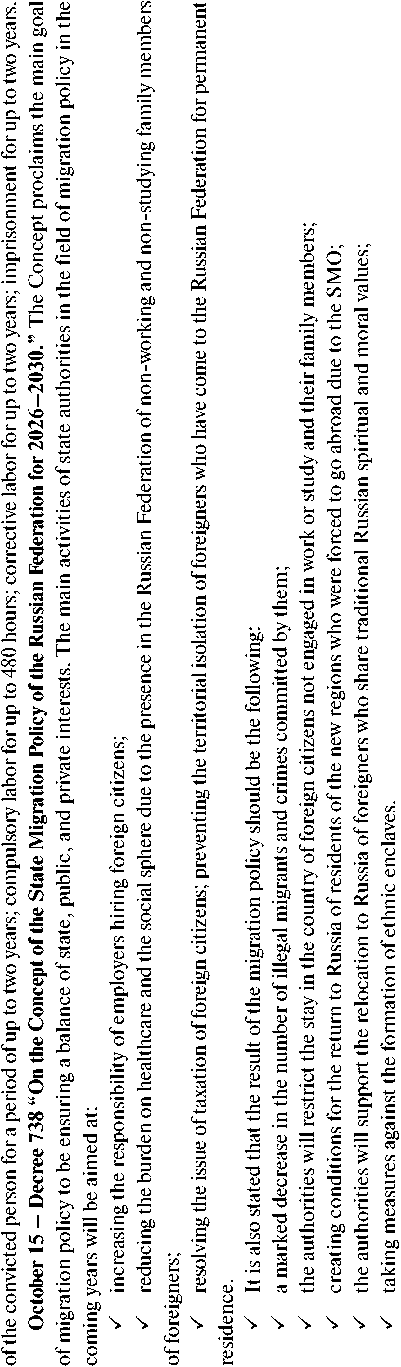
Insert 8
р
^
я о
о
о
я о
й1
S я о
р-
о
й1

о
о я
я о
о
я о
О
о
я о
о
-С о .я о
я
О й? о g
ь я
я 00
я о
о
ф .5 ’Й "5
-С я
я р
с
а
я
2 ф -о ГФ я я
ЕЙ
о
я о
ь я
о
8 и g я
с
Ё
о
2 ф ■я
1 я ф о
ф
S я о
я
с 5-Ф
с й?
й?
Ё
я о
я
Ё
WD 5-Ф
S
Ф .5 ’Й "5
я Ф
"Й
о
й?
о
я
я о
я я о о
я
я
I я о 'оо
Рй в ■g
^
я 5
О
я о
я
я
о 40 t od Он
WD
о S

Л (Л
я
о ф св 55
я
о о я
о 00
оо
Я
о
я
й о 'й
о Г) S
я я
а
6 о
ф Л S ф о ф
о
я
я
Ф О я
WD in
я о
о ь
я о
с й
о я
-С
Z я" .о 'оо
Рй я л N
РЙ
о я о
Й
я
Ё
X
о
ад
6 .о
Я
о
с я
Ё
х
о
й
о 00
6 ,о
о
я я о о я о
00 я
я
-С
S -Н ад с Ф ’Й ф я W S ■о 2 ы я ’я ф ф S ф ф я W ф ф .5 я ,Я ей ь о ф я я ф ф in с о Й о 5 g й я Ё ад с о й й я g с й О ^ о ^ о й о Й х 3 N с в? о е X о с о о й о й Й е 3 е о О Й е § ^ й о о й с 5Р й я о >л -с Ё © «Ь U V 77 Ivanov A. A long-term deputy of the State Duma is suspected of raping a young assistant. Available at: https://zavtra.ru/events/mnogoletnego_deputata_gosudarstvennoj_ dumi_podozrevayut_v_iznasilovanii_yunoj_pomoshnitci?ysclid=mgrmbw658c102524228 78 Panteleev D., Zykina T., Sarsania N. “Organized criminal group and assets worth 9 billion rubles”: what is known about the lawsuit against the head of the Council of Judges. Available at: https://www.rbc.ru/business/23/09/2025/68d26a509a79476cc45d7597 ш ф О ф ф ы S3 5 ф ф g S3 ф сл Ф ф ф л сл С S3 ф ф д ■с? Е о я д д д д о д о о д о Е с д о Е S 2 д о 8 й1 д о о о д о £ д га 5 о V о д д о й Е N д р о д о 00 о д N N о V О д о д Е о? Е о д о Е -Н сю С О д Е о д о д .о Е Е с о д Ф о о й1 д д 'оо ай s' Е д Q д д S N д о д о д Е о ф Source: RT in Russian. The latest news about arrests. Available at: However, as V. Matviyenko, Chairwoman of the Federation Council of the Russian Federation, rightly notes, “all current conflicts, including the Ukrainian one, have a chance of resolution only if their root causes are eliminated”80. This thesis is often voiced concerning international conflicts, but, as the results of this study show, it is fully applicable to the country’s internal life as well. It is necessary to understand that under the conditions of the SMO, all events, phenomena, and processes occurring within the country should be viewed not only as part of internal daily life but also in the context of their potential external, geopolitical consequences. In this sense, the consolidating function of the ruling party as the “instrument for implementing the president’s policy”81 plays a crucial role in fulfilling one of the key tasks facing the country – the formation of a new Social Contract as a “basic, yet at the same time special state of relations between the state and the people, expressed in the philosophy of a common destiny”82. And although this task is not explicitly formulated by the head of state, numerous expert assessments testify to the growing need of Russian society for a new Social Contract.838485 1. “The conduct of the SMO, along with active and contradictory processes of socio-cultural turbulence within Russia and in Near Abroad states, requires adjustments to the existing social contract”83. 2. “As a result of the global transformation of the geopolitical system in 2022, the problem of a radical revision of the social contract emerged... The initiated shifts signify a fundamental change in the country’s governance regime – from a dependent (colonial) one to an independent (sovereign) one... The need for forming a qualitatively different social contract between the supreme authority of Russia, represented by its president (and simultaneously the leader of the nation!), and the population has already ripened”84. 3. “...currently, solutions to specific state and societal problems in a significant number of cases lead to distorted processes and phenomena, which do not always embody the equal unity of the people and the political power, leading to various forms of tension reflecting the deformation of the existing Social Contract”85. 4. “For many years, a discussion about the necessity of creating and introducing a common ideological platform into society has been intensifying in the country. This platform should serve as a guiding thread for state development... At the current civilizational rupture experienced by the world, we need such a guiding thread more than ever... A more or less clear outline, let alone one approved at the state level and purposefully, yet creatively (through discussions and probable corrections), proposed to broad elite circles and introduced into public consciousness, does not yet exist... The state’s leadership stratum is still dominated by economist-technocrats, ‘political technologists’. They are useful for current management, they do much that is necessary, but they are incapable of leading the country and the people towards new horizons, of ensuring a deep, ideological unity between the people and the authorities in the difficult, fateful struggle which the country and the world have entered... The above is not a call for a change of the supreme authority, especially during an acute foreign policy crisis, which will last for many more years. But the renewal of the governing elites is a mandatory condition for success”86. Nevertheless, as the research results show, the unconditional victory of the ruling party (70–75%) in regional and municipal elections is, in fact, secured by only about half (45–50%) of all eligible voters. The remaining portion of the population (judging by sociological survey data) either supports other parties or is fundamentally skeptical of the country’s political system. This solves the tactical task of ensuring the stability of the political system in the present but becomes ineffective in the context of the country’s responses to future challenges.8687 “In recent years, it has not been uncommon for governors to end up in the defendant’s dock. And it seems rather unseemly when someone who showed a super-high result of over 80% ends up under investigation or on trial. Let’s say, similar to what happened with the former governor of Kursk Region, Alexey Smirnov, although last year he did receive 65.3%. But ultimately, this situation still looks politically unacceptable”88. “Among analysts, who usually work precisely for the authorities, an apprehensive mood has recently begun to prevail... the essence is that in the year of the upcoming State Duma elections, neither the people, nor the elites, nor, apparently, the political technologists themselves understand the future. And they cannot know or even attempt to predict what might happen in it”87. Hence the conclusion – apparently, the electoral process requires adjustment, as it does not entirely accurately reflect the real situation in the country and the relationship between society and the authorities. 8It should be noted that elections, like mass sociological surveys of society, are merely an indicator, a “litmus test,” allowing for periodic “snapshots” of the relationship between the state and society. The real “root causes” that lead to only 50, 40, or even 20% of voters participating in elections are much deeper and require not just “adjustments,” but far more decisive actions to change the entire system of state governance and life in the country as a whole: S overcoming the persistently high level of inequality and the most acute social contradictions; “The Forbes list of the world’s richest people continues to be replenished with Russian billionaires. In 2025, the number of Russians in the ranking of the wealthiest people increased by 21 individuals, reaching 146 people. Moreover, during the period of the SMO, each of them increased their annual income by 1.5–2 times”89. “…when our soldiers and commanders are dying on the fronts of the SMO, the issue of corruption takes on a special hue. If in peacetime the boundless theft by pampered clans simply slowed the country down, now it’s a completely different story. The law of justice and the law of retribution demand that such crimes be paid for with blood”92. ^ eliminating instances of the real, “egregious” (as Nikita Mikhalkov noted in his TV show “Besogon”90), behavior of elites as a systemic phenomenon; as part of ordinary, everyday life; ^ resolving contradictions and disagreements (within the expert community and among broad segments of the population) in interpreting the national development course and understanding the Image of Russia’s Future, which is impossible without a clear, unequivocal assessment of past and present events; ^ not merely “adjusting,” but creating a mechanism of state governance, or a system that would “filter out” people incapable of effectively performing their official duties while in “state service”: either those unprepared due to their professional qualities, or those fundamentally not sharing the general vector of national development that Russia has been following for almost a quarter of a century now. As A. Shkolnikov writes, “There are many musicians, but virtuosos are few; yet they all must feel and hear the music. If an official does not understand these principles of work, it means they are in the wrong profession”91. 92 Thus, decisive actions (primarily from the head of state) are required to address all those problems that have remained unresolved throughout virtually the entire post-Soviet period, have had (and continue to have) a cumulative nature, which has, among other things, led to the reduced effectiveness of elections as a diagnostic tool. And what happens when diagnostic tools fail is quite well-known. The painful experience of the Ukrainian Armed Forces’ incursion into the Kursk Region due to the seemingly banal embezzlement by officials through yet another “Development Corporation” serves as a highly instructive lesson in this regard, from which necessary conclusions must be drawn... – by the President, the State Duma, the Government, and entities within the state governance system at all levels of authority: federal, regional, and municipal. This thesis, in our view, is largely confirmed by the expert assessment presented in the report by the Center for the Study of Russian Political Culture (CSPCR), prepared for the 34th anniversary of the GKChP putsch on August 19, 2025: “We must be aware that the risks of a repetition of the August 1991 tragedy exist today. The modern risks are significant – history could repeat itself: after 30 years, the threat has not disappeared. The Western concept of the ‘decolonization of Russia’ explicitly aims to dismember the last large fragment of historical Russia – the Russian Federation. As during perestroika, part of the elites sees salvation in a deal with the West, hoping to return to the happy times for them of exchanging resources for the ‘glass beads’ of Western overconsumption, as under ‘Grandfather Yeltsin’. But the price of such a deal today is ‘decolonization,’ meaning total dismemberment. And the existing risks of another elite betrayal could very well materialize with the convergence of three ‘factors’. The first – a ‘crisis of trust’ in the authorities. But for now, this is offset by the president’s ‘super-high rating,’ however, stability cannot hang on a single ‘nail’ indefinitely. The second – the ‘comprador psychology of the ‘elites’,’ some of whom hope to return to the times of the happy exchange of the ‘glass beads’ of Western ‘overconsumption’ for the export of domestic resources, as it was under ‘Grandfather Yeltsin’. But hopes to ‘make peace’ with the global ‘hegemon,’ which has decided to purge the ‘overfed Russian oligarchy,’ can now only be realized through the conditions of Russia’s ‘decolonization,’ that is, its total dismemberment. And the third – the ‘absence of a sovereign ideology,’ an alternative civilizational ‘project.’ And this is the risk that the rebellious province of global capitalism, in the form of Russia, will be neutralized, lacking its own civilizational identity and ‘project’. Today, these three threats are blocked by the tough stance of the security forces and the consolidation of society around the goals of the SMO, including ‘Putin’s statements’ – about the impossibility of ‘returning Russia to the pre-2022 situation,’ and that ‘capitalism has exhausted itself’. However, ‘pragmatic security officials and technocrats’ have betrayed historical Russia more than once – both in February 1917 and in August 1991. Yes, history knows no subjunctive mood. But it demands to be studied and for the necessary lessons to be learned”93. In conclusion, we note that on October 2, 2025, speaking at the plenary session of the Valdai International Discussion Club, Russian President V. Putin gave a comprehensive assessment of the situation in the country and the historical moment Russia is experiencing today: “None of us, of course, are granted the ability to foresee the future in its entirety. However, this does not absolve us from the obligation to be prepared for anything that might happen. In practice, as both time and recent events show, one must be ready for absolutely anything. In such periods of history, everyone’s responsibility is especially great – for their own fate, for the fate of the country, and for the fate of the entire world. And the stakes are extraordinarily high”94. In our view, this is not only an assessment but also a call to action that must be heard and internalized by the ruling elites at all levels of power.