
Smart materials in materials science
Journal: Journal of Siberian Federal University. Engineering and Technologies @technologies-sfu
Article in issue: 7 т.6, 2013.
Free access
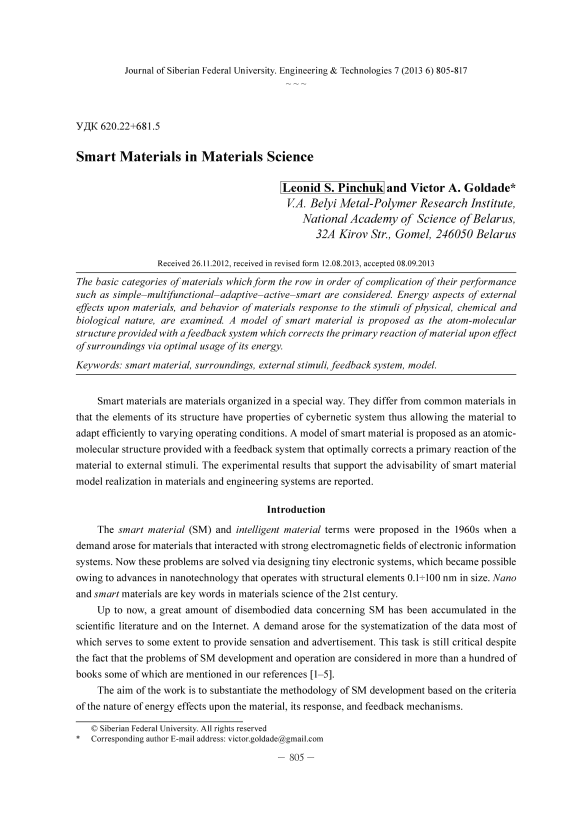
The basic categories of materials which form the row in order of complication of their performance such as simple–multifunctional–adaptive–active–smart are considered. Energy aspects of external effects upon materials, and behavior of materials response to the stimuli of physical, chemical and biological nature, are examined. A model of smart material is proposed as the atom-molecular structure provided with a feedback system which corrects the primary reaction of material upon effect of surroundings via optimal usage of its energy.
Similar articles in the section Materials testing. Commercial materials. Power stations. Economics of energy
Short address: https://sciup.org/146114794
IDS: 146114794 | UDC: 620.22+681.5
Умные материалы в материаловедении
Умный материал – это особым образом организованный материал, отличающийся от обычного тем, что элементы его структуры имеют свойства кибернетической системы, рационально приспосабливая материал к изменяющимся условиям эксплуатации. Предложена модель умного материала как атомно-молекулярной структуры, снабженной системой обратной связи, которая оптимально корректирует первичную реакцию материала на воздействие окружающей среды. Приведены результаты экспериментов, подтверждающие целесообразность реализации модели умного материала в материалах и технических системах.
