
Соотношение понятий "мир" и "нейтралитет" во внешней политике Швеции
Журнал: Studia Humanitatis Borealis @studhbor
Рубрика: Международные отношения
Статья в выпуске: 1 (6), 2016 года.
Бесплатный доступ
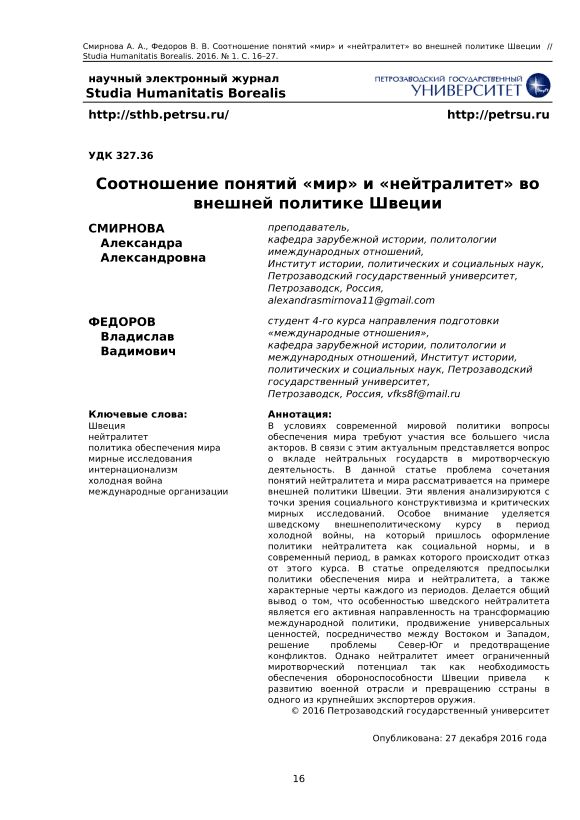
В условиях современной мировой политики вопросы обеспечения мира требуют участия все большего числа акторов. В связи с этим актуальным представляется вопрос о вкладе нейтральных государств в миротворческую деятельность. В данной статье проблема сочетания понятий нейтралитета и мира рассматривается на примере внешней политики Швеции. Эти явления анализируются с точки зрения социального конструктивизма и критических мирных исследований. Особое внимание уделяется шведскому внешнеполитическому курсу в период холодной войны, на который пришлось оформление политики нейтралитета как социальной нормы, и в современный период, в рамках которого происходит отказ от этого курса. В статье определяются предпосылки политики обеспечения мира и нейтралитета, а также характерные черты каждого из периодов. Делается общий вывод о том, что особенностью шведского нейтралитета является его активная направленность на трансформацию международной политики, продвижение универсальных ценностей, посредничество между Востоком и Западом, решение проблемы Север-Юг и предотвращение конфликтов. Однако нейтралитет имеет ограниченный миротворческий потенциал так как необходимость обеспечения обороноспособности Швеции привела к развитию военной отрасли и превращению cстраны в одного из крупнейших экспортеров оружия.
Похожие статьи в разделе Международные отношения. Мировая политика. Внешняя политика
Короткий адрес: https://sciup.org/147225765
IDS: 147225765 | УДК: 327.36
Correlations between the concepts "peace" and "neutrality" in Sweden's foreign policy
In the context of current world politics peacemaking requires participation of an increasing number of actors. This is why the question of the possible contribution of neutral states into peacebuilding activities appears relevant. This article examines the relationship of the “peace” and “neutrality” concepts as exemplified by Swedish foreign policy. These phenomena are analyzed from the perspective of Social Constructivism and Critical Peace Research. Special attention is given to the Swedish foreign policy during the Cold War, when the neutrality policy was formed as a social norm, and the contemporary period, during which a shift from neutrality is taking place. This article examines the background for Sweden’s peace and neutrality policy, as well as characteristics of the two major periods. The general conclusion states that the distinguishing feature of Swedish neutrality is its active focus on the transformation of world politics, promotion of universal values, mediation between the East and West, struggle to soften the North-South division and conflict prevention. However, neutrality also demonstrates its peace-limiting potential: the need for self-defense has contributed to the development of the military sphere, turning Sweden into one of world’s top arms exporters.
Список литературы Соотношение понятий "мир" и "нейтралитет" во внешней политике Швеции
- Agius C. The social construction of Swedish neutrality. Manchester: Manchester University Press, 2006. 247 p.
- Andrén N. On the Meaning and Uses of Neutrality//Cooperation and Conflict. 1991. Vol. 26. No. 2. P.67-83.
- Albrecht U., Auffermann B., Joenniemi P. Neutrality: the need for conceptual revision//Tampere Peace Research Institute: Occasional Papers. 1988. №. 35. P. 1-41.
- Archer C. The Nordic area as a "zone of peace"//Journal of Peace Research. 1996. Vol. 33. №. 4. P. 451-467
- Berger P. Luckmann T. The Social Construction of Reality: A Treatise in the Sociology of Knowledge. NY: Anchor Books, 1967. 219 p.
- Bjorkdahl A. Ideas and Norms in Swedish Peace Policy//Swiss Political Science Review. 2013. № 19(3). P.322-337.
- Consolidated version of the Treaty on European Union . URL: http://eur-lex.europa.eu/legal-content/en/TXT/?uri=CELEX%3A12012M%2FTXT, свободный (Дата обращения 11.12.2016)
- Devine K. Neutrality and the development of the European Union’s common security and defence policy: compatible or competing?//Cooperation and Conflict. 2011. Vol. 46. №. 3. P. 334-369.
- Ellasson J. Traditions, identity and security: the legacy of neutrality in Finnish and Swedish security policies in the light of European integration//European Integration online Papers. 2004. Vol. 8. №. 6. P. 1-24.
- Ferreira-Pereira L. C. Swedish Military Neutrality in the Post-Cold War: ‘Old Habits Die Hard’//Perspectives on European Politics and Society. 2005. Vol. 6. №. 3. P. 463-489.
- Forsberg T., Vaahtoranta T. Inside the EU, outside NATO: Paradoxes of Finland's and Sweden's post-neutrality//European Security. 2001. Vol. 10. №. 1. P. 68-93.
- Galtung J. Violence, Peace, and Peace Research//Journal of Peace Research. 1969. Vol. 6. №. 3. P. 167-191.
- Goetschel L. Bound to be peaceful? The changing approach of Western European small states to peace//Swiss Political Science Review. 2013. № 19(3). P. 259-278.
- Goetschel L. Neutrality, a really dead concept?//Cooperation and Conflict. 1999. Vol. 34. №. 2. P.115-139.
- Joenniemi P. The Peace Potential of Neutrality: A Discursive Approach//Bulletin of Peace Proposals. 1989. Vol. 20. №. 2. P. 175-182.
- Lindström G. Sweden’s security policy: engagement -the middle way//Institute for Security Studies -Western European Union. 1997. P. 1-57.
- Malmborg M. Neutrality and state-building in Sweden. Houndmills: Palgrave, 2001. 226 p.
- Morgenthau H. J. Dilemmas of politics. Chicago: University of Chicago Press, 1958. 390 p.
- Relations with Sweden . URL: http://www.nato.int/cps/en/natolive/topics_52535.htm, свободный (Дата обращения 11.12.2016).
- President Bush Gives Weekly Radio Address . URL: http://edition.cnn.com/TRANSCRIPTS/0309/27/se.01.html, свободный (Дата обращения 11.12.2016).
- Richmond O. P. Understanding the Liberal Peace . URL: https://www.academia.edu/2974440/Understanding_the_Liberal_Peace, свободный (Дата обращения 12.12.2016).
- Ruggie J. G. Multilateralism: the anatomy of an institution//International Organization. 1992. Vol. 46. №. 3. P. 561-598.
- Rundquist S. Sweden Celebrates 200 Years of Peace . URL: http://www.thelocal.se/20140815/sweden-celebrates-200-years-of-peace, свободный (Дата обращения 11.12.2016).
- Schweitzer C. Johansen J. To Prevent or Stop Wars: What Can Peace Movements Do? Ed: Irene Publishing, 2016.133 p.
- Statement of Government Policy in the Parliamentary Debate on Foreign Affairs . URL: http://www.government.se/speeches/2016/02/statement-of-government-policy-in-the-parliamentary -debate-on-foreign-affairs-2016/, свободный (Дата обращения 11.12.2016).
- Sweden in the militarisation of the European Union . URL: http://www.oldsite.transnational.org/SAJT/pressinf/2000/pf109_SwedenEUmilit.html, свободный (Дата обращения 11.12.2016).
- Sweden’s priorities in the UN . URL: http://www.government.se/government-policy/sweden-and-the-un/swedens-priorities-in-the-un/, свободный (Дата обращения 11.12.2016).
- Swedish weapons exports in spotlight . URL:http://www.thelocal.se/20150626/swedish-weapons-exports-in-global-spotlight, свободный (Дата обращения 11.12.2016).
- Tepe F. F. Swedish neutrality and its abandonment//İstanbul Ticaret Üniversitesi Sosyal Bilimler Dergisi. 2007. Vol. 6. № 11. P. 183-201.
- The basics about NORDEFCO . URL: http://www.nordefco.org/the-basics-about-nordefco, свободный (Дата обращения 11.12.2016).
- The Cooperation Areas . URL: http://www.nordefco.org/The-Cooperation-Areas, свободный (Дата обращения 11.12.2016).
- The Position of the United States With Respect to Scandinavia . URL: https://history.state.gov/historicaldocuments/frus1948v03/d146, свободный (Дата обращения 11.12.2016).
- Trust Funds: supporting demilitarization and defence transformation projects . URL: http://www.nato.int/cps/en/natolive/topics_50082.htm, свободный (Дата обращения 11.12.2016).
- Tunander O. The Uneasy Imbrication of Nation-State and NATO: The Case of Sweden//Cooperation and Conflict. 1999. № 34(2). P. 169-203.
- Wahlbäck K. The roots of Swedish neutrality. Stockholm: Swedish Institute, 1986. 80 p.
- Wendt A. Social Theory of International Politics. Cambridge: Cambridge University Press, 1999. 452 p.
