
Statistical Analysis of Blood Pressure and Pulse Parameters in Medical Students According to Sex and Age
Журнал: Бюллетень науки и практики @bulletennauki
Рубрика: Медицинские науки
Статья в выпуске: 10 т.12, 2026 года.
Бесплатный доступ
The aim of this study was to evaluate sex- and age-related differences in blood pressure (systolic, SBP, and diastolic, DBP), pulse rate, and related hemodynamic indices (pulse pressure, PP, and mean arterial pressure, MAP) among medical students, and to identify their independent determinants. In a cross-sectional design, self-reported indices were collected from 71 participants (47 women, 24 men, aged 18–42 years) by means of an anonymous online questionnaire. In addition to the hemodynamic variables, data on height, weight, lifestyle (smoking, alcohol, caffeine intake, physical activity, sleep, stress level), and health history were obtained; body mass index (BMI), PP, and MAP were calculated as derived indices. The Welch t-test, the Mann-Whitney U test, Pearson/Spearman correlation, two-way ANOVA (sex × age), and multivariable linear regression were used in the analysis. SBP (127.0±18.6 vs 111.7±12.3 mmHg; p<0.001; d=1.04), DBP (78.8±11.5 vs 72.9±11.7 mmHg; p=0.049), and PP (48.2±13.3 vs 38.8±10.6 mmHg; p=0.004) were significantly higher in men than in women, whereas pulse rate did not differ between the sexes (84.0±18.9 vs 81.2±16.0 beats/min; p=0.54). The sex × age interaction was significant for SBP (p=0.004) and DBP (p=0.023): SBP increased with age in men but did not change in women. The results showed that male sex (β=+12.4; p=0.022) and age (β=+0.80/year; p=0.049) are independent predictors of SBP, whereas BMI was the main independent predictor of DBP (β=+1.20; p=0.004). Body mass index (BMI) and sex proved to be the main determinants of SBP.
Короткий адрес: https://sciup.org/14139246
IDS: 14139246 | УДК: [612.143:612.16]-053.81-055.1/.2 | DOI: 10.33619/2414-2948/131/15
Статистический анализ показателей артериального давления и пульса у студентов-медиков в зависимости от пола и возраста
Целью настоящего исследования являлась оценка половых и возрастных различий артериального давления (систолического — САД, и диастолического — ДАД), частоты пульса и связанных с ними гемодинамических показателей (пульсового давления — ПД, и среднего артериального давления — СрАД) у студентов-медиков, а также выявление их независимых детерминант. Исследование выполнено в поперечном дизайне; данные о самостоятельно измеренных показателях получены от 71 участника (47 женщин, 24 мужчины, возраст 18–42 года) с помощью анонимной онлайн-анкеты. Помимо гемодинамических переменных собраны данные о росте, массе тела, образе жизни (курение, употребление алкоголя и кофеина, физическая активность, сон, уровень стресса) и анамнезе; в качестве производных показателей рассчитаны индекс массы тела (ИМТ), ПД и СрАД. В анализе использованы t-критерий Уэлча, U-критерий Манна — Уитни, корреляция Пирсона/Спирмена, двухфакторный дисперсионный анализ (пол × возраст) и многофакторная линейная регрессия. Результаты. САД (127,0±18,6 против 111,7±12,3 мм рт. ст.; p < 0,001; d = 1,04), ДАД (78,8±11,5 против 72,9±11,7 мм рт. ст.; p = 0,049) и ПД (48,2±13,3 против 38,8±10,6 мм рт. ст.; p = 0,004) были достоверно выше у мужчин, чем у женщин, тогда как частота пульса между полами не различалась (84,0±18,9 против 81,2±16,0 уд/мин; p = 0,54). Взаимодействие «пол × возраст» было значимым для САД (p = 0,004) и ДАД (p = 0,023): с возрастом САД повышалось у мужчин и не изменялось у женщин. Мужской пол (β = +12,4; p = 0,022) и возраст (β = +0,80 в год; p = 0,049) являлись независимыми предикторами САД, тогда как основным независимым предиктором ДАД был ИМТ (β = +1,20; p = 0,004). Индекс массы тела и пол оказались основными детерминантами САД.
Текст научной статьи Statistical Analysis of Blood Pressure and Pulse Parameters in Medical Students According to Sex and Age
Бюллетень науки и практики / Bulletin of Science and Practice
УДК [612.143:612.16]-053.81-055.1/.2
Arterial blood pressure and heart rate are the principal physiological indices reflecting the functional state of the cardiovascular system. Elevated blood pressure is the most widespread cardiovascular risk factor worldwide: in the 30-79-year age group, its prevalence amounts to 32% in women and 34% in men [1].
In 2024, the European Society of Cardiology introduced a new classification of blood pressure, defining the range of 120-139/70-89 mmHg as a separate category of “elevated blood pressure,” which increases the importance of early assessment at a young age [2].
The normal range and the variability of these parameters depend on a number of biological factors, including sex and age. Epidemiological studies show that during young adulthood, systolic pressure is higher in men than in women; this difference is explained in part by the effects of androgens, muscle mass, and body dimensions, as well as the vasodilatory effect of estrogen in women [3].
According to review data on this subject, this difference between the sexes is observed most markedly in young age groups and gradually decreases with age [4].
Since medical students constitute an accessible and relatively homogeneous population, they are a convenient group for the preliminary assessment of hemodynamic indices according to sex and age. Although the overall prevalence of hypertension in student populations is relatively low, it is several times higher in men than in women (6.2% vs. 1.1%) and has shown an increasing trend over the past decade [5].
The aim of the present work is to evaluate sex- and age-related differences in blood pressure, pulse rate, and related indices (pulse pressure, mean arterial pressure) and to identify their independent determinants while taking into account the role of lifestyle and anthropometric factors.
Material and methods
The study used a cross-sectional design. Data were collected by means of a voluntary and anonymous online questionnaire from 71 participants (47 women [66.2%], 24 men [33.8%]) aged 18–42 years (mean 21.6 ± 4.8 years). Data on systolic and diastolic pressure (mmHg), pulse/heart rate (beats/min), height, weight, lifestyle (smoking, alcohol, caffeine intake, physical activity, sleep, stress level), and health history (diagnosis of hypertension, antihypertensive medication, chronic disease, family history of hypertension) were collected. Body mass index (BMI), pulse pressure (PP), and mean arterial pressure (MAP) were calculated as derived indices. Quantitative variables are reported as mean ± standard deviation. The normality of the distribution was tested using the Shapiro– Wilk test; the Welch’s t-test and the non-parametric Mann–Whitney U test were applied for comparisons between the sexes, and the effect size was assessed with Cohen’s d. The associations between age and the indices were measured with Pearson and Spearman correlation coefficients. The joint effect of sex and age was computed via two-way ANOVA. The threshold of statistical significance was set at p < 0.05. Statistical analyses were performed using SPSS software.
Results and discussion
The general and sex-specific characteristics of the study population are presented in Table 1. Men are older (23.7 vs. 20.6 years), taller (179.2 vs. 163.1 cm), and heavier (82.5 vs. 56.0 kg) than women and have a higher BMI (25.6 vs. 21.1 kg/m²). The proportion of current smokers is considerably higher in men (37.5% vs. 6.4%).
Table 1
GENERAL CHARACTERISTICS OF THE SAMPLE (BY SEX)
|
Parameter |
Men (n=24) |
Women (n=47) |
Total (n=71) |
|
Age, years |
23.7±6.5 |
20.6±3.3 |
21.6±4.8 |
|
Height, cm |
179.2±6.1 |
163.1±5.5 |
168.5±9.5 |
|
Weight, kg |
82.5±17.1 |
56.0±7.3 |
65.0±17.0 |
|
BMI, kg/m² |
25.6±4.6 |
21.1±2.5 |
22.6±4.0 |
|
Current smoker, n (%) |
9 (37.5) |
3 (6.4) |
12 (16.9) |
|
Family history of hypertension, n (%) |
9 (37.5) |
15 (31.9) |
24 (33.8) |
|
Caffeine, cups/day |
2.5±1.9 |
2.8±2.0 |
2.7±1.9 |
|
Physical activity, hours/week |
6.8±6.5 |
4.3±5.6 |
5.1±6.0 |
|
Sleep, hours |
6.8±1.9 |
6.5±2.3 |
6.6±2.1 |
|
Stress (1–5) |
2.8±1.2 |
3.7±1.3 |
3.4±1.4 |
The comparison of hemodynamic indices by sex is presented in Table 2. Systolic pressure in men was, on average, 15.3 mmHg higher than in women (127.0 vs. 111.7 mmHg; t=3.65; p<0.001), and the effect size was large (Cohen’s d=1.04). For diastolic pressure, the difference was smaller (5.9 mmHg; p=0.049; d=0.51), whereas for pulse pressure, the difference was greater (9.5 mmHg; p=0.004; d=0.82). Mean arterial pressure was also higher in men (94.8 vs. 85.8 mmHg). No significant difference between the sexes was detected in pulse rate (84.0 vs. 81.2 beats/min; p=0.54). The higher pulse pressure in men is consistent with the findings of a study conducted on 1,719 students in China [6].
All significant differences were also confirmed by the Mann–Whitney test (Figures 1 and 2).
Table 2 COMPARISON OF THE HEMODYNAMIC INDICES BY SEX
|
Parameter |
Men |
Women |
Difference (95% CI) |
t |
p (t) |
p (MW) |
d |
|
SBP, mmHg |
127.0±18.6 |
111.7±12.3 |
+15.3 (6.8; 23.9) |
3.65 |
<0.001 |
<0.001 |
1.04 |
|
DBP, mmHg |
78.8±11.5 |
72.9±11.7 |
+5.9 (0.0; 11.7) |
2.02 |
0.049 |
0.021 |
0.51 |
|
Pulse, /min |
84.0±18.9 |
81.2±16.0 |
+2.8 (-6.3; 11.9) |
0.61 |
0.543 |
0.423 |
0.16 |
|
Pulse pressure, mmHg |
48.2±13.3 |
38.8±10.6 |
+9.5 (3.2; 15.8) |
3.03 |
0.004 |
0.005 |
0.82 |
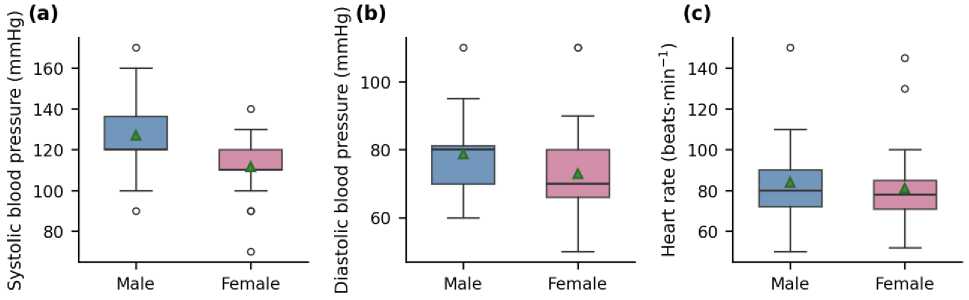
Figure 1. Comparison of cardiovascular parameters by sex
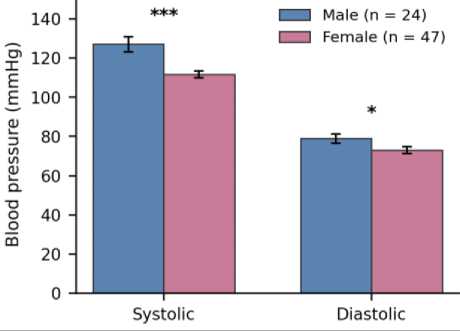
Figure 2. Mean blood pressure by sex (mean ± SEM). *** p<0.001, * p<0.05
In the sample as a whole, age showed a positive correlation with systolic pressure (Pearson r = 0.33; p = 0.005) and, particularly, with pulse pressure (r = 0.38; Spearman ρ = 0.47; p < 0.001). Twoway ANOVA showed that the sex × age interaction was significant for systolic (F = 9.06; p = 0.004) and diastolic pressure (F = 5.40; p = 0.023) (Table 3).
RESULTS OF THE TWO-WAY ANOVA (sex × age group ≤20/>20)
Table 3
|
Dependent variable |
Source |
F |
p |
|
Systolic pressure (SBP) |
Sex |
13.95 |
0.0004 |
|
Age group |
2.21 |
0.142 |
|
|
Sex × Age |
9.06 |
0.0037 |
|
|
Diastolic pressure (DBP) |
Sex |
6.21 |
0.015 |
|
Age group |
2.51 |
0.118 |
|
|
Sex × Age |
5.40 |
0.023 |
|
|
Pulse pressure (PP) |
Sex |
5.04 |
0.028 |
|
Age group |
13.03 |
0.0006 |
|
|
Sex × Age |
2.18 |
0.144 |
|
|
Pulse |
Sex |
0.59 |
0.447 |
|
Age group |
0.25 |
0.617 |
|
|
Sex × Age |
0.03 |
0.855 |
In men, SBP increased with age (≤20 years: 115.0 mmHg → >20 years: 134.2 mmHg), whereas in women it remained practically unchanged (112.5 mmHg → 109.7 mmHg) (Figure 3). In men, DBP increased slightly with age (76.1 mmHg → 80.3 mmHg), whereas in women it decreased (75.7 mmHg → 66.2 mmHg); this latter decrease, while physiologically unexpected, may be related to the small size of the subgroup and the variability of the self-reported values.
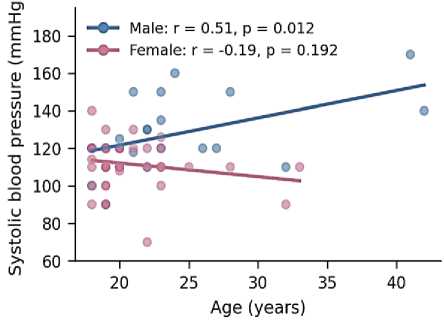
Figure 3. Relationship between age and systolic blood pressure by sex
In the multivariable linear regression for systolic blood pressure, male sex (β=+12.4 mmHg; p=0.022) and age (β=+0.80 mmHg/year; p=0.049) remained independent predictors. For diastolic blood pressure, however, the primary independent predictor was BMI (β=+1.20 mmHg/unit; p=0.004). The correlation matrix showed that BMI was the variable most strongly associated with both systolic (r=0.37; p=0.001) and diastolic blood pressure (r=0.43; p<0.001) (Figure 4). The associations between blood pressure and physical activity, sleep, stress, and caffeine intake were weak and statistically non-significant (all |r|<0.22).
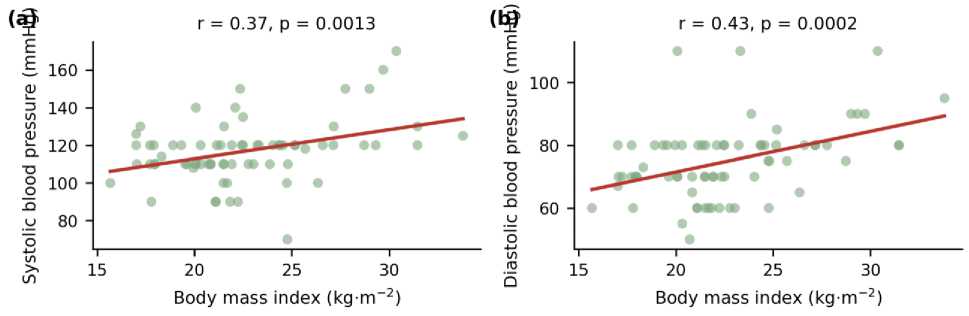
Figure 4. Relationship between body mass index and blood pressure
The principal finding of this study is that systolic and diastolic pressure, as well as pulse pressure, are significantly higher in men than in women in a young, predominantly student population. The effect size for systolic pressure was large (d≈1.0). This result is consistent with the literature demonstrating sex differences in blood pressure during early adulthood and may be explained by the vasodilatory effect of estrogen in women and by the role of androgens, greater muscle mass, and body dimensions in men [3].
In mechanistic terms, the retardation of vascular aging by endogenous 17β-estradiol in premenopausal women is indicated as one of the principal biological explanations for this difference [7].
The difference in diastolic pressure disappears after adjustment for BMI, which indicates that a large part of the crude difference is mediated by body mass. Thus, BMI acts as the strongest modifiable correlate of blood pressure in this young sample. This is also important from a preventive point of view. A meta-analysis conducted in student populations has likewise identified overweight and obesity as the main risk factors for hypertension [5].
In a study conducted on 842 university students in South Africa, overweight and obesity were strongly associated with elevated blood pressure [8].
The sex × age interaction (the increase of systolic pressure with age only in men) is a conceptually interesting finding of the study, but one that must be interpreted with caution. The observed interaction pertains mainly to the early adulthood stage and may be partly conditioned by the small subgroup of older men (up to 42 years of age), as well as by the higher BMI in this group. The absence of sex and age differences in pulse rate is to be expected. Resting pulse rate is an index with high individual variability that depends greatly on the conditions of measurement (caffeine, stress, activity).
Conclusions
In a young, predominantly student population, systolic and diastolic blood pressure, as well as pulse pressure, were significantly higher in men than in women, whereas there was no difference in pulse rate. In the multivariable analysis, male sex and age were independent predictors of systolic pressure, whereas for diastolic pressure, the sex difference was explained mainly by body mass index. A sex × age interaction was observed, showing that systolic pressure increased with age only in men. The results are consistent with known early-adulthood sex differences in blood pressure and emphasize the central role of body mass.
