
Subjective social status of Russians: Relationship with property characteristics
Journal: Economic and Social Changes: Facts, Trends, Forecast @volnc-esc-en
Section: Social and economic development
Article in issue: 6 т.18, 2025.
Free access
The article analyzes the relationship between subjective status and the level of consumption and volume of property in contemporary Russian society. It shows that key differences in income (the material basis of consumption), sets of durable goods, volume of property, and financial behavior are formed mainly between the subjective lower classes, which constitute a minority of the Russian population (14.5%), and the majority, which includes the subjective middle classes, as well as those who assess their status as high (85.5%). An analysis of the list of durable goods and various types of property made it possible to identify those that have become the generally accepted standard for the population, as well as those that have lost their differentiating power over the past two decades. Relatively new “markers” of subjective status include goods and property related to home comfort (e.g., air conditioners and dishwashers), mobility (foreign cars), and digital inclusion (computers and high-speed Internet access). The differences are even more pronounced depending on the novelty of certain types of consumer goods and property among owners from different status groups. Differences between status groups have been identified in terms of the financial behavior of their members: from wide-spread consumer loans for current needs among the “subjective lower classes” to the investment use of resources among “high-status” groups, while the “middle classes” adhere to a hybrid model. The low differentiating power of housing conditions in the context of subjective status was demonstrated, although ownership of a second apartment is more common among representatives of the subjective middle classes and in the “high-status” group and living in rented accommodation or in cramped conditions is more often associated with low status self-esteem.
Similar articles in the section Social processes. Social dynamics
Short address: https://sciup.org/147252998
IDS: 147252998 | UDC: 316.44 | DOI: 10.15838/esc.2025.6.102.8
Text of the scientific article Subjective social status of Russians: Relationship with property characteristics
Subjective stratification and consumption: current state of research
The research on the relationship between subjective stratification and the consumption level has deep theoretical foundations and a rich empirical tradition. Although the term “subjective status” was coined in science in the 1950s–1970s, the prerequisites for its study, including in terms of its relationship with the wealth level and consumption characteristics, appeared in the middle of the 19th century in the works of K. Marx and F. Engels, who pointed out the essential role of consumption and access to certain goods in capitalist society, which have a high symbolic significance in it and become a mechanism of social identification 1 .
The idea of the relationship between social status and consumption was further developed in the works of T. Veblen and M. Weber. In T. Veblen’s famous work “The Theory of the Leisure Class”, the relationship between social status and consumption is described in detail and the term “conspicuous consumption” was coined as a scientific concept (Veblen, 1984). It also shows that in conditions of increasing social mobility, property and consumption are becoming the main tools for demonstrating and confirming one’s social status. In turn, M. Weber revealed in more detail the essence of the relationship between social status and consumption in the framework of his proposed multidimensional approach to social stratification, showing through the concept of status groups (one of the stratification dimensions along with economic class and political party) that consumption is not limited only to demonstrating wealth, but is an integral element of lifestyle, which sets the boundaries between status groups based on social prestige (Weber, 2016). The topic was further developed in the works of P. Bourdieu, who linked consumption styles and cultural capital to the reproduction of class differences (Bourdieu, 1979). The importance of cultural and consumer practices as elements of structural differentiation was also pointed out by D. Goldthorpe in his studies of class mobility (Goldthorpe, 1980).
However, these classical works largely dealt with the relationship between objective status and the volume of property and consumer practices. Instead, the importance of subjective status has increased dramatically, as modern research shows, precisely with the transition of developed societies to the post-industrial stage of development, which is characterized by a profound transformation of the employment structure, accompanied by an increasing role of knowledge and technology, and as well as changes in values and consumption patterns (Bell, 1999; Castells, 2000). In addition, the opportunities for social mobility in the new environment are gradually narrowing, and institutional opportunities are limited.
In this sense, modern research focuses not so much on expanding as on deepening the interpretations of the relationship between the consumption level and subjective status, the construction of which is multidimensional and very complex. This, in particular, was vividly demonstrated in the experiments of L. Festinger. According to them, any self-assessment requires comparing individual’s abilities, results or opinions with those that are characteristic or common among representatives of the individual’s reference group (Festinger, 1954).
Modern studies of the relationship between subjective status and consumption correspond to this position and show, for example, that low subjective status, regardless of real income, correlates with so-called “conspicuous consumption” (Walasek, Brown, 2016). Thus, in the context of social comparison, the consumption level and property volume become not only a tool for distinguishing one’s position, but also a real social marker an individual can be guided by to subjectively achieve a certain status. The work carried out as part of a large-scale Whitehall II2 study showed that low relative income and limited consumer opportunities consistently correlate with low subjective status and deterioration in health indicators, even when basic needs are met. At the same time, subjective social status reflects the cognitive average of standard indicators of socio-economic status and it is almost free of psychological prejudice. In this regard, researchers are trying to consider the factors of influence not only of the current socio-economic environment of adult individuals, but also of their past socioeconomic experience, including childhood. Thus, research shows that subjective social status in adulthood is the result of a complex developmental process associated with the acquisition of socioeconomic self-perception, which is an integral part of subjective social status and includes current and past experiences, as well as individual and family experiences (Ferreira et al., 2018; Lindberg et al., 2021; Varghese et al., 2021).
In the Russian context, characterized by a high level of socio-economic inequality and the consequences of the transformation period, the relationship between subjective status and consumption is becoming particularly acute. Against this background, the works of Russian researchers focus both on the lifestyle features of consumption and its role in the development of social identity, which are beyond the scope of this article, and on how consumption in post-Soviet Russia turned from meeting basic needs into the fundamental mechanism of social differentiation. In particular, researchers analyze how new consumer markets have created the basis for a “new middle class” with a set of benefits which has become not just an attribute of comfort, but an element of group identity and confirmation of social success. Also, there is an important theoretical premise that consumer practices not only reflect, but also actively shape the Russian social structure, and differences in access to goods and services become visible boundaries between social groups (Radaev, 2005; Radaev, 2025).
The findings of Russian stratification studies, which focus largely on consumption and property volume as criteria for belonging to the middle class (a group that creates a demand for a higher standard of living (Ovcharova, Popova, 2013), also show that for Russians, assessment of their place in society is closely linked to the ability to maintain a standard of consumption perceived as “normal” 3 (Pishnyak et al., 2020). Accordingly, the inability to afford this standard set can lead to a decrease in subjective status.
Along with this, the relationship between subjective status and consumption is influenced by the peculiarities of the Russian development model based on the fusion of power relations with property relations (Shkaratan, 2004). For example, selfassessed status can be underestimated due to informal employment, even if incomes are equal (Zudina, 2013). These features and the existing multidimensionality of the social system lead to the fact that not every good, service or other property is perceived by Russians as indicators of achievement, increasing their self-assessment or lowering it in the absence of such property.
In this regard, in Russia there was a noteworthy change in the attitude toward certain types of property and durable goods, for example, cars, which gradually turned from a luxury item into a means of transportation for the mass strata, but their presence still affects the subjective feelings of
Russians (Kononenko, 2011). The situation with housing in Russia is also ambiguous, a significant part of which is inherited rather than acquired through one’s own efforts (Zavisca et al., 2021), although the main tool for improving housing conditions for Russians is currently the purchase of housing, which is not affordable to everyone (Kolennikova, 2024a). Thus, as a hypothesis, it can be suggested that even with access to goods that are substantial for the subjective status assessment, it is not only and not so much their availability that is crucial, as their quality and, probably, even their origin and legitimacy.
As a result, in order to develop a discussion about the changing differentiating power of consumption and property for self-determination of an individual’s position in the context of a wide consumer choice, partly demonstrated by the data of the last round of RLMS-HSE, the aim of this study was to analyze the relationship of Russians’ self-assessment with their consumption level and a set of property characteristics, including its quality parameters available. In particular, we will focus, first, on the peculiarities of differentiation of Russians according to their subjective status, evaluated through individuals’ self-assessment of their position on a respect scale. Objective social status measured, as a rule, through a set of specific indicators representing the foremost status scales in society (see, for example, Kolennikova, 2019), will remain outside the scope of this study. Second, we will turn to the analysis of income (as the material basis of consumption) and key items of expenditure in the context of their distribution within groups with different self-assessments of social status. Third, we will assess the dynamics of consumption and property characteristics, as well as analyze their differentiating power in relation to groups of people with different self-assessments of social status. The empirical base is data of the 33rd round (N = 12000) of the Russia Longitudinal Monitoring Survey –
Higher School of Economics (RLMS-HSE) 4 of the health and economic welfare of the population. To illustrate the dynamics, we also used RLMS datasets from earlier periods with a similar sample size.
Features of the allocation of status groups and changes in their numbers
Subjective status is a scientific construct and includes many empirical indicators that can be measured in different ways. In this regard, the issue of its evaluation in each specific study deserves special attention. In this study, the subjective status was evaluated based on the individuals’ selfassessment of their position on a respect scale 5 . This methodology is based primarily on the premise that status (combining both collective prestige and individual respect) is a separate stratification dimension (Weber, 1978), as well as on the generally accepted tradition of measuring subjective status through a comprehensive scale 6 reflecting not only, for example, financial status, as self-assessments of the position on the rich-poor scale do. It is worth noting that to identify the boundaries of status groups, the interrelationships of self-assessments of one’s position on the respect scale with selfassessments of economic and power statuses were considered 7 .
As can be seen from Table 1 , the higher the individuals’ position on the respect scale is, the higher they assess their economic and power statuses and, accordingly, vice versa. However, this principle is not strictly observed in comparison, for example, with economic and power statuses (their mean and median values coincided and were equal to 4 points). Russians often rate themselves on the respect scale higher (the corresponding values were 6 points each). Thus, while the 4-point value of self-assessed economic and power statuses indicates the lower limit of subjective middle classes, in terms of the respect status it is the upper limit of subjective lower classes. This is also noticeable considering the overall distribution of values of this status, when rungs from the first to the fourth are chosen by a minority, which means they are not typical for the mass strata in Russia. In addition, among those who rated their respect status from the first to the fourth rung, over 90% assessed their economic and power statuses similarly (though the average share in Russia of those who estimate these statuses from the first to the fourth rung is about 60%).
Considering the outlined theoretical, methodological and empirical prerequisites, we identified three status groups that significantly differ in their self-assessed positions on the respect scale and are conventionally designated as a group with low status scores (14.0%, those who chose the rungs 1–4), with medium status scores (60.3%, those who chose the rungs 5–7) and, accordingly, high status scores 8 (25.7%, those who chose the rungs 8–9).
Now, let us take a closer look at the changes in their numbers and some socio-demographic features, and then move directly to income, the specifics of consumption in these status groups and their property characteristics.
So, considering the dynamics of the transformation of the subjective stratification of Russian society in 1994–2024, attention is drawn primarily to the change in the number of groups with low status scores, which almost halved in the period from 1994 to 2004 ( Fig. 1 ). This happened against the background of intense transformations in the Russian social structure and the still open channels for social mobility. In the following decade (2004–2014), as positive economic developments continued, the group’s share continued to decline. However, from 2014 to 2024, there was a slight rollback and its number increased, although it does not exceed the level of 2004. In part, this may indicate a reaction to the stabilization of the social structure model that has developed as a result of the transformation period (Tikhonova, 2021a; Tikhonova, 2021b).
The group with medium status scores is the most numerous and stable throughout the entire period. The considerable fluctuations in its number were from 1994 to 2004, and since then the changes have been insignificant. This supports the thesis that it is the conditional “middle classes” that form the structural core of subjective stratification (Kolennikova, 2024b). It is noteworthy that the subjective middle classes should not be confused with the middle class, including the subjective one, since a stable identity with this group is crucial to correspond to it, which, according to available research, Russians do not yet have (Tikhonova, 2021a).
Table 1. The relationship of subjective status values based on the respect scale with self-assessments of economic and power statuses*, 2024, %
|
cd CD Е со ^ |
см |
^ СО |
ей |
ю я |
LO LO |
та |
а |
о |
lo |
lo |
см |
LO |
*4 |
а |
о о 1“ |
та ел CD О та о « CD CD CD .та CD СО СО 3 СР ОС § ё та -о £ та ел та 5 та cd та. Г <1 |
||||||
|
CD СП 5 CD О CD СП CD сп та ~о "та с сп о ф = о ^ & Е CD CD CD ^ CD о ш ° 5 С cd та О С CD cd та -С -£Z £ о та j= Е -У 15 cd та ® & CD CD та Е 1 ? о о> 1 CD ^ CD |
1— СО о I |
со |
LO |
а |
ей |
об |
*4 со |
со |
со |
см |
со |
°? со |
та |
°? |
°? |
та |
об |
со |
со ОС о со I £2 I |
|||
|
со |
N |
та-' |
ОО |
°? ей |
°? |
та |
*4 LO |
а |
°? |
та |
|> |
*4 |
об |
со |
ей |
а |
*4 со I— |
|||||
|
^ |
Т |
LO |
со |
*4 со |
*4 |
°? ей |
ОО |
см |
со |
см |
°? об |
см |
об |
lo |
ОО |
о см см |
со ОС о со S о о 2 |
|||||
|
со |
та |
СО |
1X5 ей |
°? |
°? LO |
со |
а |
со |
ей |
со |
а |
lo ю |
°? ей |
Г> |
а |
о со 1“ |
||||||
|
Ю |
^ |
LO ОО |
ОО |
lo со |
со |
а |
а |
со |
со |
я |
см |
см |
LQ |
см |
||||||||
|
^т |
со |
ОО |
1X5 со |
со |
см |
см |
°? |
ей |
та |
Е |
LQ |
LO |
а |
о© ОО |
СО ОС о со 5 о —1 |
|||||||
|
со |
°? |
О> |
та; |
со |
со |
а |
а |
ей |
со |
LO |
та |
LO |
LQ |
LO |
см ■та |
|||||||
|
см |
а |
LO |
см |
LO LO |
см |
°? |
*4 со |
ОО |
Е |
Е |
Е |
ч“ |
||||||||||
|
1— СО о О ОС _| |
lo со |
со ОО |
°? LO |
ОО ОО |
°? |
та; о |
||||||||||||||||
|
CD ^ СО |
1— СО CD о ОС _| |
см |
со |
та- |
lo |
со |
ОО |
1— СО ° I |
1— СО CD 5 О о ОС _| |
см |
со |
та |
LO |
со |
ОО |
1— СО о I |
та |
|||||
|
CD О |
ф « та ел та 2 ей та а i § Е ^ f - ° - ф ₽ 5 Е ? § 3 5 S ~ ® Е ° « g | f О CD § — -О У „ та w ° о f i е a 11 о _ u_ СО -^ t > >ч |
о) ф о
§ ° с -та “ ° ^ ^ ^ «^SS £ a a S Е-25й§ЕЕ° |
со О ОС о со со |
|||||||||||||||||||
Figure 1. Dynamics of the number of groups with different subjective statuses (status groups), 1994–2024, %
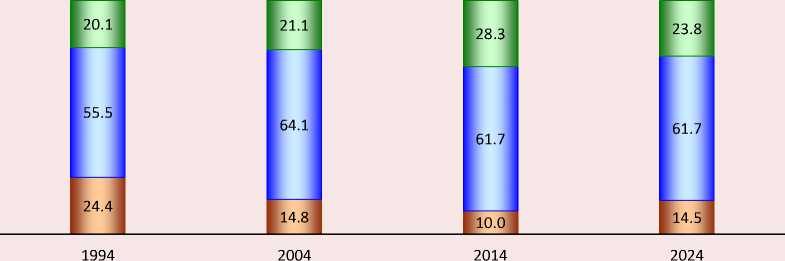
□ Low scores □ Medium scores □ High scores
Calculated based on: RLMS-HSE.
The dynamics of the number of the group with high status scores deserves special attention. On the one hand, it increased significantly from 1994 to 2014. On the other hand, the upward trend was no longer recorded in the following decade, instead, there was a downward trend. The decrease may be related to the general trend of “leveling off” the position of population masses (Mareeva, 2024), and to the increase in social inequality 9 . As a result, narrowed routes for prestigious positions are reflected in the subjective assessments of Russians.
To sum up, there are two trends in the dynamics of status groups in Russia: the group with medium status scores has stabilized while the shares of conditional bottom and top groups fluctuated with varying intensity in different periods. This indicates a high dependence of the extreme segments of the stratification pyramid on socio-economic transformations and the institutional environment.
In this context, the analysis of the consumption level and property characteristics is particularly interesting considering not only their differentiating power, but also the question what material opportunities, as well as specific sets of property, correspond to today’s “normality” and how this standard has changed in the last two decades.
Before proceeding to these issues, we will describe the profiles of the represented status groups in order to understand the role of key factors that affect, among other things, the consumption level and property characteristics of their representatives.
An analysis of the correlation dynamics between subjective status and socio-demographic characteristics in 1994–2024 shows that the set of significant factors is relatively stable, but their hierarchy is changing ( Tab. 2 ). Subjective status is better connected with educational level and profession: after 2000s when their link was not so
Table 2. Dynamics of relationships of subjective status assessments with various socio-demographic characteristics, 2003–2023, points
|
Feature |
Spearman’s correlation coefficient with subjective status (in absolute values) |
|||
|
1994 |
2004 |
2014 |
2024 |
|
|
Education |
0.137 |
0.070 |
0.097 |
0.134 |
|
Occupational group |
0.110 |
0.097 |
0.120 |
0.133 |
|
Presence of subordinates |
0.097 |
0.078 |
0.131 |
0.129 |
|
Monthly individual income |
0.050 |
0.089 |
0.140 |
0.108 |
Ranked in descending order of coefficients for 2024. Compiled based on: RLMS-HSE.
clear (at the time of the active formation of a new structures of social positions) it has strengthened again by 2024. This may indicate a gradual restoration of the value of institutional features for the stratification position, although they are not decisive for the subjective status, which, in general, corresponds to the peculiarities of the relationship between the subjective and the objective.
It is also noteworthy that in the 2010s, the relationship between subjective status and power (measured through the presence of subordinates) has significantly increased and it is still at approximately the same level. This may reflect the perception of managerial positions as one of the key and consistent objective criteria of social prestige. At the same time, the relationship between subjective status and income fluctuates dramatically, which may reflect the instability of the economic context, in which income turns out to be a less reliable marker of a subjective social position than education, profession and power.
In general, these correlation dynamics between subjective status and socio-demographic characteristics correspond to the overall European picture, where income and education also correlate with subjective status (Lindemann, Saar, 2014). The main difference of the Russian dynamics is its greater variability over a relatively short period of time. This reflects both the period of rapid transformations of the Russian social structure and its gradual stabilization, as well as the peculiarities of the etacratic (or neo-etacratic) model of Russian society, according to which symbolic and structural resources strengthen their relationship with Russians’ self-assessment influencing their position on the scale of respect.
These trends of profiles of groups with different subjective statuses suggest that the relationship of subjective status with property and consumption in Russia is indirect: income does not directly affect status, but influences its perception through accumulated material resources and forms of consumption, serving as symbolic confirmation of education and profession. It can be assumed that in the Russian context, property is more closely related to the perception of status than income. Combined with the growing importance of education and profession, this may indicate a “hybrid model” where self-assessment of one’s own position is formed on the basis of institutional achievements, while consumption and property act as confirmatory, demonstrative practices or an essential part of an individual’s status identity. Now, let us look at these issues in more detail.
Income and expenditure as markers of subjective status
First, we will turn to the dynamics of absolute indicators of individual income, which for the majority of Russians is wages (considering working people) and social transfers (considering nonworking people) 10 .
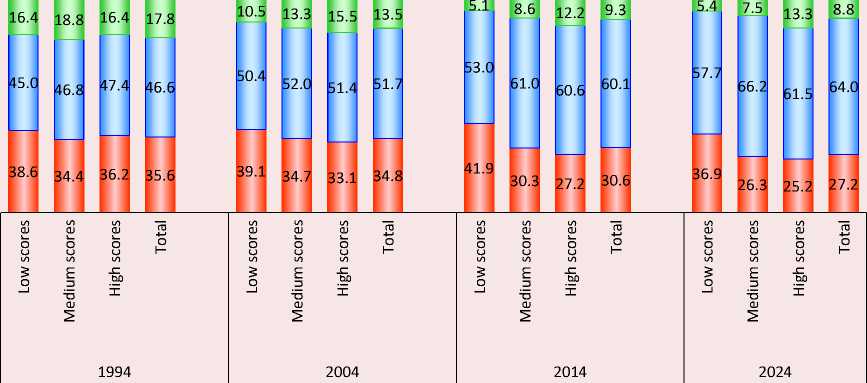
The most remarkable thing about income as the primary consumer base for different status groups is the spread of its values between those who characterize their status as low and, conversely, high. Despite the general trend of a significant excess of mean and median incomes in the group with high self-assessed status in comparison with the national average and a corresponding downward deviation in income values in the group with low self-assessed status, the gap between these indicators remains extremely small and ranges from 1.2-fold in 1994 to 1.4-fold in 2024 ( Tab. 3 ).
This is also noticeable when considering the dynamics of the number of income groups 11 . From
1994 to 2024, there was a gradual “compression” of income distribution extremes and concentration of population majority in the “medium income zone”, including in the context of the status groups under consideration ( Fig. 2 ). This suggests a homogeneous consumption structure and a reduction in opportunities for demonstrative distancing directly through income.
However, there are still dissimilarities in income and subjective perception of status in the context of income. Nevertheless, they are expressed primarily in the different probability for representatives of each status group to fall into the low-income category or stay in the middle-income group.
To sum up, the relationship between subjective status and the level of material security in Russia is becoming “flatter”, although the group with low status scores still faces increased risks of poverty, and those who assess their status as high have comparatively frequent access to relatively high income.
Table 3. Dynamics of the mean and median level of individual income in groups with different self-assessed subjective status, 1994–2024, rubles
|
Status scores (self-assessment) |
1994 |
2004 |
2014 |
2024 |
|
Individual income (mean) |
||||
|
Low scores |
227193.0 |
4364.6 |
18597.3 |
40053.2 |
|
Median scores |
276921.4 |
5316.3 |
21714.3 |
49740.1 |
|
High scores |
268620.6 |
6088.5 |
26168.9 |
55169.9 |
|
Sample average (for reference) |
265620.9 |
5384.8 |
22651.6 |
50109.6 |
|
The gap between groups with high and low scores, -fold |
1.2 |
1.4 |
1.4 |
1.4 |
|
Individual income (median) |
||||
|
Low scores |
150000.0 |
3200.0 |
15000.0 |
35000.0 |
|
Median scores |
190000.0 |
4000.0 |
18000.0 |
41000.0 |
|
High scores |
180000.0 |
4100.0 |
20000.0 |
45000.0 |
|
Sample average (for reference) |
180000.0 |
4000.0 |
19000.0 |
40000.0 |
|
The gap between groups with high and low scores, -fold |
1.2 |
1.3 |
1.3 |
1.3 |
|
Compiled based on: RLMS-HSE. |
||||
10 Rosstat revealed the income structure of the poorest and richest Russians. Available at: 2/01/2024/659eb1429a79470c7c9a19c0 (accessed: 08.08.2025).
11 Median income is used as a typical standard of living. This version considered regional income inequality, and used the regional median of individual incomes to identify three income classes.
Figure 2. Dynamics of the number of people from different income classes depending on their subjective status, 1994–2024, %
□ Low income (less than 0.75 of the median) □ Medium income (0.75–2.00 of the median)
□ High income (more than 2.00 of the median)
Compiled based on: RLMS-HSE.
These features are also revealed in the context of the financial behavior of representatives of different status groups. First of all, this concerns saving activity – it is more characteristic of groups with high subjective status (24.2% versus national average 19.6% and 14.6% among the subjective lower classes). In the last month before the survey, they managed to save a relatively large amount (26,001 rubles versus national average 23,617 rubles) than representatives of the subjective lower classes (18,123 rubles) and the middle classed (23,507 rubles), although the gap in this parameter remains relatively small as well. Moreover, credit exposure of different status groups does not differ considerably, despite the fact that representatives of the group with low subjective status are slightly more likely to take out loans and have them 12 .
However, the difference is noticeable considering types of loans applied for by representatives of different status groups. For example, representatives of the group with low subjective status compared to other groups are more likely to buy goods on credit, probably to provide a supplement to their current consumption level. Moreover, the share of people taking out loans to buy houses among them is several times lower than among representatives of the subjective “middle classes” and Russians with high subjective status ( Tab. 4 ). Also, this group has the highest percentage of student loans, although in general this type of loan is not popular among Russians. It can be assumed that such a deviation is an attempt by some of the members of this group to invest in the children’s or their own future in the hope of positive changes.
Table 4. The prevalence of loans by purpose among Russians with different subjective statuses*, 2024, %
|
Type of loan |
Status scores (subjective assessment) |
Sample average (for reference) |
||
|
Low scores |
Medium scores |
High scores |
||
|
Consumer loan in a bank for any purpose |
40.2 |
41.3 |
36.4 |
40.0 |
|
To buy something in a shop |
32.5 |
22.9 |
28.6 |
25.8 |
|
To buy a car |
17.9 |
23.6 |
21.4 |
22.2 |
|
Mortgage to buy a house, real estate |
4.3 |
10.3 |
12.3 |
9.7 |
|
To pay for a service in a company |
5.1 |
2.4 |
6.5 |
3.8 |
|
Student loan |
2.6 |
1.4 |
1.3 |
1.6 |
* The highest values in the row are highlighted in grey. Compiled based on: RLMS-HSE.
Against this background, Russians with a high subjective status demonstrate an investment model of using loans. Among them, the share of mortgages to buy a house is high. This indicates not a lack of money for living, but the perception of such investments as a tool for building assets. In addition, this group has the lowest percentage of those with consumer loans without a specific purpose. This model of financial behavior is consistent with the relatively high saving activity of this group. To sum up, this group members’ consumption primarily has goals, including long-term ones, and acts as a tool for improving their well-being.
The most popular group with a medium subjective status demonstrates a hybrid and the most active model of financial behavior. On the one hand, they have the opportunity to combine strategies to supplement the current standard of living with longer-term consumer goals. On the other hand, due to the high credit activity compared to other groups, it creates quite high financial risks.
Now, we will take a closer look at some of the expenditure items of Russians with different subjective statuses, which deepen the conclusions about consumer patterns and consumer activity levels of different status groups. In general, the structure of expenditures not typical for most Russians is not very diverse. Spending on supplementing the current standard of living (keeping pets, buying cosmetics and perfumes), as well as investments in children’s education, costs on attending cultural events, loan and tax payments are relatively common. Medical expenses, mortgages (probably due to their limited availability), adult education (a rather alarming signal in the context of constantly changing labor market requirements), and insurance payments are less common.
All this indicates inequality not only and not so much on the basis of income, but rather on the availability of various opportunities for the accumulation of social and cultural capital. It means that, though status groups are quite similar in terms of their income, they use it differently, which is partly determined by the self-assessment of their status, and partly influences it. The key differences are recorded between the aggregate majority (groups with medium and high subjective statuses) and the minority, who assess their status as low ( Tab. 5 ).
To summarize, subjective low position on the “social ladder” is indeed fraught with difficulties in terms of compliance with the generally accepted status norm both in terms of income and involvement in effective models of financial behavior that allow not only supplementing the current standard of living, but also to increase intangible capabilities, as well as in consumer practices that have not only more diverse but also more long-term goals. At the same time, a high subjective status is not at all a confirmation of “isolation” and a qualitatively different standard of living, but rather indicates greater confidence (in comparison with a group whose representatives rate their status as medium) in their abilities not only to sustain current needs, but also to build up additional assets. Now, we will look at how these patterns, identified in relation to income, financial behavior, and expenses, are consistent with data on various consumer assets13 of Russians, taking into account their subjective status.
Property characteristics and housing conditions of various status groups
All the property and durable goods available for analysis within the framework of the RLMS toolkit in terms of their prevalence among Russians can be roughly divided into three zones. The first of them includes products that have become a common standard and are available to at least half of the population, regardless of their self-assessed status. These are goods, the presence of which in itself does not significantly differentiate the Russian population and does not mark an objective or subjective social status. Nevertheless, first, some of these goods are relatively less common among the subjective lower classes, and second, there are small differences in
Table 5. The prevalence of monthly expenditures on goods and services among Russians with different subjective statuses*, 2024, %
The exception is access to high-speed Internet, the mean duration of use of which is highest among those who rate their status as medium (9.1 years versus 8.6 in groups with low and high self-status scores), and the median duration is lowest in the group with high self-status scores (8.0 years versus 9.0 in the other two status groups). In other words,
Russians from the low subjective status group started using high-speed Internet earlier than those who rate their status as high. This is probably due to, first, the popularity of high-speed Internet among young people (for example, 83.5% of those aged 18 to 24 and only 54.5% of those aged 55 and older have this technology) 15 , and second, due to the fact that youth representatives aged 18–24 are relatively more common among those who give low estimates of their status (10.2% versus 5.2% in the group with high estimates) 16 .
Table 6. Property and durable goods among representatives of different status groups*, 2024, %
|
Property and durable goods |
Low scores |
Medium scores |
High scores |
Total |
|
Flat-screen TV – plasma or LCD |
92.2 |
94.9 |
95.3 |
94.6 |
|
Automatic washing machine |
92.0 |
95.0 |
94.8 |
94.5 |
|
Microwave oven |
76.6 |
82.8 |
85.7 |
82.6 |
|
Refrigerator with no frost function |
73.3 |
82.6 |
83.2 |
81.4 |
|
Desktop computer or laptop |
64.6 |
73.6 |
77.7 |
73.3 |
|
High-speed Internet access |
55.9 |
71.2 |
75.8 |
70.1 |
|
Passenger car of foreign make |
22.8 |
36.0 |
40.6 |
35.2 |
|
Cable TV |
32.7 |
32.6 |
38.9 |
34.1 |
|
Separate freezer |
21.5 |
26.9 |
31.1 |
27.1 |
|
Adult bike |
25.3 |
25.7 |
28.1 |
26.2 |
|
Russian passenger car |
19.9 |
23.6 |
22.6 |
22.8 |
|
Satellite dish |
18.0 |
22.5 |
22.6 |
21.9 |
|
Air conditioner |
8.0 |
20.1 |
26.1 |
19.8 |
|
Dacha or other house, part of a house, garden house |
16.3 |
20.4 |
18.6 |
19.4 |
|
Lawnmower |
12.2 |
18.4 |
19.3 |
17.7 |
|
Another apartment or part of an apartment |
8.8 |
13.0 |
12.8 |
12.4 |
|
Low-speed Internet access |
17.4 |
11.3 |
11.4 |
12.2 |
|
Dishwasher |
7.0 |
10.2 |
12.6 |
10.3 |
|
Truck |
1.5 |
2.9 |
2.8 |
2.7 |
|
Motorcycle, motor scooter, motorboat, speedboat, snowmobile |
1.9 |
2.0 |
3.2 |
2.3 |
|
Tractor or mini tractor |
1.9 |
2.3 |
2.6 |
2.3 |
|
Electric scooter |
0.9 |
1.3 |
1.8 |
1.3 |
|
*Durable goods that are prevalent among at least half of the Russian population are highlighted in gray, goods of no more than 3% of the population are highlighted in pink. The indicators that deviate significantly from the national average downwards (by more than 3–5% statistical error) are highlighted in red, and those that deviate upwards, respectively, are highlighted in blue. Compiled based on: RLMS-HSE. |
||||
14 The mean age of a set of goods, including a TV, a washing machine, a microwave oven, a refrigerator (no frost), a computer or laptop, was 8.7 years across the sample. Respectively, among Russians with low status scores, this indicator was 9.1, for the medium group it was 8.7, for the high group it was 8.6. The duration of high-speed Internet access was not considered in these values and was analyzed separately.
15 Spearman’s correlation coefficient was 0.245. The significance at 0.01 is two-sided.
16 Although the variables of age and subjective status do not show a significant correlation.
The second zone includes goods and property that Russians have but that are not typical for the majority of them, which means that they have a relatively high differentiating power and influence subjective status assessment, if there are significant deviations between groups. These include, first of all, foreign cars, which clearly distinguish those who assess their status as high (40.6% of representatives of this group own them against 22.8% of the subjective lower classes, while the mean age of cars in the first group is lower – 9.4 versus 10.8 years). In this sense, the subjective status is marked both by the very fact of owning a foreign car and by its novelty.
This zone also includes goods related to providing a comfortable lifestyle: separate freezers, air conditioners, lawnmowers and dishwashers, which are relatively more common among representatives of groups with high subjective status and less common among those who assess their status as low. So far, these goods can be classified as markers of subjective status, since the differences between the groups are quite noticeable, including in terms of the mean age of the set of these goods 17 , but their availability is gradually increasing in all status groups. For example, in 2013, 15% of Russians with high status scores had air conditioners and 6.4% of those who rated their status as low. The corresponding shares for that period for freezers were 16.0 and 9.9%, for lawn mowers – 12.7 and 7.8%, for dishwashers – 4.3 and 2.5%.
The third zone includes rare goods that no more than 1–3% of Russians have. These items are not in mass use, but they have niche significance, probably related to lifestyle or, in part, professional activity. These include trucks, water transport, tractors, and electric scooters. They are prevalent in the group with high and medium scores and less so in the group with low scores.
The situation with electric scooters is unique: if we look at the analysis of not only their availability, but also the mean age, it is the highest among electric scooter owners with medium and high subjective status scores (2.8 years and 2.5 years, respectively) than in the group of Russians with low social status scores (1.8 years). This probably indicates that representatives of subjective “middle classes” and groups with high status scores have become the first buyers of this relatively new technology for Russians, while those who rate their status as low are slower to engage in such consumer practices.
The situation with real estate is also original, it is characterized by the minimal difference in ownership between the analyzed groups. This is especially true for dachas and houses. It is also small considering the mean age of such property – dachas and houses’ mean age exceeds 20 years in all groups, and among owners from the high-status group, it is the highest and is 24 years. The mean age of additional apartments is lower, but its range is not significant in different status groups (from 15 to 16.5 years), although the presence of such apartments is still significantly less common among those who assess their status as low, and in this sense, a second housing still strongly affects the likelihood of subjectively striving for higher rungs of the social ladder. Thus, the presence and age of additional real estate do not sharply divide the status groups under consideration, although there is a differentiation in the presence of a second apartment between them. This may be caused both by the cultural specifics of Russia (dacha is a multifunctional attribute of Russian life, combining opportunities for leisure, gardening, and interaction with nature), and the fact that such property is transmitted by heredity (especially in the case of a second housing) and its ownership is long-term.
High stability of real estate assets is also observed considering housing conditions of groups with different subjective statuses. Thus, over 90% of their representatives live in their own housing. The most common type of housing is a separate apartment (over 60% of Russians live in them, regardless of their subjective status), and individual houses are the next most popular. Living in part of an apartment or part of a house is rather an exception for the Russian population, although representatives of the group with low subjective status scores are slightly more common among the latter (8.6% versus 6.3% on average). Despite the fact that in the vast majority of cases, the owners of the housing in which they live are household members, among those who do not live in their own housing, those who assess their status as low are relatively more common (10.3% versus 8.0 on average in the sample).
There are also small differences in housing sizes among representatives of different status groups, but some of them are noteworthy. Table 7 shows that the largest total area of housing is typical to the subjective “middle classes”, and in the group with high subjective status scores it is slightly lower. In part, as a check on the RLMS data shows18, this may be explained by the desire of people with high selfassessed status to live in large cities, where housing is more expensive and, as a rule, more compact.
Considering housing area, we see, on the one hand, a fairly uniform distribution of its median values, which indicates the existence of a “basic standard” of living conditions. On the other hand, however, the group with medium subjective status scores shows the maximum average value of this indicator. It is also interesting that number of living rooms is slightly higher among the subjective “middle classes”. This may be indirectly affected by the peculiarities of household composition. Thus, although there is no direct relationship between subjective assessments of marital status and the number of family members, the last two variables demonstrate a high correlation with the level of consumption 19 . Based on this, it can be assumed that official marriages and large families 20 are more
Table 7. Characteristics of the main housing of Russians with different subjective statuses, 2024, %
|
Question |
Value |
Low scores |
Medium scores |
High scores |
Total |
|
What is the total usable area in your family’s apartment (house), including living rooms, kitchen, bathroom, hall, storage room, etc.? |
Mean |
61.7 |
65.0 |
62.5 |
63.9 |
|
Median |
54.0 |
57.0 |
56.0 |
56.2 |
|
|
What living area does your family have? How many square meters is it? |
Mean |
41.6 |
45.3 |
42.8 |
44.2 |
|
Median |
36.0 |
38.0 |
38.0 |
38.0 |
|
|
How many living rooms does your family have? |
Mean |
2.5 |
2.7 |
2.6 |
2.7 |
|
Median |
2.0 |
3.0 |
2.0 |
3.0 |
|
|
Compiled based on: RLMS-HSE. |
|||||
18 Although the “type of settlement” variable does not have a significant statistical relationship with the subjective status variable, it does have a significant relationship with the level of consumption, which increases as the population of the settlement increases. Given that Russians with high subjective status scores tend to have higher levels of consumption, it is possible that the type of settlement indirectly affects self-perceived social status. However, further research is needed to confirm this hypothesis.
19 Pearson’s correlation coefficient between marital status and the total amount of property and durable goods was 0.258. Spearman’s correlation coefficient between the total number of family members and the total amount of property and durable goods was 0.416. Correlations are significant at 0.01, two-sided.
20 The number of which will exceed the median of 3 people.
numerous among Russians with medium and high estimates of their status, but due to the latter’s desire to move to large cities, their housing conditions are somewhat inferior. However, this hypothesis needs additional verification. Nevertheless, although the differences in housing conditions between status groups are poorly expressed, the leading position in terms of area is occupied not by the group with high scores, but by the subjective “middle classes”. This indicates both that housing conditions in Russia do not always directly correlate with subjective status, and their dependence on cultural, regional, and demographic factors (Kolennikova, 2024a).
Conclusion
In modern Russian society, which has made the transition from the model with the large number of subjective outsiders typical of the transformational period of the 1990s to a more stable and complex system of perception of subjective well-being (Tikhonova, 2018; Sushko, 2025), consumption and property, as shown by the conducted research, become important factors reflecting not only objective characteristics of an individual’s position, but also his or her subjective place in the society.
With the current structure of subjective stratification by respect, with the dominance of subjective middle classes, a significant proportion of subjective “upper classes” and a comparative small number of subjective lower classes, the basic consumption model dominates in Russian society. It includes, first of all, the availability of durable goods in the household such as a flat-screen TV, a washing machine, a refrigerator, a computer (or laptop), a microwave oven and high-speed Internet access, which have practically lost their differentiating function, becoming a generally accepted standard of living accessible to the vast majority of the population, including Russians who rate their status as low. However, when we move from the analysis of simple availability to the qualitative characteristics of the mentioned goods or less common types of property and durable goods, significant differences between status groups still appear.
The old markers of subjective status are being replaced by new ones related to access to digital technologies, convenience and mobility. A computer or laptop, high-speed Internet access, an air conditioner, and, in particular, a foreign passenger car are now significant indicators of subjective status, and the “gaps” between groups with subjective low and high status scores in these parameters turn out to be very significant. Not only the fact of ownership is crucial, but also the “novelty” of the analyzed product or property, which is especially noticeable by the mean age of cars (primarily foreign brands).
This is complemented by the analysis of different status groups’ financial behavior, which demonstrated significant variability in the management models of available resources among these groups. Consumer loans aimed at supporting the current standard of living is more common among those who rate their status as low, which indicates a short-term planning horizon and limited resources. For representatives of the group with high subjective scores, loans become an investment instrument to purchase expensive assets, including real estate. Their financial behavior in general, including higher savings activity, is strategic in nature and is aimed at increasing the resource base. The conditional subjective “middle classes” demonstrate a hybrid, but also the riskiest model, they actively use loans to support the current standard of consumption, without forgetting about investments in health, education of children and real estate. However, this puts them in a vulnerable position during periods of economic instability. Thus, financial practices actively reproduce and deepen the existing status inequality, which is reflected, among other things, in self-assessments.
These conclusions correspond with data on the role of income in status self-determination, which do not fully explain the differences, although the incomes of the group with high subjective status scores are on average higher than in the other two groups, but the gap with those who assess their status even as low is not dramatic. Income turns out to be an even less reliable marker of a subjective status than education, profession, and the presence of power. This indicates the development of a “hybrid model” of stratification, where institutionally fixed achievements (education, profession) presuppose their symbolic confirmation through certain consumption patterns. Property and access to certain services (for example, paid education for children, cultural leisure) are visible evidence of social success, legitimizing a higher status in the eyes of both the individual and his or her environment. Nevertheless, in modern Russian conditions, status groups in the context of their property and consumption level are rather divided into the group with low subjective status and the cumulative majority of the subjective middle and high “classes”. Representatives of the high subjective status group do not differ dramatically in terms of the range of durable goods they have and property, but rather they manage it differently based on longer-term goals.
This is partly confirmed in the context of the analysis of housing conditions of different status groups, which, in addition to the peculiarities found, correspond to the general Russian specifics, when the presence of a dacha or a second house (unlike in many Western societies) is not a clear marker of high (at least subjective) status. At the same time, owning a second apartment has a significant differentiating force and is more common among representatives of the subjective “middle classes” and in the high status group. In general, although housing conditions show a tendency toward standardization, living not in one’s own housing or in cramped conditions is more often accompanied by low subjective status.
Thus, the consumption level and property characteristics are among the key mechanisms for constructing and reproducing the subjective social structure in modern Russia. In conditions where objective economic indicators (particularly income) do not always directly correlate with a person’s selfassessed position, differences in consumer practices and property characteristics form visible boundaries between social groups, making abstract social inequality partly tangible.
