
The aesthetics of post-authenticity in the era of generative artificial intelligence (AI)
Journal: Social Informatics Journal @socialinformaticsjournal
Article in issue: 1 vol.5, 2026.
Free access
This paper explores the emergence of the aesthetics of post-authenticity through a theoretical synthesis of Lev Manovich's concept of the "database" and Rolan Barthes' thesis on the "death of the author," analyzing their reflection in the era of generative artificial intelligence (AI). Starting from Manovich’s assertion that the database represses narrative as the dominant cultural form, the paper defines generative models as automated systems that reduce the creative process to algorithmic recombination within massive data sets. In the second part, the paper reactivates Barthes' "death of the author," pointing out that generative AI represents a radical fulfillment of this theory: the author is no longer a subject with intention, but a "scriptor" who operates within an infinite cosmos of quotes (data sets). Instead of originality created ex nihilo, the aesthetics of post-authenticity shifts the focus to the process of filtering and combining data. In the path of AI technologies, authenticity does not completely disappear, as the user/creator still provides inputs for the creation; the aesthetics of post-authenticity is defined as a specific media realization through a database, thereby transferring responsibility for meaning entirely from the creator to the user.
Short address: https://sciup.org/170213225
IDS: 170213225 | DOI: 10.58898/famedia.v1.6
Estetika post-autentičnosti u eri generativne veštačke inteligencije (AI)
Rad istražuje nastanak estetike post-autentičnosti kroz teorijsku sintezu koncepta „baze podataka“ Leva Manoviča i Bartove teze o „smrti autora“, analizirajući njihov odraz u eri generativne vještačke inteligencije (AI). Polazeći od Manovičeve tvrdnje da baza podataka potiskuje narativ kao dominantnu kulturnu formu, rad definiše generativne modele kao automatizovane sisteme koji kreativni proces svode na algoritamsku rekombinaciju unutar masovnih data setova. U drugom dijelu, rad reaktuelizuje Bartovu „smrt autora“, upućujući na činjenicui da generativni AI predstavlja radikalno ispunjenje o ve teorije: autor više nije subjekt sa namjerom, već „skriptor“ koji operiše unutar beskonačnog kosmosa citata (datasetova). Umesto originalnosti stvorene iz ex nihilo, estetika post-autentičnosti fokus premješta na proces filtriranja i kombinovanje podataka. U sferi AI tehnologija, autentičnost ne iščezava u potpunosti, jer korisnik/kreator ipak daje inpute za kreaciju, estetika postautentičnosti se definiše kao specifična medijska realizacija kroz bazu podataka, čime se odgovornost za značenje u potpunosti prenosi sa stvaraoca na korisnika.
Text of the scientific article The aesthetics of post-authenticity in the era of generative artificial intelligence (AI)
Oblikovanje medijske budućnosti u digitalnom okruženju
In the digital creative practice of modern ages, we are witnessing the rise in the use and popularity of artificial intelligence (AI), from generated texts, music, images, and videos. Regarding this type of production among audiences/users, opinions are divided: from ecstatic enthusiasm, to indifference where this phenomenon is viewed merely as an auxiliary tool, to extreme disappointment due to unrealized results that were expected from this perfect assistant. In order to better understand how artificial intelligence creates certain media content, and what their advantages and disadvantages are, we will refer to Lev Manovich's database theory and Roland Barthes' theory of the "death of the author," where we will attempt to explain the phenomenon of post-authentic aesthetics through their synthesis. As a pioneering example of the use of databases for artistic purposes, and prior to the emergence of artificial intelligence as we know it today, the installation "Pocket Full of Memories" is considered, which we analyze in this theoretical work as the initial phase of AI's emergence for creative purposes.
Database
For a better understanding of how the creation and aesthetics of post-authenticity arise in AI technologies, we will first explain the term database. A database is most simply defined as a set of interrelated data that is stored together. In the IT world, a database is considered a well-structured collection of data stored in digital form.
In the context of artistic media, a database is viewed in two fundamental ways: as a systematic tool for archiving and managing art, and as an independent artistic medium (so-called database art).

the Creative Commons Attribution (CC BY) license .
In contemporary digital art, a database is not just a storage but a creative form that replaces the traditional linear narrative. Media theorist Lev Manovich defines the database as a key cultural form of the digital age, where the artwork emerges through the organization, mapping, and visualization of raw data. In his book 'The Language of New Media,' Manovich, discussing the logic of the database, emphasizes that after the novel and then the film, the computer age introduces the database as an element associated with privileged narrative, a key form of cultural expression in modern times. According to him, many things in new media do not tell stories; they have neither a beginning nor an end; there is no development, thematic, formal, or any other that would organize their elements into some sequence. Instead, they are collections of individual items, each of which has the same meaning as all the others. The data stored in the database is organized in such a way that the computer can quickly search and retrieve it, and therefore, it is anything but a simple collection of items. (Manovich:2015, p.262)
‘ ’Input text appears as collections of items with which the user can perform a range of operations such as viewing, browsing, and searching. Therefore, the user experience with such computer collections significantly differs from reading a narrative, watching a movie, or navigating through an architectural work. Literary or film narratives, architectural plans, and database offerings present different models of the world .’ (Manovich:2015. p.263) This is the essence of the database as a selfsufficient cultural form that Manovich addresses in his book "The Language of New Media." Manovich argues that the database is the dominant cultural form of the computer age. While traditional art (literature, theater, film) is based on a linear narrative (causal order), digital art (such as the work of Georges Legrady) rests on a database (random simultaneous access to elements).
Generative art
When it comes to art and the critical application of databases in polyimedia art, George Legardy and his pioneering works created decades ago, before the emergence of artificial intelligence itself, stand out. The interactive installation "Pockets Full of Memories" explores concepts of collective memory, archiving, and the ways in which technology organizes data.
"Pockets Full of Memories" is an interactive installation that invites museum visitors to participate, actively engage, and contribute to a growing digital archive by scanning items they have with them (e.g., toys, mobile phones, photographs) and describing them through a questionnaire on a sensitive screen touch. Data is accumulated throughout the duration of the exhibition, while archival material increases, as does the possibility for the combinatorics of constituent elements and the generation of meaning. The self-organizing map algorithm is used to organize data, moving object images into an orderly state based on similarities defined by the semantic descriptions of collaborators. The archive of objects is projected on a large scale onto the walls of the gallery space. The audience can also interact with the data online to access object descriptions and contribute comments and messages to each object from anywhere in the world.
HcclkV © 2026 by the authors. This article is an open access article distributed under the terms and conditions of the Creative Commons Attribution (CC BY) license .
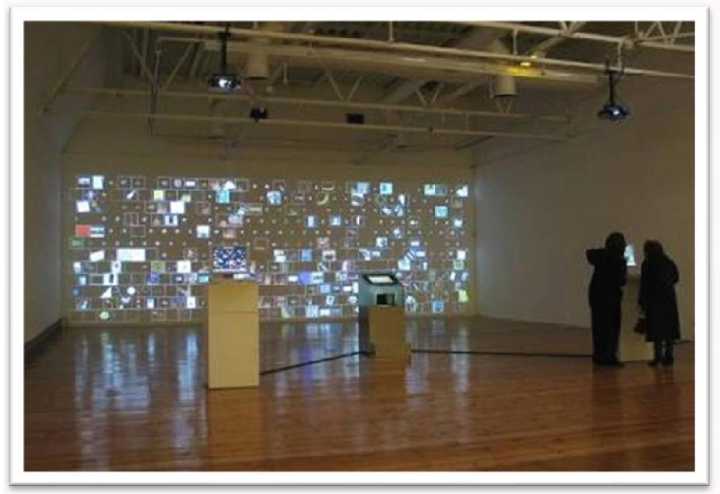
Manovich often cites George Legrady's works as examples of "database aesthetics." He believes that Legrady is one of the key artists who shifted the focus from traditional narrative to the database as a new artistic form. Manovich explains that Legrady's work transforms the "dry" database into a space for exploration. The user does not follow a single story, but instead "extracts" meanings from a multitude of digitized documents through the interface. (Manovich 2015, p.265.) Manovich has long ago emphasized that the future of film will lie in databases: actors will not exist; rather, there will be prerecorded body parts, gestures, movements, and voices from various models, and then these elements will be generated into unique "actors." Manovich's idea is gaining momentum today with the advent of AI technology. We are witnessing the emergence of countless AI-generated films. What they lack, aside from the poetics of authorship, are more convincing realistic elements of film: sound, color, and movement in their lifelike presence. In this case, aesthetics is also subordinated to the database, which justifies Manovich's neologism "database aesthetics." Such a form of aesthetics can hardly be understood as artistic in its traditional sense, but one should certainly not underestimate its significance, especially when it comes to transmedia research. This eclectic aesthetics, or rather - post-authentic aesthetics, brings us closer to the idea of the "death of the author" by Roland Barthes, in that the author creates nothing new, but rather combines existing words, ideas, and cultural codes. The author dies so that the reader/user may be born. (Barth 1986a p. 1102)
It is essential to mention that great artists and artistic movements throughout history are precisely recognized for the authentic aesthetics of their works. Aesthetics is what separates them from other authors and leaves a personal mark of the author.
Relation Author-Artwork
The first authors of visual art are considered to be cave men, who were not aware of art as a specific human activity, but believed that their gesture of drawing wounded animals was actually a magical means to achieve their goal – to obtain food more easily. Self-awareness as an author of an

2026 by the authors. This article is an open access article distributed under the terms and conditions of
the Creative Commons Attribution (CC BY) license .
artistic work certainly did not exist in that period of human civilization's development. In the earliest times, artists were merely executors of works, craftsmen. Their prestige and role in the social environment began to grow with the development of society and culture. Gradually, they started to establish associations, gathering in workshops near temples and the courts of rulers. (Uzelac, 2011, p. 155-156)
In ancient Egypt, originality was not highly valued, and all the ambitions of artists were focused on perfection and precision in crafting objects.
During the Greek and Roman epochs, there was only a clear distinction between poets as prophets, interpreters of myths, on one hand, and painters and sculptors as mere craftsmen, on the other. Larger changes occur only during the time of Alexander the Great, when stories about artists and their eccentricities arise, leading to the discovery of the "artistic genius," and the act of creation becomes mystical. (Uzelac, 2011.p.156)
In the age of spiritual revival, the Renaissance (14th–16th century), the author becomes a recognized versatile figure, focused on man, reason, and spirituality, breaking free from the confines of medieval anonymity. The practice of signing one’s work (painting, libretto, dramatic text) begins, marking a novelty in the author-artwork relation.
The concept of the author in modernism reaches its peak, but at the same time, it also begins to experience a deep crisis. Although modernism celebrates the author as a creator, it also problematizes him through new literary techniques. Modernism has reinforced the figure of the author as an individual genius and intellectual who creates complex worlds. During this period, the author is seen as the source of the only true meaning of the work. While modernism attempts to construct a meaningful world through the author's vision and personal creative stamp, postmodernism deconstructs that position, indicating that the "author" is merely another construct within language.
French literary theorist, philosopher, and semiologist Roland Barthes published his famous essay "The Death of the Author" in 1968, which introduces the reader and their main role in creating the meaning of a literary work. Barthes argues that there is no direct connection between the author and their work; rather, it could be argued that the work creates the author, and not the other way around, and that the author inevitably employs well-known methods and expressions (unconscious quotations) from the treasury of knowledge. Thus, it is impossible to speak of original authorship in literary and artistic creation. He believes that if a text is assigned an author, it "closes the writing," and by finding the author, the text is finally labeled. (Barth 1986 b. p179) Bart considers the author a modern phenomenon of our society, emphasizing the crucial role of the recipient. "The truth is that there is no original and unrepeatable, absolutely new writing or idea, but rather that the writer can only imitate (mimesis) the paradigms of writing and literature that have existed or already exist and which are not original themselves. The relationship between author and writing is no longer the same; the author does not create the book, does not precede it. It is life that imitates the book, and the book is 'a fabric of signs, an imitation that is lost, infinitely delayed.’’ (Bart 1999, p.179) Every form of creation, whether artistic or scientific, represents an inseparable relationship of the trinity author-work-audience. The absence of any of these three elements disrupts the social dimension of creation. A work without an author cannot vanish, and any work that has been created but that the audience has never seen/heard – it is as if it does not exist. An artistic work is created for the audience; it should have an effect on them (if it is true art in question). According to Roland Barthes, no text is original; rather, it is composed of cultural codes and earlier texts, which leads us to the concept of intertextuality as a technique realized through citation, allusion, plagiarism, parody, pastiche, adaptation, translation, and other forms of appropriation.
Julia Kristeva introduced the term intertextuality in 1969 in her book Semeiotique: recherches pour
HcclkV © 2026 by the authors. This article is an open access article distributed under the terms and conditions of the Creative Commons Attribution (CC BY) license .
une sémanalyse, transforming the way we understand literature and language. Intertextuality is a theoretical concept that denotes the intertwining, relationship, and dependence between texts, where each text emerges in dialogue with previous literary and cultural heritage.
‘’Every text is built like a mosaic of quotes; every text is an absorption and transformation of another text. Instead of the concept of intersubjectivity, the concept of intertextuality steps in, and poetic language needs to be read at least as dual" (Kristeva 1969: p.146)
"Intertextuality will mean textual interaction that is produced within the text itself. For the cognitive subject, intertextuality means a concept that serves as an indication of how a text reads history and engages with it." (Kristeva,1968, p. 297-317)
One of the most important implications of the thesis on the death of the author is Barthes' understanding of intertextuality, his belief that the writer merely "confronts writings," and that "the text is only a weaving of quotes derived from an immeasurable number of centers of culture" (Barthes,1986, p. 178).
The concept of intertextuality should not be exclusively tied to literature; rather, it is analogous in other artistic disciplines as well. The expansion of the idea of intertextuality to visual arts, or the concept of "text" to image, does not pertain merely to a unidirectional intertextual connection between the visual and the linguistic (words and images) into an integrated visual-meaning whole. It fundamentally concerns the text as an open space for transfiguration, reinterpretation, production, and exchange of meanings between the visual object and the observer. (Šuvaković, 2005, p. 17)
Postmodern Creative Work
Postmodern creativity represents a broad artistic and intellectual movement that developed in the mid-20th century and appears as a reaction to modernism, rejecting strict forms, "grand narratives," and the search for universal truth. Instead, it promotes fragmentation, experimentation, irony, and the blending of different styles. Eclectic postmodernism emerges in the late 70s and early 80s as a post-historical art form that represents historical traces in a non-historical (synchronic) way.
The main characteristics of postmodern creativity include intertextuality, eclecticism, citation, fragmentation, montage, and the 'death of the author.' The fundamental characteristic of postmodernism is pluralism, i.e., the synchronous existence of various social, political, and religious systems.
Digital Eclectictisim and AI
In the modern era, with the widespread use of AI technology that enables computer systems to simulate human cognitive functions, the relationships between authorship and the audience have changed in everyday practical work. The emergence of AI in creative spheres reinterprets older thoughts about the author as the creator of authentic aesthetics.The main questions that are important to pose for a better understanding of this system are: how does AI function in content generation, has the "death of the author" been realized through this innovation (content adapts to the user in real-time, erasing the boundary between author and audience more than ever before), and what is the aesthetic of AI "art works "?
AI generates media content (video, music, images, text) by taking material "quotes" from an internet database, where almost all artistic and media archives are stored in digital form. AI generates content based on detailed instructions from users, taking fragments of audiovisual material from the
the Creative Commons Attribution (CC BY) license .
database, achieving an eclectic aesthetic in the work. The aesthetics of AI audiovisual works are always polystylistic but also monolithic in the treatment of individual visual elements: light, color, contrast, etc. It is even possible to recognize the aesthetics of works by some well-known famous artists, which have been "borrowed" in a non-poetic and unethical way for new and one-time use. For the creation of art, three aspects are most important: poetics, aesthetics, and ethics. AI is excluded from all three aspects. AI "paints" works by treating them in a more or less uniform manner and without emotion. No true painter-artist treats each individual work in a similar way every time and with an unauthentic aesthetic.From the mistakes that happen to the author, it is possible to create new art; AI does not have that capability because it lacks intuition, which is an essential element alongside intellect and inspiration—characteristics that are unique to humans. Thus, it eliminates the possibility for AI to create art (in the true sense of the word).
Russian philosopher and aesthete Ivan Ilyin advocated the idea that every true work of art possesses three layers: the material, formal, and spiritual. Ilyin, from the standpoint of the highest values of traditionally understood art, particularly emphasizes the existence of the third, spiritual layer of a work of art (in addition to the material and formal). What he criticizes in modern art is the absence of this third, deepest layer in art. (Ilyin, 1996, p. 65)
For Ivan Ilyin, art is a higher form of knowledge, primarily spirituality, not merely a matter of craft, mechanical action, and skills (although it is necessary to materialize an idea and give it form).
It is logical, after all the aforementioned facts, to pose the question: why the insistence on having AI replace humans if AI cannot create art? Human being is the only being capable of creating art, and it is created specifically for humans.
Conclusion
AI should primarily be understood as an auxiliary tool or as an instrument, but certainly not as a replacement for humans. AI is not a being, but it is a "creature." Humans are irreplaceable in most activities, especially when it comes to social and cultural endeavors. AI should enable faster and easier execution but never replace human creativity and the authenticity of the author. The concept of post-authentic aesthetics in the context of AI creativity directly arises from the way databases function. They alter the very definition of "original" and "truth" in digital art. The image we receive does not represent any real location on Earth, yet it seems that AI strives to make the image look "more real than reality," while on the other hand, artificiality is evident (sometimes even surreal), and there is a lack of emotional aspect. AI does not feel what it does. Aesthetics without a basis in the physical world cannot be the aesthetics of spiritual creation—art.
AI represents a radical fulfillment of Barthes' prophecy. AI is the "perfect Barthesian author" – an entity that writes without biography, ego, or personal background. When it comes to art, a practice characteristic solely of human beings, we should always stand on the side of IA (individual artist) rather than AI (artificial intelligence).
