
The elemental composition of needles of forest-forming species in Baikal Siberia in areas with accumulated environmental damage
Journal: Journal of Stress Physiology and Biochemistry @jspb
Article in issue: 4 т.21, 2025.
Free access
The article presents the results of studying the content of 21 chemical elements in four species of coniferous trees of forest-forming species collected on the western coast of Lake Baikal in the Irkutsk Region. The article discusses the features of the elemental composition and accumulation of heavy metals in plants growing in the foothills of Khamar-Daban, where the Baikal Pulp and Paper Mill previously operated. It has been established that plants accumulate significant amounts of the metals iron and manganese. Data obtained using X-ray fluorescence analysis can be used to monitor the state of coastal ecosystems.
Similar articles in the section Systematic botany
Short address: https://sciup.org/143185130
IDS: 143185130
Text of the scientific article The elemental composition of needles of forest-forming species in Baikal Siberia in areas with accumulated environmental damage
The vegetation of the Khamar-Daban foothills is mountain taiga with a well-defined altitudinal belt. In the forest belt at altitudes up to 1,500-1,550 m sprucecedar, fir-cedar forests with admixture of pine, larch and birch forests prevail. The upper boundary of the forest is formed by cedar.
Territorially the town of Baikalsk belongs to the Slyudyansky forestry industry, located in the northern part of Baikalsky foresty of Irkutsk region in the area of the southern shore of Lake Baikal. The main townforming enterprise and the main source of pollutant emissions into the atmosphere (before the shutdown of production in September 2013) was OJSC «Baikalsk Pulp and Paper Mill» (BPPM). BPPM dust and gas emissions spread along the coast of Lake Baikal up to 160 km to the northeast, entering the territory of the Baikal Reserve up to 40-50 km and more to the west, reaching the town of Slyudyanka.
Rising up to 1,500-1,800 m upwards, these emissions spread along the slopes of the Khamar-Daban ridge and in the valleys of the Solzan, Kharlakhta, Krasny, Babkha, Utulik rivers, reaching the upper boundary of the forest, as well as along the Baikal water area, covering an area of more than 2,000 km2 (Suturin, 2019). The dynamics of industrial emissions of BPPM for the last 5 years of its operation is as follows (tab. 1).
The forests of Lake Baikal are the most important link of its ecological system. Mountain dark coniferous forests of the northern macro-slope of the Khamar-Daban ridge do not currently experience large forest exploitation loads.
A ground survey of forest condition in this area was conducted in 1986 by the Moscow Specialized Forest Survey Enterprise. Of the surveyed 240 thousand ha, 1 097 ha were found to be in unsatisfactory condition, of which 212 ha were severely weakened. In the area of about 600 km2 exposed to the influence of BPPM dust and gas emissions, drying of trees is observed, and in the area of 160 km2 – forest drying (Baenguev, 2019).
This territory is undoubtedly promising for the development of tourism industry, as it has a convenient geographical location, mild natural and climatic conditions, unique picturesque places on the shore of Lake Baikal.
The objective of the work was to determine the elemental composition and indicator properties of needles of forest-forming species of the Southern Baikal region to assess the degree of accumulated anthropogenic impact on the unique natural ecosystem of Lake Baikal.
MATERIALS AND METHODS
The object of research was the needles of forestforming species in Baikal Siberia: Abies sibirica Ledeb., Siberian fir – despite its high frost resistance, is heatloving, demanding to soil richness and moisture regime of habitats, which corresponds to the conditions of the northern macro-slope of the foothills of the Khamar-Daban; Pinus sylvestris DuTour – the range of its distribution is quite extensive; its vegetation type is intrazonal, as it grows in a wide variety of natural and climatic conditions, which predetermines its strongly pronounced geographical variability. At the same time, common pine is characterized by high sensitivity to environmental pollution, which affects stand productivity; Pinus sibirica (DuTour)E. Murray – cedar pine in the Irkutsk region occupies the 4-th place by prevalence, the upper limit of distribution lies at an altitude of 1,9002,000 m above sea level; Picea obovate Ledeb. -common spruce – is a part of the main forest forming species of the Southern Baikal region and takes part in the formation of natural landscapes in the vicinity of Baikalsk (Alekseenko, 2013).
Analytical studies of samples were carried out in the accredited laboratory of the Institute of Geochemistry named after A. P. Vinogradov SB RAS according to the approved normative documents. The samples were analyzed in the accredited laboratory of the A.P. Vinogradov Institute of Geochemistry of the Siberian Branch of the Russian Academy of Sciences according to the approved regulatory documents. The elemental composition of needles was determined by X-ray fluorescence analysis on an S4 Pioneer wave spectrophotometer (Bruker, AXS) (Accreditation certificate No. ROSS RU.0001. 513593 (valid until October 28, 2026) (Chuparina, 2024).
RESULTS AND DISCUSSION
During the period of field work in 2015-2024, samples of needles of the main forest-forming species: cedar pine ( Pinus sibirica ), common pine ( Pinus sylvestris ), common spruce ( Picea obovata ), Siberian fir ( Abies sibirica ) were collected at seven sample sites in Baikalsk and its vicinity. As a result, the minimum and maximum values of element content in Pinus sibirica needles and average values for Pinus sibirica , Picea obovata , Abies sibirica , and Pinus sylvestris were obtained.
The distribution of macronutrients in the conifers of forest-forming species (%) can be represented by decreasing series:
– Pinus sibirica : K (0,671) > Ca (0,405) >P (0,200) >
S (0,150) > Mg (0,101) > Na (0,007) > Cl (0,006);
– Picea obovata : Ca (1,087) > K (0,616) >P (0,157) >
S (0,123) > Mg (0,072) > Na (0,012) > Cl (0,004);
– Abies sibirica : Ca (1,562) > K (0,815) >P (0,208) >
S (0,138) > Mg (0,091) > Cl (0,016) > Na (0,006);
– Pinus sylvestris : K (0,494) > Ca (0,327) >P (0,184) > S (0,140) > Mg (0,093) > Cl (0,016) > Na (0,011).
It follows from the presented data that both the order of distribution of macronutrient concentrations and the concentrations themselves in the needles of different tree species are not the same. The highest concentrations of calcium and potassium are characteristic of fir needles, while the lowest concentrations were observed in pine needles. The accumulation of phosphorus and sulfur is approximately the same for all species.
When assessing the quality of the environment, it is customary to pay special attention to the content of toxic elements that pose the greatest danger to biota. According to the data of specialized literature, a large range of heavy metal toxicity for plants can be presented as follows:
Cd > Cu > Co = Ni > As == Cr > Pb > Zn >Mn = Fe ( Khan et al., 2015; Kachor et al., 2025; Kachor, 2024; Kuznetsova et al., 2023).
Accordingly, the following sequences of accumulation of toxic elements in conifers (µg/g) can be plotted for the results we obtained:
Pinus_sibirica : Mn (900) > Fe (630) > Zn(81,6) > Cu (11,2) > Cr (4,4) > Ni (4,0) > Pb (1,5);
Picea_obovata : Fe (1530) >Mn (58–0) > Zn(85,8) > Cu (7,9) > Cr (5,2) > Ni (4,0) > Pb (1,6);
Abies_sibirica : Mn (1150) > Fe (150) >Zn (77,3) > Cu (8,0) > Ni (4,7) > Cr (2,1) > Pb(< 1,5);
Pinus_sylvestris : Fe (1940) >Mn (360) >Zn(83,7) >Cu (10,0) >Cr (6,0) >Ni (4,3) >Pb (3,1).
The highest concentration of iron was observed in pine conifers, the lowest in fir conifers, and vice versa for manganese – the highest concentration in fir conifers, the lowest in pine conifers. Assimilation of such elements as zinc and nickel is approximately the same for all species, and there is an insignificant difference in the concentration of copper. As for lead accumulation, the situation is different: while in the conifers of cedar, spruce and fir the concentration of lead is close to the detection limit of the device (1.5 µg/g), for pine it amounted to 3.1 µg/g. Probably, such a relatively high value was registered due to the fact that the majority of pine samples were taken in the municipal area of Baikalsk, which is exposed to automobile exhausts. The content of toxic elements in conifers was also compared with the norms of SanPiN for plant raw materials1, since the norms of maximum permissible concentration for vegetation are not established. It was found that the content of heavy metals in all samples did not exceed the maximum permissible norms (tabl. 2).
In order to correctly assess and forecast the existence of stands in the zone of anthropogenic impact of Baikalsk, it is necessary to know the mechanisms of pollutants' impact on the assimilation apparatus of stands, the needles of which are known to be highly sensitive to environmental pollution.
In our opinion, sufficient attention has been paid for many years to the influence of various pollutants on the assimilative organs of trees under conditions of anthropogenic pollution (Parshin, 2016; Singh, 2021; Kachor, 2022, 2024, 2025; Kuznetsova, 2023), but the data on the complex impact on vegetation and its recreational potential are currently insufficient.
The regenerative capacity of an organism is called its assimilative potential, which is a key issue in environmental economics. Assimilation potential considers the ability of the environment to biosynthesis processes. This concept is based on the idea that biota should be able to withstand negative impacts of external factors: anthropogenic, anthropogenic and natural life activity. Determination of assimilation potential is based on the identification of indirect indicators of anthropogenic load, in particular, the level of heavy metal accumulation by stands, which characterizes the ecological situation in peri-urban forests. In this case, the role of the regulatory link belongs to assimilating organs – conifer, which determines the growth of other plant organs.
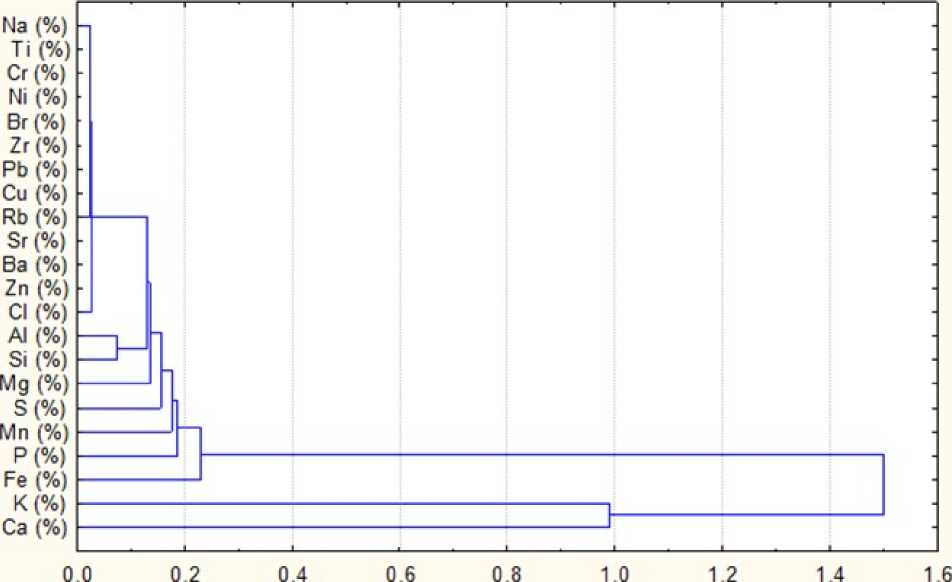
Cluster analysis gives similar behavior of all elements except calcium, potassium, phosphorus and iron, which belong to the group of essential elements. Dendrogram and tables with axis loadings are shown in Figure 1. and Tables 3,4.
The results obtained during the work can be mapped. In this regard, the traits have been grouped together as iron + phosphorus + manganese and silicon + titanium and allow certain conclusions to be drawn. Iron, phosphorus, and manganese have in common that they are important trace elements for plants. They play key roles in various physiological processes such as photosynthesis, energy metabolism, and plant growth by being part of enzyme groups. Titanium and silicon can enhance photosynthesis, increase chlorophyll content and catalase activity in plants, and promote the uptake of nitrogen, phosphorus, and potassium. The above mentioned is well illustrated by the productivity of phytomass productivity of the black forests of Khamar-Daban (Molozhnikov, 2025).
Within the framework of the geoinformation approach to the improvement of the natural environment control system for coniferous forests on the shore of Lake Baikal, the final results of observations should be available to users for analysis in the form of visual and cartographic representations of parameter values at the observation point (cartograms). The most important information material is spatial representations of observation results. Cartograms serve as expresscharacteristics of ecosystem composition and are intended, first of all, for informing environmental control bodies of residential areas; they should reliably reflect the state of the natural environment.
The database collected for 2015-2022 contains a significant number of spatially referenced points, each of which has at least twenty known chemical and/or physical and ecological-phytocenotic characteristics. A sample of about 20% of the total number of points was used to determine the conditionally background values of the observed parameters. Samples were selected for which data were considered the most reliable by all participants of the monitoring program responsible for its various parts.
Table 1. Air Pollutant Emissions by Baikalsk Pulp and Paper Mill in 2009-2013
|
Indicator |
22009 |
22010 |
22011 |
22012 |
|
Duration of operation, months. |
7 |
12 |
12 |
8 |
|
Total emission |
1 364 |
2 234 |
2 997 |
5 486 |
|
Including: suspended substances |
570 |
686 |
1 091 |
1 406 |
|
Gaseous substances |
794 |
1 548 |
1 906 |
4 079 |
Source: On the state of Lake Baikal and measures for its protection in 2013 : state report Irkutsk: Sib. fil. FSUNPP «Rosgeolfond», 462, (2014).
Table 2. Ecological and phytocoenotic characteristics of the surveyed sites
|
Plot coordinates |
Neighborhood location |
topography |
Vegetation community |
Type of nature use |
|
51.540622, 104.046103 |
Utulik dacha |
Even |
Cedar grass-shrub with woody undergrowth |
Seed nursery |
|
51.554470, 104.044008 |
Slyudyansky forestry |
Level |
Grass-shrub mixed forest, with birch undergrowth |
Forestry |
|
51.498811, 104.107868 |
The top of the mountain Sobolinaya |
Top |
Cedar-spruce-fir sparse woodland |
Skiing track |
|
51.498811, 104.107868 |
Foothills of Sobolinaya Mountain |
45° slope of northern exposure |
Cedar-spruce park landdiverse herbaceous |
Eroded slope of the ski track |
|
51.522967, 104.174966 |
Terrace Harlahta River |
Weakly zapadinny |
Fern-grass park forest |
South slope |
|
51.522967, 104.174966 |
Industrial area Baikalsk |
Weakly zapadinny |
Technogenic sparse forest |
Sludge collector |
|
51.522967, 104.174966 |
Industrial area of Baikalsk |
Level |
Technogenic sparse forest |
Territory of Baikal pulp and paper mill |
Тгее Diagram for Variables Single Linkage Euclidean distances
Linkage Distance
Figure 1: Dendrogram of chemical elements distribution in the conifers of the main forest-forming tree species (OFPD) on the territory with accumulated environmental damage of BPPM in Baikalsk town
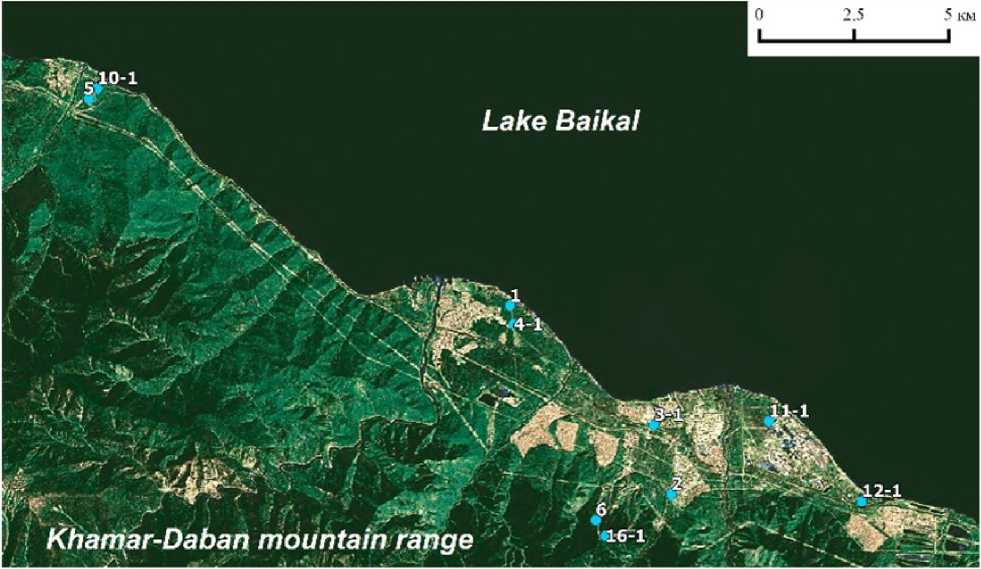
Figure 2: Map of the location of reference sampling sites in the Baikal residential area
CONCLUSIONS
A necessary condition for the implementation of various economic programs in the territories with accumulated environmental damage is the monitoring of the ecological state of biota. This work is a step towards solving the problem. The analysis of the obtained longterm data on the basis of factor analysis indicates an acceptable level of the state of the Baikal natural territory. At the same time, there are areas with insignificantly increased parameters of the content of some chemical elements. A large number of them are located in the southern part of Baikal, these are the areas of Baikal Pulp and Paper Mill, the railroad junction in Slyudyanka, the tourist hub in Kultuk settlement, the delta of the Selenga River. Selenga river delta. All this territory fits into the coniferous forests of the northern macro-slope of Khamar-Daban, with its endemics and relics of the Tertiary Cenozoic period. It should be taken into account that the data on which these conclusions are based are essentially the results of biological and chemical monitoring. It is planned to clarify and supplement them within the framework of directed research work.
CONFLICTS OF INTEREST
Author declare that she has no conflicts of interest.
