
The Hint and Its Persuasiveness in Diplomatic Discourse
Journal: Bulletin of Volgograd State University. Series 2: Linguistics @jvolsu-linguistics
Section: Межкультурная коммуникация и сопоставительное изучение языков
Article in issue: 3 т.25, 2026.
Free access
The assertion that different types of hints exert varying degrees of persuasive effect has been empirically confirmed. However, how these different types of hints influence native and non-native audiences remains largely unknown. Therefore, this study, considering the characteristics of logical, textual and contextual hints in the Chinese diplomatic discourse, tests their persuasive potential and specificity when identified by native and non-native audiences. To achieve this goal an experiment was held: we recruited 90 participants, including 30 native speakers each of Chinese, Russian, and English, and conducted a comparative analysis using a Generalized Linear Mixed Model (GLMM) based on participants' accuracy rates. The results indicate that the persuasiveness of different types of hint is not fixed. Overall, logical hint tends to demonstrate stronger persuasiveness due to their higher logical consistency and lower dependence on contextual and cultural factors. A comparison of Chinese, Russian, and English participants shows that contextual hint is the most persuasive for Chinese participants because, for native speakers, greater implicitness is associated with stronger persuasiveness. Logical hint is the most persuasive for Russian participants, which may stem from their sensitivity to the logical structure of language. Textual hint is the most persuasive for English participants, which is consistent with the tendency of English, as a low-context language, to rely on explicit semantic markers within the text itself.
Short address: https://sciup.org/149151954
IDS: 149151954 | UDC: 81’42 | DOI: 10.15688/jvolsu2.2026.3.7
Намек и его персуазивность в дипломатическом дискурсе
Положение о том, что различные типы намека обладают неодинаковой степенью персуазивного воздействия, эмпирически подтверждено. Однако влияние этих типов намека на восприятие со стороны носителей и неносителей языка остается недостаточно изученным. Поэтому в настоящем исследовании на материале китайского дипломатического дискурса рассматриваются характеристики логического, текстового и контекстуального намеков и проверяется их персуазивный потенциал, а также специфика их определения носителями и неносителями языка. Для выявления персуазивного потенциала намека и способов его установления был проведен эксперимент. На основе показателей правильных ответов испытуемых (90 участников – по 30 носителей китайского, русского и английского языков) был проведен сравнительный анализ с использованием модели обобщенных линейных смешанных эффектов (GLMM). Результаты показали, что персуазивность разных типов намека не постоянна. В целом логический намек демонстрирует более высокую персуазивность благодаря большей логической связности и меньшей зависимости от контекстуальных и культурных факторов. Сопоставление полученных данных демонстрирует, что для носителей китайского языка наиболее персуазивным оказывается контекстуальный намек, поскольку у носителей языка более высокая степень имплицитности связана с усилением персуазивности; для носителей русского языка – логический намек, что может объясняться их чувствительностью к логической структуре языка; для носителей английского языка – текстовый намек, что согласуется со свойственной английскому языку как языку низкоконтекстной культуры опорой на эксплицитные семантические маркеры в самом тексте.
Text of the scientific article The Hint and Its Persuasiveness in Diplomatic Discourse
DOI:
In August 2008, the Kremlin refuted a statement issued by the Élysée Palace, which claimed that Moscow and Paris had agreed to permit the Organization for Security and Co-operation in Europe (OSCE) to replace Russian troops in the security zone surrounding South Ossetia. In its official clarification, the Kremlin emphasized that during a telephone conversation with Nicolas Sarkozy, President Dmitry Medvedev had merely expressed his willingness to cooperate with the OSCE in accordance with the fifth provision of the conflict-resolution principles jointly formulated by the Russian and French presidents [Belyakov, 2011]. This incident illustrates that in cross-linguistic diplomatic communication, different nations may interpret the same expression in markedly different ways. Medvedev’s statement intentionally blurred the line between agreeing to cooperate and agreeing to be replaced.
Why, then, did Medvedev refrain from rejecting the proposal explicitly and instead choose to speak in such an ambiguous manner? The answer lies in the intrinsic nature of diplomatic discourse, which adheres to the principles of politeness and face-saving [Brown, Levinson, 1987; Thomson, 1996; Leech, 2016]. Diplomats, by the very nature of their profession, conduct negotiations with tact and courtesy, a practice that renders modern diplomatic discourse inherently rich in hints and implicitness [Stephen, 2015].
To understand such implicitness in diplomatic discourse, it is essential to revisit the theoretical foundations of hinting in pragmatics. In 1975, Grice first systematically drew attention to the hint as a linguistic phenomenon [Grice, 1975]. He argued that a hint forms part of the speaker’s meaning, it is created by the speaker and exists independently of whether the hearer recognizes the speaker’s actual intention [Grice, 1991]. This position was later supported by neo-Gricean scholars [Levinson, 1983; Horn, 2005; Bach, 2006; Dementiev, 2006]. In contrast, a relevance theory maintains that the hint depends primarily on the hearer’s interpretation of the utterance [Sperber, 1986; Gauker, 2001; Carston, 2006]. From this perspective, a hint comes into existence only when the non-literal, intended meaning, conveyed by the speaker, is successfully recovered by the addressee. Since the early twenty-first century, many researchers have agreed that the emergence of a hint results from the joint interaction between the speaker’s intention and the hearer’s understanding [Stepanov, 1995; Saul, 2002]. Davis further argues that what the speaker intends to communicate does not always coincide with what the hearer actually comprehends; therefore, a hint is co-constructed through what the speaker intends to imply and what the hearer interprets as being implied [Davis, 1998]. In our view as well, the formation of a hint depends on both the hearers’ comprehension and their awareness of the speaker’s communicative intent. Only when the hearer genuinely grasps that intent can a hint be regarded as successfully realized.
In psychological research, psycholinguists argue that a hint can facilitate the manipulation of the addressee by enabling the communicator to conceal their intention [Sperber et al., 2010; Reboul, 2011]. The more covert the manipulative intent is, the greater might be its likelihood of success; thus, the hint is regarded as a crucial strategy of implicit communication [Lombardi Vallauri, Masia, 2014; Cominetti, Lombardi Vallauri, Masia, 2023]. In experimental studies, Lombardi Vallauri introduced the concept of cognitive optimism [Lombardi Vallauri, Masia, Cominetti, 2020] to elucidate the manipulative nature of hints, suggesting that addressees often place excessive trust in their own interpretations of facts and judgments. From a psycholinguistic perspective, the manipulative function of the hint essentially lies in examining the extent to which the hearer comprehends the concealed communicative intention embedded in the speaker’s utterance. In other words, studies of the hint should place the speaker’s intention and the hearer’s interpretation on an equal footing. However, it should be noted that whether manipulation necessarily involves an element of falsity remains controversial [Lu Tingting, 2018]. Scholars generally agree that manipulation is not necessarily harmful to the addressee [Krysko, 2004]; it should be distinguished from demagoguery and incitement [Sergeeva, 2006] and may even be understood as a form of persuasion [Dotdaeva, 2011; Stepanova, 2012].
Scholars generally agree that the generation of a hint entails both the speaker’s communicative intention and the hearer’s processes of interpretation and inference. From this perspective, Lombardi Vallauri identifies two fundamental mechanisms to deliver implicit communication strategies. The first is the concealment of responsibility, which encompasses pragmatic presupposition and topicality. In this mechanism, information remains present on the surface of the utterance, but the responsibility for confirming and interpreting the intended meaning is shifted to the hearer. The second mechanism is the concealment of content, which includes implicature and vagueness, where the intended meaning is deliberately obscured and must be inferred by the hearer based on contextual cues and background knowledge [Lombardi Vallauri, Masia, 2014; Lombardi Vallauri, 2016; Lombardi Vallauri, Masia, Cominetti, 2020]. Building upon Lombardi Vallauri’s theoretical framework, we further conducted a more nuanced analysis of these two implicit communication strategies.
In the 1950s, the philosopher P.F. Strawson proposed that when a speaker uses a referring expression, they presuppose that the listener knows the referent, but do not assert that this referent actually exists. Therefore, even if the presupposition is false, it can only be regarded as a presupposition failure [Shu, 1989]. Although Strawson’s view already hinted at pragmatic thinking, at that time presupposition was still mainly regarded as a semantic category. It was not until the emergence of the speech act theory when the view that about indirect speech acts being presuppositions involving a “truth-value gap” was placed within real communicative contexts, marking the transition of presupposition research into the pragmatic stage [Ifantidou, 1994]. R. Stalnaker pointed out that in a particular context C, when a speaker S utters a proposition B, if S assumes that the listener L believes B, then in context C, B constitutes S’s pragmatic presupposition relative to L [Stalnaker, 1974]. G. Gazdar held a similar view, suggesting that pragmatic presuppositions arise in the process whereby semantic presuppositions enter communicative contexts [Gazdar, 1979]. Therefore, since the 1980s, scholars have generally agreed that presuppositions can be divided into two major types [Zeng, 2012]: semantic presupposition (presuppositions derived from the meaning of the sentence itself); pragmatic presupposition (presuppositions that arise entirely from contextual information) [Shu, 1989].
In the 1970s, Ch.N. Li and S.A. Thompson, in developing their theory of information structure, argued that the topical element of a sentence typically appears at its beginning [Li, Thompson, 1976]. Lu Shuxiang likewise noted that “the progression from the known to the new is a general tendency in speech. This is not merely for the listener’s convenience; in the speaker’s mind, familiar information tends to arise earlier, while new information appears later” [Lu, 1984, p. 562]. Thus, in the organization of information, the principle of moving from old to new is most commonly observed – the closer an element is to the end of a sentence, the more topical and salient the information becomes. In other words, within the same context, different ways of expressing a particular event may yield different communicative effects. By placing new information at the beginning of a sentence and establishing it as topical, the speaker can effectively guide the listener’s attention and thereby achieve an implicative or suggestive communicative purpose [Loftus, 1975].
Paul Grice’s theory of implicature [Grice, 1975] is the implicit content of an expression, when the information complex is not expressed verbatim in the statement, which is extracted as a result of semantic inference (implication) with the involvement of additional elements from the cognitive environment (background knowledge) [Sitdikova, Sabirova, 2015]. Scholars generally classify implicature into three categories: conventional implicature based on specific words, conversational implicature based on specific contexts, and generalized implicature , which is activated in almost all contexts due to the general functioning rules of language [Levinson, 1983].
B. Russell pointed out that vagueness is an inherent property of language and incorporated this concept into linguistic inquiry [Russell, 1923]. With the development of pragmatics, scholars have recognized that vagueness, as a linguistic feature, inherently carries multiple layers of meaning. The pragmatic study of vagueness thus lies in using specific contexts to constrain and refine these indeterminate meanings [Wilson, Carston, 2007; Lombardi Vallauri, 2019]. Therefore, in the expression of verbal hints, vagueness may yield multiple possible interpretations in the absence of context, whereas context functions as a selective mechanism that enables the hearer to choose the interpretation seems most compatible with the communicative situation.
In this study, we provide an integrated overview of presupposition, topicalization, implicature, and vagueness, and summarize their specific mechanisms to express hints verbally. Distinguishing differences in expressive means, we classify verbal hints into three types: textual , logical , and contextual hints . A textual hint is defined as an utterance that indirectly conveys the speaker’s genuine intention through the fixed lexical meaning of words. Its corresponding implicit communicative strategy is the conventional implicature. A logical hint is defined as an utterance that conveys the speaker’s genuine intention within a particular context, based on the semantic logic embedded in the sentence [Del Pinal, Bassi, Sauerland, 2024]. Linguists generally agree that semantic presupposition, generalized implicature, and vagueness share the property of inferability, which reflects the core characteristics of logical hints. A contextual hint is clarified in an utterance by conveying the speaker’s genuine intention in a specific communicative context. As the most covert mechanism of implicit communication, pragmatic presupposition, conversational implicature, and topicalization all exhibit a strong dependence on context [Zhang, 2020], forming the core strategies of contextual hint expression.
The studies conducted by Lombardi Vallauri, Cominetti, and others have opened new avenues for exploring how hearers comprehend verbal hints. However, Lombardi Vallauri’s research remains limited to the English discourse, focusing primarily on implicature and its persuasive effects among English-speaking audiences [Lombardi Vallauri, Masia, 2014; Cominetti, Lombardi Vallauri, Masia, 2023].
The objectives of the present study are twofold: to examine the persuasive effects of verbal hints in the Chinese diplomatic discourse among Chinese and non-Chinese audiences; to investigate the factors influencing the persuasive strength of verbal hints arising from the different linguistic backgrounds of the audiences.
Methods and material
To achieve the research objectives, an experiment was conducted with the primary task to collect and analyze the response accuracy rates of participants with the Chinese, Russian, or English language backgrounds through a comprehension test. The statistical analysis of the experimental data consisted of two parts with the aims: to evaluate the persuasive effects of different types of verbal hints in the Chinese diplomatic discourse on native Chinese speakers and non-Chinese speakers; to analyze separately the specific persuasive effects of verbal hints on audiences with the Chinese, Russian, and English linguistic backgrounds. The experiment was based on the materials drawn from press conference transcripts of the Chinese Ministry of Foreign Affairs and translated into Russian and English.
The research was established in accordance with the 10–20-minute online experiment standard suggested by Revilla and Höhne [Revilla, Höhne, 2020]. Consequently, participants’ response time was capped at double the maximum standard duration, which is 40 minutes (twice the 20-minute limit). Due to this criterion, 32 participants were excluded from the study. Ultimately, we successfully recruited 30 native speakers from China, Russia, and the United Kingdom, summing up to a total of 90 participants aged between 18 and 30 years old (Table 1). They all held
Table 1. The detailed age and gender information of the participants
|
Parameter |
China |
Russia |
England |
Total |
|
Number of males |
17 |
13 |
11 |
41 |
|
Number of females |
13 |
17 |
19 |
49 |
|
Mean age |
24.90 |
22.77 |
25.43 |
24.37 |
bachelor’s degrees or higher academic qualifications and possessed normal reading comprehension abilities; a fee of Ј3 per person was paid for their participation.
Experimental design
Brysbaert proposed that the reading speed of adults is 238 words per minute. Based on the standard duration of the experiment, which ranges from 10 to 20 minutes [Brysbaert, 2019], we set the number of test questions at 15. This experiment is a singlefactor, three-level experiment conducted across three groups with different linguistic backgrounds. For each of three groups, the independent variable is the “category of hint,” which encompasses three categories: textual hint, logical hint, and contextual hint. Consequently, we designed five questions for each category of hint. The dependent variable is the “accuracy” of the answers. A higher accuracy rate for a specific category of hint suggests a stronger persuasive effect of that category within a particular linguistic context, whereas a lower accuracy rate indicates a weaker persuasive effect.
The questions in the test are presented in a multiple-choice format, with four options to choose. Among these options, two are derived from the literal meaning of the corpus, while the remaining two are based on the understanding of hints, with one of them representing the correct interpretation. If a participant’s choice aligns with the correct interpretation of the corresponding category of hint, it is deemed correct, indicating successful persuasion; otherwise, it signifies persuasion failure. Participants from each linguistic background complete the experiment in their respective languages. Consequently, each group should gather 450 data points (15 questions multiplied by 30 participants), amounting to a total of 1,350 data points across the three groups.
Our hypothesis posits that the persuasiveness of the hint is influenced not only by its various categories but also by different linguistic backgrounds. To validate this hypothesis, we utilize R 4.4.1 to construct Generalized Linear Mixed Effects Models
(GLMMs), examining the impact of two factors – category of hint and linguistic background – on the persuasiveness of implicature. The GLMMs are capable of capturing both the relationship between the dependent and independent variables and the individual differences among participants.
Experimental materials
The textual materials for the experiment are sourced from the press conferences of the Chinese Ministry of Foreign Affairs held from June to December 2024 . Each segment of the corpus is divided into a context (the question posed by a reporter) and a main text (the response given by the press spokesperson). The main text of each segment consists of three sentences, with one sentence containing a hint. Across all experimental texts, there are no significant differences in word frequency and word count within the main text sections (with the average word frequency and word count presented in Table 2, p > 0.05). Therefore, participants’ understanding of the hint is not influenced by factors related to the textual characteristics of the experimental materials.
Experimental procedure design
The experimental materials consisted of a total of 15 questions, divided into three groups corresponding to the three types of verbal hints: textual, logical, and contextual hints, with five questions in each group. Each question is further divided into two parts: the corpus (textual material) and the question (prompt for analysis).
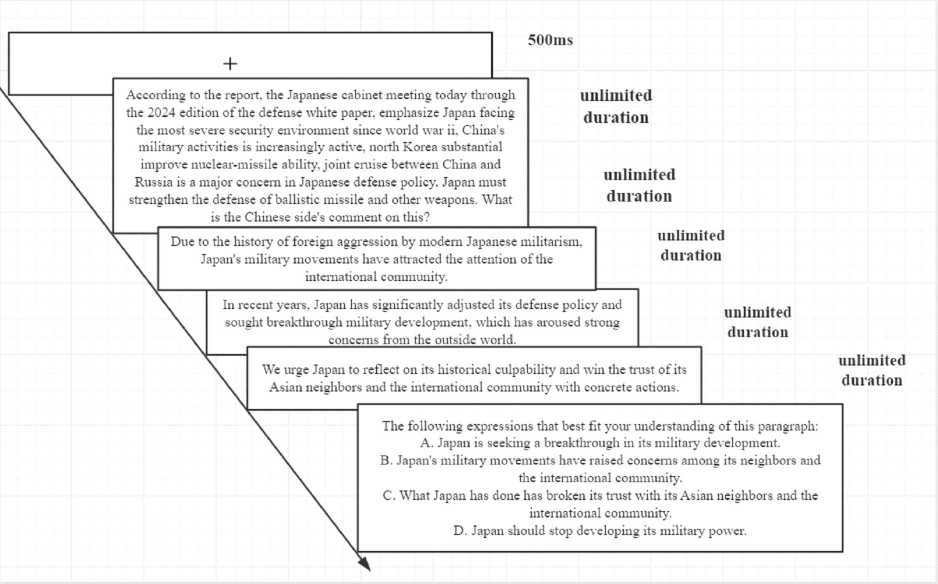
We designed the experiment using the webpage . The experiment consists of four parts: Instructions, Questionnaire for Participant Information Collection, Experiment, and Ending with Thanks. The Instructions section mainly emphasizes the operation method for switching pages (by pressing the spacebar). The Questionnaire for Participant Information Collection section focuses on gathering the participant’s gender, age, education level, and language background. The Experiment section is divided into a Practice Session (1 item) and the Formal Test (15 items). The Practice Session serves solely to familiarize participants with the tasks and does not contribute to subsequent data analysis. The testing procedure for both the Practice Session and the Formal Test remains consistent, as illustrated in Figure 1 (Test flowchart).
Initially, a fixation point appears for 500 milliseconds, followed sequentially by the context, main text Sentence 1, Sentence 2, Sentence 3, and finally the question. To ensure that participants’ comprehension of the text is not influenced by text presentation or response time constraints, the test employs self-paced reading.
Results and discussion
To address our research questions, we first conducted descriptive statistics on the data. Subsequently, we employed mixed-effects models to test differences between groups. All statistical analyses were performed using R 4.4.1.
Descriptive statistics results
We primarily calculated the mean (M) and standard deviation (SD) of hint persuasiveness across different categories. Table 3 presents the computed results, which details the descriptive statistics.
The overall persuasive effects of hints in the Chinese diplomatic discourse on Chinese- and non-Chinese speaking audiences
To investigate the persuasive effects of hints, we employed a mixed-effects model for statistical analysis (see Table 4). The results revealed statistically significant disparities in accuracy among different categories of hints. Specifically, the contextual hint (category b: Estimate = –0.610276, SD = 0.1437, z = –4.247, p < 0.001) and the textual hint (category c: Estimate = –0.872935, SD = 0.146713, z = –5.95, p < 0.001) show certain effects.
In order to evaluate concurrence between the three categories, we conducted post-hoc tests
Table 2. ANOVA of the average word frequency and average word count in the main text sections
|
Case |
Sum of Squares |
df |
Mean Square |
F |
p |
||
|
й 2 О |
Average word frequency |
logical hint |
1.228 |
4 |
0.307 |
1.256 |
0.349 |
|
contextual hint |
2.703 |
4 |
0.676 |
0.847 |
0.527 |
||
|
textual hint |
2.975 |
4 |
0.744 |
2.114 |
0.154 |
||
|
total |
1.685 |
2 |
0.842 |
1.697 |
0.196 |
||
|
Average number of words |
logical hint |
3.067 |
4 |
0.767 |
0.885 |
0.507 |
|
|
contextual hint |
2.000 |
4 |
0.500 |
0.500 |
0.737 |
||
|
textual hint |
0.267 |
4 |
0.067 |
0.077 |
0.988 |
||
|
total |
2.533 |
2 |
1.267 |
1.629 |
0.208 |
||
|
1 |
Average word frequency |
logical hint |
0.550 |
4 |
0.137 |
0.215 |
0.924 |
|
contextual hint |
2.586 |
4 |
0.646 |
2.115 |
0.153 |
||
|
textual hint |
1.443 |
4 |
0.361 |
0.727 |
0.593 |
||
|
total |
0.211 |
2 |
0.106 |
0.233 |
0.793 |
||
|
Average number of words |
logical hint |
7.333 |
4 |
1.833 |
1.719 |
0.222 |
|
|
contextual hint |
4.000 |
4 |
1.000 |
0.750 |
0.580 |
||
|
textual hint |
2.400 |
4 |
0.600 |
0.333 |
0.849 |
||
|
total |
4.844 |
2 |
2.422 |
1.825 |
0.174 |
||
|
и ЬО й И |
Average word frequency |
logical hint |
17.190 |
4 |
4.297 |
1.282 |
0.340 |
|
contextual hint |
15.437 |
4 |
3.859 |
0.495 |
0.740 |
||
|
textual hint |
1.164 |
4 |
0.291 |
0.057 |
0.993 |
||
|
total |
5.543 |
2 |
2.772 |
0.592 |
0.558 |
||
|
Average number of words |
logical hint |
11.733 |
4 |
2.933 |
2.316 |
0.128 |
|
|
contextual hint |
13.333 |
4 |
3.333 |
2.778 |
0.087 |
||
|
textual hint |
41.067 |
4 |
10.267 |
0.837 |
0.532 |
||
|
total |
4.311 |
2 |
2.156 |
0.424 |
0.657 |
||
on the results, as shown in Table 5. The inconsistency between the logical hint (category a) and the contextual hint (category b) was significant (z = 4.247, p = 0.0001). The discrepancies between the logical hint (category a) and the textual hint (category c) are even more evident (z = 5.95, p < 0.0001), whereas slight variance (z = 1.777, p = 0.1773) is seen between the contextual hint (category b) and the textual hint (category c).
To better present the results, we have created a boxjitter plot (see Fig. 2). From the plot, it can be observed that the persuasive power of logical hint (a) is significantly higher than the other two types of hints, while the persuasive power of the other two types is roughly the same.
500ms
According to the report, the Japanese cabinet meeting today through the 2024 edition of the defense white paper, emphasize Japan facing the most severe security environment since world war ii. China's military activities is increasingly active, north Korea substantial improve nuclear-missile ability, joint cruise between China and Russia is a major concent in Japanese defense policy. Japan must strengthen the defense of ballistic missile and other weapons. What is the Chinese side's comment on this?
In recent years. Japan has significantly adjusted its defense policy and sought breakthrough military development, which has aroused strong _____________concerns from the outside world.__________________ unlimited duration unlimited duration unlimited duration unlimited duration
Due to the liistory of foreign aggression by modem Japanese militarism. Japan's military movements have attracted the attention of the international conununity.
unlimited duration
We urge Japan to reflect on its historical culpability and win the trust of its Asian neighbors and the international community with concrete actions.
The following expressions that best fit your understanding of this paragraph: A. Japan is seeking a breakthrough in its military development.
B. Japan's military movements have raised concerns among its neighbors and the international community.
C. What Japan has done has broken its trust with its Asian neighbors and the international conununity.
D. Japan should stop developing its military power.
Fig. 1. Test flowchart
Note. The flowchart pertains to the English test, with a process consistent with the other two test groups.
Table 3. Descriptive statistics results
|
Parameter |
Language |
Chinese |
Russian |
English |
||||||||
|
Category |
a |
b |
c |
a |
b |
c |
a |
b |
c |
a |
b |
c |
|
Mean Value |
0.502 |
0.369 |
0.316 |
0.567 |
0.627 |
0.413 |
0.787 |
0.327 |
0.313 |
0.153 |
0.153 |
0.22 |
|
Standard Deviation |
0.501 |
0.483 |
0.465 |
0.497 |
0.485 |
0.494 |
0.411 |
0.471 |
0.465 |
0.362 |
0.362 |
0.416 |
Note. In the table the following designations are used: a = logical hint; b = contextual hint; c = textual hint.
Table 4. Persuasive effects of hints by category
|
Parameter |
Estimate |
std.Error |
z value |
Pr[>|z|] |
|
Intercept |
0.004008 |
0.125944 |
0.032 |
0.975 |
|
Category b |
–0.610276 |
0.1437 |
–4.247 |
<0.001*** |
|
Category c |
–0.872935 |
0.146713 |
–5.95 |
<0.001*** |
Table 5. Comparison of persuasive effects differences among categories of hints
|
Contrast |
Estimate |
SE |
df |
z.ratio |
p.value |
|
a–b |
0.061 |
0.144 |
inf |
4.247 |
0.0001 |
|
a–c |
0.873 |
0.147 |
inf |
5.95 |
<0.0001 |
|
b–c |
0.263 |
0.148 |
inf |
1.777 |
0.1773 |
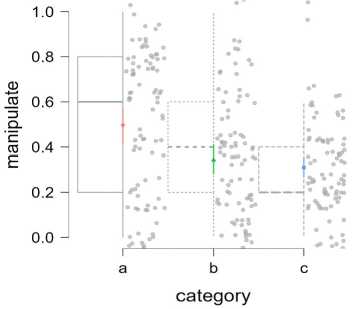
Fig. 2. Boxjitter plot of persuasive effects of hint categories
Note. The x-axis represents the types of hints, and the y-axis represents the persuasive impact on the addressee for each category.
Persuasive effects of variable categories of hints on audiences with different linguistic backgrounds
To investigate the persuasive effects of the categories of hints under study on audiences with the Chinese, Russian, and English linguistic backgrounds, we once again fitted a generalized linear mixed-effects model (Table 6). For Chinese participants, the textual hint (category c) was identified statistically significantly less accurately than the logical hint (Estimate = –0.6195, SE = 0.2342, z = –2.645, p = 0.008), whereas the contextual hint (category b) did not differ significantly from the logical hint (Estimate = 0.2501, p = 0.290). For Russian participants, both the contextual hint (category b: Estimate = –2.0282, SE = 0.2646, z = –7.664, p < 0.001) and the textual hint (category c: Estimate = –2.0895, SE = 0.2659, z = –7.858, p < 0.001) were identified statistically significantly less accurately than the logical hint, indicating that the logical hint was the most accurately interpreted in this group. For English participants, neither the contextual hint (category b: p = 1.000) nor the textual hint (category c: p = 0.138) differed significantly from the logical hint, indicating no statistically significant differences in accuracy among the three categories of hints.
We compared the statistical figures of the persuasive effects among the three categories of hints for each linguistic background, and the results are as follows (Table 7). In the Chinese context, the difference in persuasive effect between the logical hint and the contextual hint (category a–b) is not significant (z = –1.059, p = 0.5395); however, there is more disparity between the logical hint and the textual hint (category a–c: z = 2.645, p = 0.0223) and between the contextual hint and the textual hint (category b–c: z = 3.664, p = 0.0007). In the Russian context, there is certain discrepancy between the logical hint and the contextual hint (category a–b: z = 7.664, p < 0.0001) and between the logical hint and the textual hint (category a–c: z = 7.858,
Table 6. Persuasive effects of the categories of hints under study on participants with different linguistic backgrounds
|
Parameter |
Chinese |
Russian |
English |
||||||
|
intercept |
b |
c |
intercept |
b |
c |
intercept |
b |
c |
|
|
Estimate |
0.2687 |
0.2501 |
–0.6195 |
1.3049 |
–2.0282 |
–2.0895 |
–1.73 |
–0.00000168 |
0.447 |
|
std.Error |
0.1567 |
0.2361 |
0.2342 |
0.1993 |
0.2646 |
0.2659 |
0.237 |
0.322 |
0.302 |
|
z value |
1.622 |
1.059 |
–2.645 |
6.547 |
–7.664 |
–7.858 |
–7.298 |
0.000 |
1.483 |
|
Pr[>|z|] |
0.10481 |
0.28953 |
0.00817** |
<0.001*** |
<0.001*** |
<0.001*** |
<0.001*** |
1.000 |
0.138 |
Note . Significance codes: ** indicates p < 0.01; *** indicates p < 0.001.
Table 7. Comparison of differences in persuasive effects among categories of hints in different linguistic backgrounds
|
Contrast |
Estimate |
SE |
df |
z.ratio |
p.value |
|
|
Chinese |
a–b |
–0.25 |
0.236 |
Inf |
–1.059 |
0.5395 |
|
a–c |
0.62 |
0.234 |
Inf |
2.645 |
0.0223 |
|
|
b–c |
0.87 |
0.237 |
Inf |
3.664 |
0.0007 |
|
|
Russian |
a–b |
2.0282 |
0.265 |
Inf |
7.664 |
<0.0001 |
|
a–c |
2.0895 |
0.266 |
Inf |
7.858 |
<0.0001 |
|
|
b–c |
0.0613 |
0.248 |
Inf |
0.248 |
0.9668 |
|
|
English |
a–b |
0.0000017 |
0.322 |
Inf |
0.000 |
1.000 |
|
a–c |
–0.447 |
0.302 |
Inf |
–1.483 |
0.2992 |
|
|
b–c |
–0.447 |
0.302 |
Inf |
–1.483 |
0.2992 |
|
p < 0.0001); however, the gap between the contextual hint and the textual hint (category b–c) is less meaningful (z = 0.248, p = 0.9668). In the English context, there are no significant differences among all categories of hints (category a–b: p = 1.000; category a–c and category b–c: p = 0.2992).
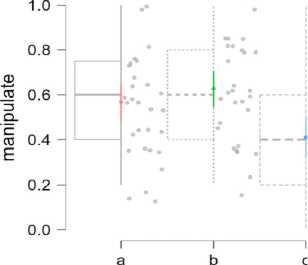
To better present the results, we have created boxjitter plots for the three different linguistic backgrounds. As shown in the plots, the persuasiveness of categories of hints in the Chinese diplomatic discourse is highest for Chinese participants and lowest for British participants. Specifically, according to Figure 3, contextual hints are the most persuasive for Chinese participants, followed by logical hints, and textual hints are the least persuasive (in all figures, the x-axis represents the category of hint, and the y-axis represents the persuasiveness for recipients from different linguistic backgrounds).
category
Fig. 3. Chinese participants
Note. In Figures 3–4, the x-axis represents the category of hint, and the y-axis represents the persuasiveness for recipients from different linguistic backgrounds.
According to Figure 4, logical hints are the most persuasive for Russian participants, while contextual and textual hints are less persuasive and have roughly the same level of persuasiveness.
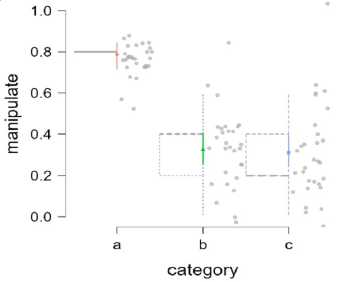
Fig. 4. Russian participants
According to Figure 5, the persuasiveness of hint categories in the Chinese diplomatic discourse is generally low for British participants, with textual hints being slightly more persuasive than the other two categories, and logical and contextual hints having roughly the same level of persuasiveness.
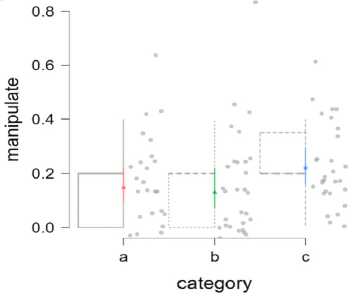
Fig. 5. English participants
Considering the data gained, we have stated the pragmatic reasons for the difficulties in discovering the hints in the diplomatic discourse, as the audience language diversity and contextual differences.
Audience language diversity can affect the persuasive power of the hint. This study, through quantitative analysis, expands upon the theoretical hypotheses proposed by Lombardi Vallauri and others regarding the persuasiveness of the hint [Lombardi Vallauri, Masia, 2014; Lombardi Vallauri, Masia, Cominetti, 2020]. The results of data analysis indicate that the persuasive effect of the hint in the Chinese diplomatic discourse on multilingual audiences differs from the theoretical hypotheses put forward by Lombardi Vallauri et al. We argue that, for native speaker audiences, the persuasive variations among types of hints are related to the degree of implicitness. Specifically, the contextual hint, which relies on context, is deemed to have the highest degree of implicitness. The logical hint, that depends on the semantic logic of the text, has a lower degree of implicitness than the contextual hint. The textual hint, expressed solely through words or sentences within the text, possesses the lowest degree of implicitness. However, when the audience consists of non-native speakers, the persuasiveness of the hint is not solely determined by the degree of implicitness; it also hinges on the adaptability of each type of hint to a recipient type. In comparison, the logical hint, which relies more on the internal semantic logic of the text, is generally more persuasive [Averina, 2011; Antoshina, 2019], may be due to the fact that the logical hint is least influenced by recipients’ personal experiential interpretations and cultural disparity, thus being more universally understandable.
Contextual differences are the main factor influencing the persuasive effect of the hint. For Chinese participants, the contextual hint was found to be the most persuasive, followed by the logical hint, while the textual hint exhibited the lowest persuasive power. This finding aligns closely with the hypotheses previously proposed by Lombardi Vallauri and others. This suggests that the persuasive impact of implicit information delivered to native speakers depends on the degree of its implicitness. Specifically, the more concealed the implicit information is, the stronger its persuasive effect on the native language users will be.
However, for non-Chinese speaker audiences, the persuasive effect of the contextual hint is more susceptible to the influence of their own “contexts” [Hall, 1976; Gudykunst, Nishida, 1986]. The concept of “context” encompasses how information is conveyed, directly or indirectly, across cultures in different countries. Hall argues that in high-context cultures, a significant amount of information is transmitted through non-verbal, implicit, or shared assumptions and background knowledge, whereas in low-context cultures, information relies more on explicit and direct verbal expressions [Gudykunst, Nishida, 1993; Gavrilenko, 2014; Jiang, 2024]. The research by Gudykunst et al. suggests that a country’s context can be judged by its individualism or collectivism, with countries dominated by collectivist cultures typically being high-context, such as China, Japan, and Russia, while countries dominated by individualist cultures are often low-context, like the English-speaking countries (the United States and the United Kingdom) [Gudykunst et al., 1996]. This also explains why the persuasive effect of the hint is generally higher on the Russian audiences than on the British audiences.
Based on the aforementioned theories, both China and Russia are high-context countries. However, the degree of Russian audiences’ understanding of logical hints is even higher than that of native Chinese speakers, potentially reflecting the sensitivity of Russians to the logical structure of language [Lopukhina, 2012; Zolotukhina, 2016; Polyakova, 2018 ]. In contrast, for the UK, which is a low-context country, textual hints tend to be more persuasive compared to the other two types of implicature. This also demonstrates the inclusiveness of English as a global language in understanding diverse linguistic expressions [Fenner, 1989; McCallen, 1989]. Moreover, the persuasive effect of the contextual hint is undoubtedly influenced by geographical locations and differences in the political stances, but this requires further experiments for verification.
Our experimental results reinforce the idea that the persuasive impact of the hint hinges not solely on the speaker’s ability to veil implicit information, but also on the listener’s cultural background and language interpretation capabilities. This aligns with our previously proposed theoretical viewpoint, which underscores the equal importance of both speakers and listeners in the study of the hint. In essence, the persuasive strength of various categories of hints is not fixed, and significant disparities exist among different linguistic audiences. This underscores the crucial role of cultural backgrounds and linguistic factors, particularly in the realm of diplomatic discourse research.
While our research offers valuable insights, it is not devoid of limitations. The experimental materials were confined to content from Chinese Foreign Ministry press conferences, suggesting that future research could explore a wider array of discourse types and topics. Additionally, the translation process might have introduced subtleties that influenced non-native speakers’ interpretation of hints. Future studies could delve into other potential factors that may affect the persuasive power of hints, such as age and gender.
In summary, our research contributes to a deeper understanding of the expression and persuasive effects of implicit information in the Chinese diplomatic discourse across diverse linguistic backgrounds. This has important implications for both linguistic theory and cross-cultural communication practice.
Conclusion
This article argues that, unlike the traditional understanding of hints in linguistic pragmatics, the realization of hints in actual diplomatic discourse communication depends on whether the hearer genuinely grasps the speaker’s hidden communicative intention. Based on the analysis of two implicit communicative strategies, this study classifies hints into three categories: textual hints, logical hints, and contextual hints. Each type of hint corresponds to a different expressive strategy. Textual hints are realized through conventional implicature and exhibit the lowest degree of implicitness. Logical hints are presented through semantic presupposition, generalized implicature, and vagueness, exhibiting a relatively high degree of implicitness. Contextual hints are accomplished through pragmatic presupposition, conversational implicature, and topicalization, exhibiting the highest degree of implicitness.
Combined with psycholinguistic analysis, the persuasive function of hints can essentially be understood as the extent to which hearers comprehend the hidden communicative intention embedded in the speaker’s utterance. Therefore, in the experiment, the persuasiveness of hints was quantified through the accuracy with which participants interpreted different types of hints.
The experimental results indicate that logical hints generally demonstrate stronger persuasiveness because they are less affected by cultural and contextual factors. Furthermore, for native Chinese speakers, the higher the degree of implicitness, the more accurately they identify the hidden information conveyed by hints, and the stronger the persuasive effect. For non-native audiences, however, the persuasiveness of hints depends on the audience’s degree of cultural adaptability. Specifically, logical hints are the most persuasive for Russian audiences, whereas textual hints are the most persuasive for English audiences.
These differences are associated with variations in cultural context. China and Russia are both high-context cultures, however, compared with native Chinese speakers, Russian audiences tend to infer the implicit meaning of hints from the logical structure of language. By contrast, English-speaking countries are typical low-context cultures, in which the interpretation of implicit meaning relies more heavily on explicit semantic markers within the text itself.
