
The impact of innovative development on economic growth in the Russian Federation
Journal: Economic and Social Changes: Facts, Trends, Forecast @volnc-esc-en
Section: Science, technology and innovation development
Article in issue: 1 т.19, 2026.
Free access
This article assesses the impact of innovative development on the growth of the Russian economy. By considering factors such as scientific research, the implementation of its results in production, and net exports, the innovative state of the economy is characterized. The manifestation of these factors clearly demonstrates how the economy’s innovative capacity is utilized. Economic modeling allowed determining the effect of innovative development on Russia’s economic growth. An economic-mathematical model of the innovative development of the Russian Federation was built. Based on this model, the influence of the studied factors was determined, revealing the effectiveness of using the economy’s innovative capacity. By calculating the contribution of these factors to the GDP growth rate, the economic structure of Russia’s innovative development was constructed. This formed the basis for developing principles and postulating a taxonomy for the intensification of the Russian economy. Utilizing the predictive function of Russia’s innovative development, three types of economic growth were identified: 1) inertial; 2) imperative; 3) experimental. It is emphasized that collectively, this constitutes a methodology for assessing economic intensification, which involves decomposing the effect of the identified factors on GDP growth, summing these effects, and determining their contribution to building the structure of such an effect. The assessment of innovative development revealed the factors driving the intensification of the Russian economy. Regulation of these processes became the foundation for developing the taxonomy of economic intensification. The impact of innovative development on the dynamics of the final economic indicator provides a new qualitative dimension to its growth rates, signaling the creation of a new economic management model that can allow achieving technological independence in the near future.
Similar articles in the section Dynamics of the economy. Economic movement
Short address: https://sciup.org/147253448
IDS: 147253448 | UDC: 330.341; 330.352.3 | DOI: 10.15838/esc.2026.1.103.10
Text of the scientific article The impact of innovative development on economic growth in the Russian Federation
The authors express their sincere gratitude to the journal’s editors and the anonymous reviewers for their attentive approach to the article and their valuable comments, which helped improve its quality.
The ongoing restructuring of the entire reproductive mechanism in Russia is intended to fundamentally change existing structures and impart new dynamism to economic growth1. Addressing the issue of a new quality of growth for the Russian economy should be based on identifying and substantiating the prospects for the development of scientific research and the comprehensive, rapid implementation of its results in production. In this regard, a key goal has been set: achieving technological sovereignty for the Russian Federation. Specifically, the Concept of Technological Development for the period up to 2030 was developed2, and an instrument like the “technology credit” was introduced3. Simultaneously, the negative trend associated with importing certain types of products essential for the Russian economy should be reversed in the very near future.
As a result of persistent efforts over a relatively short period, a federal law on technological policy was adopted4, which, in our view, could serve as one of the instruments for achieving technological independence for the Russian economy. It will complement the already substantial list of other regulatory legal documents related to scientific and technological development which are currently in force.
In foreign literature, a key direction in the study of innovative development assessment can be identified (Cantamessa, Montagna, 2023). While earlier works primarily focused on individual stages of innovative activity, contemporary research is mostly devoted to defining the interaction of stakeholders for the effective use of innovative capacity (Ahmed et al., 2025; Spigel et al., 2026). However, the question of assessing the impact of innovative development on ensuring economic growth remains open and is the subject of active debate.
Consequently, the scientific problem lies in resolving the contradiction between the potential to intensify the Russian economy through the effective use of its innovative capacity and the ability to change the economy’s structure.
This approach is of fundamental importance and defines the aim of our work: to assess the impact of innovative development on the growth of the Russian economy. Achieving this aim requires setting and solving the following tasks:
-
1) identify the factors exerting the greatest influence on the change in the final economic indicator to shape the innovative state of the economy;
-
2) determine the degree of influence of these factors on the GDP growth rate;
-
3) reveal the qualitative content of the Russian economy’ s growth rates and develop ways to regulate it;
-
4) based on the predictive function of innovative development, justify the choice of growth type for the Russian economy.
The subject of the study is a set of issues related to the implementation of innovative development in the Russian economy. It is worth noting here that while this process persists, the approaches to its deployment remain unchanged. Hence, the picture of the economy’s innovative state has remained largely static for a long time. We are to break this tradition, which hinders and, in some cases, destroys economic growth.
The object of the study is the Russian economy.
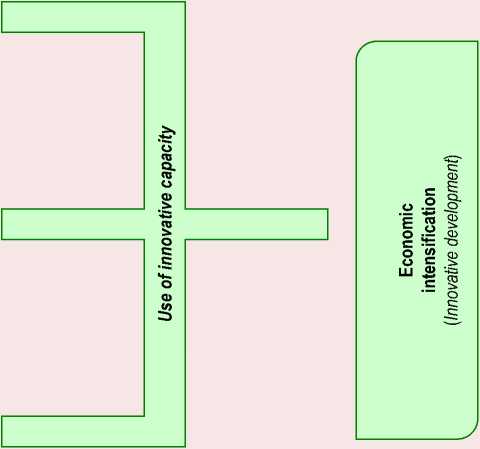
Under current economic constraints, the role of innovative development as a determining condition for economic intensification immeasurably increases. It becomes pivotal. In this context, the use of the economy’s innovative capacity acts as the primary tool for ensuring this intensification. It is a fundamental requirement for overcoming existing limitations and an imperative for the emerging innovation economy. Let us recall that innovative capacity is the aggregate ability and readiness of an economic unit to produce innovative products 5.
Every challenge facing Russia today urgently requires the effective use of the economy’s innovative capacity (Brown, 1966; Troisi et al., 2024). Therefore, constant and utmost attention should be paid to the development of domestic science and the technical re-equipment of all economic sectors without exception, based on the application of scientific research results. This is precisely why the effectiveness of using innovative capacity is among the key economic issues.
This formulation of the question implies the intensification of the economy through the creation and widespread application of new machinery, materials, and technological processes. In this context, what does the “innovative development” concept, frequently encountered in various publications not so long ago – particularly in fundamental works like (Mensch, 1973; Freeman, 1992; Santo, 1990) – and heard in academic discourse, actually mean? It is not given due attention anymore because of the current situation in the scientific agenda (a focus on foreign issues rather than domestic developments) and especially the requirements for scientific results to be published in foreign journals.
In Russian literature, for instance, in (Trifonova, Prikazchikova, 2011; Golova, 2021), researchers examine intermediate assessments of Russia’s innovative development, which do not allow revealing its internal potential. T.A. Nevzorova and V.G. Kucherov in their work present the concept of a technological innovation system used in studying technological innovations in developed countries. This system’s assessment is process-oriented rather than result-oriented (Nevzorova, Kucherov, 2022).
Despite their progressiveness, foreign developments also have drawbacks. For example, the assessment of innovative development is often limited to the stage of scientific research, while the implementation of its results in production is not reflected, potentially indicating the inadequacy of the methodological toolkit for such an assessment (Zeng et al., 2010; Franco, Leoncini, 2013; van Beers, Zand, 2014). At the same time, attempts are being made to organize the process of implementing scientific research results into production (Torrecillas et al., 2017; Spanuth et al., 2020). However, works (Lu, Chesbrough, 2022; Rammer, 2023; Srisathan et al., 2023) lack an assessment of how the economy assimilates the research results implemented in production.
The applied definitions of innovative development and the assessments based on them in previous years proved untenable, as they not only failed to contribute to the theory of the issue but also, crucially, were not followed by concrete practical results due to the lack of a comprehensive methodological toolkit for assessing the contribution of innovative development to the dynamics of the country’s GDP.
At the same time, there are certain achievements in the development and resolution of these issues. Works (Farbirovich, 1978; Abalkin, 1988; Griliches, 1988; Barbiroli, 1996) are devoted to constructing the sequence from idea to practical implementation of scientific and technical achievements. They also study the problems of qualitatively enriching economic growth rates. In turn, studies (Karlsson et al., 2004; Freeman, Soete, 2009) develop indicators for assessing the effectiveness of using innovative capacity. Consequently, problems of modeling innovative development have been addressed in works (Lawson, Samson, 2001; Yi et al., 2021; Codini et al., 2023).
Despite certain achievements, the issues of assessing the impact of innovative development on economic growth are not studied sufficiently to solve the problems of economic intensification.
We defined innovative development using the concept of “innovative capacity” because it unites scientific research, the implementation of its results in production, and their subsequent assimilation by the economy into a single chain, while also considering the import of necessary products. A break in this sequence would indicate the inaccessibility of innovative development for the economy. In this regard, the effectiveness of using innovative capacity is one of the key tasks for intensifying the Russian economy, as it substantiates the choice of prospects for its innovative development. Without ensuring the necessary level of such effectiveness, the economy cannot move toward intensification, i.e. development driven by factors like scientific research, the implementation of its results, and net exports, based on the transformation of old properties and the emergence of new ones. These types of movement constitute the taxonomy of economic intensification.
Innovative development is an indispensable condition for radical restructuring and successful progress toward new frontiers, for the transition to economic intensification. This is not merely an economic directive; it should have detailed and substantial content and be reflected in the impact on the final economic outcome, i.e. assess the efficiency of resources used in influencing the resulting indicator. The aspiration to give new content to economic growth is linked to the action of specific factors, among which we highlight science, the implementation of its results in production, and net exports. In these conditions, the objective necessity for restructuring is dictated by the fundamentally changed internal structure of the innovative development of the Russian economy in the preceding stage of its functioning.
In light of the above, existing approaches to assessing the innovative development of the economy also require new content. In many ways, the transition to technological independence will contribute to a significant increase in production efficiency. Based on this, for the first time in economic science, the authors propose an original method for assessing the innovative development of an economy , which consists of calculating the efficiency of using its innovative capacity, i.e. decomposing into components and determining the effect of the aforementioned factors on the final economic indicator, summing these effects, and also isolating their contribution and constructing its structure. This will allow for a more comprehensive investigation and resolution of the stated scientific problem.
The established course toward intensifying the Russian economy, its scale, and complexity require formulating and solving a research task. Its essence lies in assessing the impact of factors such as expenditures on scientific research, expenditures on implementing their results in production, and net exports on the GDP growth rate. Using the method of regression and correlation analysis and its tools, we need to evaluate the efficiency of allocated resources and their contribution to the growth of the Russian economy.
The introductory part of the work is prepared based on the method of concretization. The current state of the scientific problem was investigated using the method of literature analysis. Using the modeling method, an economic-mathematical model of the innovative development of the Russian Federation was created. The study of the economy’s innovative capacity is based on methods of analysis and synthesis. Using deduction and induction methods, the economic structure of Russia’s innovative development was examined. Based on the classification method, a taxonomy of economic intensification was constructed. The forecasting method allowed investigating the predictive function of the innovative development of the Russian economy. The statistical method runs through the entire work. In accordance with the generalization method, conclusions were drawn and proposals formulated.
Data sources for the paper are the Federal State Statistics Service (Rosstat) and the International Monetary Fund (IMF).
Research results
Modeling the innovative development of the Russian economy
In examining innovative development, we noted that it is a determining condition for economic intensification, as its economic role is to reduce the impact of imports on GDP dynamics. State economic policy should increasingly focus on stimulating such structural shifts.
In this regard, economic design consists of determining the elements, their structure, and characteristics (the degree of factor influence) of using the economy’s innovative capacity. The approach applied in this article is that the assessment reflects the final results calculated under the influence of innovative development (from idea to implementation and assimilation by the economy) on GDP dynamics. The choice of the economic-mathematical model is based on the analysis of Russia’s GDP components according to the form approved by the Federal State Statistics Service, where research expenditures, costs on implementing their results in production, net exports, and other relevant factors are considered. On this basis, a preliminary correlation analysis was conducted, and the factors exerting the greatest influence on GDP dynamics were selected6.
To examine the influence of scientific research, the implementation of its results in production, and net exports on GDP dynamics, we represent the innovative state of the Russian economy ( Tab. 1 ).
A fundamental place in the methodological substantiation for solving the stated scientific problem – economic intensification – belongs to a new theoretical understanding of innovative development, as it is now perfectly clear that existing backlogs do not guarantee its automatic and uninterrupted implementation. Innovative development is a purposeful change in the state (the composition – ability, and structure – readiness, i.e., stable connections) of the innovative capacity of an economic unit, i.e., the transition of innovative capacity from an initial (baseline) to a final (planned or desired at a certain point in time) state7, ensuring imperative economic growth. This definition expands the cognitive potential of the concept of innovative economic development.
The mechanism for realizing the economy’s innovative capacity is presented in Figure 1.
Using the innovative state ( Tab. 1 ), we will characterize the process of utilizing the economy’s innovative capacity (Fig. 1), i.e., the effects of the selected factors. To assess the impact of these factors on the GDP growth rate, an economic-mathematical model of innovative development was developed, which is presented below:
Y = 55 349.66 + 10.04 x X1 +
+ 12.72 x X2 + 1.01 x X3 . (1)
The developed economic-mathematical model of Russia’s innovative development is adequate (Fisher’s test: F statistic (38.63) > F critical value (4.07) ) and can be used in further calculations and analysis. At the same time, the scope of its practical application may be limited by the state of information support.
Thus, the change in GDP under the influence of scientific research, the implementation of its results in production, and net exports is shown in Figure 2.
Table 1. Innovative state of the Russian economy, in 2016 prices, billion rubles
|
Analyzed period |
Result |
Factors |
||
|
GDP, Y |
Research expenditures, X 1 |
Costs on implementing research results in production, X 2 |
Net exports, X 3 (exports – imports) |
|
|
2010 |
75 363.14 |
741.59 |
607.28 |
6 086.04 |
|
2011 |
81 750.60 |
772.96 |
997.94 |
6 601.63 |
|
2012 |
85 040.30 |
817.97 |
1 129.52 |
5 666.44 |
|
2013 |
86 533.10 |
829.87 |
1 318.92 |
4 675.84 |
|
2014 |
87 170.20 |
877.34 |
1 336.72 |
5 597.07 |
|
2015 |
85 450.60 |
878.59 |
1 237.87 |
6 876.58 |
|
2016 |
85 616.10 |
873.78 |
1 284.59 |
4 444.20 |
|
2017 |
87 179.30 |
902.00 |
1 333.64 |
4 625.07 |
|
2018 |
89 626.60 |
829.02 |
1 270.96 |
8 967.70 |
|
2019 |
91 596.67 |
886.31 |
1 633.02 |
6 996.25 |
|
2020 |
89 166.01 |
903.88 |
1 767.48 |
4 527.37 |
|
2021 |
94 181.03 |
830.87 |
1 656.55 |
8 694.01 |
|
Calculated based on: Rosstat, IMF data. |
||||
Figure 1. Mechanism for realizing the economy’s innovative capacity
Scientific research ( Irreversible changes)
Implementation of research results in production
(Targeted changes )

Assimilation of the results by the economy ( Natural changes )
Source: own compilation.
Figure 2. Intensification of the Russian economy
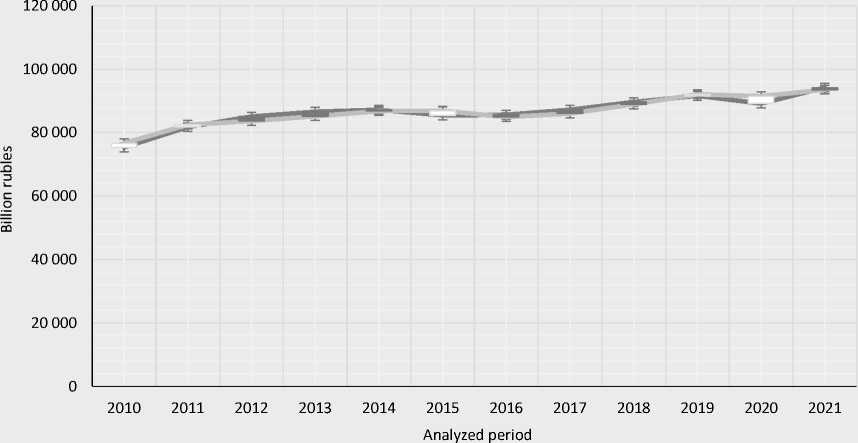
GDP Calculated GDP
Source: own calculation.
Under the current conditions, the intensification of the Russian economy requires improving the interaction between science and the implementation of its results, at all levels of management: from an individual enterprise to the state as a whole. Organizational shortcomings are explained by the slow assimilation of designed capacities in industry. Due to the lack of production at the necessary science and technology level, the Russian economy underproduces a significant volume of innovative products.
This suggests that the mechanism for using the economy’s innovative capacity represents the organization of effective interaction between science and industry. In this case, the economy’s innovative capacity acts as the direct source for creating such interaction.
Effectiveness of using Russia’s innovative capacity
The transition to innovative development of the Russian economy, i.e., the intensive use of its innovative capacity, is objectively an urgent need. Economic intensification is crucial for achieving high growth rates. Today, the directions that should justify the predominance of reindustrialization and new fixed assets construction over imports have been identified, namely: scientific research, the implementation of its results in production, and net exports.
Examining this issue through the lens of the impact on GDP, it is necessary to assess the influence of these factors on its change.
First, in the context of economic intensification, the role of scientific research is as follows ( Fig. 3 ).
Figure 3. Effectiveness of research activities
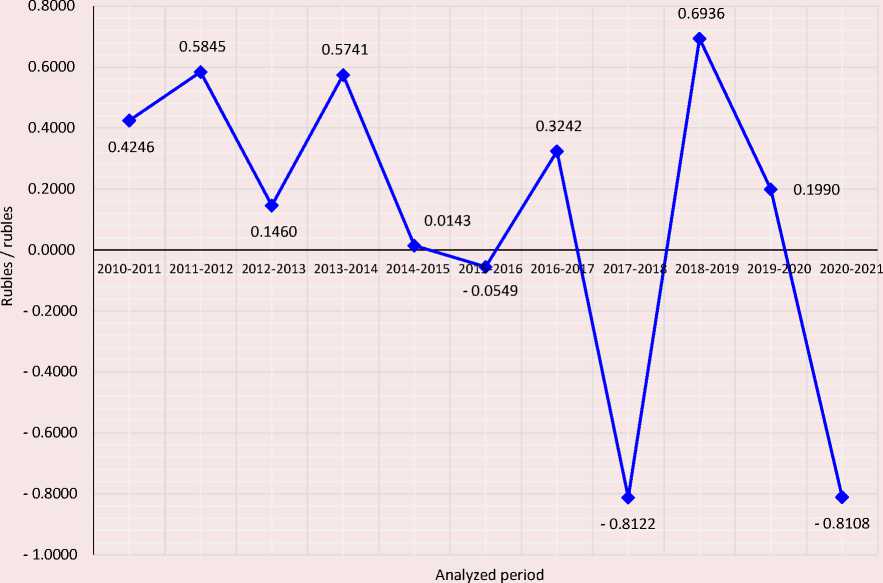
Note: calculated based on the developed economic-mathematical model of Russia’s innovative development. Source: own calculation.
Despite constantly increasing research expenditures – from 741.59 billion rubles in 2010 to 830.87 billion rubles in 2021 – their effectiveness decreased from 0.4246 rubles/rubles in 2010–2011 and even turned negative to -0.8108 rubles/rubles in 2020–2021 (Fig. 3). This is explained by the fact that the predominant result of research activities in the analyzed period was publications, especially in foreign journals and publishing houses. The process of implementing results into production was of secondary or sometimes even no importance. Periodic spikes in efficiency improvement in 2013– 2014 (from 0.1460 to 0.5741 rubles/rubles), in 2016– 2017 (from -0.0549 to 0.3242 rubles/rubles), and especially from -0.8122 to 0.6936 rubles/rubles in 2018–2019 respectively, are due to governmental attempts to create conditions for implementing research results into production (specifically, the creation of science cities, the National Technology Initiative Project Support Fund, (Skolkovo Foundation), the Foundation for Promotion of Small Innovative Enterprises (Innovation Promotion Fund), etc.), as well as the implementation of developments from previous years. However, as we can see, these efforts are insufficient.
At the same time, it should be emphasized that generally this factor has a negative impact on GDP: for every additional ruble invested in science, GDP grows by a smaller amount, so we can state a slowdown in its growth. In our opinion, the continued work of the “Priority-2030” program8 to improve the current situation will yield positive results.
Second, the influence of the factor “implementation of research results in production” on GDP change is no less significant ( Fig. 4 ).
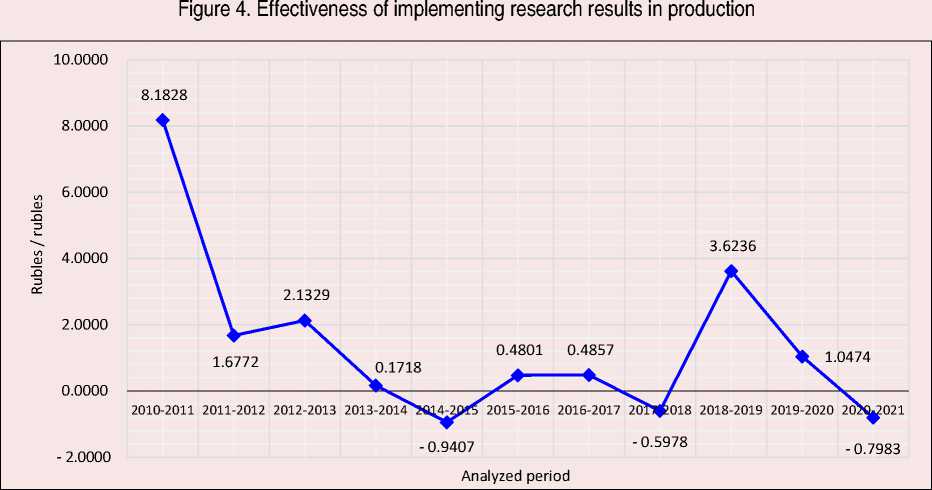
Note: calculated based on the developed economic-mathematical model of Russia’s innovative development. Source: own calculation.
We can see (Fig. 4) that in the analyzed period, there was a downward trend in the effectiveness of implementing research results into production, as it dropped from 8.1828 rubles/rubles in 2010– 2011 to a negative value of -0.7983 rubles/rubles in 2020–2021. This situation is explained by the near-complete depletion of Russia’s production potential, which is also confirmed by the persistent decrease in the growth rate of expenditures on implementing research results. A certain jump in this indicator from -0.5978 to 3.6236 rubles/rubles in 2018–2019 indicates the effect obtained from the aforementioned recent efforts to implement research results. This characterizes not only a slowdown in Russia’s GDP growth due to this factor but also its decline at the end of the analyzed period, as research results find virtually no support in the economy.
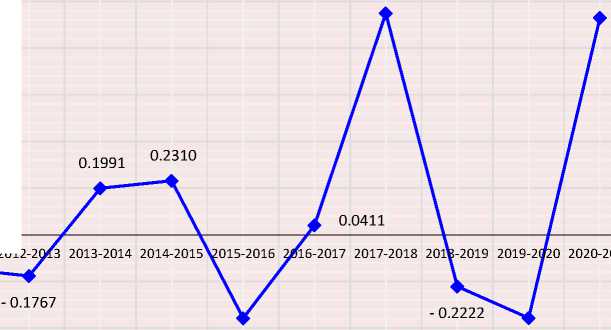
Third, the influence of net exports on GDP change is presented in Figure 5.
Under current conditions, this trend looks most paradoxical (Fig. 5). Despite the increase in GDP due to net exports from 0.0856 rubles/rubles in 2010–2011 to 0.9301 rubles/rubles in 2020–2021, a trend of gradual slowdown in its impact is evident. Although certain breakthroughs are observed in 2017–2018 (from 0.0411 to 0.9489 rubles/rubles, respectively) and in 2020–2021 (from a negative value of -0.3566 to 0.9301 rubles/rubles), they are, unfortunately, associated with a slight increase in Russia’s export opportunities, mainly in the raw materials sector, and, crucially, with a significant decrease in imports related to restrictions imposed by Western countries.
In the long term, the trend of exports taking the lead over imports should become a natural result of the innovative development of the Russian economy.
These are just some data on the influence of the economy’s innovative capacity on GDP change.
-
Figure 5. Effectiveness of net exports
1.2000
0.8000
0.6000
ф
0.4000
0.2000
0.0000
0.0856
1.0000
о
- 0.2000
- 0.4000
- 0.6000
2010-2011
0.9489
0.9301
1-2012
- 0.1432
- 0.3575
- 0.3566
Analyzed period
Note: calculated based on the developed economic-mathematical model of Russia’s innovative development. Source: own calculation.
In the current situation, major tasks are set to improve conditions for the effective use of the economy’s innovative capacity to achieve high growth rates. In our opinion, the very adoption of the federal law on technological policy in Russia speaks to its paramount importance.
The economic structure of innovative development
Naturally, the phase of efficiency fluctuations (or the limits of a given factor’s influence) should aim for permanent GDP growth. This becomes achievable by selecting and justifying priorities in science, identifying the production base for implementing its results, and managing net exports. This implies building a system that spans from scientific research to the implementation of its results in production, contingent upon the economy’s successful assimilation of these results. In this case, the amplitude of efficiency fluctuations will, without a doubt, be minimal. Organizing this system and its institutionalization require immediate decisions today, as the current framework for this process has proven ineffective, a fact confirmed by the results obtained.
There should be such a combination of scientific research, implementation of its results in production, and net exports that yields the maximum GDP growth rate.
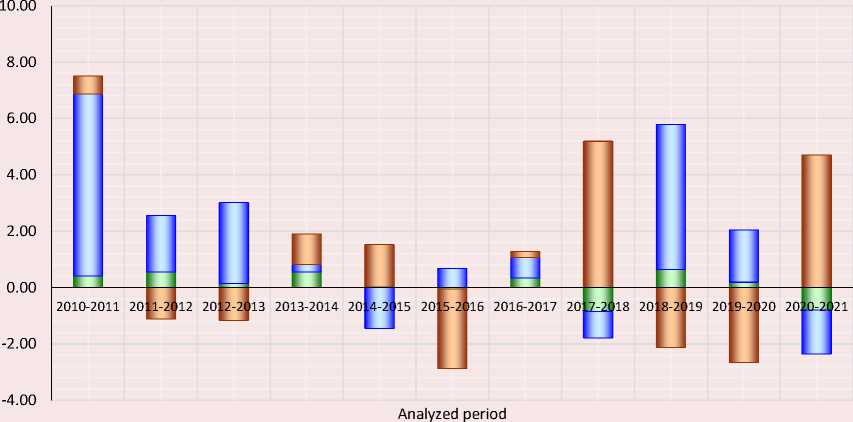
Alongside the steady decline in the role of imports in meeting existing and emerging needs in Russia, the implementation of research results into production becomes the determining factor for GDP growth ( Fig. 6 ).
It can be seen (Fig. 6) that while the implementation of research results in production is the main driver of GDP growth compared to other factors (scientific research and net exports), a process of gradual attenuation of this impact is observed. This fact, undoubtedly, necessitates production facilities restoration and, primarily, new production capacities construction. To resolve the issue – a decline in the contribution
Figure 6. Innovative development of the Russian economy
□ Contribution of net exports
□ Contribution of the implementation of research results in production
□ Contribution of scientific research
Note: calculated based on the developed economic-mathematical model of Russia’s innovative development. Source: own calculation.
of the implementation of research results to the GDP growth rate from 6.45% in 2010–2011 to a negative value of -1.55% in 2020–2021 so that GDP growth is restrained – favorable conditions for implementation should be created. As calculations show, the existing levers are insufficient.
Considering the contribution of factors influencing GDP change, the structure of such a contribution should be noted ( Tab. 2 ).
The data in Table 2 clearly demonstrate the impact of the dominant factor – the implementation of research results in production – on GDP dynamics. In these conditions, the transformation of innovative development should begin with shifts in the reproductive, sectoral, and technological structures of the Russian economy.
Taxonomy of intensification of the Russian economy
A primary focus on using innovative capacity, rather than simply scaling up production, will give new meaning to the very concept of “economic intensification”, which lies in the impact of innovative development on GDP growth within the limits of influence of the studied factors ( Tab. 3 ).
The data in Table 3 reveal the full picture of the taxonomy of Russian economic intensification.
Table 2. Economic structure of Russia’s innovative development
|
Indicator name |
Analyzed period |
||||||||||
|
2010– 2011 |
2011– 2012 |
2012– 2013 |
2013– 2014 |
2014– 2015 |
2015– 2016 |
2016– 2017 |
2017– 2018 |
2018– 2019 |
2019– 2020 |
2020– 2021 |
|
|
R expenditures |
5.48 |
14.87 |
3.42 |
29.32 |
0.49 |
(1.56) |
26.09 |
(12.20) |
8.18 |
4.07 |
(11.33) |
|
I expenditures |
86.05 |
54.80 |
68.80 |
13.86 |
(48.70) |
19.27 |
57.26 |
(13.39) |
65.06 |
39.44 |
(21.99) |
|
Net exports |
8.48 |
(30.33) |
(27.79) |
56.82 |
50.82 |
(79.17) |
16.65 |
74.41 |
(26.77) |
(56.49) |
66.67 |
|
Real GDP growth rate |
100 |
100 |
100 |
100 |
100 |
(100) |
100 |
100 |
100 |
(100) |
100 |
Source: own calculation based on data in Figure 6.
Table 3. Classification of economic intensification principles
|
Analyzed period |
Principles of economic growth intensification |
|||||||||||
|
I. Cost principle |
II. Efficiency principle |
III. Contribution principle |
||||||||||
|
Result |
Factors of economic intensification |
Result |
Factors of economic intensification |
Result |
Factors of economic intensification |
|||||||
|
CD О Q CD |
ecs CD co CD DC |
о -s с Й § = § i £ Ц p -5^0 |
+2 CD § |
CD О o" Q CD |
CCS CD CO CD DC |
ci -s с Й i Epp ci ® ,S £ |
+2 CD § |
CD О o" CD |
CCS CD CO CD DC |
ci -s i Epp ,E £ |
+2 CD § |
|
|
2010–2011 |
7.50 |
9.23 |
11.92 |
78.85 |
7.50 |
4.88 |
94.13 |
0.98 |
7.50 |
5.48 |
86.05 |
8.48 |
|
2011–2012 |
1.45 |
10.74 |
14.83 |
(74.42) |
1.45 |
24.30 |
69.74 |
(5.95) |
1.45 |
14.87 |
54.80 |
(30.33) |
|
2012–2013 |
1.86 |
12.16 |
19.33 |
(68.51) |
1.86 |
5.95 |
86.86 |
(7.19) |
1.86 |
3.42 |
68.80 |
(27.79) |
|
2013–2014 |
1.91 |
11.23 |
17.11 |
71.66 |
1.91 |
60.75 |
18.18 |
21.07 |
1.91 |
29.32 |
13.86 |
56.82 |
|
2014–2015 |
0.08 |
9.77 |
(13.76) |
76.47 |
0.08 |
1.21 |
(79.31) |
19.48 |
0.08 |
0.49 |
(48.70) |
50.82 |
|
2015–2016 |
-2.18 |
(13.23) |
19.46 |
(67.31) |
-2.18 |
(6.15) |
53.79 |
(40.06) |
-2.18 |
(1.56) |
19.27 |
(79.17) |
|
2016–2017 |
1.28 |
13.15 |
19.44 |
67.41 |
1.28 |
38.10 |
57.07 |
4.83 |
1.28 |
26.09 |
57.26 |
16.65 |
|
2017–2018 |
3.41 |
(7.49) |
(11.48) |
81.03 |
3.41 |
(34.43) |
(25.34) |
40.23 |
3.41 |
(12.20) |
(13.39) |
74.41 |
|
2018–2019 |
3.68 |
9.31 |
17.16 |
(73.52) |
3.68 |
15.28 |
79.83 |
(4.89) |
3.68 |
8.18 |
65.06 |
(26.77) |
|
2019–2020 |
-0.61 |
12.56 |
24.55 |
(62.89) |
-0.61 |
12.41 |
65.34 |
(22.25) |
-0.61 |
4.07 |
39.44 |
(56.49) |
|
2020–2021 |
2.36 |
(7.43) |
(14.82) |
77.75 |
2.36 |
(31.93) |
(31.44) |
36.63 |
2.36 |
(11.33) |
(21.99) |
66.67 |
Note: the combined influence of factors is 100%.
Source: own compilation based on data in Figures 3, 4, 5, 6.
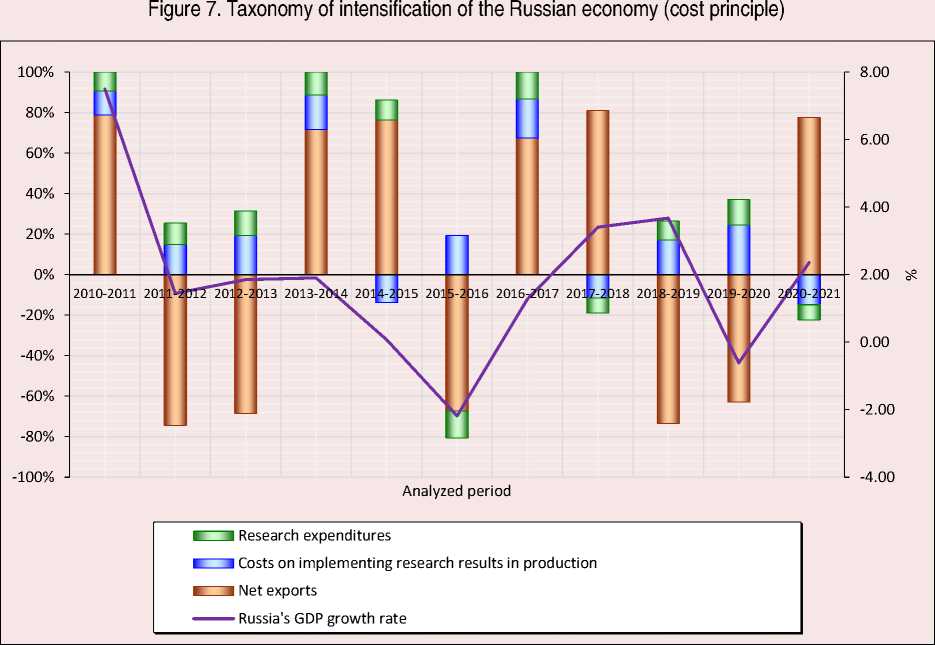
According to the cost principle, economic intensification is presented in Figure 7.
We can see (Fig. 7) that the cost structure for intensifying the Russian economy contributes not only to inertial GDP growth, mainly due to factors like net exports, but also to a decline in growth from 7.50% to 2.36% over the analyzed period. In this case, the main components of investment flows into economic intensification that do not lead to an increase in GDP growth rates are expenditures on research and on implementing its results.
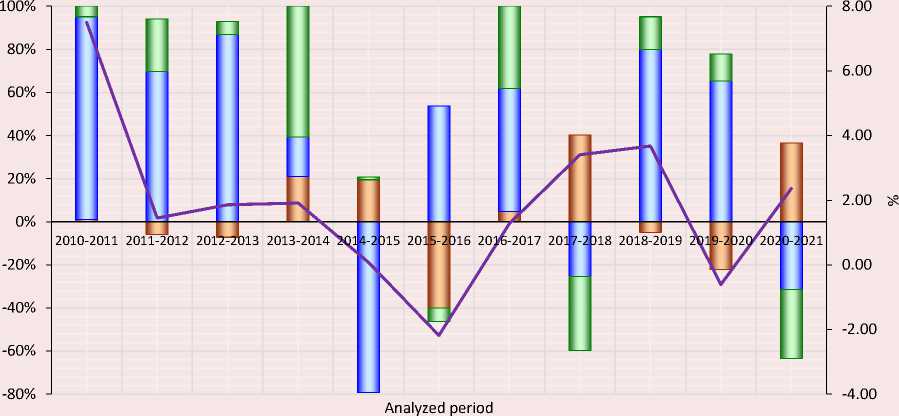
The Russian economy intensification based on the efficiency principle is presented in Figure 8.
At the same time, the shift in the structure of Russia’s economic intensification (Fig. 8), despite the fluctuations in GDP growth rates, toward the efficiency of scientific research and the efficiency of implementing its results in production indicates a reduction in the payback period for these expenditures, meaning that the period for utilizing scientific and technical achievements in the production process is shortened.
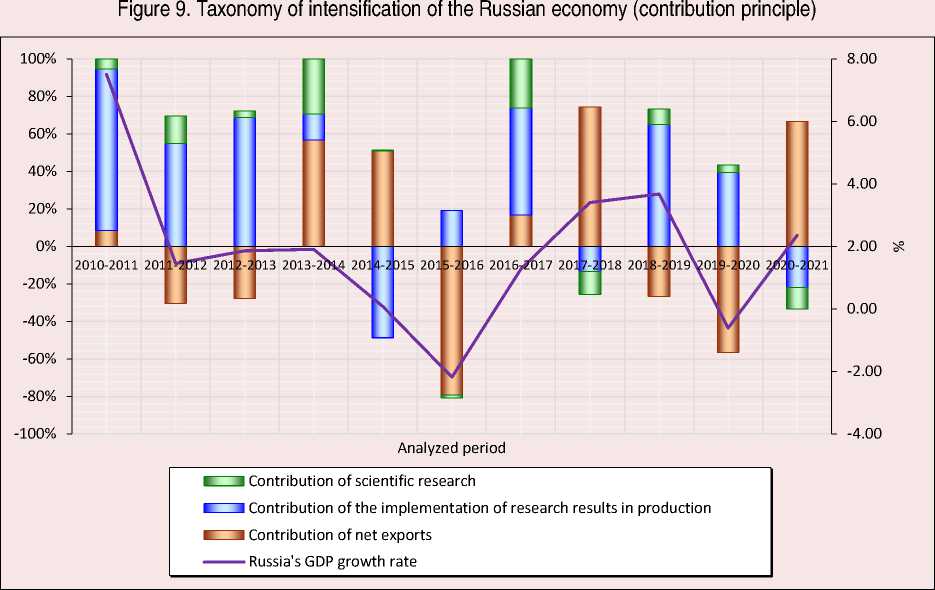
Finally, the contribution principle of the Russian economy intensification is presented in Figure 9.
Accordingly, the economic structure of Russia’s innovative development, or the structure of the factors’ contribution to the real GDP growth rate (Fig. 9), suggests that achieving imperative economic growth at the current stage will be extremely difficult. The contribution of scientific research and the implementation of its results in production to the GDP growth rate from 2010 to 2021 is minimal and steadily declining.
In this regard, the taxonomy of economic intensification reveals and substantiates ways to regulate innovative development in order to achieve the desired GDP values in the future.
Calculated based on: data in Table 3.
Figure 8. Taxonomy of intensification of the Russian economy (efficiency principle)
■ ■ Research efficiency
■ — ■ Efficiency of the implementation of research results in production
■ _ J Net exports efficiency
^^^^^^^^ Russia's GDP growth rate
Calculated based on: data in Table 3.
Calculated based on: data in Table 3.
In light of the above, it can be argued that economic intensification is a process accompanied by qualitative changes (reorganization) of the economic structure of innovative development (through the use of innovative capacity). In other words, this is a type of movement associated with the accelerated achievement of the resulting indicator (GDP growth rate) and its maintenance at the required level (e.g., optimal or maximum value) under the prevailing conditions.
The analysis of the Russian economy intensification allows us to establish the following patterns of innovative development:
The decline in GDP growth rates is explained, first, by the negative influence of scientific research and net exports, and, second, by the positive impact of implementing research results in production. In this context, when transitioning to positive values in research and implementation simultaneously with a negative influence of net exports, a reduction in the downturn of the Russian economy is observed, indicating an increasing importance of scientific research.
Minimal influence of scientific research and the implementation of its results in production allows maximizing Russia’s GDP growth rate. At the same time, the influence of net exports allows achieving such GDP growth rates only at its maximum, peak values. This means that science and the implementation of its results in production ensure intensive economic growth, when a stable interaction between science and industry is being established. Net exports, in turn, tend to have an extensive impact on economic growth.
This follows from the previous points. There is a tendency toward a compensatory effect of the considered factors on positive GDP dynamics.
Across the entire Russian economy, the development of these natural tendencies will contribute to imperative growth.
The predictive function of innovative development of the Russian economy
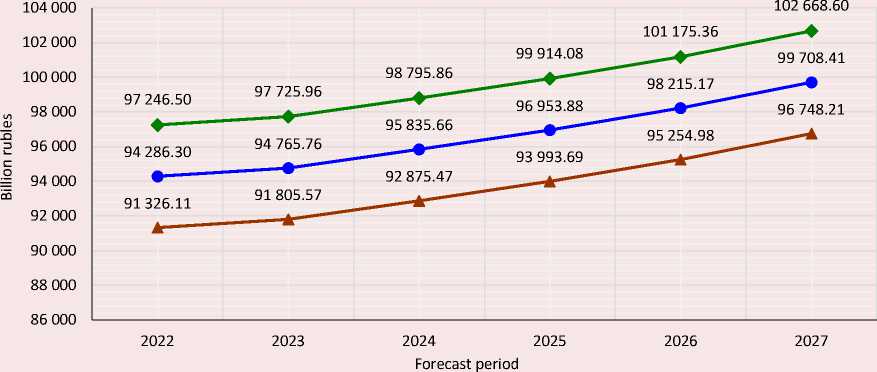
Assessing the current intensification of the Russian economy requires making a forecast of the impact of innovative development on its growth. According to the developed economic-mathematical model of innovative development, the point and interval forecast of inertial GDP change is presented in Figure 10.
Figure 10. Inertial growth of the Russian economy
Calculated GDP (point) GDP lower limit (interval) GDP higher limit (interval)
Note: calculated based on the developed economic-mathematical model of Russia’s innovative development. Source: own calculation.
It is easy to notice (Fig. 10) that in the forecast period, while maintaining the influence of the studied factors, GDP dynamics is not changed significantly. On the contrary, their contribution to it constantly decreases. They have considerable influence provided that Russian production capacities are overloaded, which may subsequently lead to the depletion of the economy’s innovative capacity.
In accordance with the calculations performed, to characterize the imperative growth of the economy, we will use structural contribution indicator. Achieving its required value facilitates imperative economic growth.
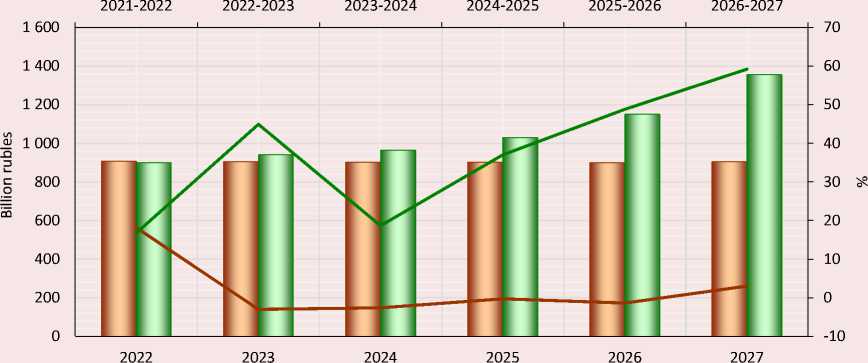
Within the framework of the identified innovative economic development pattern, the growing influence of research is presented in Figure 11.
The anticipated transformations of the Russian economy’s innovative capacity (Fig. 11), causing qualitative changes in science, lead to significant transformations in management. The process of assessing the quality of scientific research acquires important new features. This set of issues requires immediate consideration in the near future.
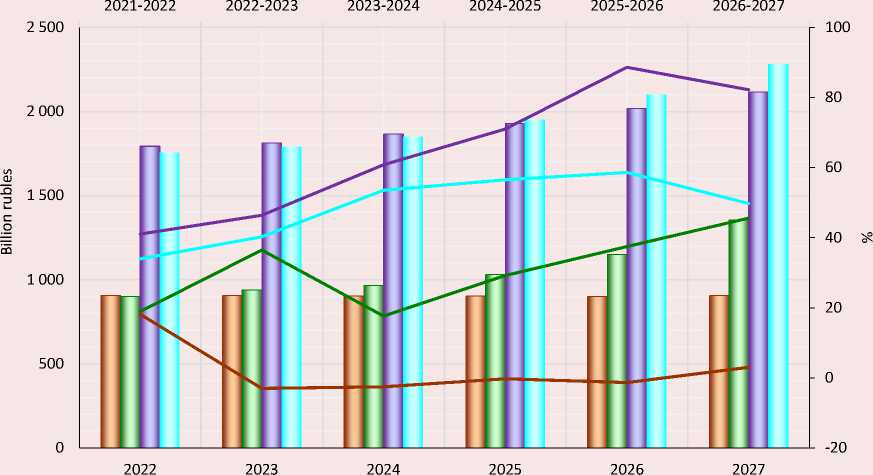
Undoubtedly, the development of science has been and remains an objective pattern for the effective use of the economy’s innovative capacity. However, the practical implementation of new scientific ideas today, as always, is no less important than their development. In this regard, the established pattern concerning the combined influence of scientific research and the implementation of its results in production reveals the following picture of the Russian economy intensification in the forecast period ( Fig. 12 ).
Figure 11. Imperative growth of the Russian economy
Forecast period
i i Research expenditures (conservative growth of the economy)
Research expenditures (imperative growth of the economy)
Structural contribution of research (conservative growth of the economy)
Structural contribution of research (imperative growth of the economy)
Note: calculated based on the developed economic-mathematical model of Russia’s innovative development. Source: own calculation.
Figure 12. Experimental growth of the Russian economy
Forecast period
L Л Research expenditures (conservative growth of the economy)
Research expenditures (experimental growth of the economy)
■ ■ Costs on implementing research results in production (conservative growth of the economy)
Costs on implementing research results in production (experimental growth of the economy)
^^^^^^^^мStructural contribution of research (conservative growth of the economy)
^^^^^^^^м Structural contribution of research (experimental growth of the economy)
^^^^^^^^ш Structural contribution of the implementation of research results in production (conservative growth of the economy)
^^^^^^^MStructural contribution of the implementation of research results in production (experimental growth of the economy)
Note: calculated based on the developed economic-mathematical model of Russia’s innovative development. Source: own calculation.
It seems that this variant of economic intensification (Fig. 12) allows using innovative capacity more effectively, shaping its rational state and the desired economic structure to prevent its premature depletion. In other words, a coherent system is being built, and the innovative development of the Russian economy is being fine-tuned. The ongoing changes in innovative capacity can significantly accelerate economic intensification and establish a faster, broader, and more effective implementation of scientific and technical achievements.
It is worth noting that in the forecast period, the Russian economy, unfortunately, cannot do without imports. At the same time, its impact (structural contribution) on economic growth under the emerging conditions of intensification is systematically decreasing, from 28.72% in 2022– 2023 to 6.22% in 2026–2027, despite its slowdown in 2021–2022 (-41.51%). The same picture is observed with experimental economic growth – a decrease from 23.26% in 2022–2023 to 4.74% in 2026–2027. The growth slowdown here amounts to -47.10% in 2021–2022. The negative values characterizing the slowdown in economic growth are just a natural outcome of previous periods.
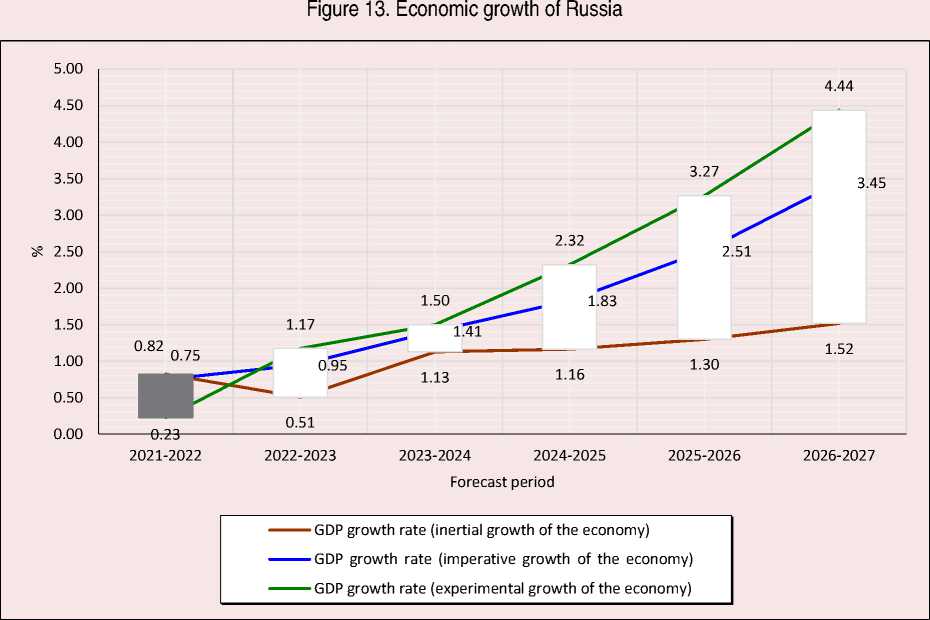
All this substantiates the choice between the identified variants of intensifying the Russian economy – variants of the economic structure of innovative development. So, the rate and scale of economic growth depend on the effectiveness of using innovative capacity (Fig. 13).
The choice in favor of one or another variant should be made based on the feasibility of forming specific conditions for Russian economy intensification. We believe that the most acceptable variant is associated with the experimental growth of the Russian economy, under which the maximum GDP growth rate can be achieved (Fig. 13).
Overall, it can be argued that forecasting innovative development is the basis for formulating, selecting, and substantiating promising paths for Russian economy intensification.
Note: calculated based on the developed economic-mathematical model of Russia’s innovative development. Source: own calculation.
The results obtained have led to the following conclusions.
The key characteristics of an economy’s innovative state have been identified as scientific research, the implementation of its results in production, and net exports. Together, these factors facilitate the entire process – from an idea, to its implementation, and finally its assimilation by the economy – which demonstrates the application of innovative capacity. The degree to which each of these identified factors impacts GDP dynamics determines the innovative development of the economy. Consequently, when aiming for intensification, innovative development should be viewed as a reflection of qualitative transformations within the economy.
Using the developed economic-mathematical model of innovative development, we assessed the influence of the factors under study on changes in GDP. This assessment reflects the efficiency of utilizing Russia’s innovative capacity. Overall, it should be noted that the assessment indicates a modest impact of innovative development on the dynamics of this final economic indicator.
The contribution of these factors to the GDP growth rate reveals the economic structure of Russia’s innovative development. The factor exerting the greatest influence is the implementation of scientific research results in production.
Based on this, a taxonomy for economic intensification was established, founded on specific principles: costs, efficiency, and the contribution of the identified factors. Applying this taxonomy allowed determining the patterns of innovative development in the Russian economy.
Through forecasting the innovative development of the economy, three types of economic growth for Russia have been substantiated: inertial, imperative, and experimental. In the authors’ view, the experimental growth path is the most preferable for Russia.
Taken together, the above constitutes a methodological approach that differs from those already existing. Its essence lies in the fact that the assessment reflects the final results achieved through the impact of innovative development (from idea to implementation and economic assimilation) on the change in the final indicator, thereby revealing opportunities for economic intensification. Its uniqueness lies in its applicability at various levels: a region, a territory, an economic area, an association of enterprises (a complex), or an individual production enterprise.
Based on the foregoing, a method for assessing the innovative development of an economy is proposed. This method involves calculating the efficiency of using its innovative capacity. This is achieved by decomposing it into its components, determining the effect of the aforementioned factors on the final economic indicator, aggregating this effect, isolating their individual contributions, and constructing a structure of these contributions.
In light of the above, the application of the method developed by the authors consists of a sequence of the following procedures:
– defining the innovative state of the economy;
– assessing the efficiency of the factors under study;
– determining the contribution of the factors under study to the growth rate of the final economic indicator;
– on this basis, constructing a taxonomy of economic intensification to regulate its innovative development.
Accordingly, economic intensification is a process accompanied by qualitative changes (a restructuring) of the economic structure of innovative development (through the use of innovative capacity). It represents a type of dynamic focused on accelerating the achievement of the resulting indicator (the GDP growth rate) and maintaining it at the required level (e.g., optimal or maximum value) under the prevailing conditions.
All of this determines a new quality of economic growth, namely the selection of its type based on the proposed principles of economic intensification. This, in turn, allows for a more comprehensive consideration of the prospects for innovative development when constructing the mechanism for the economy’s functioning. In other words, it concerns a new qualitative substance for the growth rates of the final economic indicator.
The outlined measures and initiatives aimed at addressing the priority tasks of economic intensification can and should form the basis for developing a comprehensive scientific and technical program for Russia to achieve technological independence for its economy. In addition to this, to ensure genuine, true, and proper technological sovereignty for the Russian Federation at the current, initial stage of this process, the first step of the proposed comprehensive scientific and technical program should be the immediate reinstatement of the federal law on scientific discoveries, which ceased to be in effect in Russia in 1992. The consequences of its absence are evident, and we are witnessing them today. This federal law would become the primary resource for implementing the program and, most importantly, is precisely what is needed to accomplish this.
