
The Persuasiveness of Digital Transformation in the Global Competitive Economies: The Gains, The Pains and The Balancing Strategy
Journal: International Journal of Information Engineering and Electronic Business @ijieeb
Article in issue: 1 vol.18, 2026.
Free access
Digital transformation has emerged as a critical driver of economic growth and competitiveness in the global economy. By integrating advanced technologies such as artificial intelligence, blockchain, cloud computing, and the Internet of Things (IoT), organizations across industries are reshaping their operational models, enhancing productivity, and promoting innovation. This study examines the multifaceted impact of digital transformation on global economy competitiveness, focusing on how businesses, governments, and societies are adapting to the rapidly evolving digital landscape. It describes the evolution of digital transformation through the literature review, while highlighting the key digital transformation drivers, gains, challenges, and the relationship between digital transformation and global economy with United States of America, United Kingdom, China and South Africa as case studies using a systematic literature review approach. The study underscores the necessity for digital transformation implementation strategy to sustain competitive advantage in an interconnected world. The findings contribute to a deeper understanding of how digital transformation not only disrupts traditional economic paradigms but also creates opportunities for sustainable growth and innovation in the 21st century by presenting an all-inclusive comprehensive digital transformation implementation strategy for the global competitive economy.
Similar articles in the section Communication and transport industries. Accountancy. Business management. Public relations



Short address: https://sciup.org/15020164
IDS: 15020164 | DOI: 10.5815/ijieeb.2026.01.05
Text of the scientific article The Persuasiveness of Digital Transformation in the Global Competitive Economies: The Gains, The Pains and The Balancing Strategy
Published Online on February 8, 2026 by MECS Press
Digital transformation, characterized by the integration of digital technologies across industries and societal frameworks has emerged as a critical force shaping the contours of global competitive economies in the 21st century. This phenomenon transcends mere technological adoption to encompass deeper changes in organizational structures, business models, and value creation processes [1]. In an era marked by rapid technological advancements, such as artificial intelligence (AI), blockchain, and the Internet of Things (IoT), digital transformation has become synonymous with innovation, agility, and resilience. The key attributes for nations and enterprises striving to maintain or enhance their competitive edge in the global economy [2]
The increasing ubiquity of digital technologies has significantly disrupted the traditional economic paradigms. From enabling seamless global supply chains to fostering data-driven decision-making, digital transformation has redefined how businesses operate and compete [3]. Moreover, it has created unprecedented opportunities for economic growth and development, particularly for emerging economies leveraging digital tools to leapfrog traditional industrialization pathways [4]. According to the World Economic Forum [5], digital transformation contributes significantly to GDP growth, with estimates suggesting a potential $18 trillion boost to the global economy by 2030. This transformation is evident in key industries such as manufacturing, healthcare, Education, Advertising, Security, and finance, where advancements in artificial intelligence (AI), the Internet of Things (IoT), and cloud computing have revolutionized traditional models.
However, the journey toward digital transformation is also fraught with challenges, particularly for emerging economies, as many economies struggle to balance the advantages and challenges of digital transformation. Some businesses fail to fully capitalize on digital tools due to resource constraints, such as inadequate digital infrastructure, workforce skill gaps, and cybersecurity threats [6]. Furthermore, the United Nations Conference on Trade and Development [7] asserts that the regulatory and infrastructural disparities across countries exacerbate the uneven distribution of digital transformation benefits, further widening the digital divide. Addressing these challenges to stimulate inclusive and sustainable digital growth requires coordinated efforts from governments, businesses, and international organizations.
Given these complexities, there is a pressing need to develop a strategy that organizations and economies can adopt to maximize the gains of digital transformation while mitigating its negative consequences. This study explores the dynamics of digital transformation in global competitive economies, identifying its several types, key drivers, success factors, and challenges. and effective balancing strategies that ensure sustainable and inclusive economic growth. By examining empirical evidence and theoretical frameworks, the study provides a comprehensive understanding of how digital transformation shapes economic competitiveness in an interconnected world. Ultimately, an all-inclusive implementation strategy encompassing all the various digital transformation types that ensure sustainable and inclusive economic growth is presented, specifically for the stakeholders in the global competitive economies.
2. Literature Review
Digital transformation (DT) refers to the integration of digital technologies into all areas of business, fundamentally reshaping global economies by altering how organizations operate and deliver value to customers. It encompasses technological advancements, organizational restructuring, and cultural shifts aimed at enhancing performance and adaptability in a rapidly evolving digital landscape, and has therefore become a crucial driver for innovation, productivity, and economic growth within the global competitive economies. Marino-Romero and Folgado-Fernández [8] emphasize that digital transformation is not just a technological upgrade but a comprehensive transformation affecting economic and financial structures globally.
The evolution of digital transformation in global economies is a dynamic and multifaceted process, shaped by technological advancements, economic demands, and socio-political factors. Its origin is traced to the adoption of information technology (IT) in businesses and automation of manual tasks between 1960s and 1980s which focus was to improve operational efficiency through mainframe computers and enterprise resource planning (ERP) systems [9]). Castells [10] , in “The Rise of the Network Society: The Information Age - Economy, Society, and Culture”, discusses how the advent of the internet in the late 1990s redefined global economic structures to create networked economy by enabling globalization through communication, commerce, and connectivity revolution.
The emergence of the data-driven and AI-enable economies of the 2020s made big data analytics, artificial intelligence (AI), and machine learning (ML) to become critical drivers of digital transformation, enabling organizations to use data to make informed decisions, optimizing supply chains, and personalizing customer experiences. Yoşumaz [11] highlights the importance of big data analytics and artificial intelligence in driving competitive advantage. Furthermore, the COVID-19 pandemic accelerated digital transformation adoption, pushing organizations and governments to embrace remote work, digital services, and e-governance at unprecedented rates. Verhoef et al. [12] in “Digital Transformation: A Multidisciplinary Reflection and Research Agenda” emphasize that the pandemic underscored the need for resilience and agility, prompting investments in digital infrastructure.
Leão and Silva [13]observe that digital transformation significantly influences organization competitive advantages by enhancing innovation, operational efficiency, and costs reduction through increased specialization, expanded geographic reach, and improved governance structures within global value chains. It also impacts global competitiveness by enabling countries to enhance productivity and economic growth through the integration of digital technologies resulting to more efficient processes, opens new markets, and fosters innovation ecosystems. This assertion is corroborated by the European Commission [14] report, which highlights correlation between digital transformation and economic performance across member states. According to Skare et al. [3] the Fourth Industrial Revolution which is characterized by the convergence of physical, digital, and biological technologies, has transformed global value chains and reshaped competitive dynamics.
Despite the numerous benefits of digital transformation like reshaping the global economic landscape by driving innovation, productivity, and competitiveness, organizations often face unique challenges in its implementation, particularly in the developing economies. Marino-Romero and Folgado-Fernández [8] note that issues like inadequate infrastructure, limited access to technology, and insufficient digital skills hinder the effective adoption of digital practices. Furthermore, the lack of leaders with sufficient digital literacy to make informed decisions is considered as a major challenge for digital transformation implementation [15] while Saeed et al. [6] present fears of data breaches, security vulnerabilities, and regulatory non-compliance as barriers to digital transformation adoption. The authors assert that addressing these challenges requires coordinated efforts from all the stakeholders both in public and private sectors to build necessary capabilities and frameworks.
Cosa [16] emphasizes the long-term socio-economic effects of digital transformation and the development of implementation strategies as future research priorities to promote global inclusiveness and sustainable digital growth. However, a comprehensive strategy outlining implementation procedures for the digital transformation has yet to be developed. This study seeks to address this critical gap by proposing a holistic and inclusive digital transformation implementation strategy tailored to the needs of global competitive economies.
3. Research Methodology
The study adopts a systematic literature review methodology that followed a structured review research approach to ensure a rigorous and transparent analysis of the available literature. A review research is described as research inquiries that apply scientific methods to analyze and synthesize previous researches to develop new knowledge for academic, practice and policy-making purposes [17]. According to Alegre et al. [18] and Marzi et al. [19] the motivation behind the reviewing and analysis of academic articles is to identify research gaps, explore the underresearched areas and activate the introduction of new theories or ideas.
This study research review follows series of steps to produce the desires outcomes. The first step is the informal scanning of the literatures called search strategy, a series of tasks to gain further familiarity with the area under scrutiny that defines the potential strategic contribution of the study overall [20]. The search strategy identified relevant articles, reports, and other documents through systematic searches of academic databases such as Scopus, Web of Science, Google Scholar, and Emerald Insight, books and organizations’ researched reports. The search terms included Digital Transformation, Global Economy, Innovation, Technology Adoption, and Digital Economy. This initial search produced 1648 articles.
The inclusion and exclusion criteria were defined to enable steady focus on the research area. Studies were included if they: Focused on the impact of digital transformation on the global economy; were published in peer-reviewed journals, academic conferences, or reputable research reports; were written in English; addressed specific aspects of digital transformation on global economy. However, studies were excluded if they: were purely theoretical or conceptual without empirical evidence related to digital transformation on global economy; focused solely on specific technologies without considering their broader economic impact; were not accessible or available in full-text format. This process narrowed the search to 143 potentially relevant articles.
The second step in the process is the data extraction and synthesis of the literatures, reports and documents. Relevant information was extracted from the selected materials using standardized data extraction form. The extracted data included: Authors and publication year; Research objectives and methodology; Key findings and conclusions; Specific identified challenges and opportunities; Recommendations for policy, practice, and further work. Finally, the extracted data was analyzed using thematic analysis to identify recurring themes and patterns related to the impact and adoption of digital transformation on global economy, including the development and adoption of digital transformation in varying economies of USA, UK, China and South Africa. In total 99 articles, books and reports were thematically analyzed for the study.
4. Findings and Discussion 4.1. Theoretical Perspectives on Digital Transformation and Economies
Digital transformation is shaping economic competitiveness, as organizations adopt advanced technologies, understanding its impact on economic competitiveness requires examining its various theoretical perspectives on the economies. Findings from the literature revealed the key theoretical perspectives that analyze the relationship between digital transformation and economic competitiveness. Technological Disruption Theory explores how emerging technologies reshape markets and value networks, often leading to the decline of established firms and the emergence of new competitors [21].
In digital context, digital transformation drives disruptive innovations that challenge traditional business models, forcing organizations to adapt or risk obsolescence. This theory aligns with Joseph Schumpeter’s Innovation Theory, which highlights continuous innovation as a key driver of economic growth and competitiveness [22]. It provides a strong theoretical foundation for understanding the link between digital transformation and economic competitiveness, asserting that digital innovations propel economic change through creative destruction, fostering new industries and enhancing productivity.
In another perspective, Resource-Based View (RBV) asserts that an organization’s internal resources and capabilities play a crucial role in securing a competitive advantage. Within the realm of digital transformation, this perspective highlights the strategic use of digital assets, such as data analytics, proprietary technologies, and digital skills to drive efficiency and innovation [23]. However, the rapid pace of technological change challenges the sustainability of competitive advantages derived solely from internal resources, as digital transformation reshapes business operations, necessitating a re-evaluation of traditional RBV frameworks. Valentowitsch et al. [24] argue that the pervasive adoption of digital technologies and the growing significance of data disrupt conventional RBV assumptions. They advocate for a revised model that prioritizes continuous adaptation and resource reconfiguration over long-term sustainability, emphasizing agility as a key factor in maintaining competitiveness in dynamic digital environments.
The Dynamic Capabilities Framework builds upon the Resource-Based View (RBV) by emphasizing on business organization's ability to adapt, integrate, and reconfigure both internal and external competencies in response to changing environments [25]. In the digital era, dynamic capabilities play a vital role in enabling firms to rapidly adapt to technological advancements and market fluctuations. Research suggests that these capabilities have a significant impact on performance, often mediated by innovation capabilities, this highlights the need for continuous resource development and adaptation to sustain competitiveness [26]. Digital transformation necessitates the development of key capabilities such as agility, technological proficiency, and data-driven decision-making. Organizations with robust dynamic capabilities can effectively harness emerging technologies, navigate market disruptions, and maintain longterm economic competitiveness [27].
The traditional models typically focus on firm-specific resources or industry structures. In contrast, the networkcentric perspective underscores the significance of interorganizational networks in the digital economy. As digital technologies dissolve industry boundaries, value creation increasingly depends on cross-firm, cross-industry, and crosssector collaborations [28-29]. This view maintains that an organization's network position and its ability to manage relationships are crucial for maintaining a competitive edge [30]. It further argues that companies harness network effects to dominate markets, illustrating how digital platforms transform competitive dynamics by expanding global reach, lowering entry barriers, and enhancing customer engagement.
On the other hand, the Triple Helix model illustrates the dynamic interactions between universities, industries, and governments to drive innovation [31-32]. Expanding on this concept, Quadruple Helix model integrates the public and media, heightening the increasing influence of civil society in the innovation ecosystem [33]. These models highlight that digital transformation and economic competitiveness stem not only from individual firms but also from collaborative engagements among multiple societal stakeholders [34].
Finally, the institutional theory examines how digital transformation is shaped by regulatory frameworks, cultural norms, and organizational structures [35]. It provides a valuable lens for understanding digital transformation, underscoring how organizations conform to external pressures, norms, and regulations to gain legitimacy. This perspective explains why organizations adopt digital technologies not only for efficiency but also to align with industry standards, regulatory requirements, and cultural expectations [36]. Governments and institutions play a crucial role in fostering an environment conducive to digital adoption through policies that promote digital literacy, infrastructure development, and cybersecurity. Countries with favourable institutional settings are more likely to experience enhanced economic competitiveness [37].
These theoretical perspectives provide valuable insights into the relationship between digital transformation and economic competitiveness. While innovation drives disruption, firms must develop strategic capabilities, leverage digital resources, and adapt to institutional settings to remain competitive. As digital transformation accelerates, economies that embrace these theoretical foundations will be better positioned for sustainable growth and global competitiveness.
-
4.2. Digital Transformation Drivers
Digital transformation in the global competitive economies is driven by a combination of technological advancements, economic pressures, organization changes, changing consumers’ expectations, and environmental demands. Padmanabhan [38] submits that technological advancements are pivotal force behind digital transformation in the global economy. The emerging technologies such as artificial intelligence (AI), cloud computing, robotics, the Internet of Things (IoT), and 5G connectivity are enabling businesses to enhance operational efficiency and develop innovative value propositions across industries, including manufacturing, education, finance, supply chain, transportation, and healthcare.
De Novi et al. [39] underscored the exponential growth of data as a key driver for the adoption of advanced analytics and machine learning to extract actionable insights. Corroborating this assertion, Mckinsey and Company [40]study, project that the global datasphere will expand to 250 zettabytes by 2030, highlighting the critical role of data-driven programmes in digital transformation. In addition, they estimated that AI adoption could contribute an additional US$13 trillion to the global economy by 2030.
According to the World Economic Forum [5], digital transformation is very essential for businesses striving to succeed in an increasingly interconnected global economy caused by the global economic pressure that compel companies to innovate swiftly in order to maintain a competitive edge. This heightened competitiveness has driven the widespread adoption of digital transformation. Similarly, the threat of disruption from digital and technology giants has accelerated the digital transformation efforts of established organizations [41]. Industries once considered resistant to digital disruption, such as healthcare, construction, and finance are now undergoing profound changes.
The present consumers’ demands for seamless and personalized experiences across all touchpoints are pushing for rapid adoption of digital transformation by various organizations [42]. By prioritizing personalization, real-time interactions, trust, and transparency, businesses can effectively address these evolving demands. As a result, the integration of physical and digital channels has become crucial for delivering an omnichannel experience, particularly in the retail and banking sectors. The implementation of digital solutions such as augmented reality, virtual reality, IoT, and blockchain are significantly enhancing customer experiences by offering innovative and secure services [12]. Retail organizations are increasingly leveraging data analytics and AI technologies to predict customer needs and provide tailored products recommendation, thereby promoting a highly personalized experience.
Besides, the stringent data privacy regulations and the growing sophistication of cyber threats are driving organizations to adopt secure digital solutions [43]. Technologies such as blockchain and artificial intelligence (AI) are being utilized to enhance security, improve transparency, and streamline compliance processes. In addition, Rahore [44] posits that the increasing awareness of environmental issues and social responsibility is encouraging businesses to adopt digital technologies for sustainable practices. Digital transformation facilitates sustainability by enabling energyefficient operations, optimizing resource utilization, and reducing waste through predictive analytics and smart technologies.
Digital transformation encourages international cooperation and innovation, allowing organizations to access global talent pools and shared infrastructure, resulting in costs reduction and risks mitigation while advancing innovation, agility, and resilience. The disruptions caused by events like the COVID-19 pandemic and geopolitical tensions have underscored the critical role of digital tools in maintaining supply chain agility. Obokoh et al. [45] assert that organizations are extending beyond traditional boundaries to build networks of partners, suppliers, and customers by embracing open innovation and platforms thinking.
According to Hai et al. [46], the hybrid and remote work models, collaboration platforms, and AI-driven tools are intrinsically transforming workplaces and compelling organizations to reimagine their talent strategies. This rapid adoption of remote work technologies has made digital transformation essential for sustaining productivity, prompting organizations to prioritize digital upskilling as a critical measure to bridge workforce skill gaps.
-
4.3. Types of Digital Transformation
The finding from the literature review highlights the different types of digital transformation, each addressing distinct areas within an organization. Among these, process transformation emerges as a key category, involving strategic and tactical efforts to redesign and optimize business processes through the use of digital technologies and automation. Its primary aim is to align processes with business and organizational goals more effectively [47]). Verhoef et al. [12] assert that the transformation enhances efficiency, scalability, reduces costs, and improves the customer experience by leveraging technologies such as artificial intelligence (AI), machine learning (ML), robotic process automation (RPA), and cloud computing. The goal is not just incremental improvement but radical rethinking of end-to-end processes to align with the dynamic demands of the digital economy [48]. For instance, Internet of Things (IoT) sensors can be employed to monitor equipment in real-time, enabling predictive maintenance and minimizing downtime.
On the other hand, Vial [1] describes business model transformation (BMT) as a significant aspect of digital transformation (DT), involving profound changes that organizations undergo by leveraging digital technologies to fundamentally innovate business processes, customer experiences, and organizational culture. These transformations are driven by competitive pressures, emerging technologies, and evolving customer expectations. It requires reconfiguration of the value creation, delivery, and capture mechanisms of a business through the strategic use of digital technologies [49]. Rather than simply enhancing existing processes through digitisation, it focuses on redefining entire processes using technology to develop new value propositions [50]. This often involves adopting innovative revenue models, such as subscription-based services, platform-driven businesses, or digital goods.
Domain transformation is another form of digital transformation, involving a strategic move of exploring digital technologies to enter new industries and develop innovative business models, products, or services, thereby enhancing an organization’s capabilities [51]. According to Verhoef et al. [12] domain transformation involves entering new geographical regions or launching entirely new product categories, often enabled by digital platforms and innovative technologies. For instance, a fintech company venturing into the insurance sector by offering customized policies through its digital tools, or an online bookstore evolving into a global leader in cloud computing, logistics, and streaming services. Contrary to merely enhancing existing processes, domain transformation involves adding entirely new markets or business domains to an organization’s portfolio by building or joining digital platforms and partnerships [52]. This transformation requires organizational agility, a robust digital infrastructure, and visionary leadership.
Besides, our literature review further identifies Customer Experience Transformation (CXT) as a type of digital transformation that has gained increasing attention in academic research and practice over the past decade. Customer Experience Transformation refers to the tactical reimagining and improvement of customer interactions and relationships through digital technologies, processes, and mindsets to enhance customer satisfaction, loyalty, and business outcomes [53]. Zhao et al. [54] explain customer experience transformation as a critical subset of digital transformation that focuses on leveraging digital technologies to enhance the way businesses interact with and serve their customers by adopting digital touchpoints integration, data-driven personalization, customer-centric design, realtime engagement, AI and automation techniques. CXT involves the re-envisioning of customer journeys, personalizing interactions, and optimizing touchpoints across various digital and physical channels [55]. The goal of CXT is to meet or exceed customer expectations in a rapidly evolving digital landscape, fostering loyalty, satisfaction, and competitive advantage.
Vial [1] defines digital transformation as a process that aims to improve an entity by triggering significant changes to its properties through combinations of information, computing, communication, and connectivity technologies. However, the author maintains that, these changes are only effective when aligned with cultural and organizational shifts, making cultural and organization transformation a critical foundation of digital transformation. This assertion is corroborated by Kane et al. [56] highlighting that digital maturity is more about people than technology, positing that organizations with digitally mature cultures foster innovation, risk-taking, and strategic thinking, making them more adaptable to future changes.
Therefore, cultural and organizational transformation involves redefining an organization's internal structures and operations to align with digital capabilities. This process requires shifting employees' mindsets and behaviours toward digital-first practices. According to Pfaff et al. [57] and Vlasenko et al. [58] such transformation fosters a culture of innovation, collaboration, and agility, supported by digital tools and technologies. Key elements include adopting new leadership models, reshaping organizational hierarchies, and utilizing digital tools to enhance collaboration and decision-making.
Finally, our findings reveal ecosystem transformation as another major type of digital transformation, which occurs when digital technologies enable new forms of collaboration and coordination across multiple organizations, leading to the evolution or disruption of entire industry ecosystems [52]. Ecosystem transformation is a pivotal concept in digital transformation, involving the reconfiguration of relationships, roles, and value flows across interconnected organizations and stakeholders.
Cui et al. [59] explained ecosystem transformation as a strategy of creating a network of partners, collaborators, and platforms that extend beyond traditional business boundaries. Iansiti and Lakhani [60] In their book “Competing in the Age of AI”, argued that digital platforms enable ecosystem transformation by leveraging AI and data to create scalable and adaptable systems. Unlike other forms of digital transformation, which often focuses on individual organizations adopting technology, ecosystem transformation emphasizes the collective impact of digital technologies on entire networks of organizations’ dynamics and co-innovation. Notwithstanding its significance, ecosystem transformations are complex, with challenges such as governance, data sharing, standardization, and managing competing interests [61].
Above all, digital transformation is not a one-size-fits-all approach. organizations undergo different types of transformation depending on their specific goals, challenges, and opportunities. A comprehensive digital strategy should involve multiple types of transformation happening simultaneously to ensure that an organization can advance in this digital age. A summary of the digital transformation types highlighting their descriptions, focus areas and examples is presented in Table 1.
Table 1. A summary of Types of Digital Transformation
|
Type of Digital Transformation |
Description |
Key Focus Areas |
Examples |
|
Process Transformation |
Optimizing or reengineering business processes using digital tools to enhance efficiency and effectiveness. |
Workflow automation, AI-powered analytics, robotics, and IoT integration. |
Automating supply chain management, implementing AIdriven quality checks in manufacturing. |
|
Business Model Transformation |
Rethinking how businesses deliver value by creating new revenue streams or modifying core operations. |
Transitioning to subscriptionbased models, platform-based ecosystems, and digital-first strategies. |
Netflix shifting from DVD rentals to streaming, Uber creating a ride-hailing platform. |
|
Domain Transformation |
Entering or redefining business domains by leveraging digital technologies to expand or diversify. |
Adopting new technologies like AI, cloud computing, and blockchain to disrupt traditional industries. |
Amazon expanding into cloud computing (AWS), Apple entering the financial sector with Apple Pay. |
|
Cultural/Organizational Transformation |
Changing the organizational culture to support innovation, agility, and digital-first mindsets. |
Emphasizing collaboration, upskilling employees, agile methodologies, and data-driven decision-making. |
Encouraging remote work through digital tools, implementing agile project management across teams. |
|
Customer Experience Transformation |
Enhancing customer interactions by leveraging digital tools for personalized and seamless experiences. |
Omnichannel engagement, AIdriven personalization, and realtime customer support. |
personalized product recommendations, AR/VR for immersive shopping. |
|
Ecosystem Transformation |
Reshaping how organizations interact and create value by leveraging digital platforms, data, and collaborative networks. |
Interconnectedness and Collaboration, Value Creation and Co-Creation, Dynamic Roles and Relationships |
MyChart integrating patients, providers, and insurers for effective healthcare delivery |
-
4.4. Gains of Digital Transformation
-
4.4.1. Increased Economic Productivity
-
4.4.2. Improved Global Connectivity
-
4.4.3. Innovation and New Business Models
-
4.4.4. Enhanced Decision-Making through Big Data
-
4.4.5. Job Creation in Digital Sectors
Digital transformation involves embedding digital technologies into every facet of business and society, revolutionising the way economies function and deliver value. In the complex global economies, this transformation has led to numerous substantial benefits, such as:
Digital transformation has played a critical role in boosting economic productivity by empowering businesses to optimize operations, improve decision-making, and innovate through technologies such as automation, cloud computing, data analytics, and artificial intelligence (AI). By automating routine tasks, organizations can better allocate resources to focus on high-value activities. Bai et al. [62] emphasize the transformative potential of big data analytics, blockchain, and AI in generating actionable insights from large datasets. These insights facilitate strategic decision-making, enhancing productivity and competitiveness. Similarly, digital transformation also drives innovation by enabling businesses to create new, data-driven products and services tailored to customer preferences [50]. This innovation not only boosts economic growth but also enhances productivity that contribute to GDP growth.
Improved global connectivity is a cornerstone of digital transformation, driving the integration of economies, societies, and cultures through improved communication and data exchange. Digital platforms enable seamless crossborder collaboration, granting businesses access to global markets. Baldwin [63] maintains that digital technologies reduce transaction costs, creating opportunities for organizations to compete globally while fostering economic efficiency, innovation, and inclusivity across various sectors such as healthcare, education, commerce, and governance. Likewise, Arsentyeva [64] in the “Digital Silk Road and Global Connectivity: Opportunities and Challenges for Latin America and the Caribbean”, demonstrates how investments in digital infrastructure strengthen global connectivity and facilitate trade.
Digital transformation drives innovation by exploiting advanced technologies to strengthen agility and create opportunities for disruptive change. It has reshaped and advanced business models, often marked by platform-based economies, data-driven approaches, and collaborative ecosystem partnerships. Technologies like artificial intelligence (AI), blockchain, and the Internet of Things (IoT) empower businesses to innovate across product development, customer engagement, and operational efficiency [65]. For instance, the emergence of the sharing economy and fintech innovations demonstrates how digital technologies are redefining industries. These tools also offer valuable insights into customer preferences, enabling the creation of personalized products and services.
Big Data is a critical driver of business process transformation, empowering businesses and governments to make informed, data-driven decisions that boost efficiency, agility, productivity, and competitiveness. By enabling the analysis of patterns, trends, and correlations previously inaccessible, big data provides valuable insights that shape strategic actions [43]. For instance, Amazon leverages Big Data for inventory management, personalized recommendations, and pricing strategies, while Netflix applies it to enhance user experience and optimise content delivery. According to Okorie et al. [66], big data analytics significantly improves supply chain management, customer engagement, and policy-making, that strengthen economic resilience.
Digital transformation, while disrupting traditional jobs, has simultaneously generated new opportunities in technology-driven sectors. Appreciable job growth has been observed in fields like artificial intelligence (AI), cybersecurity, and data science, balancing some of the losses in the traditional industries. Huang [67] highlights the rapid expansion of the IT sector, driven by advancements in cloud computing, AI, and software development. This growth has given rise to roles like data scientists, cloud architects, and AI specialists to meet the demands of a digital-first economy.
Besides, the rise of e-commerce platforms has fuelled demand for professionals in digital marketing, supply chain management, and logistics, with skills in search engine optimization (SEO), social media marketing, and data analytics becoming increasingly valuable [68]. The financial technology (fintech) sector has also introduced positions such as blockchain developers, cybersecurity analysts, and digital payment specialists to address the rising need for secure and efficient financial systems.
-
4.4.6. Sustainability and Resource Efficiency
-
4.4.7. Resilience in Times of Crisis
-
4.5 Digital Transformation and Global Economy
-
4.5.1. United States of America (USA)
Digital technologies play a vital role in advancing sustainability by promoting efficient resource utilisation, minimising waste, and accelerating the adoption of renewable energy. They enable industries like manufacturing, agriculture, and energy to optimise resource use. For instance, IoT devices and smart grids improve energy efficiency by dynamically balancing supply and demand [69], while digital platforms facilitate the circular economy [70]. The adoption of digital solutions also reduces the carbon footprint of traditional processes, exemplified by remote work, which appreciably cuts commuting-related emissions leading to global sustainability [71].
Digital transformation reinforces organizational resilience during crises by leveraging technology to adapt, recover, and thrive in challenging situations. For example, remote work technologies, e-commerce platforms, and digital health solutions sustained economic activities and public health systems during the COVID-19 lockdowns [72]. By enabling real-time decision-making and process adaptability, digital technologies empower organizations to respond swiftly to disruptions. They ensure seamless communication and collaboration, even in the absence of physical proximity, while fostering personalized, efficient, and consistent customer interactions to build trust in uncertain times.
Digital transformation has emerged as a key force shaping the global competitive economy, immensely impacting industries, businesses, and governments. Its role in driving efficiency, fostering innovation, and enhancing customer experiences cannot be overstated. As a result, digital transformation and the global economy have become deeply interconnected, with the former both influencing and responding to the evolving economic landscape. Fundamentally, digital transformation entails integrating digital technologies into business processes, operations, and strategies, reshaping how organizations deliver value to customers [59]. This transformation strengthens global competitiveness by enabling businesses to adapt, innovate, and thrive in a rapidly changing market.
Moreover, digital technologies have eliminated geographical barriers, promoting unprecedented global connectivity and collaboration. Businesses and organizations now operate seamlessly on an international scale, while individuals connect across borders, transcending cultural and linguistic differences [14]. The interplay of factors such as globalization, technological convergence, and digital connectivity has led to increasingly complex global economies where nations, organizations, and businesses compete to establish a competitive advantage.
The state of digital transformation development and adoption across various nations defers based on the interplay of different factors. The highlights of the levels of adoption and effects of digital transformation in the USA, UK, China, and South Africa are outlined herein as case studies.
Digital transformation in the United States of America (USA) has been a significant driver of economic growth and productivity, innovation and societal change in the country [73]. It encompasses the integration of digital technologies into all areas of business, government, and daily life, inherently altering how organizations in the USA operate and deliver value to their customers or constituents. Yoşumaz [11] highlights the transformative impact of digital technologies across industries such as manufacturing, healthcare, finance, and retail in the USA, stressing that the adoption of AI-driven digital transformation has surged in sectors like manufacturing, advertising, technology, and healthcare.
Research and Markets-USA [74] reports that the USA digital transformation market, valued at USD 0.55 trillion in 2024, is expected to grow significantly, reaching USD 1.38 trillion by 2029. This growth is stimulated by the widespread adoption of advanced technologies such as AI, machine learning, and cloud computing across various industries. Despite these advancements, challenges persist in the USA digital landscape. The digital divide remains a significant issue, with disparities in access to digital technologies affecting education, healthcare, and economic opportunities.
-
4.5.2. United Kingdom (UK)
-
4.5.3. People’s Republic of China
China's digital transformation is a dynamic and multifaceted process that has deeply reshaped its economic landscape. Xi et al. [77] highlight significant advancements in digital transformation across diverse sectors in China, including manufacturing, finance, agriculture, and government services. The introduction of the "Internet Plus" strategy in 2015 has played a crucial role in integrating internet technologies with traditional industries to drive economic development [78].
-
4.5.4. Republic of South Africa
The United Kingdom is a global leader in the digital transformation landscape, using technology to drive its Vision 2030 objectives. The digital transformation of the United Kingdom's economy has been a major catalyst for growth, innovation, and competitiveness [75]. This transformation has reshaped industries, created new opportunities, and addressed emerging challenges through the adoption of advanced technologies. Both the government and private sectors have played critical roles in driving digital adoption through targeted policies, strategic investments, and various initiatives [75].
The UK stands as a global leader in FinTech, with London serving as a hub of innovation. The sector capitalises on technologies like blockchain, AI, and digital payments to enhance efficiency and customer experience. Besides, the adoption of digital health technologies, including telemedicine and AI-powered diagnostics, has significantly improved patients care and operational efficiency within the healthcare sector.
According to Research and Markets-UK [76], the UK's digital transformation market is valued at £47.33 billion in 2024, with projections to nearly double to approximately £94.07 billion by 2029, reflecting a compound annual growth rate (CAGR) of 14.72%. This growth is caused by the increasing implementation of advanced technologies such as AI, machine learning, and analytics across various industries. The government's National AI Strategy underscores AI's critical role in boosting economic resilience, productivity, and innovation. In spite of these advancements, challenges such as skills shortages, regional disparities, and cybersecurity threats remain in the UK's digital transformation.
The rapid expansion of China’s digital economy has established it as a cornerstone of the country’s economic development strategy. Ouyang et al. [79] report that the digital economy was valued at approximately US$7.1 trillion in 2022, contributing 41.5% to GDP. This remarkable growth is driven by advancements in e-commerce, fintech, artificial intelligence (AI), big data, and smart manufacturing. Sahoo and Lo [80] emphasize that smart manufacturing has enhanced efficiency and product quality in key industries in China like automotive and electronics.
Regardless of these significant benefits, digital transformation in China also presents challenges. Urban-rural and inter-regional disparities in digital infrastructure remain a pressing concern, while the rapid pace of digitisation has raised critical issues related to data governance and cybersecurity [79].
South Africa stands at the forefront of Africa’s digital economy, driven by its advanced digital infrastructure, dynamic start-up ecosystem, and a government that actively supports digital growth. The country has made substantial investments in digital infrastructure to reduce the digital divide, initiatives such as the expansion of broadband networks, the rollout of 4G and 5G technologies, and the South African Connect Policy have significantly enhanced high-speed internet connectivity [81].
In the public sector, South Africa’s digital transformation has focused on improving service delivery through egovernment initiatives, including online tax filing, digital identity solutions, and automated administrative processes [81]). Additionally, the integration of digital tools in education, such as e-learning platforms and virtual classrooms, has been accelerated. The private sector’s digital transformation has been propelled by the adoption of emerging technologies like artificial intelligence (AI) and blockchain, which are reshaping industries such as finance, agriculture, and manufacturing [45]. These advancements have contributed to significant growth in South Africa’s digital economy.
According to the International Trade Administration [82], the South Africa digital economy is expected to contribute 15-20% to the country’s GDP by 2025, up from 8-10% in 2020. However, despite this progress, digital inequality, cybersecurity risks, and regulatory obstacles remain as challenges. The comparison summary of digital transformation in the USA, UK, China, and South Africa is presented in Table 2.
Table 2. The comparison of digital transformation in the USA, UK, China, and South Africa
|
Characteristics |
USA |
UK |
China |
South Africa |
|
Digital Economy |
Largest digital economy |
Strong digital economy, |
Moderate digital economy |
Emerging digital |
|
Size |
globally with major tech hubs. |
strong fintech & ecommerce. |
driven by digital experts. |
economy with potential for growth. |
|
Government |
Strong Federal funding for |
The digital Strategy 2022 |
Made in China 2025 and |
National Development |
|
Initiatives |
AI, 5G, and cybersecurity programmes. |
focusing on innovation, data, and AI. |
14th Five-Year Plan for digital innovation. |
Plan 2030 and SA Connect for digital inclusion |
|
Digital |
Advanced infrastructure; |
Robust digital |
Leading infrastructure; |
Limited infrastructure |
|
Infrastructure |
nationwide strong broadband penetration. |
infrastructure; widespread fiber-optic and 5G networks. |
investments in smart cities and 5G networks. |
concentrated at the urban areas. |
|
Technology |
High adoption of AI, IoT, |
Rapid adoption of AI and |
Advanced in AI, robotics, |
Growing adoption of |
|
Adoption |
and cloud computing across industries. |
automation in healthcare and finance. |
and 5G; world leader in smart cities. |
mobile banking, ecommerce & cloud services. |
|
Technology |
Abundant talent pool; |
Strong skilled workforce |
Large talent pool; focus on |
Growing technology |
|
Talents |
world-class universities and tech companies attract global talents. |
with initiatives to upskill workers in digital technologies. |
STEM education and technology innovation. |
talent with initiatives to address skills gaps in ICT. |
|
Cybersecurity |
Advanced cybersecurity measures; focus on protecting critical infrastructure. |
Strong cybersecurity with strong general data protection regulation compliance. |
Significant investments in cybersecurity with concerns over state surveillance. |
Emerging focus on cybersecurity with increasing awareness but limited resources. |
|
Digital Inclusion |
High digital inclusion; some disparities in rural and low-income areas. |
High inclusion; efforts to bridge gaps in rural areas. |
Rapid urban digitization, but low digital penetration at rural areas |
Strong digital divide; strong efforts to improve access in underserved communities. |
-
4.6. Barriers to Digital transformation
-
4.6.1. Cultural Resistance to Change
-
4.6.2. Lack of Skilled Workforce
-
4.6.3. Legacy Systems and Technical Debt
-
4.6.4. Lack of Leadership and Strategic Vision
-
4.6.5. Financial Constraints
-
4.6.6. Data Privacy and Cybersecurity Concerns
Notwithstanding the remarkable benefits of digital transformation to the global economy, society and organizations, stakeholders still encounter various implementation challenges. The key challenges in adopting digital transformation are outlined below.
Cultural resistance to change is widely recognized as a major obstacle to digital transformation. Employees and management often hesitate to embrace new technologies, driven by concerns over job security, a lack of digital skills, or doubts about the advantages of digital transformation. Vial [1] stresses the exigency of fostering a culture that prioritizes agility, experimentation, and continuous learning to achieve successful digital transformation. The need to establish a sense of urgency and a guiding coalition to address resistance to change has been proposed as digital transformation demands a cultural shift that harmonizes organizational values with digital objectives [83].
A critical barrier to digital transformation is the shortage of employees with essential digital skills and expertise. Many countries and organizations face challenges in attracting, retaining, and upskilling talents in key areas such as data analytics, artificial intelligence, and cybersecurity. The lack of digital talent is hindering organizations from effectively utilizing new technologies, as the rapid pace of technological advancement has surpassed the ability of numerous organizations to adequately upskill their workforce [15]. To address this gap, leaders must prioritize continuous training and development initiatives in the digital transformation efforts.
The implementation of digital transformation faces significant challenges due to inadequate infrastructure, particularly outdated legacy systems that are incompatible with modern technologies [84]. Upgrading or replacing these systems is both costly and time-intensive, often demanding substantial investments. According to Sebastian et al. [85] legacy IT systems lack the scalability and interoperability essential for digital transformation. Therefore, the IT architecture plays critical role in fostering agility during digital transitions as many organizations struggle with decadesold core systems that obstruct the rollout of innovative services.
Effective leadership plays central role in driving digital transformation, as leaders are responsible for championing the vision and providing strategic direction. However, many organizations face challenges due to lack of leaders with sufficient digital literacy to make informed decisions to manage the organizational dynamics that accompany digital transformation [15]. Digital transformation efforts often fail when there is a misalignment between digital strategies and overarching business objectives. Without a coherent strategy, these initiatives risk becoming disjointed and ineffective. Martínez-Peláez et al. [70] highlight the importance of a well-defined digital strategy, emphasizing that successful digital transformation requires a clear vision and strategic alignment across all levels of the organization.
Digital transformation demands considerable investment in technology, infrastructure, and workforce training. This financial commitment poses a significant challenge, often leading to delays or downsizing of digital initiatives, especially for resource-constrained entities such as small and medium-sized enterprises (SMEs) and developing or underdeveloped nations. Davenport and Westerman [86] argue that organizations frequently underestimate the total cost of ownership for digital technologies, encompassing implementation, training, and ongoing maintenance. Consequently, it is crucial for organizations to assess the return on investment (ROI) carefully and adopt phased implementation to minimize financial risks
The growing dependence on digital technologies has heightened concerns regarding data privacy, cybersecurity, and adherence to privacy regulations. Fears of data breaches, security vulnerabilities, or regulatory non-compliance hinder the pace of adoption of digital transformation [6]. Consequently, organizations must prioritize balancing innovation with strong security protocols to safeguard customer trust and prevent legal repercussions. Ejjami [87] highlights the critical role of robust cybersecurity measures in fostering trust and ensuring the success of digital initiatives, arguing that proactively addressing cybersecurity issues during the early stages of digital transformation enhances adoption rates.
To overcome these barriers, an adoption of holistic implementation approach is essential, one that encompasses active management change, investments in skills and technology, strategic planning, and a strong emphasis on cybersecurity. Researches have shown that digital transformation extends beyond being a technological initiative, but a multifaceted organizational shift requiring alignment across various dimensions [1, 8, 59,75].
4.7. Digital transformation Frameworks
5. Recommended Digital Transformation Implementation Strategy
5.1. Digital Transformation Implementation
Although, the benefits of digital transformation, such as improved efficiency, innovation, and customer experience, are well-documented, challenges like resistance to change, cybersecurity risks, and the high costs of implementation also arise. Balancing these benefits and challenges requires strategic frameworks and models that help organizations to navigate their digital journey effectively. A few frameworks and models have been developed to guide organizations in balancing these mixed characteristics of digital transformation.
The technology, organizational, and environmental (TOE) framework, introduced by Tornatzky and Fleischer [88], is a widely recognized model for analyzing factors that impact the adoption of digital technologies. It categorizes these factors into three dimensions: technological, which encompasses readiness, infrastructure, and tools; organizational, that focuses on structure, strategy, and culture; and environmental, involving market trends and competitive pressures [89, 90]. By considering internal capabilities, external influences, and available technologies, the model enables organizations to assess both the opportunities and challenges associated with digital technologies.
The Digital Transformation Framework (DTF) , initially developed in 2011 [91], highlights the necessity for organizations to seamlessly integrate new technologies, processes, and structures. It defines three key dimensions of digital transformation: Operational Transformation, Customer Experience Transformation, and Business Model Transformation . The framework presents a process-focused approach to balancing digital transformation, emphasizing organizational change, technology adoption, and strategic alignment. Its core components include Leadership and Vision, Technology Investment, Strategic Alignment, and People and Culture [92]. Zaoul and Souissi [93] revised the DTF, expanding it to incorporate digital-driven business strategy, enablers/capabilities, and a participative dimension as fundamental elements. The DTF frameworks play crucial role in balancing the benefits and challenges of digital transformation by aligning strategic initiatives with organizational objectives.
Furthermore, the Capability Maturity Model (CMM) offers a structured framework for enhancing organizational processes [94]. It has been adapted for digital transformation initiatives by evaluating the maturity of digital transformation capabilities across multiple levels. The model's core components include technology infrastructure, governance, human capabilities, and culture. By providing a process-driven approach, CMM helps organizations to navigate digital transformation effectively, ensuring a balanced progression that maximizes benefits while mitigating the risks of inconsistent execution or inadequate implementation [95].
The Digital Transformation Readiness Model (DTRM) was recently developed to evaluate an organization's preparedness for digital transformation across multiple dimensions. Its core components focus on technology adoption, process orientation, and cultural openness [96]. The model primarily assesses an organization's technology adoption maturity and ensures alignment between digital technologies and business processes. By providing insights into current capabilities and maturity levels , DTRM supports organizations in their transformation journey through gap analysis and the development of a roadmap for improvement [97].
Notwithstanding, the efforts of the existing digital transformation frameworks to facilitate a seamless transition of digital processes, approximately 80% of digital transformation projects fail to achieve their stated objectives, and nearly 70% of such initiatives falter before they even begin. These high failure rates have been corroborated by findings across industries such as aviation, healthcare, security, journalism, and tourism where majority of the transformation initiatives had failed. The primary cause of these failures is often attributed to a lack of executable digital transformation strategy specifically designed for digital transformation [16]. Additionally, many organizations see digital transformtion as a form of technological changes or initiatives, rather than a comprehensive organization structural and philosophical changes.
Digital transformation is perceived as a crucial approach to navigate the existential threat posed by digital disruption in the era of the Fourth Industrial Revolution. Nations, businesses, and organizations must either adapt or risk obsolescence in this rapidly evolving landscape. In response to this challenge, the adoption of digital transformation initiatives has surged as organizations strive to remain competitive and relevant in the global economy.
The ability to digitally reimagine a business or organization largely depends on having a clear digital strategy, supported by leadership that cultivates a culture of innovation and adaptability. While this principle aligns with previous technological evolutions, what sets digital transformation apart is the increasing cultural normalisation of risk-taking as digitally advanced organizations push for new competitive advantages.
The strength of a digital transformation strategy lies in its scope and objectives. While many organizations tend to focus narrowly on specific technologies and adopt operationally focused strategies, a truly effective digital transformation strategy must aim to holistically transform the organization itself to withstand future disruptions. The implementation of digital transformation in the complex global economies requires an inclusive strategy and a multifaceted approach. This study presents a Digital Transformation Implementation Strategy specifically designed for a Digital Transformation adoption in globally competitive economy. It is structured to address the complexities associated with implementing digital transformation in the context of a global economic landscape.
-
5.2. Digital Transformation Implementation Mathematical Model
In developing an optimized digital transformation implementation strategy that incorporates the dynamic nature of technological advancement and global economies. A mathematical model is formulated for a digital transformation (DT) implementation strategy in a competitive economy modelling the key factors that influence transformation success ( S ). The study defines the factors (variables) that affect digital transformation success in a competitive economy as: I = Investment in technology and infrastructure; L= Level of leadership and organizational support; T = Talent and skill development of workforce; C = Change management effectiveness; A = Agility in responding to market trends; D = Data-driven decision-making capability; M = Market competition intensity; and R = Return on digital investments.
The success of digital transformation implementation depends on the combination of these factors. Therefore, a basic mathematical representation of these factors is:
S = ( ( I , L , T , C , A, D , M , R )
Applying these factors in a competitive economy, we propose a weighted additive-multiplicative model, a hybrid statistical framework that combines both additive and multiplicative effects of covariates on a response variable, offering flexibility in capturing complex data relationships to better represent complex systems [98-99], such as digital transformation. The mathematical model is represented in equation 1.
s = k * 1 ^ ^ x. I * П x * (1)
\ i = 1 J i = 1
where k is a proportionality baseline constant, ^ represents weight for each factor in the additive term, X represent success factors ( I, L, T, C, A, D, M, R ), ф stands for the elasticity of each factor in the multiplicative term, and ^ is the scaling parameter that adjusts the contribution of the additive component. This is further simplified as shown in equation 2 by incorporating the identified factors and the elasticity parameters.
S = k [(al + e L + Y T + S C ) x(0 A + A D ) x e - * M + R ] (2)
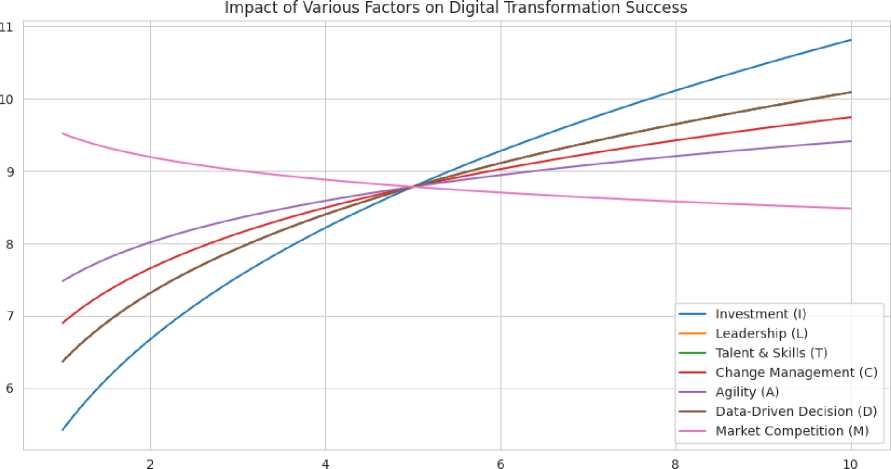
where k is a proportionality baseline constant that captures the baseline conditions of digital transformation, and a . в , Y , S , в , A , e are elasticity parameters representing the relative influence of each factor on success. Furthermore, Investment and Organization Support ( I, L, T, C) represents the foundational elements (technology, leadership, workforce, and change management), weighted by their relative impact ( a • в , Y , S ). Agility and Data-Driven Decisions ( A, D ) represents the growth accelerators, which are multiplied to the base. They have their weights ( в , A ) to show their contributions. The Market Competition (M) negatively or positively affects transformation success, this is modelled as an exponential decay ( e -* M ), where * controls the sensitivity to competition. Finally, the Return on Investment (R) is an additional term that accounts for financial gains from digital transformation. By defining the success function with default elasticity values ( a = 0.3, в = 0.2, Y = 0.2, S = 0.15, в = 0.25, A = 0.28), representing the baseline constant k as 1 and generate a range of values for each factor (in this case, the values are fixed to 5) while keeping others constant. The impact of various factors on the success of digital transformation is represented in figure 1 when simulated.
The Figure 1 shows that more investment in technology and infrastructure, strong leadership, high workforce competence (talent and skills), and higher change management create a solid foundation for digital transformation. Also, greater reliance on analytics (data-driven decision) and the ability to adapt quickly by organization will increase digital transformation success. However, intense market competition can either drive or hinder transformation, if the market competition is high, e -* M shrinks, making transformation harder and vice versa.
Factor Value
Fig. 1. Impact of Various Factors on Digital Transformation Success
-
5.3. The Digital transformation Implementation Strategy
Digital transformation in complex global economies requires a holistic approach that integrates technology, human capital, and strategic partnerships. By aligning transformation efforts with local contexts and global trends, organizations can achieve sustainable competitive advantages. Derived from the developed mathematical model in section 5.2. An all-inclusive digital transformation implementation strategy is herein presented. The strategy comprises of six key components: Vision and Objectives, Key Pillars of the Strategy, Implementation Roadmap, Measuring Success, Challenges and Mitigation, and Future-Proofing for the Strategy as shown in Figure 2, each clearly defined with corresponding steps.
Vision and Objectives
Technologies to enhance agility, innovation
Achieve opcraltonal excellence Deliver superior customer experiences Strengthen competitive advantage
Key Pillars of the Strategy
Customer-Centric Approach Leadership and Culture Operational Excellence Workforce Transformation Technology Adoption Ecosystem Collaboration
Implementation Roadmap
Phase 1: Assessment and Alignment
Phase 2: Workforce Enablement
Phase 3: Technology Deployment Phase 4: Continuous Improvement

Measuring Success
Customer Metrics
Operational Metrics
Innovation Metrics
Employee Metrics
Challenges and Mitigation
Resistance to change Cybersecurity risks. Rapid technology evolution
Future-Proofing the Strategy
Adopt a modular architecture
Embrace sustainability
Fig. 2. Digital transformation Implementation Strategy for Global Competitive Economy
-
5.3.1. Digital Transformation Vision and Objectives
Description: Organizations must articulate a clear vision that aligns with their overall business or organizational goals and economic contexts. This should involves identifying specific objectives for implementing digital transformation, such a vision can be defined as leveraging digital technologies to enhance agility, innovation, customer experience, operational efficiency, and ensuring sustainable growth in a global competitive landscape, with objectives as:
-
^ Achieve operational excellence through automation and data-driven decision-making.
-
^ Deliver superior customer experiences using personalized, omnichannel solutions.
-
^ Foster innovation by embracing emerging technologies.
-
^ Strengthen competitive advantage through scalable and resilient digital ecosystems.
-
^ Build a workforce equipped with digital skills and a culture of continuous learning.
-
5.3.2. Key Pillars of the Strategy
-
5.3.2.1. Customer-Centric Approach
-
5.3.2.2. Leadership and Culture
-
5.3.2.3. Operational Excellence
-
5.3.2.4. Workflow Transformation
-
5.3.2.5. Technology Adoption
Digital transformation is a comprehensive process that involves leveraging digital technologies to create or enhance business processes, culture, and customer experiences. Therefore, a successful digital transformation strategy must be built on several key pillars that guide organizations through this complex process. This study established six primary pillars for a comprehensive digital transformation implementation strategy, these are: Customer-Centric Approach, Leadership and Culture, Operational Excellence, Workforce Transformation, Technology Adoption, and Ecosystem Collaboration.
These key pillars are interconnected and must be approached systematically. A clear vision, coupled with the right technologies, leadership, and a customer-first mindset, are essential for driving successful transformation. This will enable organizations adapt to change, improve operational efficiency, and achieve long-term growth in a digitally global competitive economy. Based on the findings, the following practicable recommendations are made regarding each of the pillar outlining the focus, key actions, and technology enabler.
The focus is the delivery of exceptional customer experiences by understanding and addressing customer needs, preferences, and behaviours. Key actions include leveraging customers’ data to create personalized experiences, use omnichannel strategies to ensure seamless interactions across touchpoints, and gathering of customers’ feedback to refine offerings. The examples of technology enablers for a customer-centric implementation approach are CRM systems, AI-driven analytics, and customer journey mapping tools.
The focus of leadership and culture as a pillar of digital transformation is the fostering of a culture of innovation and adaptability, driven by strong digital leadership. The key actions under the leadership and culture include securing buy-in from leadership to champion the transformation, encourage collaboration, creativity, and a willingness to embrace change, and the implementation of cross-functional teams with continuous feedback loop. The technology enablers for leadership and culture principle are collaboration platforms, change management tools, and business intelligence tools.
This focus on creation of flexible and efficient processes to respond quickly to markets and organizational changes. The key actions include automation of routine tasks to improve efficiency, flexibility, and reduce costs, implementation of agile methodologies for faster project delivery, and continuous optimization of workflows to eliminate bottlenecks. The technology enablers are workflow automation tools, devops practices, robotic process automation (RPA) tools, and cloud technologies.
The focus is the provision of ongoing training and upskilling opportunities for employees through agile methodologies and collaboration. Examples of the key actions are the conduct of gap analysis to identify organization’s current capabilities and desired requirement, provision of continuous training and development programmes, and the implementation of platforms that enhance team collaboration and productivity. The enabling technology includes learning management systems, data visualization and analytics tools, virtual reality (VR) and augmented reality (AR), and artificial intelligence (AI)-powered tools.
The central point of the implementation factor is the selection and adoption of the right technologies to drive transformation taking into consideration the regional differences in infrastructure, regulatory environments, and cultural attitudes toward technology. The key actions comprise adopting emerging technologies like AI, IoT, cloud computing, and blockchain with emphasis on scalability and interoperability of systems, regular conduct of security audits and vulnerability assessments, and regular evaluation and update of technology stacks to stay competitive. The enabling technology includes cloud platforms, AI/ML models, cybersecurity platforms, and compliance management software.
-
5.3.2.6. Ecosystem Collaboration
-
5.3.3. The Implementation Roadmap
-
5.3.3.1. Phase 1: Assessment and Alignment
-
5.3.3.2. Phase 2: Workforce Enablement
-
5.3.3.3. Phase 3: Technology Deployment
-
5.3.3.4. Phase 4: Continuous Improvement
-
5.3.4. Digital Transformation Measuring Success
The focus is building of strong partnerships and collaboration with external partners, government, academic institutions, and industries to amplify the positive impact of transformation efforts. The major actions consist of working with technology vendors, consultants, academics, and industry peers, participating in digital ecosystems to access new markets and innovations, and aligning with global sustainability standards and frameworks. The examples of the technology enablers are API management tools, partner portals, and collaborative platforms.
The implementation roadmap is designed as a tactical plan that outlines the steps, milestones, and resources needed to guide an organization through the process of adopting and integrating digital technologies into its operations, culture, and business models. This will help in ensuring that digital transformation efforts are structured, aligned with organizational goals, and effectively executed. The implementation roadmap within this strategy are as outlined in phases herein with actionable recommendations.
Assessment and Alignment phase is a critical early stage of the implementation roadmap process. The stage lays the foundation for informed decision-making and strategic execution. It involves analysing the organization's existing environment to identify strengths, weaknesses, opportunities, and challenges which provides a baseline for planning the transformation. The alignment focuses on bridging the gap between the current state and the desired outcomes. It ensures that all stakeholders share a common vision and objectives for the transformation, and that the identified gaps and opportunities are addressed cohesively. Together, they create a strong foundation for the subsequent phases of the roadmap. This includes analysis of the organization's current digital maturity, processes, technology stack, and workforce capabilities to identify gaps and areas for improvement; engagement of the key stakeholders across the organization to secure buy-in and support; and development of a plan to manage cultural and organizational changes, including training, communication, and support for employees.
Workforce enablement is a cornerstone of successful digital transformation. It drives innovation and ensure smooth implementation of digital initiatives by empowering employees with the tools, skills, and culture needed to adapt to new technologies and processes. Workforce enablement is not a one-time effort but an ongoing process. It requires a clear plan, commitment from leadership, and active participation from employees. Steps such as conduct of skills gap analysis to identify workforce capabilities and future requirements; design of comprehensive training programmes tailored to various roles and skill levels; and the provision of continuous development programmes support to ensure smooth adoption of new technologies
Technology deployment is a critical phase in the digital transformation journey. It involves the planned integration of digital tools, systems, and processes to achieve organizational goals. The phase ensures that technology deployment is strategic, effective, and aligned with their digital transformation goals. The phase will incorporate the establishment of a robust IT infrastructure with scalable, and efficient cloud solutions; implementation of change management strategies to address resistance through pilot projects; development of an implementation plan with timelines and milestones; and regular update of the technology plan to align with evolving organization needs.
Continuous improvement is designed as one of the fundamental phases of successful digital transformation that empower organization to evolve in response to changing technologies, market dynamics, and internal performance metrics. To enable continuous improvement in digital transformation, agile approaches should be adopted which allow for iterative development and continuous feedback loops. Steps such as identification of key performance indicators (KPIs) to measure success based on organization’s transformation goals; implementation of incremental changes by using agile methodologies to deploy solutions in manageable phases; adoption of real-time analytics and dashboards in tracking progress against KPIs; and the embedment of CI into the organization's template by establishing governance frameworks for ongoing evaluation are very crucial at the phase.
Continuous evaluation of digital transformation efforts is essential for ensuring alignment with transformation goals and enabling necessary adjustments throughout the implementation process. To achieve this, organizations should establish key performance indicators (KPIs) to monitor progress and measure return on investment (ROI). Regular audits should also be conducted to maintain alignment with transformation objectives. The performance metrics for measuring digital transformation success as identity in this strategy is outlined below.
-
5.3.4.1. Customer Metrics
-
5.3.4.2. Operational Metrics
-
5.3.4.3. Innovation Metrics
-
5.3.4.4. Employee Metrics
Customer evaluation is a critical metric in the implementation of digital transformation as it provides direct insights into how customers perceive and respond to the digital initiative changes. It is a measure of how well the transformation aligns with customer needs, expectations, and experiences. It also ensures that the transformation remains aligned with the customer preferences while creating a feedback loop for continuous improvement, refining strategies based on real-world data.
The evaluation can be conducted using the key metrics: (i) Customer Satisfaction (CSAT) to measure how satisfied customers are with a specific product, service, or interaction; (ii) Net Promoter Score (NPS) to assess customer loyalty and the likelihood of recommending the organization, products or services to others; (iii) Retention Rates to track whether customers continue to engage with the organization after the transformation; and (iv) Usage Metrics to monitor how customers interact with digital tools, platforms, or services, indicating their usability and value.
The digital transformation operation evaluation is essential to measure the success of the transformation implementation using specific operational metrics. These metrics help organization to track efficiency, productivity, and overall performance improvements driven by digital inventiveness.
Some key operational metrics to use include: (i) Process Efficiency and Automation to determine the cycle time reduction rate, automation rate, and resource utilization; (ii) System Performance Metric to measure system uptime/downtime rate and response time; and (iii) Cost Metric to determine the cost savings via digitalization, revenue growth from digital channels, and return on digital investment (RODI).
The Innovation evaluation helps organizations to monitor progress, identify areas for improvement, and ensure that transformation efforts are delivering value. The key innovation metrics that can be used include: (i) Idea Generation & Implementation to measure the number of new ideas generated, idea-to-implementation ratio, and time to market;
Determining the digital transformation implementation success using employee metrics is very crucial as employees are at the core of all digital changes. Therefore, their engagement, productivity, and skill development will impact the success or failure of the transformation.
The employee metrics can include: (i) Employee Satisfaction and Engagement to determine how digital changes impact employee morale and job satisfaction like employee net promoter score (eNPS); (ii) Employee Productivity to evaluate whether digital transformation enhances efficiency such as employee digital adoption rate and employee efficiency; (iii) Employee Retention Rate to determine if digital transformation is causing frustration or making jobs easier, such as retention rate before against after digital implementation, and (iv) Training and Upskilling Progress to track how employees are developing digital skills like number of employee’s digital skills completion rate or number of certifications obtained in digital tools. The main idea is to continuously monitor, adapt, and provide support to employees throughout the transformation process.
-
5.3.5. Expected Challenges and Mitigation
-
5.3.6. Future-Proofing the Implementation Strategy
Notwithstanding the expertise and meticulousness of the personnel involve in the implementation of digital transformation, challenges are expected to be encountered during and after the implementation. Such expected challenges are to be prepared for with the necessary mitigation techniques. Some of the expected challenges are resistance to change, cybersecurity risks, rapid technology evolution, and shortage of skilled workforce. However, such challenges can be planned for and mitigated by strong leadership with clear communication, and change management programmes that foster a culture of openness and inclusion; investment in advanced security solutions and regular auditing of the organization systems ; building a flexible, scalable and interoperable technology stack by partnering with technology providers for expertise and scalability; and investing in attracting, retaining, and upskilling talents in key digital areas.
The constant changes in digital technologies makes digital transformation implementation a dynamic process, rather than static process. Therefore, the incorporation of a future-proof implementation technique will ensure that organizations can adapt to evolving technologies, market trends, and customer needs by achieving a resilient and scalable digital transformation while minimizing disruption.
The following recommended approaches are identified to be practically useful to adapt to the future changes that may occurs as result of the technology and economic dynamics.
^ Staying ahead of technology trends through investment in research and development.
^ Adopting modular architectures to quickly adapt to new technologies.
^ Establish a Centre of Excellence (CoE) for digital transformation by encouraging experimentation with emerging technologies.
^ Ensure cross-functional collaboration between digital technologies, operations, and leadership.
^ Embrace transformation sustainability by integrating green technologies and practices.
6. Conclusion
This study examines the adoption of digital transformation by governments and organizations as a cornerstone for economic growth and competitiveness in the global economy by leveraging advanced technologies such as cloud computing, artificial intelligence (AI), blockchain, big data, and the Internet of Things (IoT), to reshape industries, optimising processes, and creating innovative business models. The findings provided insights into the evolution of digital transformation, identifying key drivers like technological advancements, economic pressure, changing consumers expectations, regulatory and environmental factors, and geopolitical and ecosystems collaborations.
Furthermore, the study explores digital transformation developments and adoption in the USA, UK, China, and South Africa, highlighting their distinct characteristics in digital economy size, government initiatives, digital infrastructure, technological talent, cybersecurity, and digital inclusion. The findings further shown that the significance of digital transformation lies in its ability to advance innovation and resilience by exploiting technology not only to maintain business continuity and service delivery, but also in increasing operational efficiency, unlocking new value propositions through innovation, enabling economies resilience in a hyper-competitive global landscape, and serving as key driver of sustainable development, promoting resource efficiency and enabling circular economy models that align with global sustainability goals.
However, despite its benefits, digital transformation faces significant challenges, including cultural resistance to change, legacy systems, cybersecurity risks, a lack of digital leadership, an unskilled workforce, and the absence of a viable implementation strategy, factors that contribute to a high failure rate in digital transformation initiatives. This study highlights the need for a well-defined, actionable digital transformation implementation strategy to maintain a competitive advantage in an interconnected world.
The study seeks to bridge this critical gap by presenting a comprehensive, inclusive implementation strategy model that balances technological advancements with economic equity, ensuring that the benefits of digital transformation are accessible across all levels of society. By synthesizing existing research and proposing new model, the study adds to the body of knowledge regarding how businesses, industries, and governments can effectively manage the process of digital transformation.
