
The strategic dilemma of support settlements: Between self-development and transfer dependence
Journal: Economic and Social Changes: Facts, Trends, Forecast @volnc-esc-en
Section: Public administration
Article in issue: 1 т.19, 2026.
Free access
The relevance of the study stems from the introduction into the Spatial Development Strategy of the Russian Federation until 2030 of a new instrument of regional policy – support settlements, formally intended to become growth points for balancing spatial development. The aim of the work is to identify systemic contradictions in the concept of support settlements as presented in the Strategy and to substantiate necessary adjustments aimed at reorienting this institution from a compensatory to an economically stimulating model of functioning. The scholarly novelty lies in the comprehensive identification and structuring of four key institutional contradictions: between goal-setting and unified instrumentation; in the logic of selecting settlements based on the criterion of "problematic nature" rather than potential; between the functions assigned and available resources; between long-term development goals and the short-term nature of budget planning. The methodological basis of the study comprised systemic and content analysis of the text of the Strategy and related documents, as well as conducting a series of semi-formalized expert interviews with representatives of local self-government bodies from twelve constituent entities of the Russian Federation. The main results indicate that the current implementation of the support settlement institution tends toward the logic of fiscal equalization, and the empirical data obtained confirm the skepticism of municipalities and their demand for economic incentives. A stimulating model has been developed, proposing specific institutional solutions for transitioning to a paradigm of self-development, the key elements of which are a functional typology of settlements, the introduction of special economic regimes, a clear delineation of powers, and a shift to long-term program-based financing. A limitation of the study is its focus on qualitative analysis of the perception of the problem, which determines the need for further quantitative assessment of the effectiveness of pilot projects implemented within the framework of the proposed paradigm
Similar articles in the section Regional economics. Territorial economics


Short address: https://sciup.org/147253445
IDS: 147253445 | UDC: 332.14 | DOI: 10.15838/esc.2026.1.103.7
Text of the scientific article The strategic dilemma of support settlements: Between self-development and transfer dependence
The adoption of the Spatial Development Strategy of the Russian Federation for the period up to 2030 with a forecast up to 20361 (SDS-2030) marked a new stage in the state’s understanding of the principles of Russian territorial organization. Unlike the previous, largely unsuccessful, Spatial Development Strategy of the Russian Federation for the period up to 20252 (SDS-2025), the new document contains several conceptually important innovations, among which the institution of support settlements (SS) stands out. Formally positioned as one of the key tools for ensuring balanced spatial development, this institution is designed to accumulate resources and efforts for the development of non-agglomeration territories.
However, as with many other initiatives in the field of Russian strategic planning, a systemic methodological issue lies hidden behind the declaration of good intentions. An analysis of the SDS-2030 document, as well as the prior practice of implementing similar “targeted” instruments (e.g., macro-regions and geostrategic territories in the SDS-2025), allows us to hypothesize that SS policy is based on the predominantly compensatory model rather than stimulating in nature. In fact, it risks replicating the vicious logic of “transfer dependence”, where support from the federal center is directed not at triggering endogenous mechanisms of economic growth, but at plugging budget holes and maintaining the social sphere in the context of chronic depression.
Thus, a fundamental dilemma emerges: will the support settlements (there are over two thousand of them in Russia3) become real points of growth and self-development for the surrounding territories, or will their lot be to establish themselves as passive recipients of budget funds, whose existence depends solely on the amount of incoming subsidies? Resolving this dilemma has not only a purely economic but also a constitutional and political dimension, as it directly concerns the issue of combining the principle of equality of constituent entities of Russia with the need for a differentiated approach to their support.
The aim of the study is to identify systemic contradictions in the concept of support settlements presented in the SDS-2030 and to substantiate necessary adjustments aimed at reorienting this institution from a compensatory to an economically stimulating model of functioning. In accordance with this aim, the work addresses the following tasks: a critical analysis of the interpretation of SS in the text of the Strategy; a synthesis of practical expectations and concerns associated with this status among representatives of municipalities; identification of the underlying conflict between equalization and self-development; formulation of specific proposals for integrating SS into real economic processes and creating sustainable revenue sources for them.
For a deeper understanding of the identified dilemma and systemic contradictions, it is necessary to turn to the theoretical foundations of spatial development, within which the dichotomy of equalization and self-development is traditionally key.
Theoretical and methodological foundations of the research
The issue of the correlation between equalization and self-development of territories, central to understanding the role of support settlements in Russia’s new Spatial Development Strategy, has deep theoretical roots. An analysis of the evolution of scientific views allows us to identify the methodological basis of the managerial contradictions embedded in the SDS-2030.
Classical theories of regional growth, developed by F. Perroux (the concept of “growth poles”) and A. Hirschman (the theory of “unbalanced growth”), revealed the fundamental mechanism of spatial development: the concentration of economic activity in “centers” is natural and can stimulate the development of the “periphery” through “trickledown effects” (Perroux, 1955; Hirschman, 1958). However, as G. Myrdal showed, in the absence of targeted policy, cumulative causation dominates, reinforcing inequality (Myrdal, 1957). These ideas were further developed in the works of M. Fujita, P. Krugman, and A.J. Venables (Fujita et al., 2001), who, within the framework of the “new economic geography”, proved that agglomeration effects scale advantage are key factors in the spatial concentration of activity.
Theorists of institutionalism made a significant contribution to understanding the institutional aspects of spatial development. O. Williamson explored the role of transaction costs in organizing economic activity across different territories (Williamson, 1985), and D. North substantiated the decisive influence of institutions and their evolution on the long-term economic dynamics of regions (North, 1990), which is highly relevant to the formation of effective development institutions for support settlements.
In the Russian scientific tradition, this dilemma has always been the focus of attention of regional scientists. A.G. Granberg, whose ideas greatly influenced domestic regional policy, consistently argued that the Russian economic space as a “multi-regional organism” requires a combination of integrity and diversity (Granberg, 2009). He warned that equalization suppresses initiative, but spontaneous polarization threatens the unity of the country. P.A. Minakir emphasized that spatial development is not a choice between equalization and growth, but a search for a balance where support for lagging territories should not hinder the development of leaders (Minakir, Demyanenko, 2014). A.N. Demyanenko, developing these ideas in his interdisciplinary research, underscores the complexity of the challenges of spatial development in Russia (Demyanenko, 2021).
Close to the settlement network concept are the ideas of V.L. Glazychev about the frame-nodal structure of the territory, where support centers act as integrators of the surrounding space (Glazychev, 2008). E.M. Buchwald and O.N. Valentik contributed to the understanding of economic space as an object of management (Buchwald, Valentik, 2024), while R.F. Gataullin researched the processes of forming a new framework model of spatial development (Gataullin, 2020). Methodological aspects of assessing the quality of regional economic space are revealed in the works of A.A. Urunov and I.M. Morozova (Urunov, Morozova, 2024), and a macro-level analysis of Russia’s economic space is presented by P.V. Stroev and O.V. Pivovarova (Stroev, Pivovarova, 2024).
Also important for the analysis of SS is the modern concept of “smart specialization” (formed as a result of objective processes), detailed by P. McCann and R. Ortega-Argiles (McCann, Ortega-Argiles, 2013); Russian researchers in this field are M.V. Kurnikova, G.A. Khmeleva, E.V. Bolgova (Kurnikova et al., 2023), A.A. Pobedin (Pobedin, 2025), and others. This concept involves abandoning universal recipes in favor of identifying and supporting the unique potential of each territory. This approach gains particular relevance in light of international experience, notably the European Union’s smart specialization strategy4, where the key principle is the concentration of resources on a limited number of priorities identified through a process of “entrepreneurial discovery” involving business, science, and government. However, as A. Wigger notes, the “smart specialization” policy can deepen structural asymmetries, which requires a cautious and adapted application of this approach (Wigger, 2023). Unlike the compensatory paradigm dominating the current Russian practice of fostering support settlements, the stimulating approach aims to activate endogenous growth through the formation of competitive advantages based on the unique assets of territories. This implies not just budget equalization, but the creation of special economic regimes that stimulate private investment and diversification into related segments. Applied to SS, this means the need to move from unified support for “problem” territories to differentiated strategies that consider the specifics of the local economic landscape and the potential for forming growth points within regional and global value chains, which is reflected in studies on the differentiation of rural sub-regions development conducted by E.N. Koroleva and L.A. Mustafina (Koroleva, Mustafina, 2025).
Contemporary analysis of Russian regional policy, presented in the works of N.V. Zubarevich, reveals systemic institutional barriers to spatial development. The author convincingly argues that the established highly centralized management model, relying on large-scale but inefficient budget redistribution, not only fails to overcome but actually reinforces disparities (Zubarevich, 2017). In this context, her conclusions about the need for a transition to decentralization, support for leading cities, and targeted social policies mitigating inequality serve as a critically important argument against maintaining the compensatory paradigm in the policy of periphery development.
The conducted analysis of modern scientific literature on support settlements suggests that this topic has been actively developed by Russian researchers in recent years. The article by E. Markvart, N.N. Kiseleva, and D.P. Sosnin makes a fundamental contribution to the theoretical and methodological substantiation of the SS policy. The authors conduct a meticulous analysis of central place theory, examine in detail its application in German spatial planning, and then critically evaluate attempts to adapt this concept in contemporary Russia (Markvart et al.,
2022). The work of A.V. Odintsova is one of the first to systematically raise issues of integrating SS into the institutional architecture of federal relations and local self-government (Odintsova, 2025). This direction is significantly complemented by the research of A.V. Vilenskiy, who provides a detailed critical analysis of the functions and tasks assigned to various types of SS (non-urban and strategic) within the framework of the SDS-2030. The author not only reveals the essence of the new concept but also identifies its duality: on the one hand, SS are seen as a tool for solving demographic and social problems; on the other, as centers of economic growth and ensuring national security (Vilenskiy, 2025). The study by M.V. Gligich-Zolotareva and N.I. Luk’yanova offers a deep insight into the theoretical foundations of the concept (Gligich-Zolotareva, Luk’yanova, 2024). This direction is developed further in the article by E.V. Evlampieva, which examines the evolution of the SS phenomenon – from W. Christaller’s central place theory and the Soviet concept of the “support framework of settlement” to the modern criteria enshrined in the 2022 methodological recommendations and the new Strategy. The author focuses on the role of SS as a basis for counteracting “spatial compression” and forming a settlement system, clearly distinguishing approaches to nonurban and strategic support points (Evlampieva, 2025). The article by O.M. Roy and V.S. Bichun analyzes the role of SS in the new spatial strategy through the lens of the settlement system. The authors propose an original classification of SS based on criteria from the unified list, analyze the levels of their interaction, and conclude that the likely scenario of population inflow into support points is optimal (Roy, Bichun, 2025). Their research shifts the focus from general principles to specific mechanisms of territorial reorganization.
The conducted analysis allows us to conclude: the modern paradigm of spatial development, enriched by theories of new economic geography, institutionalism, and smart specialization, rejects the dichotomy “equalization or growth”, offering a strategy for their combination. However, a textual analysis of the SDS-2030 shows that this balance has not been found concerning support settlements. The approach embedded in the Strategy leans toward a compensatory rather than a stimulating logic, which contradicts both theoretical ideas about self-development and the declared goals of forming a balanced territorial organization of the economy. Thus, theoretical analysis indicates the need for a balance that should be institutionally embodied.
To achieve the aim of the work, a set of methods was applied, including:
-
1) systemic analysis of the text of the Spatial Development Strategy of the Russian Federation for the period up to 2030 with a forecast up to 2036, as well as related regulatory legal acts;
-
2) content analysis of strategic planning documents of Russian regions concerning spatial development and support for municipalities;
-
3) expert interviews with representatives of local self-government bodies from 12 constituent entities of Russia, conducted from January to March 2025 (sample – municipalities included and not included in the list of support settlements).
Based on the literature analysis, it can be concluded that this study provides constructive criticism and performs a synthesizing function, thus occupying a special place among the mentioned publications. The following directions are realized:
-
1) deepening of critical analysis and movement toward paradigmatic contradictions; while A.V. Odintsova points to institutional inconsistencies, A.V. Vilenskiy to functional duality and inconsistency, M.V. Gligich-Zolotareva, N.I. Luk’yanova, and E. Markvart et al. to methodological and practical implementation problems, the authors of this article identify systemic paradigmatic contradictions in the very logic of state policy;
-
2) empirical substantiation by “demand from the field”; unlike works based primarily on document analysis and theoretical models (A.V. Vilenskiy, E.V. Evlampieva, E. Markvart, etc.), this study is supported by the results of expert interviews with representatives of local selfgovernment bodies;
-
3) proposal of a holistic alternative model as a roadmap; the main contribution of the study lies not only in in-depth criticism but also in the created mature stimulating paradigm for the development of SS.
Research results
In the text of the Strategy there is a formal definition of support settlements as “settlements located outside the boundaries of urban agglomerations, forming the basis for accelerated infrastructure development, allowing for realization of social guarantees... and other needs of the population of the territory of one or more municipalities” (section IV).
Critical analysis reveals several systemic problems in this concept.
-
1. Socio-infrastructural bias. The definition is dominated by the social function of the SS, with almost no attention to economic component. The text implies that support settlements are intended primarily for the implementation of social guarantees, rather than for generating economic growth.
-
2. Lack of differentiation. The Strategy does not provide for different types of SS depending on their economic capacity, geographical location, and specialization. All 2,160 settlements fall under uniform criteria and, presumably, uniform support mechanisms.
-
3. Uncertainty of implementation mechanisms. The text lacks a description of specific tools that would ensure accelerated development. Sources of funding, the scope of powers, and performance criteria are not specified.
Toassesstheperceptionandpracticalexpectations associated with the institution of support settlements at the local level, an expert survey of representatives of local self-government bodies was conducted from January to March 2025 (Center for Federalism and Regional Development, Institute of Economics of RAS)5. The research sample included 47 experts (heads of municipalities, their deputies, and heads of relevant committees). The expert survey was conducted among representatives of 12 constituent entities of the Russian Federation, selected to ensure representativeness in terms of geographical, economic, and typological characteristics. The sample included the following regions: Arkhangelsk Region, Sverdlovsk Region, Krasnoyarsk Territory, Voronezh Region, Republic of Bashkortostan, Novosibirsk Region, Perm Territory, Republic of Crimea, Volgograd Region, Irkutsk Region, Tver Region, and Chelyabinsk Region. This list covers several federal districts (Northwestern, Ural, Siberian, Central, Volga, Southern) and includes both donor regions and recipient regions, which allowed considering different conditions and positions in analyzing SS perception.
The selection criterion was the presence within the municipality’s territory of a settlement included in the SS list under the SDS-2030. Municipalities that did not receive this status were also included for comparative analysis. The data collection methodology involved semi-structured in-depth interviews using a unified questionnaire, which allowed obtaining both quantifiable assessments and detailed qualitative judgments. The program included the following key thematic blocks:
-
1) perception and awareness: knowledge about the SS status, expectations and concerns associated with obtaining it;
-
2) assessment of support instruments: opinions on the effectiveness of existing (transfers) and potentially necessary (tax incentives, special regimes) measures;
-
3) institutional and budgetary barriers: assessment of the sufficiency of existing powers and resources to perform the functions assigned to SS, problems of inter-budgetary relations;
-
4) proposals for optimization: specific initiatives from experts to change approaches to fostering support settlements.
Processing and analysis of interview transcripts were carried out using content analysis with qualitative coding. During the coding process, stable semantic categories were identified, such as: “budget dependence”, “demand for economic incentives” (including subcategories “tax incentives” and “investment preferences”), “criticism of status uncertainty”, “demand for expanded budget autonomy”, and “skepticism about the effectiveness of transfers”. Subsequent statistical aggregation of the frequency of mentions of these codes allowed for a transition from qualitative data to quantitative estimates presented in the results.
The survey results revealed a contradictory picture of the perception of the new institution at the municipal level.
-
1. Awareness and formal attitude. The vast majority of respondents (78%) confirmed awareness of their territories’ inclusion in the SS list. However, only 24% of those surveyed could specify the potential opportunities or obligations associated with this status, indicating its formal, declarative nature at the initial stage of implementation.
-
2. Assessment of potential effectiveness. Two-thirds of experts (67%) expressed skepticism regarding the real possibilities of obtaining additional resources and managerial preferences. The main risks cited were the preservation of the previous logic of inter-budgetary relations and a high probability of transforming the SS into another
-
3. Priorities in support measures. When asked about the most effective support measures, the distribution of responses clearly indicated a demand for economic rather than budgetary instruments. Almost half of the respondents (45%) indicated the need to introduce special tax regimes and preferences for businesses as a priority measure. Another 32% of experts emphasized the importance of expanding budget powers and securing additional revenue sources for local budgets. Only 23% of survey participants saw the solution in increasing the volume of gratuitous transfers from higher-level budgets.
instrument of targeted transfer equalization without creating incentives for economic growth.
The quantitative assessments of the experts were also reflected in their judgments during the interviews. Qualitative analysis of interview transcripts revealed key narratives. For instance, the head of a municipal district from the Sverdlovsk Region noted: “We expect not just subsidies, but real tools to attract investment – special economic zones, tax incentives. The status should create a competitive advantage, not just label problems”. Similarly, the mayor of an urban settlement from the Voronezh Region stated: “Without changing the principles of inter-budgetary relations, the SS status will remain just a pretty signboard. We need not one-time injections, but long-term rules of the game that allow us to plan development”.
The conducted research demonstrates that at the municipal level, there is a clear demand for a transition from the compensatory paradigm of support to a stimulating model based on the creation of economic incentives and the expansion of financial independence. The identified skepticism among experts indicates that a credit for new spatial development institutions is lost after previous experience with similar initiatives.
The empirical data from expert interviews, as well as the textual analysis of the SDS-2030, allow us to identify not just individual shortcomings, but systemic contradictions embedded in the very concept of support settlements. These contradictions explain the lost credit from municipalities and predetermine the risks of implementing the SS institution.
The first fundamental contradiction lies in the fact that the declared goal of creating “growth points” on the periphery objectively requires the concentration of resources and the creation of special economic conditions, while the established system of inter-budgetary relations and public administration continues to operate within the logic of unification and equalization. In fact, there is an attempt to create islands of a special economic regime in a sea of unified rules, which is doomed to failure. A municipality included in the SS list does not receive real tools to change its economic trajectory; it merely receives a status that, at best, allows it to claim a slightly larger volume of transfers.
The second contradiction is the fact that the very logic of selecting SS is based on their “problem nature”: low fiscal capacity, remoteness, depopulation. This approach systematically excludes the possibility of identifying and supporting actually promising growth points on the periphery, which may have a relatively better starting position.
The third contradiction manifests itself in the institutional plane. Declaring a settlement as “support” actually means imposing additional functions on it to serve the surrounding territories. However, neither the financial nor managerial resources to perform these functions are transferred. The SS status should be economically beneficial. However, local administrations find themselves in a situation where their responsibility increases, but their capabilities remain the same. This gives rise to the phenomenon of a “symbolic status” – much is said about the importance of SS, but real powers and resources are concentrated at higher levels of government.
The fourth contradiction concerns the time horizon. Economic development is a long-term process requiring consistent policy over many years. However, budget planning and political cycles are focused on the short and medium term. As a result, support measures for SS are targeted and project-based, not forming a unified development strategy. Municipalities receive scattered subsidies for individual infrastructure facilities but do not get the opportunity to pursue a consistent investment policy.
It is worth noting that long-term socioeconomic development plans for up to 10 years have already been approved for urban agglomerations and large support settlements6. However, for the vast majority of SS (non-agglomeration territories), there are no such documents or they provide only a general framework. Furthermore, existing longterm development plans are focused primarily on infrastructure and social investments, while mechanisms for stimulating economic activity are presented fragmentarily.
To resolve the identified contradictions, especially the second (selection by “problem nature”) and third (institutional vagueness), “smart specialization” principles can be applied. This would require shifting the focus from criteria of depression to mechanisms of “entrepreneurial discovery” of the unique potential of each SS with the participation of businesses and local communities, followed by the development of differentiated strategies and targeted economic regimes for them depending on the identified specialization – agro-industrial, logistical, tourist-recreational, or service-oriented.
-
6 RF Government Resolution 2058-r, dated July 31, 2023. Available at: http://publication.pravo.gov.ru/docum ent/0001202308010028?index=1 (accessed: 13.02.2026); RF Government Resolution 3014-r, dated October 27, 2025. Available at: http://publication.pravo.gov.ru/ document/0001202510270034 (accessed: 13.02.2026).
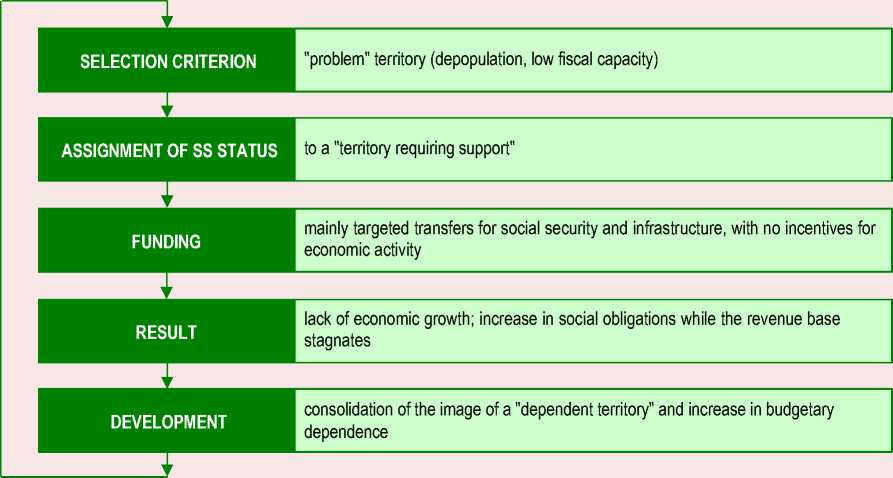
The combined effect of these contradictions creates a vicious circle: the SS status, designed to stimulate development, in fact reinforces the dependency model. Breaking it requires not an evolutionary, but a paradigmatic shift – a transition from compensatory logic to a stimulating paradigm ( Fig. 1 ).
The comparison between the current and proposed models is presented in Table 1 .
The data analysis demonstrates that the current model reproduces dependency practices. The proposed model, on the contrary, is based on the principles of economic stimulation and implies a transition to a program-targeted method of
-
Figure 1. Reproduction of the compensatory development model in the current mechanism for implementing support settlements
Source: own compilation.
Table 1. Comparative analysis of the current and proposed models for implementing the institution of support settlements
|
Analysis criterion |
Current model (compensatory) |
Proposed model (stimulating) |
Transformation effect |
|
Basic principle |
Equalization of fiscal capacity, social standards maintenance |
Stimulation of economic selfdevelopment, increasing tax capacity growth |
Overcoming of the principle of compensatory financing and transition to self-development |
|
Main tools |
Subsidies, grants, targeted transfers |
Tax incentives, investment funds, guarantees |
Creation of institutional environment for private investment |
|
Effectiveness criteria |
Budget development, compliance with standards |
Growth of tax revenues, volume of investment, job creation |
Focus on real economic results |
|
Budgetary consequences |
Increase in expenditure obligations of higher-level budgets |
Growth of local budget revenues |
Reduction of long-term budget burden |
|
Time horizon |
Short-term (annual) planning |
Long-term (5–7 years) financial program |
Stable conditions for investors and local self-government bodies |
|
Source: own compilation. |
|||
Table 2. Key elements of the proposed stimulating model for the development of support settlements
|
Model element |
Content |
Expected effect |
|
1. Functional typology of support settlements |
Transport and logistics centers; agro-industrial centers; centers for tourism and recreation; social service centers |
Differentiated approach allows applying targeted support instruments depending on the specialization and potential of the territory |
|
2. Tax incentives and preferences |
Regional level: reduced income tax rate and exemption from property tax, investment deductions; municipal level: land tax and personal property tax incentives (for businesses of individual entrepreneurs and self-employed), reduced rent for municipal property |
Creation of competitive advantages to attract private investment; stimulation for creating new industries and jobs |
|
3. Delineation of powers and resources |
Federal level: establishes general framework, creates targeted development funds; regional level: develops and co-finances specialized programs for each type of SS; municipal level: granted expanded budgetary powers and responsible for implementing specific project s |
Overcoming of “institutional vagueness”; assignment of responsibilities and resources to each level of government |
|
4. Financing vehicles |
Long-term programs (7–10 years) – appendix to approved long-term socio-economic development plans or independent documents; co-financing: a) targeted investment funds (federal, regional) of state programs and development institutions; b) infrastructure budget loans, concessions, bonds |
Stable long-term resource base, budget planning linked with long-term socio-economic development plans, replacement of one-time subsidies with program financing |
|
5. Infrastructure |
Reorientation of expenditures: from individual objects to comprehensive development of investment sites; differentiation by SS type: – logistics: access roads, warehouses; – agro-industrial: energy, water supply, land reclamation; – tourism: roads, communications, beautification; – social services: educational, healthcare facilities, service centers |
Creation of a material base for private investment, reduction of infrastructure costs for businesses, increase in extra-budgetary investment in fixed capital |
|
6. Key performance indicators (KPIs) |
Universal KPIs:
Specialized KPIs (by SS type):
|
Transition from assessing budget development to assessing real socio-economic results; link between the volume of support and effectiveness |
|
Source: own compilation. |
||
managing SS development. The key difference is effectiveness assessment reorientation from budget development criteria to indicators of real economic growth – an increase in tax revenues, the volume of fixed capital investment, and job creation. It is not superficial adjustments that can help overcome the identified systemic contradictions – it is a different approach to SS development management. The stimulating model presented in Table 1 serves as the basis for developing specific institutional solutions structured in Table 2.
The criteria for assigning a support settlement to a particular functional type should be based on objective quantitative and qualitative indicators verifiable at the regional level:
-
1) transport and logistics centers: presence of transport junctions of federal/regional significance; roads included in the core road network; active railway stations, river ports, multimodal terminals; share of employment in transportation and storage above the regional average;
-
2) agro-industrial centers: specialization in processing agricultural products; presence of operating agricultural producers and food industries; high proportion of rural population; potential for creating storage and marketing logistics;
-
3) centers for tourism and recreation: presence of cultural heritage sites, nature reserves, natural areas of preferential protection; tourist flow not less than a threshold value; developed or promising accommodation infrastructure; inclusion in federal and regional tourist routes;
-
4) social service centers: performance of intermunicipal service functions (education, healthcare, service centers); stable commuting from surrounding territories; absence of pronounced economic specialization, but availability of human and infrastructural capacity for developing noncommercial services.
The typology is not rigidly fixed; mixed types are allowed (e.g., agro-industrial-logistical), as well as transition from one type to another based on the implementation of long-term development plans.
Tax incentives for SS are understood not as new types of special economic zones or priority development territories (which would require separate federal laws), but as targeted adaptation of existing mechanisms to the context of support settlements: extending certain preferential elements to SS: investment tax deduction, benefits on rent for municipal property; certain tax benefits.
Investment funds for SS development are proposed to be created on co-financing principles:
– federal level: state programs funds, as well as targeted inter-budgetary transfers as part of the oversight of SS by federal executive authorities;
– regional level: funds from the budgets of Russian regions, including grants to support balanced-budget measures, reoriented from current expenditures to investment purposes;
The transition to long-term program financing (7–10 years) proposed in this study does not mean duplicating or replacing approved longterm development plans, but substantively supplementing them with economic blocks (tax incentives, investment regimes, KPIs for private investments and jobs) and extending this approach to all types of SS.
The key direction is a paradigm shift in supporting SS – a transition from unified budget equalization to differentiation of development. Simultaneously, differentiation and division of support settlements into several types are required, which will allow moving from the vicious logic of selection based on the criterion of “problem nature” toward supporting real potential. Finally,
-
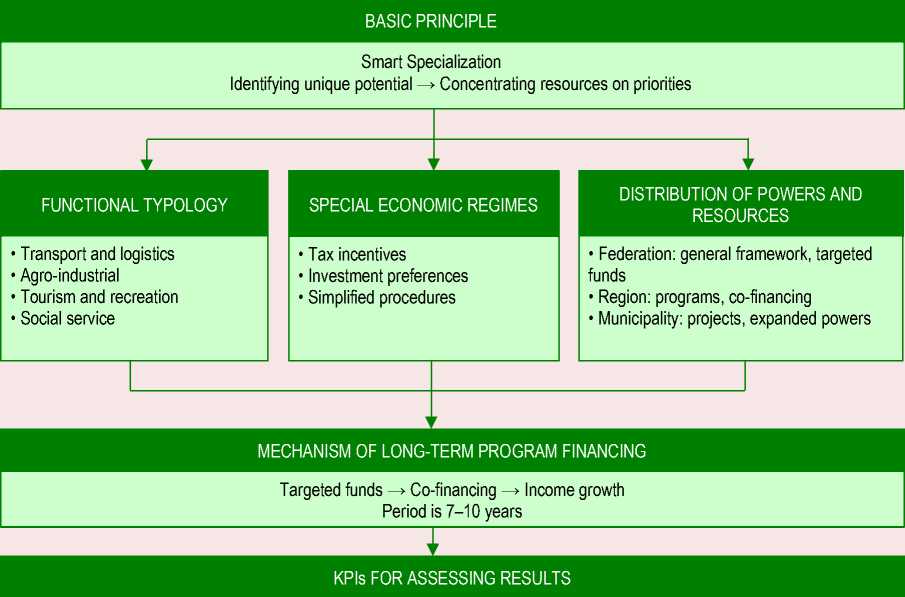
Figure 2. Stimulating model for support settlements development within the self-development paradigm
STIMULATING PARADIGM OF SS DEVELOPMENT
Goal – economic growth and self-development
• Growth of tax revenues | • Volume of private investment | • New jobs
TARGETED SITUATION
SS as an active subject of the territory’s economic growth
Source: own compilation.
overcoming of “institutional vagueness” and the contradiction between long-term goals and shortterm planning is possible through a clear structuring of powers between levels of government and the introduction of budgetary innovations based on long-term financing programs.
The stimulating model presented in Table 2 serves as the basis for developing specific institutional solutions. Its conceptual architecture, integrating functional typology, special regimes, delineation of powers, and long-term financing, is reflected in Figure 2 .
A key condition for implementing the stimulating model is a clear distribution of responsibility between the regional and municipal levels for the introduction of economic instruments.
At the regional level, the following is ensured: – establishment of reduced rates for the corporate income tax payable to the budget of the Russian constituent entity for residents of SS;
– exemption from payment of corporate property tax (its regional component) for the investment period.
At the municipal level (within transferred or expanded powers):
– establishment of benefits for land tax and personal property tax for individual entrepreneurs and self-employed individuals (for business objects) for the duration of the investment project;
-
– application of reduction coefficients to rental rates for municipal property and land plots;
-
– reduction of administrative procedures according to the “one contact” principle for projects implemented on the territory of the SS.
The growth of tax potential and revenues of local budgets is ensured not by directly increasing deduction standards, but indirectly – through expanding the tax base as a result of attracting new investments and creating jobs. It is private investment, stimulated by the listed preferences, that forms a stable revenue increase, replacing transfer dependence.
The issue of developing social, engineering, utility, and transport infrastructure of the SS deserves special attention. In the current version of the SDS-2030, infrastructural development is positioned as the main tool for implementing social guarantees. However, in the absence of economic incentives, infrastructure investments do not create a multiplier effect and are not converted into growth of the revenue base.
In the proposed stimulating model, infrastructural development is seen not as a goal, but as a necessary condition for attracting private investment and triggering endogenous growth. This implies:
-
1) reorientation of infrastructure budget expenditures from point objects to the comprehensive development of investment sites (industrial parks, industrial sites, tourist clusters) with connected networks and engineering preparation;
-
2) integration of infrastructure sections into long-term development plans of SS, linking timelines, funding volumes, and responsible executors; in this regard, the performance criterion becomes not the volume of funds utilized, but the commissioning of facilities and the subsequent increase in private investment on the created infrastructure base;
-
3) use of mechanisms such as infrastructure budget loans, bonds, and concessions, repaid from future tax revenues from investment projects implemented in the SS territory;
-
4) differentiation of infrastructure standards depending on the functional type of SS: access roads and warehousing are priorities for logistics centers; for agro-industrial centers – energy capacity and water supply; for tourist centers – roads, communications, beautification.
Thus, infrastructure policy towards SS should be subordinated to the logic of economic selfdevelopment. Only in this case can support settlements perform the function of “growth points” for the surrounding territories and transform into effective instruments of spatial regulation.
Discussion
The findings indicate the systemic nature of the issues in implementing the SS institution. The identified contradictions between the declared goals of growth and compensatory instruments are not accidental – they naturally stem from the persistent logic of unified budget equalization. This confirms theoretical concerns about the reproduction of a “dependency” model of development in the absence of a targeted stimulating policy.
The proposed model, integrating the principles of “smart specialization” and international experience, offers a way to overcome this systemic trap. Its key advantage is the rejection of unification in favor of targeted support for the competitive advantages of territories. However, its implementation will require overcoming institutional barriers, primarily the established system of inter-budgetary relations.
A limitation of the study is its focus on a qualitative analysis of the perception of the problem. Further work should be directed toward a quantitative assessment of the effectiveness of pilot projects implemented within the proposed paradigm.
Conclusion
The conducted research allows us to draw a fundamental conclusion about the systemic nature of the problems associated with the implementation of support settlements in the Spatial Development Strategy until 2030. The empirical data obtained from document analysis and expert interviews convincingly demonstrate that the SS institution in its current methodological and regulatory form not only fails to solve the issue of reducing spatial disparities but also reproduces the vicious model of “transfer dependence”, systematically entrenching the chronic dependence of territories on budget transfers. The identified set of fundamental contradictions between the declarative goals of growth and compensatory instruments, the logic of selecting “problem” areas and the expected results of self-development, indicates a deep methodological crisis in the approach to periphery development.
Overcoming these systemic dysfunctions requires not partial adjustments or an increase in the volume of transfers, but a genuine paradigmatic shift in the philosophy of regional policy – a decisive transition from unified budget equalization to a strategy of purposefully creating and supporting endogenous competitive advantages. The stimulating model developed in this study, integrating a functional typology of settlements, targeted special economic regimes, a clear legislative delineation of powers between levels of government, and long-term program financing, outlines the specific institutional framework of this necessary transition. Its implementation will allow reorienting management from criteria of fund utilization to indicators of real economic growth – an increase in tax revenues, investments, and the creation of new jobs.
It is precisely this comprehensive, institutionally-oriented approach that will make it possible in practice to transform support settlements from passive recipients of aid into real growth points and drivers of spatial development. This will ensure not artificial, but organic development, based on unlocking and utilizing the maximum unique internal potential of each territory, which will ultimately contribute to strengthening not only regional but also national economic resilience.
