
The Use of Computer Games in Teaching: The Impact on the Psychological State and Educational Success of Students
Journal: International Journal of Modern Education and Computer Science @ijmecs
Article in issue: 1 vol.18, 2026.
Free access
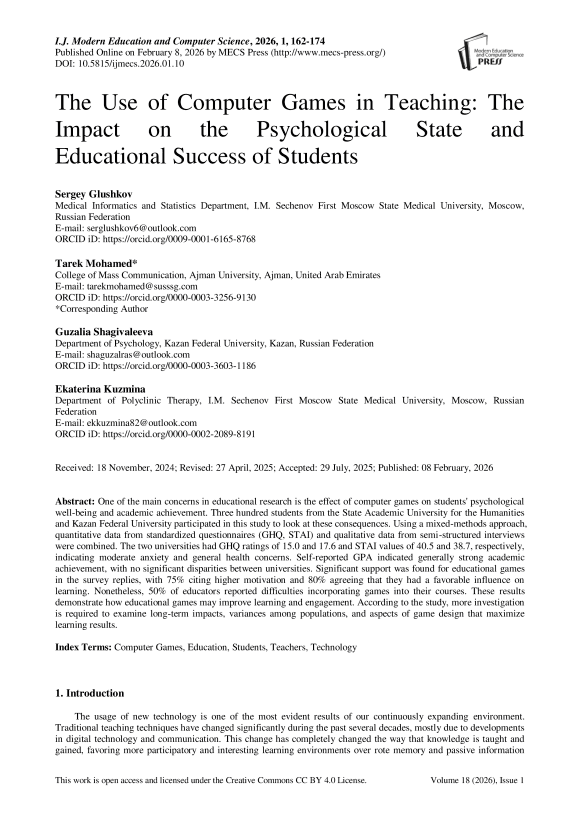
One of the main concerns in educational research is the effect of computer games on students' psychological well-being and academic achievement. Three hundred students from the State Academic University for the Humanities and Kazan Federal University participated in this study to look at these consequences. Using a mixed-methods approach, quantitative data from standardized questionnaires (GHQ, STAI) and qualitative data from semi-structured interviews were combined. The two universities had GHQ ratings of 15.0 and 17.6 and STAI values of 40.5 and 38.7, respectively, indicating moderate anxiety and general health concerns. Self-reported GPA indicated generally strong academic achievement, with no significant disparities between universities. Significant support was found for educational games in the survey replies, with 75% citing higher motivation and 80% agreeing that they had a favorable influence on learning. Nonetheless, 50% of educators reported difficulties incorporating games into their courses. These results demonstrate how educational games may improve learning and engagement. According to the study, more investigation is required to examine long-term impacts, variances among populations, and aspects of game design that maximize learning results.
Similar articles in the section Education in relation to the educand, pupil. Guidance

Short address: https://sciup.org/15020157
IDS: 15020157 | DOI: 10.5815/ijmecs.2026.01.10
