
Университеты в региональном развитии: роль абсорбционной способности территории на примере трех кейсов Чешской Республики
Журнал: Регионология @regionsar
Рубрика: Региональная и отраслевая экономика
Статья в выпуске: 3 (136) т.34, 2026 года.
Бесплатный доступ
Введение. В условиях усиления территориальной неравномерности экономического развития возрастает значимость поиска эффективных механизмов сопряжения научно-образовательного потенциала и региональных стратегий роста. Актуальность исследования обусловлена необходимостью преодоления разрыва между вкладом университетов в глобальную научную повестку и способностью стимулировать локальное экономическое обновление, особенно в менее развитых регионах. Присутствие университета не гарантирует автоматического регионального обновления; эффекты зависят от способности территории абсорбировать и использовать знания. Цель работы – выявить условия, при которых деятельность университетов и вузов становится драйвером регионального развития, на материале трех кейсов Чешской Республики: Устецкого края (Университет Я. Э. Пуркине), края Высочина (Политехнический институт в Йиглаве) и Оломоуцкого (Университет Палацкого в Оломоуце). Материалы и методы. Проведено качественное сравнительное исследование на мезоуровне (регион). Единицей анализа выступила конфигурация «университет – регион». Кейсы отобраны методом целенаправленной выборки с максимальной вариацией: они представляют различные территориальные структуры (постиндустриальный, сельский производственный и внутренне разделенный регионы) и разные типы университетов (комплексный, прикладной политехнический, исследовательский). Источниками данных послужили официальные показатели Чешского статистического управления (валового внутреннего продукта на душу населения, уровень безработицы, численность студентов) и сторонние исследования. Аналитическая процедура включала структурированное сопоставление, сопоставление паттернов и аналитическое обобщение. Результаты исследования. Показано, что университеты и вузы сталкиваются со стратегической перегрузкой: местные участники ожидают от них решения практических региональных проблем, тогда как национальные системы финансирования поощряют престиж, публикационную активность и глобально значимые результаты исследований. Сравнение трех кейсов демонстрирует, что влияние университета на развитие региона является условным: оно усиливается при наличии спроса на квалифицированные кадры, инновационных фирм, институциональных посредников и координации между образовательными учреждениями, властью и бизнесом. В регионах со слабой абсорбционной способностью знания и выпускники перенаправляются вовне. Заключение. Сделан вывод о том, что менее развитые регионы получают наибольшую выгоду не от простого расширения предложения высшего образования, а от интеграции университетов в широкую коалицию развития, способную преобразовывать знания в локально укорененное экономическое и социальное обновление. Результаты могут быть полезны региональным властям, муниципалитетам, руководителям вузов, профильным министерствам, инновационным агентствам при разработке территориально дифференцированных стратегий.
Короткий адрес: https://sciup.org/147255021
IDS: 147255021 | УДК: 322.1:378(437.1/.2) | DOI: 10.15507/2413-1407.26343.478-497
Universities in Regional Development: The Role of Territorial Absorptive Capacity in Three Czech Regional Cases
Introduction. In the context of increasing territorial unevenness in economic development, the search for effective mechanisms for aligning scientific and educational potential with regional growth strategies is becoming increasingly important. The relevance of this study stems from the need to bridge the gap between universities' contribution to the global scientific agenda and their ability to stimulate local economic renewal, especially in less developed regions. The presence of a university does not automatically guarantee regional renewal; the effects depend on the territory's ability to absorb and utilize knowledge. The aim of this study is to identify the conditions under which the activities of universities and higher education institutions become drivers of regional development, using three cases from the Czech Republic: Ústí nad Labem University (J. E. Purkyně University), Vysočina Region (Jihlava Polytechnic College), and Olomouc Region (Palacký University in Olomouc). Materials and Methods. A qualitative comparative study was conducted at the meso-level (region). The unit of analysis was the “university – region” configuration. Cases were selected using purposive sampling with maximum variation: they represent various territorial structures (post-industrial, rural production, and internally divided regions) and different types of universities (comprehensive, applied polytechnic, research). Data sources included official indicators from the Czech Statistical Office (GDP per capita, unemployment rate, student enrollment) and third-party studies. The analytical procedure included structured comparison, pattern matching, and analytical synthesis. Results. It is shown that universities and colleges face strategic overload: local stakeholders expect them to solve practical regional problems, while national funding systems reward prestige, publication activity, and globally significant research results. A comparison of three cases demonstrates that a university's influence on regional development is conditional: it increases with demand for qualified personnel, innovative firms, institutional intermediaries, and coordination between the university, government, and business. In regions with weak absorptive capacity, knowledge and graduates are redirected outward. Conclusion. The conclusion is that less developed regions benefit most not from simply expanding higher education offerings, but from integrating universities into a broad development coalition capable of transforming knowledge into locally rooted economic and social renewal. The results are useful for regional authorities, municipalities, university administrators, relevant ministries, and innovation agencies in developing territorially differentiated strategies.
Текст научной статьи Университеты в региональном развитии: роль абсорбционной способности территории на примере трех кейсов Чешской Республики
РЕГИОНАЛЬНАЯ И ОТРАСЛЕВАЯ ЭКОНОМИКА / REGIONAL AND SECTORAL ECONOMY
EDN:
a Cambridge Institute for Advanced Studies (Cambridge, United Kingdom) b Prague Business School,
In regional research and higher education literature, there persists a strong belief that universities and higher educational institutions (HEIs) can foster regional economic development and transformation [1–3]. When an old industrial district loses jobs, or when rural territories fall behind the metropolitan core, the expansion of higher education is frequently imagined as a decisive corrective [4; 5]. A university campus can offer graduates, top-notch research, cultural life, as well as symbolic confidence [6; 7]. The expectation is straightforward: where knowledge grows, prosperity will follow. However, the history of peripheral regions suggests that the relationship is more conditional, more uneven, and more politically demanding than these optimistic views assume [8–10].
The central idea of this paper is that universities can contribute significantly to regional development, especially in less-developed regions, but only when they are embedded in an environment able to absorb, translate, and retain the knowledge they produce. In other words, a university or HEI is not a self-executing engine of territorial renewal. It is better understood as a high-potential institutional seed whose effects depend on the quality of the surrounding social and economic soil. Where the regional environment is thin (e.g. marked by weak firms, narrow labor markets, fragmented governance, and long histories of dependence) the university or HEI might stabilize public services and widen educational opportunities yet still fail to trigger broad-based transformation.
Figure 1 that follows outlines the conceptual pathway of the present research that is linking university capacity, absorptive capacity, and regional outcomes showing that universities contribute most when regional demand and institutional support can absorb knowledge while weak demand or thin innovation ecosystems redirect graduates and knowledge outward.
The aim of the study is to identify the conditions under which universities and higher education institutions contribute to regional development by comparing three contrasting Czech regional cases. The study pursues three tasks: (1) to characterize the university type and regional economic context of each case; (2) to compare the channels through which university knowledge and graduates are absorbed or lost; and (3) to assess whether territorial absorptive capacity explains the differences observed across the cases.
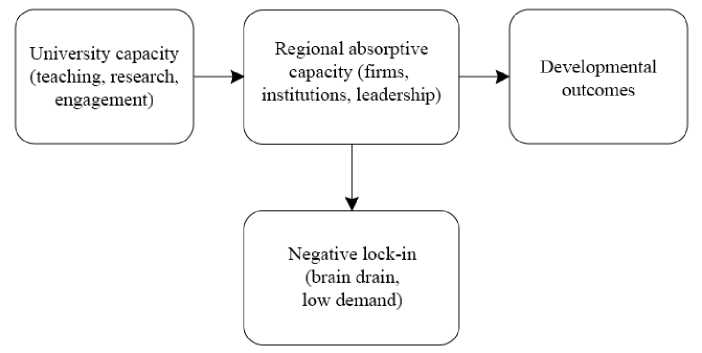
F i g. 1. Conceptual pathway of research
Source : prepared based on the results of the research.
The research question is: Why does the presence of a university lead to different developmental outcomes in regions with different economic structures and institutional capacities? The working proposition is that universities make a stronger positive contribution to regional development when their teaching, research, and engagement activities are matched by sufficient territorial absorptive capacity. Where this capacity is weak or spatially uneven, higher education expansion is expected to produce limited local spillovers, a frustrated regional mission, or an enclave effect. This proposition guides a structured qualitative comparison rather than a statistical test.
LITERATURE REVIEW
The concept of a university's “third mission” extends the institutional agenda of higher education beyond teaching and research toward direct contributions to society, the economy, and community life [11; 12]. In regional terms, the third mission refers to the capacity of higher education institutions to support regional development through knowledge exchange, workforce formation, civic leadership, public problem-solving, cultural participation, and collaboration with firms and public agencies [13–15]. Rather than operating as isolated intellectual enclaves, universities are expected to actively participate in shaping regional futures.
This expectation is particularly pronounced in less-developed regions, where the university often emerges as one of the few institutions capable of convening actors across economic and social divides [16; 17]. It can educate local youth, anchor public-sector expertise, generate applied research, support entrepreneurship, and symbolize a commitment to reversing regional decline [18]. Universities also help peripheral areas redefine their narrative–shifting from territories of deficit to territories of potential [19–21]. This symbolic function is critical because regional development is not merely material; it is also interpretive, involving confidence, belonging, and the articulation of credible futures.
However, the third mission should not be idealized. A university may offer educational mobility without ensuring that the resulting human capital remains local [22; 23]. It may cultivate knowledge networks that are globally impressive yet regionally detached [24]. It may also generate civic energy while lacking the structural means to reshape labor markets [25; 26]. Consequently, the third mission is best understood as a relational endeavor; its outcomes arise not from the university in isolation, but from the interface between institutional capacities and regional conditions [27].
In general terms, less-developed regions rarely begin from scratch – their current opportunities are constrained by inherited infrastructures, industrial legacies, demographic trends, and prior policy choices [28]. Path dependency captures this historical layering, demonstrating that a region formerly organized around mining, heavy manufacturing, or low-value assembly cannot effortlessly convert itself into an innovative knowledge economy [29]. Physical landscapes, workforce skills, organizational routines, and local expectations often remain calibrated to yesterday's economy rather than tomorrow's technological demands.
Core-periphery theory sharpens this perspective by illustrating that development is inherently spatially uneven. Core regions accumulate firms, capital, prestigious institutions, and highly educated labor, while peripheral regions consistently lose them [30]. This divergence is a cumulative process rather than a one-time event. Talented students migrate to metropolitan centers, investors prefer locations with dense networks and lower uncertainty, and peripheral public institutions face pressure to achieve more with fewer resources. Over time, the gap widens because the core benefits from self-reinforcing concentration, whereas the periphery confronts self-reinforcing depletion [31].
One of the most damaging expressions of this regional depletion is stagnation. Peripheral regions can become locked in an equilibrium characterized by the out-migration of educated residents, restricted local demand for high-level skills, and limited firm innovation. Cheap land and low living costs, often framed as advantages, do not automatically attract knowledge-intensive sectors [32]. Instead, they frequently reflect weak market demand and coincide with fiscal stress, population aging, or social marginalization, placing additional strain on local administrations. In such contexts, a university enters a region already facing a structural mismatch between educational supply and productive demand [33].
The developmental challenge, therefore, is not simply to increase graduate numbers, but to alter the regional trajectory itself. This requires institutions capable of forging new combinations among knowledge, enterprise, public administration, infrastructure, and civic life, as highlighted by recent studies from Russia [34–36]. Universities are vital to such projects, but they cannot execute them alone [37].
Furthermore, not all universities enter regional space with the same orientation. Some are research-intensive institutions whose primary horizon is national or global prestige. They seek visibility in competitive research systems, publish for international audiences, and align internal priorities with scientific reputation [38]. Others are teaching-led or vocationally oriented, making them more responsive to local labor-market needs. Still others occupy an intermediate position, combining applied work with broader scholarly ambitions. These distinctions matter because the developmental footprint of a university depends not merely on its geographic location, but on its institutional identity and strategic goals.
A central difficulty is strategic overload: universities in less-developed regions are frequently expected to solve immediate, territory-specific problems, such as improving school quality, supporting local firms, training healthcare and education professionals, retaining youth, and revitalizing the local economy [39]. Yet the funding and evaluation regimes under which they operate are usually national, privileging spatially portable outputs: journal publications, citation impact, competitive grants, and reputation markers associated with excellence. This creates a structural contradiction: regional actors require engaged problem-solvers, whereas higher education systems reward globally legible performance.
This contradiction can lead to various forms of misalignment. A university may be institutionally capable yet territorially detached, pursuing academic prestige while surrounding communities seek practical support [40]. Alternatively, a university may be deeply committed to its region yet constrained by a local labor market unable to absorb its graduates [41]. In other cases, the university and the region may share administrative boundaries while inhabiting different realities – a prosperous urban enclave juxtaposed against a struggling rural hinterland. In each scenario, physical proximity is mistaken for institutional integration, and the presence of a campus is falsely assumed to guarantee routine regional spillovers.
The reviewed approaches therefore provide complementary but incomplete explanations. Third-mission studies often overstate the automaticity of local spillovers; core-periphery studies under-specify university agency; and absorptive-capacity studies typically lack a comparative account connecting institutional orientation to concrete regional structures. The present study addresses this gap through a structured comparison of three Czech cases, integrating university type, labor-market demand, institutional coordination, and the spatial distribution of benefits into a single analytical framework.
MATERIALS AND METHODS
Study design. This study adopts a qualitative multiple-case design at the regional (meso) level. The unit of analysis is the university-region configuration rather than an individual university department, firm, or person. The design is explanatory and mechanism-oriented: it examines how university orientation interacts with regional labor demand, economic structure, and institutional coordination.
The selection of cases can be explained as the following: Vysocina, and Olomouc were selected through purposive maximum-variation sampling. First, they represent three different territorial structures: a post-industrial region in transition, a predominantly rural manufacturing region, and an internally divided region containing both a prosperous university city and disadvantaged peripheral areas. Second, they contain contrasting university types (Fig. 2): a comprehensive university seeking stronger research standing (UJEP), a small teaching- and applied-research-oriented polytechnic (VSPJ), and a large research-intensive university (UPOL). Third, all three are outside the Prague metropolitan core, which makes comparison of peripheral and semi-peripheral dynamics analytically meaningful.
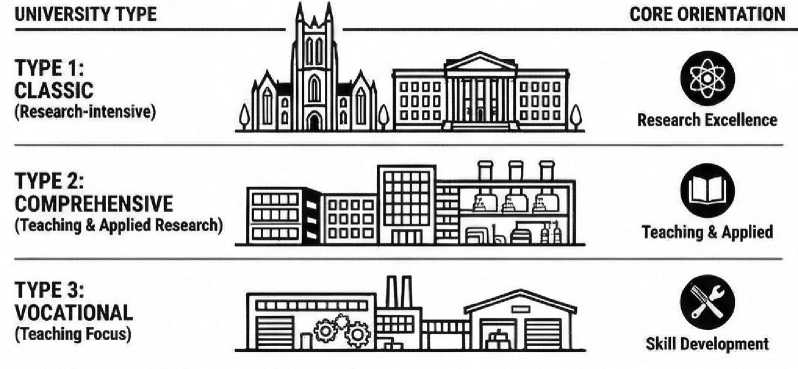
F i g. 2. University types and core orientation
Source: Kohoutek J., Pinheiro R., Čábelková I., Šmídová M. Higher Education Institutions in Peripheral Regions: A Literature Review and Framework of Analysis. Higher Education Policy. 2017;(30):405–423.
Thus, the research design is clarified as a structured comparison of three cases. Each case is interpreted through the same analytical categories: university orientation, scale of university activity, regional absorptive capacity, labor-market demand, and the spatial distribution of potential spillovers [42].
The second configuration is the regionally loyal teaching-oriented institution in a labor market dominated by low-value production or branch-plant activity. Here the university or college does what regional policy often requires – it educates local people, cultivates practical skills, and attempts to retain youth. Yet local employers, especially subsidiaries embedded in global supply chains, may seek primarily routine labor rather than highly qualified graduates. The educational project succeeds, but the local economy cannot metabolize its outcome. Graduates leave not because the institution failed to form them, but because the regional opportunity structure failed to receive them.
The third configuration is the enclave university in a split region. In this arrangement, a large and historically established university sits inside the prosperous segment of a broader administrative territory. Policy discourse treats the institution as though it serves the entire region equally, but actual interaction is concentrated in the already advantaged urban zone. Knowledge, investment, and prestige circulate locally around the university without meaningfully reaching poorer sub-regions. The formal geography of the region conceals the social geography of exclusion.
Descriptive indicators. A targeted structured comparison of three Czech regional university cases is carried out in four stages. First, each university is classified by institutional orientation and regional mission. Second, each region is characterized by basic descriptive indicators, including population, university student concentration, GDP per capita, and unemployment. Third, the observed pattern is interpreted through the concept of absorptive capacity. Fourth, the three cases are compared to identify whether the university functions primarily as an enclave, a frustrated regional actor, or a potential developmental anchor.
This methodology provides an analytically sound empirical triangulation: numerical indicators are used to structure the comparison and avoid purely narrative interpretation, and the logic of the case study explains mechanisms that cannot be captured by a single cross-sectional table.
GDP per capita is used only as a descriptive regional development indicator in the comparative table (Table). Absorptive capacity is discussed conceptually through the presence of qualified labor demand, innovative firms, institutional coordination, and channels for retaining graduates and using university knowledge.
T a b l e. Descriptive regional indicators used for comparative case-study triangulation
|
Region, university |
University students |
Population |
Students per 1,000 residents |
GDP per capita |
General unemployment rate, % |
|
Usti Region, UJEP |
8,393–8,700 |
805,943 |
10.4–10.8 |
CZK 513,153 |
5.1 |
|
Vysocina Region, VSPJ |
about 2,300 |
515,953 |
4.5 |
CZK 618,344 |
2.3 |
|
Olomouc Region, UPOL |
22,764 |
631,480 |
36.1 |
CZK 599,812 |
2.6 |
Note : the table uses the latest available official regional indicators at the time of revision: population at 31.12.2025, GDP per capita for 2024, and general unemployment rate for Q4 2025. University student counts are based on official university and Study in Czechia public information. These figures are used for descriptive casestudy triangulation and mechanism-based interpretation, not for regression-based causal inference.
Source: Czech Statistical Office. Latest statistical data – Ustecky Region. Prague: CZSO; 2026. Available at: (accessed 07.08.2025) ; Ibid. Vysocina Region. Available at: (accessed 07.08.2025) ; Ibid. Olomoucky Region. Available at: (accessed 07.08.2025).
RESULTS
Empirical results of a comparative analysis of three regional cases. The descriptive indicators reinforce the working proposition that university presence and regional outcomes are mediated by territorial absorptive capacity. Usti combines a sizeable regional university with the weakest regional economic indicators among the three cases: lower GDP per capita and the highest unemployment rate. This supports the interpretation that university capacity alone cannot compensate for a weak regional demand structure and historical industrial lock-in.
Olomouc displays the strongest concentration of students relative to population, but the case remains analytically different because the university is embedded in a more developed urban part of a split region. The descriptive comparison therefore supports the enclave-effect interpretation: a large and prestigious university may strengthen its immediate urban environment without automatically reducing intra-regional disparities.
The relationship between higher education institutions and regional development is highly contingent upon the structural characteristics of the regions in which they are embedded. The Czech Republic provides three illustrative regional case studies (Ustí nad Labem, Vysocina, and Olomouc regions) each demonstrating distinct configurations of regional economies and university roles and highlighting different mechanisms through which the regional mission of universities may stagger (Fig. 3) [43].
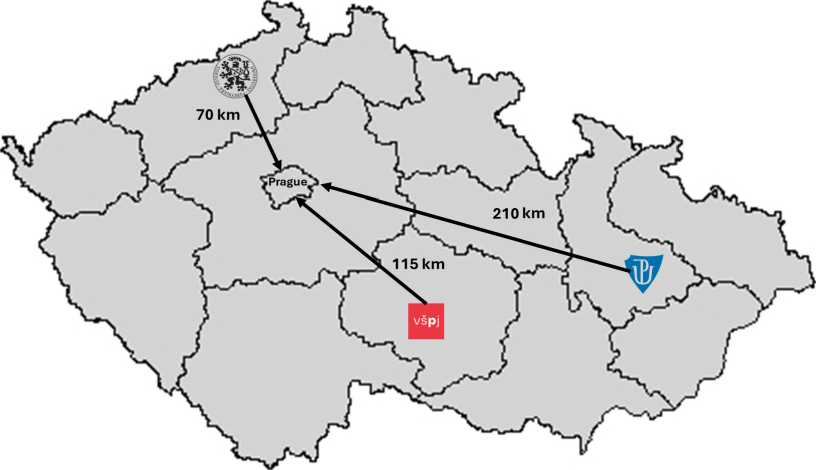
F i g. 3. Geographical position of 3 regional Czech universities
Source : hereinafter in the article, prepared on the basis of the research results.
Figure 3 locates the three universities relative to Prague and illustrates their distribution across the Czech territory. UJEP is located in the north-western post-industrial Usti Region, VSPJ in the centrally located Vysocina Region, and UPOL in the eastern Olomouc Region. The figure was prepared by the authors using an administrative map of Czech regions and official university logos; distances are approximate road distances and are included only for geographical orientation.
Ustí Region and the University of Jan Evangelista Purkyne (UJEP): The Ustí region represents a structurally disadvantaged industrial periphery shaped by historical path dependency. Its economic landscape has been heavily influenced by coal mining and heavy industry, leaving behind environmental degradation and persistent socio-economic challenges. The legacy of industrial decline is compounded by a relatively low educational attainment among the population. At the beginning of the 21stcentury, a significant share of residents possessed only primary-level education. This combination creates a difficult environment for economic restructuring toward knowledge-intensive activities.
Situated within this context, UJEP occupies a strategically important position as a potential catalyst for regional modernization. Structurally, the institution is oriented toward applied research and could, in principle, support local industries in technological upgrading and workforce development. However, national-level research and development policies prioritize globally visible, theoretically oriented outputs, thereby incentivizing universities to pursue academic prestige rather than locally embedded engagement.
As a result, UJEP faces discord between its institutional incentives and regional needs. While the Usti region requires practical innovation, technical problem-solving, and workforce upgrading, the university is increasingly oriented toward academic outputs with limited local applicability. Consequently, the benefits of research activity remain largely internal to the institution and fail to translate into broader regional economic renewal. This case exemplifies how policy-induced “strategic overload” can redirect universities away from their immediate socio-economic environment, weakening their potential developmental impact.
Vysocina Region and the College of Polytechnics Jihlava (VSPJ): In contrast to Ustí region, the Vysocina region is characterized by a predominantly rural structure with low population density and an economic base rooted in traditional manufacturing and skilled trades, particularly metalworking. VSPJ is a relatively small and regionally oriented institution that demonstrates a strong commitment to serving local needs. Its educational mission is closely aligned with the production of human capital tailored to the regional economy, reflecting an embedded institutional orientation.
Despite this alignment, the region exhibits a fundamental structural limitation related to the nature of its integration into global production networks. Many key employers in Vysocina region are subsidiaries of multinational corporations that locate production facilities in peripheral regions primarily to exploit lower labor and land costs. These operations are typically limited to routine manufacturing and assembly, while higher-value activities such as research, design, and strategic management remain concentrated in core regions abroad.
This configuration results in a structural mismatch between the supply of educated graduates and the demand within the local labor market. Highly educated individuals produced by VSPJ are often overqualified for available positions, leading either to underemployment or outward migration. In this case, the university fulfills its regional mission in terms of educational provision, yet the regional economy lacks the absorptive capacity to utilize this human capital effectively. The outcome is a paradoxical situation in which alignment at the institutional level is undermined by misalignment at the level of global economic structures.
Olomouc Region and Palacky University Olomouc (UPOL): The Olomouc region presents a third configuration, often described as a “split region”, where significant intra-regional disparities coexist within a single administrative unit. The northern part of the region is characterized by rurality, economic underdevelopment, and heightened risks of social exclusion. In contrast, the southern part, where the regional capital Olomouc is located, exhibits relatively strong economic performance and industrial development.
Within this framework, UPOL is large and historically prestigious institution with a strong research orientation, and it is situated within the more developed southern sub-region.
Its institutional strategy is predominantly oriented toward global academic networks, emphasizing research excellence and international visibility. While this positioning enhances the university’s reputation and academic output, it also limits its engagement with less-developed parts of the region.
The assumption that the presence of a major university within a region would automatically generate spillover benefits across all sub-regions proves unfounded in this case. The benefits of UPOL’s activities remain geographically concentrated, with limited diffusion toward the disadvantaged northern areas. This reflects a broader pattern in which knowledge and innovation do not naturally disseminate across administrative boundaries without deliberate institutional mechanisms and policy interventions. The Olomouc case thus illustrates the “enclave effect”, where a high-performing university operates within a localized sphere of prosperity while remaining disconnected from surrounding areas of need.
Theoretical conclusions and conceptual generalizations. Taken together, these three case studies from the Czech Republic highlight distinct but interrelated mechanisms that constrain the regional developmental role of universities. In the Ústí Region, institutional incentives divert the university from local engagement. In Vysocina Region, the regional economy lacks the capacity to absorb skilled graduates. In Olomouc Region, spatial disparities limit the diffusion of academic benefits within the region. These patterns underscore the importance of aligning university strategies, regional economic structures, and policy frameworks to enable meaningful contributions of higher education to regional development.
Figure 4 outlines the matrix of Czech regions (rural region, industrial region, split region) and university types (classic and research intensive, vocationally oriented with teaching and research, and vocationally oriented with teaching focus only) used in this study.
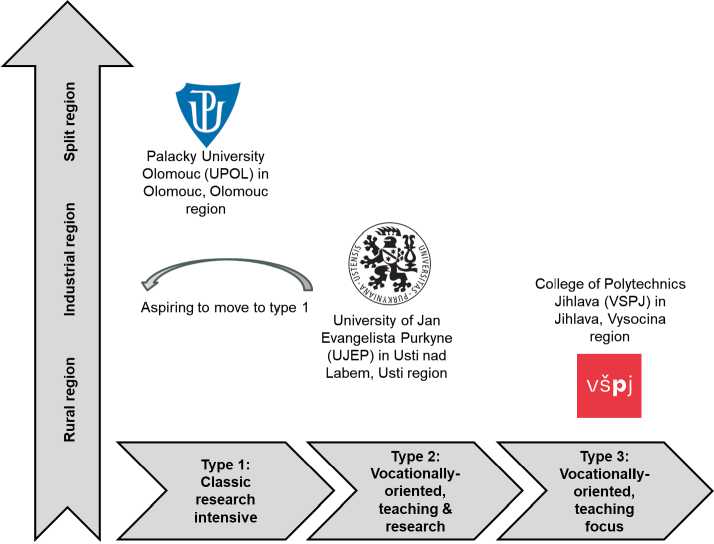
F i g. 4. Matrix of regions and university types

The matrix shown in Figure 4 above highlights the deliberate variation in case selection. UJEP, VSPJ, and UPOL occupy different institutional positions and are embedded in different territorial structures, allowing university type and regional context to be compared jointly.
The descriptive triangulation shows that the developmental role of universities differs according to regional absorptive capacity. In the Usti case, relatively substantial university activity is embedded in a region with weaker GDP and labor-market performance. In the Vysocina case, a regionally loyal college faces a labor market whose demand is structured by routine production rather than knowledge-intensive upgrading. In the Olomouc case, a large research university coexists with stronger regional indicators but produces geographically selective benefits. These patterns support the interaction logic of the conceptual framework rather than a simple linear assumption that higher education automatically boosts regional development.
The concept of absorptive capacity as an explanatory framework. The concept that most effectively explains these patterned outcomes is absorptive capacity. In regional development terms, absorptive capacity refers to the ability of a territory to recognize, utilize, and scale the knowledge, skills, and innovation generated by universities. It includes the presence of firms capable of collaboration, public institutions able to coordinate strategy, intermediary organizations that translate between academic and commercial worlds, financial mechanisms that support experimentation, and civic conditions that make staying in the region desirable for graduates and professionals.
Absorptive capacity matters because knowledge must land somewhere. A graduate requires meaningful employment, a researcher requires partners, an entrepreneur requires networks and capital, and a collaborative project requires institutions that can sustain trust over time. Where these channels are absent, the university's output leaks outward. Skilled residents migrate, research connects upward to national and global systems rather than sideways into the local economy, and local firms continue to compete on cost instead of upgrading through learning.
Figure 5 below depicts the alignment matrix showing likely outcomes under different combinations of university orientation and regional absorptive capacity.
Low absorptive capacity High absorptive capacity

|
Enclave effect High symbolic prestige, limited local spillovers |
Selective growth Research links can scale into clusters |
|
Frustrated mission Strong commitment, weak labor-market pull |
Transformative fit Graduates, firms, and public actors co-evolve |
F i g. 5. Alignment matrix of university orientation and regional absorptive capacity
Matrix model: university orientation and regional absorptive capacity. This framework helps explain why investment in higher education alone can unintentionally intensify metropolitan concentration. If the region finances educational mobility but cannot offer pathways for local professional realization, the university becomes a sorting and export mechanism. Peripheral territories effectively subsidize the human capital of the core. Such outcomes are especially likely in less-developed regions where labor markets are narrow, innovation systems are weak, and local public institutions have limited convening power.
Conversely, where absorptive capacity is stronger, even a modestly sized university can become a developmental broker. It can help firms modernize, support new ventures, improve public administration, attract professionals, and shape a thicker regional ecosystem. The critical insight is that the university's role is mediated, not direct. It contributes through a network of receiving structures, not through academic presence alone.
A useful theoretical way to synthesize our results is to distinguish between university orientation and regional absorptive capacity. When a prestige-led institution operates in a region with low absorptive capacity, the most likely outcome is enclave development: the university may accumulate symbolic capital and attract resources, but spillovers remain narrow and socially uneven. When a regionally embedded institution operates in a low-capacity region, the outcome is often a frustrating mission because the commitment is high, but the environment cannot convert educational effort into structural change.
By contrast, when absorptive capacity is stronger, both prestige-led and regionally embedded institutions have more developmental room to operate. A research-oriented university may help generate specialized clusters if firms, public agencies, and intermediary organizations can receive and extend their knowledge. A teaching-led or applied institution can become transformative when graduates encounter local demand, entrepreneurial support, and civic infrastructures that encourage long-term settlement. In both cases, what matters is not merely institutional goodness or regional need, but their co-evolution.
DISCUSSION
The results stemming from our analysis are theoretically important because they demonstrate that university effectiveness is contingent on regional prosperity and economic growth. The same institutional asset can perform very differently depending on whether it is inserted into an industrial region in transition, a rural economy shaped by external corporate control, or a territorially divided region with uneven internal development. The lesson is not that universities fail everywhere, but that developmental outcomes depend on patterned interactions among institutional type, labor-market structure, governance, and history.
The comparison supports the working proposition: university presence is associated with stronger and more territorially inclusive developmental effects only when a region possesses sufficient receiving structures. The proposition is not statistically “confirmed” in a causal sense, because the design uses three qualitative cases, but it is supported through consistent pattern matching. Differences in GDP and unemployment alone do not explain the outcomes; the decisive mechanisms are the character of labor demand, institutional coordination, university orientation, and the spatial reach of university-region interaction.
The empirical placement of the cases is interpreted in the following paragraphs: Usti/ UJEP is associated with enclave risk under relatively low capacity; Vysocina/VSPJ with a frustrated regional mission; and Olomouc/UPOL with selective growth in the university city combined with weaker diffusion across the wider region.
The Usti case is closest to the upper-left cell of Figure 5 – low absorptive capacity combined with a partly prestige- and research-led orientation-although UJEP also retains an important regional mission. The result is an enclave risk rather than a complete enclave: the university accumulates educational and research capacity, but the surrounding post-industrial economy and weaker labor market limit the scale at which this capacity is translated into broad regional upgrading. This interpretation is consistent with work showing that third-mission outcomes depend on community and institutional capabilities, not on university capability alone [27], and with studies emphasizing cumulative peripheral disadvantage [8; 31; 32].
VSPJ is closest to the lower-left cell-regionally embedded orientation under comparatively limited knowledge-intensive absorptive capacity. Its institutional mission is aligned with local needs, but the regional production structure generates relatively modest demand for advanced research careers and large numbers of highly qualified graduates. This “frustrated mission” pattern corresponds to evidence on higher-educa-tion/labor-market mismatch [33]. It also qualifies the optimistic strand of third-mission research: commitment and applied engagement are necessary, but they are insufficient when higher-value corporate functions and strategic decision-making remain outside the region.
UPOL is best located between the upper-right and upper-left cells, depending on the spatial scale used. At the level of Olomouc city and its immediate knowledge ecosystem, the combination of a research-intensive university and relatively high institutional density resembles “selective growth”. At the level of the entire administrative region, however, absorptive capacity is spatially uneven, and the benefits diffuse weakly toward northern peripheral districts. The case therefore demonstrates that a region can possess high aggregate capacity while still producing an intra-regional enclave effect. This extends previous research by showing that absorptive capacity should be assessed territorially rather than assumed to be homogeneous within administrative borders.
The cases do not have identical starting conditions, and this is analytically important. Their outcomes differ because historical industrial trajectories, the composition of employers, university missions, and internal geography create different channels for using knowledge. Usti faces post-industrial lock-in and weaker demand; Vysocina has a functioning labor market but a narrower knowledge-intensive segment; Olomouc has a dense university-city ecosystem whose benefits are spatially selective. The concept of absorptive capacity connects these differences and explains why the same policy instrument-supporting a university-does not produce the same result everywhere.
This model presented in this paper suggests that universities and HEIs in less-developed regions should be understood less as isolated catalysts and more as anchor institutions within regional coalitions. Their transformative potential rises when they are linked to municipal and regional governments, small and medium-sized enterprises, schools, hospitals, cultural organizations, and development agencies. The task is to create repeated pathways through which teaching, research, and engagement become territorially productive. Once such pathways exist, the university can support not only economic upgrading but also social resilience, civic participation, and local confidence.
The model also widens the meaning of development. Universities and HEIs in peripheral settings should not be judged solely by their capacity to generate immediate high-tech growth. In some contexts, their most important contribution may be to thicken institutional life, retain social infrastructure, and serve as civic glue in communities otherwise exposed to fragmentation and exit. This is not a lesser function. In regions where market dynamism is weak, social cohesion and institutional continuity may be preconditions for later economic renewal.
Compared with earlier studies, the findings agree with the view that universities' regional engagement is relational and organized through multiple actors. They also support research on uneven development and peripheral adaptability. Our study departs from accounts that imply a broadly automatic third-mission effect: in all three cases, academic activity requires complementary demand-side institutions. It likewise adds nuance to core-periphery explanations by demonstrating that universities are not merely passive reflections of regional structure; their orientation can reinforce or mitigate territorial constraints, although it cannot eliminate them alone.
The study has four limitations. First, three purposively selected cases cannot support statistical generalization. Second, the analysis relies on public documents and secondary statistics rather than interviews with university, business, and government stakeholders. Third, the available indicators do not permit construction of a fully comparable numerical absorptive-capacity index. Fourth, some university effects unfold over long periods and cannot be inferred from a single recent statistical snapshot. Future research should combine longitudinal regional data with interviews, graduate-retention measures, firmlevel innovation indicators, and network analysis of university-region partnerships.
CONCLUSION
Our study set out to explain why universities generate different developmental outcomes across three Czech regional settings. The comparison answers this question by showing that university capacity is mediated by territorial absorptive capacity. A university can supply education, research, and engagement, but these outputs become regional development only when firms demand advanced skills, intermediary organizations translate knowledge, public actors coordinate strategy, and graduates have reasons and opportunities to remain.
The first research task was to characterize the cases. Usti represents a post-industrial transition region with weaker economic and labor-market indicators and a comprehensive university pursuing both regional and research ambitions. Vysocina represents a rural manufacturing region with a small, professionally oriented polytechnic and limited demand for knowledge-intensive functions. Olomouc represents an internally divided region with a large research university whose strongest effects are concentrated in the regional capital.
The second task was to identify absorption and leakage mechanisms. In Usti, industrial lock-in and weak demand constrain the translation of university capacity. In Vysocina, educational and applied-research commitment meets a production structure that offers too few advanced local career paths. In Olomouc, a strong university-city ecosystem generates benefits that do not automatically reach peripheral districts. These mechanisms produce, respectively, enclave risk, a frustrated regional mission, and spatially selective growth.
The third task was to assess the working proposition. The cross-case evidence supports the proposition that university effects are stronger where university orientation and regional receiving structures are aligned. The contribution of the study is therefore not a claim that one university type is universally superior, but a relational model linking institutional orientation, labor-market structure, governance, and geography.
The findings have practical significance for regional authorities, ministries responsible for education and regional development, university leaders, innovation agencies, municipalities, and employer associations. They indicate that higher-education expansion should be embedded in a place-based strategy combining supply-side educational investment with demand-side ecosystem building. Useful instruments include innovation vouchers, joint laboratories, technology-transfer intermediaries, mission-oriented public procurement, support for local suppliers and start-ups, graduate internships and career ladders, and quality-of-life investments that improve retention.
Evaluation and funding systems should also recognize territorially relevant forms of excellence. Research quality remains essential, but it should be complemented by credible evidence of collaboration with regional firms, schools, hospitals, municipalities, and civic organizations. Differentiated institutional missions are preferable to requiring every peripheral university to imitate metropolitan research models.
