
Upravljanje kadrovima u visokom obrazovanju i specifičnosti liderskih stilova
Журнал: Ekonomski signali @esignali
Статья в выпуске: 1 vol.17, 2022 года.
Бесплатный доступ
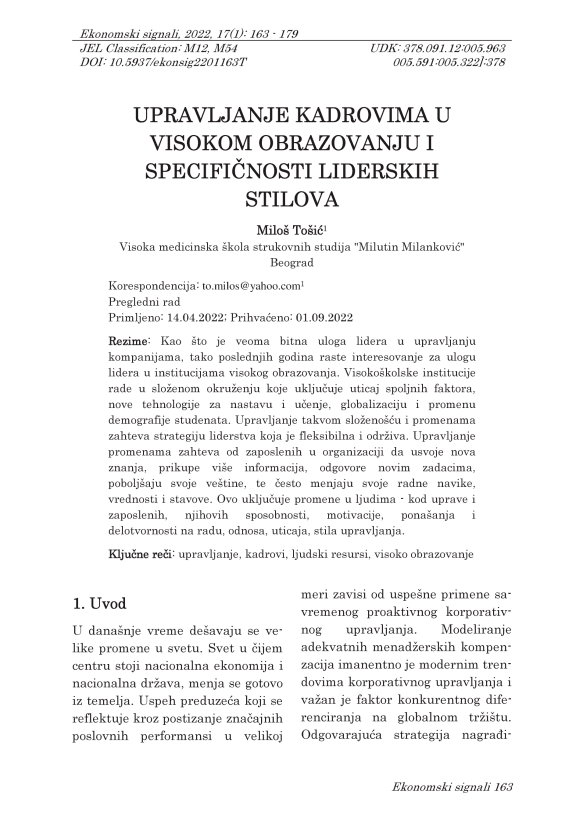
Kao što je veoma bitna uloga lidera u upravljanju kompanijama, tako poslednjih godina raste interesovanje za ulogu lidera u institucijama visokog obrazovanja. Visokoškolske institucije raste u složenom okruženju koje uključuje uticaj spoljnih faktora, nove tehnologije za nastavu i učenje, globalizaciju i promenu demografije studenata. Upravljanje takvom složenošću i promenama zahteva strategiju liderstva koja je fleksibilna i održiva. Upravljanje promenama zahteva od zaposlenih u organizaciji da usvoje nova znanja, prikupe više informacija, odgovore novim zadacima, poboljšaju svoje veštine, te često menjaju svoje radne navike, vrednosti i stavove. Ovo uključuje promene u ljudima - kod uprave i zaposlenih, njihovih sposobnosti, motivacije, ponašanja i delotvornosti na radu, odnosa, uticaja, stila upravljanja.
Похожие статьи в разделе Воспитание. Обучение. Образование
Короткий адрес: https://sciup.org/170204042
IDS: 170204042 | DOI: 10.5937/ekonsig2201163T
Personnel management in higher education and the specifics of leadership styles
Just as the role of leaders in company management is very important, in recent years there has been a growing interest in the role of leaders in institutions of higher education. Higher education institutions are growing in a complex environment that includes the influence of external factors, new technologies for teaching and learning, globalization and changing student demographics. Managing such complexity and change requires a leadership strategy that is flexible and sustainable. Change management requires employees in the organization to acquire new knowledge, collect more information, respond to new tasks, improve their skills, and often change their work habits, values and attitudes. This includes changes in people - management and employees, their abilities, motivation, behavior and effectiveness at work, relationships, influence, management style.
Список литературы Upravljanje kadrovima u visokom obrazovanju i specifičnosti liderskih stilova
- Global definitions of leadership and theories of leadership development: Literature review. University of Cambridge, Institute for Sustainability Leadership, https://www.britishcouncil.org/sites/default/files/finalleadershipcompositereportwithreferences_26-06-17.pdf
- Alvesson, M. (2002) Understanding organizational culture. London: Sag
- Bisbee, D.C. (2007) Looking for leaders: Current parities in leadership identification in higher education. Planning and changing, vol. 38, no. 1&2, 77-88
- Blaok, S.A. (2015) Qualities of effeotive leadership in higher eduqation. Open Journal of Leadership, 4, 54-66
- Daft, R. (1999) Ledadership theory and practice. The Dryden Press
- Dašić, D., Stevanović, M. (2019) Quality management as a component of competitiveness and social responsible operations. u: Ristić Vladica [ur.] IRASA International Scientific Conference Science, Education, Technology And Innovation Seti I 2019, Beograd, 208-216
- Dašić, D., Tošić, M., Jovanović, N. (2020) Corporate social responsibility in the field of educational processes. u: Dašić P. [ur.] Economics and Management-Based on New Technologies (EMoNT-2020), 10th International Conference, Vrnjačka Banja, Serbia; 21-24 June 2020, Proceedings, SaTCIP Publisher Ltd, pp. 131-136, ISBN 978-86-6075073-2
- Dašić, D., Ristić, P., Zlatković, M. (2021) Marketing and change management in the services sector. Ekonomski signali: poslovni magazin, vol. 16, br. 1, str. 13-25
- Dašić, D. (2014) Etički aspekti marketing miksa neprofitnih organizacija. Poslovna ekonomija, vol. 8, br. 2, str. 315-330
- Dimitrijević, L. (2012) Upravljanje kadrovima u funkciji efikasnog upravljanja marketingom. Ekonomski vidici, vol. 17, br. 3, str. 397-406
- Drugus, D.L. (2014) Leadership in higher education. Bulletin of the Transilvania university of Bra§ov series v•' economic sciences, vol. 7 (56), no. 2 , 125-132
- Druoker, P. (1995) Postkapitalističko društvo. Beograd: Poslovni sistem Grmeč
- Đorđević, B. (2019) Liderstvo - konceptualnost i vizija. Beogradska bankarska akademija, Fakultet za bankarstvo, osiguranje i finansije Univerzitet Union Beograd, Doktorska disertacija
- Đorić, N., Sinanović-Vukosavljević, S.J.I. (2021) Quality management as a determinant of healthcare user satisfaction. Horizonti menadžmenta, I(1), 69-91
- Ebener, D.R. (2021) Poslovna misao. Profit magazin, br. 26, https://www.profitmagazin.eom/idania/broi26.252.html 8 (12.1.2022)
- Ferench, J.J., Raven, B. (1960) The bases of social power. New York: Harper J Row
- Gaither, G.H. (2002) Developing leadership skills in academia. Academic Leadership, The Online Journal, 2(l), www.academicleadership.org/leaderactiontips/Developing_eadership_Skills.shtm
- Gajić, J. (2010) Marketing strategija u visokom obrazovanju. Beograd: Univerzitet Singidunum, doktorska disertacija
- Gigliotti, R.A.J., Ruben, B.D. (2017) Preparing higher education leaders: A conceptual, strategic, and operational approach. Journal of Leadership Education, 16, 96-114
- Griffin, G. (2022) The 'work-work balance' in higher education: Between over-work, falling short and the pleasures of multiplicity. Studies in Higher Education
- Janićijević, N. (2011) Uticaj liderstva na organizacionu kulturu. Ekonomika preduzeća, vol. 59, br. 5-6, str. 215-226
- Marinković, T.J., Tvrdišić, D. (2021) Rukovođenje u funkciji praćenja i unapređenja rada zaposlenih u obrazovanju. Horizonti menadžmenta, II (l), 77-100
- Mews, J.G. (2019) Effective leadership in higher education: A review of leadership style preferences among faculty and staff within the United States. Open Journal of Leadership, 8, 58-74
- Milošević-Stolić, J. (2021) Mogućnost razvijanja liderskih kompetencija kroz sistem vojnog obrazovanja - otvorenost sistema. Bezbednost, Beograd, vol. 63, br. 1, str. 82-97
- Northouse, P.G. (2007) Leadership: Theory and praotioe. Thousand Oaks, CA: Sage
- Notgrass, D. (2014) The relationship between followers' perceived quality of relationship and preferred leadership style. Leadership & Organization Development Journal, 35, 605-621
- Raletić-Jotanović, S., Ratković, M., Dašić, D. (2015) The differences between human resource management in domestic and international environment. Vojno delo, vol. 67, br. 6, str. 159-175
- Smiroioh, L., Morgan, G. (1982) Leadership: The management of meaning. Journal of Applied Behavioral Science, v. 18, 257-273
- Staokman, R., Pinder, C., Connor, P. (2000) Values lost. u: Ashkanasy N., Wilderom C., Peterson M. [ur.] Handbook of organizational culture & climate, Thousand Oaks: Sage, pp 37-54
- Stefanović, N., Stefanović, Z. (2007) Liderstvo i kvalitet. Mašinski fakultet, Univerzitet u Kragujevcu
- Stevanović, A. (2014) Transformaciono liderstvo kao preduslov organizacionih inovacija u turbulentnim socio-ekonomskim okolnostima. Škola biznisa, br. 2, str. 170-187
- Šormaz, G. (2017) Uloga i značaj menadžmenta u obrazovanju. Ekonomija: teorija i praksa, vol. 10, br. 4, str. 19-32
- Winston, B., Patterson, K. (2006) An Integrative Definition of Leadership. International Journal of Leadership Studies, Vol. 1, Iss. 2, pp. 6-66
- Wisniewski, M.A. (2002) Leadership in higher education: Implications for leadership development programs. Academic Leadership: The Online Journal, 2(1), www.academicleadership.org/leaderaotiontips/leadershipinhighereduoation.shtm
- Zečević, M. (2021) Key account management: customer analysis and selection-oreation of additional value. Horizonti menadžmenta, I(1), 135-215
