
What kind of state do Russians want to live in? What kind of state has been built?
Journal: Economic and Social Changes: Facts, Trends, Forecast @volnc-esc-en
Section: Editorial
Article in issue: 6 т.18, 2025.
Free access
This article examines the challenge of translating the desired vision for Russia's future, shared by a majority of its citizens, into practical reality. The issue's relevance is analyzed both before and after the commencement of the special military operation in Ukraine. Drawing on nationwide and regional sociological studies, as well as expert evaluations, the authors conclude that for most citizens, the desired future for Russia is that of a strong, sovereign nation grounded primarily in traditional values – with social justice being paramount – and the principles of a social welfare state. This vision broadly aligns with the course of national development pursued by Russian President Vladimir Putin over the past 25 years. However, the authors also note a persistent skepticism among experts and the broader public regarding the feasibility of actually achieving this desired future. This problem existed both prior to and following the start of the special military operation. Its root cause is identified as the inability or unwillingness of a significant portion of the ruling elites to implement the head of state's strategic objectives aimed at strengthening national sovereignty. As a result, the future of Russia remains uncertain in the eyes of many of its citizens. Consequently, Russia's struggle for continued sovereign development is framed not only as a conflict with the Collective West but also as an internal battle against the nation's own protracted domestic issues. For the President, a key imperative thus becomes laying the groundwork to bring the system of state governance into alignment with the public's vision for the country's future. This entails, above all, concluding the special military operation on terms favorable to Russia and selecting a successor capable of continuing and reinforcing the quarter-century-long course of national development. The empirical foundation of the research is based on the authors' own sociological monitoring data, nationwide surveys, and assessments from a broad spectrum of experts. The authors' contribution lies in developing the theoretical and methodological framework for scholarly inquiry into defining the contours of Russia's future vision and identifying the obstacles to its practical implementation.
Similar articles in the section High level, top level of administration. Central, national government
Short address: https://sciup.org/147252991
IDS: 147252991 | UDC: 354 | DOI: 10.15838/esc.2025.6.102.1
Text of the scientific article What kind of state do Russians want to live in? What kind of state has been built?
The special military operation has now been underway for almost four years. For nearly that same period, Russia has been living through a historical phase where practically everything is undergoing decisive change. As A. Dugin writes, “The SMO is a ritual of transition from one state to another. When this transition ends, we will find ourselves in a new world. This will mean a different society, different people, different borders, different principles, different ideas, different institutions, and different political orientation s” 1 . What exactly these “people”, “borders”, “principles”, and “ideas” will be is, as they say, being decided in real time. It is therefore no coincidence that V.V. Putin states that we “live in a time when everything is changing – and changing very rapidly; changing fundamentally. None of us can fully foresee the future. However, this does not absolve us of the duty to be prepared for anything that may happen” 2 …
In early 2025, we wrote that over his 25 years in the presidency, Russian President V.V. Putin had evolved from a “Warrior” (beginning with the resolution of the Chechen conflict) to a “Creator,” and that “this transformation is the result of a complex interplay of external and internal factors, which can only be analyzed within a single historical context”3.
“Putin began his presidency in the archetypal image of a ‘Warrior,’ over the years becoming a full-fledged ‘Ruler’ who in real time amends the world order, creating a new world order in the role of a ‘Creator’”.
“’Warrior’ – a purposeful and active fighter striving, on the one hand, to defeat enemies, on the other – to protect friends/people/voters. ‘Ruler’ – creates order out of chaos and maintains it, organizes processes, builds hierarchy. ‘Creator’ – a person who creates a new world order in which Russia will have a completely new role, and creates new rules of the game within the country and a new elite” 4 .
This “single historical context” means that the President has had to perform all three roles simultaneously, periodically bringing one to the fore – the “Warrior,”5 the “Ruler,”6 or the “Creator”7 – depending on the situation on the domestic and foreign political stage. Throughout, however, his focus has remained on Russia’s future, setting objectives and defining a national development strategy for decades to come.89101112
2008: “Today we are already formulating goals and objectives not for a month or two ahead, but for 20–30 years ahead” 8 .
2012: “A long-term state approach is necessary, one that considers the interests of both regions and virtually all sectors of the economy, geopolitical and social factors. We need to look 10, 20, 30 years ahead” 9 .
-
2022 : “Always – when making any decisions – it is necessary to single out the main thing. What is the main thing for us? To be independent, self-sufficient, sovereign and to ensure development for the future, both now and for future generations…” 10 .
-
2023: “The country has always thought about the future. And we, of course, must act in exactly the same way. Always, under any circumstances, think about the future of the people and our state. That is what we do” 11 .
-
2025: “...the very idea [of building the Trans-Siberian Railway across the country to the Pacific Ocean] serves as an example for us of strategic vision for the future, where not only current needs and circumstances are taken into account, but also the interests of the country for centuries to come…” 12 .
The President’s ability to effectively combine all three roles has so far ensured (and continues to ensure) the continuity of the country’s national development course over the last 25 years. Over time, this has led (as experts note) to significant geopolitical and even civilizational consequences. On December 5, 2025, the new U.S. National Security Strategy was published, in which Russia, for the first time, was not named an enemy. Some experts called this event “revolutionary” 13 ; “it states in black and white what was unthinkable until recently: ‘NATO should not be an organization for endless expansion’ ” 14 .
During the special military operation (SMO), the President faces the necessity of undergoing the same transformation of the three roles (from “Warrior” through “Ruler” to “Creator”) as he did throughout his presidencies, but now in an “accelerated” mode, under force majeure conditions, and with a sharply increased cost for any managerial error.
Thus, in the initial months of the SMO, the President’s primary task was to protect Russian statehood against the consolidated threat from the
NATO bloc and the “Kiev regime” (hostilities in the SMO zone, the sanctions “blitzkrieg,” international and domestic terrorist acts). 151617
“The White House has published an updated U.S. National Security Strategy. The appearance of this document had been awaited for several months, but the Trump administration kept delaying – making edits. And here is the result: the strategy looks revolutionary regarding Russia, Ukraine, and Europe. The Russian Federation is not an enemy of America, talk of supporting the ‘nezalezhnaya’ [‘independent’ – referring to Ukraine] ‘until victory’ is no more. The EU leadership ‘undermines political freedom’ and is generally capable of leading the Old World into the abyss. And NATO should not ‘expand endlessly’” 15 .
“If we discard diplomatic formulations, we see a radical, revolutionary turn in views on national security in the USA… The de facto removal of the ‘main threat’ status and a call for strategic stability – this is a recognition of the strength of the Russian position” 16 .
“The new U.S. National Security Strategy marks a 180-degree turn in American politics” 17 .
On December 9, 2025, speaking at a plenary session of the State Duma of the Russian Federation, the Chairman of the State Duma, V. Volodin, noted that “since 2022, 152 federal laws on support measures for participants of the special military operation and their families have been adopted” . On December 9, four more federal laws were adopted, providing for:
/ Free travel for a serviceman and two of his close relatives to and from the location of the military medical commission;
^ Extension of benefits for adult children of SMO participants after graduation from school until September 1;
^ Granting regions the authority to establish additional measures of housing provision for families of servicemen killed during their service;
^ Priority right to housing provision for SMO fighters who have the status of orphans and performed tasks to repel the invasion on the territory of the Russian Federation;
^ The right to receive housing or a subsidy out of turn for servicemen: raising disabled children over 18 years of age; those who decided to continue military service under contract after certain wounds and injuries” 18 .
As the system of state governance (society, the economy, the military-industrial complex) adapted to these challenges, the President’s role as “Ruler” grew increasingly prominent. This is associated with intensive, almost daily legislative activity across the entire system of state administration, all subordinated to the goal of organizing the country’s life under the conditions of the SMO. This includes socio-economic support for SMO participants, their families, and other categories of citizens; reorienting the economy toward cooperation with partners from friendly countries; tightening accountability for disciplinary violations in the military-industrial complex, the army, and at systemically important facilities; combating foreign agents; and reforming the system of education and upbringing for the younger generations, etc.
As noted by V. Fedorov, General Director of VCIOM 19 (the Russian Public Opinion Research Center), “in a sense, the SMO has already become routine”. This is evidenced, in particular, by data from FOM 20 (the Public Opinion Foundation), which shows a decline in public interest in news from the special military operation zone (by 20 percentage points over 4 years, from 35 to 15%).
V. Fedorov : “ The SMO is already in its fourth year, and in a sense, it has become routine . The question arises: how will we get used to living without the SMO? A serious question, by the way. Because during this time, the economy, the market, people’s mindset, their behavior, and international ties have all been restructured. And what will happen the day after the SMO ends? Clearly, new changes are coming, also quite profound» 21 .
According to FOM data 22 :
In December 2022, among the events covered in the media that generate the greatest interest, 35% of Russians named events related to the SMO (namely the situation on the battlefield, advances of Russian troops, drone attacks, etc.);
In December 2023, their share was 26% ;
In December 2024 – 28% ;
In December 2025 – 15% .
That is, over almost 4 years, interest in the SMO topic has halved (from 35 to 15%), although, undoubtedly, it was and remains the “number one topic” in public perception.
This public “habituation” to life during the SMO indicates that people are once again beginning to be concerned about the future – “what will happen the day after the SMO ends?” – which, in turn, means it is time to bring to the fore the President’s third “public image” 23 : that of the “Creator” of the future.
Thus, for Russia, two historical processes have currently converged at a single critical point: a global one – the era of nearly 25 years of the country’s development under conditions of a “liberal fog” – and, in historical terms, a relatively concrete one – the period of the SMO. As V. Fedorov remarked, during this period “ Russians are starting to talk about the future again… What exactly that future will be is the main question ” 24 .
What does the desired future image of Russia look like in people’s minds? How realistically can this image be realized given the existing external and internal challenges facing the Russian Federation? And, perhaps most importantly, to what extent does the state, led by V.V. Putin for the last 25 years, align with the vision of Russia’s desired future held by the majority of the population?
First of all, we should note that the image of the future is a topic of growing relevance in our country. Recall that back in 2015 (long before the start of the special military operation in Ukraine), an expert study 25 was conducted by the Institute of Sociology of the Russian Academy of Sciences (IS RAS). Its results showed that “ the desired future of Russia and the realistically forecasted situation in the country in the medium term (for the next 5 years) are not simply different but are in many ways opposite.
Unfortunately, the situation experts predicted for the country in the near future was distinctly pessimistic” 26 .
As experts noted in 2015, Russia needed above all in the coming 5 years : “rotation of the political elite at the center and in the regions,” “transparent and legitimate elections at all levels of government”, “stability of legislation”, “a change in the state’s attitude toward the spheres of culture, education, and science, moving away from their commercialization”, etc. However, in reality (according to the experts), something quite different would happen in the country : “a decline in public incomes, rising prices, and a falling standard of living”, “a prolongation and tightening of Western sanctions against Russia”, “a sharp drop in oil and gas prices”, “the degradation of social infrastructure (healthcare, education, culture)”, etc. (including “a large-scale war in Ukraine with the direct or indirect participation of Russia and NATO countries”; Insert 1). It is worth noting that many of these expert predictions have indeed materialized: Russia has become embroiled in a large-scale war in Ukraine, Western sanctions have continued and intensified, and a business-oriented approach still prevails in the state’s treatment of culture. As for the “rotation of the political elite at the center and in the regions,” by and large, it has not occurred (with the exception of a number of “targeted,” though very important, personnel appointments initiated personally by the President – such as the introduction of figures like M.V. Mishustin, A.R. Belousov, I.V. Krasnov, etc., into the system of state governance).
|
г- |
40 |
40 |
40 |
40 |
40 |
ох |
"Ч |
||||||
|
® sis и x 2 3 я o a « ^ 2 а а а -w а* Ря^ «ай 1 i § ОС у ^ л sa .2? Л Я д я © 2 « из а о £ я а у у Ж 2 ^ « 2 ® ^ ° .2 f о в и и £ я ; В а Q ^ л § - |
ад о ^ to ад .S с/Г о а ад .S 'В С/Г Ё я .2 а .S й § .2 Е а ^ 3 •о & 04 о —' я |
"л ° ^ й .2 .g ад у Й иГ .2 2 g О g ад у Я S Й о О и & £ ’Я 1 * й « о о ей ° |
S С/З С/З ад а ’о я "и С/З С§ С/З с/Г Ян С/З С/З л О ад я Tj Я й л о й ^ а л S й ? « & .2 ^ -3 ГП 2 |
В . S 8 О О С/З о л л ’о а Й о Я 2^ 5 £1 3 и 5 й С/З О 4а и 2 я с я с ’Й к <н-с ИЗ У о <2 'с с 2 я о а Е s а £ Ян t а а и |
С/Г § о +2 S' ’ад Ё Я я .Н Ё ’у ’^ о £ я 2 о я а у и и .2 я 1 J а я О ^н й 3 un .Ё |
О с/з с/з ’л О я ’и ад ’Ё Ё С/З ’ад 'о я о а л Ян С/З S 1 40 Ян |
У С/З ад а о • Ё с/Г ’и л .о Е С/Г о Ян О с/з л и у •а .2 I 1 д .я ’и а н д Г" и |
.2 а ад л С/З С/Г л ’с/з С/З Я о 2 С/З С/З Ян а С/З я НН |
из ’ ' Я у .2 ^ из ИЗ <Н <2 ° ^ -Я •а а й .4 "5 о , s а о й g 8 § 2 с 00 О 6 .ё я а У у я w у а Ё ° £9 ’Э а о л У м 5 £ о о ■й Я й § “ “ •S ^ £ 8 “ л Я о 2 3 а я . Ё из О & S * Й О -Й о л ох & Ё |
С/З а О Я .2 'у Ян У 2 а о У 2 а 2 У 'В S ИЗ £ я у Я Я § ? О у н О я -Н й |
У из л У У а .s' 'из С/З С§ о .g м из .2 .2 я S я я я я о О О U я Я Я я 2 1 S S и £ S с/з О Я ^ я а $н ИЗ .2Р Ё "3 о 3 х Ян в Л ИЗ й ЭД ° Ё а |
2 о 2 о У У из У У о из о я В н Я Я У Я Ё а Ян У i s .я Н 2 ■ § 2 м й а § ’Ч Ян из а из 00 д • о гч у -н у |
я о из Я О Ян я В в а S -° й у а о а У о из Д и Ян а О Я у у а ^ 2 л У .2 2 а ’й а о я у У г У У оо -Я а °" i в f Е .£9 ^ а у у из Q у * 5 |
|
ОО |
ОО |
О |
сч |
40 |
40 |
^Ч |
о |
||||||
|
-Я д из 2? о о а с я ^ о > с ИЗ азо © о 2 S § В а 2 м 5 Я И) у а а « я а я 3 о Я ад S с «.во Ьн из 5 « § 1 .^ из > w ® я « •2^и +- ИЗ ^ В Я О я© © U из во л |
С/З Я ’ад .S л о и л о о а о я .2 |
л С/З Я .2 23 о Ё ’ад ’Й ’я б о Ян О g Е g? S .я ад 'О я я о > о ^ сч ’л |
Е 00 о С/З О S .2 ’ад о (Л |
л .2 о у я и о с/з Я 2 2 S й В Е ° 8 5 S’ .s g & Ч й g ^ 8 |
о о Ё Ян о а с/Г .2 о Ё я 00 л с/з Ян 2 о ’о s Е a у ад £ й >> с? Л а я Ё un л |
а л 00 а о я 2 о с/Г я и я У С/З •Я я а с/з а О 5 60 ^ Я из а я 2 .° ^ й чо а |
00 УЗ г?3 % 2 'й S с/з я ад я о 2 я W -В а У 2 Ян 'л .^ и а я Ян а .2 о а 5 Ян а Я- у |
из 00
у я б X а о О я 'из С/З С§ 2 о у а
2 00
5 i ? й а из сл а . л оо а |
^ й О из У 73 а ^ из 2 1 'S о л л Ogg •Дит) О 4= Й й Й £ s я оо а а я а л из ° 2 -2 ! , л 8-1 Я у Ян И1 s g ’Я W ^ 1 с/з У ’§ .Ё ад Я ИЗ д •й из а •о ^ 4 S во й й .4 я _2 ОС 3 ^ |
я о из Я О Ян ю ^ S у 2 Ян У 2 >> о а S &> ” й S и 5 О 3 о У о 5 а у 2 а о я В 2 ^ ад ”2 •S 2 а о 2 ^ 2 у, из л а у у из О у * 5 |
Source: Gorshkov M.K. et al. (2016). Russian Society and the Challenges of Time. Book Four. Moscow: Ves’ Mir. 400 p.
“On the one hand, the state proclaims the necessity of preserving and strengthening traditional Russian spiritual and moral values, and on the other – through its directive instructions, it pushes the sphere of culture into market-based operating conditions with the demand for non-profit cultural organizations to ‘earn more’…
“In the economics of culture, a business approach to evaluating cultural activity still prevails, and concepts such as ‘economic efficiency,’ ‘investment,’ ‘labor productivity,’ ‘profit,’ ‘competition,’ etc., continue to be used. Meanwhile, the mechanical transfer of standard economic categories to the sphere of culture risks underestimating its social significance and also creates false expectations regarding the commercial potential of cultural goods... The market as a system of economic relations is one of humanity’s greatest achievements; however, not all spheres of public life fit into the market mechanism of economic management. And the sphere of culture is one of them» 27 .
In 2018, three years after the IS RAS expert survey and following the Russian President’s Address to the Federal Assembly, in which he announced a course toward “a decisive breakthrough… in preserving the people of Russia and ensuring the well-being of our citizens” 28 , similar studies were conducted by VCIOM and FCTAS RAS 29 . These studies likewise revealed a discrepancy between the desired image of Russia’s future and the future perceived as realistically achievable – this time according to the broader population, not just experts.
According to VCIOM data 30 ( Tab. 1 ):
^ 53% of Russians expressed the view that the president’s promises would not be fulfilled; of these, 47% cited “corruption and bureaucracy within the government” as the reason, while another 6% believed “the president’s proposals are too vague, non-specific, and therefore impossible to implement”;
^ confidence that “the President outlined specific, realistic tasks that will most likely be completed in the shortest possible time” was demonstrated by 34% of citizens.
Table 1. In your opinion, how realistic are the tasks the president outlined in his Address to the Federal Assembly of Russia, and will they be fulfilled or not? (closed-ended question, one answer), % of those who followed the Address or learned its contents from the news
|
Answer option |
2009 |
2010 |
2011 |
2012 |
2013 |
2014 |
2018 |
|
The President outlined specific, realistic tasks that will most likely be completed in the shortest possible time |
28 |
31 |
31 |
36 |
29 |
49 |
34 |
|
The President outlined specific, realistic tasks, but they will not be fulfilled due to corruption and bureaucracy within the government |
49 |
47 |
40 |
42 |
46 |
31 |
47 |
|
The president’s proposals are too vague, non-specific, and impossible to implement |
11 |
12 |
17 |
16 |
20 |
8 |
6 |
|
Difficult to answer |
12 |
10 |
12 |
6 |
5 |
12 |
13 |
|
The question was asked from 2009 to 2018. Subsequently, the wording was changed (“In your opinion, will the majority of the tasks set by Vladimir Putin in his speech be implemented in full, implemented partially, or will the majority of tasks not be implemented?” Answer options: “Will be implemented in full”, “Will be implemented only partially”, “The majority of tasks will not be implemented”, “Difficult to answer”). Source: Address of the President to the Federal Assembly: First Impressions. VCIOM Press Release. No. 3602. 2018. March 13. Available at: |
|||||||
27 Muzyychuk V.Yu. (2025). Culture in the Logic of the Market: Facts VS Myths: Monograph. Saint Petersburg: Aletheia. P. 13.
28 The exact quote from V. Putin: “...everything is based on preserving the people of Russia and the well-being of our citizens. It is here that we need to make a decisive breakthrough” (source: Presidential Address to the Federal Assembly of the Russian Federation, 01.03.2018. Available at: .
29 Federal Center of Theoretical and Applied Sociology of the Russian Academy of Sciences (FCTAS RAS).
30 Presidential Address to the Federal Assembly: First Impressions. VCIOM Press Release No. 3602. 2018. March 13. Available at:
According to FCTAS RAS data, the most important tasks announced by the President in the 2018 Address to the Federal Assembly were “growth of real incomes,” “creating accessible and high-quality healthcare,” “bringing regional and local roads into good condition,” “increasing pension sizes and indexing them above inflation rates,” etc. However, Russians believed that 8 out of 10 of the listed tasks would most likely not be fulfilled . All of them (except for “securing Russia’s place among the world’s five largest economies” and “the emergence of affordable mortgage lending”) were among the “top ten” of the head of state’s target objectives that, in the view of citizens, would not be realized ( Insert 2 ).
Thus, the question of Russia’s future image existed even before February 2022. After the start of the SMO, which became the culmination of an almost 20-year period of escalating geopolitical tensions between Russia and the NATO bloc31, the issue of the future image and a new Social Contract in Russia became even more acute. As experts note, “the global transformation of the geopolitical system in 2022 created a problem of fundamentally revising the social contract...”32. The expert community raised the question: “if we no longer want to become part of the West, then what do we want to become?”33. This is precisely what is evidenced by numerous attempts after the start of the SMO to create a desired image of the future, to outline its contours, and to formulate development benchmarks for the next 20, 30, or 40 years34.
Insert 2
|
ТЗ О й о Е и X) о 44 13 й 3 й ел й и cd +-> й о 44 |
04 |
ОО |
^ |
40 |
гН |
гч |
о и Сх •S S ад и •S <3 |
ТЗ |
||||
|
ел о ОО о 44 ел Й 'ел О Х> О й cd о о ад cd 44 й О ел cd 0) й 5 |
О Й ел ТЗ cd 3 о ТЗ Й cd 3 Й 'ад й1 I Он |
ел cd и cd 3 2 д и 5 8 +J Й -о о й cd CD и |
0) 44 44 й cd й 44 й ел Й 3 X тз ■ 1—1 'Й 44 ел”' й 'ел Й а Й о cd й 1 1 Н о |
й 3 а а й 44 ел О а о й ■ I—1 3 2 3 Й О |
о cd о 3 3 о 8 .^ 3 7 ад д ■о д га 3 3 .s' cd CD и |
ел ■2 3 а о 3 Й 3 тз о 3 & cd CD и |
о 44 й ад cd 44 ел '44 Й й 'ел ел ^ й 3 з д 8 й I й (О ■2 3 £ 8 |
В* Й о о о й 44 й ел ел 3 3 тз 8 1 ел ел cd 8 cd 3 Й .2 Й cd |
й о о о 44 й ел ел ъ 3 3 о 44 3 й 2 |
|||
|
д 'ел £ о й 44 X X и й Й й й СЛ ел cd +-> cd 44 8 д 44 |
^ ОО 04 |
^ ОО 04 |
^ ОО 04 |
40 04 |
ю 04 |
04 |
04 |
04 |
04 |
о 04 |
■3 г: |
|
|
й .о с? 44 ел О а й ■ 1—1 о О |
о cd о 3 3 CD .^ 3 7 д д га и ■Е? cd CD и |
3 о й ел ТЗ cd 3 ТЗ Й cd 3 Й 'ад CD й1 I Он |
3 0) 44 44 й cd й 44 ■ЕР 3 ел Й cd тз ■ 1—1 'Й 44 ел” Й Й а Й о ел cd ■^Н 44 ? н .8 |
ел cd и cd 3 8 д и 5 В ■р ел 3 8 тз о й .2 3 CD б |
ел ■ 2 3 а о 3 Й .2 cd й тз о 3 & ■Е? 3 CD б |
Й о cd О й1 cd +-> ел” 3 й 'ел ел О ел й 3 е 1 а ел О О •о д ■о £ ел Й Й ■2 .2 3 3 Bi 8з |
2 cd >> о ОО о 44 ел Й 'ел ел 3 X* й cd 44 X <2 о ад cd cd о 44 й о ел cd й |
3 дЕ 44 й ел О а о й о о 44 ел О cd 1 44 й й 3 3 ел Й О О ел 3 'ел ел |
3 <0 о 2 3 2 cd 2 3 ^ -о ад 2 О N Cd ТЗ ел ел Cd <| । Й О й х> о cd § В 4 ад cd гн о О н ^ |
|||
Without illusions. Available at:
“We cannot move forward while constantly looking back. And deciding who was right – the Reds or the Whites ... 100 years ago? Or – how did we come to the collapse of the USSR 35 years ago?!... We must argue not about the past, but about the future. And set landmarks – where should we be in 5–10–20 years? What needs to be done for that?
In the late Soviet Union, there was its own quite strong futurological school and tradition, its own vivid science fiction. Alas, with the collapse of the USSR, it all disappeared. We were told: there’s no need to invent anything of our own, everything has already been invented – in the West! And if we dream, then only of building a society of the Western type here in Russia. Well, what’s the need for futurology here?! So it vanished; our future became today’s West.
And so it continued for several decades, until it became clear that this goal is both unattainable and does not inspire us... A vacuum of goal-setting emerged: if we no longer want to become part of the West – then what do we want to become? A good, substantive answer to this question has not yet been found; instead, there are only pseudo-historical fantasies…
We need our own vivid image of the future, not reducible to either our own previous experience or the experience of Western or Eastern countries. Such an image can only be invented, created, brought to life. This is our most urgent task today. Solve it – and many problems that seem unsolvable today will either be solved or simply disappear from the agenda” 36 .
During this period (after the start of the SMO), research by FCTAS RAS showed a sharp increase in the share of Russians who would prefer to live in a socialist rather than a capitalist society.
Thus, in 2020 (before the SMO), the share of Russians who wanted to live under socialism was 26%, while in 2022 (the first year of the SMO) it increased to 48% (a rise of 22 percentage points; Tab. 2 ).
For comparison, the proportion of those who wanted to live in a capitalist society decreased from 21 to 12% over the same period (a drop of 9 p.p.).
Overall, during the period of V.V. Putin’s presidencies (from 2000 to 2025), the share of those wishing to live under socialism increased from 31 to 44% (+13 p.p.), while the share for capitalism decreased from 21 to 14% (-7 p.p.). 36
Table 2. What kind of society would Russians prefer to live in? (Data from FCTAS RAS), % of respondents
|
Answer option |
Years |
Dynamics (+/-) |
||||||||||||
|
1998 |
2000 |
2004 |
2008 |
2012 |
2018 |
2020 |
2022 |
2023 |
2024 |
2025 |
2025 to 2000 |
2022 to 2020 |
2025 to 2022 |
|
|
Period of V. Putin’s presidencies |
First SMO year vs. last* pre-SMO year |
Period of the SMO |
||||||||||||
|
In a socialist one |
38 |
31 |
34 |
33 |
39 |
29 |
26 |
48 |
48 |
43 |
44 |
+13 |
+22 |
-4 |
|
In a capitalist one |
22 |
21 |
22 |
18 |
18 |
24 |
21 |
12 |
5 |
15 |
14 |
–7 |
-9 |
+2 |
|
In some other |
10 |
12 |
8 |
10 |
7 |
6 |
4 |
6 |
10 |
7 |
6 |
–6 |
+2 |
0 |
|
Difficult to answer |
30 |
36 |
36 |
39 |
36 |
41 |
49 |
34 |
37 |
35 |
36 |
0 |
-15 |
+2 |
*Data for 2021 are not available.
Calculated from: Levashov V.K., Velikaya N.M., Shushpanova I.S. et al. (2025). “How Are You, Russia?” Express Information. 55th Stage of the All-Russian Sociological Monitoring, May 2025: Bulletin. FCTAS RAS. Moscow: FCTAS RAS. P. 56.
The reason for the growing public demand specifically for socialism in Russia’s future image is largely connected to an acute deficit of social justice, which has long been noted in Russian society. As early as 2013, RAS Academician M.K. Gorshkov wrote: “ Russia, for the most part, does not accept an unjust society … Successful people today reason like this: ‘Alright, I’m on my feet. But I have children, grandchildren. Will there be a place for them in an unjust society? Where is the guarantee that tomorrow they won’t find themselves in the same place as my low-income neighbors? Today I buy my way out of problems. But I am not eternal…’. Society has matured. People have become more measured in their assessments; they are not against innovations, but on one condition: the foundation of society must remain traditional values, in which lies Russia’s strength” 37 .
According to data from VolRC RAS, the majority of people (50–60%) note that “Russian society is structured, on the whole, unfairly” ( Fig. 1 ). This is largely due, as experts note, to “radically liberal reforms guided by far from the best examples of Western economic thought”.
“The stubborn continuation of radically liberal reforms, guided by far from the best examples of Western economic thought. The avalanche-like breakdown of property relations and the unregulated, uncontrolled privatization of state property and national natural resources essentially opened the floodgates for unlimited and unjustified growth of social inequalities.
As a result, in just 10–15 years, the country received enormous differentiation in the social status of various groups of the Russian population, and social inequalities acquired sharper forms than ever before” 38 .
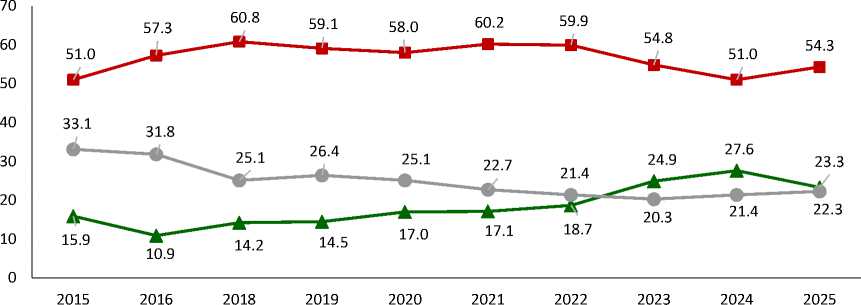
—*— Fairly ■ Unfairly —•— Difficult to answer
Figure 1. Distribution of answers to the question: “In your opinion, is modern Russian society structured fairly or unfairly on the whole?”*, % of respondents
* The question has been asked since December 2015.
Source: VolRC RAS data.
With the start of the SMO, the share of those who note the unfairness of modern Russian society’s structure began to gradually decline (by 9 p.p., from 60% in 2021–2022 to 51% in 2024). This was most likely related to the “rally ‘round the flag” effect amid a sharp aggravation of national security threats and the consolidation of society around the President of the Russian Federation, who declared a strategic course toward strengthening national sovereignty based on traditional Russian values 39 .
However, according to the latest data (for 2025), the proportion of people who consider Russian society to be unfair has increased again (from 51 to 54%).
“What do people expect from the state? Above all, social justice” 40 , noted M.K. Gorshkov, Director of the Institute of Sociology FCTAS RAS, in one of his 2025 interviews. Social justice is the foundation of a social state and is included in the list of traditional Russian spiritual and moral values 41 , which have been proclaimed “ the foundation of Russian society, allowing for the protection and strengthening of Russia’s sovereignty ” 42 .
“The state is obliged to promote the economic and social progress of all its citizens , for ultimately the development of one is the condition for the development of the other, and it is in this sense that we speak of a social state... The function of the state is to maintain absolute equality in rights for all different social classes , for each private self-determining individual, through its power” 43 . (Lorenz von Stein – author of the term “social state”, German historian, philosopher, and economist).
However, as experts note, among citizens, “the dominant opinion is that the creation of a just society in Russia is unlikely even in the medium term” 44 . This forces us to recall once again the words of VCIOM Director V. Fedorov: “ Russians are starting to talk about the future… What exactly that future will be is the main question” 45 .
The significant role of social justice in the desired image of Russia’s future is also evidenced by the fact that, in people’s opinion, “justice” (44%) and “collectivism” (48%) are the key characteristics of socialism (and by a large margin over any other answer options; Tab. 3 ).
However, while “collectivism” has become a less significant criterion reflecting the essence of socialism over the period from 1998 to 2025 (down 10 p.p., from 58 to 48%), “social justice”, on the contrary, has come to be assessed significantly more often by Russians as the main characteristic of a socialist society (up 15 p.p., from 29 to 44%; Tab. 3 ). Ultimately, this indicates that the “deficit” of social justice is one of the system-forming, essential characteristics of the state under the leadership of V.V. Putin over the past 25 years.
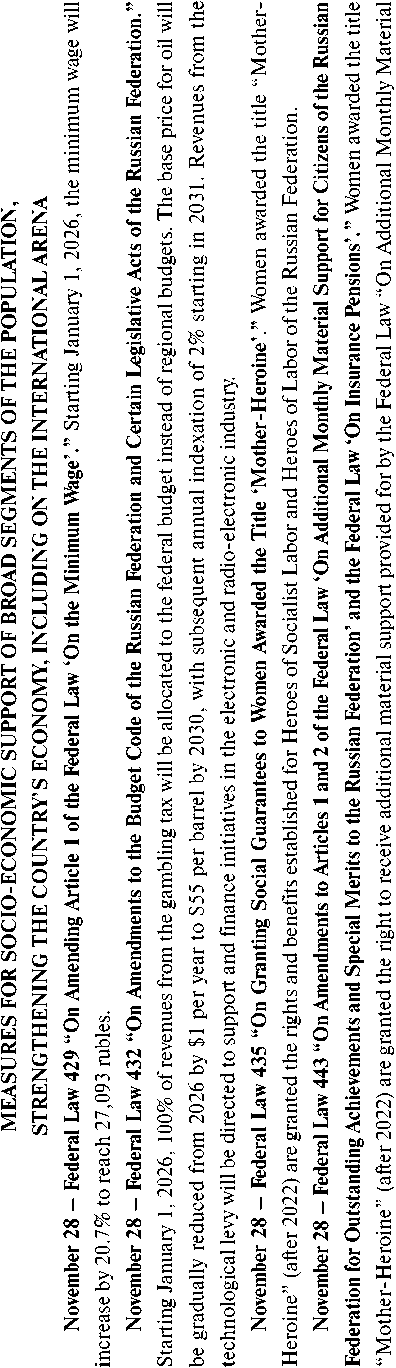
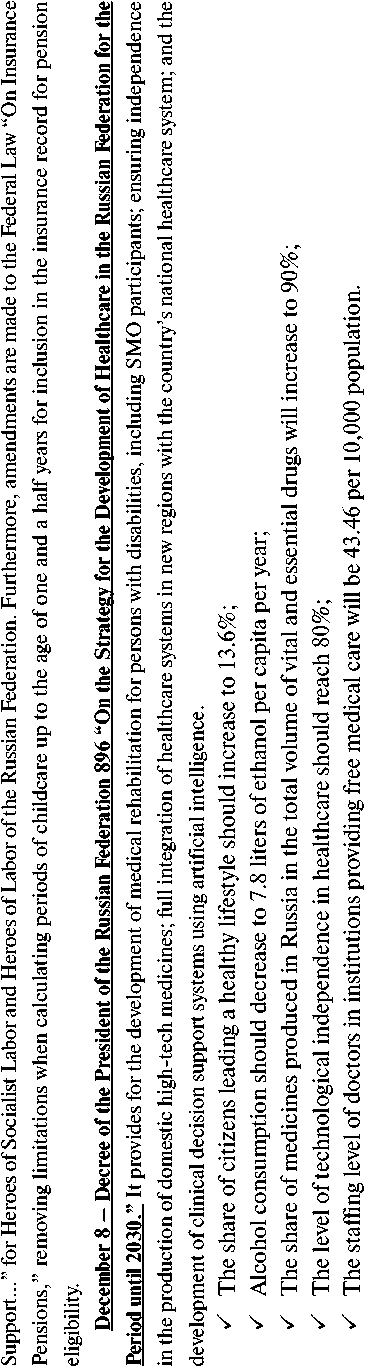
Thus, to date, Russians’ conception of Russia’s future image is quite clear: a strong, sovereign state oriented primarily toward the values of socialism (a social state), the most significant of which is social justice. It is important to note that this conception did not arise solely against the backdrop of national security threats during the SMO but was largely shaped by the targeted, methodical long-term policy of the head of state (specific steps and managerial decisions by the President, the Government, and the State Duma of the Russian Federation in this direction are presented in Insert 3 (over 25 years) and Insert 4 (for the period from October to December 2025)).
Table 3. Dynamics of respondents’ opinions on what the concept of “socialism” means to them, % of respondents
|
Answer option* |
Year |
Dynamics (+/-) |
||||||||||||
|
1998 |
2000 |
2004 |
2008 |
2012 |
2018 |
2020 |
2022 |
2023 |
2024 |
2025 |
2025 to 1998 |
2022 to 2020 |
2025 to 2022 |
|
|
Entire measurement period |
First SMO year vs. last pre-SMO year** |
Period of the SMO |
||||||||||||
|
Collectivism |
58 |
55 |
53 |
44 |
45 |
39 |
38 |
39 |
43 |
49 |
48 |
-10 |
+1 |
+9 |
|
Justice |
29 |
25 |
25 |
34 |
34 |
30 |
29 |
44 |
44 |
46 |
44 |
+15 |
+15 |
0 |
|
Patriotism |
40 |
40 |
38 |
36 |
36 |
41 |
48 |
39 |
38 |
38 |
33 |
-7 |
-9 |
-6 |
|
Order |
43 |
39 |
41 |
38 |
40 |
38 |
44 |
35 |
35 |
38 |
31 |
-12 |
-9 |
-4 |
|
Morality |
23 |
20 |
21 |
25 |
21 |
17 |
25 |
24 |
25 |
27 |
24 |
+1 |
-1 |
0 |
*The table presents the first “top five” most common answer options (out of 23).
**The question was not asked in 2021.
Calculated from: Levashov V.K., Velikaya N.M., Shushpanova I.S. et al. (2025). “How Are You, Russia?” Express Information. 55th Stage of the All-Russian Sociological Monitoring, May 2025: Bulletin. FCTAS RAS. Moscow: FCTAS RAS. P. 56.
Insert 3



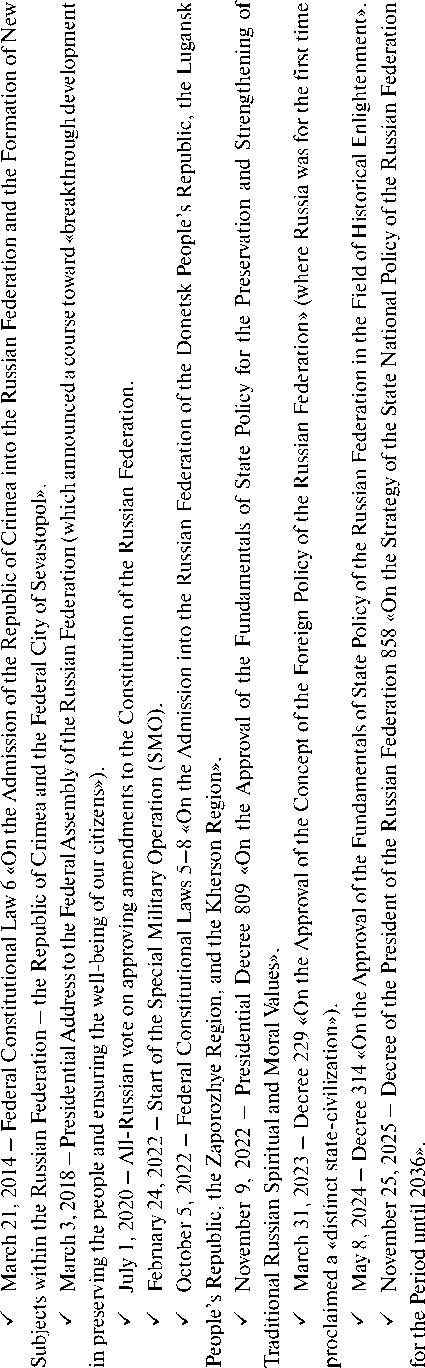
46 On Assessing Citizens’ Evaluation of the Effectiveness of Heads of Territorial Bodies of Federal Executive Authorities (Their Structural Subdivisions) and Territorial Bodies of State Extra-Budgetary Funds (Their Regional Branches) Taking into Account the Quality of Public Service Delivery, Heads of Multifunctional Centers for Providing State and Municipal Services Taking into Account the Quality of Organizing the Provision of State and Municipal Services, as well as on Using the Results of the Said Assessment as Grounds for Decisions on the Early Termination of the Performance of Official Duties by the Relevant Heads: RF Government Resolution 1284.
Insert 4

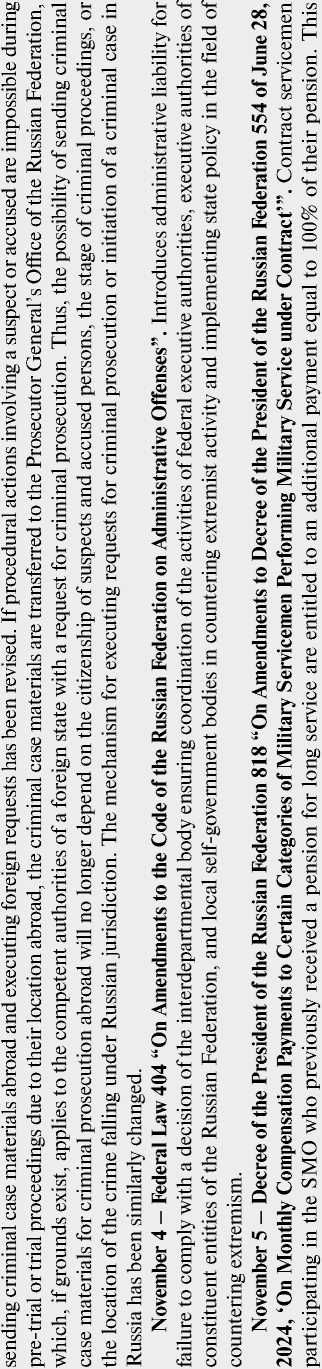

47 The insert is a continuation of the monitoring of the most important regulatory legal acts signed by the President of the Russian Federation, which has been conducted since June 2022 (the first issue of monitoring is presented in the article: Ilyin V.A., Morev M.V. (2022). A difficult road after the Rubicon. Economic and Social Changes: Facts, Trends, Forecast, 15(3), 9–41.
д
-О
ф
я о
й о
й о
й
О
ев
й
я
Я о
ф
ф
-О
я
й
й о
ь О
X
о
р о и ci
о и
X
Pi
h X нн
Pi
ь
(Д и Pi й
(Д X
и X и О Pi И О
X Р £ ь
X НН
X НН Pi PC Рн Р ix
О
И
о
СХ
Й О
Q
8 £
И ад .5 ф я
О я
i
2 ф "О ГФ й
Ф
ф
Я Ф 8 я я ф
я
Ш 00
2 ф "О ГФ й
Ф
О
Й
д
I
й
й о ад
й о
"5
X
g
о
й я
о
8 о
«3 а
щ с?
д д о
д о д о
8 о
2 ф "О ГФ й
Я ев
ев 5-Ф -е гф й в ев
Pi
ф
Я
О
й о
й
ф
о я
о я о
ад
00 о
ф
р
й
Ф
f^
ф
ф
Ф
Ф
Ф
ф ад ев я ад я ев
Ф
ев
Ф
я
ОО
я
2 ф "О ГФ й
Я ев
Ф
я ф
ф
Ф
Ф Ф
Ф
ф л
8 ф
х
о
о
Он
а ф
"а я
X
"га а
О
ад я я с1
с ф ад
я
ф
О
га
Q
о
я
Я
о
о
а
я о я о 00
д
о
я
д
я о
я о
я и а а о
о я о
я о
ад
ев
я о
я я
я
я
й
f^
2 ф -е гф й с ев
Pi
О
о
О
00 га д
00 д
О
я ф
о
о
о р
о
■Я а р
X
я
й о
ь я
о
а о я о
о
я о
£
о ф
Он
а я X
я о я о 00
я
о
Q
с ф 8 д в ©
"га
я я
я
В ф ад ев
ф
К "ев
V
я
i
ев 5-Ф -е гф й
ф
я я S ■я я я
я
i
2 ф -е гф й
ф л 8 р
X
а о я о
о
ад
5 я
о я о
д
я св
Й О
ад й
5 о -й Й
й
я ф а 75 Я
я
2 ф -е гф й в ев
Pi
•Й
g a
о ф ад
я я
о
й о
а
я я о
а
X Й О и м и Й О
■ а я
я
5 u Я
Й о
й о
а
я
я
о
о
й о
5Р
о й о
й
Й о
й о
а
я
д
й ад
я я
я
о
о
£> о ад
а
й св й о
я и а я
о О
й ад
й о
о
я
я
Ч-> с?
.о
Д
р
ев 5-Ф -е й в ев
Pi ©
я я
ев
Z ф
S 55
ф
ад ф ев
сл ф
я
оо ш 00
в
2 ф ■о Р й в ев
Pi
я ф
V
V
V V
ш
ф л
8 Р
X
Й о
я
я
^
о
чо
м
о
д
я га а
.о
5 о -й Й
я
8?
я
й
'й ко
Я О
я о
ф
о
я
00 о
о
я
я
я
я я
й ф
а _g я
Я га Я
Я га
СР
о
Й о
Св
я I я
ф
Я
я
о я
я о
й х й о
о
я
я
я о
00 я
о
я
о
ад
ад й 8
я
ев
ев
ф
с?
5 о Я
й о
I й ф а
я
я и а а о
й о
00 я
о
4-*
'3 о а с о
я
О'
я о
га ф а 'С о а
а о
.о
я
я
00 р
о
Д
й о
о
д
о я
я я о
я с?
о
я о
я я о
я
00 св
Й О
я
а* я
ь я
я
я1 ■д о Ч-» 'й а я
а
§
й й о
д
я
ад св й с?
я
о х Й
я^ я
с?
о
я и а я
о О
Я
2 ф -е Р й в ев
Pi ©
я я
га
И в
i
ев и ф ■о р й
ф
я я 6 ■я я я
я
i
ев и ф ■о р й
ф л 8 р
X
я о о я
О
_о
00 я
S я о
я Е
о я
о
а о
д
я^ я
д
я о
N й св Ё? о
я
я о
о
я
о
о
я
р
.о
Ьн "я
га
а>
а*
ф
га и И а*
о
2 ф -е Р й я ев
Pi
а*
а*
а* я
а*
оо
ф
f ф ф ф
о
о
д
О'
д
00 о
я и а
я
о
о
о 00
я я
я я h
в 2 О
Я
я
я о
ад д ’С
ф
я
р
о
а о
д
Д
о
ев ф
ф
й о
Д
а о о я
о а ф
а
о я о
Рн
о
о я о
я и а я
00 я
я о
о
я
-С
5 я
я
я 00
.о
о
о
я о
а
й Й р
я
я о
N й св ад
о
о
я о я
о
я и а
д
я и а а о
я я о
О'
я
00 р
Д
о
я
о X Й О
й о
о
я
5 я
я и а я о
я
й св
■ Й
я га а я
й й о
о о
га .а "га оо 3
ф
я ев ся V
Я га Я
о о
д
а*
га я S
д
О 1 2 ф -е Р й ф
S © я
И 1s ’ф ф a сл
в
i
д
о а
о
о о
о
д
о
ф
ев 5-Ф -е Р й
ф
о а"
о
ш
о
я я
2 -й Й О
я я и а о
я
я
о
д
Я о Я
я
я
о
я
я
2 ф -е Р й
ш
ф л 8 ф ф ф
V
я га
S
л
я
я и а
Я О
я о
-W
о
X
£
ад й
о
Ч-»
'й о S
о х Й О
я
о
о
я
Nevertheless, in 2025 (just as in the IS RAS expert survey conducted 10 years ago, in 2015), the question arises: how realistic is this desired future image? It is important to note that the conclusions reached by IS RAS experts in 2015 remain quite valid today:
^ “the only actors in Russia are the President and his inner circle”;
^ “there are no other serious subjects capable of influencing the future”;
^ there is a “high probability” of the continuation of processes assessed by experts as “undesirable for the country”;
^ “the most likely scenario for the development of Russian society is a pessimistic (negative) one – but with the preservation of the dominant role of the state” 48 .
“In the summer of 2022, after the start of the SMO, we outlined new forks:
-
1) Continuation of the inertial model of Russia’s adaptation to the world economy as a raw material semi-periphery... Result – stagnation and sliding into a protracted crisis for many years.
-
2) Support for costly mega-infrastructure projects, increased etatization of the economy, elimination of private initiative, price regulation, increasing closure from the external world. Result – sliding into a pseudo-USSR with all the ‘charms’ of an inflexible planned economy.
-
3) A model of stimulating economic growth through realizing the potential of both internal and external development drivers. The main feature – orientation towards rapid economic growth rates.
Today it can be stated that a combination of the first and second options was chosen – an inertial scenario of economic development with a parallel strengthening of the trend towards etatization and economic isolation” 50 .
A. Dugin: “In essence, it is he [V. Putin] who is the main load-bearing structure of our entire statecivilization. A significant part of the elites clearly lags behind the President, his will, and instructions. Even those representatives of power completely loyal to Putin and oriented towards Victory often turn out to be incompetent and unsuitable for this activity. And that is why the head of state turned to the necessity of recruiting a new elite from SMO participants... That is, the unhurried, unawakened, internally unmobilized old elites are now letting our President down ” 49 .
Why do these sociologists’ conclusions remain relevant? Because there is still no answer to the question “What kind of state are we building, and what have we built up to the present moment?” – neither from the state itself nor, consequently, from the broader population.
Many experts point to the emergence of a “ dangerous vacuum ” in the country. As S.A. Karaganov notes, “the ruling stratum of the state is dominated by economist-technocrats”, who are “ incapable of leading the country and the people to new horizons ”. It is therefore no coincidence, as RAS Corresponding Member Zh.T. Toshchenko emphasizes, that many Russians “ still do not understand what kind of state, what kind of society they are building”.
S.A. Karaganov: “A dangerous vacuum has now formed... today, facing a new major challenge, we feel the need to comprehend our place in the world and, most importantly, to comprehend who we are and what is valuable to us.
In the speeches of the President, in the statements of the Minister of Foreign Affairs, in the latest Foreign Policy Concept of Russia, many ideas have increasingly begun to sound which, it seems, could form the basis of Russia’s ideological platform, its society and true elite, returning the country to its roots while powerfully propelling it towards a triumphant future. But a more or less clear outline, let alone one approved at the state level and purposefully, yet naturally creatively (through discussions and probable adjustments) offered to broad circles of the elite and introduced into public consciousness, does not yet exist...
In the ruling stratum of the state, economist-technocrats, ‘political technologists’ still predominate. They are useful for current management, they do much that is needed, but they are incapable of leading the country and people to new horizons, ensuring deep, ideological unity of the people and the government in the difficult, fateful struggle into which the country and the world have entered” 51 .
Zh.T. Toschenko: “ To this day, it is not clear to many Russians what kind of state, what kind of society they are building . The social state proclaimed in the Constitution of the Russian Federation, whose policy is aimed at creating conditions ensuring a dignified life and free development of the individual (Article 7.1), denotes a certain general guideline which has not been sufficiently specified for understanding and embodiment in current socio-economic, socio-political, and everyday life” 52 .
Furthermore, data from monitoring sociological studies by Vologda Scientific Center of the RAS (VolRC RAS) show that even with the obvious “preponderance” of socialism (34%) over capitalism (19%) in people’s ideas about Russia’s desired future, the most common answer to the question “In what kind of society would you like to live?” is “ in some other, difficult to answer ” ( 46% ; Tab. 4 ). 5152
This answer option predominates across all major socio-demographic categories of the population – among men and women (46–47%), among representatives of different age groups (from 43 to 53%, especially among those under 30), among people with different income levels
(40–48%) and levels of education (44–48%), living both in cities (37–49%) and in rural areas (50%; Tab. 4 ).
The cited expert assessments and sociological survey data directly indicate that Russia’s desired (socialist and sovereign) future appears weakly attainable to its citizens; as it was 10 years ago, it remains “in a fog”. Recall that the proportion of people uncertain about the future, although declining in recent years (from 56% in 2023 to 51% in 2025), still constitutes more than half of citizens . According to survey data, they state that they “face the problem of uncertainty about the future” (since 2021, their share has been 51–57%; in 2015 it was 55%; Fig. 2 ).
Table 4. What kind of society would you like to live in?, % of respondents
|
Indicator |
In a socialist one |
In a capitalist one |
In some other; difficult to answer |
|
Gender |
|||
|
Male |
34.4 |
19.5 |
46.1 |
|
Female |
34.2 |
19.2 |
46.6 |
|
Age |
|||
|
under 30 |
29.2 |
17.7 |
53.1 |
|
30-55 |
33.8 |
18.9 |
47.4 |
|
over 55 |
36.7 |
20.5 |
42.8 |
|
Education |
|||
|
Secondary and incomplete secondary |
33.1 |
20.1 |
46.8 |
|
Secondary vocational |
34.8 |
17.4 |
47.9 |
|
Higher and incomplete higher |
34.9 |
20.8 |
44.2 |
|
Income groups |
|||
|
Bottom 20% |
33.0 |
18.7 |
48.3 |
|
Middle 60% |
34.9 |
19.0 |
46.1 |
|
Top 20% |
38.5 |
22.0 |
39.6 |
|
Territories |
|||
|
Vologda |
34.1 |
17.4 |
48.6 |
|
Cherepovets |
40.2 |
22.7 |
37.1 |
|
Districts |
31.0 |
18.5 |
50.4 |
|
Region |
34.3 |
19.3 |
46.4 |
|
Source: data from VolRC RAS. |
|||
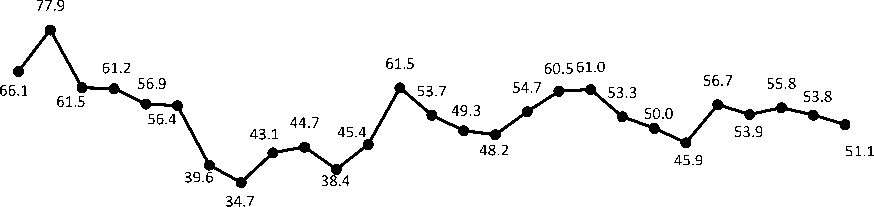

Figure 2. Share of people facing the problem of a lack of confidence in the future*, % of respondents
*The question is asked once a year, in February. Wording: “Which of the following problems did you personally encounter last year?” Answer option: “Lack of confidence in the future.” Data dynamics for the entire measurement period are presented. The question was not asked in February 2010.
Source: VolRC RAS data.
The reason lies precisely in what we discussed at the beginning of the article: today, in the President’s role as “Creator”, two temporal lines converge simultaneously – the line of Russia’s entire historical development path in the 21st century and the line of the last four years of the new path Russia began in February 2022. Therefore, the realism of achieving Russia’s desired future image upon “exiting” the SMO (or, more broadly – the civilizational conflict with the West) directly depends on a historical assessment and acknowledgment of the country’s own accumulated mistakes throughout the entire post-Soviet period. As A. Dugin writes, “We will not be able to win in Ukraine if we do not defeat the 1990s within ourselves, if we do not put on trial that historical reality, those mistakes and those crimes that we ourselves committed by destroying a great power”53.
And first and foremost, the state itself must do this. Because (as V.V. Putin himself noted in his first programmatic article, “Russia at the Turn of the Millennium”) “in our country, the state, its institutions and structures have always played an exceptionally important role in the life of the country and the people . For a Russian, a strong state is not an anomaly, not something to be fought against, but on the contrary, the source and guarantor of order, the initiator and main driving force of any change” 54 .
Nevertheless, the necessary historical assessment of the past (which includes not only public acknowledgment of mistakes but also “corrective work” and the adoption of appropriate management decisions) has still not been carried out. And, apparently, will not be implemented, at least until the SMO is concluded, until an agreement is reached between Russia and the NATO bloc that ensures our country the possibility of peaceful, longterm, sovereign development.
Over the past 25 years (since the beginning of V.V. Putin’s first presidential term), Russia has still not adopted an official state ideology. This has de facto meant one thing: “ a prohibition on revising the ideological postulates of liberalism ; the establishment of a latent ideology that ignores Russian traditional values and morality and is based on the recognition of consumerism and money as leading values in people’s lives..., an understanding of profit as the only driving force of social development” 55 .
“Our national idea should not be directed against anyone, most often this ‘anyone’ being the West. Anti-Westernism is a sign of dependence on it, of limited intellectual sovereignty. It, like all social thought and social sciences, must be emphatically sovereign. Not negating, but incorporating the intellectual achievements of all civilizations. After all, Russia is a true civilization of civilizations» 56 .
One of the reasons for this (as noted, for example, by S.A. Karaganov) is “the current unreadiness of the country’s leader (and in Russia, much depends on him) to abandon the illusions of the past – the 1980s–1990s” 57 .
In previous articles 58 , we have cited expert opinions confirming the view that “large and great countries are not built without big, forward-leading ideas, and having lost them, they collapse with a thunderous crash” 59 . We have not only cited expert assessments but also corroborated them with real “numbers” – sociological research data demonstrating a decline in the creative, intellectual, and moral-ethical potential of Russian society in the absence of an official state ideology, or more precisely – under the influence of the “latent” ideology of liberalism (some specific empirical data are presented in Insert 5 60 ).
Perhaps it is also appropriate here to mention an important observation recently voiced by N. Mikhalkov in his program “Besogon TV”. The regularly introduced measures of a “prohibitive-protective” character by the State Duma (aimed at regulating the functionality of the state mechanism in the spheres of migration, culture, etc.) indicate not only that the authorities are concerned with this issue.
N. Mikhalkov’s reaction to the draft law “On Amending the Law on the State Emblem of the Russian Federation” dated November 20, 2025 (the bill aims to prevent distortion of the state emblem of the Russian Federation):
“How strange, is it really necessary to legislatively enshrine such a simple thing – respect, preservation of the images of the country’s state symbols. Surely this is an absolutely natural thing that should not require anything but real, sober understanding?!
Well, okay, for some reasons there is a need to introduce such a law... and who could be against it? And this is precisely where the most interesting part arises . Instead of this law being simply adopted immediately in the 1st, 2nd, and 3rd readings, these familiar laments about ‘delicacy,’ ‘sensitivity,’ ‘possible infringement of religious feelings’ began to be heard... Who is saying this? And is it not clear to us that a state’s symbols change only when that state is enslaved by another state, with different symbols. And enslavement by other countries, this is not necessarily military action, bombing, tank attacks... no, it can happen from within, covertly, almost imperceptibly ” 61 .
Insert 5
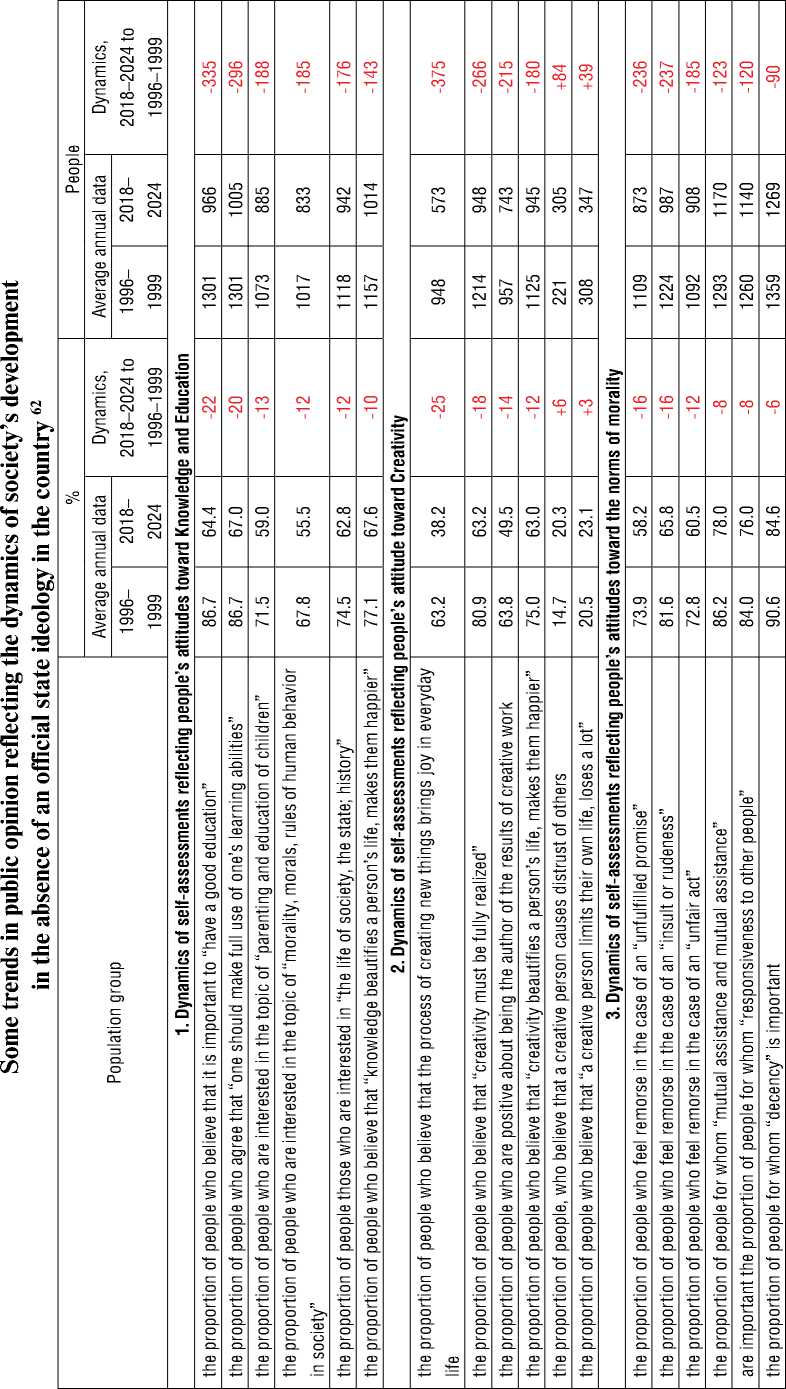
62 Source: Data from the VolSC RAS. Changes are shown for the period from 1996–1999 (B. Yeltsin’s last presidential term) to 2018–2024 (V. Putin’s fourth presidential term). More detailed data are presented in the article: Ilyin V.A., Morev M.V. (2025). “The constitutional ban on state ideology means a ban on revising the ideological tenets of liberalism”: What the 30-year absence of a state ideology leads to. Economic and Social Changes: Facts, Trends, Forecast, 18(3), 9–39.
If harsh restrictions “from above” are required to minimize the opportunities for foreign agents, representatives of the state administration system parasitizing on the migrant issue, representatives of show business transmitting spiritual and moral values and a lifestyle contrary to the national development course to the broad population, etc., it means that in Russian society, “ those layers that would like to continue the sweet-for-them but ruinous-for-the-country-and-people 1990s are still present and resisting – when ‘cash conquered evil,’ personal enrichment was considered the main goal in life, and the ideology of mass theft and plunder of the country reigned instead of the ideology of serving the people and the State 63 ; therefore, society acutely needs “for all of us, from the President to the farmer, worker, engineer, officer, scientist, entrepreneur, civil servant, to understand what we want to be and what we want our country to be” 64 .
In other words, Russian society (effectively an entire generation that grew up in a country without its own, sovereign national ideology) finds itself in a state where the state must legislate from above the most basic, utterly natural things, which (as N. Mikhalkov says) in reality “ should not require anything but real, sober understanding”…
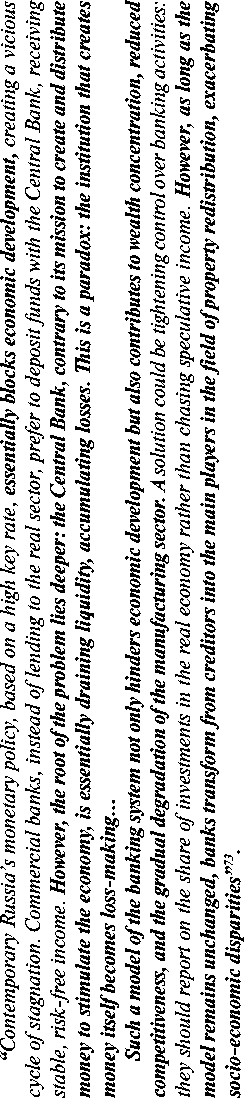
By and large, over the past 25 years, the principle of oligarchic capitalism has not disappeared anywhere, as evidenced by the entire financial system built in the country: from national accounts and the activities of the Central Bank (Insert 6) to the capital circulating within the marketplace systems that Russian citizens encounter practically every day in their daily lives. The sums are enormous, but they circulate through financial channels so concealed that even experts can only make approximate calculations.
“That oligarchic capitalism has been established in Russia today is not disputed by anyone. Oligarchic capitalism is a socio-economic model of societal and state development based on the total control of the production of goods and services by private owners of the means of production, on legalized exploitation, i.e., the unfair appropriation of practically all the results of hired labor. Policy in all spheres of life is aimed at obtaining super-profits in the shortest period, even to the detriment of national security . Control over the financial and monetary systems is exercised by a narrow circle of individuals. Merging occurs, including through the development of kinship relations, of the financial-industrial elite (oligarchy) with representatives of state power . The state begins to serve not society, but oligarch-billionaires ...
One might only add that capitalism in Russia is not simply oligarchic. Such is capitalism today in the USA, Europe, Canada, and other so-called ‘developed countries.’ In Russia, it is an oligarchic capitalism of a dependent, or comprador, type . That is, Russian oligarchs are under external management. And if so, the entire Russian Federation finds itself under external management. No signs of national sovereignty are visible, despite the loud declarations by officials about its restoration after February 24 of last year ” 65 .
Even with such an approximate examination of the financial system, some experts conclude that the policy of the Central Bank, for example, “contradicts what is written in the Constitution” (Insert 6), while marketplaces operate to the detriment of the state, “underpaying taxes by 1.5 trillion rubles”, and do not legally formalize their employees, thereby contributing to the development of “shadow” employment and the growth of the precariat – a stratum of people who are “alienated from labor and from society”, meaning they “lack confidence in their necessity to their country, their state, their society; they are not only limited but often deprived of the right to claim employment in their own or a related profession, social security, or hope for a guaranteed future for their family and loved ones”66.
We should also note that the critical assessments by experts regarding the Bank of Russia and the management of the country’s economy presented in Insert 6 did not appear in recent years or in connection with the start of the special military operation, but much earlier. In fact, they were voiced as early as the beginning of the 2000s.
-
1. V. Katasonov: “Take, for example, the current policy of the Central Bank. It is called inflation targeting. The guys have really gotten too brazen! They don’t even bother to translate into Russian what they receive from Washington, from the International Monetary Fund. I’m not even mentioning that inflation targeting contradicts what is written in the Constitution of Russia” 67 .
-
2. On November 18, 2025, at the Bank of Russia conference “Focus on the Client,” G. Gref stated that “marketplaces this year underpaid taxes by 1.5 trillion rubles . That is, all those discounts they give are at our expense. And I don’t feel the slightest bit sorry for physical retail networks, but it is unpleasant to me when marketplaces illegitimately take market share from physical network s due to non-market competitive conditions created by the state ” 69 .
-
3. S. Anureev: “Order pickup points [of marketplaces] mostly belong to individual entrepreneurs working under a simplified taxation system . In 90% of pickup points, employees are not formally registered because if people are officially registered and all 47% of taxes are paid for them [13% personal income tax, 30% social contributions], the activity of 80% of pickup points would become unprofitable, and they would close... Business media cite the number of pickup points for ‘Ozon’ as up to 75,000, for ‘Wildberries’ – up to 87,000. The total number of people working at pickup points would be 326,000, and their total annual wage bill – 258 billion rubles . The individual entrepreneur-owners simply withdraw cash as their own income, paying 6% tax instead of the aforementioned 47%, thus underpaying wage taxes by 106 billion rubles per year” 70 .
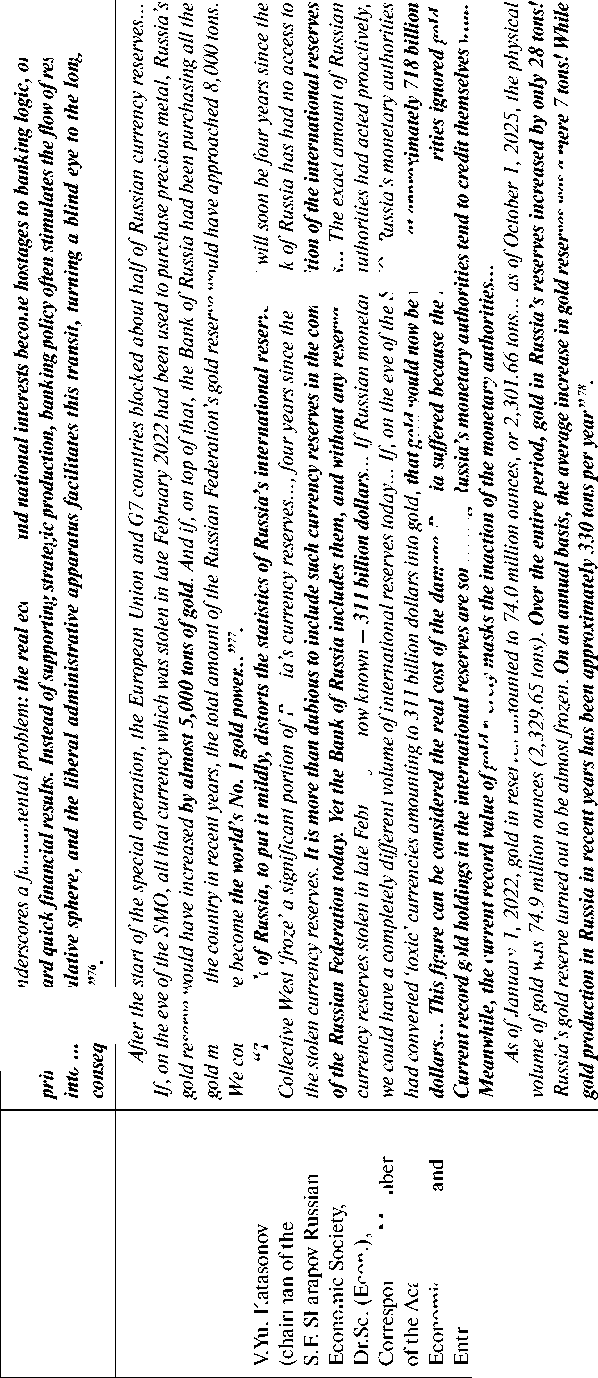
“If, on the eve of the SMO, all that currency which was stolen in late February 2022 [referring to the freezing of Russian currency reserves by the EU and G7 countries] had been used to purchase precious metal, Russia’s gold reserve would have increased by almost 5,000 tons of gold. And if, on top of that, the Bank of Russia had been purchasing all the gold mined in the country in recent years, the total amount of the Russian Federation’s gold reserve would have approached 8,000 tons. We could have become the world’s No. 1 gold power» 68 .
For example:
Delyagin M.G. Can the new Russian authoritarianism become effective? Mir Rossii. 2000. No. 1. P. 114–138.
Polterovich V.M. The root of problems – state inefficiency. Ekonomicheskaya Nauka Sovremennoy Rossii. 2000. No. 1 (5). P. 41–44.
Glazyev S.Yu. The choice rests with the country’s president. Nezavisimaya Gazeta. 28.04.2001. Available at:
Glazyev S.Yu. No need to wait for favors from the authorities. Zavtra. 13.05.2002. Available at:
Lvov D.S. What kind of economy does Russia need? Ekonomicheskiye i Sotsial’nyye Peremeny v Regione. 2003. Issue 20. P. 3–15.
Delyagin M.G. Rehearsal for a catastrophe. Zavtra. 21.07.2004. Available at:
Glazyev S.Yu. We have never had such a destructive government (interview with the newspaper ‘Izvestia’). Izvestia. 14.12.2004. Available at: https://
Under these conditions, seemingly unexpected facts uncovered by the Accounts Chamber of the Russian Federation and alarming expert forecasts regarding the present and future of the Russian economy become quite explainable: “ Russian authorities with one hand raise the profit tax, and with the other – suppress economic activity in the country . And these contradictory actions, naturally, do not ensure a proportional growth in federal budget revenues. The general deterioration of economic prospects for 2026 suggests that federal budget revenues from profit tax are more likely to decrease” 71 .
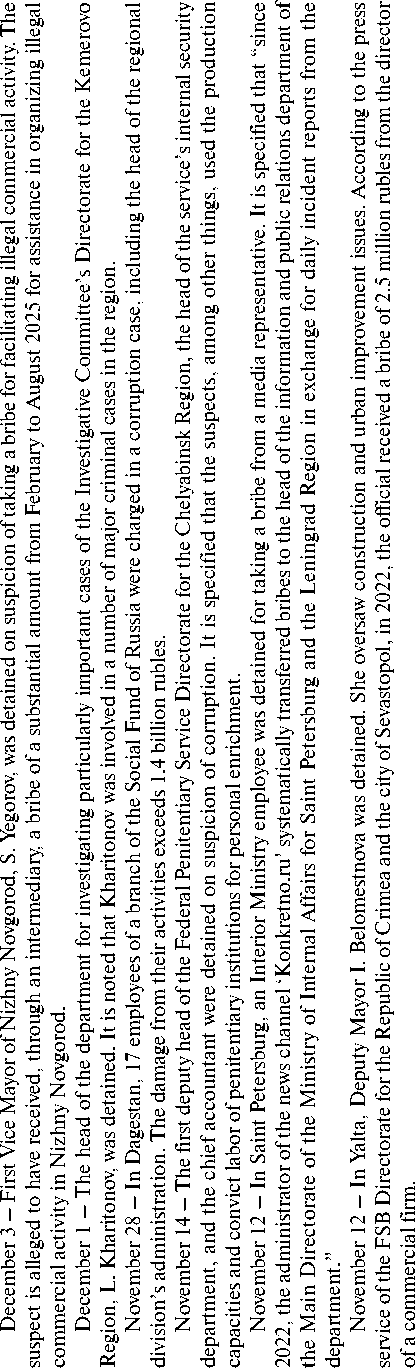
Furthermore, representatives of government bodies at all levels (federal, regional, municipal) continue to become subjects of criminal cases on a daily basis . Over 2024–2025 (during which we have been monitoring arrests and detentions of representatives of the ruling elites), one can speak of more than 90 such cases. And this – only according to open sources of information (the latest data, for October 25 – December 18, 2025, are presented in Insert 7 ) .
“The Accounts Chamber presented sensational results on the collection of profit tax, the rate of which for the federal budget was increased this year from 3% to 8%. Accounting for inflation, profit tax revenues to the treasury, all else being equal, should have increased almost threefold. But in fact, the nominal increase in federal budget revenues turned out to be around 75%. This conditional shortfall is explained by a growing number of loss-making companies and a general reduction in the total profit of enterprises...
Besides surprises with the profit tax, the SP auditors discovered a rapid growth of the state debt, which increased by almost 10% in one year . Such rapid growth of the state debt worries many economists... Expenditures on servicing the Russian Federation’s state debt amounted to 2.3 trillion rubles.
The rapid increase in budget expenditures for servicing the state debt is explained by the Central Bank’s high key rate, but the possibility for the Accounts Chamber to verify the economic rationale of the Central Bank’s key rate is not directly enshrined in Russian legislation”72.
Insert 6
л
oi
й я
ф
ф
я ф
й
ф а и
■2
sj
<з si
si
53 si
53 2
о
<3
Sc si
si
,si
<3
о
2 о
0s
5*5 ^
Si о
S
о Si
as о
S
•2 о S3 3 Si
Si о 2
О
о
О
Si 53
0s b о oi о
а
sc .S
^ О e
о
s*
§ S >
O' 5*5 §
•« §
^э
Si a 2
at о
Sc
О'
O'
о о о
2 о
§
•2 о Si 3 Si
о Si ,5?

г-" о

g
a
Ьл Ж
«3 ^3
8c
«5
t
8c
g
80 S.
g о
§с
Е
Е
а
S
р
a sc
I е о
§ а
e
о д
00 о
g
S ®
§ 3
В
д о а а о
О
<3
-а а ^
г»
Й
^
a
a
<3
О J
g
д
■о о
д
,5
g
«3
в о с о
о
а
о
Д N д л й о1
Е?^ л о
E
о
"о
о
<3
в о с о
Й
as
с о
й р
Р cd
p
Й
Й
p
й
00 с
с
с о .а оо
E
с
о
I о : 00
й
й
е
S °
р .р О Р
3 р
а о Д
д
д
О
.о с
Е
.а д
ер
а
О
L*
д ^
о о
О
Insert 7
ш е4 О <4
д л S
=3
с?
й о
й о
ад
й
о +J с?
о
о
о
Й
о д о
й
е
д и
Й О
й
й
о
S .о
Q
о
о
й
р
о
о
Й
й
о
о
й
о
о о ад ад л й о й о о +J й о й о 'ад
й й о й о й о о +J
й
о
г: р о й и 3 д
S д о
S о о а а о


79 Source: RT in Russian. Latest news on detentions. Available at:
In May 2025, at the instruction of the acting governor of the Kursk Region, A. Khinshtein, a list of more than 70 officials who had previously been exempted from criminal liability or had their convictions expunged was prepared 80 . In November 2025, A. Khinshtein noted that he was “extremely dissatisfied with the results of the work carried out: only 9people ceased their official activities , despite the fact that the list of individuals, for example, who were held liable for taking or giving bribes or for robbery, is quite substantial” 81 .
In our view, it is difficult to disagree with the head of the Kursk Region when he says that “individuals who have been subject to criminal liability for taking or giving bribes (even if not subsequently convicted)... with such a past have no place in government bodies” 82 . The very fact of their presence in the system of state governance is, at the very least, perplexing. Therefore, such work should undoubtedly be carried out intensively across the entire country, in every region, in every municipality; through the All-Russian People’s Front, political parties, the State Duma, or any other mechanism capable of most effectively and swiftly “cleansing” the state governance system of people with a “dark” past.
Expert assessment:
“Khinshtein voiced the problem openly – meaning he wanted to solve it, not hide it. This adds credibility: if it were a showcase campaign, no one would publicize the formulation ‘there are former robbers in government.’ Their very presence indicates that the personnel selection system is essentially nonfunctional. Background checks are formal, official references substitute for real filters. People whose biography itself precludes trust end up in positions where budget funds are distributed and contracts are signed. And if they have reached leadership posts – it means someone promoted them there, and not just once.
This is no longer an isolated mistake but a system failure. It means there are those within the system itself who cover up, turn a blind eye, sign the necessary papers. The personnel vertical has ceased to be a filter and turned into a pipe: whatever goes in, flies out at the top. Therefore, the Kursk region case is not a local story but a symptom that the system fundamentally cannot recognize risks and does not want to see its own flaws” 83 .
And, speaking of this – in November 2025, the Supreme Qualification Collegium of Judges of Russia (VKKS of Russia) granted the petitions of the Chairman of the Investigative Committee of Russia, A. Bastrykin, giving consent to bring criminal charges and/or arrest six judges 84 ... In all cases, the crimes were of a corrupt nature... “The most principled and slippery issue – concerning the termination of the status of judge in retirement of the former chairman of the Krasnodar Territory Court, A. Chernov – was considered on November 27. As experts noted, this is not equivalent to the VKKS’s consent to initiate a criminal case against Chernov, but along with the status, the judge also loses guarantees of immunity” 85 .
Expert assessment:
“The situation addressed by the Chairman of the Supreme Court of the Russian Federation has actually been wrong for a long time... J udges are now given a guideline: what matters are real efforts, not symbolic gestures for a checkmark . But why hasn’t the practice become uniform over so many years? Because the system itself is structured so that every decision is made manually, without common methodologies and with a huge caseload per judge. Different regions live by different legal traditions, personnel come from different agencies, and regulatory wording leaves too much room for interpretation” 86 .
On December 2, 2025, at a meeting of the Council of Judges of the Russian Federation, the
Chairman of the Supreme Court of the Russian Federation, I. Krasnov, noted that judicial decisions “ should not contain hints, unsubstantiated evaluative judgments, give rise to ambiguous interpretations, and especially should not be a catalyst for fraudulent and other illegal schemes. Unfortunately, such facts exist. Making decisions to please regional and local authorities, serving the interests of corporations and commercial structures is unacceptable. The reaction to any actions of a corrupt nature – regardless of the level at which they are committed – will be uncompromising ” 87 .
The cited facts from the real activities of the state governance system, the financial and judicial systems, answer the question of why the desired image of the country’s future, both 10 years ago and today in 2025, appears extremely difficult for Russians to achieve: because over 25 years, the state, by and large, has not changed. And, judging by expert forecasts, it is not aiming to change in the near future. This is precisely what is evidenced by the “cosmetic” changes in “Politburo 2.0”, which essentially amount to preserving this system in the condition it was in even before the start of the SMO.
Of course, we should note that deep, systemic changes in state governance are associated with risks, making them undesirable and unsuitable during an ongoing SMO. However, the problem is that experts from “Minchenko Consulting” do not link the prolongation of the “Politburo 2.0” model (which they characterize as a “conglomerate of clans and groups competing with each other for resources...”88) to the timeline for resolving the “Ukrainian conflict” (we note that at least 7 members of “Politburo 2.0” as of 2025 are listed in the Forbes ranking of Russia’s largest billionaires89).
In other words, there are no signs that the ongoing hostilities are the sole obstacle preventing the President and his close associates from the patriotic (power) bloc from making any substantial adjustments to the functioning of the state governance system... This means that in the near future, it is difficult to expect the emergence within the Russian system of state governance of a mechanism of checks and balances like, for example, the one in China, which “has determined the country’s success over the past few decades”90.
As E.V. Balatsky rightly writes, the elements of the Chinese mechanism for elite self-organization are something “Russia, like most other countries, should scrutinize most attentively... and begin work on adapting them to its own political and economic system” 91 . 92
Some key elements (institutions, principles) of elite self-organization in the Chinese governance model 92
-
1. “The hierarchy of the CPC [Communist Party of China] cadres is based on a system of ranks, which are awarded based on performance and serve as the basis for further career advancement,” and also “the principle of meritocracy, according to which any promotion in position and rank must be earned through success in the previous role. And again, in Russian management practice, there are numerous examples of appointing people to high positions with no significant positive achievements to their name. Thus, strict regulation of careers in government bodies and the CPC acts as a guarantee against personnel chaos and future managerial errors”.
-
2. “The CPC’s system of self-control, with the National Supervisory Commission serving as its institutional element. The foundation of this system of self-control rests on two interconnected principles – the total absence of immunity from criminal prosecution and the existence of the death penalty. The Chinese governance system categorically rejects the principle of irresponsibility”.
-
3. “The main difficulty [in the economy] lies in coordinating all parts of a vast and extremely heterogeneous economy to give them a unified vector of movement and development. For this, China has created a special coordinating economic body – the National Development and Reform Commission (NDRC), which is part of the structure of the PRC’s State Council and was originally called the State Planning Commission of the PRC… The peculiarity of the NDRC’s work lies in the heterogeneity of its functions, which allows it to achieve a new level of coordination for the economic life of a huge country… The NDRC’s activities are guided by two informal principles – the primacy of social stability and economic development, and the principle of delicacy and prudence”.
Excerpts from the “Minchenko Consulting” 93 report, indicating the preservation of the “Politburo 2.0” in the state governance system:
-
1. A hostile environment and risks of military confrontation with NATO make an inertial scenario in domestic politics most comprehensible to the elite, with system stability coming to the fore as the key parameter.
-
2. The composition of “Politburo 2.0” remains unchanged (Yu. Kovalchuk, S. Kiriyenko, N. Patrushev, M. Mishustin, S. Chemezov, I. Sechin, D. Medvedev, S. Sobyanin, G. Timchenko, A. Rotenberg, S. Shoigu), even despite an unfavorable socio-economic context and, consequently, a narrowing resource base: amid a growing budget deficit, increasing tax burden, and strengthening sanctions pressure, the highest echelon of the elite retains its positions.
-
3. Maintaining the current composition of “Politburo 2.0” and their confidants is largely achieved through the redistribution of assets as part of a large-scale property confiscation campaign, which most significantly affects resource-rich representatives of the regional elite.
-
4. The key strategy for resource-rich elites is not proactive actions, but strategic waiting and supporting the status quo established in recent years.
-
5. In 2021 [i.e., even before the start of the SMO], we described scenarios for the dynamics of the Politburo itself, among which the most probable was named “ stabilization of the Politburo 2.0 composition for the next few years , made possible by applying administrative resources to redistribute rents in new economic sectors and through the creation of enlarged elite coalitions.” Currently, this scenario is being implemented , with the caveat that the redistribution process now includes old economic sectors as well.
Let us recall that experts from “Minchenko Consulting” began noting the existence of the “Politburo 2.0” system itself as early as 2012, long before the special military operation. 93
Thus, Russia has now been waging a war for its future for almost four years, and how long this war will last remains unknown. At the very least, at the latest Board of the Ministry of Defense of the Russian Federation on December 17, 2025, A.R. Belousov set tasks not only for 2026 but also “outlined parameters for longer-term planning, taking into account the course of the special military operation and the development of the militarypolitical situation around Russia”94.95
Excerpt from A.R. Belousov’s speech at the expanded meeting of the Defense Ministry Board on December 17, 2025:
-
“… the priority direction for the Ministry of Defense is the modernization of the Armed Forces in the long term, considering external threats and the development of innovative technologies.
An analysis of the military-political situation shows that military security threats have changed significantly over the past three years. The North Atlantic Alliance continues to build up coalition forces, active preparations are underway for the deployment of intermediate-range missiles, the nomenclature of nuclear munitions has been updated, air and missile defense systems are being modernized, and the mobilization deployment system is changing. The operational speed of transferring alliance troops to the eastern flank is increasing… Military expenditures are increasing substantially...
All this indicates NATO’s preparations for a military clash with Russia. The alliance’s plans provide for achieving readiness for such actions by the turn of the 2030s. This has been repeatedly stated openly by official representatives of the NATO bloc” 95 .
However, it must be emphasized that Russia’s war for the future is not only a military conflict with the “Kiev regime” (which was clear from the very beginning of the SMO). Nor is it only a civilizational conflict with Western civilization (the NATO bloc, the Collective West) for a worthy place in the emerging multipolar world...
It is, first and foremost, Russia’s war with its own self from the 1990s: with the “liberal fog” that enveloped almost all spheres of our life for decades; with the deep social and mental “trauma” inflicted on our country by the collapse of the Soviet Union.
All three aspects (or rather, incarnations) of the conflict in which Russia is involved are inextricably linked. As A. Dugin rightly notes, “ the key to Victory in the SMO lies in the 1990s... The abolition of Ukraine implies the simultaneous abolition of the Russian Federation of the 1990s. These two inauthentic, caricature realities are the result of the disintegration of an organic state, an Empire [the Soviet Union]” 96 .
“...any absurd action we can think of will inevitably be carried out by the European Union. We are dealing with a clear illustration of the ratchet mechanism of degeneration. And if we ourselves do not revive our state, our political system with higher meanings, lofty ideals, sacredness, spirit, then we will come to the same point ” 97 .
In this struggle of Russia with its own 1990s self, Russian society continues to place its hopes in the President. This is evidenced by the support Russians show for the head of state’s activities, as reflected both in the official results of federal, regional, and municipal elections 98 and in data from monitoring sociological measurements 99 .
Probably aware or sensing this burden of historical responsibility before the country and its people, the President is increasingly (or rather, “constantly”, in his own words) thinking about choosing a successor and identifies as a key task of national development “ ensuring reliable continuity in the country’s development for decades to come” 100 .
“When I think about this [choosing a successor], and I think about it constantly, of course, I think that a person must emerge, or better yet several people, so that people have a choice, who could earn the trust of the country’s citizens” 101 .
However, building the desired image of the future – that very strong, sovereign, and social state in which Russians would like to live – is a question of a strategic perspective spanning 30–40 years ahead. But “here and now”, it is precisely in the hands of the President (and only his) lies the opportunity to create the foundation of this Future: to conclude the SMO, to reach agreements with the Collective West that would allow Russia to focus on solving internal problems, and to choose a successor who would be a true (and not a “kvass” or shallow) patriot, “who could earn the trust of the country’s citizens”102, and who would possess sufficient political will to continue and strengthen the course of national development that the country has been on for a quarter of a century (including conducting timely and effective “corrective work”).
V. Putin: “{The national idea of the country} lies in patriotism. I think nothing else can be. Patriotism should not be of the ‘kvass’ kind (shallow, blind and flag-waving)... This does not at all mean that one must constantly cling only to our heroic past; one must look towards our no less heroic and successful future. In this lies the key to success” 103 .
