
Защитные и рабочие перчатки как функциональные текстильные изделия: обзор коммерческих продуктов на основе инновационных волокнистых материалов
Журнал: Вестник Витебского государственного технологического университета @vestnik-vstu
Рубрика: Технология материалов и изделий текстильной и легкой промышленности
Статья в выпуске: 4 (54), 2025 года.
Бесплатный доступ
Защитные и рабочие перчатки – это функциональные текстильные изделия, созданные из различных видов сырья. В ряде случаев конструкцию подобных изделий дополняют покрытиями или мембранами. Перчатки могут изготавливаться как из обычных текстильных волокон, так и из волокон с улучшенными свойствами. Инновационные волокнистые материалы, в частности высокоэффективный полиэтилен (HPPE), стекловолокно или арамиды, используются для добавления улучшенных характеристик, например стойкости к прорезанию и термозащиты. Защитные перчатки – наглядный пример изделий, обладающих улучшенными и высокоэффективными свойствами. В статье представлен обзор ассортимента защитных перчаток, предлагаемого на немецком рынке, с указанием их состава материалов и функциональных свойств. В качестве волокон, обеспечивающих защиту от порезов, преобладают волокна HPPE или стекловолокно. Для повышения комфорта при ношении предпочтение отдаётся добавкам небольшого количества эластомерных волокон. В производстве перчаток используются также традиционные полиамидные или полиэфирные волокна. Во многих видах перчаток применяются покрытия из полиуретана или нитрила для улучшения сцепления поверхности и в качестве дополнительного защитного элемента. Свойства материалов подтверждаются измерениями воздухопроницаемости, поверхностного электрического сопротивления, данными электронной микроскопии и ИК-спектроскопии. Методы микроскопии и спектроскопии не позволяют обнаружить все волокна, указанные в информации производителя. При этом в отдельных видах перчаток определяются типы волокон, не заявленные производителями. Представленный обзор позволяет сформировать четкое представление об используемых материалах, а также может служить инструментом для анализа волокон в защитных текстильных изделиях, являющихся доступным коммерческим продуктом.
Похожие статьи в разделе Различные отрасли промышленности и ремесла. Производство изделий из различных материалов
Короткий адрес: https://sciup.org/142247316
IDS: 142247316 | УДК: 677.07 | DOI: 10.24412/2079-7958-2025-4-29-38
Protective and working gloves as functional textile products – overview on commercial products with special dedication to advanced fiber materials
Protective and working gloves are functional textile products built up by a composition of different fiber materials. Several products are further equipped with coatings or embedded membranes. Fibers used for gloves belong to the category of conventional fibers and to fibers with advanced properties. Advanced fiber materials like high-performance polyethylene HPPE, glass fibers or aramid are used to implement advanced properties like cut-resistance or heat protection. In fact, protective gloves are perfect examples for products containing advanced and high-performance properties. According to this statement, the actual paper gives an overview on selected protective gloves offered on the German market, reporting their material compositions and some functional properties. As cut-resistance fibers most often HPPE fibers or glass fibers are used. To improve wearing comfort often elastane fibers are added in amounts of few percentage. As conventional fibers mainly polyamide or polyester fibers are used. Most gloves are equipped with coatings from polyurethane or nitrile to increase the grip and as an additional protective element. Material properties are supported by measurements of air permeability, surface electrical resistance, electron microscopy and IR spectroscopic data. Microscopic and spectroscopic methods cannot detect similarly all fibers which are mentioned in supplier information. However, also fiber types which are not claimed by the suppliers are determined in some gloves. By this actual overview the reader gains a fine view on used materials and a tool for fiber analytics on commercially available protective textile products.
Текст научной статьи Защитные и рабочие перчатки как функциональные текстильные изделия: обзор коммерческих продуктов на основе инновационных волокнистых материалов
УДК 677.07 DOI:
Protective gloves consist of a variety of technical materials that are specifically combined to ensure optimal protection against mechanical, thermal, and chemical influences. The selection of fibers and coatings used significantly influences properties such as cut resistance, abrasion resistance, heat resistance and comfort (Ertekin, M. & Ertekin, G., 2020; Khanlari, Ghasemi & Heidarimoghdam, 2023; Zhai, Mao, Shen, & Yan, 2021; Dolez, Marsha & McQueen, 2022). Protective gloves are excellent examples for textile products made from different fiber materials and coatings to achieve finally an advantageous and high-performance product. The Table 1 provides an overview of some basic material properties of selected materials commonly used in modern protective gloves. The related chemical structures of polymers building up these fiber materials are given in Figure 1. Conventional fiber materials from PET and PA are used as inexpensive and also mechanically stable basic material. The maximum temperature of usage Tmax for these materials is not higher than 150 °C (Mahltig, 2021). As high cut-resistance material but with lower thermal stability HPPE can be used (Mahltig, 2021). A high cut-resistance together with a better thermal stability can be reached by fibers as aramid, PBO, glass or basalt fibers (Zhai, Mao, Shen, & Yan, 2021;
Evaluated Products
As commercially available products eight gloves are chosen as representative materials. These gloves are offered as working and protective gloves and contain additionally to conventional fibers also high-performance fibers to reach the claimed advanced properties as cutresistance and heat resistance. Table 2 offers an overview on the evaluated gloves together with supplier information on purpose, function, standards and price. Additionally, table 3 offers further information on material composition, suggested areas of usage and claimed properties. For all eight gloves, the suppliers mention several standards for claiming different protective properties. The European standard EN 388 is claimed for all eight gloves and is related to protective gloves against mechanical risks (Zhai, Mao, Shen, & Yan, 2021; European Standard EN 388:2016 «Protective gloves against mechanical risks»). Gloves according to this standard are intended e.g. for use
Table 1 – Overview on materials often used in working gloves and protective gloves
|
Material / common name |
Maximum temperature of usage T max [°C] |
Summary of typical properties |
Usage for gloves |
Ref. |
|
Polyester (PES / PET) |
150 |
inexpensive, dimensionally stable, low humidity up-take |
Basic fabric material |
(Ertekin, M. & Ertekin, G., 2020; Mahltig, 2021) |
|
Polyamide, PA (Nylon) |
115 |
Mechanically stable, stable against abrasion |
Basic fabric material |
(Mahltig, 2021) |
|
High-Performance-Polyethylen, HPPE (Dyneema) |
90 |
Very cut-resistant, lightweight, no moisture absorption, lower thermal stability |
Cut protection |
(Zhai, Mao, Shen & Yan, 2021; Mahltig, 2021) |
|
Glass fiber |
600 |
High strength, temperature and flame resistant, rigid and brittle |
Reinforcement of cut resistant yarns, heat protective fabrics |
(Zhai, Mao, Shen & Yan, 2021; Wallenberger, 2010) |
|
Polyurethan, PU |
270 |
Abrasion-resistant, elastic, good grip, oil-resistant |
Coating of specific hand and finger areas to improve adhesion |
(Zhai, Mao, Shen & Yan, 2021; Chattopadhyay, Sreedhar & Raju, 2005) |
|
Elastane (Lycra) |
90 |
Extremely stretchable, good Stretch-recovery |
Improvement of textile fit and comfort |
(Dolez, Marsha & McQueen, 2022; Boschmeier et al., 2023) |
|
Aramid |
200 |
Good temperature stability, fire retardant, cut-resistant |
Cut resistance, flame & heat resistance |
(Ertekin, M. & Ertekin, G., 2020; Khanlari, Ghasemi & Heidarimoghdam, 2023; Zhai, Mao, Shen & Yan, 2021; Mahltig, 2021; Miskiewicz, Frydrych, Pawlak & Cichochka, 2019) |
|
Polybenzoxazol, PBO (Zylon) |
310 |
High temperature stability, fire retardant, cut-resistance |
Cut resistance, flame & heat resistance |
(Zhai, Mao, Shen & Yan, 2021; Mahltig, 2021) |
Table 2 – Overview on discussed gloves, presented are trade names, suppliers, purpose and standard mentioned by the supplier. The price is given per pair gloves
|
No. |
Name & Supplier |
Purpose / function |
Mentioned Standards |
Price [Euro] |
|
1 |
Kraftwerkzeug / Sänger Haushaltsprodukte GmbH |
Cut resistance |
EN 388, EN ISO 13997 |
~ 4 |
|
2 |
TEGERA®, Textilhandschuh-Ejendals |
Cut resistance |
EN 388 |
~ 21 |
|
3 |
Duracoil 546 / Showa |
Cut resistance |
EN 388 |
~ 8 |
|
4 |
LUX-Schnittschutzhandschuh |
Cut resistance |
EN 388, EN ISO 13997 |
~ 6 |
|
5 |
Multiflex / Gebol Handelsgesellschaft GmbH |
Working glove |
EN 388 |
~ 5 |
|
6 |
Lux Allround-Handschuh |
Multipurpose glove |
EN 388 |
~ 5 |
|
7 |
KarboTECT 950 / KCL GmbH |
Heat protective glove to 250 °C / cold protective |
EN 388, EN 407 |
~ 50 |
|
8 |
Gebol Master Thermo Handschuh |
Working glove / protective glove for protection against cold and moisture |
EN 388, EN 511 |
~ 15 |
Table 3 – Overview on discussed gloves, presented are materials, areas of usage and claimed properties according to supplier information
|
No. |
Material |
Suggested areas of usage |
Claimed properties |
|
1 |
Cut-resitant HPPE yarn; PU coating |
Gardening, assembly work |
Good grip due to PU/nitrile coating, Breathable backhand, Lightweight and flexible |
|
2 |
Knitted HPPE, Dyneema |
Working with cutting tools, assembly work |
Comfortable cut protection, Air-permeable/breathable, Good fingertip sensitivity, Thin & soft |
|
3 |
Fabric from HPPE, PET and glass fibers; PU coating |
Working with cutting tools, Handling intricate parts, Light assembly of oil-coated parts, Mechanics and engineering, Automotive repair and maintenance, Bottling, Handling glass and windows |
HPPE reinforced, Polyurethane coating, Foam grip, Ergonomic |
|
4 |
Yarns from 15G HPPE / PET / glass fibers / Elastane аnd Nitrile coating |
for rough craft work and metalwork |
High abrasion resistance, Good grip, Cut-resistant |
|
5 |
96 % Nylon, 4 % Elastane, Nitrile coating |
Installation work, Storage work, Assembly work, Repair work, Carpentry work |
Skin-friendly, good, dry grip, High wearing comfort & breathable coating, Optimal dexterity |
|
6 |
Polyamid, Elastane, nitrile coating |
Assembly work |
Good fitting |
|
7 |
Para-Aramid and carbon fiber (outside), cotton (inside) |
Cold/heat work, Working with cutting tools, Metal manufacturing and processing |
Heat insulation, cut-resistance, contact heat till 250 °C |
|
8 |
Back of hand: 95 % nylon, 5 % elastane; Palm: 58 % nylon, 42 % PU |
Construction work, Forestry work, Gardening work, Agricultural work, Assembly work, Repair work |
Secure grip, Protection against cold and wet weather, High wearing comfort |
Table 4 – Overview on air permeability and thickness determined for evaluated gloves
|
No. |
Air permeability [L/m2s] |
Thickness [mm] |
||||
|
Area without coating |
Area with coating |
Band on the wrist |
Area without coating |
Area with coating |
Band on the wrist |
|
|
1 |
581 |
17 |
376 |
1.3 |
1.1 |
2.2 |
|
2 |
142 |
--- |
68 |
1.5 |
--- |
1.8 |
|
3 |
133 |
61 |
82 |
1.4 |
1.3 |
1.5 |
|
4 |
432 |
73 |
284 |
1.5 |
1.6 |
2.2 |
|
5 |
619 |
34 |
343 |
1.2 |
1.6 |
1.5 |
|
6 |
633 |
21 |
867 |
1.3 |
1.7 |
1.4 |
|
7 |
986 |
--- |
562 |
6.1 |
--- |
9.2 |
|
8 |
102 |
14 |
--- |
5.6 |
3.1 |
--- |
Table 5 – Determined electrical surface resistance for evaluated gloves
by sharp objects»). For glove product 7 additionally the standard EN 407 for heat protective properties is mentioned. For product 8 additional the standard EN 511 is mentioned. This standard EN 511 is dedicated to the evaluation of gloves for cold-protection and, to a certain extent, for protection against moisture (European Standard EN 511:2006 «Protective gloves against cold»).
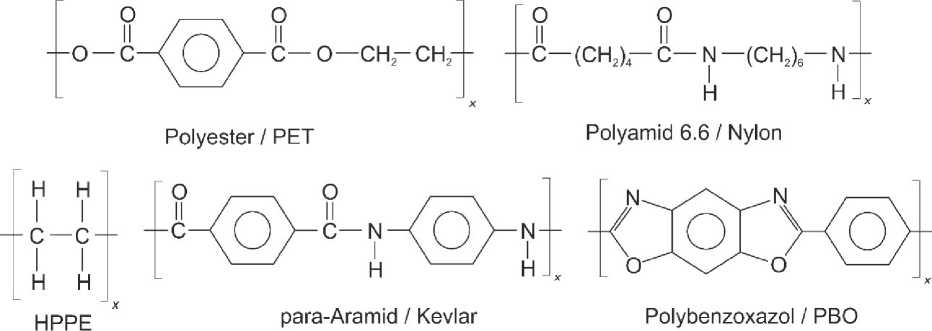
Figure 1 – Chemical structures of polymers building up prominent fibers used for glove production
The product cost is in low to medium price range.
For products 1 to 4, the cut-resistant properties are reached by using HPPE fibers, which can be further improved by co-use of glass fibers. These products are not dedicated to thermal protection. A thermal protection is only claimed for product 7, due to its composition containing aramid. Elastane fibers are present in several products to improve fitting and textile comfort. Only samples 2 and 7 are without PUR or nitrile coating. The
product 8 contains inside the glove a membrane probable to support protection against moisture.
Analytical Methods
The air permeability of the products is tested in accordance with standard ISO 9237 by using a FX 3300 Lab air test device (Textest Instruments) (ISO Standard ISO 9237:1995 «Textiles – Determination of the permeability of fabrics to air»). The thickness of the products is determined by using a Micrometer Type S16502 (Frank-
PTI GmbH). Air permeability and thickness are tested for all products at three different areas of the gloves – area without coating, area with coating and at the band on the wrist. These measurements are repeated twice and the received average value is further discussed. The electrical surface resistance is determined by a MGT-3 Antistatik Tester (MECO Energie-Kollektoren GmbH, Germany). Microscopic investigations are done by scanning electron microscopy using a Tabletop microscope TM3000 from Hitachi (Japan). Infrared spectroscopic measurements are done with an FT-IR spectrometer IR Tracer-100 (Shimadzu, Japan) which is equipped with a Specac Golden Gate ATR unit.
Air permeability and thickness of materials
Determined air permeability and thickness of considered gloves are shown in Table 4. The given values are average values gained from two individual measurements. The thicknesses of gloves type 1 to 6 are quite similar in the range of 1.1 to 1.7 mm. These gloves are mainly related to cut-protection and for this obviously no bigger thickness is needed. In comparison, gloves 7 and 8 also dedicated to heat or cold protection exhibit significantly higher thickness. For gloves with coated areas, the air permeability at these areas are significantly low. At areas without coatings the air permeability is in the range of 102 to 986 L/m2s, standing for an air permeability from average to high. The air permeability is probable
related to the textile construction and less dependent on the type of used fiber. Product 8 is a multilayer material which leads probable to the lowest air permeability of all considered products.
Electrical surface resistance of materials
The electrical surface resistance of all considered products is presented in Table 5. For most products the determined resistance is quite high with more than 1010 Ohm which is related to no or low antistatic properties. Interesting is that the coated areas exhibit lower electrical resistance. Only for the product 4 a significantly lower surface resistance of 109 Ohm is determined which can be set in relation to antistatic properties (ISO Standard ISO 9237:1995 «Textiles – Determination of the permeability
of fabrics to air»). Because this product 4 exhibits no significant difference in fiber compositions as other considered products the application of antistatic agent might be assumed.
Microscopic investigations
Microscopic images taken with scanning electron microscopy SEM in different magnifications are compared for the eight considered products and shown in Figure 2. These images are taken from uncoated areas of the gloves after cutting them into pieces of around 1 cm2 size. Unstructured and even fiber surfaces are visible for all samples which is typical for synthetic fibers, these products are made from. For products 1, 3 and 4 fibers with brighter appearance can be detected. These fibers
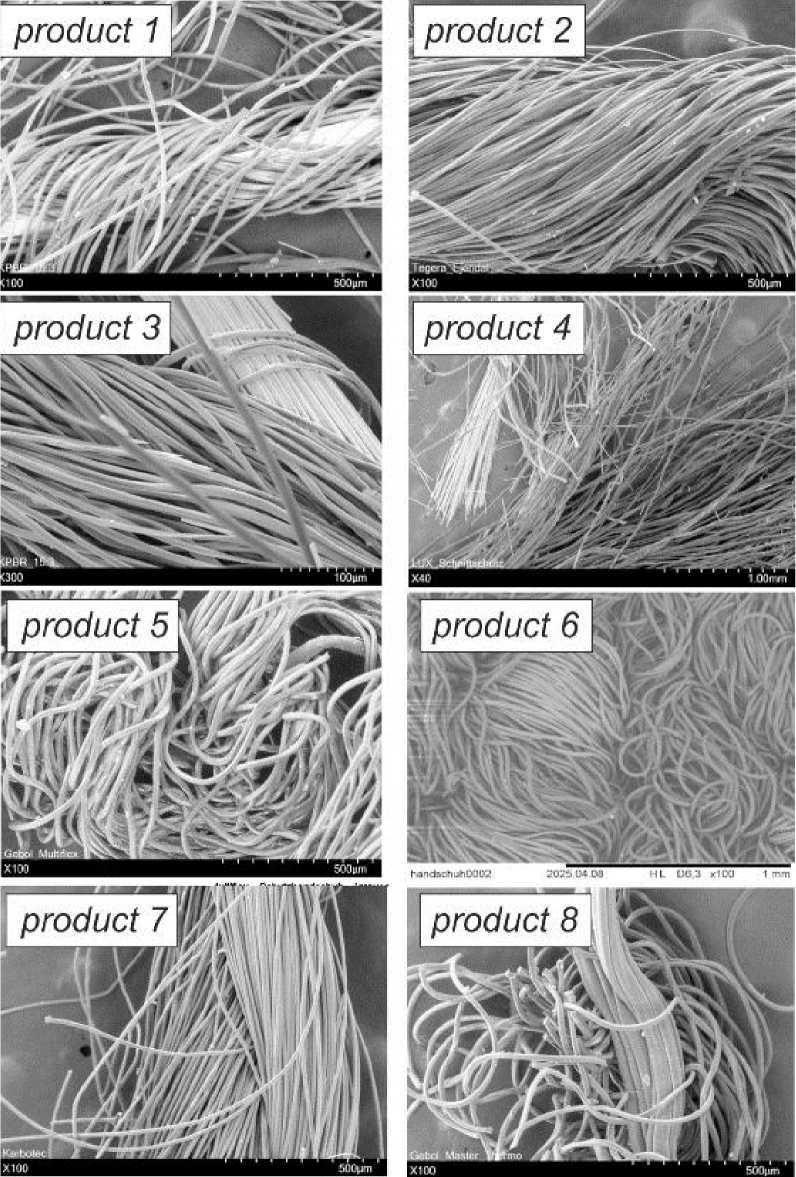
Figure 2 – Microscopic images of the different protective gloves recorded with scanning electron microscopy in different magnifications
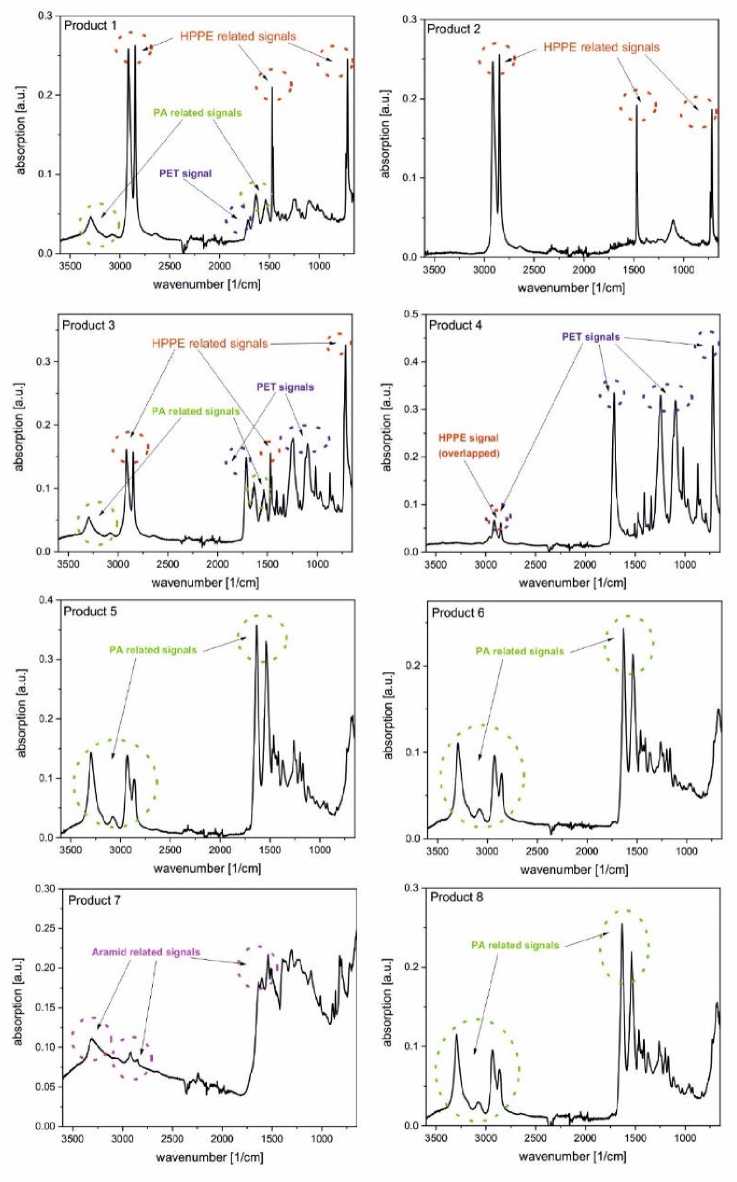
IR spectroscopic investigations
IR spectra determined from the eight considered products are shown in Figure 3. These IR spectra are taken from uncoated areas of the gloves and the most prominent IR signals are marked according to polymer composition (Mahltig, 2021). For products 1 and 2, HPPE as main fiber component can be clearly identified. For product 1, also small signals related to ester and amide groups are determined, which can be related to finishing applications or the back of the PUR coating. The IR spectrum of product 3, exhibit IR signals related to at least three fiber components – HPPE, PET and PA. Due to the presence of PET and PA in larger amounts, the HPPE signals are partly covered by IR signals from other fibers. PET is clearly identified and also part of the supplier given product composition. The determined PA is not part of the supplier information on fiber composition and might be related to finishing applications or the back of the PUR coating. The IR spectrum of product 4 is mainly determined by the signals from PET fibers. Only the small signals around 2900 cm-1 can be assigned to the HPPE fibers. The IR spectra of products 4, 5 and 8 are almost similar and can be directly set in correlation to the main fiber component Nylon (Mahltig, 2021). The also mentioned component elastane cannot be identified by these IR-measurements. The IR spectrum from product 7 can be identified to aramid fibers by comparison to literature (Mahltig, 2021).
Protective and working gloves are functional textile products often produced by a combination of different fiber types – conventional fibers and advanced fibers. By this combination protective properties against mechanical influences, heat or cold can be achieved. The current paper gives a short introduction to fiber types used and present eight product examples – commercially available protective gloves. For achieving cut-resistance, four of the products contain HPPE fibers, which are in some cases reinforced by addition of glass fibers. In comparison, for products with better thermal stability nylon or aramid fiber materials are used instead of HPPE. The use of PUR and nitrile coatings is done for most of the products to improve the grip and probable also for achieving additional protective effects. In four products, small amounts of elastane fiber are added (up to 5%) to improve fitting and textile comfort. For some products, additional components not claimed by the suppliers can be identified by methods like SEM and IR spectroscopy. Finally, it can be concluded that on the market a broad range of different protective gloves are available made from very different fiber and coating materials. The achieved protective properties can be realized using different fiber types in different combinations. There is not the single best and only used fiber composition for a protective glove.
Conflicts of interest
The authors declare no conflict of interest in the authorship or publication of this paper. All product and company names mentioned in this article may be trademarks of their respected owners, even without labeling.
Funding
The presented work and results are realized without special funding. All presented functional textile materials are purchased on the free market.
