
Advancing a Type-1 Rule-Based Fuzzy Logic Learning Model for Measuring Learner Engagement and Content Adjustment

Journal: International Journal of Education and Management Engineering @ijeme
Article in issue: 6 vol.15, 2025.
Free access
Over the years, learning has shifted from a conventional classroom environment to a digital space due to an increased interest in e-learning and swift innovations in information technology. This has brought the attention of many individuals and institutions to delve into building various approaches for adaptive e-learning technologies. Most existing e-learning systems are teacher-based, time-wasting and do not monitor learners’ progress levels. This paper presents a type-1 rule-based fuzzy logic model to implement an adaptive e-learning system by identifying students’ prior knowledge, learning style, and learning pace. The system was designed with Object-Oriented Analysis and Design Methodology and implemented using PHP, JavaScript, and MySQL technologies. A total of 31 first-year students of the University of Nigeria, Nsukka, participated in the evaluation of the software. The pre-test measured the students' prior knowledge, and the performance of each student was mapped. The system monitors students’ engagement levels and performance to improve learning outcomes. It also has an ‘Ask Teacher’ feature, which allows a student to ask the teacher questions outside the forum and the student’s feedback form. Each chapter has a pre-test to test the student’s existing knowledge, well-explained chapter content in text and audio-visual format, and a post-test to test their performance at the end of each chapter. After participating in the experiment, a questionnaire was used to collect the general students’ views on online-adaptive learning. The study implies that it assists students, teachers, and universities to have seamless learning and offers a quick feedback mechanism for the university’s decision-making.
Similar articles in the section General questions of didactics and method


Short address: https://sciup.org/15020050
IDS: 15020050 | DOI: 10.5815/ijeme.2025.06.03
Text of the scientific article Advancing a Type-1 Rule-Based Fuzzy Logic Learning Model for Measuring Learner Engagement and Content Adjustment
Education is an eye-opener and has become an effective means of transferring to students the competence required for their day-to-day activities through learning, thereby inspiring them to play important roles in society. Daily, we acquire new knowledge and concepts, either from peers, family members or our environment which includes our places of work, school and so on. Learning is a process that involves the acquisition of new ideas, incorporating the new idea into the existing knowledge base and the reordering of the knowledge base to form a new knowledge structure [1]. A framework that describes how knowledge is acquired and how learning takes place is called a learning model [2, 3]. Teachers can create more effective lesson plans with the use of learning models, and students can achieve better learning outcomes.
Usually, students and teachers must be at the same geographical location before the learning exercise will commence, but over the last two decades, learning has not only taken place in a conventional space where learners come together to learn, rather it has shifted to an environment with collective learning tools which may not only be found in a physical classroom but also in a digital world. This transition from traditional to digital learning is the result of the rapid advancement of information technology and the accessibility of mobile devices with high-speed internet connectivity [4,5]. These developments have expanded the amount of useful course materials available online and drawn the interest of numerous individuals and organizations in developing different learning strategies, plans, and tools using computer-based learning technologies.
Some of the main goals of education are to increase performance and academic happiness among learners in society, as well as to encourage moral behavior, creativity, and production especially insight from the massive data generated from the blended educational environments [6, 7, 8, 9, 10]. Only if the course materials are tailored to each student's unique needs—taking into account their prior knowledge, learning preferences, aptitudes, and speed—will this be achievable. Since each student has different needs and learning styles, as well as varying speeds and abilities, it can be challenging for a teacher to meet each student's needs in a traditional classroom setting and monitor their individual performance levels. This is especially true in cases where the class size is large. Hence, it is not possible to adopt a customized teaching style for a large class in a conventional classroom environment [6, 11, 12].
Furthermore, three modules comprise most adaptive learning systems: the students' module, the content module, and the presentation module. These modules are designed to meet students' learning needs, enhance their performance, and sustain good memory retention. The learner's module focuses on the competencies, expertise, and knowledge of the student; the content module handles the representation of learning materials, and the presentation module handles the dynamic delivery of course materials to the students [16].
Consequently, this paper objectively at presenting a student-centered learning system that gathers student profile which includes his/her existing knowledge and learning style to solve wholistic inherent issues envisage in the existing system. The system will deliver the course content either in text format or audio-visual, depending on the students’ modality choice and apply the fuzzy logic model to handle the uncertainties that may occur after a pre-test and posttests respectively. The result from the fuzzy logic model will enable the teacher to track the students’ individual performance and also adjust the learning content to help the students meet their learning needs and improve their performances. Nonetheless, our understanding of the following has helped to make this study novel:
-
- Knowledge synthesis to investigate existing studies and identify the gaps in knowledge;
-
- Design a student-centered learning system that captures student information using OOADM;
-
- Develop type-1 rule-based fuzzy logic model to implement an adaptive e-learning system by identifying
students’ pre-knowledge, learning style and learning pace;
- Implement the design framework to deliver course content either in text format or audio-visual, depending on the students’ modality choice and apply the fuzzy logic model to handle the uncertainties that may occur after a pre-test and post-tests.
2. Review of Related Literature
3. Methodology3.1 Application of Fuzzy Logic Model in the Proposed System
The remaining sections of the paper are organized as follows: Section 2 presents related literature, methodology was presented in section 3, and section 4 presents results and discussion. Finally, conclusion was highlighted in section 5.
Numerous research works have been done on learning systems different from the conventional classroom. A traditional classroom environment is simply a physical space where teachers and students gather together for teaching and learning [17,3, 13]. Because of this, a traditional classroom only uses a manual system wherein all student information, as well as information about the faculty, departments, and teachers, is manually entered into a file. For example, while students take notes for various classes in separate notebooks, staff and student attendance is kept in a file.
Recently, an increase in the quest for learning and the ability to share global information gave birth to another way of learning known as an e-learning environment. For instance, a recent study by Liu & Yu [5] elucidates a general architecture for big data-driven intelligent e-learning systems in order to satisfy the escalating demand in the field. Unlike an earlier traditional classroom, in an e-learning environment, teachers and students may be in different locations; they do not need to be in the same place. Oye et al. [18] noted that at the earliest stage of e-learning, teaching was delivered through direct access to the source computer or storage devices (floppy disks, Compact Disk ROM) that contained the learning materials. Recently, Ambele et al. [11] presented a review of the essential trends of the current situation of digital mechanisms in higher education from works done from 2010 to 2021. These ideas highlighted the uses of personalised learning Technologies to solve a particular issue related to learning and educational development. The growth of e-learning has brought better opportunities that have not been in existence before in the United States education system, and has been discussed as an advantage to the conventional classroom [19]. Also, Mathivanan et al. [12] emphasise the adoption of e-learning in India. This achieved a milestone during the coronavirus-19 pandemic that caused a total lockdown. Thus, incorporating technology into conventional classrooms can help countries with tight budgets and a worrying teacher shortage attain better outcomes at a lower cost. A method known as blended learning involves having students learn in part online and in part in a physical venue away from home while being supervised by an instructor [4, 5]. The shortcoming of blended learning is that it is not student-centric. Inculcating information and communication technology in classroom management has been on the increase recently and has assisted greatly in teaching and learning [2, 3].
Furthermore, a Fuzzy Logic-based personalized learning system for supporting adaptive English learning that is capable of assisting students to improve their vocabulary level by a thorough reading of the course material, thereby understanding the meaning of some unfamiliar words found in the material. The system recommends suitable reading materials to the student according to their individual characteristics. A post-test is taken by the student immediately after reading the recommended articles to foster their understanding of the terminology in the materials. The proposed system was able to improve the students' English vocabulary level, but the learning resources are presented only in text format using links [13]. An earlier study by Hsieh et al [20] proposed an online learning system that utilizes fuzzy logic to deliver course material. In the proposed system, the course content is divided into modules. With this, learners can select a different modality at the end of each module. The usefulness of most existing adaptive learning environments depends on the technique used in collecting information about the learner's attributes (experience, ability, need, and objective) and the way in which this information is handled [21, 14]. Khalid [22] also noted that one of the limitations of most existing adaptive learning systems is their failure to track the learners’ level of engagement. He stated that learners’ engagement level is a measure of the usefulness and quality of the learning material. He proposed a “Type-2 Fuzzy Logic-based Systems for Adaptive Learning and Teaching within Intelligent E-Learning Environments” framework that tracks and measures the learners’ engagement level by means of a 3D sensor Kinect (V2). This 3D sensor was used to capture the head position and facial expression of learners and to guess their engagement level. The proposed system uses a type-2 fuzzy-based system that uses the updated engagement level to notify the teacher of the suitable teaching method to improve learners’ engagement. The proposed system is not suitable for distance learning because of the cost incurred in procuring the 3D sensor camera. More so, a recent study by [15] utilized Fuzzy logic in intelligent education to analyze the student response. However, more validation of the system's effectiveness is required.
The software engineering methodology for the design of the proposed system is Object-Oriented Analysis and Design Methodology (OOADM). OOADM uses an object-oriented programming approach and Unified Modelling Language (UML) to improve the quality of the proposed system and enhance system interaction. We also used deskbased research by looking at existing literature and other studies carried out on the topic. We further use programming languages such as PHP, JavaScript, and MySQL technologies for full-stack development.
This section presents the fuzzy logic methodology used for the implementation of the adaptive learning system. A typical fuzzy logic system has four main parts as follows: the fuzzifier, the rule base, the inference engine, and the defuzzifier. Hence, the proposed system applied the fuzzy logic model in three simple phases. The first phase is by collecting and splitting the input set (crisp input values) and output values into their appropriate fuzzy membership functions. The second phase uses an inference rule to map the crisp input set to its output sets. The last phase is by deducing a distinct value from the fuzzy rule base. This is shown in Fig. 1 below.
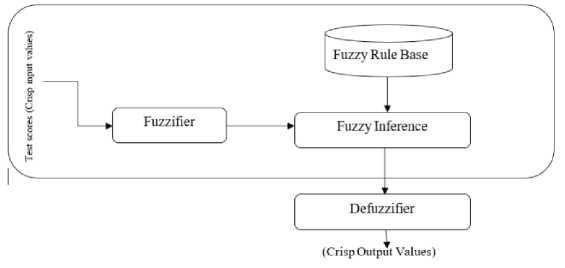
Fig. 1. A Rule-Based Type-1 Fuzzy System
-
(i) The fuzzifier: this component of the fuzzy model is used in fuzzification. Fuzzification is a process whereby the fuzzy set is split into its appropriate membership functions. In our proposed system, sets of input values could be generated by testing the student’s prior knowledge level. The crisp input values (Test scores) are generated in two stages, which are: (i) the students’ scores generated after a pre-test and (ii) the students’ scores after a post-test.
-
(ii) The fuzzy rule base: the working principles of fuzzy systems are rules, which are seen as a collection of IF-THEN statements. The IF-part of the fuzzy rule is known as the antecedent, while the THEN–part is known as the consequence.
-
(iii) The Fuzzy Inference: the fuzzy inference works hand in hand with the fuzzy rule base. They are constructed by the knowledge engineer using the scores generated from the pre-tests and post-tests. The fuzzy inference maps the crisp input set (student’s score) to its membership function using the fuzzy rule base. Because of the uncertain nature of the rule, an imprecise membership function (novice, known, moderate, advanced and expert) is mapped. For example, if a student’s score in a test is 60% which is equivalent to 0.6 in a fuzzy membership function [0...1], then he or she is classified as an advanced student, which implies that the student’s knowledge level is above average.
-
(iv) Defuzzification: the defuzzifier maps the membership function to its degree of membership. In the example above, since the test score is 60% (0.6), he or she can be categorized as a full member of advanced students and a partial member of moderate students (1 – 0.6 = 0.4). The student’s degree of membership is higher in the set of advanced students and lower in the set of moderate students.
-
3.2 Architectural Design
The architectural design of the implemented system is made up of a presentation module, learner profile module, adaptive learning module, individualized learning material module, and web and database server module. It is given in Fig. 2 below.
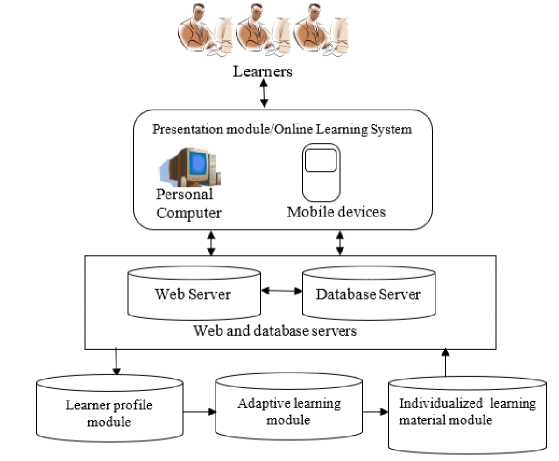
Fig. 2. OBALS Implementation Architecture
-
- Presentation module: this module controls the login, logout and new student registration tasks using either a personal computer or mobile devices like smartphones and tablets. To access the OBALS, registered students must log in with their valid login details to have their own learning environment. The student ends the session with the logout button.
-
- Learner profile module: This module is in charge of creating a profile for each student and updating it based on the student’s performance level. At each chapter of the learning session, a student is required to take a pre-test to determine his/her existing knowledge. The result of the pre-test is evaluated and stored in the student’s profile.
-
- Adaptive learning module: This module allows the student to choose a learning style and how the learning material will be delivered. He or she may choose to learn using text or audio-visual for now.
-
- Individualized learning material module: the function of this module is to present the environment which includes pages, navigation buttons or links and test.
-
- Web and database servers: the major function of a web server is to receive all the HTTPS queries made by users on web browsers and post back the query results as web documents. The web server also helps to improve the web interface when accessed with mobile devices. The function of the database server is to store all data that concern each student. This project work used XAMPP server which comprises Apache server and MySQL servers for web and database servers respectively.
-
3.3 Software Implementation details
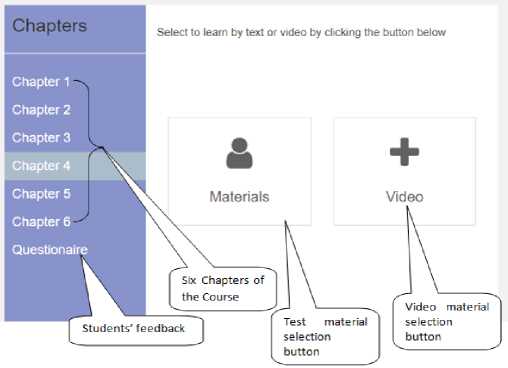
To experiment with the system, we designed an Online Base Adaptive Learning System (OBALS) that will teach Introduction to Computer Science, allow students to collaborate with other students and teachers using a forum. It also has the ‘Ask Teacher’ feature which allows a student ask the teacher questions outside the forum and also students feedback form. The course is made up of six chapters with different chapter contents. Each chapter was made up of a pre-test to test the student’s existing knowledge, well-explained chapter content in text and audio-visual format, and a post-test to test their performance at the end of each chapter. Detailed screenshots of the above-mentioned features are given in Fig. 3, 4 and 5.
-
Fig. 3. Screenshot showing course chapters
Chapters
-
Chapter 1
-
Chapter 2
-
Chapter 3
-
Chapter 4
-
Chapter 5
-
Chapter 6
Questionaire
Questions (Post Test)
-
1 Which of the following is not an output device? 42
О A • Monitor
OB 'Printer
О c • Keyboard
О D ♦ Speakers
-
2 Which of the following is not an input device? 41
О A Keyboard
О в • Joystick
® C * Monitor
О D * Microphone
-
3 The capacity of your hard drive is measured in 40
О A 'MHZ
О в • Mbps
Ос ’52X
О D * Gigabytes
Submit
-
Fig. 4. Screenshot showing student test page questionnaire, and lesson selection
-
3.3.1 Implementation pseudo code for pre-test and post-test performance (The rule used)
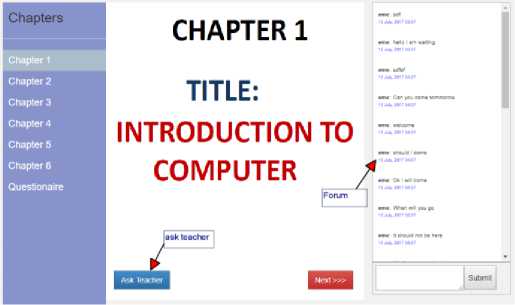
Fig. 5. Screenshot showing forum, ask teacher button and learning screen
1. Start
2. If student score is => 0 and score <= 19% Then Display “Novice”
3. Else if score is between 20%-49% then Display “Known”
4. Else if score is between 50%-59% then Display “Moderate”
5. Else if score is between 60%-79% then Display “Advance”
6. Else if score is between 80%-100% then Display “Expert”
7. End
4. Results and Discussion
These experiments aim at monitoring students’ performance rate, enforce students’ memory retention thereby, analyzing students’ post-test performance and feedback in order to improve the quality of the instructional material. Thirty-one (31) first-year students of University of Nigeria, Nsukka taught with the same learning resources were used for the studies. At first, the teacher prepared a learning content with six chapters. Secondly, the students took a pre-test to evaluate their existing knowledge about the chapter. After taking the pre-test, the students were allowed to go through well-detailed chapter content, using the OBALS, either in text or audio-visual format. At the end of the learning activities, the students were directed to take a post-test. The pre-test and post-test were used to ascertain the existing knowledge of the students before and after the learning exercise respectively. Both pre-test and post-test composed of 15 multiple-choice questions, designed by the instructor who prepared the learning materials to evaluate the students’ knowledge about the chapter contents. From the pseudo code above, a student is rated based on his/her performance after the pre-test and the post-test respectively. When a student’s score is <= 19% after a test, his performance is rated ‘Novice’ but if the student’s score is between 20% - 49%, he is rated ‘Known’. A student’s performance is rated ‘Moderate’ if the test score is between 50% - 59%, but when his score is between 60% - 79%, his performance is rated ‘Advanced’. A students’ performance is rated ‘Expert’ only if the test score is between 80% - 100%.
A questionnaire consisting of 6 three-point Likert-scale in the order of ‘Agree’, ‘Neutral’ and ‘Disagree’ were developed to collect the general students’ views on the online-adaptive learning, after being part of the exercise.
Therefore, this paper adopted a stacked bar chart in analyzing their test performance and user-feedback as shown in Fig. 6, 7, 8 and 9.
The students’ population that used the OBALS were thirty-one (31) in number drawn from first year students of university of Nigeria, Nsukka. The student’s prior knowledge was measured by the pre-test and the performance for each student were mapped into Novice, Known, Moderate, Advance and Expert using the type 1 fuzzy-logic model. The stacked bar chart of the students’ pre-test performance is shown in Fig. 6. Fig. 6 shows that 25.81% of students that participated in pre-tests for chapter one has a performance level of Novice, while 38.71%, 19.35%, 9.68% and 6.45% of the students were attained the performance level of Known, Moderate, Advance and Expert respectively. This implies that approximately 65% of the students scored below average at the end of the pre-test for chapter one while about 35% score above average. The pre-test analysis of students’ performance level for chapter one (1) through chapter six (6) is show in Table 1.
Table 1. Pre-test analysis of performance level
|
Chapter |
No. of Students |
Performance Level |
No. of students that scored below average |
No. of students that scored above average |
||||
|
Novice |
Known |
Moderate |
Advance |
Expert |
||||
|
One |
31 |
8(25.81%) |
12(38.71%) |
6 (19.35%) |
3(9.68%) |
2(6.45%) |
20 (65%) |
11(35%) |
|
Two |
28 |
4(14.29%) |
7(25%) |
7(25%) |
5(17.86%) |
5(17.86%) |
11(39.25%) |
17(60.72%) |
|
Three |
25 |
2(8%) |
6(24%) |
4(16%) |
8(32%) |
5(20%) |
8(32%) |
17(68%) |
|
Four |
20 |
3(15%) |
6(30%) |
2(20%) |
6(30%) |
3(15%) |
9(45%) |
11(55%) |
|
Five |
20 |
1(5%) |
10(50%) |
5(25%) |
1(5%) |
3(15%) |
11(55%) |
9(45%) |
|
Six |
10 |
4(40%) |
4(40%) |
2(20%) |
- |
- |
8(80%) |
2(20%) |
After the pre-test for each chapter, the students are allowed to access the course material, and then go through a post-test after reading the course material. The students are required to attain a certain score (at least moderate level) before moving further to the next chapter. The post-test performance levels are also represented with a stacked bar chart in Fig. 7.
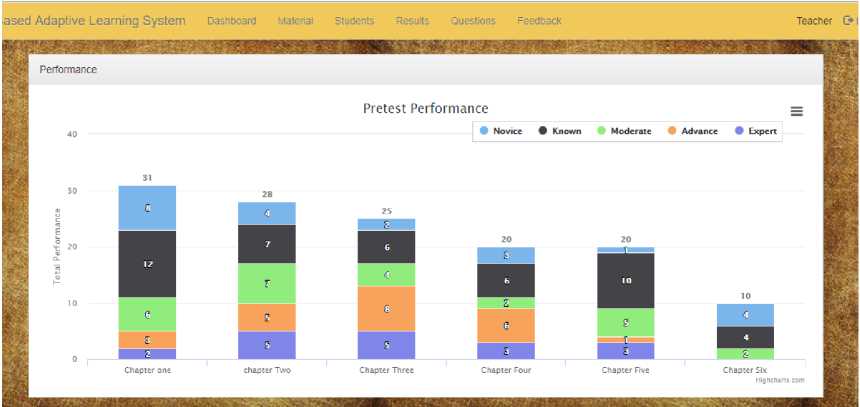
Fig. 6. Stacked Bar Chart showing the Student Pre-Test Performance.
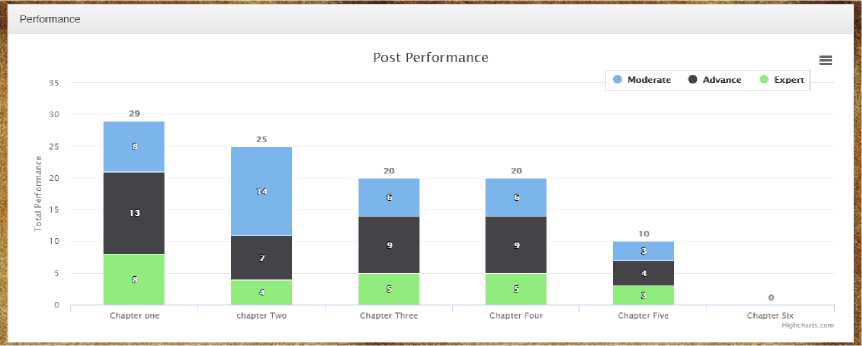
Fig. 7. Stacked Bar Chart Showing the Student Post-Test Performance.
According to Fig. 7, out of 29 students that participated in the post-test for chapter one, 8 of them, which is about 27.59% attained a performance level of Moderate before moving to chapter two, while 44.83% and 27.59% of the students reached the performance level of Advance and Expert before progressing to chapter two. Also, the post-test analysis of students’ performance level for chapter one (1) to chapter (6) is shown in table 2.
Table 2. Post-test analysis of performance level
|
Chapter |
No. of Students Performance Level Moderate Advance Expert |
|
One |
29 8 (27.59%) 13 (44.83%) 8 (27.59%) |
|
Two |
25 14 (56%) 7 (28 %) 4 (16%) |
|
Three |
20 6 (30%) 9 (45%) 5 (25%) |
|
Four |
20 6 (30%) 9 (45%) 5 (25%) |
|
Five |
10 3 (30%) 4 (40%) 3 (30%) |
|
Six |
- -- - |
Comparing the students’ performance for pre-test and post-test in Fig. 6 and 7 respectively, it was noted that the students achieved a higher learning performance in Fig. 7 than in Fig. 6. In other words, Fig. 7 reveals that the students demonstrated improved performance in post-tests after going through the course contents. These findings also show that using adaptive learning approach will profit the students in achieving a considerable knowledge outcome. The student feedbacks are captured in Fig. 8.
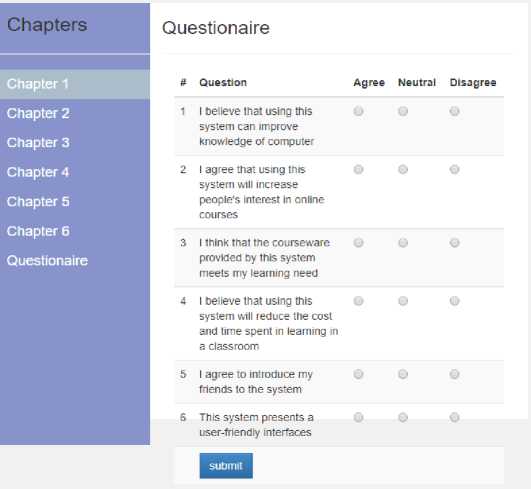
Fig. 8. Students’ Feedback Page.
Fig. 9 shows that over 83.33% of the students that used OBALS believed that using the system can help them improve their knowledge of computer science and increase their interest in online courses. About 66.66 % of the students agree that the course content provided by the system meets their learning needs and also reduces the time and cost of learning in a traditional classroom. Fig. 9 also indicates that 75% of the students are in agreement that the system presented user-friendly interfaces and also agree to introduce OBALS to their friends.
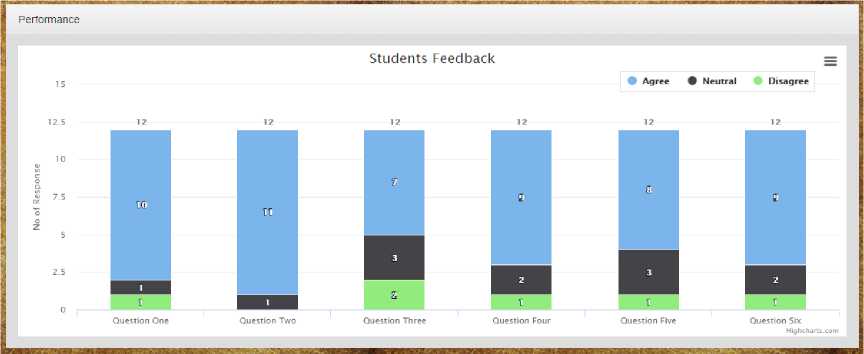
Fig. 9. Stacked Bar Chart Showing Students’ Feedback on the Questionnaire.
5. Conclusion
Online-Based Adaptive Learning System (OBALS) using Type-1 Fuzzy Logic Model; a learning environment was developed to allow student to participate in learning activities without meeting with the teacher in a physical location. Most learning systems in existence especially in traditional classroom scenario do not consider students learning styles, their learning speed and engagement level. OBALS was implemented to solve some issues identified from the existing systems by presenting a distinct technique that uses a type-1 fuzzy logic model with the aim of increasing learner’s performance and track their engagement level.
Only three user types are supported by the system: teachers, administrators, and students. Students who have registered can work with the teacher and other students, access learning resources, and take part in pre- and post-tests. Every learner is given a customized learning environment according to the modality they have selected. Pre- and posttest results are used to understand the students' prior knowledge and learning objectives. Type-1 fuzzy logic is then used to divide the students into performance categories. Retake orders for the chapter will be given to students whose posttest results are judged to be unsatisfactory, so tacitly enforcing retention requirements. A stacked bar chart is another tool used by this system to display a summary of each module's student achievement level. The teacher can detect and adjust chapter content with a larger percentage of low performance with the aid of the bar chart, which also indicates to the teacher how beneficial the learning modules are to the pupils. Teachers can observe students, track their individual performance, and post questions and instructional materials to the database. The administrator has the ability to modify, remove, and add teachers. He is able to view, update, and remove student users from the system, but not add them. In comparison to the traditional learning system, the usage of OBALS will lower the cost of instruction, the stress associated with traveling, the stress associated with tracking students’ engagement levels, and enhances student-teacher communication and prompt system response following pre- and post-test.
Future research areas: Even though OBALS has several advantages, there are still some areas that need research. First and foremost, the focus of this study was on how the instructional materials were presented in text and video formats. Therefore, it is advised that more research be done on adaptive learning systems while taking into account various learning styles including kinesthetic and logical learning. A learner using a kinesthetic learning approach would work on a physical task rather than listening to or watching instructional videos. The logical learning style pertains to a student's capacity to solve problems by analyzing the connections between one or more topics. These will be beneficial to the development of applications that replicate learning, including virtual learning environments. Second, the study used a small sample size (31 individuals) and a small amount of learning material (6 chapters). As a result, it is also advised that the study be expanded to include learning materials and a bigger sample size.
Acknowledgement
CJO screened the materials and participated in writing sections 2, 3, and 4. DUE coined the title, drafted the structure and participated in manuscript preparation especially sections 1, and 5, and formatting of the manuscripts. ACI wrote section 2, revised the complete manuscript and participated in the proofreading process by checking the grammar, correction, and editing. Finally, CVI participated in the graphical sketching, proofreading, and Grammarly check.
