
Alternative Dispute Resolution Mechanism for Sustainable Development
Журнал: Digital Social Sciences.
Статья в выпуске: 2 vol.1, 2024 года.
Бесплатный доступ
Disputes are an accepted reality associated with human life. However, numerous problems arise when such disputes are dissolved using methods adopted in rigid legal frameworks. Due to complex procedures inherited from the British legal system, there is a large public mistrust of the existing judicial system. Further, the judicial process is expensive, which hinders the low-income people of the subcontinent to seek justice in the court of law. Consequently, many problems arise that correlate to the judicial mechanism. This article explores the current and upcoming challenges impending the current judicial system, elaborating the possibilities to replace incompetent judicial processes with advanced, stable, and comprehensive Alternative Dispute Resolution (ADR) instruments to serve proper justice to people leading to peaceful, progressive, and inclusive societies, as mentioned in UN’s Sustainable Development Goal No. 16.
Короткий адрес: https://sciup.org/170213829
IDS: 170213829 | DOI: 10.69971/dss.1.2.2024.25
Текст научной статьи Alternative Dispute Resolution Mechanism for Sustainable Development
Human minds think, function, and observe issues differently. It is so unlike that one must agree with others inclusively. Thoughts and opinions vary, and different opinions sprout disagreement. So, disagreements and disputes are unavoidable and are intimately related to human nature and lives. If humans survive, disputes will be involved in every chapter of human history.
Citation: Md. Niamur Raquib. 2024. Alternative Dispute Resolution Mechanism for Sustainable Development. Digital Social Sciences 1(2) , 19-27.

Copyright: © 2024 by the authors This
article is licensed under a Creative Commons Attribution 4.0 International
License. To view a copy of this license, visit
Homo sapiens, being the most advanced and intelligent species on the planet earth, to avoid conflict, judicial system was developed by humans to resolve issues among people. Judiciary is one of the most important components of a country to uphold the public trust in its legal system. By upholding integrity, the judiciary maintains public trust and confidence in the legal system, reinforcing that no one is above the law .1 However, in recent times it has been observed globally that, the Indian subcontinent countries including India, Pakistan, and Bangladesh, due to the complex, stiff, and lengthy nature of the judicial process and political control over the judiciary, the judiciary is a less effective institution that fails to attain its core assignment of serving justice and is losing the public trust rapidly. If public trust declines in the legal system, the peace and stability of such a society may be affected, and in the long run, such a society may fail to function properly and tumble.
In 2015, the Unite d Nations (UN) adopted the 2030 Agenda, also known as the Sustainable Development Goals (hereinafter SDGs), comprehending 17 goals accompanied by 169 targets, where one of the goals, included as Goal 1 6, is to promote peaceful and inclusive societies for sustainable development, provide access to justice for all, and build effective, accountable, and inclusive institutions at all levels .2
The pit loom helped in crafting famous muslin sarees. Traditional jamdani and other sarees are still produced on these pit looms. Over time, the fly shuttle, locally known as “maku” to weavers, was introduced to this loom. The Tangail Saree, was born as each thread was meticulously woven using this maku. The name “Khatkhati Tant” for this loom is derived from the clicking sound produced when the shuttle moves at high speed.
-
2. Methods
-
3. Deficiency of Public Trust
Qualitative research has been followed by gathering information from both the primary and secondary sources. While finding the answer related to the predicted failure of the judicial system to establish peaceful and inclusive societies for the SD, primary sources consisting of various laws,
regulations, and case laws of India, Pakistan, and Bangladesh have been used. While secondary sources, including related books, journal articles, opinions, websites, and other catalogs, played a vital role in this research.
Public trust in the judiciary refers to people having trust in the judicial system to be unbiased and fair to deliver justice in public disputes .3 D.Y. Chandrachud, the former Indian Chief Justice, mentioned that public trust & legitimacy are central to judicial credibility, and judges should avoid public discernments to reach a decision .4 Public trust is one of the major components for judiciary and it may be subject to multiple factors such as impartiality, independence, transparency, the success rate of adjudication, and public perception. As it is a well-established legal proverb that ‘Justice delayed is justice denied , ’ along with all the mentioned factors, time consumed from founding a case or suit to the announcement of the final verdict plays a vital role in encouraging or wearing away public confidence.
Public trust is swiftly declining in many countries, including developed states around the globe. Gallup published its yearly survey on public confidence in the US Supreme Court in 2022. The rating of the court hit a significant low, with just 25 percent, down from 36 percent in 2021 (Lohier et al. 2022).
Recent Study regarding the public trust in American Courts indicates that confidence in the federal judiciary has diminished over the past few years. Illustration of 20 years of statistics from Annenberg surveys suggest from 75% in 2000 to less than 50% in 2022, the proportion of Americans who say they have "a great deal" or "a fair amount" of faith and confidence in the judicial branch has decreased .5
The judicial system in the UK is suffering from a low level of public confidence in its judiciary. In a press release titled “Public Confidence in J ustice Is Shot,” the chairperson of the Bar Council of England, Samuel Townend KC, articulated that the faith and confidence in the justice system in the UK and other countries are undermined by recent and continuous public attacks on the legal profession and judges, threats to fundamental rights under domestic law and international legal obligations .6 The survey of over 5,000 adults across the UK, by an advocacy group, revealed that 31% of respondents had faith in judges had decreased recently, while 28% did not trust at all (Siddique 2022). Cases like Oliver Campbell left an adverse impact on the UK’s judiciary and its public confidence, where Mr. Oliver Campbell, a British Black male, was accused of murder and conspiracy to rob, later convicted in December 1991 for the same, and was sentenced life imprisonment. In September 2024, the Appellate Court of the UK quashed the conviction .7 Oliver Campbell, after getting free, stated that although he has been cleared of the false charge of murder, he lost 34 years in captivity .8
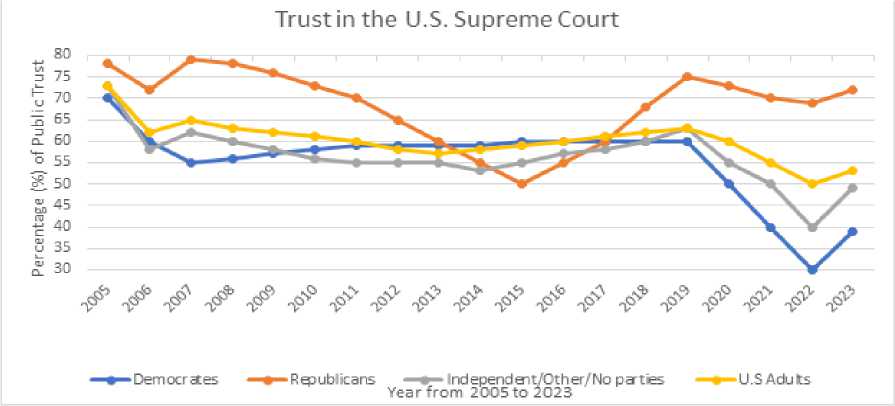
Figure 1. Public Trust in the US Supreme Court
Reduced public faith in the existing judicial system is a cause of apprehension for many governments in Europe especially. Public confidence in the judiciary in the year 1981 and 1999 to 2000, has declined in Belgium (-23.4%), Italy (-10.9%), France (10.6%), the Netherlands (-16.2%), Finland (-17.9%), Spain (-6.6%), Sweden (-12.2%), and Hungary (-43.4%), while in Northern Ireland, public trust and confidence have deteriorated from 67.5% to a concerning level of 47.9% .9
Majority of Indian people no longer regard judges as impartial and trustworthy, while hearings can last for years or decades. Currently, there are approximately 30 million pending cases before the Indian district courts alone .10 In his book, Upendra Baxi remarks on the legal crisis as a situation in which the structure of a social system , i.e., the judiciary , permits fewer options for solving problems than are essential for the system's continued existence (S. P. Sathe 1983). The declaration of the case has an extra peak in Indian judicial history. For instance, the Berhampore case is one of the lengthiest cases in the history of the Indian judiciary, which was filed on January 1, 1948, and resolved after 72 years in 2023 .11
It is a commonly held view that within the judicial system, the elite receive swift and favorable justice, whereas the average person encounters considerable delays and hurdles when seeking justice’ (Muhammad Mohsin Iqbal, 2024). Slow justice increases frustration and powerless feelings, which in turn reduces faith in the judicial system. In Pakistan, the courts are under great strain, as they deal with a staggering backlog of 2.144 million cases at both the Supreme Court and the inferior Judiciary . 12 In 2019 and 2020, in the Civil Justice ranking, Pakistan held the 118th position. While in criminal justice ranking, Pakistan's judiciary held the 92nd position, which decreased to 98th in 2020 .13
In Bangladesh, annually around 31 million people experience legal problems of both s, civil and criminal nature .14 As of 2015, approximately 100 Supreme Court judges were dealing with about 0.38 million pending cases, while around 1400 judges from district courts had 2.7 million pending cases .15 The number of pending cases is increasing every day. The Japan International Cooperation Agency (JICA) articulated that, there are up to 4 million pending cases the courts of Bangladesh because of the court system's delays and judge scarcity .16 As a result, at the grass root level of the society, the mistrust in the judiciary of Bangladesh has crossed an extraordinary phase. For an example, in the Tipu-Prity Murder case, a teenage college-going girl named Samia Afran Prity got shot and died by the assailants sent to kill the former general secretary of the Motijheel unit of the Awami League, Zahidul Islam Tipu, on a rickshaw while visiting her friend on a busy street in the capital of Dhaka’s Shahjahanpur. Prity’s father, Mr. Jamal Uddin, denied seeking justice, stating that, “Where would I seek justice? There is no justice here.” Similarly, her mother stated that, “We will not get justice even if we want to. To run a case, you need money. We won’t survive if we are to run the case” . 17 Hence, it’s still pending before the lower court, where 33 persons including politicians, are indicted . 18 Similarly, the Sagar-Runi murder case, Tonu rape & murder case, Taqi murder case, and Munia murder case, are good examples of cases that have been pending before the courts for a long period; some have even been delayed for decades. Generally, criminal proceedings are less time-consuming than civil proceedings. Where criminal cases run door-to-door in courts to seek justice for decades, it is not so surprising that civil suits consume more time compared to criminal cases and take more than decades to be resolved in the courts of law. Furthermore, after 5th August 2024, it is vibrant like crystal. As an adverse outcome of the past 16 years of dictatorial rule in Bangladesh, people lost their faith in constitutional bodies, including the executive, legislative, and judiciary, which led to political unrest and instability over law and order.
Reduction of communal trust in the judiciary may carry the judicial system to the edge of a standstill. Moreover, when public trust falls upon the judicial system, it is the state that suffers the most due to lack of legal application and failure to maintain law and order. In the long term, the country’s other organs may get affected by the absence of the rule of law. While studying the data mentioned above, a question may appear before us: is the justice system, once one of humanity’s best establishments, failing? Although the judicial system is facing multiple challenges due to a lack of public trust, resources, scarcity of expert manpower, etc., It would not be right and fair to draw a quick assumption that the judicial system is failing globally in its absolute form. Unlike other public institutions, the judiciary deals with the public directly, so the challenges before the judicial system are astonishing. To predict a certain future for an institution like the judiciary, an advanced study to assess and determine whether the judicial systems across the world are failing or not is required to attain their objective to serve justice. However, we may take approaches to extenuate the deficiency of the current judicial system and recuperate other scarcities, including lower public confidence in the judiciary.
-
4. Judicial Inability: The Outcomes
-
4.1 Upsurging Rate of Crimes and Violences
-
4.2 Mob Justice Culture
The judiciary plays the most vigorous role in holding societal peace by ensuring equal access to justice and establishing the rul e of l aw. It is the collective conscience of the society that suffers the most if the judiciary fails and reveals its inability to deliver justice. The consequences of the inefficiency of the judicial system to establish the rule of law may be ominous.
We humans are habitual lawbreakers, the rate of crime and local violence may increase for many reasons, such as socioeconomic factors (e.g. extreme poverty and unemployment; administrative incapacity to enforce the law, executive failure to maintain law and order, inability to control drug and alcohol, uncontrolled urbanization and rapid population growth and the breakdown
of family structure .19 However, judicial functionality has a tremendous capacity to control crime and violence. The crime rate may be controlled and reduced over time by deterrent effects of proper punishment through a judicial approach .
On the other hand, judicial incapacity to establish legal precedents by serving justice may contribute to an increase in crime and violence. Recent statistics on crime rate of India, Pakistan and Bangladesh may elaborate the ongoing situation in the Indian Subcontinent. According to the National Crime Records Bureau (NCRB), India’s crime rate in 2025 was 445.9 per 100,000 people compared to 143.5 per 100,000 people in 1963 and 422.2 per 100,000 in 2023 .20 The data from Pakistan Bureau of Statistics suggests that, in 2020, a total of 876,430 crimes were recorded, which is a 34.3% increase from the 652,383 total crimes reported in 2010 .21 In Bangladesh, according to the crime statistic published by Bangladesh Police, approximately 14,572 cases were filed in January, 2025 alone and in previous year, totaling 172,005 cases were filed in all the districts of Bangladesh .22 Another report suggests that, in Bangladesh, from 2019 to 2023, more than nine murders occurred every day on average, totaling 16,555 murders and 107,000 cases of violence against women and children took place in 5 years and in the same period, 1685 cases of organized robbery and 9,955 cases of robbery were documented .23
However, it is not necessary to assume that all the reported crimes originate from solely from felonious intent. In Pakistan, the culture of ‘Honor Killing’ where the killing of a member of a family who is perceived to have brought dishonor upon relatives is a dark reality .24 The story of blood feud of 2011 which shocked the nation of Pakistan where three Kohistani women were killed after being filmed singing and clapping at a wedding ceremony which led to the killing of four men . 25 Comparable cases are being witnessed in India. A study demonstrates that an increase in honor murders in India, particularly when the couple had inter-caste matrimonies or relationships .26 For example, in Komal murder case, a young women aged about 20 years, was killed by her 17-year oil brother for her love marriage with a man from a lower caste .27 Similar example is the Manoj-Babli murder case, where newlywed Manoj Banwala and Babli were murdered by their own relatives (Tulika Tripathi 2016). A TV-report published on 21 February 2025 that shook the nation of Bangladesh on an incident which documented an incident in Jamalpur, 5 women were brutally abused in medieval-style by their uncle and cousins over a land dispute .28
Nevertheless, the recent trends indicate that, mob culture reaching unprecedented levels in the Indian subcontinent. Although in Pakistan, has a strong and distinctive legal framework against blasphemy, when someone is accused of blasphemy, the defendant, police, attorneys, and courts face intimidation, assaults, and threats of violence. (Nazar Hussain et al. 2023) For instance, while in police custody, Dr. Shahnawaz Kumbhar of Umer Kot was brutally killed on accusation of blasphemy in a staged police encounter. His life was tragically cut short, and his body was seized by a mob and desecrated .29
A similar pattern of religion-based mob violence can be observed in India. For example, on 28 September 2015, Mohammad Akhlaq, a resident of the Bisara village near Dadri in the Indian state of Uttar Pradesh was brutally lynched and his 22-year-old son severely injured by an angry mob that believed he had slaughtered a cow and possessed beef (Siyech and Narain 2018). The Centre for Study of Society & Secularism (CSSS) reports that, violence or extremism based on religion in India increased by an alarming 84% in 2024 .30
In Bangladesh, mob incidents are rising swiftly in recent times. At least 21 mob incidents have been reported, most of them politically driven, since early August 2024 .31 It is well known that many of these cases go unreported, making the exact number impossible to determine. The horrendous incident took place on 18 September, 2024, where Tofazzal Hossain, a 35-year-old men-
tally challenged man was brutally beaten, fed and beaten again to death by the student mob at the country’s most prestigious academic institution Dhaka University, on allegation of stealing mobile phones, specifying the vacuum of rule of law in Bangladesh .32 Incidents like the one involving Tofazzal Hossain is a result of past decade’s judicial inability to attain the objective to uphold justice, when public perception has developed that legal loopholes allow offenders to escape accountability.
It is a common thought of people that anyone with money can always buy their way out of consequences of crime since the punishments are capricious. So that the Mob justice can be viewed as a means for the public to encourage predictability in that everyone is cognizant of the consequences of committing a crime by ‘send a message’ (Fayyaz Khokhar et al. 2024).
-
5. ADR: An Innovative Era of Judicial Sacrament?
It becomes a challenge for the judiciary to uphold its integrity and honor when people prefer to carry out judicial activities at local level rather than using the state’s judicial mechanisms. Local or societal adjudication may also create obstacles in the way of establishing justice. Without proper procedure and accountability, although it may be flexible in a certain sense, the loopholes of such adjudication are more accessible to those who hold local dominance. As a result, the retrograded part of society may easily be deprived of their right to justice in their account.
Local or societal adjudication to resolve both civil and criminal matters take place very often in countries like India, Pakistan, and Bangladesh, in different names. Whatever the name may be, without a proper, stable, and existing procedure and framework, the chances of misjudgment are so high.
The traditional ‘panchayat’ system is an age-old concept or custom in India, which interprets to "coming together of five persons," hence a council, meeting, or court composed of five or more people from a caste or village who have come together to decide on group policy or settle conflicts .33 The panchayat may be divided and discussed into many forms, such as nayana pancha-yat, gram panchayat, district panchayat, etc. But the most criticized panchayat structure is the one based upon the caste system known as khap panchayat. It is a concept rooted in patriarchal society and is based on principles of Bhaichara or brotherhood and HukkaPaani which means community living and eating together .34 This body administers justice, mediates conflicts, but primarily upholds the patriarchal laws governing marriage, property, and the prohibition of inter-caste or mixed-class relationships .35 Caste Panchayat members have committed communal boycotts, excommunication, social agony, assaults, and violate the modesty in the name of intervening in domestic violence, untouchability, love affairs, and land related issues. In addition, the group functions as judges and often prevents victims from approaching the police station, court, or other legal entities to get proper treatment of law .36
A similar system of communal adjudication may be observed in Pakistan known as jirga or faislo. As observed by Amnesty International, it is unfortunate that the state of Pakistan has generally endorsed the jirga system within the tribal justice framework. When jirga rulings result in the killing of women for allegedly violating the "honour" code or surrender of women and children to "settle" conflicts, the state typically does nothing to intervene .37
In Bangladesh, the societal misjudgments are often perpetuated under the umbrella of so-called ‘salish’ or ‘darbar’, mainly run by the local elites. Although the salish system is so controversial in Bangladesh and not part of the formal Judicial System, hence having no legal standing, but so often operates as a body that renders informal decisions, much like an elder council, to find way out for local conflicts, for instance, those involving inheritance, family, or property. Concerns arise when so-called ‘darbar’ or ‘salish’ exceeds its limits and attempts to adjudicate penal conduct or allegations of penal nature. For instance, A village arbitration council in Dohar Thana condemned a 14-year-old girl named Shefali and her mother to 100 lashes apiece in April 1992 after the girl was raped by a powerful village elder .38 Another horrific example is the story of Noorjahan, on 5 May 1993, who was tried by a village salish in Dokhin Sripur village in Faridpur district, she was found guilty of adultery by a salish, which included her husband, and sentenced to death by burning. (Amnesty International 1993).
‘ADR’ signifies the types of disputes resolving mechanism which are alternatives to the existing court system or legal procedure. In other words, it describes a wide variety of dispute resolution mechanisms that are short of full-scale court processes or judicial processes (Md. Abdul Halim 2010). More specifically, ADR refers to less time consuming and more cost-effective approaches by which contradictory parties may resolve their disagreements peacefully, and it includes all the methods other than formal court procedure or legal process. ADR may be observed in many different forms, such as arbitration, mediation, collaborative law, neutral evaluation, parenting coordination, restorative justice, settlement conferencing, the use of special master, summary jury trials, etc. 39
Regardless of its definition or method, ADR is not a brand-new development in the field of conflict resolution. The history of ADR can be traced back to ancient Greek and Rome, where mechanism like today’s ADR was used to resolve issues privately. In
medieval Europe, arbitration was often utilized in economic and maritime disputes and Native Americans used it to resolve disputes both inside and between tribes. Furthermore, King Henry II of England, known as "the Father of the Common Law," ruled from 1154 to 1189 and was acted as a wise arbitrator of disputes among the rulers of Christian majority kingdoms .40 Also in Arab world, ADR has its historical establishment. Even in pre-Islamic era, the cultural preference of Arabs for private conflict resolution is well documented in history. According to renowned Arab historian Al-Yaqoubi, who lived in the tenth century, the pagan Arabs used arbitrators to resolve their conflicts because they lacked religious faiths or rules to guide their lives (Md. Mashiur Rahman 2018).
Shortly after gaining independence, lawmakers in the United States started to adopt ADR mechanisms within its legal frameworks. For instance, the legislative body of congress introduced arbitration mechanism in the Patient Act of 1790. In the early 1900s, states began to realize the potential of ADR mechanisms and as a result, Congress approved the Federal Arbitration Act, a federal equivalent, and more than a dozen states passed contemporary arbitration laws. Today, ADR mechanisms are well adopted in almost every legal profession of USA from the judicial system to public and private corporations (Peccei et al. 2011). Beyond the USA, other developed jurisdictions, notably the UK and Australia have implemented court-based ADR mechanisms, such as mediation, as a pre-action requirement to promote promptness and efficiency in the civil judicial system (Professor Tania Sourdin 2014).
However, acceptance of ADR within legal framework is rarely found in primeval history. But in recent period, developing and underdeveloped countries like India, Pakistan and Bangladesh are receiving initiatives to include ADR mechanisms within their legal framework. Below are some examples.
From an Indian perspective, although the British East India Company introduced some of the alternative methods, during the early period of British rule, the legal framework on arbitration was introduced for the first time by the Bengal Regulation Act of 1772, which acknowledged the legitimacy of arbitral agreements to resolve conflicts. However, The Bengal Regulation, 1822, is considered as the first formal legislation on Arbitration in Indian legal system, while the Madras Regulation, 1816, provided that the conflicting parties may refer their matters to the panchayats .41 In 1899, the Indian Arbitration Act was introduced, focusing exclusively on arbitration as a dispute solution mechanism. The Civil Procedure Code of 1908 contained its second schedule entirely related to arbitration in civil matters which was later repealed by the Arbitration Act, 1940. However, later through an amendment in 1999, the Civil Procedure Code incorporated mediation as a method of dispute resolution. Apart from that, several other legislative enactments have supported for resolution of disputes in alternative ways, such as , a rbitration (p rotocol and c onvention ) a ct , 1937; The Foreign Award (Recognition and Enforcement) Act, 1961; Arbitration and Conciliation (Amendment) Bill, 2003 as a result of the report of Justice Saraf Committee in 2004, which later amended correspondingly in 2015, 2019, 2020, 2021 .42
In the legal context of Pakistan, ADR mechanisms are frequently observed. Similar to India, Pakistan has incorporated numerous provisions that encourage the use of ADR tools to resolve disputes in a peaceful manners, such as, The Arbitration Act, 1 940 with a devoted view to upheld ADR mechanism; The Civil Procedure Code of 1908 in its Section 89-A and Order X, Rule 1A; The Family Courts Act, 1964 within Sections 10 and 12; Customs Act, 1969 in Section 195C as well as the customs rules, 2001 with a devoted chapter XVII; Qanun-i-Shahadat Order, 1984 in its Article 163; Income Tax ordinance, 2001 through Section 134A along with rule 231C of the Income Tax Rules, 2002; Sales Tax Act, 1990 in Section 47A and Sales Tax Rules, 2004 in its Chapter X; Federal Excise Act, 2005 in Section 38 besides Federal excise Rules in Rule no. 52; From Section 96 to 99 of the local Government Act, 2013; SBNP Local Government Ordinance of 2001 in Section 102 to 106, etc .43
Bangladesh, for being a former British and later Pakistani colony and also a part of Indian Subcontinent, exhibits significant similarities with India and Pakistan, which derived Bangladesh to take required stances on adopting ADR mechanism within its legal framework. A major development occurred in 2003, when the code of civil procedure was amended to include Section 89A, 89B & 89C, introducing ADR into civil litigation procedures. That same year, Artha Rin Adalat Ain, 2003 was enacted with Section 22 to 25 establishing ADR as a primary means for resolving financial disputes. According to Section 209, 210 & 213 of Bangladesh Labor Act, 2006, the Chief inspector or an authorized officer by chief inspector to act as a mediator to settle disputes through ADR. Similarly, Paribarik Adalat Ain, 2023 in its Section 11 & 15 contains provisions referring to the court to utilize ADR approaches in resolving dispute over family matters. The Customs Act, 1969 Section 192A to 192K and Value Added Tax and Supplementary Duty Act, 2012, Section 119 refers to the related disputes to the facilitator to be resolved. In Section 7 of the Dowry Prohibition Act, 2018 it is mentioned that the offences recognized under the Act are compoundable. Additionally, the Salish Ain, 2001, Legal Aid Services Act, 2000, Gram Adalat Ain, 2006, Conciliation of Disputes (Municipal Areas) Board Act, 2004, etc. are good examples of legal frameworks which uphold the core revelation to endorse justice through more reachable and flexible ADR instruments, apart from rigid jurisdictive approach .44
-
6. ADR: Is it Just False Hope?
Apart from Criminal Procedures, ADR has gained significant prominence in civil and family matters as an effective method for resolving conflict between parties. Globally, through legal acceptance, gradually ADR is becoming a more common process to resolve disputes under the umbrella of the legal system. Moreover, the commercial entities and companies have also started to adore
ADR within their by-laws, regulations and mutual contracts as a method to resolve economic or corporate disputes (Carver & Vondra 1994). 45
In addition to its practical applications outside institutional frameworks, due to its notable benefits, including cost effectiveness, time efficiency, flexibility, confidentiality and the mutual collaboration of disputing parties. ADR was introduced into the legal frameworks in jurisdictions around the world, to alleviate the burdens of justice-seekers and reduce the backlog of unresolved cases before the court of law (Advantages and Disadvantages of ADR 2024). However, due to a range of legal and practical challenges. These include lack of legal precedents, informality, inefficiency in enforcement of decisions, lack of good-faith and cooperation, imbalanced-power among conflicting parties, dominance in the procedures by power holders or large corporations, other administrative challenges, etc. ADR is gradually becoming less effective .46
Recent data suggests that in India, approximately 4,52,85,563 cases that are pending before the courts where around 1,08,84,155 cases are with civil nature only about 3% of cases are heard by the courts each day, the backlog continues to grow daily .47 Although the constitution of India is committed to serve justice to each of its justice seekers and the Arbitration and Conciliation Act, 1996, suggests one of the relief containing arbitral approach, legal limitations, lack of public awareness and adverse practical challenges, people continue relying heavily on the judiciary .48 As a result, the number of pending cases are increasing gradually which drives the judiciary to a stand-still and transform into an inefficient institution that fails to deliver justice.
A 2023 statistic of Pakistan indicates that, total number of cases pending in the courts increased by 3.9% reaching an astounding 2.26 million. In its biannual report on judicial statistics for the period from July to December 2023, the Law and Justice commission of Pakistan revealed that the district judiciary accounted for 82% of the pending cases amounting to over 1.86 million, with the top tier, which comprises the Supreme Court, Federal Shariat Court, and high courts, accounting for the remaining 18% which includes approximately around 0.39 million cases (Associated Press of Pakistan 2024) .49
It took Bangladesh nearly a decade to integrate the ADR system into its legislative framework, particularly for civil proceedings, including land related disputes and corporate disagreements, aiming to ensure peaceful, flexible, speedy, and cost-efficient resolution process. However, ADR mechanism cannot be regarded as a success (Patoari et al. 2020). A study conducted by the supreme court of Bangladesh in 2023, over 4.2 million lawsuits were still pending in the country’s subordinate and supreme courts as of 31 March 2023. In response, senior Supreme Court lawyer Khurshid Alam Khan stated that, "In our country the ADR system has failed in reducing case backlog. We didn't achieve the expected results even after the amendment of the law regarding the ADR system" .50
A pertinent question may arise, even after adopting ADR mechanism into the legal frameworks, these alternative approaches merely overrated promises, as the number of pending disputes continues to rise. There are numerous legal and practical challenges, both legal and practical, that affect the outcome of the ADR process. Like all legal instruments, ADR mechanisms have its strengths and limitations besides the positive factors that compel individuals to pursue litigation in courts rather than commencing towards alternative approaches. Arbitrators are frequently criticized for being biased or lacking the necessary experience to resolve disputes fairly. Moreover, it has been observed that many legal practitioners remain unaware of the alternative approach of delivering fair justice through the arbitral procedure. Consequently, the system of ADR has coexisted and regulated under the legal system for a considerable amount of time, its practical impact has often fallen short of expectations (Kumar Singh et al. 2016).
-
7. Goal 16 of SDGs: Possibilities of ADR
-
The primary objective of Goal 16 is to establish inclusive and peaceful societies worldwide. In alignment with this aim, ADR mechanisms offer a non-adversarial platform to resolve disputes among conflicting parties. Especially the community-based ADR mechanism represents a creative and effective strategy for resolving conflicts informally to improve domestic harmony. By using non-violent methods to resolve disputes within families and communities, community-based ADR has become a vital tool for promoting communal peace. (Obafemi D Akintayo et al. 2024) Moreover, the ADR system emphasizes the values of diversity and inclusivity in the context of Goal 16. By bringing together individuals from various backgrounds, the ADR mechanism encourages communication, compassion, and teamwork, creating an environment where differences are not only acknowledged and respected but also transformed into constructive solutions .54
-
7.2 Access to Justice
Goal 16 of SDGs emphasizes that all members of societies should have access to justice. In the context of development work, access to justice is a fundamental component of the rule of law. In fact, governments can enhance their legitimacy, foster social change, and promote economic growth by granting access to justice. (Davis & Turku 2011) Unlike traditional judicial processes, ADR mechanisms offer easy access to justice regardless of the background of disputing parties. In some cases, these alternative approaches may be more reliable, quicker, and cost efficient than the conventional judicial method which ensures broader and more equitable access to justice for all.
-
7.3 Transparency and Co-operation
The SDGs target 16.7 aims to “ensure responsive, inclusive, participatory and representative decision-making at all levels” .55 In recent decades, transparency has emerged as a crucial element of international adjudication in recent decades. It is typically associated with the disclosure of documents and information and public access (Ruscalla, 2015). Although transparency is not precisely defined under international law, it generally implies that information should be open for all. However, one of the most important factors that has aided in the development of the ADR process is transparency .56 Moreover, it is one of the fundamental principles of ADR that must be shaped within a voluntary atmosphere. ADR is a method where parties, acting in good faith, cooperate to resolve disputes. In contrast to the adversity of traditional court proceedings, voluntary participation in ADR mechanisms fosters a more cooperative environment, potentially preventing the escalation of conflicts .57
-
8. Conclusions
There are several ways to conceptualize the notion of sustainable development. At the core of the concept, the term refers to a growth strategy that seeks to strike a balance between multiple dimensions, namely social, economic, and environmental constraints that our society faces. More modestly, SD may be defined as development that meets the needs of the present, without compromising the ability of future generations to meet their own needs .51
In the historic UN summit of September 2015, 17 SDGs of 2030 Agenda for SD were adopted by the world leaders from 193 member states, which came into force from January 1, 2016 .52 Founded on the achievements of the Millennium Development Goals (MDGs), the SDGs, commonly referred to as the Global Goals, seek to eradicate poverty in all its manifestations.
Goal 16 of the SDGs is about promoting peaceful and inclusive societies for sustainable development by providing access to justice for all and building effective, accountable and inclusive institutions at all levels .53 Consequently, it can be asserted that, the Goal 16 and ADR are closely interrelated since both emphasize the promotion of justice, peace, and functioning robust institutions.
As mentioned, access to justice, particularly in developing and underdeveloped countries, is not readily available to all. However, to foster inclusive societies, although ADR has its limitations due to institutional volatility, it may be a way out to provide an open door to give access to justice for everyone with number of possibilities.
Globally as public trust in the Judicial system is decreasing gradually, ADR mechanisms are gaining prominence as effective tools for developing peaceful and inclusive societies as mentioned in Goal 16 of the SDGs. Traditional legal systems often struggle to deliver justice to the public when issues become more complicated. ADR offers a viable solution by promoting collaboration, reducing adversarial confrontation, and striving for fair, mutually beneficial outcomes. Moreover, ADR empowers people and communities, enhances institutional trust and supports the aims of Goal 16 of the SDGs program by effectively, efficiently, and fairly resolving conflicts. Furthermore, to develop inclusive and peaceful societies, ADR mechanisms must be systematically integrated into legal and judicial frameworks with the support of legislative reforms, as well as capacity-building initiatives and increasing public awareness. It is important to operate independently and in good faith for not only addressing the gaps of judicial system, but also for developing the foundation for SD where accountability, harmony, and the justice guide and navigate the course of human progress. The adoption of ADR is no longer a matter of optional legal strategy, but essential for a fair and sustainable future for human societies.
