
Analysis and forecasting of the structure and dynamics of the number of graduates of Russian universities
Journal: Economic and Social Changes: Facts, Trends, Forecast @volnc-esc-en
Section: Social and economic development
Article in issue: 3 т.19, 2026.
Free access
The relevance of this study is determined by the need to improve the reliability of medium-term forecasts of the training of personnel with higher education, in order to enable well-founded planning of state-funded admission quotas and adjustments to the structure of specialist training under conditions of changing demand in the labor market. The aim of the work is to construct a forecast of the number and structure of graduates from Russian universities by 2030, disaggregated by level of education and broad field of study groups. The dynamics of enrollment and the number of graduates from Russian higher education institutions for the period 2016–2025 were analyzed based on official data from the Ministry of Science and Higher Education of the Russian Federation. An original mathematical model for forecasting the number of graduates is proposed. This model takes into account actual past enrollment figures and empirical graduation success rates (the ratio of graduates to enrollments with a fixed time lag). The model was applied to ten aggregated groups of specializations. The analysis revealed significant differentiation among the groups of specializations in terms of graduation success rates. The highest graduation efficiency was recorded for state-funded specialist programs in the “Health and Medical Sciences” group (97.6%), while the lowest was for tuition-fee specialist programs in the “Mathematics and Natural Sciences” group (32.7%). In 2025, the average success rate at the bachelor’s level was 75.8% among budget-funded places and 68.0% among non-budget-funded places; at the specialist’s level, this figure was 81.2 and 56.3%, respectively; and at the master’s level, it was 78.4 and 52.1%. In 2025, the total number of university graduates was 843 thousand people, while enrollment in 2020–2021 averaged 1,100 thousand people. According to the forecast, a steady increase in the number of graduates across all levels of education is expected by 2030, most pronounced at the bachelor’s level (up to 641.5 thousand people). The graduate structure is projected to show a sustained increase in the share of specialists in information technology and healthcare, alongside a reduction in the share of economists and lawyers. The theoretical contribution of the study consists in developing a medium-term forecasting methodology for university graduates using a balancing approach that accounts for differences in academic success. The practical relevance stems from the applicability of the projected structure and dynamics of graduate output to the allocation of publicly funded and tuition based places and to the synchronization of educational policy with labor market needs, thereby reducing the risks of both graduate oversupply in some specializations and shortages in others
Short address: https://sciup.org/147254768
IDS: 147254768 | UDC: 378:311.17 | DOI: 10.15838/esc.2026.3.105.9
Text of the scientific article Analysis and forecasting of the structure and dynamics of the number of graduates of Russian universities
As part of building the nation’s human capital – the principal driver of economic growth and social stability – the higher education system serves to reproduce a skilled workforce (Ketova, Vavilova,
2020; Akaev, Sadovnichii, 2021). According to data from the Center for Macroeconomic Analysis and Short-Term Forecasting (CMASF)1, by 2035 the Russian labor market could face a surplus of up to
2.7 million university graduates, even as shortages of specialists persist in certain sectors. Analyzing the structure and dynamics of the number of graduates from higher education institutions makes it possible to assess and forecast the supply of qualified personnel for the labor market.
University graduates constitute a distinctive segment of labor supply, one whose qualitative and quantitative parameters take shape with a considerable time lag. The lengthy training cycle for a specialist (four to seven years) trails behind the pace of technological change, which is why it is essential to engage in forward-looking planning and to adjust graduate numbers based on forecast models (Omelchenko, Safonov, 2024). It is likewise advisable to minimize the time lag between the emergence of demand in the labor market and the supply of qualified graduates (Azarnova et al., 2025).
In 2025, 1.4 million applicants enrolled in Russian higher education institutions, while 843.3 thousand graduates of bachelor’s, specialist, and master’s degree programs entered the labor market2, underscoring the scale of the supply of qualified personnel and its impact on socio-economic stability. In the modern Russian economy, which is going through a period of transformation, an imbalance is evident: the mismatch between the structure of personnel training and the real needs of the economy has worsened in recent years. According to CMASF estimates3, the largest surplus of graduates is expected in the humanities, such as political science (where supply exceeds demand sevenfold), media studies, library science, law, and linguistics, while a shortage persists in technical and blue-collar professions. The problem of personnel shortages is particularly acute in the field of science and technology, where the training of highly qualified researchers and developers in doctoral programs faces a low rate of successful completion and dissertation defense. This, too, must be taken into account when shaping the new Strategy for the Development of Education until 2040 (Karavaeva, Malandin, 2025).
The structural imbalances identified and the worsening personnel shortages against the backdrop of technological transformation compel the state to develop effective mechanisms for regulating the system of specialist training. The response to these challenges has been a new methodology for setting enrollment caps on tuition-based places in higher education4, which provides for limiting admissions to fields where graduates are in low demand. Having allowed market logic to gain strength, the state is now seeking to introduce a corrective mechanism based on employment data. According to ministry data5, the reduction will affect nearly 45,000 places across 40 fields of study, or 13% of the total number of tuition-based places; in private higher education institutions, the cuts will be broader – nearly 20%. The number of tuition-based places will be significantly reduced in higher education institutions where law and economics are non-core fields – namely, technical, medical, agricultural, and pedagogical institutions6.
The cohort of applicants oriented toward the humanities will, with a high degree of probability, be redistributed to specialized universities that maintain admissions to these programs. Some applicants who do not meet the score thresholds for higher education institutions will be able to shift to related fields of study within their own regions or temporarily move into the system of secondary vocational education (SVE). This, on the one hand, will intensify pent-up demand for higher education, and, on the other, will help meet workforce needs in the segment of blue-collar trades.
As M. Tomlinson notes, in the context of structural changes in the labor market, the relationship between universities and employers extends beyond a simple balance of supply and demand, demanding that cultural and institutional factors also be taken into account (Tomlinson, 2021). A study of higher education expansion across the European Higher Education Area (Chvorostov, Waechter, 2025) shows that demand for graduates exceeds supply in the majority of European countries, whereas a number of post-Soviet states (including Russia) exhibit a persistent imbalance toward an oversupply of specialists in certain fields of study.
To overcome the imbalance between the output of specialists from higher education institutions and the demands of the labor market, an analysis of the factors driving it is essential. First, demographic fluctuations create unevenness in the flow of applicants. The introduction of the maternity capital program in 2007 and other support measures contributed to a gradual rise in the birth rate in the 2010s (Vavilova, Ketova, 2025). As a result, an increase in the number of 15–18-year-olds has been observed since 2025, producing a new wave of applicants that will last until the mid-2030s; a subsequent wave of rising graduate numbers will follow. It is therefore already necessary to engage in forward-looking planning within the higher education system (Blinova et al., 2021).
Second, structural shifts in the economy and technological challenges are intensifying the imbalance between the training of personnel within enlarged groups of specialties and fields of study (UGSN) and sectoral workforce needs (Kolesnikova et al., 2023). Despite the redistribution of state-funded admission places in favor of technical fields, an oversupply of humanities graduates persists alongside shortages in information technology, nanotechnology, and engineering. This imbalance is compounded by qualitative changes in the structure of demand driven by technological transformation (Vavilova et al., 2025). Under the influence of artificial intelligence (AI), the competency requirements for specialists are changing. This calls for adjustments to educational programs not only in their volume but also in the content of training.
Third, the spatial concentration of higher education in the large urban agglomerations of the Russian Federation generates a shortage of qualified personnel in small towns and rural areas, exacerbating regional disparities in economic development (Gabdrakhmanov, 2019).
Forecasting the number and composition of university graduates is becoming a strategic task, yet its implementation encounters methodological difficulties. As experts note, “the most common approach applicable to forecasting the output of specialists requires linking demographic trends, the current structure of university admissions, and the economy’s prospective needs; … workforce demand forecasting must undergo substantial changes, which calls for a revision of methods and techniques, indicators, tools, and, ultimately, the information base” (Kolesnikova et al., 2024).
In addition to quantitative methods for forecasting graduate numbers, it is essential to analyze the qualitative shifts in labor demand brought about by the economy’s technological transformation. The study (Altukhov et al., 2025), which examined a corpus of job vacancies in the Russian Federation for the 2020–2024 period, reveals that, under the influence of AI, the competency requirements for specialists in economics and management are undergoing structural reconfiguration. The highest demand for specialized AI-related skills is observed in business analytics, project management, and managerial roles. These findings make it all the more urgent to adjust educational programs in light not only of projected graduate numbers but also of the qualitative alignment of graduates’ training with an employer demand that is itself being reshaped by new technologies.
The aim of the present study is to forecast the structure and dynamics of the number of graduates from Russian higher education institutions for the period up to 2030, broken down by level of education and by specialization group, under the assumption of an inertial development path for the system – that is, the preservation of current admission and academic progress parameters.
The boundaries of this study should be noted: it addresses the task of forecasting exclusively the supply of qualified personnel from the higher education system. Calculating labor market needs (demand) and matching them against projected graduation figures lies beyond the scope of the work.
To achieve this aim, the following tasks were addressed: analyzing the dynamics and structure of admissions and graduations over the past decade; constructing a mathematical model that accounts for the incoming flow of first-year students and the completion rates by enlarged groups of specialties and fields of study (UGSN), differentiated by level of education and source of funding; and estimating the projected structure and dynamics of graduate numbers by specialization group up to 2030.
The methodological foundation of the study rests on the principles of human capital theory and the reproduction of labor resources, as well as on conceptual approaches to forecasting the number and composition of graduates, approaches that combine quantitative analysis of statistical data, mathematical modeling methods, and a comparative analysis of structural shifts.
The instrumental toolkit includes:
– data aggregation (grouping the UGSN into ten specialization groups based on the classification used in statistical compilations by Rosstat and HSE University, which ensures data comparability and the representativeness of the results);
– statistical analysis (analysis of time series; calculation of admission and graduation indicators broken down by level of education and specialization group; analysis of relative indicators and of graduation completion rates);
– mathematical modeling (development of a mathematical model for forecasting the number of graduates, one that takes into account the admissions figures of previous years and the percentage of successful completion of studies, broken down by level of education and specialization group);
– forecasting method (an inertial forecast with a fixed time lag that reflects the normative durations of study: 4 years for bachelor’s programs, 5 years for specialist programs, and 2 years for master’s programs).
The study’s information base comprises official statistical data from the Russian Ministry of Science and Higher Education, as presented in the annual reporting on Form No. VPO-1 “Information on Organizations Conducting Educational Activities in Higher Education Programs – Bachelor’s Programs, Specialist Programs, and Master’s Programs” for the 2016–2025 period, as well as analytical materials from HSE University and CMASF. The panel dataset, covering a 10-year period, encompasses approximately 500 bachelor’s, specialist, and master’s degree programs (depending on the year) and two indicators (admissions and graduations), broken down by two forms of funding (state-funded and tuition-based). In all, the analysis involves more than 20,000 structured data entries.
The study is grounded in the following scientific hypothesis: the use of differentiated empirical graduation completion rates within the model makes it possible to obtain a sufficiently accurate inertial forecast of the dynamics of graduate numbers, compared to traditional trend-based models that ignore the factor of intra-institutional attrition by UGSN.
The study’s novelty lies in the adaptation and synthesis of the balance-based approach for forecasting graduate numbers, one that incorporates into the model empirically calculated, differentiated graduation completion rates. Until now, this degree of detail – simultaneously spanning three levels of education, two sources of funding, and ten enlarged groups of specialties – had not been employed for medium-term forecasting. The proposed approach has been applied to the contemporary Russian higher education system for the first time. The theoretical value of the work consists in demonstrating that ignoring the heterogeneity of attrition rates across specializations leads to a systematic overestimation of projected human resource potential. The level of detail proposed ensures high forecast accuracy while preserving full transparency and interpretability of the model for decision-makers. The study’s practical significance is defined by its contribution to solving applied problems of state policy. The projected estimates of the composition and dynamics of graduate output make it possible to minimize the risks of an oversupply of personnel in some fields of study and of shortages in others, which is critically important for the implementation of the “Personnel” national project7.
Research methods and materials
Among the approaches to forecasting the number of university graduates, regression modeling – including trend extrapolation – is the most common. For instance, the study (Bychkovskaya, Bychkovsky, 2024) examines the dynamics of the number of graduates from Russian higher education institutions over the 2007–2023 period and, based on a graphical analysis of this dynamic, proposes constructing a forecast using cubic trend models. The resulting projections appear debatable, particularly with regard to specialist programs, where the forecast values obtained seem overstated and, in our view, lead to substantively unjustified results.
In the study (Bobko et al., 2023), the number of graduates from regional higher education institutions is forecast while taking into account changes in socio-economic development indicators. Using the proposed regression model, one can study the influence of each model argument on the number of university graduates, forecast its dynamics, and set target benchmarks for devising managerial decisions in the area of regulating the number of young specialists with higher education needed for the regional economy. A similar approach employing machine learning methods is applied in the work (Presnetsova, Konstantinov, 2025), which presents the results of modeling the dynamics of university graduates while considering changes in a number of factors, such as gross regional product and investment, and links the forecast to job vacancies in the labor market.
In international studies, survival analysis models are actively employed to forecast the number of graduates. In the work of Martinez-Carrascal, Hlosta, and Sancho-Vinuesa (2023), this method is used to estimate the risk of student attrition at various stages of study, which influences the likelihood of successful completion (Martinez-Carrascal et al., 2023). This approach is comple- mented by the study (Loder, 2024), which assesses the probability that a student will successfully complete at least one higher education program. Balance equations of student flows – admissions, attrition, and graduations – are also applied to forecasting graduate numbers (Aikashev et al., 2025); in part, demographic data are taken into account for forecasting student admissions (Popescu et al., 2026).
The study (Kovalenko, Fedotov, 2024) presents the results of an analysis of the dynamics of training highly qualified scientific and pedagogical personnel (doctoral and post-doctoral researchers) for the 2010–2023 period. It proposes a methodology for forecasting the demand for highly qualified personnel based on a dynamic model of the qualification-age structure, one that accounts for the inflow of graduates from doctoral and postdoctoral programs, the outflow of personnel by age, and changes in student-to-faculty ratio norms. A further development of such approaches to modeling the age structure of scientific personnel is presented in the work (Balatsky, Yurevich, 2018), which offers a model that considers not only the quantitative but also the qualitative characteristics of the reproduction of scientific potential. This approach makes it possible to build forecasts, which is useful for the long-term planning of graduate output at the doctoral and post-doctoral levels.
In the present study, official statistical data from the Russian Ministry of Science and Higher Education are used to construct the projected dynamics of graduate numbers. These data are presented in the annual reporting on Form No. VPO-1, “Information on Organizations Conducting Educational Activities in Higher Education Programs – Bachelor’s Programs, Specialist Programs, and Master’s Programs”. They contain information on admissions and graduations, broken down by source of funding and by UGSN program.
Given the variability in the names of the currently existing UGSN8, and for the purpose of analyzing the situation on the labor market, it is common practice to combine them into larger groups9. In the course of the study, ten specialization groups were identified:
-
1) “Mathematics and Natural Sciences” (UGSN 01–06);
-
2) “Engineering, Technology, and Technical Sciences” (UGSN 07–29), including “Information Technology” (UGSN 09, 10);
-
3) “Information Technology” (IT) (UGSN 09, 10);
-
4) “Healthcare and Medical Sciences” (UGSN 30–34);
-
5) “Agriculture and Agricultural Sciences” (UGSN 35, 36);
-
6) “Social Sciences” (UGSN 37–43), including “Economics and Management” (UGSN 38) and “Jurisprudence” (UGSN 40);
-
7) “Education and Pedagogical Sciences” (UGSN 44);
-
8) “Humanities” (UGSN 45–48);
-
9) “Arts and Culture” (UGSN 49–55, 58);
-
10) “Defense and State Security, Military Sciences” (UGSN 56, 57).
Within the framework of this study, a mathematical model for medium-term graduate forecasting is proposed. The model takes into account the incoming flow of first-year students and the graduation completion rate for each UGSN program. The following notation is introduced:
Si (t)- the number of students enrolled (admitted) in the first year of the i-th specialization group at the j-th level of education (j = 1 -bachelor’s, j = 2 - specialist, j = 3 - master’s) in year t (j = 1:3, i = 1:10); for example, 511(2025)-the number of students enrolled in the first year of bachelor’s programs in the “Mathematics and Natural Sciences” group in 2025;
a / ( t ) - the graduation completion rate for students in the i -th specialization group at the j -th level of education; it is defined as the ratio of the number of graduates in year t to the number of students admitted in year ( t - t), where т - the time lag associated with the duration of study: τ = 4 years for bachelor’s programs, τ = 5 years for specialist programs, and τ = 2 years for master’s programs; for example, a | (2025) - the graduation completion rate for students of specialist programs τ = 5 admitted in ( t - t) = 2020 in the “Engineering, Technology and Technical Sciences” group ( i = 2);
GJ i (t ) - the actual number of graduates in year t for the i -th specialization group at the j -th level of education; G] i (t ) - the forecast number of graduates in year t for the i-th specialization group at the j -th level of education.
To construct the forecast of the number of graduates for the i-th specialization group at the j-th level of education in year t, the following model is proposed:
« (t)=[,
a [ (t) •Sfa-r), .« / (t) •5/(t-r),
if the forecast period < т, if the forecast period > т, where Si' (t - t) = ki' • Si' (t - т -1) — the forecast value of admissions, adjusted by the correction coefficient kij , which accounts for the planned regulatory constraints on the volume of tuitionbased admissions (based on Russian Ministry of Science and Higher Education Order No. 913 of November 27, 2025)10. The numerical values of kij are set as intervals: for priority fields (IT, engineering, medicine) kij =1,0; for fields with enrollment restrictions (humanities, economics in non-core higher education institutions) kij is taken in the range of 0.80–0.87 (corresponding to the announced reduction of 13–20%).
The empirical graduation completion rate a/ ( t ) over the forecast period is calculated as a weighted moving average (Wang et al., 2023):
a i ( t ) =
3~ / ( t - 1) + 2a i ( t - 2) + a i ( t - 3) 6
Table 1. Number of students and number of educational programs delivered by higher education institutions of the Russian Federation (at the beginning of the academic year)
|
Academic year |
Number of educational programs delivered, units |
Total number of students, persons |
Including by level of education, persons |
||||
|
Bachelor’s |
Specialist |
Master’s |
Bachelor’s |
Specialist |
Master’s |
||
|
2016/2017 |
23613 |
4185 |
13314 |
4431653 |
3282820 |
695990 |
452843 |
|
2017/2018 |
24631 |
3235 |
14387 |
4277034 |
3051983 |
710418 |
514633 |
|
2018/2019 |
26020 |
3418 |
15381 |
4191957 |
2920166 |
730043 |
541748 |
|
2019/2020 |
26579 |
3635 |
16283 |
4099245 |
2814179 |
753393 |
531673 |
|
2020/2021 |
27312 |
3854 |
16424 |
4082961 |
2793051 |
777407 |
512503 |
|
2021/2022 |
30081 |
4610 |
17129 |
4079342 |
2780944 |
800775 |
497623 |
|
2022/2023 |
30564 |
4854 |
17642 |
4169976 |
2800405 |
832048 |
537523 |
|
2023/2024 |
30980 |
5142 |
18190 |
4368445 |
2909678 |
873361 |
585406 |
|
2024/2025 |
31109 |
5343 |
18300 |
4479455 |
2977371 |
910504 |
591580 |
|
2025/2026 |
30700 |
5350 |
18391 |
4708241 |
3127378 |
958177 |
622686 |
Source: Form No. VPO-1 "Information on Organizations Conducting Educational Activities in Higher Education Programs – Bachelor’s Programs, Specialist Programs, and Master’s Programs". Data for the 2016–2025 period. Available at: stat/highed/
Summing across all specialization groups ( i = 1, 10) within a given level of education, we obtain the forecast number of graduates for the bachelor’s, specialist, and master’s levels:
G j ( t ) = E ~ i ( t ) • S i ( t - T ) . (3) i = 1
Summing across all levels of education ( j = 1,3) within a particular specialization group, we obtain the forecast number of graduates for a specific UGSN:
G i ( t ) = E ~ i ( t ) • S i ( t - t ) . (4) .j = 1
Formulas (3) and (4) represent aggregation operators. Formula (3) sums the absolute values of the forecast graduate output (Formula 1) across all specializations to yield the final figure for a given level of education (e.g., the total number of bachelor’s graduates in 2030). Formula (4) sums the graduate output across all levels of education to yield the final figure for an enlarged specialization group (e.g., the total number of IT specialists at all levels graduating in 2030).
Model (1)–(4) can be characterized as a mathematical model for forecasting the number of university graduates based on the UGSN graduation completion rate with a fixed time lag. It is a deterministic linear construct in which the estimate of future graduate output is built on two components: the incoming flow of students (a known or planned quantity) and the empirical graduation completion rate averaged over the last three years. The model can be implemented in the practice of planning and forecasting graduate numbers. The coefficient α i j has a clear substantive meaning: it is the share of students who make it to graduation. Differentiation by i and j makes it possible to capture differences in completion rates across engineering, natural science, and humanities fields, as well as across bachelor’s, specialist, and master’s programs.
Analysis of indicators of the Russian higher education system
Let us turn to an analysis of the data characterizing the current state and dynamics of the Russian higher education system. We will examine changes in the number of students and the structure of admissions and graduations over the 2016–2025 period, broken down by level of education, source of funding, and specialization group. Table 1 presents data on the number of students in higher education institutions at the beginning of the academic year, as well as on the number of higher education programs being delivered in the Russian Federation.
According to the data, the increase in the number of educational programs, especially at the specialist and master’s levels, reflects both the implementation of state policy aimed at restoring the specialist level in priority fields of study and the sustained demand among applicants for programs of in-depth specialization11. However, growth in the number of programs does not in itself guarantee their quality or their alignment with market demands. Over the 10-year period under analysis, the dynamics of the overall number of students in the Russian Federation exhibit a wave-like pattern: having declined from 4.4 million persons in 2016 to 4.1 million persons in 2021 (a drop of 352.3 thousand persons, or –8.0% relative to the 2016 figure), the number of students has been steadily rising since 2022. In 2025, it increased to 4.7 million persons (an increase of 628.9 thousand persons over four years, or +15.4% relative to the 2021 figure). This means that, after the completion of their studies over the medium term (up to 2030), the supply of young specialists in the labor market will be expanding.
Table 2. Dynamics of admissions and graduations in the higher education system of the Russian Federation, 2016–2025
Year of admission / graduation 2016 2017 2018 2019 2020 2021 2022 2023 2024 2025 Admissions, thousands of persons, of which 1157.8 1142.0 1147.9 1129.4 1093.3 1129.1 1201.5 1287.6 1298.1 1419.5 – bachelor’s 773.9 745.0 741.1 735.1 707.3 732.1 751.8 819.6 829.7 905.5 – specialist 150.1 154.0 162.4 167.5 166.0 176.4 187.6 202.4 208.3 224.5 – master’s 233.8 243.0 244.5 226.8 220.1 220.6 262.2 265.6 260.0 289.5 Distribution of admissions by source of funding, % 100.0 100.0 100.0 100.0 100.0 100.0 100.0 100.0 100.0 100.0 State-funded 44.2 44.4 46.0 45.0 47.7 48.6 49.9 43.9 43.5 40.0 Tuition-based 55.8 55.6 54.0 55.0 52.3 51.4 50.1 56.1 56.5 60.0 Graduations, thousands of persons, of which 893.6 960.5 933.2 908.5 849.4 813.3 816.3 805.9 827.6 843.3 – bachelor’s 761.7 732.5 661.7 621.9 558.8 528.9 540.7 532.7 527.6 534.3 – specialist 49.5 90.1 101.1 104.5 105.4 108.0 110.5 115.0 117.9 120.6 – master’s 82.4 137.9 170.4 182.1 185.2 176.4 165.2 158.3 182.0 188.4 Distribution of graduations by source of funding, % 100.0 100.0 100.0 100.0 100.0 100.0 100.0 100.0 100.0 100.0 State-funded 40.1 42.2 43.5 45.5 47.8 48.4 46.6 46.4 47.8 47.9 Tuition-based 59.9 57.8 56.5 54.5 52.2 51.6 53.4 53.6 52.2 52.1 Absolute difference between graduations and admissions, thousands of persons -264.2 -181.5 -214.7 -220.9 -243.9 -315.8 -385.2 -481.7 -470.5 -576.2 Source: Form No. VPO-1 «Information on Organizations Conducting Educational Activities in Higher Education Programs – Bachelor’s Programs, Specialist Programs, and Master’s Programs.» Data for the 2016–2025 period. Available at: stat/highed
The fastest growth in student numbers is being shown by specialist programs (+37.7% over 10 years). This may represent a response to market demand for narrowly specialized professionals requiring deep sector-specific knowledge. Master’slevel enrollment is likewise growing (+37.5% in 2025 compared to 2016), which may point to an emphasis on advanced training and the acquisition of competencies for working with complex technologies. Bachelor’s programs, by contrast, showed a decline in enrollment from 2016 to 2021; by 2025, however, enrollment had increased by 12.5% relative to 2021. This may indicate a shift in applicants’ focus toward longer, more practice-oriented programs (the specialist level) or toward programs of advanced training (the master’s level).
The dynamics of the indicators presented in Table 1 attest to the fact that higher education institutions are expanding admissions and creating new programs, especially at the specialist and master’s levels. The key question is whether this kind of adaptation is adequate and sufficiently forwardlooking in relation to the sweeping changes in the labor market brought about by the introduction of AI, or whether it is merely extensive growth that may exacerbate the future imbalance.
Table 2 presents the dynamics of admissions and graduations in the higher education system, broken down by level of education and source of funding.
The figures in Table 2 reflect a steady increase in total admissions to higher education programs against a backdrop of stagnant graduate numbers. Over the period from 2016 to 2025, admissions rose by 22.6% (from 1,157.8 to 1,419.5 thousand persons), whereas graduations fell by 5.6% (from 893.6 to 843.3 thousand persons). In 2025, the gap reached a record 576.2 thousand persons (meaning that admissions exceeded graduations by 68.3%). This absolute difference does not reflect annual attrition alone, but rather a systemic imbalance between the incoming (applicant) and outgoing (graduate) flows. It stems from the 2021–2025 state policy of raising state-funded admission quotas (control figures), aimed at building a personnel reserve at the exit from the higher education system. However, a substantial share of the contingent that expanded during this period remains temporarily within higher education institutions, owing to a trend toward longer actual durations of study (due to academic leaves, conscription for military service, changes of educational program, and other reasons), which postpones the transition of these students into the graduate category.
If we evaluate the structure of higher education admissions and graduations by level of education, the patterns for 2025 are roughly identical: bachelor’s programs account for 63–64% of both admissions and graduations, specialist programs for 14–16%, and master’s programs for 20–22%. Over the ten-year period, the most pronounced structural changes have affected specialist programs: the share of graduates rose from 5.5% in 2016 to 14.3% in 2025. A similar increase has been recorded in the admissions structure. This confirms the demand for longer, five- to six-year programs with in-depth, practice-oriented training, of the kind characteristic of medicine, engineering, and defense-related specialties.
An analysis of the admissions and graduations structure in higher education by source of funding reveals that the share of tuition-based (fee-paying) admissions, after declining in the 2016–2022 period, rose from 50.1% in 2022 to 60.0% in 2025. At the same time, the graduation structure has remained more stable over the past five-year period (52–54% being tuition-based). This points to a partial shift in the philosophy of state regulation of higher education toward a greater emphasis on market mechanisms.
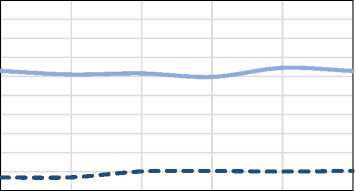
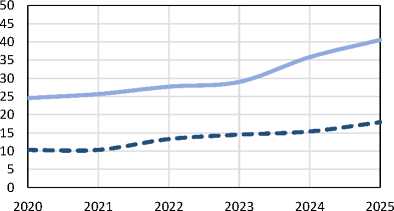
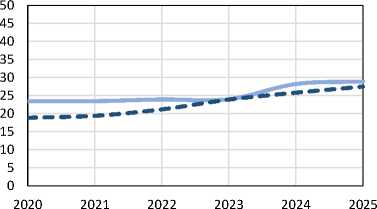
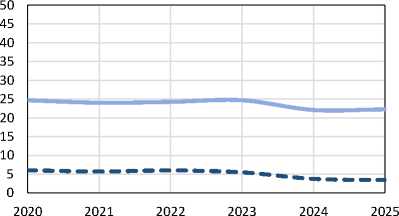
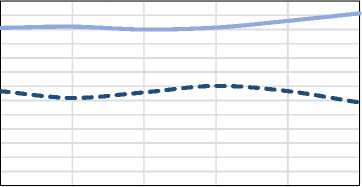
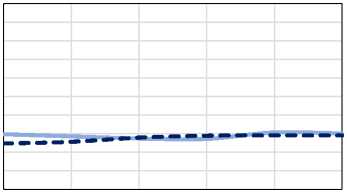
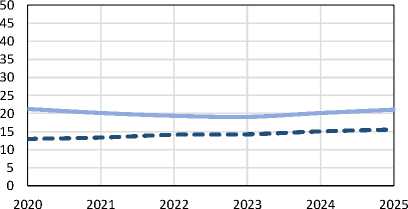
Figure 1 presents the actual dynamics of the number of graduates from Russian higher education institutions over the 2020–2025 period across the ten specialization groups.
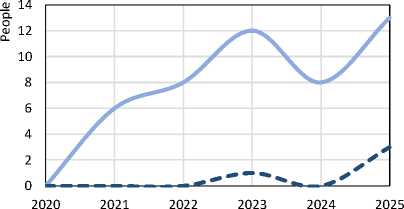
The graphs in Figure 1 reveal a growth trend in the number of graduates in the “Information Technology” group (average annual growth rate of +10.9% for 2020–2025), the “Healthcare and Medical Sciences” group (+5.9% per year), and the “Defense and State Security, Military Sciences” group (+26.0% per year).
The largest specialization group – “Social Sciences” (which encompasses programs in psychology, economics and management, sociology, law, political science and area studies, media and libraryinformation sciences, and service and tourism) – accounts for more than one-third of all graduates. Only in this specialization group does the number of tuition-funded graduates exceed the number of state-funded graduates by a factor of more than four.
The engineering field remains the leader in terms of the scale of state-funded training, forming the core of the nation’s technical workforce potential. In 2024, graduations rose to 160.6 thousand persons, and in 2025 they reached a seven-year high of 164.5 thousand specialists. This represents the effect of the increased admissions of recent years, which were aimed at meeting the workforce shortage in industry.
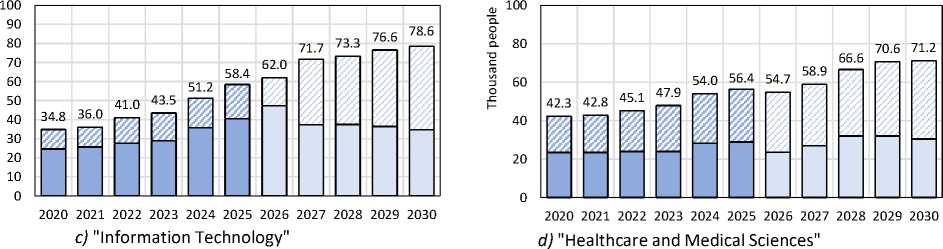
The “Information Technology” group shows the most impressive growth dynamics among all fields of study. State-funded graduate output rose by more than 1.6 times, from 24.5 thousand persons in 2020 to 40.5 thousand persons in 2025. A decisive leap occurred in 2024–2025, which directly reflects the state policy aimed at achieving digital sovereignty, as well as the multi-year efforts to increase state-funded admission quotas (control figures) for IT fields.
It should be noted that the statistical data on the “Defense and State Security, Military Sciences” group are presented only to a limited extent, owing to the specific nature of the accounting and the
Figure 1. Actual dynamics of the number of graduates from higher education institutions of the Russian Federation by specialization group, 2020–2025
2020 2021 2022 2023 2024 2025
ф 180
ф 160
I 140
2020 2021 2022 2023 2024 2025
b ) "Engineering, Technology, and Technical Sciences"
а ) "Mathematics and Natural Sciences"
d ) "Healthcare and Medical Sciences"
c ) "Information Technology"
Ф 300
О.
Q. 250
О
H 150
e ) "Agriculture and Agricultural Sciences"
2020 2021 2022 2023 2024 2025
о
о
2020 2021 2022 2023 2024 2025
f ) "Social Sciences"
g ) "Education and Pedagogical Sciences"
i ) "Arts and Culture"
2020 2021 2022 2023 2024 2025
h ) "Humanities"
j ) "Defense and State Security, Military Sciences"
«■■■мм* State-funded Tuition-based
Source: own calculations.
classified character of the departmental educational institutions. The state-funded graduate output reflects only a small portion of civilian specialists who studied in open programs at higher education institutions subordinate to the Russian Ministry of Science and Higher Education. Tuition-based graduations in this group are virtually absent, which is logical given the closed nature of the majority of specialties and their funding exclusively from the federal budget in the interests of the country’s defense capability.
Forecast of the structure and dynamics of the number of graduates from Russian Higher education institutions
In order to construct a forecast of the structure and dynamics of the number of graduates from higher education institutions of the Russian Federation, it is necessary to take into account the percentage of those who successfully completed their studies. This will be done for each specialization group.
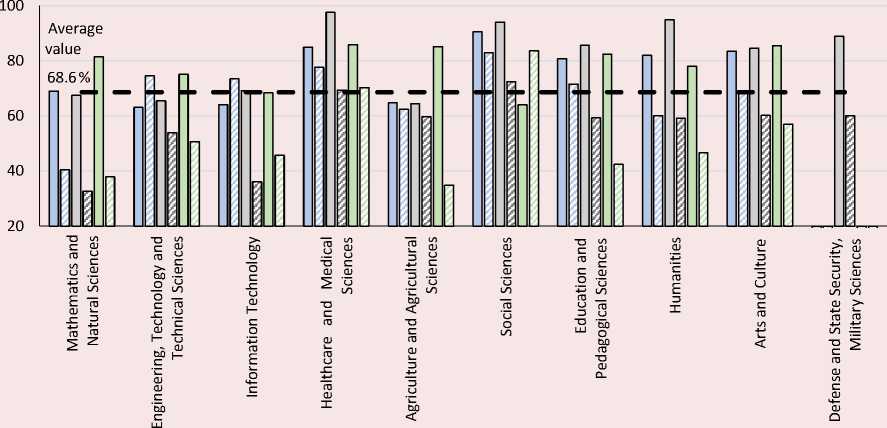
Figure 2 presents the results of calculating the empirical graduation completion rate for students in the respective specialization group for the year 2025.
If we evaluate the performance of the Russian higher education system by the criterion of successful graduation completion, it appears to be high. The average completion rate across all specialization groups is 68.6% (this figure is provided for reference and reflects a generalized picture across the higher
Figure 2. Percentage of those who successfully completed their studies (as a share of those admitted four years ago for bachelor’s programs, five years ago for specialist programs, and two years ago for master’s programs) by specialization group in 2025, %
I I Bachelor's (state-funded)
I I Bachelor's (tuition-based)
I I Specialist (state-funded)
dZZH] Specialist (tuition-based)
I I Master's (state-funded)
I I Master's (tuition-based)
Average graduation completion rate across all UGSN
Source: own calculations.
education system, without serving as a forecast parameter). Underlying these values, however, are structural gaps – not only between specialization groups, but also between forms of study (state-funded versus tuition-based) and between levels of education (bachelor’s and specialist programs versus master’s programs).
Among state-funded places, the leaders are the following groups: “Healthcare and Medical Sciences” (specialist) – 97.6% – practically universal graduation; the system of professional selection, training, and social support functions without disruption; “Humanities” (specialist) – 94.9% – characterized by high motivation, conscious choice on the part of applicants, and low attrition; and “Social Sciences” (bachelor’s) – 94.0% – economics and law programs continue to retain students. In the lagging zone are “Engineering” (bachelor’s) – 63.1%, “Information Technology” (bachelor’s) – 64.1%, and “Agriculture” (bachelor’s) – 64.7%. Engineering and agricultural specialties lose one out of every three state-funded students already at the first stage of education.
At the master’s level, the specialization groups showing the highest graduation rates among state-funded places are “Healthcare and Medical Sciences” at 85.7%, “Arts” at 85.5%, “Agriculture” at 85.2%, “Education and Pedagogical Sciences” at 82.4%, and “Mathematics and Natural Sciences” at 81.4%. Attrition in these groups is clearly minimal, which indicates that those entering state-funded master’s programs in these fields are highly motivated students. Among tuition-based master’s programs, there are five groups that fall within a critical zone: the percentage of successful completers in these programs ranges from 34.9 to 46.6% –meaning that more than half of the master’s students who study on a fee-paying basis do not make it to graduation. These groups, in particular, are “Agriculture” at 34.9%, “Education and Pedagogical Sciences” at 42.4%, and “Information Technology” at 45.6%. It is most likely that these fields are entered by students who are not prepared for research and other scholarly activities, who become disillusioned during the course of their studies and do not see the economic rationale for obtaining a degree, and who, moreover, combine their studies with full-time employment. There are exceptions as well: tuition-based master’s programs show a record 83.6% completion rate in the “Social Sciences” group.
Figure 2 captures the problems of student retention in the higher education system. In 2025, the average graduation completion rate at the bachelor’s level was 75.8% among state-funded places and 68.0% among tuition-based ones; at the specialist level, these figures stood at 81.2 and 56.3%, respectively; and at the master’s level, at 78.4 and 52.1%. The greatest losses in personnel training occur in tuition-based master’s programs and in engineering bachelor’s programs. These are areas requiring priority management intervention. In tuition-based master’s programs, agriculture, mathematics, pedagogy, and the humanities lose more than 50% of their student cohort. This means that the state (through subsidies to universities) and the population (through tuition payments) incur enormous losses. Every second student does not receive a diploma. A systemic problem is evident in engineering bachelor’s programs. The loss of 36.9% of state-funded students is a signal to revise educational programs. Students leave because they cannot cope with the workload or do not see the relevance of the education to their future work.
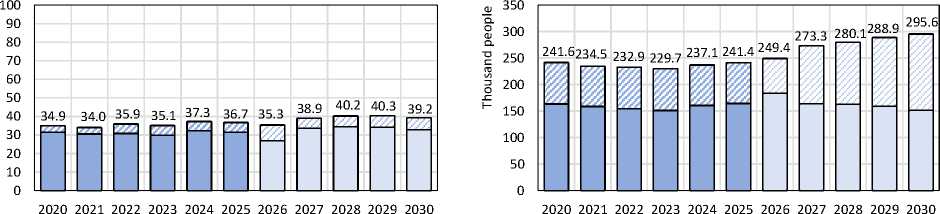
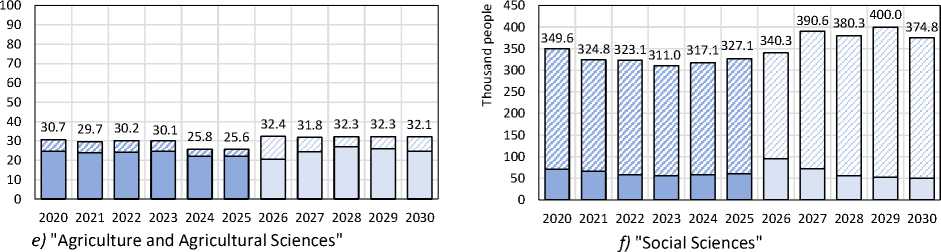
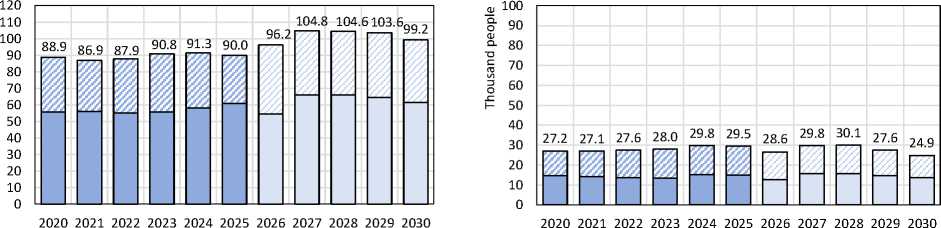
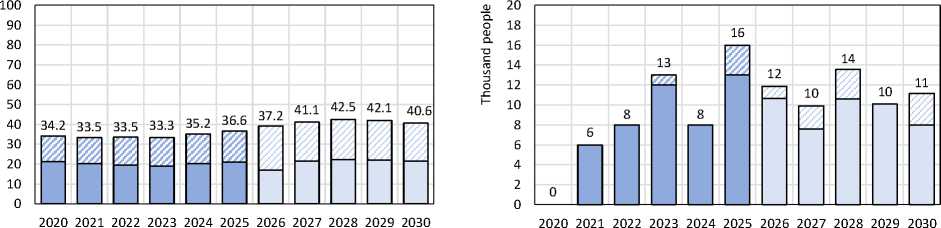
Using mathematical model (1)–(4), a forecast of the number of graduates from Russian higher education institutions was obtained, taking into account the empirical graduation completion rate for students in the corresponding specialization group. The actual (for the 2020–2025 period) and projected (for the period up to 2030) number of graduates from Russian higher education institutions by UGSN group is presented in Figure 3.
Thousand people Thousand people Thousand people Thousand people Thousand people
Figure 3. Actual (for the 2020–2025 period) and forecast (up to 2030) number of graduates from higher education Institutions of the Russian Federation by specialization group
а) "Mathematics and Natural Sciences" b) "Engineering, Technology, and Technical Sciences"
g) "Education and Pedagogical Sciences" h) "Humanities"
i) "Arts and Culture" j) "Defense and State Security, Military Sciences"
*■■■■■■• State-funded Tuition-based
Source: own calculations.
The model (1)–(4) was verified using statistical data for the 2021–2025 period: the mean approximation error (the standard mean absolute percentage error) for the number of graduates in individual specialization groups ranges from 2.2 to 7.8%. At the same time, the mean error for the total number of graduates was 2.9%, which confirms the adequacy of the constructed forecasts.
The actual (for the 2020–2025 period) and projected (up to 2030) composition of graduates from Russian higher education institutions by specialization group is presented in Figure 4.
The structure of specialist training in Russia is undergoing changes, and a number of trends that emerged during the actual observation period are intensifying in the forecast period. In the socioeconomic block, the share of the “Economics and Management” group declines from 21.7% in 2020 to 17.5% in 2030, while that of “Jurisprudence” falls from 13.0 to 11.5%. The relative weight of the “Humanities” group (to 2.5%) and the “Education and Pedagogical Sciences” group (to 10.2%) is also decreasing.
In the technology block, the share of graduates in “Engineering, Technology, and Technical Sciences (excluding IT)” declines from 24.3 to 22.2%; in the “Information Technology” group, it rises from 6.9% in 2025 to 8.0% by 2030. The share of the “Mathematics and Natural Sciences” group remains stable at around 4.0%.
Figure 4. Actual (for the 2020–2025 period) and forecast (up to 2030) structure of graduates from higher education institutions of the Russian Federation by specialization group, %
|
Mathematics and Natural Sciences |
4.1 |
4.2 |
4.4 |
4.4 |
4.5 |
4.3 |
4.0 |
4.0 |
4.1 |
4.0 |
4.0 |
|
Engineering, Technology, and Technical Sciences (excluding IT) |
24.3 |
24.4 |
23.5 |
23.1 |
22.5 |
21.7 |
21.4 |
20.8 |
21.2 |
21.1 |
22.2 |
|
Information Technology |
4.1 |
4.4 |
5.0 |
5.4 |
6.2 |
6.9 |
7.1 |
7.4 |
7.5 |
7.6 |
8.0 |
|
Healthcare and Medical Sciences Agriculture and Agricultural Sciences |
5.0 |
5.3 |
5.5 |
5.9 |
6,5 |
6.7 |
6.3 |
6.1 |
6.8 |
7.0 |
7.3 |
|
3.6 |
3.6 |
3.7 |
3.7 |
3.1 |
3.0 |
3.7 |
3.3 |
3.3 |
3.2 |
||
|
Social Sciences (excluding |
6.4 |
3.3 |
|||||||||
|
Econ., Manag. and Jur.) |
6.7 |
6.8 |
7.3 |
7.6 |
8.2 |
9.0 |
9.2 |
9.0 |
9.7 |
||
|
9.4 |
|||||||||||
|
Economics and Management |
21.7 |
20.8 |
20.9 |
20.2 |
18.9 |
18.6 |
18.6 |
18.4 |
17.8 |
17.9 |
17.5 |
|
Jurisprudence |
13.0 |
12.5 |
11.8 |
11.1 |
11.8 |
12.0 |
11.3 |
12.7 |
12.1 |
12.2 |
11.5 |
|
Education and Pedagogical Sciences |
10.5 |
10.7 |
10.8 |
11.3 |
11.0 |
10.7 |
11.0 |
10.8 |
10.7 |
10.3 |
10.2 |
|
Humanities |
3.2 |
3.3 |
3.4 |
3.5 |
3.6 |
3.5 |
3.3 |
3.1 |
3.1 |
2.7 |
2.5 |
|
Arts and Culture Defense and State Security, Military Sciences |
4.0 |
4.1 |
4.1 |
4.1 |
4.3 |
4.3 |
4.3 |
4.2 |
4.4 |
4.2 |
4.2 |
|
0.0 2020 |
0.0 2021 |
0.0 2022 |
0.0 2023 |
0.0 2024 |
0.0 2025 |
0.0 2026 |
0.0 2027 |
0.0 2028 |
0.0 2029 |
0.0 2030 |
Source: own calculations.
Among the specialized fields, “Healthcare and Medical Sciences” will strengthen its position from 5.0% in 2020 to 7.3% by 2030. The shares of the “Agriculture” group (from 3.6 to 3.3%) and the “Arts and Culture” group (from 4.0 to 4.2%) fluctuate within a range of 0.5 percentage points.
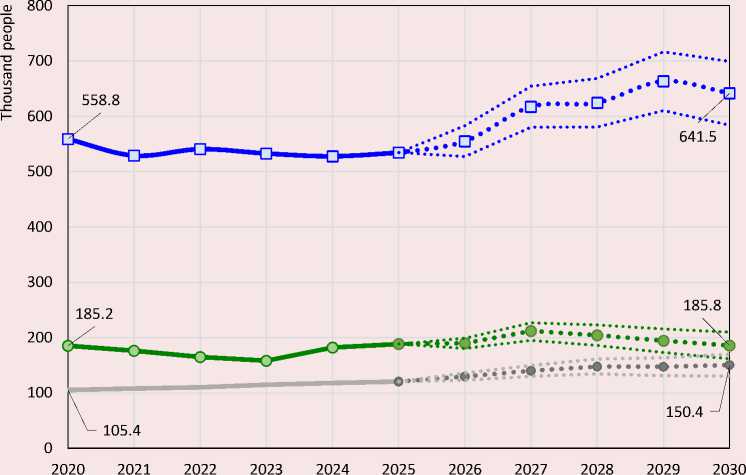
Thus, the structure of higher education in the forecast to 2030 will be characterized by a contraction of the economics and law block (provided the policy of limiting tuition-based places is maintained) in favor of narrower and more applied specialties, primarily information technology and healthcare. Engineering specialties retain a high share but lose ground relative to other groups. Summing across all specialization groups within each level of education yields the forecast number of graduates (Fig. 5).
The graphs in Figure 5 reflect the actual and forecast dynamics of the number of students enrolled in bachelor’s, specialist, and master’s degree programs. From 2020 to 2022, the number of bachelor’s graduates steadily declined from 558.8 thousand to 528.0 thousand persons. Beginning in 2026, growth in the number of bachelor’s graduates is forecast. Over the forecast period from 2026 to 2030, the indicator is expected to increase from 555.0 thousand to 641.5 thousand persons. The number of specialist graduates by 2030 is forecast at 150.4 thousand persons, which points to a sustained demand for traditional engineering and medical
Figure 5. Actual (for the 2020–2025 period) and forecast (up to 2030) number of graduates from higher education institutions of the Russian Federation by level of education: Bachelor’s, specialist, and master’s
^чэ— Bachelor's (actual) • ••□•• Bachelor's (forecast)
« ■■■■■■■■■ в Specialist (actual) • • аф • • Specialist (forecast)
Master's (actual) • • «О • * Master's (forecast)
Note: Dashed lines represent 95% confidence intervals for the forecasts, constructed on the basis of the standard deviation of the empirical graduation completion rates over the retrospective period (2016–2025).
Source: own calculations.
specialties that are delivered through specialist programs. The master’s level remains broadly stable: over the forecast period, the number of graduates is expected to be on the order of 185.0 thousand specialists. In total, a combined figure of 977.7 thousand graduates across all levels of education is forecast for 2030.
Conclusion
The results of the analysis and forecasting of the structure and dynamics of graduates from Russian higher education institutions allow us to formulate a number of conclusions of high practical significance. The model proposed in this study, based on an inertial scenario of the system’s development, yields a baseline forecast of the changes in graduate numbers over the medium term (up to 2030).
In contrast to simplified approaches, the proposed model – constructed on balance relationships between student admissions and their graduation after a fixed time lag, using empirical graduation completion rates differentiated by level of education, source of funding, and specialization group – makes it possible to move from abstract extrapolations to a forecast that rests on the actual flows of students. This deepens the theoretical understanding of the higher education system as a dynamic system with a delay.
The verification of the proposed model confirmed the scientific hypothesis put forward. The calculation of the mean approximation error over the retrospective 2021–2025 period demonstrated that the use of differentiated empirical graduation completion rates (in a three-dimensional breakdown: level of education, source of funding, and enlarged specialization group) ensures high accuracy of the inertial forecast: the mean error for the total number of graduates amounted to just 2.9%, while for individual specialization groups it ranged from 2.2 to 7.8%.
In contrast to traditional trend-based models (e.g., Bychkovskaya, Bychkovsky, 2024), which extrapolate aggregate enrollment trends and ignore the factor of intra-institutional attrition, the proposed differentiated approach makes it possible to avoid the systematic overestimation of the forecast – in particular for specialist programs, where trend models yield substantively unjustifiably high values. Taking into account the real heterogeneity of completion rates (ranging from 97.6% in state-funded specialist programs in the “Healthcare and Medical Sciences” group to 32.7% in tuition-based specialist programs in the “Mathematics and Natural Sciences” group) helps to identify structural “rupture points” that remain invisible to aggregated extrapolation models.
Thus, the hypothesis that a differentiated balance-based approach that accounts for the attrition factor by UGSN yields a more accurate and substantively sound forecast compared to traditional trend models has received empirical confirmation.
The forecast estimates obtained in the course of the study correlate with the macroeconomic warnings from CMASF concerning the risk of an oversupply of graduates by 2035. The resulting forecast shows a steady increase in graduate output up to 2030 (up to 977.7 thousand persons) against the backdrop of a structural contraction in the share of the economics and law block. This confirms the timeliness and adequacy of current state regulatory measures, such as Russian Ministry of Science and Higher Education Order No. 913 on limiting tuition-based admissions to fields of study lacking labor-market demand. Had the model failed to account for the real differentiation in completion rates (for example, 97.6% in medicine versus 32.7% in tuition-based natural sciences), it could not have identified these rupture points.
From an applied perspective, the significance of this work lies in its focus on addressing the tasks of state personnel policy. The projected estimates of graduate numbers up to 2030, broken down by ten enlarged specialization groups and three levels of education, make it possible to:
-
1) verify current state policy; the study clearly demonstrates the consequences of the increases in state-funded admission quotas (control figures) in recent years: the forecast growth in graduate output in engineering, information technology, and healthcare is a direct consequence of earlier decisions and confirms their effectiveness in expanding the supply of strategically important personnel;
-
2) identify zones of structural imbalance; the study documents a persistent skew in favor of the “Social Sciences” group, which, despite a declining share, continues to dominate the graduation structure, largely on account of tuition-based education; this serves as an empirical foundation for the introduction of regulatory measures such as Russian Ministry of Science and Higher Education Order No. 913 and underscores the need for their further refinement;
-
3) identify “rupture points” in personnel training; the analysis of graduation completion rates has revealed critical zones of student cohort loss – above all, in tuition-based master’s programs in the natural sciences, pedagogical, and agricultural fields, as well as in engineering bachelor’s programs; this is a signal to university leadership and governing bodies of the need to revise program content and improve the quality of work with applicants and students.
The imbalances identified in personnel training are broadly consistent with global patterns. As in many countries (including European Union member states, the United States, and developing economies), the global digital transformation and the adoption of AI technologies are generating a persistent worldwide shortage of personnel in STEM fields (science, technology, engineering, and mathematics) and healthcare, accompanied by an oversupply of graduates in the humanities and socio-economic fields. The Russian case, however, also possesses distinctive features. First, the high proportion of tuition-based education in the “Social Sciences” and “Humanities” groups, combined with low graduation completion rates (especially at the master’s level), may indicate that, for a significant share of students, obtaining a diploma is more important than mastering the program. Second, the scale and speed of state regulation – for example, the capping of tuitionbased admissions to fields of study lacking labormarket demand and the proactive redistribution of state-funded admission quotas – demonstrate a more stringent and centralized model of correcting imbalances compared to the liberal market models of education systems that predominate in a number of Western countries. Thus, the Russian Federation is following the global trend of reorienting higher education toward technological sovereignty, but is implementing this strategy by relying on specific demographic conditions and administrative levers.
For constructing long-term scenario-based forecasts (with a horizon of more than 10 years), the mathematical model needs to take into account leading demographic factors, in particular the projected decline in the population of the Russian Federation aged 15–18 after the mid-2030s. The formalization of factors that account for demographic waves, macroeconomic shocks, and changes in labor market demand – and their incorporation into the mathematical apparatus – will be the subject of further research.
