
“Angular” and “Trestle” Forts in 17th to Early 18th Century Russia
Journal: Archaeology, Ethnology & Anthropology of Eurasia @journal-aeae-en
Section: The metal ages and medieval period
Article in issue: 1 т.53, 2025.
Free access
Written sources of the 17th century mention “kosoi” (angular or slanted) forts. F.F. Laskovsky of the Engineer Corps interpreted this term as referring to forts with walls made from inclined logs (palisades). This idea was generally accepted by the scholarly community. The architect S.N. Balandin, without offering any proof, claimed that the “kozelchaty” forts (from “kozly”, trestle supports) were a subtype of “kosoi” (angular) forts. The purpose of the present study is to test the conclusions of Laskovsky and Balandin using new evidence. As it turns out, neither the written nor archaeological sources support these versions. In fact, there is enough information to disprove both. The meaning of the word “kosoi” in the 17th–19th century Russian language suggests four hypotheses regarding the structure of walls of “angular” forts. Comparison of them reveals that the term “angular” referred to fortifications with nonstraight walls, those joining not at a right angle, as well as those that were triangular in plan view. The specific layout of “kozelchaty” forts cannot be determined due to the lack of evidence. Probably their walls actually rested on trestle supports—two supports made of two or three logs each, on which a horizontal log was placed. Such forts were common mostly in northeast Asia, where forests were scarce, and the ground was frozen or rocky, preventing people from digging ditches for log palisade walls.
Similar articles in the section Military engineering
Short address: https://sciup.org/145147251
IDS: 145147251 | DOI: 10.17746/1563-0110.2025.53.1.109-117
Text of the scientific article “Angular” and “Trestle” Forts in 17th to Early 18th Century Russia
The descriptions of wooden defensive structures from the written sources of the 17th century sometimes mention a kosoi (‘angular’, ‘slanted’) fort* as a type of palisade wall. At the current time, there has been formed a consensus in historiography that an angular palisade should be understood as a palisade wall that is inclined towards the enclosed space and rests on a platform, trestle supports, or an earth embankment, and palisade walls could be either set into the ground or not. It seems, however, that such a construction of the walls does not provide any advantages over an ordinary palisade, neither for construction nor for defense. Vertically installed logs do not have to be deepened into the ground either. Therefore, we should turn to the historiography of the problem and trace the path by which scholars arrived at their current ideas about the structure of angular forts.
Historiographical overview
The issue of the structure of such walls was first addressed by F.F. Laskovsky in the mid-19th century: “Since the 17th century, fort fences, in terms of construction method, were subdivided into standing, logwork, and angular fences. <...> ...an angular fort probably consisted of logs that were inclined towards
the interior; and in such a case, they were supported on that side by a rack that served as a platform for the shooters or a small embankment adapted for the same purpose” (see Figure , 1 , 2 ) (1858b: 101; 1858a: Fig. 84, 85). Laskovsky’s conclusion is based on information contained in the order to the Astrakhan governors from 1625: “...and whether the fort was built straight standing, or of logwork, or angular” (Akty..., 1841: 217). Laskovsky was aware of the uncertainty of a reconstruction based on a single example from which the meaning of the term “angular” did not follow directly, and thus formulated his conclusion as a hypothesis.
In 1916, M.V. Krasovsky briefly mentioned angular forts, merely indicating that the wall was inclined towards the enclosed space and could have been supported by a platform. However, the illustration also showed an inclined wall resting on a soil backfill of space between two parallel palisade walls with the outer one inclined and raised above the level of the platform (see Figure, 1, 2) (Krasovsky, 2002: 100, fig. 100, a, b).
In 1950, E.A. Ashchepkov thus wrote about angular forts: “The difference between a ‘standing fort’ and ‘angular fort’ was only that in the former case, the palisade fence stood vertically, while in the latter case, it was inclined towards the enclosed space” (1950: 49). The author probably adopted this point of view from Laskovsky or Krasovsky, whom he did not refer to due to the popular nature of his publication, yet he removed Laskovsky’s doubts regarding the design of “angular forts” from his formulation.
P.A. Rappoport proposed a curious reconstruction of the structure of the “angular” palisade wall: it was inclined, set up at the bottom of the outer slope of the rampart or inner slope of the ditch. The slope of the wall could either be in the direction of the field or the fortress. He came to this conclusion
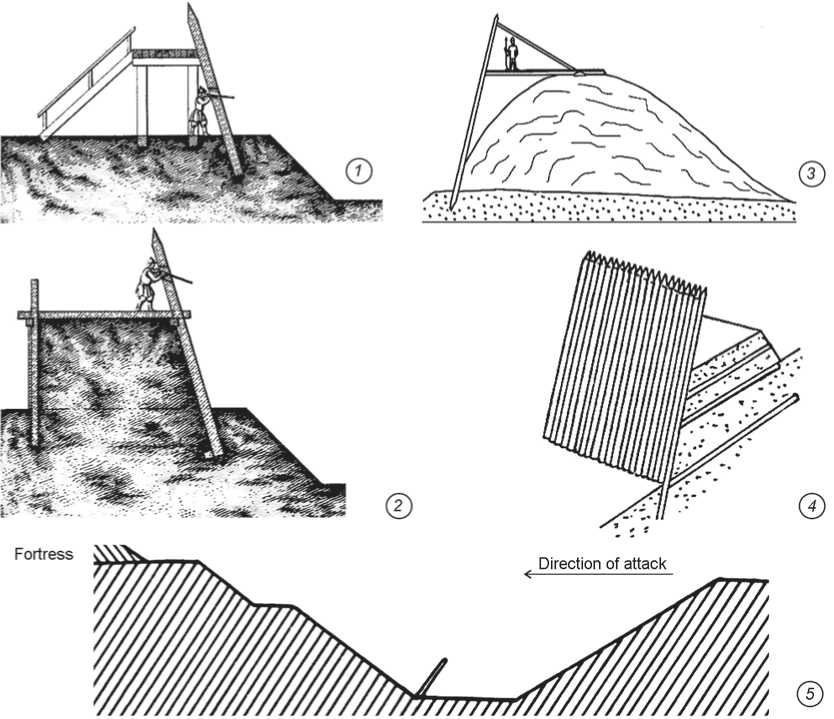
Reconstructions of angular fort walls.
1 , 2 – structure of an angular palisade (after (Laskovsky, 1858a: Fig. 84, 85)); 3 – reconstruction of a defense system at the Ratskoye fortified settlement, 6th construction period (after (Enukov, 2005: 77, fig. 17, 1 )); 4 – angular fort of the Late Middle Ages (after (Enukov, 2005: 77, fig. 17, 2 ; Nosov, 2002: 62)); 5 – angular palisade wall in a ditch (after (Rappoport, 1967: Fig. 111, 2 )).
by analyzing evidence from a number of sites: 1) at the fortress in Galich, at the base of the inner slope of the ditch, obviously a paling that sloped towards the field was set up* (see Figure, 5); 2) in Suteisk, a palisade wall inclined towards the fortress might have been in the middle part of the inner slope of the ditch**; 3) at the Belyovskoye fortified settlement, “on the front slope of the field rampart... the remains of two posts dug into the embankment were uncovered. <...> They were inclined forward at an angle of 65° to the horizon. There was a distance of about 60 cm between the posts, that is, the paling in this case was not continuous. Apparently, the space between the posts was closed with something, most likely with horizontally laid logs. This structure should no longer be described as paling, but as a simple type of wooden frame wall”*** (Rappoport, 1967: 164, 165). Rappoport also pointed out that the palisade wall on the front slope of the rampart in Pereyaslavl in the 16th or 17th century was inclined. It was built by driving thick pine logs into the ground (1956: 86; 1967: 135). It seems impossible to build an inclined palisade wall by driving thick piles into the ground at an angle, since this is a technically non-trivial task requiring a sophisticated pile-driving mechanism. There is no evidence as to its existence during that period. In addition, the remains of the wall survived as individual palisade logs, which is not evidence of an extended wall of this design. Thus, the examples and arguments provided by Rappoport do not allow for the conclusion that there was a practice of building inclined palisade walls in the western Russian lands in the 10th–17th centuries.
Several years later, S.N. Balandin addressed the issue of angular forts: “Angular forts with walls slanting inward were a variety of palisade fortification. An angular fort had a platform on the inside of the walls, on which the palisade fence rested” (1974: 15; fig. 3, b). This thesis reiterated the conclusions made by Laskovsky, although the author did not refer to him and ignored his doubts regarding the correctness of such an interpretation of “angular forts”. Balandin did not limit himself to this and went further in reconstructing the structure of angular palisade walls. He stated: “The bottom of the palisade logs could have been dug into the ground, but apparently, this type of wall construction was more common with palisade logs not dug into the ground. <...> Angular forts were often built in the northeast of Siberia, which is probably also associated with permafrost, which made earthworks difficult” (Ibid.: 15–16). To confirm his statement, Balandin cited a description of an attack: “...Kataev’s Cossacks attacked the Yukaghir fortification ‘going behind the shields’. Apparently, these were the shields of a ‘walking town’— a movable field fortification, widely used in the Russian military” (Ibid.). From this, Balandin moved on to another assumption: “Such portable shields could have protected the Cossack fort instead of palisade logs” (Ibid.: 16). The Cossacks built the fort “in one day... 40 sazhens away, and the next day a new fortification 20 sazhens away from the Yukaghir fortress, and ‘began to fire guns at the fortress from above, from their fort...’ (source: (Dopolneniya..., 1848: 283))” (Ibid.: 15). Then, the author made yet another unsubstantiated assumption: “Perhaps the fortification of Kataev’s Cossacks was an angular fort with walls resting on trestle supports with a platform from which the ‘upper battle’ was conducted” (Ibid.: 16). After that, Balandin, as it seemed to him, found a confirmation of his suggestion: “Documents indicate the occurrence of such a wall design. In 1704, Vasily Kolesov built a ‘trestle fort with a circumference of seventy sazhens and height of two and a half state sazhens’ near the Upper winter quarters and the state granary in Kamchatka, ‘and built a trestle fort with a height of two and a half state sazhens near the Lower winter quarters, which is in Kamchatka, on the springs...’ (source: (Strelov, 1916: 23))” (Ibid.). Thus, the author first invented the word “trestle”, and then discovered that there existed trestle forts*, which by their name confirmed his conjecture. Consequently, angular and trestle forts are the same thing in terms of typology of their wall structure.
Balandin’s argumentation was based on assumptions that had no evidence at all. In his research, he must have proceeded from his idea of an angular fort, interpreting the facts in such a way that they would confirm this concept. As will be shown below, the Balandin’s initial guess was erroneous, which entailed argumentation aimed at “proving” a concept that had no relation to historical reality and therefore could not be derived from it on the basis of the available historical facts. This example shows the methodological inadequacy of the research procedure moving from guesswork to its proof. More feasible seems to be the approach moving from factual evidence through its analysis to a targeted generalization, in order to identify common features and patterns, and formulate a conclusion on their basis.
Twelve years later, N.P. Kradin published an article on the walls of wooden defensive structures in Siberia. The article says the following about the structure of angular forts: “...the fort logs had an inclined position. Such a wall was supported by a small embankment of the fortress, ‘special trestles’, or a platform attached to the wall” (Kradin, 1986: 243). Kradin did not refer to the works of his predecessors either, although the above fragment clearly borrowed some points from the work of Laskovsky and the article by Balandin discussed above, from which Kradin took the idea that the wall of the angular fort could have rested on trestle supports. In 2002 Balandin’s concept was repeated by K.S. Nosov (2002: 62).
The assumptions of Balandin that trestle forts were a type of angular fort and that the latter’s palisade logs were not dug into the ground were accepted by the scholarly community (see, e.g., (Berezikov, 2016: 14; Vershinin, 2018: 139, 141; Vilkov, 1987: 13, 14; Nikitin, 1987: 60; Opolovnikova, 1989: 65; Istoricheskaya entsiklopediya..., 2009: 564)). Thus, it can be stated that Balandin was the author of the current, generally accepted concept of angular forts.
In the early 21st century, the topic of angular forts became discussed in the context of the East European Plain of the 10th–11th centuries. V.V. Enukov
*Or vice versa: first he learned about the existence of trestle forts, and then came to the conclusion that a siege fort had a wall resting on trestle supports. In this case, Balandin did not prove the fact of the existence of such trestles in trestle forts as he imagined them to be (see (Balandin, 1974: 16, fig. 3, b)).
suggested that fortified settlements of the Romny culture in Posemye had sloping palisade walls, and pointed out their genetic connection with angular forts of the 17th century on the fringes of the Russian State, including Siberia and the Far East (see Figure , 3 , 4 ) (Enukov, 2005: 81–83). Enukov’s concept was refuted by Y.Y. Morgunov who believed that palisadelike structures discovered during archaeological excavations should be interpreted as inclined facing of the escarpment wall. However, Morgunov did not challenge the existence of forts with sloping walls in the 17th century (2008: 42).
Laskovsky, and later Balandin, might have relied on purely linguistic considerations: structural features of a slanted palisade wall were derived from the meaning of the word kosoi (‘angular’, ‘slanted’). If we turn to the dictionary of V.I. Dahl*, it is written in the beginning of the relatively extensive article “Kosoi”: “A slanted wall or post, not vertical, inclined”. Further on, some meanings may also be applied to the structural features of a palisade wall: “non-straight” (a wall that does not form a straight line), “curved line, bend, arc” (a wall that goes crookedly or along an arc), “a slanted angle, inclined, more or less than a right angle, acute or obtuse” (a junction of the walls of a fort at an acute or obtuse angle), “triangular” (the fort is triangular in plan view; at a certain stage, the Angular (Okhotsk) Fort was like this) (Dahl, 2006: 176, 177; Rezun, Vasilievsky, 1989: 224). Dahl’s dictionary was available to Balandin, but he did not take these additional meanings into consideration.
In 1980, the seventh edition of the Dictionary of the Russian language of the 11th–17th centuries was published. In the article “Kosoi”, the first meaning was indicated as “having slanted, not vertical lines or edges”. This meaning was illustrated, among other things, by some descriptions of fort walls: “An angular fence, wall, angular fort—a fence, wall made of slanted poles or logs. And from that tower down the Busolga River, there is an angular fort wall made of logs, and at the end of that wall there is an angular fence made of logs, low, without a bridge. <...> And on the women’s passage from the Opoka River, a standing angular fort was built measuring 263 sazhens. <...> And from the Polnaya River, [there is] an angular fort and palisade of 100 sazhens” (Slovar..., 1980: 365). From these descriptions, it is not possible to deduce that the walls of the forts were inclined. The author of the dictionary entry could have been familiar with the concept of angular forts, which had already taken shape by that time, since he ignored other meanings of the word “angular” applicable to the structure of palisade walls in angular forts: having a curvature, bend, crookedness (Ibid.: 365–366) (curved palisade wall). In addition, the author was not perplexed by a number of contradictions in the examples he had given, if angular forts were understood as palisade walls with an inclination towards the enclosed space. For example, it is unclear what an “angular fort wall made of logs” and “angular fence” were. Following the concept of inclined walls, one has to conclude that not only were the palisade walls inclined, but also the log walls, that is, the walls consisting of logwork of some design; and the “angular fence” had a wall inclined towards the interior space. Cribworks are known to have horizontally laid logs. The slope of such a wall would allow a foot soldier to climb it, especially since such a fence was low. No less dramatic contradiction is present in the phrase “standing angular fort”. According to the current generally accepted concept of angular palisade walls, this is impossible, since a standing fort had a vertical palisade wall, while an angular fort had an inclined wall. A palisade wall could not be both vertical and inclined at the same time. Therefore, the classification of palisade walls into angular and standing does not reflect the historical reality, and angular forts should mean not an inclined palisade wall, but a wall whose design would not contradict the concept of a “standing fort”.
Hypotheses as to the structure of “angular” forts
It seems to be the case that the definition of “angular” as applied to the palisade wall describes its design. Our predecessors were right that the solution to the specifics of angular palisade walls should be sought starting with the meaning of the word “angular” in the 17th century. However, they limited themselves to an unmotivated choice of just one meaning of this word. This article, however, will consider all possible aspects in the design of angular palisade walls as alternative hypotheses, following from the appropriate meanings of the word “angular”:
-
1) a palisade wall having an inclination towards the enclosed space (the traditional and generally accepted concept);
-
2) a vertical non-linear palisade wall (arc-shaped, wavy, or having sharp bends);
-
3) adjacent vertical palisade walls joining not at a right angle;
-
4) an angular fort triangular in plan view (a variation of hypothesis 3, since in this shape of the fort, the adjacent vertical palisade walls join at an acute angle).
It would be important to discuss each hypothesis by identifying the facts that confirm or refute it in the sources. No information has been found confirming the validity of the first hypothesis. On the contrary, there are arguments in favor of its inconsistency. For example, the description of Fort Okhotsk, which was originally called “Angular”, says: “Okhotsk log town” (cited after (Rezun, Vasilievsky, 1989: 223)). In the description of the Stroganovs’ patrimonial estate of 1629–1639, “an angular log wall of the fort” is mentioned (Dopolneniya..., 1846: 119). The absurdity of building inclined log walls has been discussed above, and therefore the existence of such has been rejected.
According to the description of Odoev* from 1678, its walls were “a standing angular fort” (Dopolneniya..., 1875: 234). A similar example would be: “ And on the women’s passage from the Opoka River, a standing angular fort was built ...” (Slovar..., 1980: 365). Judging by these descriptions, a fort could have been both standing and angular.
The description of a section of the Ryazan Vozhskaya Abatis from 1659 mentions that “many links fell out” of an angular fort “and it rotted completely” (Storozhev, 1890: 4). According to the generally accepted idea of an inclined palisade wall, it should rest on a platform, trestles, or a rampart. In this case, it is unclear in what way many links could fall out of the palisade. This was only possible if the wall stood vertically or was inclined without support.
Another section of the Ryazan Vozhskaya abatis in 1659 was described as follows: “...a ditch was made behind those log obstacles, and an earthen rampart was on the other side of the ditch, and an angular fort was behind the rampart” (Ibid.: 13). If we assume that in this case, the angular fort had an inclined wall resting on the rampart, it should have had been inclined towards the field. However, such a wall design lacks an advantage over a vertical fence, because its defenders could not hit the enemy from behind such a wall, since there was no place for them to stand there. Finally, numerous descriptions of angular forts have no information about connection of the wall with any supporting structures (platform, trestles, or rampart).
Archaeological studies provide only one case of studying a site that might have had an angular fort wall: the excavations at Fort Alazeya. However, a six-meter section of the palisade made of vertically set logs was discovered there (Alekseev, 1996: 24).
The second hypothesis (a non-straight palisade wall) has a number of indirect confirmations. For instance, the descriptions of the Ryazan Vozhskaya abatises, as well as abatis fortifications near the town of Dobryi and on the Opoka River, and the Stroganovs’ patrimonial estate, mention angular forts that were comprised of extended open walls (up to 337 sazhens), partitioning off the space from one natural or artificial obstacle (ravines, rivers, swamps, log obstacles, etc.) to another. These were obviously not rectilinear, but ran in a curve, adapting to the terrain. The hypothetical straightness of such walls is meaningless, since it was not assumed that the space along them would be shot at from towers, which were usually absent* (Storozhev, 1890: 1, 3, 4, 12, 13; Dopolneniya..., 1846: 119; 1875: 301; Slovar..., 1980: 365).
The second hypothesis is also confirmed by the presence of angular palisade walls near the Tyumen and Pelym posads (Leontieva, 1988: 56; Russkaya istoricheskaya biblioteka..., 1875: 138). Unlike the town walls, which ran straight from corner to corner, the posad walls were much longer and followed the terrain (for example, adjusting to the contours of the hill slope**). It was impractical to enclose the space of the spontaneously formed posads with straight walls from the point of view of both consumption of building materials and tactics of defense, which did not involve shooting along the walls from towers.
A request for describing forts near Astrakhan can be cited as a confirmation of this hypothesis: “...was the standing fort built straight, or made of logs or angular...” (Akty..., 1841: 217). This phrase shows that a standing fort (with a vertical palisade wall) could be built straight or not straight. The latter feature could not refer to the inclination of the wall, since it was reported to be vertical (“a standing fort”). Therefore, what is discussed here is the straightness or curvature of the wall in plan view. It seems that the cited phrase should be understood as follows: was a standing fort set in a straight manner? Was a fort made of logs set in a straight manner? Or were they set at an angle? We have not examined the original request, but believe that this passage was not divided into semantic parts by commas. The punctuation marks must have been added during editing of the document for publication, which led to a change in the meaning. We have not found any information in the sources, which refutes this hypothesis.
The third hypothesis (the joining of adjacent palisade walls not at a right angle) is also confirmed by the sources. The description of (“Angular”) Fort Okhotsk reports: “...the town made of logs, and made at an inclined angle” (Rezun, Vasilievsky, 1989: 223). That is, the angle was not a right angle; it was more or less than 90°. The image of Fort Nizhnyaya Kamchatka from 1755 clearly shows that several angles (possibly all) were acute or obtuse (Krasheninnikov, 1755: Pl. between pp. 240 and 241). The description of the Stroganovs’ patrimonial estate reports: “...at the end of that wall, there is an angular fence of logs” (Dopolneniya..., 1846: 119). It seems pointless to build a fence with an inclined wall, as mentioned above. Therefore, the “angular fence” should be understood as cribwork with angles larger or smaller than right angles. In the sources of the 17th century, one can also find references to angular barns that obviously meant those made of logs with corners that were not 90° (Russkaya istoricheskaya biblioteka..., 1904: 907, 909). One of the towers of Fort Krasnoyarsk, according to the description of 1761, was diamond-shaped in plan view (Kochedamov, 2021: 64). We have not found any information that would refute this hypothesis.
The fourth hypothesis (an angular fort that is triangular in plan view) is a variation of the third hypothesis, since the triangular shape of a fort suggests that the adjacent walls were joined at an acute angle (at least two angles had to be acute). An example is Fort Okhotsk: “...it was built... in the form of a triangle” (Rezun, Vasilievsky, 1989: 224). Fort Alazeya could have been the same, as suggested by the excavation plan and topography of the area (southern half of the excavation) (Alekseev, 1996: 20, fig. 4), as well as satellite images (N68.128300 E152.205630). Although the latter may demonstrate not the actual spatial distribution of fortifications, but the nature of vegetation that emerged after completion of excavations. We have not found any information that would refute this hypothesis.
Discussion
Examination of the hypotheses has shown that the generally accepted ideas about angular palisade walls as being inclined (usually towards the enclosed space) do not align with the historical reality. In the 17th century, “angular forts” implied two spatial distribution types of wall structure, which could have been combined with each other: 1) the wall was not straight, but curved; 2) adjacent walls were not joined at a right angle. In light of these conclusions, it has become possible to interpret some features in the depiction of palisade walls of Siberian towns by S.U. Remezov (Tobolsk, Berezov, Kuznetsk) as an indication of angular fort walls.
The widespread use of angular palisade walls in fortifying winter camps in Northeastern Asia in the 17th century was due to the initial lack of fences in the layout of winter camp buildings. These were arranged in accordance with local conditions, defense requirements, and economic activities. When the need arose, they were surrounded by a fence in such a way that many buildings would end up being a part of the palisade walls. Since buildings were initially located “chaotically”, the fence would turn out to be uneven (with breaks or a wavy shape, if it repeated the outline of the slope of the hill where the winter camp was located), and the adjacent walls were not joined at a right angle.
Balandin unreasonably claimed that trestle forts were a variety of angular forts (with an inclined palisade wall supported by trestles) (1974: 16). Scholars (Vershinin, 2018: 141; Vilkov, 1987: 14; Korchagin, Ugryumova, 1997: 61; Kurilov, Mainicheva, 2005: 40) have accepted this point of view. After proving that angular forts had vertical walls, it is necessary to investigate what kind of walls trestle forts had. Such forts were mentioned in the sources only three times* and only in the far parts of northeastern Eurasia: Fort Kozelchaty (in this case, it is a proper name) on the Kolyma River and two forts in Kamchatka (Strelov, 1916: 24; Dopolneniya..., 1862: 29). Their descriptions do not make it possible to determine the structural features of the walls. In this case, it also seems appropriate to turn to the meaning of the word “kozelchaty” in the 17th–19th centuries.
In the Dictionary of the Russian language of the 11th–17th centuries, the fourth meaning in the article “Kozel” is “rafters” (Slovar..., 1980: 223). This is illustrated by a fragment of text from 1700, describing the structure of a wall which was supported on the outside by logs cut into the wall (Materialy..., 1884: Col. 1200). The dictionary by V.I. Dahl has the following meanings of the word “kozly”: “three poles placed like a tripod; two such tripods with a crossbar; a small log on legs for a platform, for sawing logs or firewood”, “a lying log on posts, for a bridge or for woodcutters” (2006: 134).
Thus, we can offer two hypotheses about the walls of trestle ( kozelchaty ) forts: 1) a palisade wall had supports in the form of logs cut into the wall at one end and resting on the ground at the other end; 2) the outer fence consisted of a row of forks (trestles). We do not have a sufficient amount of sources to give a substantiated preference to one of the two. Therefore, we will only express our thoughts on each hypothesis. The first hypothesis seems less likely, since supports for a wall are only required when it collapses due to decay or soil shifts, whereas the forts in Kamchatka were originally built as trestle forts.
The second hypothesis seems more likely, since the practice of surrounding forts with forked obstacles was widespread in Siberia and the Far East. Using a fence of forked obstacles ( cheval de frise ) without a wall could have been caused by the impossibility of building a palisade ditch in the winter, in permafrost, or in rocky soil. A shortage of timber in tundra zones cannot be ruled out as well. Such fences could be quite effective even against attackers with firearms. This is confirmed by the use of stationary forked obstacles filled with stones for fencing fortresses and movable forked obstacles for protecting temporary camps of hunters of the Russian-American Company on the Aleutian Islands in the 19th century (Zorin, 2002: 116), as well as by the image of the fence in the seasonal Yamyshevo fortress on the Upper Irtysh (Remezov, 2011: 97). Although a rampart of stones could also be made without forked obstacles, such a rampart would make it difficult to fight against the attacking enemy, which usually had numerical superiority. Forked obstacles could have served as a retaining wall, onto which stones and other available materials (logs, driftwood, rocks, loose soil, etc.) were piled from the outside. Overcoming such a wall was rather difficult for attackers. The defenders had the opportunity to take cover behind it, move safely and quickly under its cover, and shoot with both firearms and bows. If the enemy appeared on such a wall, it was possible to use a piercing weapon on a long shaft.
Conclusions
Using the definitions of kosoi (“angular”) and kozelchaty (“trestle”) as examples, this study has shown that some concepts related to the architecture of wooden defensive structures of the Russian State in the 16th to early 18th centuries, borrowed from written sources and used as terms in the process of scholarly comprehension of historical realities, do not have a strictly proven historical content. Therefore, when operating with the same terms, each scholar endows them with his own content, which he correlates with the historical reality in an unsubstantiated manner. Thus, clarifying the meanings of terms relating to the architecture of wooden defensive structures is an urgent task for Russian archaeology at this stage.
Acknowledgment
This study was carried out under the State Assignment of the RF Ministry of Education and Science, Project No. FSUS-2025-0009 “Specific Aspects of Formation of Intercultural Communications in Siberia—from the Stone Age to the Early Modern Age (According to Archaeological and Written Sources)”.
