
Antimony Ornaments, Votive and Ritual Items of the Koban Culture in the Caucasus as a Historical Source
Journal: Archaeology, Ethnology & Anthropology of Eurasia @journal-aeae-en
Section: The metal ages and medieval period
Article in issue: 1 т.53, 2025.
Free access
Archaeological excavations carried out in the Republic of North Ossetia – Alania over the past 15 years have yielded numerous artifacts associated with the Proto-Koban (15th/14th to early 12th century BC) and “classic” Koban culture (9th–8th centuries BC). Here, we analyze antimony artifacts from the cemeteries of Adaidon, dating to the Proto-Koban stage, and Elkhotovo, representing “classic” Koban. The analysis of composition of the metal revealed the recipes used by ancient craftsmen for manufacturing weapons, ornaments, and votive items. Antimony ornaments from Elkhotovo suggest that this substance was used not only in the Middle and the beginning of the Late Bronze Age in the Caucasian highlands, but also much later in the piedmont zone of the region. The study of certain bronze artifacts from Adaidon suggests that to make ornaments and votive items more attractive, antimony in the amount of 4.5–5.0 % was added. As a result, they acquired a light-golden color and luster.
Similar articles in the section Prehistory. Prehistoric remains, artefacts, antiquities
Short address: https://sciup.org/145147248
IDS: 145147248 | DOI: 10.17746/1563-0110.2025.53.1.083-089
Text of the scientific article Antimony Ornaments, Votive and Ritual Items of the Koban Culture in the Caucasus as a Historical Source
Scientific analysis methods are crucially important in studies of the material culture of ancient populations, including research on the ancient metal ware. In a number of recent scientific publications (Skakov, 2001, 2003; Gak, Mimokhod, Kalmykov, 2014: 89), it is rightly noted that antimony artifacts have not previously been considered first-priority objects in studying ancient history. Meanwhile, analysis of archaeological finds for the presence or absence of antimony and the antimony percentage content in the metal composition, as well as the cartography and chronology of these products, provide important information concerning metallurgical production techniques, the nature and vectors of social contacts, and, possibly, economic ties between the Caucasus and adjacent regions. Antimony artifacts, primarily personal ornaments, were used by the bearers of the Kayakent-Khorochoy culture, which was widespread in the Northeastern Caucasus in the third quarter of the 2nd millennium BC (Kruglov, 1958: 82; Krupnov, 1951; Markovin, 1960: 97), and the Koban culture in the Proto-Koban stage (Koban 1, A, B, according to the periodization by V.I. Kozenkova) (Krupnov, 1951; Kozenkova, 1996: 114–115; 2013: Fig. 16, 21–22; Moshinsky, 2003; Moshinsky, Skakov, 2000; Skakov, 2001, 2003; Gak, Mimokhod, Kalmykov,
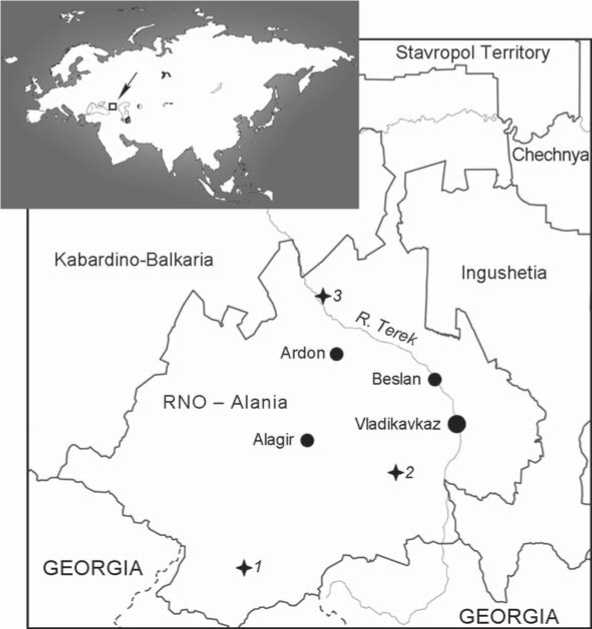
Fig. 1. Location of Adaidon ( 1 ) and Elkhotovo ( 3 ) cemeteries and the place of discovery of the accidental find ( 2 ).
2014). A.Y. Skakov carried out a comparative chemical
analysis of Proto-Koban beads and similar items from Transcaucasian sites, and inferred certain connections between the Proto-Koban antiquities and materials from Transcaucasia and the steppe regions of Eastern Europe (2003: 20).
The present paper reveals the metal composition of 31 artifacts from the Adaidon and Elkhotovo cemeteries, and one artifact accidentally found near the village of Koban in North Ossetia. The sample includes personal ornaments, weapons, and outfit accessories. These artifacts of the Caucasian Koban culture have been found in three landscapealtitude zones in the Republic of North Ossetia (RSO) – Alania, and can be attributed to two chronological periods (Fig. 1). The Adaidon cemetery (15th/14th–5th centuries BC) is located in the alpine meadow zone, at an altitude of 1673–1700 m asl (Chshiev, 2012). The accidental find—a pendant shaped like a ram’s head (9th–7th centuries BC)—comes from the mountain-forest landscape belt at an altitude of 1328 m asl. Elkhotovo cemetery (9th to early 7th century BC) is located in the foothillplain zone at an altitude of 315 m asl.
In addition to antimony items, the sample under study comprises artifacts made of copper- and silver-based alloys originating from the same closed complexes as the antimony pieces; the analyses provided a great amount of information and revealed the whole variety of paleometal recipes used (see Table, No. 2–5, 7, 9, 18–20, 22, 32). Analysis of large, massive weapons bearing use-wear traces and made of copper alloyed with arsenic has shown that this alloying element,
Metal composition of the artifacts under study, %
|
Sample No. |
Artifact |
Cu |
As |
Sn |
Pb |
Sb |
Ag |
Ni |
Fe |
Other |
|
1 |
2 |
3 |
4 |
5 |
6 |
7 |
8 |
9 |
10 |
11 |
|
1 |
Bronze twisted cylinder-shaped bead |
83–85 |
Trace |
14–16 |
– |
Trace |
Trace |
Trace |
< 0.5 |
– |
|
2 |
Bronze pin with five protrusions |
70–75 |
2–4 |
22–26 |
– |
– |
– |
– |
< 0.2 |
– |
|
3 |
Bronze straight axe with tubular butt |
94–95 |
4–5 |
– |
Trace |
– |
Trace |
– |
< 0.3 |
– |
|
4 |
Bronze subtriangular dagger’s blade |
89–90 |
8–9 |
– |
– |
– |
Trace |
– |
– |
Bi < 0.4, Au < 0.6 |
|
5 |
Silver oval-shaped pendant |
2–4 |
– |
– |
< 0.4 |
– |
> 95 |
– |
– |
– |
|
6 |
Bronze laminar bracelet |
93–95 |
1–1.5 |
13–15 |
< 0.6 |
Trace |
Trace |
– |
– |
– |
|
7 |
Bronze pin with five protrusions |
88–91 |
Trace |
8–10 |
< 0.7 |
– |
Trace |
< 1 |
– |
– |
|
8 |
Bronze head of votive mace |
95–97 |
1–2 |
– |
– |
1–2 |
Trace |
1.0–1.5 |
– |
– |
|
9 |
Bronze pin with twisted top |
95–96 |
3–4 |
– |
– |
– |
– |
< 1 |
Trace |
– |
|
10 |
Bronze pole-axe with arched blade |
91–92 |
7–8 |
– |
< 0.6 |
– |
Trace |
– |
– |
– |
Table (end)
|
1 |
2 |
3 |
4 |
5 |
6 |
7 |
8 |
9 |
10 |
11 |
|
11 |
Bronze straight axe with tubular butt |
94–95 |
4–5 |
– |
– |
– |
Trace |
< 1 |
– |
– |
|
12 |
Antimony cone-shaped bead |
~1 |
1–2 |
– |
– |
> 97 |
– |
– |
< 0.5 |
– |
|
13 |
Antimony disc-shaped button-bead |
Trace |
4–5 |
– |
– |
> 95 |
– |
– |
– |
Mn |
|
14 |
Bronze bullet-shaped pendant |
69–71 |
29–31 |
– |
– |
Trace |
? |
– |
– |
– |
|
15 |
Antimony ovoid pendant with transversal flutes |
– |
1–2 |
– |
– |
> 98 |
– |
– |
– |
– |
|
16 |
Antimony globular bead |
– |
1–2 |
– |
– |
> 98 |
– |
– |
– |
– |
|
17 |
Antimony amphora-shaped bead |
– |
2–3 |
– |
– |
> 97 |
– |
– |
< 0.3 |
– |
|
18 |
Bronze straight axe |
66.816 |
0.522 |
0.418 |
– |
0.219 |
– |
– |
– |
|
|
19 |
Bronze bracelet sub-triangular in crosssection |
90–91 |
9–10 |
– |
Trace |
– |
– |
– |
– |
– |
|
20 |
Bronze double-curved axe |
93.312 |
0.210 |
0.160 |
– |
– |
– |
0.179 |
– |
|
|
21 |
Antimony mace head with geometric ornaments |
< 0.7 |
1–2 |
– |
– |
> 97 |
– |
– |
– |
– |
|
22 |
Bronze leaf-shaped spearhead |
88–91 |
8–10 |
– |
– |
Trace |
< 0.7 |
1–1.5 |
Trace |
– |
|
23 |
Antimony disc-shaped button-bead |
Trace |
7–8 |
– |
– |
> 91 |
– |
– |
< 0.8 |
Zn |
|
24 |
Antimony ring-shaped pendant |
– |
2–3 |
– |
– |
> 97 |
– |
– |
– |
– |
|
25 |
Antimony amphora-shaped bead |
– |
2–3 |
– |
– |
> 97 |
– |
– |
– |
– |
|
26 |
Antimony ovoid pendant |
Trace |
1–2 |
– |
– |
> 98 |
– |
– |
– |
– |
|
27 |
Bronze arch-shaped pole-axe with a socket decorated with two sculptured ram heads |
90.438 |
1.168 |
14.319 |
– |
4.522 |
– |
0.358 |
– |
– |
|
28 |
Antimony sub-rectangular fluted clasp |
Trace |
1–2 |
– |
– |
> 98 |
– |
– |
– |
– |
|
29 |
Bronze arch-shaped axe with a socket decorated with two sculptured ram heads |
77.243 |
11.23 |
0.232 |
5.267 |
0.246 |
0.077 |
Zn 0.428 |
||
|
30 |
Bronze pendant “winged ram” |
80–82 |
13–15 |
– |
– |
4–5 |
< 1 |
Trace |
– |
– |
|
31 |
Bronze pendant in the shape of ram’s head |
97–98 |
< 0.5 |
< 0.8 |
< 0.5 |
Trace |
Trace |
~1 |
– |
– |
|
32 |
Bronze arch-shaped axe |
83–85 |
14–16 |
– |
– |
~1 |
< 0.6 |
– |
– |
– |
*Corresponds to the number of the artifact in Fig. 2.
in contrast to antimony, was used by ancient craftsmen in production of everyday utensils rather than votive artifacts.
Materials and methods
The study focused on the artifacts found in the course of archaeological excavations of the Elkhotovo and Adaidon cemeteries of the Koban culture (excavations by V.T. Chshiev), and the accidental find from the village of Koban—a pendant in the form of a sculpted ram’s head. As was noted above, metal samples of 32 artifacts were analyzed.
Samples (up to 1 g) were collected mechanically. Samples No. 1–17, 19, 21–26, 28, and 30–32 were subjected to X-ray fluorescence (XRF) analysis using an ArtTAX spectrometer (Brüker) in the Scientific and Technical Examination Department of the State Hermitage Museum in April 2023.
The metal compositions of samples No. 18, 20, 27, and 29 were analyzed using the techniques of X-ray photoelectron spectroscopy (XPS), inductively coupled plasma atomic emission spectroscopy, and Fourier transform infrared spectroscopy. The samples were placed into the metal ultra-high vacuum measuring chamber of a Thermo Fisher Scientific Escalab 250 Xi spectrometer. A high degree of vacuum (residual gas pressure 2 x 10⁻¹⁰ mm Hg) was achieved by means of pumpingout technique in the following sequence: forevacuum – zeolite – turbomolecular – magnetic discharge – titanium sublimation pump. The physical basis of the XPS method is the X-ray photoeffect: the photons cause emission of electrons from the sample, with a kinetic energy depending on their atomic energy level. These studies were carried out in the laboratories for the physics of adsorption phenomena and the physics of surface and catalysis of the Khetagurov North Ossetian State University under the supervision of Prof. T.T. Magkoev in July 2022.
Interpretation of the findings
The analysis has revealed that the archaeological items under study were made of antimony, arsenic, tin, or a multi-component alloy with a combination of copper, tin, arsenic, lead, and antimony.
Of the total of 32 artifacts, ten items are weapons found in the tombs of the Adaidon cemetery. Analysis of the materials has shown that these were made of copper alloyed with tin and arsenic. Eight weapons (Fig. 2, 3 , 4 , 10 , 11 , 22 , 27 , 29 , 32 ) belong to the Proto-Koban period, two other items to the period of the “classic” Koban culture (after periodization by V.I. Kozenkova (1996)). Notably, seven items from the Proto-Koban stage—a dagger-blade, a spearhead, a poleaxe, and axes—are made of arsenic bronze with a copper content of 77–94 % and the arsenic share varying from 4–5 to 14–16 %. This is typical of the Caucasian metal ware of the Middle and Early Late Bronze Age. Interestingly, the Proto-Koban poleaxe (Fig. 2, 27 ) is cast of tin bronze with a high Sn content (see Table , No. 27). This content is higher than that in the double-curved axe belonging to the “classic” Koban stage (see Table , No. 20), which is characterized by the widespread use of such metal. For comparison: the tin content in bronze items from the Tli cemetery of the same period is 11–15 % and more (Tekhov, 1977: 200–202).
The analyzed ornaments and accessories of the Proto-Koban outfit from the Adaidon cemetery (16 items) include a cylindrical twisted bead; two rod-shaped pins with five protrusions and one with a twisted head; an oval temple pendant of one and a half turns; a bracelet with a subtriangular crosssection, and one made from a thin plate of bronze, decorated with linear punched design; a bullet-shaped pendant; a fluted ovoid pendant; one globular and two amphora-shaped beads; a disc-shaped buttonbead with a hidden loop; a ring-shaped pendant and an ovoid one; and a sub-rectangular fluted clasp (Fig. 2, 1, 2, 5–7, 9, 14–17, 19, 23–26, 28). Quite unexpectedly, the metal of the twisted bead, two pins with five protrusions and the laminar bracelet showed a high tin content (see Table, No. 1, 2, 6, 7), while the copper alloy of the bracelet with subtriangular crosssection showed only arsenic admixture (see Table, No. 19). Only a small admixture of copper and lead was revealed in the silver alloy of the oval temple pendant of one and a half turns, covered with a loose violet patina (see Table, No. 5). Metal samples from the other ornaments and the clasp (these items bear a thin layer of beige and light brown patina) predictably showed a high content of antimony (see Table, No. 15–17, 23–26, 28).
The votive mace heads made of bronze (Fig. 2, 8 ) and antimony (Fig. 2, 21 ) and a massive bronze pendant plaque in the form of a flattened figure with hatchet-shaped “wings” crowned with a sculpted head of a curve-horned ram (Fig. 2, 30 ) were analyzed in addition to the above-described Proto-Koban items from the Adaidon cemetery. The former two artifacts may have served as insignias, while the third item, with an oval loop at the top of the reverse side, was probably used as a standard or was related to sacred symbolism. The bronze head is a hollow ball with four rounded protrusions and a thin tubular socket. The shape of the head is similar to that of the bronze mace heads of the Proto-Koban stage, but the latter are larger and not hollow, but full cast. Such items are typical of high-mountain burial grounds of that period (Tekhov, 2000: 162; 2006: 179, fig. 26, 2 ). The antimony mace head with a linear and concentric ornament over the entire surface is cast of a brittle alloy and, accordingly, is less durable than bronzecast products. Therefore, both items under study we classify as votive. An artifact identical to the abovedescribed antimony head in shape, metal composition, and ornamentation pattern was discovered in the ProtoKoban Faskau cemetery in the vicinity of the village of Galiat in the Uallagkom Gorge in the RSO – Alania (Gak, Mimokhod, Kalmykov, 2014: 104, fig. 3, 49 ). Another antimony head of a similar shape and with close, but not identical, ornamentation is kept in the collection of A. Kossnierska in the German Historical Museum (Motzenbäcker, 1996: Abb. 6). It was found “in Faskau or Kumbulta” (Ibid.: 68). This mace head is small and has a thin, non-through socket, which again convinces us that the above items had votive, symbolic meaning. E.I. Gak, R.A. Mimokhod, and A.A. Kalmykov rightly emphasize that during the smelting process, the antimony raw material “was transformed into metal, the further use of which, owing to its physical and chemical properties, was limited to the casting of decorative and ritual-cultic products...” (2014: 119).
Comparing the metal composition of the antimony ornaments from the Adaidon necropolis with that of those from the cemeteries of Faskau, Upper Rutkha (Kumbulta), and Kayakent provides noteworthy
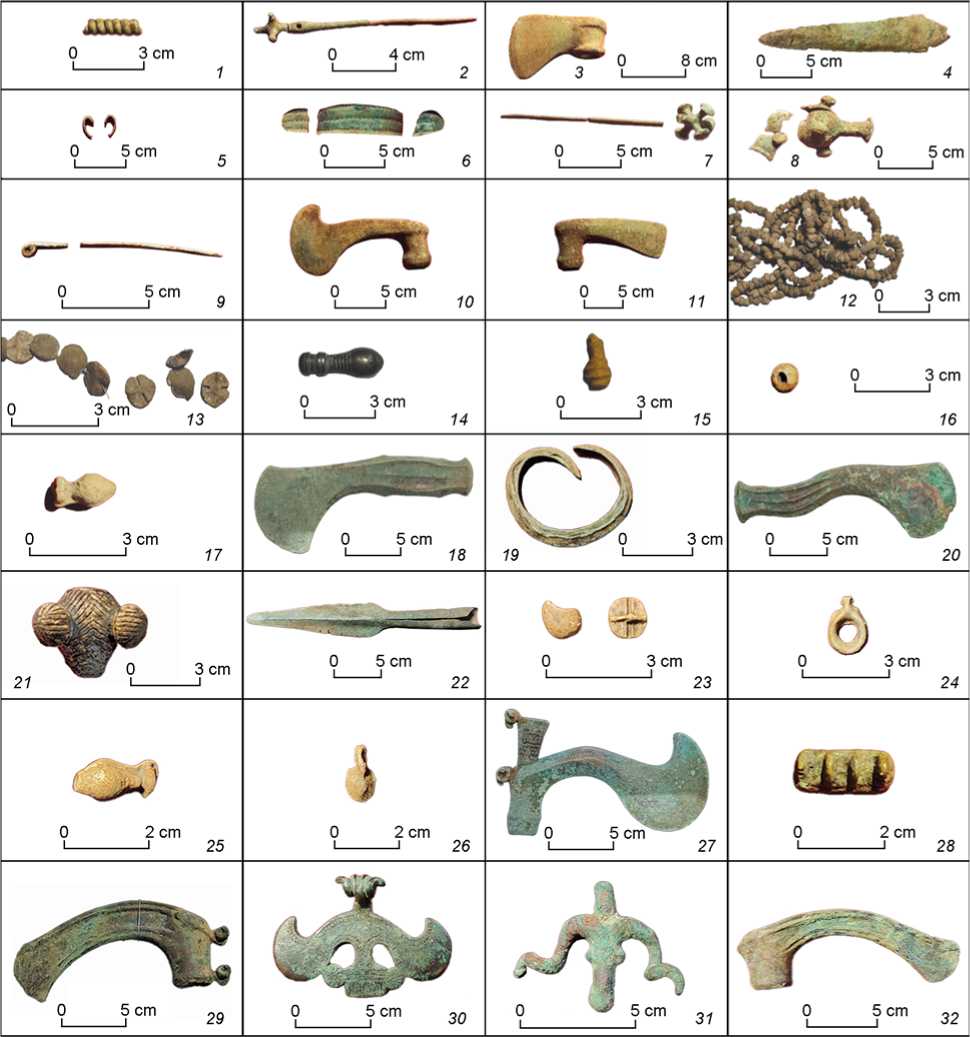
Fig. 2. Artifacts under study.
1–11 , 14–30 , 32 – Adaidon cemetery; 12 , 13 – Elkhotovo cemetery; 31 – accidental find, village of Koban. 1–4 , 6–11 , 14 , 18–20 , 22 , 27 , 29–32 – bronze; 5 – silver; 12–13 , 15–17 , 21 , 23–26 , 28 – antimony.
results. The analysis of the X-ray fluorescence data derived for the items from the latter three sites (Ibid.: 93–95, Tab. 1) as compared to our findings (see Table) has shown that the antimony content in these ornaments is practically the same – 97–98 %. Notably, the metal of the items from Faskau, Upper Rutkha (Kumbulta), and Adaidon contains almost no impurities, except for a small amount of copper and arsenic (from 0.21 to 2–3 %) (Ibid.). Citing data on the antimony content, Gak, Mimokhod, and Kalmykov rightly note: “Such high antimony values leave no doubt that we are dealing with a fairly pure metal that was smelted directly from the antimony mineral. The noticeable admixture of copper in the bead and paw pendant from Faskau (3.54 % and 4.62 %), as well as silver (4.5 %) and iron (up to 4.43 %)
in some Lolin beads is considered normal in this case. The total share of natural ore impurities in the extracted metallic antimony can reach several tens of percent” (Ibid.: 94). The above-mentioned similarity in the metal composition suggests that the population of the sites under discussion, including Adaidon, used raw materials from the same ore deposit to make antimony ornaments and insignias.
The main element in the metal of the “winged ram” pendant is copper. Noteworthy is the high concentration of arsenic in combination with the antimony content that is quite high in impurities (see Table , No. 30). In our opinion, this indicates intentional alloying, as a result of which the metal of the pendant became quite solid (tested during sample selection) and at the same time got an attractive bronze shine.
Conclusions
The executed analyses have shown that the artifacts selected as supposedly containing antimony from the burials of the Adaidon and Elkhotovo cemeteries were actually made of antimony, the content of which in the samples ranges from 91 to 98 %. Tin and antimony were added to the main metal (copper) for manufacturing personal ornaments and votiveceremonial products of the Proto-Kaban period from the Adaidon necropolis; some items were cast from pure antimony (beads, pendants, votive mace heads).
An important finding of the study is the frequent occurrence (in the same complex of burial goods at the Adaidon cemetery) of the artifacts made of bronze alloyed not only with arsenic, as expected for such an early time (15th/14th to 13th centuries BC), but also with tin, including in high concentrations, which is not typical of Late Bronze Age materials from the northern slope of the Main Caucasian Range.
Another significant result of the study is that the antimony ornaments occurred not only in early (ProtoKoban) burials, but also in graves of the Early Scythian period. The analysis of the bead and the button-bead from Elkhotovo (Chshiev, 2021: 63–68; 2022: 162, fig. 23, 38 ; p. 180, fig. 41, 40 ) has shown for the first time that antimony items were used by the population of the Caucasus not only in the Middle and Early Late Bronze Age, but also much later— in the 9th–8th centuries BC. The metal composition and the shapes of the above artifacts and the similar items from the Proto-Koban complexes of the Adaidon and Kari Tsagat cemeteries (Digor Gorge,
RSO – Alania) were strikingly similar (Skakov, 2003: 21, fig. 1, 1–13 , 29–31 ), despite the gap of 400– 500 years between burial dates and the location of the sites in different landscape zones and altitude belts. In our opinion, this can be explained by the stable metallurgical tradition of manufacturing antimony products, which was practiced in the entire distribution area of the Koban culture and survived, at least in the area of the culture’s main variant, until the 9th–8th centuries BC.
The comparison of the metal composition of the analyzed Proto-Koban artifacts from Adaidon with their functional attribution and appearance has shown that ancient craftsmen used various, often complex, multi-component alloys, depending on the purpose of the manufactured product. In particular, daggers, axes, spears, and poleaxes bearing use-wear signs and used as real weapons were made of arsenic bronze; while ornaments, votive items, ritual, and symbolic items, including ceremonial and ritual poleaxes and mace heads, were cast of antimony or bronze with an admixture of tin and antimony. These additives were apparently introduced into the metal to give a more attractive appearance (golden color with a shimmer, luster) to bronze products. In our opinion, a fairly high content of tin and antimony in the bronze of the socketed poleaxe decorated with two sculpted ram’s heads is explained by the fact that it was not a combat weapon, but a ceremonial poleaxe; therefore, the requirements as to its appearance prevailed. The analysis of the ceremonial and combat bronze belt with rich engraved ornaments from burial 350 of the Tli cemetery (excavations by B.V. Tekhov), carried out in the laboratory of the University of Debrecen (Chshiev et al., 2020), has shown a similar tin concentration (11–12 %).
Acknowledgements
This study was supported by the Russian Science Foundation (Project No. 22-28-01363). The authors thank S.V. Khavrin (the State Hermitage Museum), who performed a number of analyses to determine the composition and percentage ratio of metals of the artifacts.
