
Ценностно-смысловая природа удивления в литературе на примере прочтения рассказа Рюноске Акутагавы «Мандарины»
Журнал: Новый филологический вестник @slovorggu
Рубрика: Зарубежные литературы
Статья в выпуске: 3 (78), 2026 года.
Бесплатный доступ
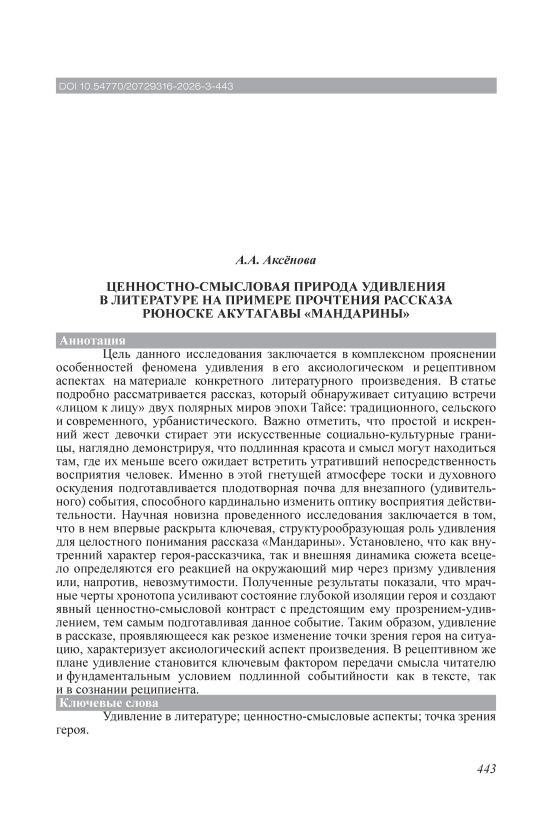
Цель данного исследования заключается в комплексном прояснении особенностей феномена удивления в его аксиологическом и рецептивном аспектах на материале конкретного литературного произведения. В статье подробно рассматривается рассказ, который обнаруживает ситуацию встречи «лицом к лицу» двух полярных миров эпохи Тайсе: традиционного, сельского и современного, урбанистического. Важно отметить, что простой и искренний жест девочки стирает эти искусственные социально-культурные границы, наглядно демонстрируя, что подлинная красота и смысл могут находиться там, где их меньше всего ожидает встретить утративший непосредственность восприятия человек. Именно в этой гнетущей атмосфере тоски и духовного оскудения подготавливается плодотворная почва для внезапного (удивительного) события, способного кардинально изменить оптику восприятия действительности. Научная новизна проведенного исследования заключается в том, что в нем впервые раскрыта ключевая, структурообразующая роль удивления для целостного понимания рассказа «Мандарины». Установлено, что как внутренний характер героя-рассказчика, так и внешняя динамика сюжета всецело определяются его реакцией на окружающий мир через призму удивления или, напротив, невозмутимости. Полученные результаты показали, что мрачные черты хронотопа усиливают состояние глубокой изоляции героя и создают явный ценностно-смысловой контраст с предстоящим ему прозрением-удивлением, тем самым подготавливая данное событие. Таким образом, удивление в рассказе, проявляющееся как резкое изменение точки зрения героя на ситуацию, характеризует аксиологический аспект произведения. В рецептивном же плане удивление становится ключевым фактором передачи смысла читателю и фундаментальным условием подлинной событийности как в тексте, так и в сознании реципиента.
Короткий адрес: https://sciup.org/149152213
IDS: 149152213 | УДК: 10.54770/20729316-2026-3-443
The Value-Semantic Nature of Amazement in Literature on the Example of Reading Ryūnosuke Akutagawa’s Short Story “Mandarins”
The aim of this research is to provide a comprehensive elucidation of the features of the phenomenon of Amazement in its axiological and receptive aspects, based on the material of a specific literary work. The article examines in detail a short story that reveals a situation of a face-to-face encounter between two polar worlds of the Taishō era: the traditional, rural one and the modern, urban. It is important to note that a simple and sincere gesture made by a girl erases these artificial socio-cultural boundaries, clearly demonstrating that genuine beauty and meaning can be found where they are least expected by a person who has lost the immediacy of perception. It is precisely in this oppressive atmosphere of melancholy and spiritual impoverishment that fertile ground is prepared for a sudden (amazing) event, capable of radically altering the optics of perceiving reality. The scientific novelty of the conducted research lies in the fact that it is the first to reveal the key, structure-forming role of Amazement for a holistic understanding of the short story “Mandarins”. It has been established that both the internal character of the narrator-hero and the external dynamics of the plot are entirely determined by his reaction to the surrounding world through the prism of Amazement or, conversely, imperturbability. The obtained results have shown that the gloomy features of the chronotope intensify the state of the hero’s deep isolation and create a powerful axiological contrast with the impending epiphany-amazement, thereby preparing for this event. Thus, Amazement in the story, manifested as a sharp change in the hero’s viewpoint on the situation, vividly characterizes the axiological aspect of the work. In the receptive sense, Amazement becomes a key factor in conveying meaning to the reader and a fundamental condition for genuine eventfulness, both within the text and in the mind of the recipient.
