
Changes in the functional state of skeletal muscles during repeated karate kicks
Журнал: Человек. Спорт. Медицина @hsm-susu
Рубрика: Спортивная тренировка
Статья в выпуске: S1 т.26, 2026 года.
Бесплатный доступ
Aim. This study aims to determine the quantitative and qualitative characteristics of muscle strength during repeated kicking actions in karate. Materials and methods. Highly qualified karate athletes aged 18–22 years performed repeated kicking techniques. The functional state of the skeletal muscles was assessed using myometry, which recorded oscillation frequency, oscillation decrement, and muscle stiffness. Changes in movement trajectories and angular positions of body segments were also analyzed. Results. The study revealed the nature of skeletal muscle response to specific loading. Temporal parameters of skeletal muscle recovery after intensive specific loading were identified. Changes in the structure of movement technique resulting from skeletal muscle fatigue were also observed. Conclusion. The identified pattern of changes in the functional state of skeletal muscles during specific exercises enables the modeling of training activities in karate.
Короткий адрес: https://sciup.org/147255203
IDS: 147255203 | УДК: 796.015.68:611.73:796.853.26 | DOI: 10.14529/hsm26s113
Изменение функционального состояния скелетных мышц при серийном выполнении ударов ногами в каратэ
Цель: определение количественных и качественных параметров силовой активности мышц при серийном выполнении ударных действий в каратэ. Материалы и методы. При выполнении серийных ударных действий ногами заданной направленности высококвалифицированными спортсменами в возрасте 18–22 лет проводилась оценка функционального состояния скелетных мышц методом миометрии. Оценивались параметры частоты колебания, декремента колебания и индекса жесткости скелетных мышц. Определялся характер изменения траекторий движения и угловых положений в звеньях тела. Результаты. Выявлен характер адекватности восприятия скелетными мышцами специальной нагрузки заданной направленности. Определены временные параметры скорости восстановления скелетных мышц после интенсивной специфической нагрузки. Отмечены изменения в структуре техники движений, обусловленные утомлением скелетных мышц. Заключение. Выявленный характер изменения функционального состояния скелетных мышц при выполнении специальных упражнений заданной направленности позволяет моделировать тренировочную деятельность в каратэ.
Текст научной статьи Changes in the functional state of skeletal muscles during repeated karate kicks
К.К. Бондаренко1,2, , И.И. Болдырев3, , 1 Гомельский государственный медицинский университет, Гомель, Беларусь
Introduction. Achieving peak athletic performance is directly contingent upon an athlete's ability to biomechanically optimize the structure of competitive movement [3, 4, 7]. The functional performance of skeletal muscles, which bear the primary load, plays a pivotal role in enabling efficient movement trajectories [11]. Analyzing the patterns of kinematic changes within the context of shifts in muscle functional state provides the foundation for designing targeted training methodologies.
The effectiveness of executing specific motor elements in sports is underpinned by interjoint coordination, which allows muscles to maintain the required amplitude and precision of movement against a backdrop of accumulating fatigue [13].
The adaptive capacity of the muscular system to a specific motor task is fundamental to forming the most rational trajectories for body segment displacement and contributes to optimizing the working ranges of joint angles [21].
The level of functional readiness of the musculature is a significant factor influencing the coordinative aspect of movement [1, 12]. An adequate muscular response to the imposed load helps reduce excessive tension and minimizes the risk of injury [2, 15].
The efficacy of a motor action is determined by the timely recruitment of relevant muscle groups and the generation of required force at specific movement phases [10], which, in turn, is directly dependent on their current functional state [6, 8, 14].
The nature of the motor task and the specific features of the movement trajectory determine the unique distribution and modulation of force potential during the execution of structural components in striking actions, closely linked to the dynamics of angular displacements [18].
Fatigue developed during intensive training or competition negatively impacts the coordina-tive capabilities of the muscular system, leading to altered trajectories of body segment movement [9]. A potential consequence is a general reduction in the speed of the athlete's working body segments. In the context of striking techniques in karate, muscular fatigue manifests as a distortion of the optimal trajectory and a decrease in the horizontal velocity of striking segments [5]. Therefore, a profound understanding of physiological changes within skeletal muscles paves the way for selecting the most effective training strategies.
Materials and methods. This study was conducted as part of a joint research project between Francisk Skorina Gomel State University and the Voronezh State Academy of Sport. The participants were qualified karate athletes (age group 18–22 years). Three types of kicking techniques with varying biomechanical complexity were selected as the model motor activity: “Mae-geri”, “Mawashi-geri”, and “Ura-mawashi-geri”.
The study protocol involved performing these kicks in series lasting from 30 to 60 seconds. The total testing duration for each participant was seven days. Load intensity was varied by adjusting the duration of each series, while the rest intervals between sets were fixed at 1 minute. The loading profile of the exercises was determined by their total volume and intensity.
The baseline functional state (tone) of the skeletal muscles was recorded prior to the loading tests. Following each completed series of specialized exercises, the functional state was re-evaluated according to the studied parameters via myometry. The criterion for determining the maximum number of series was the recorded shifts in muscle functional state, indicating an inadequate response of the neuromuscular system to the applied load, as well as the visually observed changes in joint trajectories.
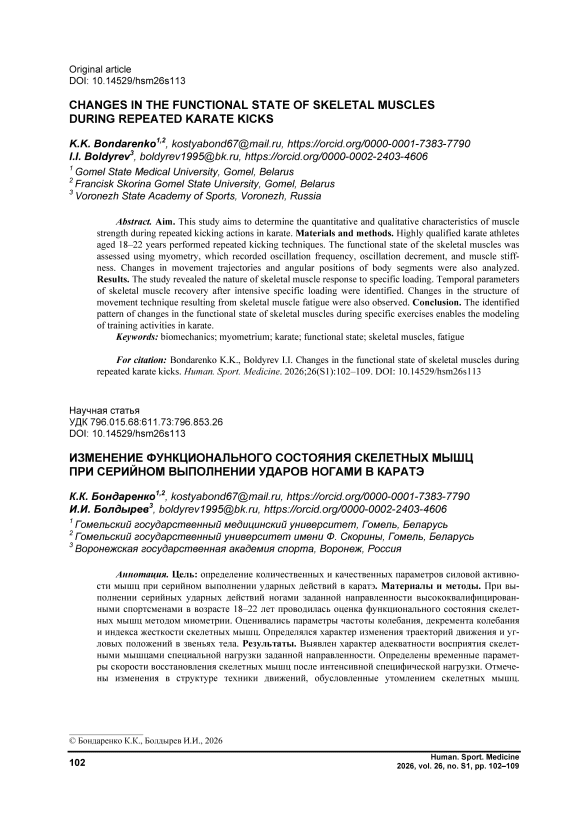
A MYOTON-3 myometer was used to assess functional state. The measurement principle is based on analyzing the damped oscillations of muscle tissue caused by a standardized mechanical impulse. The device's striker, with a mass (m) of 20 g, delivered a dosed impact to a premarked point on the muscle, with the specific pressure determined by a contact area (S) of 7.07 mm². The resulting damped oscillations in the tissue were recorded by an accelerometer and transmitted as a graphical plot of acceleration versus time (Fig. 1) [16, 17, 20].
of a skeletal muscle
From the obtained damped oscillation curve, the period of free oscillations (T, s) was determined. The natural oscillation frequency of the muscle (f, Hz) was calculated using the formula: f = 1/T. To characterize energy dissipation within the tissue, the logarithmic decrement of damping (λ) was calculated as the natural logarithm of the ratio of two successive oscillation amplitudes.
X = ln(4 (1)
Яз
Data interpretation was conducted within the framework of a damped oscillation model, described by the equation of Arved Vain [18, 19]:
m— + b^ +c*x = o, (2)
dt2 dt where x – is the magnitude of deformation, b – is the damping coefficient, and C – is the tissue stiffness (N/m).
The coefficient b was determined as:
b = X A . (3)
2m
Based on these parameters (f, λ, C), integral indices were calculated: the stiffness index (reflecting the muscle's force-generating potential) and the decrement index (characterizing efficiency and elasticity). Reference ranges for these indices were established through long-term studies. For instance, a decrement index value below 0.6 conventional units indicates a reduced ability of the muscle to work through its full range of motion, while a drop in the stiffness index below 0.45 N/m signifies impaired recovery of mechanical energy during dynamic movement [14].
Parallel to the myometric measurements, video analysis of the kicking technique was performed in two planes, with subsequent processing in the specialized software complex “KinoVea”. This allowed for the quantitative assessment of kinematic parameters, particularly the angles at the hip and knee joints, and for recording deviations from the reference movement model.
Results. The study analyzed cha n ges in the functional state of thigh m uscles during the execution of serial striking movements in karate. The workload was generated through repeated ki c ks against a suspended punching b a g with variable intensity and regulated intervals o f work and rest. Monitoring was conducted on the rectus fe-moris, vastus lateralis, and biceps femor i s muscles.
Participants performed series of k i cks lasting from 30 to 60 seconds. A ssessments of the skele t al muscles' functional state were carried out during the rest periods between sets.
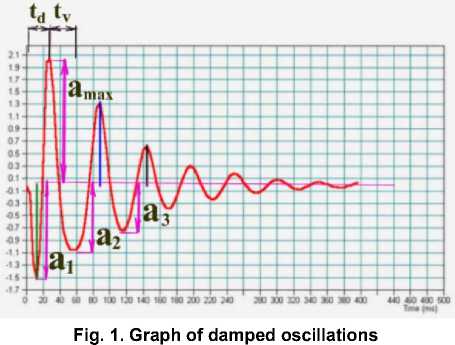
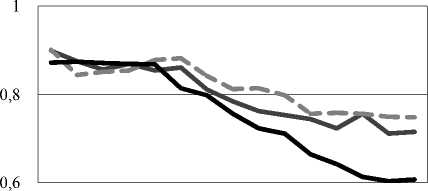
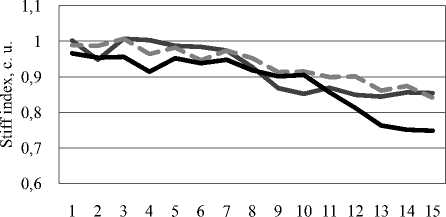
Data analysis revealed a significant drop in the elasticity of the rectus femoris muscle during the execution of the front kick (“Mae-geri”) and the reverse roundhouse kick (“Ura-mawashi-geri”). For instance, during “Mae-geri”, a reduction in elasticity exceeding normal limits was noted as early as the seventh series, indicating a decline in the muscle ' s working efficiency. A decrease in efficiency f or “Ura-ma w ashi-geri” w a s observed after the eighth series (Fig. 2). T h e strength potential of the rectus f emoris allows for no more than 11 consecutive series, after w h ich a marked decline i n strength performance is observed, assessed as e x ceeding normal limits by the 14th series for “Mae-geri”. It is notew o rthy that during the execution of 15 series of the roundhouse kick “Mawashi-geri”, performance and strength indicators remai n ed within a normal response range.
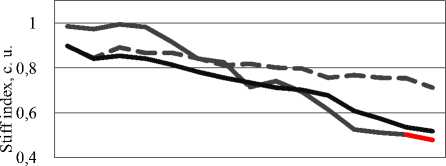
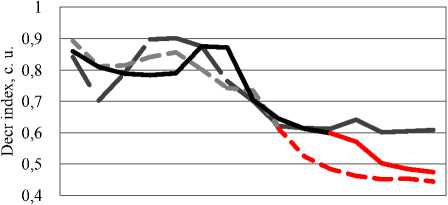
The biceps femoris muscle over a ll demonstrated stable function within normal limits. However, its efficiency began to decline aft e r 10 series when performing the “Ura-mawashi - geri” kick (Fig. 3).
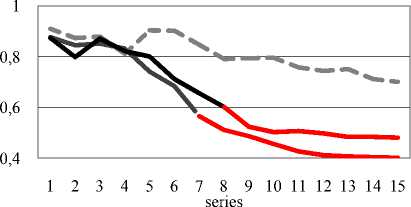
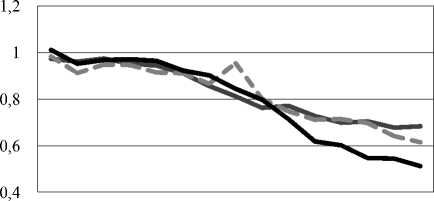
The vastus lateralis muscle sho w ed a pronounced tendency towards decreased performance during the sequential execution of “Mawashi-geri” and “Ura-mawashi-geri” kicks (Fig. 4). For “Ma-w a shi-geri”, adequate load tolerance was mainta i ned within 9 series, and for “Ur a -mawashi-geri”, within 11 series. The strength potential of this muscle showed an earlier decline in performance during the execution of the “Ura-mawashi-geri” kick.
— • — mae geri------mawashi geri -------uramawashi geri
Fig. 2. Dynamics of the functional state of the musculus rectus femoris during serial performance of special karate kicks
1 2 3 4 5 6 7 8 9 10 11 12 13 14 15
series
— • — mae geri ------mawashi geri -------uramawashi geri
1 2 3 4 5 6 7 8 9 10 11 12 13 14 15 series
— • — mae geri ------mawashi geri -------uramawashi geri
series
— • — mae geri ------mawashi geri -------uramawashi geri
1 2 3 4 5 6 7 8 9 10 11 12 13 14 15 series
— ■ — mae geri------mawashi geri -------uramawashi geri
Fig. 4. Dynamics of the functional state of the vastus lateralis musculus during serial performance of special karate kicks
Fig. 3. Dynamics of the functional state of musculus biceps femoris during serial performance of special karate kicks
1 2 3 4 5 6 7 8 9 10 11 12 13 14 15 series
— ■ — mae geri ------mawashi geri -------uramawashi geri
By the end of the prescribed exercise cycle, a slight decrease in the strength and endurance of the biceps femoris muscle was noted. The rectus femoris and vastus lateralis muscles demonstrated an inconsistent reaction to the specialized striking actions.
Elasticity and strength potential parameters for several muscles exceeded the boundaries of normal performance. This indicates an inability to sustain the specific physical load due to a low level of adaptive conditioning for this type of action. The maximum level of reduction in the functional performance of the skeletal muscles was recorded immediately before the final exercise series.
Driving the functional state of the biceps fe-moris muscle beyond normal response limits through the serial execution of the roundhouse kick “Mawashi-geri” results in an inability to ensure maximum movement performance for approximately 36 hours. This primarily affects the muscle's ability to generate force and its elasticity.
“Ura-mawashi-geri” induces more prolonged changes in functional state. The low performance level of the biceps femoris muscle following repeated execution of this kick type, at the pre- scribed intensity and rest intervals, leads to a reduced functional state lasting approximately 48 hours.
Fatigue in the quadriceps femoris muscle has a more profound impact. Specifically, its ability to develop peak force returns to the baseline level only after about 60 hours, while elasticity indicators may remain reduced for up to 72 hours. This limits the ability to execute kicks with full amplitude during these respective periods.
Video analysis of the technique used during the specialized exercises indicates that deviations from optimal movement trajectories occur under fatigue. During the leg lift phase, the angle at the hip joint increases by an average of 10–12°.
Fatigue and the reduced functional state of the quadriceps muscle disrupt the optimal positioning of the thigh relative to the torso, causing the strike trajectory to deviate from a straight line. This impairs both the power and the effectiveness of the kick.
Such changes in the functional state of the skeletal muscles negatively affect not only the technical execution of the strike but also the athlete's ability to recover quickly between actions. Ultimately, this reduces the overall effectiveness of performed actions during a match.
Conclusions. When muscle function declines and fatigue sets in, athletes deviate from proper kicking form. This study identified the following specific technical breakdowns:
– During the Leg Lift: The angle between the thigh and torso widens, forcing the athlete to expend more energy to complete the kick.
– During Torso Rotation: The hip “drops” or sags, and the plane of the thigh shifts out of alignment with the torso.
– During the Follow-Through: The speed of the shin retraction decreases. This slow recovery both makes the technique less effective and leaves the leg vulnerable to being grabbed by an opponent.
