
Человекоцентричный экономический рост в регионах Приволжского федерального округа: композитный индекс, типология и взаимосвязь с ключевыми показателями развития
Журнал: Вестник Волгоградского государственного университета. Экономика @ges-jvolsu
Рубрика: Региональная экономика
Статья в выпуске: 2 т.28, 2026 года.
Бесплатный доступ
В условиях роста макроэкономической волатильности понимание структурных ограничений потребительского спроса становится критически важным. Данное исследование фокусируется на феномене анкерных расходов – обязательных, неэластичных статей бюджета домохозяйств, которые, согласно теориям поведенческой экономики и институционализма, формируют «финансовый пол» и влияют на макроэкономическую стабильность. Для преодоления методологического пробела, связанного с отсутствием кросс-странового сопоставимого измерителя, разработан и эмпирически валидирован количественный индикатор – Индекс ригидности потребления. Индекс рассчитывается как разность между средними эластичностями потребления по ВВП в периоды роста и падения экономики. На основе данных Всемирного банка за 1960–2023 гг. CRI рассчитан для 94 стран. Ключевым результатом является выявление двух качественно различных типов структурных ограничений, которые он диагностирует. Значения CRI, близкие к нулю, коррелируют с бытовой ригидностью, обусловленной высокой долей расходов на базовые потребности. Напротив, резко отрицательные значения CRI сигнализируют о долговой хрупкости – проциклической уязвимости, порожденной чрезмерной долговой нагрузкой домохозяйств. Таким образом, CRI трансформируется из измерителя ригидности в диагностический инструмент для дифференциации политических ответов: мер поддержки доходов или макропруденциального регулирования.
Короткий адрес: https://sciup.org/149151503
IDS: 149151503 | УДК: 332.1 | DOI: 10.15688/ek.jvolsu.2026.2.5
Human-Centered Economic Growth in the Regions of the Volga Federal District: A Composite Index, Typology, and Linkages to Key Development Indicators
The article examines the economic growth of regions in the Volga Federal District through the lens of human-centeredness. To this end, the authors have advanced a methodology for assessing a Composite Index of Human-Centeredness (IHC) by incorporating stages for evaluating its relationship with key regional economic development indicators and for typologizing regions based on the stability and balance of their human-centered development. The IHC comprises five sub-indices: welfare and comfortable living environment, health and longevity, culture and education, labor and self-realization, and innovation and digital infrastructure. This detailed breakdown allows for not only an assessment of the overall level of human-centeredness but also the diagnosis of developmental “bottlenecks.” Based on Rosstat data for 2014–2023, the index values are calculated for the subjects of the Volga Federal District. A strong positive correlation is empirically confirmed between the index and GRP per capita, labor productivity, and the region’s migration attractiveness. The results, which possess scientific novelty, enable the identification of four regional types: stable and balanced, stable but unbalanced, unstable but balanced, and unstable and unbalanced development. The scientific novelty is characterized by the quantitative relationship established between IHC and both GRP per capita and labor productivity using panel data from the regions of the Volga Federal District. The proposed methodology serves as an effective tool for monitoring and comparative analysis to support managerial decision-making aimed at the comprehensive development of human potential and enhancing the stability of the regional economy. Based on the findings, measures are proposed for developing the regional economy within the framework of the human-centeredness concept.
Текст научной статьи Человекоцентричный экономический рост в регионах Приволжского федерального округа: композитный индекс, типология и взаимосвязь с ключевыми показателями развития
DOI:
Человеческому потенциалу и его влиянию на экономику регионов в современном мире уделяется особое внимание, что подтверждается федеральными программами, национальными проектами, стратегиями регионального развития в Российской Федерации. Поиск эффективного механизма, методики оценки, дальнейшего распределения бюджетов субъектов РФ – ключевые стратегически важные вопросы, на которые нет еди- ного однозначного ответа. Исследования экономистов [Аганбегян, 2017; Насырова, 2024] свидетельствуют о возрастающей роли человеческого потенциала в развитии региональной экосистемы как ключевого фактора устойчивости социально-экономического развития регионов, основанного на накоплении и максимально эффективном его использовании. Вместе с тем существующие подходы к оценке регионального развития слабо учитывают человекоцентричность и баланс подсистем, а также устойчивость траекторий во времени
[Rostom, 2011]. Большинство работ фокусируются либо на классических моделях роста [Башлаева и др., 2025], либо на отдельных социальных индикаторах без оценки влияния на экономику и миграционную привлекательность региона [Кузнецова и др., 2020]. Ранее авторами предложена и апробирована идея композитного индекса человекоцентричной экономики [Хмелева и др., 2025а] как индикатора развития экономики региона в условиях возрастающей значимости человеческого потенциала.
Цель данной статьи исследования – развить и апробировать методику оценки композитного индекса за счет проверки взаимосвязи с валовым региональным продуктом (далее – ВРП) на душу населения, производительностью труда, миграцией, а также типологи-зации регионов по критериям устойчивости и сбалансированности.
Объекты и методы исследования
Объектом исследования послужил Приволжский федеральный округ (далее – ПФО), в состав которого входят различные по промышленному потенциалу регионы (лидеры, середняки и отстающие), что делает его хорошим полигоном для проверки гипотезы о положительном влиянии композитного индекса человекоцентричности на социально-экономическое развитие региона.
В работе использован экосистемный подход, отвечающий ранее предложенной авторской концепции человекоцентричности [Хмелева и др., 2025б], направленной на сбалансированное динамичное развитие региона за счет возможностей раскрытия человеческого потенциала в условиях цифровой трансформации общества, увеличения запросов со стороны подрастающего молодого поколения к инфраструктуре, качеству жизни, возможностям для саморазвития и самореализации.
В процессе расчетов применялся метод нормализации разнородных показателей, отобранных для построения композитного индекса человекоцентричности, в рамках авторской методики и подробно описанной в работе [Хмелева и др., 2025а].
Структура композитного индекса чело-векоцентричности региона (далее – IHC) характеризует пять ключевых измерений разви- тия человеческого потенциала в регионе: благосостояние и комфортная среда (WCE), здоровье и долголетие (HL), культура, образование и навыки будущего (SF), труд и возможности самореализации (WSR), инновации, цифровая инклюзивность и инфраструктура (DII), – и представлена в таблице 1.
Система индикаторов для каждого субиндекса была сформирована с учетом их релевантности концепции человекоцентричности, способности отражать возможности реализации потенциала человека, современных вызовов цифровизации, а также корреляции с ключевыми показателями эффективности экономики и привлекательности региона (ВРП на душу населения, въездной миграцией и производительностью труда). Для учета региональной дифференциации ряд показателей был очищен с использованием региональных дефляторов.
Особенностью расчета композитного индекса является использование метода скорректированного среднего, что позволило выявить внутренние дисбалансы в отдельных подгруппах показателей. Для оценки влияния композитного индекса на социально-экономическое развитие региона с целью подтверждения гипотезы о положительной направленности влияния были построены диаграммы рассеяния. Для детализации устойчивости и сбалансированности развития регионов в статье использован метод типологизации.
Эмпирическая база сформирована на основе официальных статистических данных Росстата, Единой межведомственной информационно-статистической системы (далее – ЕМИСС) за период 2014–2023 гг. по субъектам ПФО. Использование данных официальных источников обеспечило высокую степень доступности, достоверности и объективности эмпирических данных.
Результаты и обсуждение
Региональная экосистема носит динамичный характер и обеспечивает непрерывный доступ хозяйствующих субъектов к ключевым видам услуг, включая финансовые, транспортные, образовательные, медицинские и др. В свою очередь, работник, реализуя свой потенциал и накапливая человеческий капитал, формирует доход для всех участ- ников экосистемы. Последующее наращивание благ и ресурсов способствует переходу общества на новый уровень социально-экономического развития и позволяет удовлетворять такие потребности, как общение, трудовая самореализация и расширение кругозора. Ядром эффективной экосистемы региона выступает самодостаточная личность, человеческий капитал которой формируется постепенно, через количественное и качественное удовлетворение потребностей, что подтверждает концепцию человеческого капитала как источника экономического роста региона [Аганбегян, 2017].
Идеология человекоцентричности предполагает переориентацию региональных и национальных стратегий на максимальное раскрытие возможностей человека, что предполагает улучшение инфраструктуры, создание комфортных условий труда, а также пересмотр экономических приоритетов для поддержки сфер, обеспечивающих устойчивый рост человеческого потенциала. Акцент делается на социальной справедливости, включенности и устойчивом развитии, что требует системных изменений в политике, направленных на поддержку человека как главного ресурса общества [Долганова и др., 2024].
Таблица 1. Субиндексы и состав показателей для оценки человекоцентричности региона
Table 1. Subindexes and composition of indicators for assessing the region’s human-centeredness
|
Наименование и характеристика субиндекса |
Индикатор для расчета |
|
Благосостояние и комфортная среда (WCE): раскрывает обеспечение базовых потребностей и комфортной среды |
Среднедушевые денежные доходы населения, руб. / мес. (очищенные от инфляции); удельный вес жилых домов, построенных населением за счет собственных и заемных средств; удельный вес расходов домашних хозяйств на оплату ЖКУ от общей суммы потребительских расходов; количество преступлений, зарегистрированных в отчетном периоде на 10 000 чел. населения; плотность транспортной сети, км на 1 000 км2; расходы консолидированных бюджетов субъектов РФ на ЖКХ на душу населения, тыс. руб. / чел. (очищенные от инфляции); расходы на охрану окружающей среды на душу населения, тыс. руб. / чел. (очищенные от инфляции) |
|
Здоровье и долголетие (HL): оценка возможностей, сформированных в регионе для обеспечения здоровья |
Мощность амбулаторно-поликлинических организаций на 10 000 чел. населения; заболеваемость на 1 000 чел. населения (всего); число ФАПов на конец года на число населенных пунктов от 100 до 1 000 жителей в зависимости от удаленности; расходы консолидированных бюджетов субъектов РФ на здравоохранение на душу населения, тыс. руб. / чел. (очищенные от инфляции); число спортивных сооружений, ед. на 10 000 чел. населения |
|
Культура, образование и навыки будущего (SF): оценка возможностей для раскрытия трудового потенциала человека, развития нравственно-патриотических ценностей |
Численность зрителей театров на 1 000 чел. населения; число посещений музеев на 1 000 чел. населения; охват детей дошкольными образовательными организациями, %; выпуск бакалавров, специалистов, магистров на 10 000 чел. населения; расходы консолидированных бюджетов субъектов РФ на образование на душу населения, тыс. руб. / чел. (очищенные от инфляции) |
|
Труд и возможности самореализации (WSR): оценка возможностей человека в регионе для достойного труда, карьеры и предпринимательства |
Ежегодный рост высокопроизводительных рабочих мест по субъектам Российской Федерации, %; инвестиции в основной капитал на душу населения, руб. (очищенные от инфляции); оборот МСП на одного занятого в МСП, млн руб. / чел. (очищенный от инфляции) |
|
Инновации, цифровая инклюзивность и инфраструктура (DII): оценка возможностей человека для доступа к цифровым благам и инновационной деятельности |
Численность персонала, занятого научными исследованиями и разработками на 10 000 чел. населения; внутренние затраты на научные исследования и разработки на одного занятого научными исследованиями и разработками, тыс. руб. / чел. (очищенные от инфляции); затраты на информационные и коммуникационные технологии на 10 000 чел. населения, тыс. руб. / чел. (очищенные от инфляции) |
Примечание. Разработано авторами: [Хмелева и др., 2025а].
В широком смысле человекоцентрич-ность – это ориентированность социально-экономической системы на человека, выступающая способом достижения стратегических целей ее функционирования. Иными словами, провозглашается подход «человек – ценность для человека – все для человека» [Гальченко и др., 2022].
В данной работе под человекоцентричной региональной экономикой авторы понимают «совокупность региональных подсистем (экономической, социальной, экологической, цифровой), взаимодействие которых образует экосистему, позволяющую наиболее полно использовать потенциал территории и удовлетворять потребности населения в росте человеческого капитала и качества жизни» [Хмелева и др., 2025б, с. 2714]. Человекоцен-тричность выступает фундаментальным свойством социально-экономической системы, характеризующим степень интеграции потребностей населения в экосистемный подход к развитию региона.
Экосистемы регионального развития как концептуально-платформенный дискурс исследованы в работах Г.Б. Клейнера [2019], Н.С. Гришковой [2022], где «платформенный интерес» направлен на обеспечение устойчивости экосистем, а также в контексте цифровых экосистем, формирующихся на основе инновационных платформ [Якимова и др., 2023].
Такой подход позволяет фокусироваться на создании благоприятных условий для жизни и труда, раскрытии человеческого потенциала через инновационную цифровую инфраструктуру для обмена ресурсами, знаниями и технологиями [Титов, 2024]. Таким образом, человекоцентричный и экосистемный подходы взаимодополняют друг друга, необходимы для обеспечения сбалансированного развития и устойчивой траектории роста региональной экономики.
Это позволит не только эффективно использовать ресурсы территории, но и создать условия для реализации человеческого потенциала, что в конечном итоге определит рост и конкурентоспособность экономики региона. Конкурентоспособность регионов в данном контексте проявляется через способность формировать благоприятные условия для миграционного притока специалистов, востребованных современной экономикой, включая кадры из других регионов и иностранных государств.
Опираясь на представленные выше теоретические положения, целесообразно выдвинуть гипотезы исследования и предложить методику, позволяющую не только оценить человекоцентричность экономики, но и проверить взаимосвязь композитного индекса с ВРП на душу населения, производительностью труда и миграцией, а также выделить типы регионов по устойчивости и сбалансированности.
Гипотеза 1. Регионы характеризуются значительной региональной дифференциацией по уровню человекоцентричности.
Гипотеза 2. Между композитным индексом показателями развития экономики присутствует положительная статистическая связь.
Методика реализуется следующими этапами.
Этап 1: оценка компонентов и композитного индекса человекоцентричности. Анализ полученных значений и интерпретация. Проводится анализ значений IHC, ранжирование регионов, выявление сильных и слабых сторон через декомпозицию индекса.
Этап 2: оценка взаимосвязи композитного индекса с ключевыми показателями конкурентоспособности региональной экономики такими, такими как ВРП на душу населения (в постоянных ценах), производительность труда, миграция (по числу въезжающих в регион из других регионов и из-за рубежа).
Показатель производительности труда рассчитан по методике профессора В.А. Цы-батова [2024] по формуле (1), что позволяет провести анализ более качественно.
LPi ( t ) = VRPi ( t ) / Ei ( t ), (1)
где LPi ( t ) – производительность труда в i -м регионе в году t ; VRP i ( t ) – ВРП в i -м регионе в году t в базисных ценах, учитывает региональную инфляцию; Ei ( t ) – среднегодовая численность занятых в экономике i -го региона в году t .
Этап 3: типологизация регионов по критериям структурного индекса человекоцент-ричности и его динамике.
Критерий 1. Структурная сбалансированность индекса человекоцентричности позво- ляет выявить субъекты РФ с неравномерным развитием экосистемы. Сбалансированная экосистема отражает человекоцентричное развитие, при котором все компоненты (субиндексы) развиваются равномерно и на высоком уровне. Однако расчеты показали, что даже при применении «штрафов» за дисбаланс сохраняются диспропорции в развитии регионов и их компонентов. Возможна ситуация, когда все компоненты имеют низкие ранги, что свидетельствует о стагнации при формальной сбалансированности показателей. Поэтому критерий сбалансированности индекса человеко-центричности был критерием его динамики. Выявленные дисбалансы на фоне изменений композитного индекса человекоцентричности дают ценную информацию для разработки дифференцированных мер экономической политики. Авторами предложено оценивать структурную сбалансированность по среднему рангу региона за N лет (Ar), то есть среднему значению за N лет из разниц максимального (наихудшего) и минимального (наилучшего) ранга по субиндексам региона (max-min) по формуле (2).
Z ^r _ rmax rmin
N ~ N ’
где Ar – это средний ранг за N лет; N – число лет, r max и r min – соответственно максимальное (наихудшее) и минимальное (наилучшее) значение рангов по субиндексам региона за год.
Из полученных значений выделяются две группы с диапазоном более и менее среднего значения.
Критерий 2. Оценивается динамика устойчивого развития региона по среднегеометрическому темпу роста композитного индекса человекоцентричности за выбранный период. Прирост (стагнация) показателя характеризует способность (неспособность) к человекоцентричному развитию (табл. 2).
Представим апробацию предложенной методики на примере регионов ПФО. Результаты ранжирования индексов скорректированного среднего по пяти субиндексам представлены в таблице 3.
Из таблицы видно, что многие регионы характеризуются неравномерностью развития компонентов. Так, например, Самарская область по субиндексу «инновации, цифровая инклюзивность и инфраструктура» (DII) имеет 3-й ранг, в то время как по субиндексу «благосостояние и комфортная среда» (WCE) имеет только 8-й ранг.
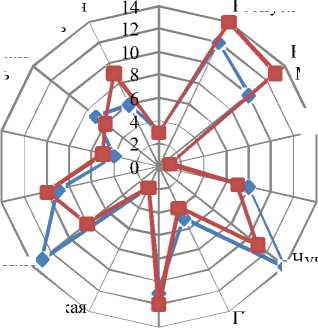
Наглядно изменение распределения субъектов ПФО по композитному индексу человекоцентричности за 2014 и за 2023 гг. представлено на рисунке 1.
Результаты (см. табл. 3, рис. 1) показали, что лидером по IHC является Республика Татарстан, чья стратегия имеет ярко выраженный человекоцентричный фокус на создание комфортного пространства для развития
Таблица 2 . Градация для типологии субъектов ПФО в 2014–2023 г. по уровню устойчивости и сбалансированности человекоцентричной региональной системы
Table 2. Gradation for the typology of subjects of the Volga Federal District in 2014–2023
according to the level of stability and balance of the human-centered regional system
|
Тип |
Критерий 1: уровень сбалансированности |
Критерий 2: динамика роста, % |
|
Средний ранг по разнице (min-max) ранга регион а за 2014–2023 гг. ( Δr = 6) |
Среднегеометрический темп роста композитного индекса за 2014–2023 гг. |
|
|
Тип I – регионы с устойчивым и сбалансированным человекоцентричным развитием |
< Δ r |
100 |
|
Тип II – регионы с устойчивым, но несбалансированным человекоцентричным развитием |
Δ r |
100 |
|
Тип III – регионы с неустойчивым, но сбалансированным человекоцентричным развитием |
< Δ r |
< 100 |
|
Тип IV – регионы с неустойчивым и несбалансированным человекоцентричным развитием |
Δ r |
< 100 |
Примечание. Разработано авторами.
человеческого капитала [Итоги реализации Стратегии …]. Высокие позиции также занимают Нижегородская область, Республика Башкортостан и Пермский край, демонстрирующие различные модели сбалансированного развития. Наиболее низкие значения индекса были выявлены у Республики Марий Эл и Республики Мордовия, что указывает на наличие существенных диспропорций и ограничений в социально-экономическом развитии.
Таким образом, композитный индекс человекоцентричности выступает эффективным инструментом для мониторинга, сравнительного анализа и принятия управленческих решений, направленных на комплексное развитие человеческого потенци- ала и повышение устойчивости региональной экономики.
Для верификации методики был рассчитан коэффициент корреляции IHC с ВРП на душу населения (0,709), с числом прибывших в регион из других регионов и из-за рубежа (0,768) и с производительностью труда (0,667), что подтверждает высокую корреляцию по шкале Чеддока и работоспособность предложенного подхода. Рисунки 2–4 показывают положительное влияние композитного индекса человекоцентричности на ключевые показатели экономики региона. Из рисунка 3 можно заметить положительное влияние предложенного в работе композитного индекса че-ловекоцентричности на производительность
Таблица 3. Сравнительная динамка распределения регионов по субиндексам челове-коцентричности в 2014 г. и 2023 г.
Table 3. Comparative dynamics of the distribution of regions by subindexes of human-centeredness in 2014 and 2023
|
Субъект ПФО |
AM WCE |
Ранг WCE |
AM HL |
Ранг HL |
AM SF |
Ранг SF |
AM WSR |
Ранг WSR |
AM DII |
Ранг DII |
|
2014 г. |
||||||||||
|
Республика Башкортостан |
0,897 |
1 |
0,590 |
2 |
0,321 |
10 |
0,419 |
6 |
0,222 |
5 |
|
Республика Марий Эл |
0,161 |
13 |
0,079 |
14 |
0,343 |
8 |
0,382 |
9 |
0,001 |
14 |
|
Республика Мордовия |
0,165 |
12 |
0,239 |
10 |
0,268 |
11 |
0,401 |
7 |
0,013 |
13 |
|
Республика Татарстан |
0,734 |
2 |
0,609 |
1 |
0,727 |
1 |
0,927 |
1 |
0,357 |
2 |
|
Удмуртская Республика |
0,193 |
10 |
0,244 |
9 |
0,483 |
4 |
0,395 |
8 |
0,040 |
9 |
|
Чувашская Республика |
0,209 |
8 |
0,089 |
13 |
0,479 |
5 |
0,050 |
14 |
0,026 |
12 |
|
Пермский край |
0,298 |
6 |
0,244 |
8 |
0,507 |
3 |
0,668 |
3 |
0,264 |
4 |
|
Кировская область |
0,179 |
11 |
0,307 |
7 |
0,344 |
7 |
0,165 |
13 |
0,038 |
10 |
|
Нижегородская область |
0,540 |
3 |
0,406 |
5 |
0,589 |
2 |
0,711 |
2 |
1,001 |
1 |
|
Оренбургская область |
0,398 |
5 |
0,227 |
12 |
0,116 |
14 |
0,187 |
12 |
0,027 |
11 |
|
Пензенская область |
0,276 |
7 |
0,460 |
4 |
0,128 |
13 |
0,345 |
11 |
0,099 |
8 |
|
Самарская область |
0,504 |
4 |
0,234 |
11 |
0,470 |
6 |
0,664 |
4 |
0,299 |
3 |
|
Саратовская область |
0,206 |
9 |
0,476 |
3 |
0,221 |
12 |
0,351 |
10 |
0,101 |
7 |
|
Ульяновская область |
0,133 |
14 |
0,384 |
6 |
0,330 |
9 |
0,427 |
5 |
0,107 |
6 |
|
2023 г. |
||||||||||
|
Республика Башкортостан |
0,708 |
1 |
0,276 |
5 |
0,290 |
4 |
0,489 |
5 |
0,232 |
5 |
|
Республика Марий Эл |
0,069 |
14 |
0,047 |
14 |
0,166 |
9 |
0,126 |
12 |
0,005 |
14 |
|
Республика Мордовия |
0,171 |
12 |
0,233 |
6 |
0,132 |
10 |
0,055 |
14 |
0,007 |
13 |
|
Республика Татарстан |
0,699 |
2 |
0,537 |
1 |
0,672 |
1 |
0,950 |
1 |
0,498 |
2 |
|
Удмуртская Республика |
0,181 |
11 |
0,164 |
10 |
0,282 |
5 |
0,441 |
6 |
0,062 |
8 |
|
Чувашская Республика |
0,188 |
10 |
0,125 |
13 |
0,227 |
8 |
0,234 |
10 |
0,022 |
12 |
|
Пермский край |
0,402 |
5 |
0,308 |
3 |
0,327 |
3 |
0,560 |
3 |
0,293 |
3 |
|
Кировская область |
0,290 |
7 |
0,142 |
12 |
0,229 |
7 |
0,085 |
13 |
0,043 |
11 |
|
Нижегородская область |
0,569 |
3 |
0,222 |
8 |
0,427 |
2 |
0,804 |
2 |
0,871 |
1 |
|
Оренбургская область |
0,439 |
4 |
0,153 |
11 |
0,119 |
13 |
0,334 |
7 |
0,052 |
9 |
|
Пензенская область |
0,150 |
13 |
0,222 |
7 |
0,091 |
14 |
0,304 |
9 |
0,050 |
10 |
|
Самарская область |
0,269 |
8 |
0,285 |
4 |
0,272 |
6 |
0,525 |
4 |
0,273 |
4 |
|
Саратовская область |
0,367 |
6 |
0,343 |
2 |
0,131 |
11 |
0,227 |
11 |
0,103 |
7 |
|
Ульяновская область |
0,264 |
9 |
0,209 |
9 |
0,122 |
12 |
0,311 |
8 |
0,119 |
6 |
Примечание. Разработано авторами.
труда в регионе, что соответствует общей тенденции улучшения качества жизни населения субъектов ПФО с учетом реализации Национальных проектов РФ.
Человекоцентричность отражает не только экономическую эффективность, но и привлекательность региона, уровень его развитости, обеспеченность рабочими местами, инфраструктурное развитие и качество жизни населения. Население «голосует ногами», что предполагает наличие статистически значимой взаи- мосвязи между показателем миграционной привлекательности и композитным индексом чело-векоцентричности. Указанная гипотеза получила эмпирическое подтверждение на рисунке 4.
Данные по числу прибывших в разрезе миграционных потоков в статистике (ЕМИСС) отражены только с 2017 г., несмотря на это, композитный индекс человекоцент-ричности хорошо демонстрирует корреляцию с числом прибывших в регион из других регионов и из-за рубежа.
Саратовская область
Республика Марий Эл
Республика Мордовия
Оренбургска область
Нижегородск область
Республика Башкортостан
Ульяновская область
Самарская область
Пензенская область
Республика Татарстан
Удмуртская Республика
Пермский край Кировская область
Чувашская Республика
2014 г.
♦2023 г.
Рис. 1. Диаграмма распределения регионов ПФО по композитному индексу человекоцентричности за 2014 и 2023 гг., баллы
Fig. 1. Distribution diagram of the Volga Federal District regions according to the composite index of human-centeredness for 2014 and 2023, points
Примечание. Разработано авторами.
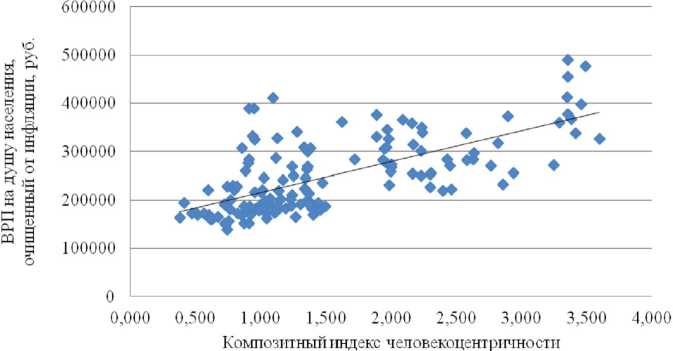
Рис. 2. Диаграмма рассеяния ВРП на душу населения, очищенного от инфляции и композитного индекса человекоцентричности за 2014–2023 гг. в регионах ПФО
Fig. 2. Scatterplot of GRP per capita cleared of inflation and composite index of human-centeredness for 2014–2023 in the regions of the Volga Federal District
Примечание. Разработано авторами.
Верификация полученных оценочных результатов на основе статистических данных подтверждает практическую применимость предложенной методики. Таким образом, доказана адекватность композитного индекса как индикатора оценки условий со- циально-экономического развития экосистемы региона.
Для того, чтобы учесть дифференциацию регионов при разработке мер повышения уровня человекоцентричности целесообразно разработать типологизацию регионов по крите-
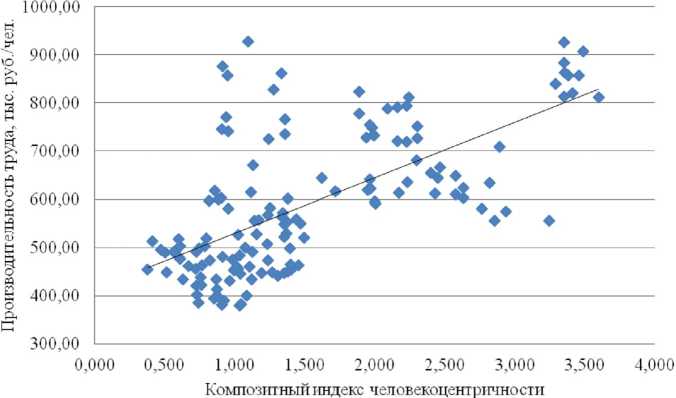
Рис. 3. Диаграмма рассеяния значений производительности труда и композитного индекса человекоцентричности за 2014–2023 гг. в регионах ПФО
Fig. 3. Scatterplot of labour productivity values and composite index of human-centeredness for 2014–2023
in the regions of the Volga Federal District
Примечание. Разработано авторами.
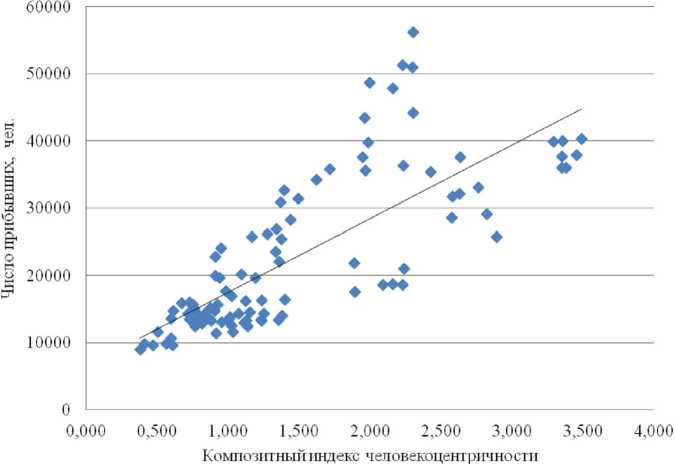
Рис. 4. Диаграмма рассеяния числа прибывших в регион с композитным индексом человекоцентричности за 2017–2023 гг. в регионах ПФО
Fig. 4. Scatterplot of arrivals in the region with the composite index of human-centeredness for 2017–2023 in the regions of the Volga Federal District
Примечание. Разработано авторами.
риям уровня сбалансированности и динамики роста. Это позволит выделить приоритетные регионы для улучшения их экосистемы, направленной на обеспечение достойных условий труда и повышение качества жизни. Результаты типологизации регионов ПФО представлены на рисунке 5.
В первой группе (I), «регионы с устойчивым, сбалансированным человекоцентричным развитием», находится только один регион – Республика Татарстан. Данный субъект РФ занимал 1 место за 2014–2023 гг. по композитному индексу человекоцентричности. В 2023 г. республика занимала 2-е место в ПФО по численности населения и 1-е место по уровню среднедушевых денежных доходов населения, относится к числу основных миграционных центров округа, занимая 2-е место по числу прибывших как во внешней, так и во внутренней миграции, что свидетельствует о его высокой привлекательности с позиций человекоцентричного развития. В 2023 и 2024 гг. Татарстан занял 2-е место в нацио- нальном рейтинге состояния инвестиционного климата, сразу после Москвы [Внешние связи Республики Татарстан]. По индексу человеческого развития Республика Татарстан в 2019 г. занимала 6-е место среди субъектов Российской Федерации, что позволяет отнести ее к группе регионов с очень высоким уровнем человеческого развития. В 2023 г. регион занял 5-е место по индексу качества жизни в РФ [Рейтинг российских регионов ... , 2023]. Для региона характерно сочетание сравнительно высоких доходов населения, развитой социальной и образовательной инфраструктуры, более благоприятных показателей здоровья и продолжительности жизни, а также относительно устойчивой демографической и социальной ситуации.
Во второй группе (II), « регионы с устойчивым, но несбалансированным человекоцентричным развитием», находится Оренбургская область. В 2014–2023 гг. в регионе представлена лучшая динамика роста композитного индекса человекоцентричности за счет
110,00
Inin
Пшп

Оренбургская область
100,00
Республика Татарстан (Татарстан)
Нижегородская область
Кировская область
■ Пермский край
' _ Саратовская область
Чувашская Республика
Самарская область
♦ _ Удмуртская Республика
Ульяновская Республика область Башкортостан
Пензенская область
А Республика Мордовия
90,00
III Ilin
•Республика Марий Эл

0123456789 10
Уровень сбалансированности
Рис. 5. Классификация регионов ПФО по критериям устойчивости и сбалансированности за 2014–2023 годы
Fig. 5. Classification of regions of the Volga Federal District according to the criteria of stability and balance for 2014–2023
Примечание. Разработано авторами.
улучшения значений по всем компонентам, в группе «труд и возможности самореализации» (WSR) рост составил пять ранговых позиций (см. табл. 3). Отток населения ежегодно снижается (с 28 тыс. человек в 2017 г. до 23 тыс. человек в 2023 г.). В 2024 г. область вошла в топ-10 по динамике реальных денежных доходов населения среди регионов ПФО [Оренбуржье в топ-10 ...]. По данным рейтинга качества жизни регион поднялся с 40-го места в 2021 г. до 33-го места в 2023 г. [Рейтинг российских регионов ...], что отражает улучшение интегральных показателей материального благополучия, занятости и развития инфраструктуры. Регион традиционно силен в сырьевом и промышленном секторах, обеспечивающих устойчивый вклад в ВРП и прирост высокопроизводительных рабочих мест, который за 2021–2023 гг. составил 5,4 %. Положительно на интегральном индексе человекоцен-тричности сказались динамика денежных доходов, очищенных от инфляции (в 2021–2023 гг. прирост на 12 %), инвестиции в развитие и обновление промышленных производств, улучшение жилищных условий (+12,7 % собственно построенного жилья за 2021–2023 гг.). Однако сохраняются миграционные потери и структурные диспропорции, которые свидетельствуют о несбалансированности человекоцентричного развития по сравнению с наиболее благополучными регионами ПФО.
Рост показателей человекоцентричнос-ти связан с успешной реализацией стратегического приоритета обеспечения сбалансированной системы расселения [Стратегия социально-экономического развития ...]. Экономическая политика региона направлена на повышение качества инфраструктуры, формирование комфортной среды проживания населения.
В третьей группе (III), «регионы с неустойчивым, но сбалансированным человекоцентричным развитием», находятся различные по экономическому потенциалу регионы. Так, развитая промышленная база и диверсифицированная экономика, особенно в машиностроении и высокотехнологичных отраслях для Нижегородской и Самарской областей, обеспечивают им ведущие позиции в рейтингах ПФО по уровню жизни, но усиливают зависимость от колебаний промышленного и инвес- тиционного циклов. Во всех пяти регионах сформирована относительно сбалансированная социальная инфраструктура и система расселения, где крупные агломерации (Нижний Новгород, Самара, Тольятти, Киров, Ульяновск, Димитровград) выступают ключевыми центрами занятости, образования и здравоохранения, сглаживая внутритерриториаль-ные различия по основным человекоцентричным показателям.
Четвертая группа (IV), «регионы с неустойчивым и несбалансированным человекоцентричным развитием», включает большинство регионов ПФО (Башкортостан, Мордовия, Удмуртия, Чувашия, Пермский край, Пензенская, Саратовская).
Выводы
Интеграция экосистемного и человекоцентричного подходов формируют теоретический базис для разработки научно-методического обоснования устойчивого и сбалансированного развития экономики региона в современных условиях роста значимости человеческого фактора.
Развитие и апробация методики композитного индекса позволили подтвердить выдвинутые гипотезы. Выявлена значительная региональная дифференциация по уровню че-ловекоцентричности региональных экосистем, что негативно сказывается на экономике отстающих регионов. Типологизация регионов на основе предложенных критериев – структурной сбалансированности (разброс рангов по субиндексам) и динамики устойчивого развития (среднегеометрический темп роста IHC) – позволила выделить четыре различных типа регионов, среди которых большинство относятся к группе регионов с неустойчивым и несбалансированным человекоцентричным развитием. Вместе с тем коэффициенты корреляции и диаграммы рассеяния показали сильную положительную статистическую связь между уровнем человекоцентричности региона и ключевыми показателями его социально-экономического развития.
Эмпирически показано, что регионы, фокусирующиеся на создании комфортной среды, развитии человеческого капитала и инновационной инфраструктуры, достигают более высоких экономических результатов и становятся центрами притяжения населения.
Композитный индекс и типологизация выступают эффективным инструментом диагностики, мониторинга и сравнительного анализа, выявляя не только общий уровень развития, но и внутренние «слабые места» региональных экосистем. Практическая ценность работы заключается в возможности ее применения органами государственного и регионального управления для:
– обоснования дифференцированной экономической политики с учетом выявленного типа региона;
– приоритизации бюджетных расходов на направления, отставание по которым сдерживает человекоцентричное развитие (например, цифровая инфраструктура, здравоохранение, создание высокопроизводительных рабочих мест);
– разработки и корректировки стратегий социально-экономического развития, направленных на повышение качества жизни и миграционной привлекательности.
Дальнейшие исследования направлены на разработку дифференцированных мер региональной политики, исходя из типологии регионов и расширения географических рамок анализа.
