
Commentary on “The Division of the Quadrant” by Omar Khayyam
Journal: Schole. Philosophy, Classical Studies and Classical Tradition @classics-nsu-schole
Section: Статьи
Article in issue: 2 т.20, 2026.
Free access
In his treatise On the Division of the Quadrant, Omar Khayyam examines two interconnected geometric problems leading to cubic equations. This paper provides a detailed mathematical commentary on Khayyam’s text, translating his verbal geometric operations into the language of symbolic algebra. By analyzing the internal logic of Khayyam’s constructions–including his unsuccessful attempts in the main text and their subsequent corrections in the appendix–the author restores the sequence of reasoning that led to his algebraic findings. Furthermore, the study examines these problems in the light of Alpay Özdural’s hypothesis, which links Khayyam’s geometry to practical architectural ornamentation found in an anonymous Persian manual. The analysis demonstrates how Khayyam’s “pure” mathematics, while presented in a closed and abstract style, is intrinsically embedded in the applied tradition of medieval Islamic design.
Short address: https://sciup.org/147254389
IDS: 147254389 | DOI: 10.25205/1995-4328-2026-20-2-758-770
Комментарий к трактату Омара Хайяма «Деление квадранта»
В своем трактате «О делении квадранта» Омар Хайям рассматривает две взаимосвязанные геометрические задачи, приводящие к кубическим уравнениям. В данной работе представлен подробный математический комментарий к тексту Хайяма, переводящий его словесные геометрические операции на язык символической алгебры. Анализируя внутреннюю логику построений Хайяма, включая его неудачные попытки в основном тексте и их последующие исправления в приложении, автор восстанавливает последовательность рассуждений, которая привела к его алгебраическим выводам. Кроме того, исследование рассматривает эти проблемы в свете гипотезы Алпая Оздурала, которая связывает геометрию Хайяма с практическим архитектурным орнаментом, найденным в анонимном персидском руководстве. Анализ демонстрирует, как «чистая» математика Хайяма, хотя и представлена в замкнутом и абстрактном стиле, неразрывно связана с прикладной традицией средневекового исламского дизайна.
Text of the scientific article Commentary on “The Division of the Quadrant” by Omar Khayyam
The great Persian poet Omar Khayyam (1048–1131) was also a prominent mathematician of his time. As an astronomer, he invented a precise calendar based on the principle of “eight leap days in every cycle of 33 years”. He investigated the theory of parallel lines, proposed his own version of the theory of ratios and proportions based on the Euclidean algorithm, elaborated a classification of cubic equations and developed a geometric method to solve them.
Khayyam presented his results on cubic equations in his treatise On the Proofs of Problems of Algebra and Almuqabala . This treatise, written between 1071 and 1079, was preceded by an earlier work where Khayyam considered two geometric problems leading to cubic equations. A facsimile of this Arabic manuscript with a Farsi translation was published by G.-H. Mosaheb (1960). The following year, this treatise was translated into English (Amir-Moéz 1961). The next was a Russian
translation by S. A. Krasnova and B. A. Rosenfeld (Khayyam 1963); Khayyam’s work was called here The First Algebraic Treatise . French and German translations were published under the title On the Division of the Quadrant (Rashed & Djebbar 1981, Linden 2012).
Khayyam’s text, where all algebraic operations are carried out verbally in geometric notation, is not easy to read; so it requires a commentary which translates these operations into the language of symbolic algebra. A significant obstacle to understanding is that Khayyam presents his results in a closed style: he proposes a problem, then he describes a certain geometric construction, and finally he proves that this construction leads to the solution of the problem. Reading such a text, one can check the steps of the proof, but does not understand where the task originated or how its solution was invented. Therefore, we need to restore Khayyam’s reasoning that led to the statement of the problem and its solution.
The first geometric problem
Khayyam’s treatise opens with the problem of cutting a quarter circle AEB with a segment HG parallel to EA in the proportion EA : HG = EH : HB (Fig. 1).
Denoting the radius of the quarter circle as r , the length of the secant segment as s , the lengths of the lateral parts as a and b , we can rewrite this proportion as r : s = a : b . Multiplying its terms crosswise, we have rb = sa . In terms of geometric algebra this equation is treated as the equality of the areas of two rectangles with the sides ( s , a ) and ( r , b ).
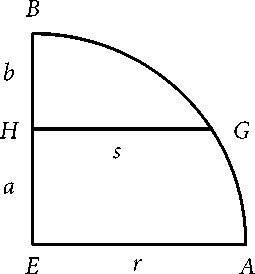
Fig. 1.
Khayyam depicts these rectangles in the drawing, assuming that the problem has already been solved. A rectangle GKEH with sides (s, a) is obtained by dropping a perpendicular GK onto EA. To construct a rectangle BHLM with sides (r, b), we draw another quarter of the circle BEC, circumscribe a square BECM around it and extend the segment GH until it meets CM at point L. In the next step, we extend the segments KG and MB until they meet at point F. By adding the rectangle FGHB to the rectangles GKEH and BHLM, equal in area, we obtain the rectangles FKEB and FGLM, which are also equal in area. It follows that the points L and E lie on the hyperbola with asymptotes FM and FK (Fig. 2).
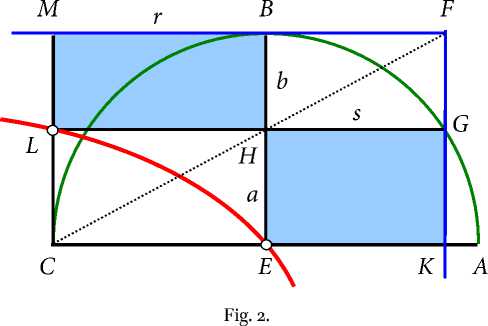
Now we need to find out whether it is possible to obtain a solution to the problem based on this construction. To determine the position of the segment HG , we need to know either the position of the point L on CM , or the position of the asymptote FK intersecting the arc of the circle at point G . However, only the positions of the asymptote FM and point E are known, which is not enough to draw the hyperbola. Therefore, the problem is not solved directly this way, although Khayyam writes about a certain possibility of completing the construction, relying on the methods from the Conics of Apollonius. It seems, however, that here he has lost his way and does not understand how to proceed with this drawing.
Solution in the appendix
In the appendix to Khayyam’s treatise, a solution to the first problem is presented. Here Khayyam draws a hyperbola with asymptotes CA and CM , passing through points B and G (Fig. 3). Now both asymptotes and point B are known by position. The hyperbola drawn through point B intersects the semicircle at point G , which solves the problem.
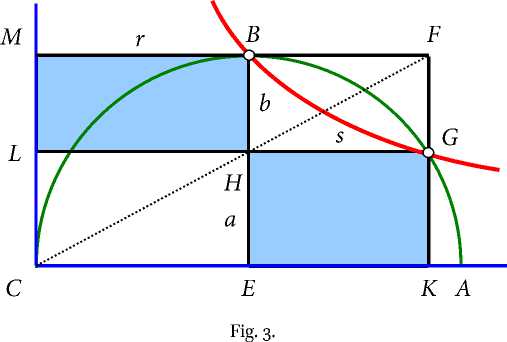
The fact that Khayyam did not find this correct solution at first and only later detected his mistake indicates that the text of the treatise was written down in parts and was not revised later. During such a revision, the unsuccessful approach would have been rejected and replaced with the successful one, but this did not happen.
Methodological remark
Solutions to geometric problems using conic sections are purely speculative. Straight lines and circles are drawn using a ruler and compass, but how can we draw a hyperbola with given asymptotes passing through a given point? It is difficult to consider such a construction as practically feasible.
So, if we want to divide a quarter of a circle in the required proportion, we must compose the corresponding algebraic equation and find an approximate value of its root, as al-Biruni did before Khayyam, considering a regular nonagon. Or we must perform this construction by the neusis method, similar to how some ancient mathematicians solved the cube doubling problem, or how Archimedes constructed a regular heptagon.
Algebraic equations
In the language of algebra, the problem of dividing a quarter of a circle leads to a system of three equations relating four quantities:
r = a + b , r 2 = s 2 + b 2, rb = sa .
There are six ways to eliminate two variables from this system and obtain one equation. Due to the similarity of the right triangles BGH and HAE, the equations for (s, r) and (b, a), as well as the equations for (r, a) and (s, b), will be the same. Three of these equations are cubic, and the fourth is of the fourth degree:
s 3 + 2 a 2 s = 2 as 2 + 2 a 3, b 3 + 6 r 2 b = 4 rb 2 + 2 r 3, s 3 + 2 rs 2 = 2 r 3, r 4 + a 4 = 2 r 3 a .
In any of these equations one can fix the numerical value of one quantity, and treat the second quantity as the unknown. However, for some reason, Khayyam does not follow this path, but instead proceed to a second geometric problem based on the first one.
The second geometric problem
Let us assume that point G has already been found. So we draw a tangent GF to the arc AB until it meets the extension of radius EB at point F . We also draw the quarter circle AED and segments GB , GE , and GD (Fig. 4).
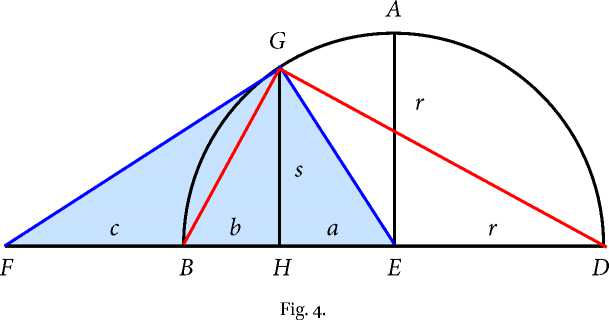
Expressing the square of the common altitude GH of the right triangles GBD and GFE through the products of the parts of their hypotenuses, we obtain s2 = (c + b)a = b(a + r).
Subtracting ba from both sides, we get ac = br . On the other hand, according to the conditions of the problem, we have as = br . From these two equalities we find that c = s .
Thus, the hypotenuse FE is equal to the sum of the altitude GH and the side GE . (Khayyam proves that this side is the smaller of the two legs). And Khayyam’s second geometric problem is to construct a triangle with this property.
This triangle Khayyam calls “very useful in such applications”; therefore we need to understand which applications he is talking about.
Another property of Khayyam’s triangle
Next, Khayyam formulates and proves another property of this triangle. Namely, its larger leg is equal to the sum of the smaller leg and the projection of the smaller leg onto the hypotenuse. The proof of this fact is based on Fig. 5.
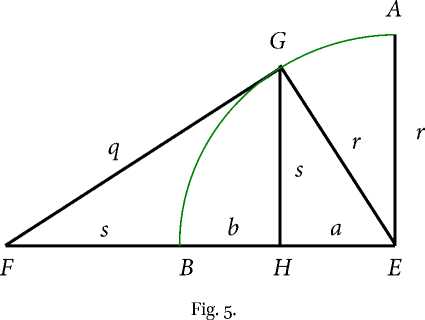
On the one hand, initially we have r : s = a : b, therefore, by the properties of proportions, we obtain r : s = (r + a) : (s + b).
On the other hand, from the similarity of the triangles HGE and HFG r : s = q : ( s + b ).
Equating the right-hand sides of these two proportions, (r + a) : (s + b) = q : (s + b), which gives q = r + a.
Why does Khayyam derive this property, which is not used anywhere else? Why does he pay special attention to it? This is another question that deserves to be addressed.
Writing a cubic equation
In the next step, Khayyam obtains a cubic equation relating s and a (we know that he could have done this earlier, within the first geometric problem). He assumes a = 10 and performs all calculations with this numerical value. Making such an assumption was a common technique in many medieval treatises on algebra, beginning with the algebraic treatise by al-Khwarizmi. Let us reproduce Khayyam’s reasoning below.
From the similarity of triangles GFE and GHE, the hypotenuse s + r is to the leg r as this leg r is to its projection onto the hypotenuse a = 10, therefore s + r = r2/10.
According to the Pythagorean theorem for triangle GHE r2 = s2 + 100, therefore r = r2/10 – s = (s2 + 100)/10 – s = s2/10 + 10 – s.
Squaring both sides, we get r2 = s2 + 100 = (s2/10 + 10 – s)2.
Expanding the parentheses and combining like terms, we obtain a cubic equation s3 + 200s = 20s2 + 2000, which Khayyam writes in the standard form for medieval algebra, so that all terms to the right and left of the equals sign are positive (“cubes and things are equal to squares and numbers”).
Reducing the cubic equation to a convenient form
The equation is set up, but how to solve it? Here begins Khayyam’s path to finding its root using conic sections. Let’s rewrite this equation as
20 s 2 – s 3 = 200 s – 2000
and factor out the common factors on both sides:
s 2(20 – s ) = 200( s – 10).
Geometrically, this equation can be interpreted as the equality of the volumes of two cuboids. To reduce three-dimensional constructions to two-dimensional ones, we multiply both sides by s – 10 and extract the square root of both sides:
s · √(20 – s )( s – 10) = √200 · ( s – 10).
From this, we derive the proportion s : √200 = (s – 10) : √(20 – s)(s – 10), which can be interpreted as the similarity of two rectangles.
Analysis and construction
Assuming that s is known, we draw a rectangle ALFC with sides AL = s and AC = √200. By marking off a segment AD = 10 along AL , the remainder DL = s – 10. By marking off a segment AB = 20 along AL , the protrusion BL = 20 – s . Now we draw a semicircle on the diameter BD , which intersects the segment LF at point K . In this case, LK = √(20 – s )( s – 10), as the altitude of a right triangle inscribed into the semicircle. Due to the similarity of rectangles ALFC and DLKH and the resulting equality of the areas of rectangles ADEC and MKFC , points K and D lie on a hyperbola with asymptotes CF and CA (Fig. 6).
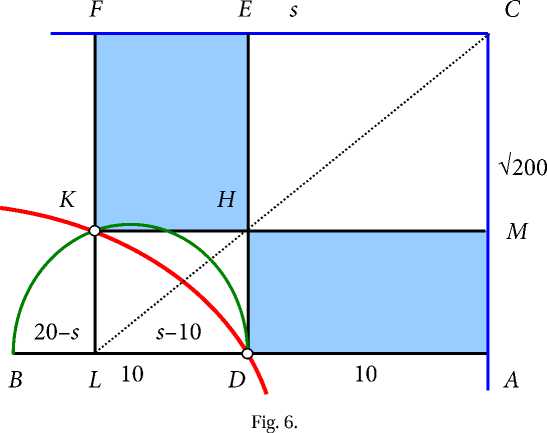
To perform the construction, draw the ray CF and lay off the segment CA = √200 perpendicular to it. Draw the segment AB = 20 parallel to CF and divide it at point D into two segments of the length 10. Through point D draw a hyperbola with as- ymptotes CF and CA. On the diameter BL draw a semicircle that intersects the hyperbola at point K. Draw the segment LF through K until it meets the ray CF at point F. The segment AL (or CF) has the desired length s, thus the root of the cubic equation is found.
Trigonometric solution
At the end of his treatise, Khayyam states that the problem of dividing a quarter of a circle can be solved using trigonometric tables (Fig. 7).
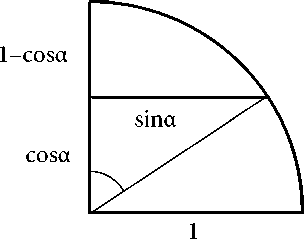
Fig. 7.
Taking the radius r = 1 (Khayyam uses r = 60 in order to utilize the Almagest tables, but this does not change anything), the problem leads to the equation sinα : 1 = (1 – cosα) : cosα.
Khayyam finds from the tables an approximate solution α = 57°, after which he notes that “by further refinement, one can ensure that the difference will be imperceptible.” To the nearest arcminute, the solution is α = 57°4ʹ, which gives sinα = 0.8393, cosα = 0.5437.
It should be noted that this solution provided by Khayyam is the only one that can be used in practice. But what might a practical situation look like in which such a construction is required? We will discuss this below.
Khayyam’s final words
Khayyam’s treatise ends with a passage which I quote below:
This is what came to my mind on this issue during the division of concepts, the exertion of thought and the practical verification of examples of these particulars. If it were not for the nobility of the assembly, may this nobility be eternal, and the dignity of the questioner, may Allah make His support for him eternal, I would be at a great distance from this, since my attention is limited to what is more important to me than these examples and to which all my strength is devoted.
What can we conclude from these words? We see that Khayyam was busy with some important matter that occupied all his time; at the same time, he participated in some scholarly assembly, perhaps at the ruler’s court. The Turkish historian of mathematics Alpay Özdural conjectured that this important matter was the construction of an observatory in Isfahan, to which the Seljuk Sultan Malik Shah invited Khayyam in 1073, so that the aforementioned assembly took place soon after, and Khayyam was asked a question at this assembly (Özdural 1995). Khayyam’s expertise as a geometer was sufficient to answer this question, and this answer was a short treatise he compiled. Now I want to discuss the possible content of this question, based on the considerations put forward by Özdural.
Khayyam’s triangle and the pattern with a rotated square
Khayyam’s right-angled triangle is also considered in the anonymous Persian treatise. Its Russian translation by A. B. Vildanova was published under the title Introduction to Similar and Corresponding Figures in the book Bulatov 1988. The English translation by A. Özdural was published under the title On Similar and Complementary Interlocking Figures in the book Necipoğlu 2017. Below we will refer to this work as Anonymous Treatise .
The Anonymous Treatise deals with various geometric patterns used in ornamentation. In particular, the pattern shown in Fig. 8 is considered there. Here the large square is divided into five main parts: the central small rotated square and four surrounding right-angled triangles. Also a special condition is added: the perpendiculars dropped from the vertices of the central square to the sides of the outer square are equal to the sides of the central square.
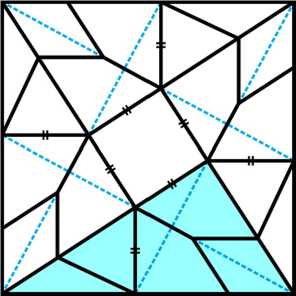
Fig. 8.
This drawing is accompanied by the following comment:
The proportion of this pattern is also from conics. The objective is to construct a rightangled triangle in which the altitude plus the shorter side is equal to the hypotenuse. Ibn al-Haytham has composed a treatise on the construction of this triangle, and his construction uses conic sections, a hyperbola and a parabola.
Ibn al-Haytham (965–1039) was a prominent Arab mathematician, known in Europe by his Latinized name Alhazen. Also he was born in Basra in southern Iraq, he spent most of his life in Cairo. It is highly unlikely that he would have studied the triangle discussed here in connection with architectural ornamentation, since this art was in its infancy at the beginning of the 11th century and developed mainly in Greater Khorasan, far from Cairo. Thus, scholars generally accept that there is a lapsus calami here, and person mentioned is, in fact, Omar Khayyam.
Let us transform Fig. 8 to Fig. 9 by removing excess details and labeling the dimensions. It is now evident that the hypotenuse of the large right-angled triangle (marked in blue) is equal to the sum of its leg r and altitude s , which corresponds to Khayyam’s second problem. It is also clear that the larger leg of this triangle is equal to the sum of the smaller leg r and its projection a .
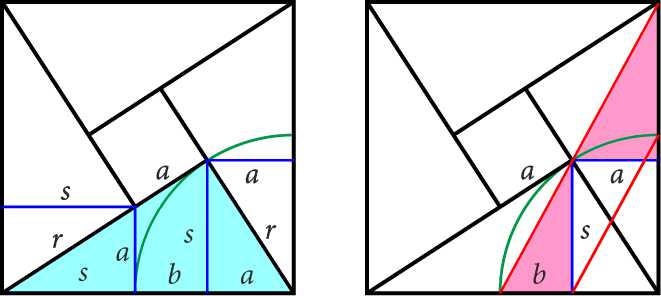
Fig. 9.
In addition, two similar right triangles (marked in pink) yield the proportion r : s = a : b . The upper rectangle can be shifted down so that its upper vertex lies on the arc, which leads back to Khayyam’s first problem. Thus, both of Khayyam’s problems are embedded into the structure of this drawing.
Why does Khayyam not mention the pattern that leads to his geometrical problems? Perhaps he was trying to separate “pure” mathematics from the “applied” art of ornamentation, guided by the philosophical principles inherited from Platonist antiquity. As a result, his “pure” mathematics forfeits much of its clarity and comprehensibility. On the other hand, we see that the restoration of the original applied problem renders the entire situation more understandable.
Construction of Khayyam’s triangle by neusis method
In the Anonymous Treatise , Khayyam’s triangle is constructed using a T-square and a ruler by the neusis method. We know that the vertex of the right angle of this triangle lies on a semicircle drawn on the side of the square; we also know that the distances from this vertex to the bottom corner and to the upper side of the square are equal.
To perform this, we place the T-square along the upper side of the square and move it along this side. The ruler is also moved so that its end touches the T-square at a point lying on the arc of the semicircle, while its edge passes through the bottom vertex of the square (Fig. 10). We need to find a point of the arc such that two aforementioned distances will be equal, which solves the problem.
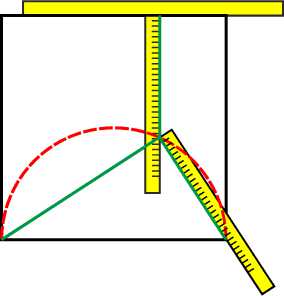
Fig. 10.
Conclusion
The above analysis shows that abstract equations of the medieval algebraists could have a very specific, applied origin. It is only because the text of Introduction survived and was compared by Alpay Özdural with Khayyam’s treatise that we know both Khayyam’s problems were connected with a specific pattern invented by one of the masters of this art.
From this point of view, we can also look at the cubic equations that Khayyam examines in his main algebraic work. Thus, as an example, he mentions the equation:
x2 + 2x + 10 = 20/x, which he immediately reduces to the form:
x 3 + 2 x 2 + 10 x = 20.
This equation was examined a century and a half later by Leonardo Pisano (Fibonacci) in his treatise Flos (1225), having been proposed to him by Johannes of Palermo at a mathematical tournament at the court of Emperor Frederick II.
In light of what has been said above, we can ask whether this equation was also connected with some geometric problem. Of course, it is not easy to reconstruct the initial problem from its algebraic equation, but this possibility should be kept in mind.
