
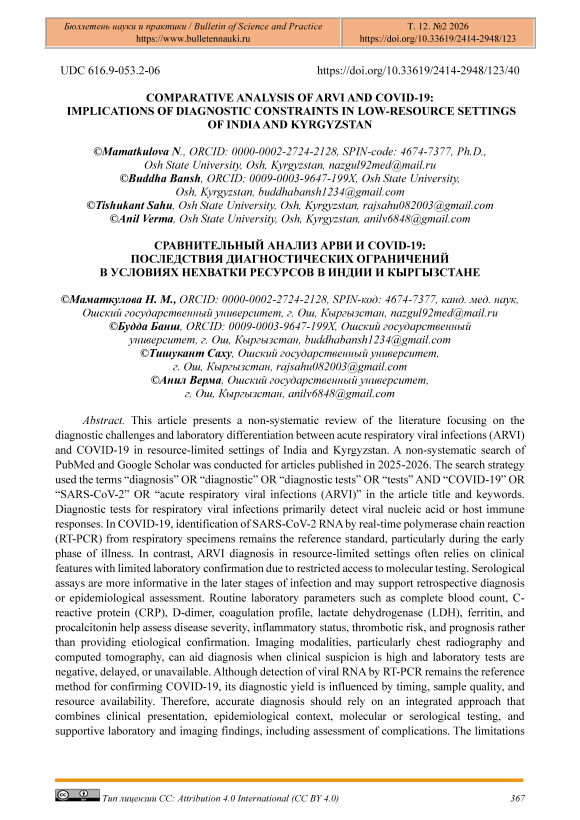
Comparative Analysis of ARVI and COVID-19: Implications of Diagnostic Constraints in Low-Resource Settings of India and Kyrgyzstan
Journal: Bulletin of Science and Practice @bulletennauki
Section: Медицинские науки
Article in issue: 2 т.12, 2026.
Free access
This article presents a non-systematic review of the literature focusing on the diagnostic challenges and laboratory differentiation between acute respiratory viral infections (ARVI) and COVID-19 in resource-limited settings of India and Kyrgyzstan. A non-systematic search of PubMed and Google Scholar was conducted for articles published in 2025-2026. The search strategy used the terms “diagnosis” OR “diagnostic” OR “diagnostic tests” OR “tests” AND “COVID-19” OR “SARS-CoV-2” OR “acute respiratory viral infections (ARVI)” in the article title and keywords. Diagnostic tests for respiratory viral infections primarily detect viral nucleic acid or host immune responses. In COVID-19, identification of SARS-CoV-2 RNA by real-time polymerase chain reaction (RT-PCR) from respiratory specimens remains the reference standard, particularly during the early phase of illness. In contrast, ARVI diagnosis in resource-limited settings often relies on clinical features with limited laboratory confirmation due to restricted access to molecular testing. Serological assays are more informative in the later stages of infection and may support retrospective diagnosis or epidemiological assessment. Routine laboratory parameters such as complete blood count, C-reactive protein (CRP), D-dimer, coagulation profile, lactate dehydrogenase (LDH), ferritin, and procalcitonin help assess disease severity, inflammatory status, thrombotic risk, and prognosis rather than providing etiological confirmation. Imaging modalities, particularly chest radiography and computed tomography, can aid diagnosis when clinical suspicion is high and laboratory tests are negative, delayed, or unavailable. Although detection of viral RNA by RT-PCR remains the reference method for confirming COVID-19, its diagnostic yield is influenced by timing, sample quality, and resource availability. Therefore, accurate diagnosis should rely on an integrated approach that combines clinical presentation, epidemiological context, molecular or serological testing, and supportive laboratory and imaging findings, including assessment of complications. The limitations observed in current diagnostic strategies highlight the need for more sensitive, specific, and rapid diagnostic tools, particularly in resource-constrained settings.
Similar articles in the section Communicable diseases. Infectious and contagious diseases, fevers
Short address: https://sciup.org/14134452
IDS: 14134452 | UDC: 616.9-053.2-06 | DOI: 10.33619/2414-2948/123/40
Сравнительный анализ АРВИ и COVID-19: последствия диагностических ограничений в условиях нехватки ресурсов в Индии и Кыргызстане
Представлен несистематический обзор литературы, посвященный диагностическим проблемам и лабораторной дифференциации острых респираторных вирусных инфекций (ОРВИ) и COVID-19 в условиях ограниченных ресурсов Индии и Кыргызстана. Был проведен несистематический поиск статей, опубликованных в 2025–2026 годах, в PubMed и Google Scholar. Стратегия поиска использовала термины «диагноз» или «диагностический» или «диагностические тесты» или «тесты» и “COVID-19” ИЛИ “SARS-CoV-2” или «острые респираторные вирусные инфекции (ОРВИ)» в названии статьи и ключевых словах. Диагностические тесты на респираторные вирусные инфекции в первую очередь выявляют вирусные нуклеиновые кислоты или иммунные реакции хозяина. При COVID-19 идентификация РНК SARS-CoV-2 с помощью полимеразной цепной реакции в реальном времени (ОТ-ПЦР) из респираторных образцов остается эталонным стандартом, особенно на ранней стадии заболевания. Диагностика ОРВИ в условиях ограниченных ресурсов часто основывается на клинических признаках с ограниченным лабораторным подтверждением из-за ограниченного доступа к молекулярному тестированию. Серологические анализы более информативны на поздних стадиях инфекции и могут способствовать ретроспективной диагностике или эпидемиологической оценке. Обычные лабораторные параметры, такие как общий анализ крови, С-реактивный белок (СРБ), D-димер, профиль коагуляции, лактатдегидрогеназа (ЛДГ), ферритин и прокальцитонин, помогают оценить тяжесть заболевания, воспалительный статус, тромботический риск и прогноз, а не обеспечивают этиологическое подтверждение. Методы визуализации, в частности рентгенография грудной клетки и компьютерная томография, могут помочь в диагностике, когда клинические подозрения высоки, а лабораторные анализы отрицательны, запоздалы или недоступны. Хотя обнаружение вирусной РНК с помощью ОТ-ПЦР остается эталонным методом подтверждения COVID-19, на его диагностическую эффективность влияют время, качество образца и доступность ресурсов. Таким образом, точная диагностика должна основываться на комплексном подходе, сочетающем клиническую картину, эпидемиологический контекст, молекулярное или серологическое тестирование, а также подтверждающие результаты лабораторных исследований и визуализации, включая оценку осложнений. Ограничения, наблюдаемые в современных диагностических стратегиях, подчеркивают необходимость в более чувствительных, специфичных и быстрых диагностических инструментах, особенно в условиях ограниченных ресурсов.
Text of the scientific article Comparative Analysis of ARVI and COVID-19: Implications of Diagnostic Constraints in Low-Resource Settings of India and Kyrgyzstan
Бюллетень науки и практики / Bulletin of Science and Practice
The emergence of coronavirus disease 2019 (COVID-19) has posed a major challenge to global health systems. Caused by the novel severe acute respiratory syndrome coronavirus 2 (SARS-CoV-2), the disease was first reported in Wuhan, China, and rapidly spread across countries, affecting millions of people worldwide. One of the most concerning aspects of COVID-19 is its ability to cause severe respiratory illness, leading to complications and death, especially in vulnerable populations.
Acute respiratory viral infections (ARVI) represent a broad group of illnesses with clinical features that often overlap with COVID-19, including fever, cough, sore throat, and shortness of breath. This clinical similarity has made early and accurate diagnosis particularly difficult, especially in settings where access to advanced laboratory investigations is limited. In many low- and middleincome regions, including parts of India and Kyrgyzstan, diagnostic decisions are frequently based on clinical judgment rather than confirmatory testing. Laboratory diagnosis plays a key role in differentiating COVID-19 from other respiratory viral infections.
However, molecular tests such as reverse transcriptase–polymerase chain reaction (RT-PCR), although considered the reference standard, are not always readily available and may show variable sensitivity depending on timing, sample quality, and infrastructure. As a result, healthcare providers often rely on a combination of clinical findings, epidemiological history, basic laboratory markers, and imaging studies to guide diagnosis and management.
Resource limitations further complicate the diagnostic process, leading to delays in detection, misclassification of cases, and challenges in infection control. Understanding these diagnostic gaps is essential for improving patient outcomes and optimizing the use of available resources. This article aims to compare the diagnostic approaches for ARVI and COVID-19, with a particular focus on laboratory challenges faced in resource-limited settings in India and Kyrgyzstan.
This study was conducted in a tertiary care hospital in India. Data were collected during the COVID-19 pandemic, covering periods before and after the implementation of lockdown measures. The pre-lockdown phase corresponded to the early phase of the outbreak, while the post-lockdown phase included the period when restrictions were gradually implemented and healthcare services were functioning under pandemic protocols.
The study population consisted of patients presenting with acute respiratory symptoms and healthcare staff involved in their initial assessment. A total of 43 participants were included in the study, selected using a simple random sampling technique. The sample size was estimated using Cochran’s formula to ensure adequate representation.
Baseline data regarding clinical presentation, diagnostic testing, and initial management of acute respiratory viral infections were collected during the pre-lockdown period. After the lockdown, a separate group of participants was randomly selected to evaluate changes in diagnostic approaches, laboratory availability, and clinical decision-making related to COVID-19. Randomization was applied to minimize selection bias and ensure comparability between the two phases.
Data were obtained from hospital medical records and laboratory registers using a structured data extraction form designed for this study. The form included variables related to patient demographics, presenting symptoms, laboratory investigations, imaging findings, and final diagnosis. The data collection tool was reviewed for content validity by senior clinicians and microbiology faculty. Reliability testing showed acceptable internal consistency.
A total of 43 cases presenting with acute respiratory symptoms were included in the analysis. The majority of patients were adults aged 18–40 years (62.7%), followed by those aged 41–60 years (27.9%). Elderly patients above 60 years accounted for a smaller proportion of the sample (9.4%). Most patients were male (58.1%), while females constituted 41.9% of cases.
Before the implementation of lockdown measures, diagnosis of respiratory infections was largely based on clinical assessment and basic laboratory investigations. Complete blood count and chest radiography were the most commonly used investigations, while confirmatory molecular testing was limited due to restricted availability. During this period, a significant proportion of cases were initially labeled as non-specific ARVI.
After lockdown, there was a noticeable shift in diagnostic approach. The use of RT-PCR testing for SARS-CoV-2 increased, and a greater number of patients underwent confirmatory testing at presentation. As a result, a higher proportion of cases were correctly identified as COVID-19
compared to the pre-lockdown period. This change was statistically significant, indicating improved diagnostic accuracy following the expansion of testing facilities.
Analysis showed that patients diagnosed using molecular testing had a significantly higher rate of confirmed COVID-19 compared to those evaluated solely on clinical and radiological findings. In the pre-lockdown phase, misclassification of COVID-19 as ARVI was more frequent, particularly among patients with mild symptoms. Post-lockdown data demonstrated a reduction in diagnostic uncertainty, with fewer cases requiring revision of diagnosis during hospitalization.
These findings highlight the impact of diagnostic availability on case identification and underline the limitations of symptom-based diagnosis in differentiating COVID-19 from other acute respiratory viral infections.
Table 1
|
Diagnostic parameter |
Pre-lockdown, n = 43 |
Post-lockdown, n = 43 |
p-value |
|
Clinical diagnosis only (no lab confirmation), n (%) |
26 (60.5) |
9 (20.9) |
<0.01 |
|
RT-PCR performed, n (%) |
11 (25.6) |
34 (79.1) |
<0.001 |
|
Diagnosed as COVID-19, n (%) |
8 (18.6) |
29 (67.4) |
<0.001 |
|
Diagnosed as ARVI, n (%) |
31 (72.1) |
12 (27.9) |
<0.01 |
|
Chest X-ray performed, n (%) |
29 (67.4) |
31 (72.1) |
0.63 |
|
Elevated CRP, n (%) |
18 (41.9) |
24 (55.8) |
0.21 |
|
Diagnosis revised during hospital stay, n (%) |
10 (23.3) |
3 (7.0) |
0.03 |
Before lockdown, almost all patients had heard about COVID-19, with 90.7% correctly identifying it as a viral infection and the main causative agent. After lockdown, awareness improved, with 100% of participants knowing that COVID-19 is caused by a virus.
Regarding knowledge of transmission methods (Table 2), before lockdown, most patients recognized sneezing (86%), coughing (69.8%), touching surfaces (65.1%), shaking hands (60.5%), and close contact like hugging (41.9%) as ways the virus spreads. After lockdown, there was a notable improvement: sneezing (97.7%), coughing (97.7%), touching surfaces (95.3%), shaking hands (97.7%), and hugging (79.1%). Awareness about other possible transmission sources, such as contaminated objects (doorknobs, money, mobile phones), also increased significantly from 33.7% pre-lockdown to 75.5% post-lockdown. These results suggest that lockdown measures, along with increased access to media and hospital awareness programs, contributed to better understanding of COVID-19 transmission among patients and hospital staff.
Table 2
|
Transmission Method |
Pre-lockdown, n % |
Post-lockdown, n % |
Change % |
|
Sneezing |
37 (86.0) |
42 (97.7) |
+11.7 |
|
Coughing |
30 (69.8) |
42 (97.7) |
+27.9 |
|
Touching contaminated surfaces |
28 (65.1) |
41 (95.3) |
+30.2 |
|
Shaking hands |
26 (60.5) |
42 (97.7) |
+37.2 |
|
Hugging / close contact |
18 (41.9) |
34 (79.1) |
+37.2 |
|
Contaminated objects (doorknobs, money, mobile phone) |
14 (33.7) |
32 (75.5) |
+41.8 |
Knowledge about the major sources of infection for ARVI and COVID-19 is summarized in Table 3. Before lockdown, only 41.9% of participants correctly identified airborne transmission (through coughing and sneezing droplets) as a source of infection, while 81.4% correctly recognized person-to-person contact. Misconceptions were common: 55.8% of participants incorrectly thought contaminated meat could transmit the virus, and 32.6% considered domestic animals to be a source. Smaller percentages of students also incorrectly identified water, soil, cross-contamination with camels, and seafood as infection sources.
After lockdown, awareness improved significantly. Correct identification of airborne transmission rose to 93%, and person-to-person contact was recognized by 97.7% of participants. Meanwhile, misconceptions about contaminated meat and domestic animals decreased, with only 27.9% and 18.6% respectively still holding incorrect beliefs. Knowledge about other incorrect sources, such as water, soil, camels, and seafood, also decreased slightly.
These results indicate that lockdown measures, together with increased access to public health messaging and hospital awareness programs, helped improve understanding of the actual sources of ARVI and COVID-19 infections while reducing common misconceptions among patients and staff.
Recognition of the main sources of infection improved notably after lockdown. Correct identification of airborne transmission increased to 53.5%, while awareness of person-to-person contact as a source rose sharply to 97.7%. Despite this improvement, some participants continued to mention incorrect sources, such as contaminated meat, domestic animals, water, soil, camels, and seafood, indicating that certain misconceptions persisted even after lockdown and awareness efforts.
Table 4 shows participants’ knowledge about the main symptoms of COVID-19. The correct symptoms included fever, cough, shortness of breath, and headache. Before lockdown, most students correctly identified fever (79.1%), cough (76.7%), and shortness of breath (72.1%) as symptoms. However, only 34.9% recognized headache as a symptom. Some students also incorrectly mentioned other symptoms such as runny nose, diarrhea, and general body pain.
After lockdown, awareness improved for all correct symptoms, with more participants identifying fever, cough, shortness of breath, and headache accurately. Misconceptions about other non-specific symptoms decreased slightly, indicating that the lockdown period, along with increased access to information, helped improve knowledge of COVID-19 symptoms among the participants.
Table 3
|
Symptom |
Pre-lockdown, n (%) |
Post-lockdown, n (%) |
Change (%) |
|
Fever |
34 (79.1) |
42 (97.7) |
+18.6 |
|
Cough |
33 (76.7) |
41 (95.3) |
+18.6 |
|
Shortness of breath |
31 (72.1) |
40 (93.0) |
+20.9 |
|
Headache |
15 (34.9) |
28 (65.1) |
+30.2 |
|
Runny nose |
10 (23.3) |
5 (11.6) |
-11.7 |
|
Diarrhea |
7 (16.3) |
4 (9.3) |
-7.0 |
|
General body pain |
12 (27.9) |
6 (14.0) |
-13.9 |
After lockdown, awareness improved for all correct symptoms, with more participants identifying fever, cough, shortness of breath, and headache accurately. Misconceptions about other non-specific symptoms decreased slightly, indicating that the lockdown period, along with increased access to information, helped improve knowledge of COVID-19 symptoms among the participants.
Participants’ knowledge regarding COVID-19 protection methods improved notably after lockdown. Before lockdown, correct knowledge was limited. For instance, 79.1% of participants correctly identified “avoid contact with infected persons” as a protective measure, which increased to 100% post-lockdown. Similarly, awareness of mask-wearing as an effective preventive measure improved from 37.2% pre-lockdown to 62.8% post-lockdown. Misconceptions also decreased; for example, fewer students incorrectly considered “avoid contact with domestic animals” as a protection method, with responses dropping from 25.6% to 14%. These results suggest that lockdown measures, along with public health campaigns and hospital awareness programs, contributed to better understanding of protective measures among participants.
Table 4
|
Protection Method |
Pre-lockdown, n (%) |
Post-lockdown, n (%) |
Change (%) |
|
Avoid contact with infected persons |
34 (79.1) |
43 (100) |
+20.9 |
|
Wear face mask |
16 (37.2) |
27 (62.8) |
+25.6 |
|
Wash hands frequently |
28 (65.1) |
40 (93.0) |
+27.9 |
|
Maintain social distancing |
22 (51.2) |
38 (88.4) |
+37.2 |
|
Avoid contact with domestic animals |
11 (25.6) |
6 (14.0) |
-11.6 |
Figure shows participants’ overall knowledge levels about COVID-19 before and after the lockdown. Before lockdown, the mean knowledge score was 73.2%, indicating moderate understanding among participants. After lockdown, the mean score increased to 81.5%, reflecting improved awareness of COVID-19 symptoms, transmission methods, sources of infection, and protection measures. This suggests that lockdown measures, along with increased access to information through media and hospital awareness programs, helped enhance participants’ knowledge about the disease.
Effective protection against highly contagious diseases like COVID-19 requires strict adherence to guidelines, particularly non-therapeutic interventions such as mask-wearing, social distancing, and hand hygiene. The implementation of these measures depends heavily on individuals’ knowledge, attitudes, and practices. The current study aimed to assess the impact of lockdown on preparatory year students’ awareness and behavior regarding COVID-19. Most participants were aged between 17–23 years, an age group considered more socially active and potentially asymptomatic carriers, which could contribute significantly to the spread of infection among peers and family members.
The results indicated that students’ knowledge of COVID-19 transmission methods, including sneezing, coughing, and touching contaminated surfaces, improved significantly following lockdown. This highlights the important role of Saudi authorities and public health campaigns in raising awareness during the pandemic. Participants correctly understood that water, soil, domestic animals, and contaminated meat are not sources of COVID-19 infection, reflecting reduced misconceptions compared to reports from other student populations.
Knowledge regarding protective measures also improved post-lockdown. For example, the percentage of students recognizing the importance of avoiding contact with infected persons increased from 79.1% to 100%, and awareness of mask-wearing rose from 37.2% to 62.8%. Similarly, social distancing, avoiding hugging, and proper hand hygiene were better understood, aligning with national and international preventive measures. These findings are consistent with studies conducted among students in China, Indonesia, and Saudi Arabia, where similar improvements in awareness and preventive practices were reported.
Participants’ understanding of COVID-19 symptoms also improved. Fever, cough, and shortness of breath were widely recognized, with post-lockdown identification rates reaching nearly 100% for fever and shortness of breath and almost all participants recognizing cough. Headache awareness also improved, though it remained lower than other symptoms. This pattern is in line with previous research in Saudi Arabia, Indonesia, and China, which found that students generally recognized major COVID-19 symptoms, though minor symptoms were less frequently identified.
Knowledge about treatment and vaccines was satisfactory. Most participants were aware that no clinically approved treatment or vaccine existed at the time of the study, consistent with previous studies in Saudi Arabia and India. This indicates that students had realistic expectations about the disease, which may help reduce risky behaviors and overreliance on unproven remedies.
The study also highlighted the significant role of social media, television, and family in disseminating COVID-19 information. Post-lockdown, the influence of family and friends increased, especially among younger students, suggesting that personal networks played an important role alongside institutional efforts from IAU. Social media emerged as the primary source of information, consistent with findings from other higher education institutions in Jordan, Malaysia, and the UAE, where students relied heavily on online platforms for verified information.
Behavioral outcomes also changed following lockdown. Students demonstrated increased anxiety related to potential contact with infected peers and a rise in absenteeism. These findings are consistent with global reports on the mental health impact of COVID-19 on students, emphasizing the need for psychological support and strategies to manage stress.
Some limitations should be considered. First, the study was conducted among a small sample of male students from a single university, limiting generalizability. Second, the exclusion of female students introduces potential gender bias. Third, different participants were selected for pre- and postlockdown assessments, which may not fully capture individual knowledge, attitudes, and practices over time. Despite these limitations, the study provides valuable insight into student awareness, behavior, and information sources during a major public health crisis.
Future research should explore individual-level longitudinal assessments, include broader and more diverse student populations, and investigate how students interact with peers and family regarding COVID-19 information and safety practices. Such studies could help design better-targeted interventions to improve disease prevention and mental well-being during pandemics.
Conclusion
The similarities and differences in the clinical presentation of ARVI and COVID-19 make accurate diagnosis challenging, especially in resource-limited settings. Students’ limited knowledge about diagnostic methods and the distinguishing features of these infections may contribute to delays or errors in identification. This study suggests that the majority of students had a fair understanding of the basic diagnostic approaches for ARVI and COVID-19, but awareness of advanced testing and limitations was lower. Media and online resources played a key role in improving their knowledge. Introducing simple, practical health education programs focused on differentiating ARVI from COVID-19 could further enhance students’ diagnostic understanding. The findings of this study can help in designing awareness initiatives that support early recognition and appropriate management of respiratory infections in resource-limited areas.
Referances:
