
Comparative Analysis of Electoral Behavior Patterns and Preferences in the Kalevalskiy District of the Karelian Arctic (2015–2024)
Journal: Arctic and North @arctic-and-north
Section: Northern and arctic societies
Article in issue: 61, 2025.
Free access
The article examines the specifics of electoral behavior and preferences of voters in the Kalevalskiy District of the Republic of Karelia from the moment it was included in the Arctic zone of the Russian Federation in 2015 until the 2024 presidential elections. The author points out that, despite increased research interest in the Arctic national territory, electoral practices and the will of voters are not given due attention, while they allow to identify not only the value preferences of the electorate, but also to localize existing problems in the area that require measures to be taken to resolve them. The paper studies the election participation behavior of the residents of the Kalevalskiy District at the federal, regional and local levels in comparison with the population of the Republic of Karelia and its Arctic territories. The paper establishes the values of voter turnout, the indicator of protest potential in relation to the degree of elections’ alternativeness. The author also analyzes the role of political powers that traditionally participate in the elections and their influence on the voting preferences of residents of the Arctic Karelian border region. As a result of the study, a model of the typical voter in the Kalevalskiy District is created (in terms of demographic structure, it is predominantly a person older than working age, not inclined to protest, with an established system of values, and diligent civic participation in elections at various levels) that determines voting behavior and preferences. Using a neo-endogenous approach and identifying the cleavages structures based on multifactor analysis, a pattern of the Arctic national region of the Russian Arctic was constructed as a possible case for future comparative researching of national territories of the Arctic zone.
Similar articles in the section Elections. Plebiscites. Referendums. Election campaigns. Electoral corruption, malpractice. Election results
Short address: https://sciup.org/148332695
IDS: 148332695 | UDC: [324:316.3](985)(045) | DOI: 10.37482/issn2221-2698.2025.61.237
Text of the scientific article Comparative Analysis of Electoral Behavior Patterns and Preferences in the Kalevalskiy District of the Karelian Arctic (2015–2024)
DOI:
H, ORCID:
The Arctic is an important strategic region for the Russian Federation. The rich resource potential of the Arctic Zone of the Russian Federation (AZRF) is relevant not only to domestic policy issues, but also to socio-economic and political processes related to the country’s external security. The main priority of Russia's policy in the Arctic is to preserve its status as a territory of peace, stability and mutually beneficial cooperation.
The AZRF is diverse and includes territories with special jurisdictional and closed status, border regimes, single-industry municipalities that influence the investment climate and capital inflows, national regions, languages of indigenous and small peoples, and historical sites protected by UNESCO and have historical and cultural value of global significance. The economic activities of the residents are linked to the traditional crafts of indigenous peoples.
∗ © Rozhneva S.S., 2025
T his work is licensed under a CC BY-SA License
The Republic of Karelia includes six Arctic territories of different status, including both industrial and national northern areas. This influences the specifics of ongoing socio-economic and political processes [1, Khare N., Khare R.; 2, Elias S.], and highlights issues of civic identity in the context of global challenges and threats, the militarization of the Arctic [3, Petersen M.B., Pincus R.], etc., particularly affecting the daily practices of border residents.
The Kalevalskiy District is the only national border area in the Karelian Arctic, with about 36% of its residents being Karelians (as of January 1, 2020) 1. The district is a place where the titular nation and the cultural and historical heritage of the northern territories are preserved, which influences the value matrix of its residents. “The region’s location, its natural environment, and its cultural heritage contribute to the emergence of a specific spirit of the region, its ethno-cultural uniqueness” 2.
For the Karelian Arctic, the Kalevalskiy National District plays the role of a “territory brand” [4, Kostyaev A.I., p. 104], due to such cultural and ethnic sites as the Kalevala National Park, protected marshes, rapids, abundant water bodies, rune-singing and historical villages, the KALEVAL-ATALO Ethno-cultural Center, and others. The Arctic National District has the potential to preserve, maintain, and revive national cultural traditions, crafts, local customs, and way of life 3. Of all the Arctic territories of the Republic of Karelia, it has the largest proportion of rural to urban population (42.20% to 57.80%, respectively) 4, and does not contain any single-industry municipalities within its boundaries 5.
The peripheral nature of the Russian Arctic territories in relation to the rest of the country, due to the geographical features of the region, determines the specifics of its socio-economic and political potential. The Karelian Arctic, as part of the AZRF macro-region, has both strengths and weaknesses in its development [5, Volkov A.D., Tishkov S.V., pp. 14–21]. The Kalevalskiy National District is the subject of study due to the implementation of Presidential Decrees No. 164 “On the
Fundamentals of State Policy of the Russian Federation in the Arctic until 2035” 6 and No. 645 “On the Strategy for Developing the Russian Arctic Zone and Ensuring National Security until 2035” 7; besides, it is covered by the state program “Socio-Economic Development of the Arctic Zone of the Russian Federation” 8.
It should also be noted that at present, the national Arctic region is experiencing deterioration in the socio-economic situation caused by the outflow of the working-age population and the ageing demographic structure of the Kalevalskiy District. At the same time, the territory demonstrates a general development trend, whereby “rural territories of border regions are located on the distant periphery in relation to regional centers or large industrial centers, with lower population density and lower degree of economic development, specific demographic conditions and other features. A significant part of the border areas is in a state of depression, despite the presence of various resources for their development” [4, Kostyaev A.I., pp. 93–94]. Natural population decline, including among native speakers of the Karelian language, resulted in the inclusion of this language in the UNESCO Atlas of the World’s Languages in Danger in 2010 [6, Suvorova I.M., Korobaynikova S.V., p. 790].
The Kalevalskiy District borders the Kainuu region of Finland, which demonstrates not only the existence of cultural and socio-economic ties between Russia and Finland, but also the emerging risks of complications in relations between the inhabitants of the two countries, especially in the border areas, due to changes in the modern international agenda. There is a crisis in established cross-border ties in terms of political, socio-economic and everyday interaction, since “a specific feature of border regions is that, in addition to their peripheral location, their development potential depends primarily on inter-state relations” [7, Bacsi Z., Kovács E., p. 486].
Modern scientists are researching various aspects of development and processes taking place in the Kalevalskiy District, organizing complex expeditions based on the project activities of the innovation parks of Petrozavodsk State University and the Karelian Scientific Center of the Russian Academy of Sciences. Issues of the region’s resource potential, tourism development, as well as the historical and socio-cultural significance of the territory, its “phantom borders” manifested “in various forms and modes of economic, social and political activity today” [8, Kolosov V., Medvedev A., Zotova M., p. 49], ethnicity, and intensifying socio-economic and political problems and practices are being studied.
Despite the scientific community’s interest in the Kalevalskiy District as a research subject, we believe that electoral practices and voter participation have not received due attention in studies of this Arctic territory. We suppose that election results and voter participation not only reveal the value preferences of the electorate, but also localize existing problems in the area and suggest specific measures to resolve them, which specifies the subject area of this work and defines its purpose — to identify the specific behavior and preferences of voters in the Kalevalskiy National District in elections at various levels.
The scientific value of this work lies in the systematization of the available socio-economic characteristics of the northern regions of the Republic of Karelia, which were used to identify social cleavage structures and compile a “Socio-economic map of the Karelian Arctic territories”, allowing us to determine the specific features of the national regions of the AZRF. All electoral practices of residents of the Kalevalskiy District during the period under review have been studied, cases of electoral behavior and preferences of voters in the border national territory of Karelia in elections at various levels have been created, indicators have been identified, and a comparison of the Kale-valskiy District with other regions of the Karelian Arctic and locally has been carried out. As a result, the study of the electoral experience of residents of the Arctic border Kalevalskiy National District of Karelia can be used as an example for future studies of the specifics of voter behavior and preferences in the national districts of the Russian Arctic.
The chronological framework of the study covers the period from 2015 to 2024. The lower time limit is related to the classification of the Kalevalskiy District as part of the Arctic zone of the Russian Federation, and the upper time limit is associated with the presidential elections of the Russian Federation on March 17, 2024, as the latest data available at the time of analysis.
From 2015 to 2024, voters of the Kalevalskiy National District of Karelia participated in the elections of the President of the Russian Federation (RF), the Head of the Republic of Karelia (RK), the heads of the Luusalmskiy, Yushkozerskiy and Borovskiy rural settlements, deputies of the State Duma of the Russian Federation (SD RF) of the 7th and 8th convocations, the Legislative Assembly of the Republic of Karelia (LA RK) of the 6th and 7th convocations, and deputies of local councils of the district.
Methodology
The research methodology is determined by the border landscape of the transboundary Arctic national region, which serves as a marker indicating “the peculiarities and differences in the economic, political, and legal space of neighboring countries” [8, Kolosov V., Medvedev A., Zotova M., p. 48], manifested in the specifics of regional policy in the context of security issues and the diversity of aspects of state influence on the economic and social activities of residents.
Using Western and Russian theories of electoral behavior [9, Rozhneva S.S., pp. 90–91], the methodological basis of this work was formed by an interdisciplinary approach that allowed us to combine the theory of social cleavages by S. Lipset and S. Rokkan [10], the neo-endogenous concept of rural border areas development [4, Kostyaev A.I., p. 95], and a comparative analysis of models of electoral behavior and preferences of residents of the Kalevalskiy National District in elections at various levels.
The theory of cleavages emerged in the mid-20th century, when S. Lipset and S. Rokkan, using statistical analysis, identified the structures of social cleavages that influence the preferences and voting behavior of electors for particular political parties in Western countries. The researchers studied electoral behavior in alternative and non-alternative (“monolithic” [10, p. 206]) party systems (“polities”) using the dichotomy “conflict — integration” [10, p. 207].
However, the current trend of the United Russia party dominating the political system of the Russian Federation allows us to use the approach of S. Lipset and S. Rokkan only partially, taking into account the adaptation of the theory of “cleavages” to the study of electoral behavior and preferences of voters in the Kalevalskiy National District. The dominance of United Russia in the structure of government at various levels of power has an impact on the lack of noticeable dynamics in the electoral preferences of voters regarding the leading forces in the elections. This, in turn, indicates not cleavages, but rather differences along social cleavages in the absence of obvious conflict. Thus, the author of this work supports the view that “cleavages” in the terminology of S. Lipset and S. Rokkan [10] should be interpreted not as “division”, but as “separation”, “difference”, which does not contain the semantic connotation of conflict.
The study should take into account the borderline and peripheral status of the Kalevalskiy District and the large proportion of rural areas within it, which complements the theory of social cleavages with a neo-endogenous approach.
The term “neo-endogenous development” was first introduced in relation to rural areas by C. Ray. Its essence lay in the belief in the local potential of local areas for their future development [11, Kostyaev A.I., p. 968] while maintaining the influence of external environment factors. The scientist believed that “the core of neo-endogenous development is based on the assumption that currently disadvantaged rural areas can take action to improve their situation” [12, Ray C., p. 4]. The concept of neo-endogenous development focuses on the interactions of “local areas with the broader political, institutional, commercial and natural environment, as well as how these interactions are mediated” [11, Kostyaev A.I., p. 968].
The nature of the bordering Kalevalskiy District is understood by its residents, which is reflected, among other things, in electoral practices affected by the transformation of the international situation, especially near the Arctic northwestern European borders. “At the same time, the contribution of the neo-endogenous thesis was seen not in presenting a model of development, but in demonstrating a way of understanding the process of rural development and how everything works on the ground” [11, Kostyaev A.I., p. 969]. The neo-endogenous approach reveals the internal development potential of a territory by using socio-economic and human resources in the context of external environmental risk factors.
The predominantly rural nature of the northern territory allows for the application of a neo-endogenous approach to its development, as reflected in the “Strategy for the Socio-Economic Development of the Kalevalskiy National District Municipality until 2030”, adopted in 2020 9. A study conducted by the Information and Analytical Centre of the State Commission for Arctic Development, jointly with the Institute of Regional Consulting, made it possible to classify the urban-type settlement of Kaleva as a key settlement for ensuring internal security of local significance, granting it the status of one of the new entities of spatial development in the Arcti c10.
It is also worth mentioning that the electoral process is quite diverse. This is especially true considering that the number of cases of electoral activity among voters in the Kalevalskiy District analyzed for the period from 2015 to 2024 includes election campaigns at the local, federal and regional levels, which are divided into “first” and “second” order elections.
The authors of the “second order elections” theory are K. Reif and H. Schmitt [13]. Analyzing the results of the 1979 European Parliament vote, they concluded that “’first order elections’ in parliamentary systems are national parliamentary elections, and in presidential systems — national presidential elections. However, in addition to these, there are many “second-order elections”: byelections, municipal elections, various types of regional elections, elections to the “second chamber”, etc. The specific significance of these elections lies in the particular arena in which public positions are filled” [13, Reif K., Schmitt H., p. 8].
Among Russian approaches, a comparative study conducted by R.F. Turovskiy, E.M. Korneeva, and O.S. Vaselenko is of interest, in which the authors identified patterns in local electoral voting, including those applicable to elections in Russia. They noted that voter turnout depends on the type of election; electoral activity in municipal elections is higher than in elections of representative authorities, provided that the elections are held separately, since “in municipal elections, voters tend to make strategic choices, expecting that the winner will have a greater influence on the decision-making process” [14, p. 121]; elections to local legislatures “are characterized by higher competition and expressive voting”, since “in elections of representative authorities, voters express their political and ideological preferences to a greater extent” [14, p. 121].
In this work, the summary of statistical data from the Central Electoral Commission of the Russian Federation (CEC RF), correlation and factor analyses are presented in three research cases, which made it possible to compare the electoral practices of voters in the Kalevalskiy District with the behavior of the electorate of the Republic of Karelia and its Arctic territories, as well as to identify the specifics of voter preferences in the elections of the President of the Russian Federation, the Head of the Republic of Karelia, heads of settlements, and parliamentary elections at various levels in the Arctic national district of Karelia.
Each case includes the following comparative indicators:
-
• election level;
-
• electoral turnout values (calculated as average and median indicators);
-
• presence of “traditional” and “non-traditional” political players in the electoral district;
-
• alternativeness of elections (average value);
-
• specific preferences of voters for the winning candidate by subject of nomination, percentage of support and predictability of voting results;
-
• Pearson correlation coefficient (R xy ) as an indicator of the linear correlation between the number of invalid ballots and the number of votes for the candidate/party list that ranked last in the election race, determination of the level of connection on the Chaddock scale [15, Bavrina A.P., Borisov I.B., p. 71] and confirmation of the presence (or absence in the case of R xy =0) of protest potential in the electoral behavior of voters in the Kalevalskiy National District.
Social cleavage structures in the Karelian Arctic
As mentioned previously, this study uses a theory of social cleavages adapted and supplemented by a neo-endogenous approach to the specifics of electoral behavior and voter preferences in the Karelian Arctic.
As part of this work, the author identified cleavage structures that served as the basis for creating a “socio-economic map” of the Arctic territories of the Republic of Karelia:
-
• “center — periphery”: this indicator includes the geographical location of the territories relative to the central part of Russia;
-
• “urban — rural”: this indicator demonstrates the ratio of urban and rural population to the total population as a percentage;
-
• “districts with single-industry towns — districts without single-industry towns”: this parameter reflects the presence of single-industry entities within the territory — “singleindustry towns”, which both contribute to the industrial development of the region and are responsible for the presence of socio-economic risks in the area and the specific nature of demographic processes and changes;
-
• “districts with specially protected natural areas (SPNA) — districts without SPNA ( SPNA )” [4, Kostyaev A.I., p. 103]: this demarcation structure defines cultural and recreational areas, promoting the development of the tourism sector and requiring investment in its prosperity (see Table 1).
Table 1
Socio-economic map of the territories of the Karelian Arctic 11
|
Cleavages |
Kalevalskiy District |
Belomorskiy District |
Loukhskiy District |
Kemskiy District |
Segezhskiy District |
Kostomuksha Urban District |
|
“center — periphery” |
periphery |
periphery |
periphery |
periphery |
periphery |
periphery |
|
“urban — rural” (%) 12 |
57.8–42.2 |
59.0–41.0 |
70.3–29.7 |
76.4–23.3 |
91.8–8.2 |
97.8–2.2 |
|
“districts with single-industry towns — districts without single-industry towns” |
without single-industry towns |
without single-industry towns |
without single-industry towns |
without single-industry towns |
with single-industry towns |
with single-industry towns |
|
“districts with specially protected natural areas (SPNA) — ( SPNA )” |
SPNA (4) |
SPNA |
SPNA (3) |
SPNA |
SPNA |
SPNA (3) |
The resulting social cleavage structures in the Kalevalskiy District, compared with other areas of the Karelian Arctic, made it possible to identify a pattern for the Arctic national district, which is characterized by a lack of industrial facilities and high potential for the development of tourism due to the presence of specially protected natural areas. A competent regional investment policy for the development of northern national territories will make it possible to overcome the demographic risks of deterioration in the future, despite the large proportion of rural areas with low population density and natural population decline.
The peculiarities of the socio-economic pattern of the Arctic national region contribute to the modeling of the political behavior of its residents in elections and the specifics of their electoral preferences.
Electoral turnout
Voter activity analysis allows predicting and managing electoral processes. Changes in the socio-economic situation in a given region are reflected in electoral turnout dynamics and demonstrate the degree of voter interest in electing public officials.
Taking 100% as a baseline, the author has identified three levels of voter turnout: low (0%– 33%), medium (34%–66%) and high (67%–100%).
We believe that the dynamics of electoral turnout in our country can be explained by a number of reasons.
Firstly, the level of the elections: federal, regional or local, which are classified as “first” and “second” order elections.
Secondly, their nature: parliamentary or presidential elections, elections of the highest official of a constituent entity of the Russian Federation, or elections of the head of a settlement.
Thirdly, the coincidence of election campaigns at different levels on a single voting day.
Fourthly, the high degree of predictability of the final election results under the influence of administrative resources, the image of the candidate/party, the traditional nature of electoral support among a significant portion of voters.
Fifthly, the alternative nature of elections, demonstrating the electorate’s ability to vote for different candidates based on their preferences.
Sixthly, the participation of “traditional” and “non-traditional” political forces in election campaigns. “Traditional” political actors are parties that systematically nominate candidates/party lists for elective office and can secure sufficient support from the electorate to represent their interests, including winning elections. In the Russian Federation, these include United Russia (UR), the Communist Party of the Russian Federation (CPRF), the Liberal Democratic Party of Russia (LDPR), and A Just Russia / A Just Russia — For Truth (SR / SRZP). During the analyzed period, alongside UR, CPRF, LDPR, and SRPZP, the Yabloko party, which is represented in the Legislative Assembly of the Republic of Karelia, continues to be among the traditional players in Karelia. Since 2021, the New People (NL) party has become an important participant in the electoral process, having successfully debuted in both federal and regional elections. The status of this party is still difficult to determine due to its “youth” in the political arena. In the study, “non-traditional” actors were defined as parties whose candidates occasionally participate in elections and episodically get support from voters in the district [16, Rozhneva S.S.]. It should be noted that in the latter case, those “non-traditional” political forces that participated in federal and regional elections were excluded from the analysis of the electoral preferences of residents of the Kalevalskiy National District, since they were represented in all electoral districts where voting took place. Therefore, in this study, only those political parties that nominated their candidates/party lists for local elections were classified as “non-tradi-tional” actors. During the study period, these were: the “Russian Party of Pensioners for Social Justice” (RPPSJ) and the Communist Party “Communists of Russia” (CPCR).
Seventhly, turnout may depend on the individual preferences of the electorate and their possible interest in socio-economic and political issues specific to their area of residence. It should be noted that this indicator is not unambiguous, since it affects not only the level of electoral activity, but also the degree of conflict potential in the electoral district, which is always present during elections. At the same time, according to some researchers, the Republic of Karelia is not a subject of the Russian Federation with a high level of protest potential [14, Sokolov A.V.], although the financial attractiveness of the Arctic territories for labor migrants, including foreign ones, on the contrary, indicates a high conflict index in the region [17, Pitukhina M.A., Tolstoguzov O.V., Belykh A.D.]. According to the decision of the State Duma of the Russian Federation dated June 12, 2006 13, the column “against all” was excluded from the ballots [16, Rozhneva S.S., p. 272]. However, according to the election results, there are invalid ballots, the percentage of which may be linearly dependent on the smallest number of votes cast for a candidate/party list and thus determine the presence of protest potential in the electoral district, even despite the reasons for their invalidity, which cannot be identified from statistics. It was assumed that voters could spoil their ballots intentionally, because they were dissatisfied with all of the candidates/party lists, thereby expressing their protest in the election. At the same time, it would be wrong to completely exclude this indicator from the analysis, since, based on the calculation of the number of invalid ballots, it can reveal, albeit insignificantly, the configuration of electoral preferences in the district in a situation where none of the candidates/party lists were supported by the voters. Such a manifestation of protest activity can be considered as an individual conventional form of political protest [18, Kerimov A.A., Lugovtsov M.M. pp. 204–205] and, by and large, does not pose a threat to public authority. However, the indicator itself undoubtedly identifies electoral activity and determines the attention of residents to existing socio-economic problems in the district. Moreover, the existence of a variety of approaches in science to calculating index modelling of political protest [18, Sokolov A.V.] allows the use of the indicator of protest activity as a sufficiently important factor in determining the specifics of electoral behavior and voter preferences. In the presence of a correlation using the Pearson (Rxy) method, additional analysis of data from specific election campaigns was carried out. It was noted that if the difference between the number of votes cast for the candidate/party list that ranked last and the number of invalid ballots is negative, then protest potential is observed in voter behavior, and vice versa — with positive values, it is practically absent.
From 2015 to 2024, residents of the Kalevalskiy National District participated in 29 elections of various levels. The units of analysis included additional/by-elections for deputies of the Kalevala Urban Settlement (3), Yushkozerskiy (2), and Luusalmskiy (4) rural settlements (see Fig.1).
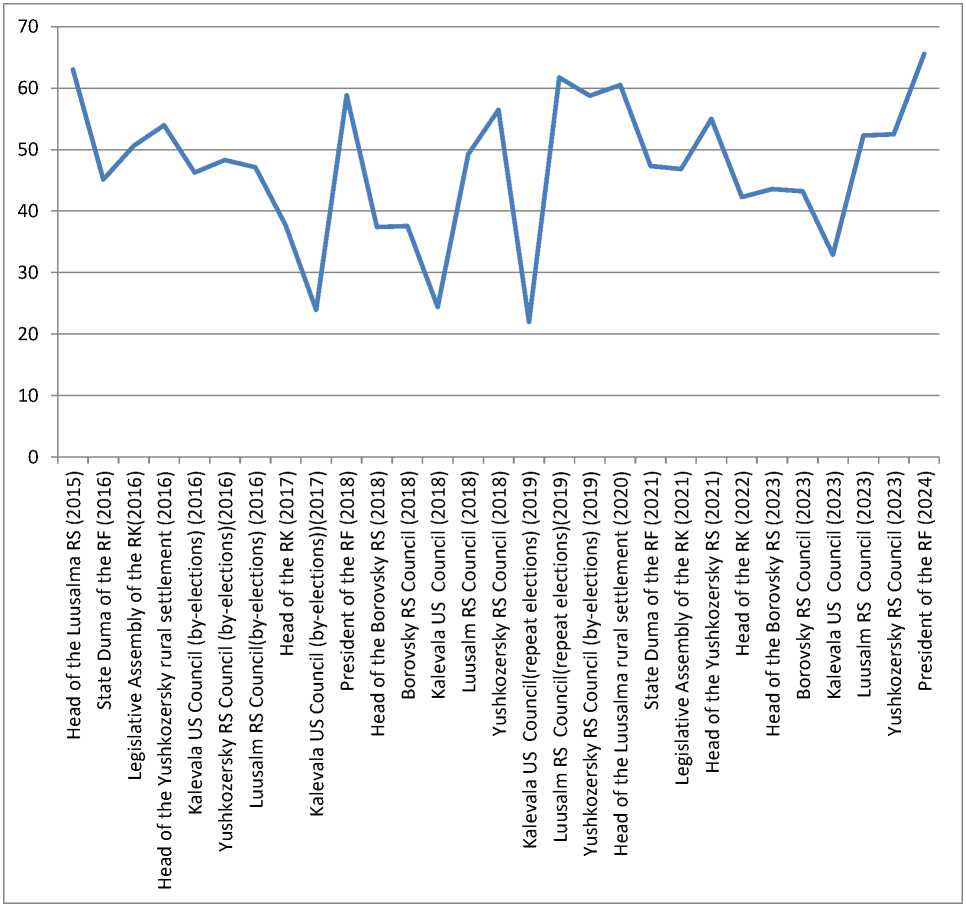
Fig. 1. Dynamics of electoral turnout in the Kalevalskiy District: 2015–2024 (in %) 14.
An analysis of the electoral turnout dynamics based on the data obtained reveals its instability, characterized by periods of both sharp declines and rises. It should be noted that in Figure 1, the values of voter activity in the district were distributed by year, and in the case of elections held on a single voting day, the data were ranked according to the level of authority. Peaks in voter turnout were observed during the presidential elections, while the lowest values were recorded in the elections for deputies to the Kalevala Urban Settlement Council.
Case 1. Federal elections
From 2015 to 2024, elections for deputies of the State Duma of the Russian Federation of the 7th (2016) and 8th (2021) convocations, as well as for the President of the Russian Federation (2018, 2024) were held.
Federal, “first-order” [13, Reif K., Schmitt H.; 14, Turovskiy R.F., Korneeva E.M., Vaselenko O.S.] elections are identified by voters as the most important, which increases both electoral
-
14 Source: compiled by the author based on data from the CEC RF.
turnout and protest potential. However, it should be noted that since the head of state and the chamber of the Russian parliament are elected by nationwide vote at the national level, these election campaigns do not coincide with each other. This factor also influences voter turnout and voting results.
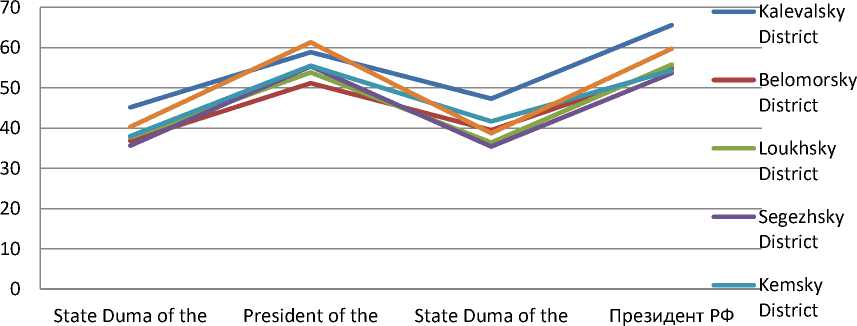
Comparing electoral turnout in national elections across all Arctic regions of Karelia, it can be seen that voters are more active in voting for the President of the Russian Federation than for deputies of the State Duma of the Russian Federation (see Fig. 2).
Russian Federation Russian Federation Russian Federation
Kostomuksha
Urban District
Fig. 2. Electoral turnout in federal elections in the Karelian Arctic regions: 2016–2024 (in %) 15
One of the main reasons for this ranking of electoral turnout may be the fact that voters see the President of the Russian Federation as the person responsible for the country’s policies, which increases their interest in participating in the vote. Moreover, this factor is influenced by external circumstances, which always affect the final election results, correlate with the personality of the candidate elected to the office of head of state, etc., which inevitably reflects in the consciousness of the electorate and resonates with their preferences.
As can be seen in the graph (Fig. 2), turnout rates for the presidential elections in all Arctic regions of the Republic of Karelia were distributed within the median range. In 2018, the highest electoral turnout was observed in the Kostomuksha Urban District, while in 2024, there was a significant gap in voter turnout for residents of the Kalevalskiy National District compared to other northern territories, with a median of 62.22 (see Table 2).
Table 2
Electoral turnout in presidential elections in Karelian Arctic regions: 2018, 2024 (median ) 16
|
Kalevalskiy District |
Belomorskiy District |
Kemskiy District |
Loukhskiy District |
Segezhskiy District |
Kostomuksha Urban District |
|
62.22 |
53.02 |
54.91 |
54.81 |
54.51 |
60.53 |
This distribution could be due to a number of factors. In 2024, voters participated in the presidential election over three days, from 15 to 17 March. This increased the potential for higher
-
15 Source: compiled by the author based on data from the CEC RF.
-
16 Source: compiled by the author.
voter turnout. It is also important to consider the specific preferences of voters in the Arctic national territory, which could be influenced not only by the migration outflow of the working-age population and demographic ageing trends, resulting in increased citizen participation in the election (it is well known that older age groups participate more actively in elections than younger voters and give their preference to political forces whose policies they are familiar with from the previous period), but also by the deterioration of the international situation in the border area, causing personal concern among its residents about the resolution of the situation, who see the President of the Russian Federation as an actor capable of dealing with it.
Moreover, by 2024, the alternatives in the election had decreased (from eight registered candidates in 2018 to four in 2024), but the voting results remained quite predictable. In this regard, the votes not in favor of V.V. Putin, who received high support in all regions of the Russian Federation, and the dynamics of the voting results were insignificant, but rather the votes for the candidate who came second in the region and actually demonstrated popular, possibly opposition ideas that resonated with a fairly large group of voters, are of particular interest.
Karelia became the leading region where, in the 2024 presidential race, V. Davankov, the candidate from the New People party, received the highest number of votes for second place, with 8.38% electoral support. It’s important to note that V. Davankov also came second abroad, with 16.65% of the vote, and second “according to the results of the federal voting platform (6.28%)” 17. However, while L.E. Slutskiy (LDPR) came third in the republic and N.M. Kharitonov (CPRF) came last, in the Kalevalskiy District the last two places were distributed in the reverse order. We believe that these presidential election results were caused, on the one hand, by the support of residents of the border region for the progressive ideas promoted by the candidate from the New People party and, on the other hand, by the preservation of traditional voting trends, as in the 2018 Russian presidential election, P.N. Grudinin (CPRF) surpassed V.V. Zhirinovskiy (LDPR) in terms of the number of votes in the Kalevalskiy District (see Table 3).
Table 3
Electoral support in the Russian presidential elections: 2018, 2024 18
|
Candidate s 19 |
Russian Federation |
Republic of Karelia |
Kalevalskiy District |
|
Russian Presidential Elections (March 18, 2018) |
|||
|
V.V. Putin (independent) |
76.69% |
73.04% |
72.97% |
|
P.N. Grudinin (CPRF) |
11.77% |
11.35% |
10.52% |
|
V.V. Zhirinovskiy (LDPR) |
5.65% |
7.83% |
10.39% |
|
Russian Presidential Elections (March 17, 2024) |
|||
|
V.V. Putin (independent) |
87.28% |
79.53% |
80.80% |
|
V.A. Davankov (New People) |
3.85% |
8.38% |
6.00% |
|
N.M. Kharitonov (CPRF) |
4.31% |
4.76% |
5.89% |
|
L.E. Slutskiy (LDPR) |
3.20% |
5.02% |
4.85% |
Furthermore, we believe the “New People effect” 20 played a role in the 2024 presidential elections in the region. Their campaign was focused on the regions, emphasizing their socio-economic problems, which the “old” parties had so far been unable to address. This was reflected in the campaign slogan “Davankov. Time for New People”. Sergey Usatenko, secretary of the Karelian regional branch of the party, commented on the success of the New People party: “Our team worked without populism. At the same time, we raised issues that concern people: economic growth, social support, education, and healthcare. Solving old problems with new approaches. This, along with people’s demand for new solutions and ideas in politics, resulted in Vladislav Davankov’s strong support in Karelia. It is important for us to build a country in which we want to live” 21.
At the same time, despite the predictability of the voting results, protest voting was observed in the presidential elections, with the Pearson correlation coefficient for all regions of the Karelian Arctic — R xy = 0.94, indicating a “very high” linear dependence (according to the Chaddock scale [15, Bavrina A.P., Borisov I.B., p. 71]) between the number of invalid ballots and the number of votes cast for the candidate who took the last place in the election race. In the latter case, it was possible to observe the dynamics of protest potential in electoral behavior in the 2018 presidential election compared to the 2024 election campaign among residents of northern territories, including the Kalevalskiy National District. While in 2018, the difference between the number of votes for the candidate who came last and the number of invalid ballots was negative, in 2024, it was positive, indicating a clear voter preference for candidates in the 2024 elections.
This could also have been caused by both a decrease in the number of candidates competing in the elections (from 8 in 2018 to 4 in 2024) and an increase in electoral turnout in the Republic of Karelia (2018 — 57.14%, 2024 — 59.88%), and, consequently, a decrease in the level of absenteeism. In the Kalevalskiy District, voter turnout for the 2024 presidential election was the highest among Arctic territories, reaching 65.59%, with a maximum increase of 6.74% in electoral turnout in the national district compared to 2018 (see Table 4). We believe that this dynamic in the electoral behavior of residents of the republic’s Arctic border territory is due not only to the demographic structure of voters, but also to the image of the candidates and the transformation of their political agenda.
Table 4
Dynamics of electoral turnout in the Russian presidential elections in the Karelian Arctic regions: 2018, 202 4 22
|
District |
2018 |
2024 |
Dynamics |
|
Kalevalskiy District |
58.85 |
65.59 |
6.74 |
|
Belomorskiy District |
51.19 |
54.85 |
3.66 |
|
Kemskiy District |
55.49 |
54.34 |
- 1.15 |
|
Loukhskiy District |
53.85 |
55.78 |
1.93 |
20 The party was registered on March 24, 2020 (according to the Russian Ministry of Justice). In September 2021, it won parliamentary representation in the State Duma and regional parliament elections (in 19 of 38), “breaking into big politics” — author’s note.
21 Karelia demonstrated the highest level of support in Russia for New People candidate Vladislav Davankov. URL: (accessed 13 August 2024).
22 Source: compiled by the author.
|
Segezhskiy District |
55.35 |
53.67 |
1.68 |
|
Kostomuksha Urban District |
61.31 |
59.75 |
- 1.56 |
The situation in the State Duma elections was somewhat different, despite the fact that they are also considered to be “first-order” elections. In the minds of the Russian electorate, parliamentary elections are perceived as less important due to their collegial nature, which reduces the level of personal responsibility of deputies. This fact is reflected not only in the reduced voter turnout compared to presidential elections (see Fig. 2), but also in the level of alternativeness and the degree of protest potential.
The alternativeness of Duma elections is naturally always higher than that of presidential elections, and the mixed nature of the electoral system influences the modification of electoral preferences, since all candidates for elected office represent the Republic of Karelia and are, as a rule, known to the voters of the district. Therefore, the analysis of the electoral preferences of residents of the Kalevalskiy District was carried out in comparison not with the Arctic territories, but with the Republic of Karelia as a whole. A summary table was compiled ranking the political forces (based on the subject of nomination) that received more than 5% of the votes (see Table 5).
Table 5
Electoral support in the elections to the State Duma of the Russian Federation: 2016, 2021 23
|
Elections |
State Duma of the RF (2016) |
State Duma of the RF (2021) |
||
|
Mixed electoral system |
Single-mandate constituency |
Federal constituency |
Single-mandate constituency |
Federal constituency |
|
Republic of Karelia |
|
5.Yabloko (7.80%) |
|
6. NP (7.00%) |
|
Kalevalskiy National District |
|
|
|
|
As the data obtained shows, electoral preferences in the Arctic border region differed from those of voters in the Republic of Karelia in all four cases across the single-mandate and federal constituencies. The only exceptions were candidates/party lists nominated by United Russia, whose electoral support was slightly higher than in the republic. Otherwise, there were only differences.
While candidates/party lists from the Yabloko party secured sufficient electoral support at the regional level in 2016, in the Kalevalskiy District they received less than 5% of the vote. In 2021, the Yabloko candidate (E.E. Slabunova) in the single-mandate constituency received 6.08% of the vote, which was still insufficient for election to the 8th convocation of the State Duma.
It should be noted that the configuration of electoral preferences in the Arctic National District in the 2021 Duma elections was more diverse compared to the Republic of Karelia. In the singlemandate constituency, seven candidates received more than 5% of the votes: from both
“traditional” (United Russia, SRPZP, CPRF, NP 24, LDPR, Yabloko) and “non-traditional” (RPPSJ) political forces. At the regional level, only five candidates were represented. While the LDPR party list received 9.77% of the votes in the federal electoral district in Karelia, in the Kalevalskiy District, the party was represented only by a single-mandate candidate (A.M. Pakkuev). However, unlike in the Republic of Karelia, candidates/party lists from the Russian Party of Pensioners for Social Justice and New People gained more than 5% in both single-mandate and federal constituencies.
Federal parliamentary elections in Russia are the most alternative compared to all others, which is inevitably reflected in the increased level of conflict potential and the presence of protest potential in electoral preferences. With an average value of 12 for elections to the State Duma of the 7th and 8th convocations, the Pearson correlation coefficient R xy = 0.79 for the Kalevalskiy electoral district. In the analyzed cases, the number of votes for the candidate or party list that ranked last in the elections was less than the number of invalid ballots. The negative values of the linear correlation indicate the presence of protest activity in the elections to the State Duma of the Russian Federation in both 2018 and 2021.
Case 2. Regional elections
According to the typology of K. Reif and H. Schmitt [13], regional elections are considered
“second-order” elections, so voters may perceive them as secondary, which can reduce their desire to participate in them.
Between 2015 and 2024, residents of the Kalevalskiy National District participated in the elections of deputies of the Legislative Assembly of the Republic of Karelia (2016) and the 7th (2021)
convocations and the Head of the Republic of Karelia (2017, 2022). However, they demonstrated electoral behavior that differed from other territories of the Karelian Arctic (see Fig. 3).

^^^мKalevalsky District
^^^мLoukhsky District
^^^^^в Kemsky District
■■■■ в Belomorsky District
^^^^^»Segezhsky District
^^^^^^Kostomuksha Urban District
Legislative Assembly of Head of the Republic of Legislative Assembly of Head of the Republic of the Republic of Karelia Karelia (2017) the Republic of Karelia Karelia (2022)
Fig. 3. Electoral turnout in regional elections in the Karelian Arctic: 2016–2022 (in %) 25
The graph shows that voter turnout in the Arctic border region is higher than in other northern territories, both in elections to the Legislative Assembly of the Republic of Karelia and in elections for the Head of the Republic of Karelia. In addition, all regions show distinct peaks in activity during parliamentary elections and troughs during elections for the highest official of the constituent entity of the Russian Federation.
This pattern may be due to the fact that in the Republic of Karelia, federal and regional parliamentary elections are held on the same voting day, which has virtually no impact on the dynamics of electoral turnout during this period. Meanwhile, the election campaign for the Head of Karelia does not coincide with the primary elections, and electoral support depends on the image of a particular candidate.
Similar to the Duma elections, the electoral preferences of residents of the Kalevalskiy District were analyzed, and data on candidates/party lists (by subject of nomination) that received more than 5% of the votes were entered into a summary table (see Table 6).
Table 6
Electoral support in the elections of deputies to the Legislative Assembly of the Republic of Karelia: 2016, 2021 26
|
Elections |
Legislative Assembly of the RK (2016) |
Legislative Assembly of the RK (2021) |
||
|
Mixed electoral system |
Single-mandate (multi-mandate) constituency |
Single constituency |
Single-mandate (multi-mandate) constituency |
Single constituency |
|
Kalevalskiy National District |
|
|
|
|
Based on the results, in 2016 it was observed that in both regional parliamentary and Duma elections in the single Kalevalskiy constituency, candidates from the Yabloko party did not overcome the 5% threshold, and in the single-mandate (multi-mandate) elections for deputies to the Legislative Assembly of the Republic of Karelia in 2021, there were no candidates from either the Yabloko party or even from the CPRF in the national district, in contrast to the 2016 elections, although they were represented in the region at the federal level (see Table 5). Thus, over the past five years, the positions of these political parties have weakened at the regional legislative level in the Arctic National District. This could be caused by both demographic decline and the outflow of the population supporting the ideas of the “traditional” regional political players, Yabloko and the CPRF, from the Kalevalskiy District.
Furthermore, based on the nature of electoral preferences, the Kalevalskiy National District cannot currently be classified as either a “red belt” (in the terminology of R. Turovskiy [20]) or a “Yabloko” constituency (by analogy). In the regional parliamentary elections, although the residents demonstrated a position that differed from that of the republic, this was fundamentally different only in relation to the Yabloko party. The electoral support of voters in the Arctic border region for candidates/party lists nominated by United Russia was as stable in the elections to the Legislative Assembly of the Republic of Karelia as it was in the State Duma of the Russian Federation.
Despite the lower average alternativeness values for regional parliamentary elections (6.5) compared to federal elections (12), R xy = 0.91 in the Kalevalskiy District. In three out of four cases, the negative values of the difference between the number of votes cast for the candidate/party list that ranked last in the election race and the number of invalid ballots indicate the presence of protest potential in the electoral preferences of residents of the Arctic border national territory.
A slightly different pattern of voter turnout in the Kalevalskiy District was observed during the elections for the Head of the Republic of Karelia, although it was still higher than in other parts of the Karelian Arctic (see Fig. 3). We believe that maintaining average voter turnout values for the elections for the republic’s highest official depends on the demographic structure of the electorate in the district and the significant proportion of people of retirement age 27, who regularly participate in elections.
In their electoral preferences for candidates for the elected position of Head of the Republic of Karelia, voters of the Kalevalskiy National District demonstrated similarity with the final results of the vote in the Republic of Karelia, and the average values of the alternativeness of elections were equal to 4.5. The predictability of the voting results (that the winner of the elections for the Head of the Republic of Karelia in both 2017 and 2022 would be the candidate from the United Russia party, A.O. Parfenchikov) was also very high. When calculating the Pearson correlation coefficient for all regions of the Karelian Arctic, R xy = 0.50, which is interpreted as “average” according to the Chaddock scale [15, Bavrina A.P., Borisov I.B., p. 71] depending on the number of invalid ballots and the candidate who received the fewest votes in the elections for the highest official of the subject.
However, in both federal and regional elections, the configuration of electoral preferences among residents of the Kalevalskiy National District of the Karelian Arctic is always influenced by external factors — those political forces that represent not the district, but Karelia or Russia. Therefore, only local elections can reveal the real picture and ranking of the electoral preferences of voters in the Arctic border region.
Case 3. Local elections
According to the theory of “second-order” elections by K. Reif and H. Schmitt [13], local elections are of secondary importance. “Voter turnout in local government elections is usually the lowest compared to presidential and parliamentary elections” [14, Turovskiy R.F., Korneeva E.M., Vase-lenko O.S., p. 121]. However, the participation of residents of the Kalevalskiy District in local elections only partially confirms this statement, as an analysis of data for the period 2015–2023 showed that voter turnout in the Borovskiy, Luusalmskiy, and Yushkozerskiy rural settlement council elections was distributed within the average range, with declines only in the Kalevala Urban Settlement Council elections 28 (see Figures 1 and 4) amid weak political competition (see Table 7).
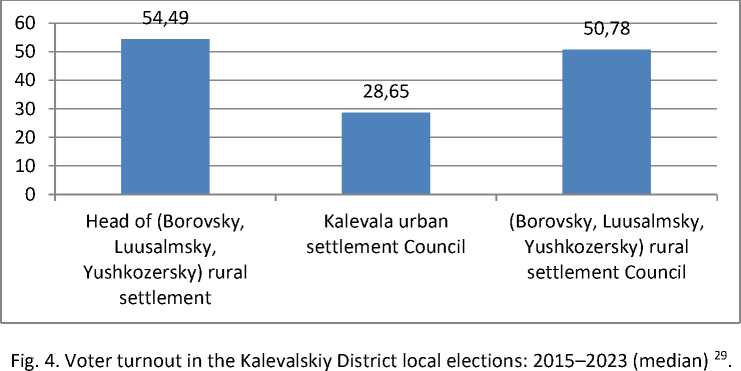
Table 7
Number of registered candidates: 2015–2023 (average) 30
|
го с If сп CD О тз СУ) |
2 О ОС о ГО 4-» Е £ $ Е ~1 ф СУ) |
IL Ф о n с о ф 2 ^ GO о _ О ос |
£ =5 го с ГО Ф ГО ф GO |
С CD Ф ■ о 2 ф Ф о ^ £ S го -L- 1— |
с CD Ф ч- _ф О го ■ О 25 Ф ГО tn |
Ф Ф О ^ 4-> ГО с- tn ф — Т 15 2 |
|
1.15 |
1.11 |
1.72 |
2.04 |
2 |
2.5 |
2 |
It should be noted that local elections in the border Arctic national region of Karelia were held mainly separately, although there were cases when the elections of the head and deputies of a rural settlement were carried out on the same day (in the Borovskiy rural settlement (2018, 2023)). In 2016, in parallel with the election of deputies to the State Duma of the Russian Federation of the 7th convocation and the Legislative Assembly of the Republic of Karelia of the 6th convocation, byelections were held for the deputy of the Council of the Kalevala Urban Settlement of the 3rd convocation in single-mandate electoral district No. 1 (turnout — 46.28%), the deputy of the Council of the Yushkozerskiy Rural Settlement of the 3rd convocation in single-mandate electoral district No. 7 (turnout — 48.33%) and the deputies of the Council of the Luusalmskiy Rural Settlement of the 3rd convocation in single-mandate electoral districts No. 1 (turnout — 59.25%) and No. 4 (turnout — 47.14%), as well as the election of the Head of the Yushkozerskiy Rural Settlement (turnout — 53.97%), which confirms the impact of holding elections at different levels on a single voting day on the growth of electoral activity indicators.
In this regard, in order to identify the specifics of the electoral behavior of the residents of the Kalevalskiy District in local elections, all additional and by-elections of deputies to rural settlement councils in the district were excluded from the analysis.
It is worth noting that voters in rural settlements in the Kalevalskiy District actively participate in voting, and voter turnout in elections for both heads of local authorities and council deputies is practically identical and distributed within the average range (see Fig. 4). The rural areas of the Arctic border national district of Karelia are characterized by a low population density 31, with a predominance of residents above working age. This has an impact on voter activity and preferences because people may know candidates for elective office personally and may come to the polls and vote for someone they know, rather than for their political party affiliation. However, in rural areas of the district, the winning candidates were predominantly those nominated by United Russia.
In the 2023 elections for heads of settlements, only in the Borovskiy rural settlement, a candidate from the Russian Party of Pensioners for Social Justice competed with a candidate from United Russia; in all other cases, the opponents were independent candidates. The results of the voting for heads of rural settlements were also predictable, with the winners being exclusively candidates nominated by United Russia, with a low level of alternatives, averaging 2.16. This is also reflected in the weak correlation between the number of invalid ballots and the number of votes for the candidate ranked last in the election race (R xy = 0.39) and the virtual absence of protest potential in the electoral behavior of rural residents.
Voter turnout differed slightly in the elections for rural council deputies. While voter turnout remained at average levels, the configuration of electoral preferences varied. The local legislative bodies included not only deputies from UR, but also from SR/SRPZP, CPRF and independent candidates, although the Borovskiy rural settlement councils of the 4th (2018) and 5th (2023) convocations and the Luusalmskiy rural settlement of the 5th (2023) convocation were represented only by UR deputies.
The urbanized nature of the Kalevala urban settlement, with more than 60% of the district’s population located there 32, was reflected in the low values of electoral turnout in the district in the elections of deputies of the Council of the Kalevala urban settlement of the 4th (2018, turnout — 24.41%) and 5th (2023, turnout — 32.89%) convocations, and the calculation of the correlation coefficient of the dependence of the number of invalid ballots and the number of votes for the candidate who ranked last in local parliamentary elections is expressed in low values — R xy = -0.11, which is of no interest for data analysis in a situation of low election alternatives.
It should be noted that, overall, in the elections of deputies to local legislative councils in the Kalevalskiy District, R xy = -0.47, and according to the Chaddock scale, the correlation is “weak” [15, Bavrina A.P., Borisov I.B., p. 71]. The alternativeness of all parliamentary elections held in the district is low (average values — 2.03), which demonstrates an insignificant degree of protest potential in the behavior and preferences of voters in the border Arctic national territory of the Republic of Karelia.
Conclusion
The comparative study of the electoral behavior and preferences of residents of the border Kalevalskiy National District of the Karelian Arctic in elections at different levels of public authority made it possible to identify their specific features and construct a pattern of the Arctic national district of the Russian Arctic as a possible unit for future comparative analysis of the national territories of the Arctic zone of the Russian Federation.
By comparing social cleavage patterns and electoral participation practices in “first” and “second” order elections between 2015 and 2024 with those in other Arctic regions of the Republic of Karelia, we identified seven patterns of voter behavior and preferences in the Kalevalskiy District (see Table 8).
Table 8 Patterns of electoral behavior and preferences in the Kalevalskiy National District of the Karelian Arctic: 2015–2024 33
|
Elections |
Elections of the President of the RF, the Head of the RK, heads of rural settlements |
Elections of deputies of the State Duma, the Legislative Assembly of the RK, councils of urban*/rural settlements |
||||||
|
ф го о с н |
с о ф ф "о ф с ф го с ф < |
ею с о О СП 5 £ ГО "ф |
.2 с ф ф о |
ф го о с н |
с о ф Ъ ф с ф го с < |
ею о О (Л го "ф |
го с ф ф о |
|
|
Federal |
middle |
+ |
yes |
rather present |
middle |
+ |
yes |
rather present |
|
Regional |
middle |
+ |
yes |
rather present |
middle |
+ |
yes |
rather present |
|
Local |
middle |
+ |
yes |
rather absent or not clearly expressed |
middle |
+ |
yes |
rather absent or not clearly expressed |
|
low* |
+* |
yes* |
rather absent or not clearly expressed * |
|||||
Like all Arctic regions of Karelia, this border national district is peripheral, but has the highest proportion of rural to urban residents. The Kalevalskiy District contains the largest number of areas with specially protected natural status, but it does not have a single settlement founded around a city-forming enterprise (single-industry town) to provide labor for production. This is characterized by the risk of deterioration in the demographic situation of the district due to the outflow of the working-age population and an increase in the proportion of older residents, which reveals the specifics of voter participation in the district.
The predominantly active voting in elections at various levels of public authority is reflected in the average voter turnout figures, with the exception of the elections for deputies of the Kalevala Urban Settlement Council. Otherwise, the behavior of voters in the Arctic border national district correlates with federal and regional trends: despite the competitive nature of the elections, voting results are quite predictable, and the protest potential, although present, does not affect the configuration of electoral preferences in the district. Residents of the Kalevalskiy District, as in other Arctic regions of Karelia, prefer “traditional” political forces, and the positions of candidates/party lists nominated by the United Russia party are generally stable, and on this basis, they win elections.
