
COP29 outcomes and perspectives
Journal: Pravo - teorija i praksa @pravni-fakultet
Section: Articles
Article in issue: 4 vol.42, 2025.
Free access
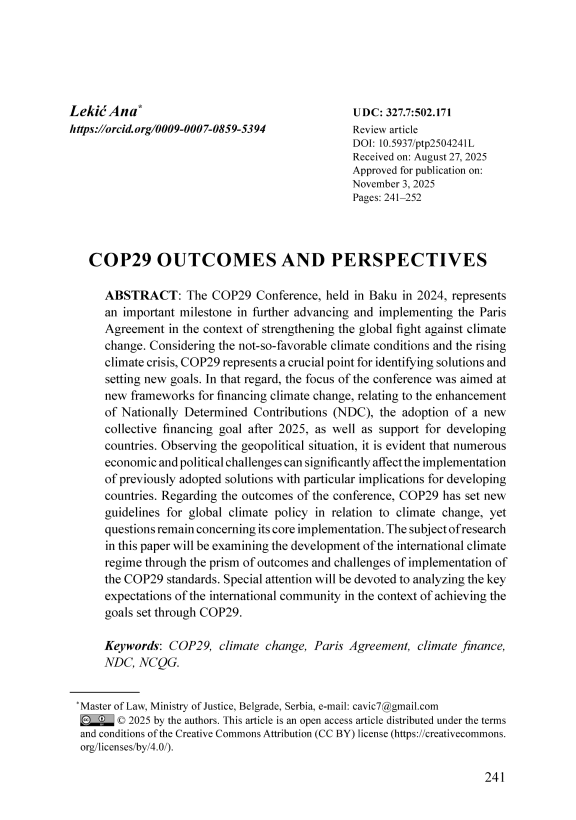
The COP29 Conference, held in Baku in 2024, represents an important milestone in further advancing and implementing the Paris Agreement in the context of strengthening the global fight against climate change. Considering the not-so-favorable climate conditions and the rising climate crisis, COP29 represents a crucial point for identifying solutions and setting new goals. In that regard, the focus of the conference was aimed at new frameworks for financing climate change, relating to the enhancement of Nationally Determined Contributions (NDC), the adoption of a new collective financing goal after 2025, as well as support for developing countries. Observing the geopolitical situation, it is evident that numerous economic and political challenges can significantly affect the implementation of previously adopted solutions with particular implications for developing countries. Regarding the outcomes of the conference, COP29 has set new guidelines for global climate policy in relation to climate change, yet questions remain concerning its core implementation. The subject of research in this paper will be examining the development of the international climate regime through the prism of outcomes and challenges of implementation of the COP29 standards. Special attention will be devoted to analyzing the key expectations of the international community in the context of achieving the goals set through COP29.
Similar articles in the section International relations. World, global politics. International affairs. Foreign policy
Short address: https://sciup.org/170211452
IDS: 170211452 | UDC: 327.7:502.171 | DOI: 10.5937/ptp2504241L
COP29 ishodi i perspektive
Konferencija COP29, održana u Bakuu 2024. godine predstavlja važan trenutak dalje nadgradnje i sprovođenja Pariskog sporazuma u kontekstu osnaživanja borbe protiv klimatskih promena. Imajući u vidu ne tako povoljne klimatske prilike i klimatsku krizu koja je u usponu, COP29 predstavlja ključnu tačku za pronalaženje rešenja i postavljanja novih ciljeva. Sa tim u vezi, fokus konferencije bio je usmeren na nove okvire za finansiranje klimatskih promena, a koje se odnose na povećanje nacionalno utvrđenih doprinosa (NDC), zatim usvajanje novog kolektivnog cilja finansiranja nakon 2025. godine, kao i podrška zemljama u razvoju. Posmatrajući geopolitičku situaciju evidentno je postojanje mnogobrojnih ekonomskih i političkih izazova koji u velikoj meri mogu da utiču na implementaciju svih do sada donetih rešenja, a koji se pogotovo reflektuju na države u razvoju. Ako govorimo o ishodima konferencije, COP29 je postavio nove smernice u vezi sa globalnom politikom oko klimatskih promena, ali se postavlja pitanje njegove suštinske implementacije. Predmet istraživanja u radu predstavljaće sagledavanje razvoja međunarodnog klimatskog režima kroz prizmu ishoda i izazova implementacije standarda COP29. Posebna pažnja biće posvećena analizi ključnih očekivanja međunarodne zajednice u kontekstu ostvarivanja ciljeva postavljenih kroz COP29.
Text of the scientific article COP29 outcomes and perspectives
The need to alleviate climate change at the global level is a tendency which has been a consistent trend since the adoption of the United Nations Framework Convention on Climate Change (UNFCCC, 1922) and the Kyoto Protocol to the United Nations Framework Convention on Climate Change (1997), followed by the adoption of the Paris Agreement to the United Nations Framework Convention on Climate Change (2015) at the 21st Conference of the Parties in Paris (hereinafter: UNFCCC). All countries globally are facing contemporary challenges such as climate change, so being aware of the fact that the question of climate change is that of the planet’s survival, the countries are making efforts to address it. That raises concerns regarding countries’ capacities to establish clear and effective mechanisms in combating climate change. Those exact mechanisms, alongside to the assumption that there exists a developed collective awareness of the dangers of climate change and its consequences, are certainly influenced by the economic power of a country, reflecting in their financial capacities to implement the mentioned agenda.
At first glance, the task of encompassing all the factors that negatively affect climate change may seem simple and thereby identify effective means of combating it, however, the reality is far more complex and truly represents a global challenge of today. In that ambient, alongside international frameworks and mechanisms countries have to also build their own internal capacities in this battle, all of which has to be supported by the political readiness and accountability of each of the countries.
Conceptually observed, countless questions arise concerning climate change on a global level, therefore it is logical to ask the question of whether, in today’s practice, the principles of contemporary state policies in the context of climate change are truly being implemented, or whether they remain a collage of good intentions on a paper. Regarding that, the question of whether member countries are following the goals and principles established at COP29, including all previous annual meetings.
The general goal of the COP29 summit, held in 2024 in Baku, Azerbaijan, is of financial nature, which is supposed to replace the previous goal of 100 billion USD annually, while also takes into account the growing needs of developing countries. One segment also refers to existing funds, considering that they are deemed insufficient for overcoming challenges (Regional Center for Environmental Law (RCEL), 2024).
In regards to the discussion above, and given that the focus was placed on climate finance, a concrete consensus was achieved which implies that the financing of developing countries will triple, from the previous goal of 100 billion USD annually to 300 billion USD annually by year 2035 and that every effort will be made by countries to collectively increase climate financing for developing countries to 1.3 trillion USD annually by 2035 (United Nation Climate Change, 2024). Considering the ambitious set goals, they should be approached with caution, as the geopolitical circumstances necessitate confronting the reality of whether such a scale of financial resources can truly be mobilized.
In the light of the rising climate crisis, COP29 undeniably represents a key point in implementing the Paris Agreement and although the expectations of countries can be diverse it is clear that the new currents of strengthening the fight with climate change which will shape the currents of future climate policy.
The following text will examine the context of the outcomes achieved and the perspectives of COP29.
2. Historical overview of the COP
To begin with, if we were to consider the formulation of the COP, including its essence, the very nature of its name translates literally as the “Conference of the Parties” referring to the countries that have ratified the UN Framework Convention, the Kyoto Protocol, or the Paris Agreement. It is important to emphasize that each COP conference achieves a certain balance between political compromises, specific considerations, and economic interests.
Undoubtedly, at the level of the United Nations, there are several educational bodies responsible for the task of implementation of the UN Framework Convention, however, according to Todić and Dimitrijević (2012), COP represents factually the most important body within the UN Framework Convention which holds annual meeting, therefore its importance is indisputable.
Based on the previously discussed points, it can be concluded that from the adoption of the Framework Convention to the Paris Agreement, countries have developed awareness and showcased the political will to more concretely define obligations that need to be fulfilled in the context of climate change.
A review of the history of the Conference of the Parties is indispensable too, taking us to 1995, when the first COP was held in Berlin, Germany.
This moment can be considered as the beginning of the institutionalized global negotiations on the topic of climate change. Starting from then, the signatory countries have tended to select different locations or even different countries within regions recognized by the UN for their annual meetings. It is important to highlight the decisions made in Berlin, as they guided the further development of this field. At the Berlin Summit, it was decided to establish an ad hoc Committee for negotiations on a protocol or other legal instrument by 1997, which would include specific obligations for countries for a period after 2000. Furthermore, it was agreed to initiate a joint financial activities project involving both developed and developing countries, and to continue the provisional use of the Global Environment Facility, which serves as the financial mechanism of the UN Framework Convention (Bodansky, 2001).
When examining the importance of all COP conferences held to date, it is evident that not all have contributed to the expected extent. In correlation with that, and from the perspective of tangible results and what these Conferences have delivered for humanity, it must be acknowledged that over that past 30 years, the amount of human carbon dioxide emissions have doubled, which can be seen as a failure of the undertaken measures (Maslin, 2020).
The ambitious goals set at COP29, based on the consensus among countries, are intended to guide agreement on the directions of future actions by countries in order to achieve the objectives established by previously ratified conventions. Through the analysis and evaluation of the outcomes of previous Conferences, an evolution in the approach to climate change issues becomes evident, highlighting that COP29 emerges at a moment when concrete, rather than merely declarative actions are more necessary than ever before.
Considering the continuity of previous conferences, the next chapter is dedicated to the analysis of expectations and goals as they have been set.
3. Goals and expectations of COP29
This chapter aims at analysis of crucial expectations of COP29, where it is primarily important to consider that the conference was held at a time when the international community is striving towards aligning climate change initiatives with economic and political realities. Additionally, the specificity of the political context must be taken into account, given the location of the conference, as Azerbaijan is a country whose economy largely depends on fossil fuel exploitation, mainly that of oil and gas (Townend, 2024).
This is reflected directly in the goals. Regarding the objectives of COP29 and the agreed positions adopted in Baku, the UN Executive Secretary for
Climate Change, Simon Stiell, emphasized in his concluding remarks that a new financial goal had been achieved at the UN Climate Conference, describing it as an insurance policy for humanity. He stated: “This deal will keep the clean energy boom growing and protect billions of lives. It will help all countries to share in the huge benefits of bold climate action: more jobs, stronger growth, cheaper and cleaner energy for all. But like any insurance policy – it only works – if the premiums are paid in full, and on time” (United Nations Climate Change, 2024).
Considering the aforementioned financial goals, and in the context of expectations and the achievement of truly realistic results, it is questionable whether the stated financial framework is indeed feasible, or rather too ambitious. In this sense, the issue arises regarding the realism and to some extent the failure in fulfilling earlier goals from previous conferences. The stated goal, therefore, to a certain extent raises doubts about its feasibility.
Analyzing the objectives and expectations of the ambitiously set frameworks, the realization of the agreement requires clear political will as well as precise mechanisms for collection and allocation of funds. In this regard, potential problems could arise concerning the fulfillment of obligations by donor countries. Furthermore, institutional, administrative, and technical support in many developing countries lacks the capacity to implement large-scale climate projects, and special attention should be given to this issue in the context of striving to achieve all established expectations.
All of the above casts doubt on the highly ambitious goals. It is undeniable that strategically, it is important to take all measures regarding mitigating the consequences of climate change and that those are crucial projects for the survival of humanity, which makes the financial framework set for COP29 understandable. However, concern remains since even the previous goal set in the Copenhagen Conferences, which was set to 100 billion dollars yearly wasn’t entirely achieved, or has been “hardly met” (AP News, 2024).
Accordingly, in addition to clearly defined ambitious goals, it is essential to ensure a mechanism for their implementation, and the question here remains whether the stated frameworks will deliver the desired results till the next Conference.
4. Perspective COP29
Even though COP29 brought an advancement in regards to climate financing, and can be considered an important moment in the evolution of climate negotiations, there remains an open question of its implementation, meaning that it will be necessary to monitor whether the obligations agreed upon will be carried out.
All of the above indicates that the next Conference, COP30, which will be held in Belém (Brazil), will represent the key event, primarily the first steps in the implementation of the new NCQG and NDCs should already be visible. In this connection, and in the context of the perspective of COP29, it is necessary to look at the upcoming COP30. At the COP30 meeting, and according to the Open Science Charter initiative, it is emphasized that scientific data should be open, in order to achieve the goal of accelerating climate solutions. Also, Marina Silva, Minister of Environmental Protection and Climate Change of Brazil, pointed out that COP30 should mark the transition from the declaration phase to the implementation phase, planning the end of use of fossil fuels and enhance forest protection (Villamil, 2024).
Summarizing the above, and looking at the perspective of COP29, the fact is that a clear intention to make concrete and long-term decisions has been expressed, and the intention of the international community for the existence of consistency and the creation of large-scale goals for the best possible results in the future can be seen. For now, we cannot speak with clarity about a more concrete perspective of COP29, because it remains to see the results in practice, i.e. for states to undertake obligations to mitigate climate risks, as well as the question of whether the next COP will confirm this current direction and transform global climate policy.
5. Concluding remarks
The conference in Baku showed once again that the existence of complexities around climate negotiations is evident, but also a key message about climate consensus and solidarity was also sent. The states have certainly expressed their readiness for further negotiations and improvement of cooperation, for which compromises and the states’ agreement to additional compromise solutions are always necessary, and once again the continuity in the development of global climate policy has been demonstrated.
COP29 resulted in agreements on defining the NCQG of 100 billion dollars, partial progress was made in the implementation of market mechanisms from Article 6 of the Paris Agreement, countries were invited to improve their NDCs by COP30, work continued on the operationalization of the loss and damage fund, and the need for a just energy transition and the advancement of the global adaptation goal was additionally emphasized.
In accordance with the above, and considering that COP29 is also called the “financial COP”, the question arises whether the mentioned financial measures to be taken really answer the pressing questions about climate finance, because it often happens that the agreed activities are lacking, given the frequent lack of political will to implement them. Also, an indispensable segment in order to achieve the set goals implies the harmonization of energy, economic and climate interests, which complicates the process of realization itself. Also, some progress can be expected if national policies are harmonized with the conclusions adopted at COP29.
It remains to be seen in the future whether concrete agreements will produce the expected results, and whether COP29 will remain just another in a series of conferences that had partial results, or whether it will really have concrete results in full. In this regard, perhaps C29 will be remembered in history as a tipping point and turning point that provided a new direction in the fight against climate change, or it will be remembered as just another compromising agreement.
Conflict of Interest
The author declares no conflict of interest.
Lekić Ana
Ministarstvo pravde Republike Srbije, Beograd, Srbija
