
Creative industries of Russia as a vector of economic growth and employment
Journal: Services in Russia and Abroad @service-rusjournal
Section: Отраслевая экономика
Article in issue: 4 (119), 2025.
Free access
Creative industries are one of the key vectors of sustainable economic growth and a condition that opens potential opportunities for effective employment. The use of creative industries as a resource base for the innovative development of Russia is defined by the dynamic implementation of activities related to the realization of the provisions of the concept. The study analyzes the contribution of Russia’s creative economy to GDP among BRICS+ countries, and the state of export of creative industry products in Russia. It includes the overview of the top 15 Russian regions in terms of the economic development of creative industries and the share of employees engaged in creative sector organizations. The calculation of the employment workload coefficient in creative industries made it possible to assess their impact on the process of employment of the population. The study established that the key mainstreams that allow creative industries to actively develop are quite an effective tool aimed at the optimal socio- economic development of Russia as a whole and its constituent entities, in particular. Cooperation between government agencies, representatives of creative industries, as well as other ecosystem elements will serve as a basis for implementation of significant creative projects.
Similar articles in the section Regional economics. Territorial economics
Short address: https://sciup.org/140313784
IDS: 140313784 | UDC: 332.1+331.5 | DOI: 10.5281/zenodo.17627841
Креативные индустрии России как вектор экономического роста и занятости населения
Креативные индустрии представляют собой значимый вектор устойчивого экономического роста и условие, открывающее потенциальные возможности для эффективной занятости населения. Использование креативных индустрий в качестве ресурсной базы для инновационного развития России определено динамическим осуществлением мероприятий, которые связаны с исполнением положений «Концепции развития творческих (креативных) индустрий и механизмов осуществления их государственной поддержки в крупны х и крупнейших городских агломерациях до 2030 года». В исследовании изучен вклад креативной экономики России в ВВП среди стран БРИКС+, доля занятого населения в креативных индустриях, состояние экспорта товаров креативных индустрий России (печатная продукция, дизайнерские товары, товары для новых медиа, художественные промыслы и прочее); представлен топ-15 российских регионов по уровню экономического развития креативных индустрий и доле сотрудников, занятых в ведущих организациях сектора креативных индустрий. Расчет коэффициента нагрузки занятых в креативных индустриях дал возможность оценить их положительное воздействие на процесс трудоустройства населения. В процессе исследования установлено, что ключевые мейнстримы, позволяющие креативным индустриям активно развиваться, представляют собой достаточно эффективный инструмент, направленный на оптимальное социальноэкономическое развитие России в целом и ее субъектов в частности. Сотрудничество между государственными органами, представителями креативных индустрий, а также иными экосистемными элементами креативной индустрии послужит основой для реализации существенных креативных проектов.
Text of the scientific article Creative industries of Russia as a vector of economic growth and employment
To view a copy of this license, visit
Статья принята к публикации: 28.10.2025.
Introduc^ on
Russia’s creative economy, the structure of which includes creatve spheres of actvity whose ideas are transformed into cultural goods and services (cultural economy, creatve industry, goods, services or developments related to the cultural sector), actvely influences the development and support of domestc entrepreneurship, stmulates the introducton of innovatve, in partcular, digital technologies, creates jobs, and opens up potental opportunites for the country as a whole and for its subjects, in partcular.
Taking into account the conditons of the 2030 Agenda for Sustainable Development approved by the world community 1 , the creatve economy itself is a significant benchmark of sustainable development, which is confirmed by the development strategies and concepts of support for the creatve economy developed and approved at the state level.
At the same tme, in some countries, a significant share of value-added of creatve industries is formed by the management of intellectual property rights and actve creatve actvity, has taken on an important purpose as economic growth, cultural progress, and a stmulus for innovaton.
The aim of this study is to examine the creatve industries of Russia as a fundamental vector for economic growth and employment.
Background
In the current conditons of development, there is a growing interest among researchers in both do-mestc and internatonal academic circles in studying the characteristcs of the creatve economy and creatve industries. A number of works present the results of a comprehensive analysis of the development indicators of global and Russian creatve industry markets. For instance, T. S. Zaitseva emphasized the place of creatve industries in the innovatve development of the Russian economy [4]. At the same tme, I. B. Koroleva and I. L. Sokolova paid attenton to specific groups of problems
(legislatve, insttutonal, coordinaton, etc.) in management and development of the creatve economy [6]. The highlight of E. R. Bajkova’s work was the experiences of several foreign countries in applying various tools to support the creatve sector, and also models that allow creatve industries to develop actvely [1]. V. N. Kurochkin’s research is devoted to increasing the potental of creatve service industries, describing their place in filling the GDP [7]. In her research, Y. V. Petrasheuskaya presented a comparatve analysis of creatve (artistic) and traditonal employment, identfied the unique aspects of creatve labor, reviewed a classificaton of professions within creatve industries, and calculated the number of creatve workers in the Republic of Belarus [9].
A significant porton of research focuses on the role of creatve industries in the development of regional economy, as well as their inversion on the example of partcular Russian regions. Scholars N. V. Sopina, I. V. Klimova, and L. N. Semerkova attempted to establish the relatonship between the level of development of creatve industries in partcular Russian regions and the level of innovatve development of these regions [5; 11]. O. N. Naumova focused on the nature and characteristcs of creatve industries clusters in the regional economy [8]. A. S. Efimova and N. V. Bryukhanova analyzed the circumstances of creatve industries development in the Southern Federal District [3], while M. Yu. Vakhovskaya conducted an analysis of the prospects for developing creatve (artstc) industries in the Republic of Crimea and proposed measures to promote the growth of cre-atve sectors [2]. L. D. Saifullina emphasized cultural and creatve sectors of the economy of the Republic of Bashkortostan, highlighted the directons of their support and prospectve development [10].
Foreign researchers have also made significant contributons to the study of creatve industries. Scholars from the University of Valencia (Spain), Rafael Boix-Domenech, Jesús Peiro-Palomino, and Pau Rausell-Köster [13], described the impact of creatve industries on the development of leading
European regions, demonstrating that the growth of these industries directly influences labor produc-tvity levels. Christaan De Beukelaer [12] from the University of Leeds (UK), taking into account UNCTAD reports, studied the development of creatve industries in developing countries and classified them by the level of development of creatve economy; scholar Zheng Liu [16], representng Cardiff University (UK) and Nanjing University of Science and Technology (Nanjing, China), assessed the level of influence of UK and Chinese public policy on the innovatve development of their creatve industries, identfied the key elements of open, closed and social innovaton within the creatve economy.
Chinese researchers have highlighted the advantages of large Chinese cites in enhancing the productvity of creatve industries. They concluded that the disparity in the distributon of creatve industry productvity between large and small Chinese cites is driven by agglomeraton economies rather than the enterprises available in the area. They assessed the impact of creatve industry clusters on the development of culture and the crea-tve economy in Shanghai and elaborated a project for the development of cultural and creatve industries in the Qinba Mountains of Southern Shaanxi. The above aspects are covered in publicatons by C.-Y. Ho and Y. Sheng [15], J. Zheng and R. Chan [18], and L. Cui, S. Wei, K. Wang, S. Yuan, M. Lei, and K. Cheng [14].
Rinku Gupta [17], a scholar from the Tata Inst-tute of Social Sciences (Mumbai, India), used quan-tle regression in his research to identfy key groups of factors determining the wages of workers in the creatve industry. He demonstrated that men earn significantly more than women.
Despite the scientfic significance of these studies, certain aspects focused on the development of creatve industries as a basic vector of economic growth and employment need further study.
Methods and Methodology
The methodological basis of the conducted research is the practce-proven provisions and developments, revealing the prerequisites, regular-ites of formaton and development of creatve industries; provisions of federal normatve-legal acts, which are devoted to the issues of state support of the analyzed industries; applied research of domes-tc and foreign organizatons, which are devoted to individual provisions of their development.
The instrumental methodological foundaton of the research includes general scientfic methods such as analysis, synthesis, comparison, and stats-tcal data analysis. The conducted research has enabled the examinaton of creatve industries in Russia as a fundamental vector for economic growth and employment.
Results
Russia dynamically implements measures aimed to realize of the developed Concept 1 , according to the forecast values of which the proporton of creatve industries in the country’s economy will increase to 6 % by 2030, while the level of creatve employment (especially women, young people, and people with disabilites) will increase to 15 % by the same year. Increase the proportons of creatve industries and creatve (artstc) entrepreneurship in Russia as a whole in the structure of world exports to 3.5 % by 2030.
Creatve industries, which generate added value by convertng ideas and creatvity into products and services, are a crucial resource for both the economic and innovatve development of Russia as a whole and its individual regions. Given the global trend towards economic innovaton and creatvity, Russia has identfied the use of creatve industries as a resource base for its innovatve development as one of the mechanisms for achieving sustainable economic growth.
The potental of Russia’s 17 major creatve industries (IT and video games; educaton; design; fashion; publishing, etc.) lies in the breadth of labor opportunites and potental collaboratons that can be productvely exploited.
It should be noted that creatve industries serve as an effectve source of sustainable inclusive growth, because they provide additional opportunities for self-development and are focused on the formation of a favorable living environment.
Currently, the following priority areas of creative industries are identified as the basic vector of Russia’s economic growth: increasing the involvement of women, youth, and people with disabilities in creative professions; enhancing the capitalization of intangible assets in Russian businesses, among other initiatives 1 .
Figure 1 shows the contribution of Russia’s creative economy to GDP among the BRICS+ countries of which it is a member, %.
According to the data reflected in Figure 1, Russia shares the third ranking position with the United Arab Emirates (3,5 %) in the contribution of the creative economy to GDP, while Ethiopia (4,7 %) and China (4,6 %) hold the leading positions.
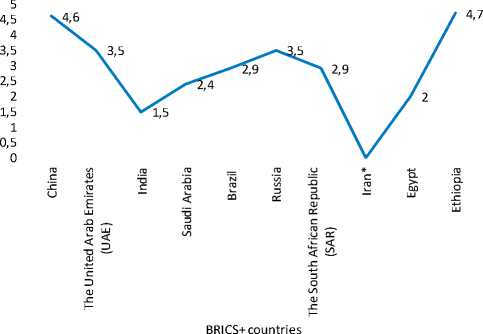
Fig. 1. The Contribution of Russia's Creative Economy to GDP Among BRICS+ Countries, %2
* no data available
Russia ranks similarly (6.6 %) by the level of employment in the creative industries, with India in second place (8.3 %) and China in first place (9.46 %) 3 .
In terms of the export of creative industry goods (including print media, design products, new media goods, handicrafts, etc.), Russia is ranked fourth with $ 1,58 billion, behind China ($ 220 billion), India ($ 13,785 billion), and the United Arab Emirates ($ 9,129 billion) 4 .
Under current conditions, Russia aims to realize the economic potential of its creative industries in all regions, taking into account their unique characteristics and specificities.
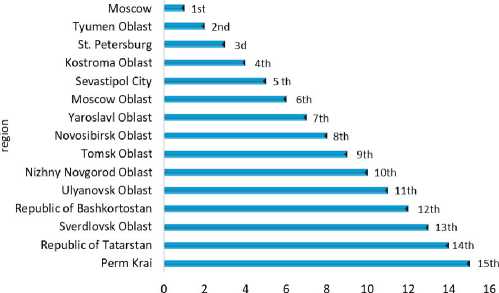
Figure 2 shows top 15 Russian regions ranked according to the level of economic development of creative industries.
ranking
Fig. 2. Top 15 Russian Regions by the Level of Economic Development of Creative Industries5
The analysis of Figure 2 concludes that the highest concentration of creative industry development is observed in Moscow, Tyumen Oblast, and Saint Petersburg, while Perm Krai rounds out the list. These regions significantly surpass other Russian regions in terms of the economic scale of creative industries development.
Creative employment of the Russian population can be assessed by taking into account the following components:
-
1) creative (artistic) industries;
-
2) creative professions.
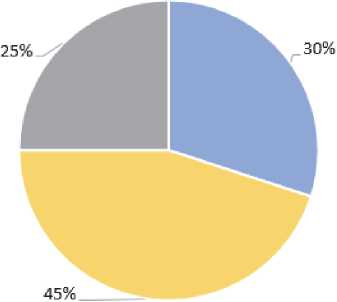
Fig. 3 presents the groups of the employed population in the Russian labor market, taking into account the peculiarities of the development of the above-mentioned components.
■ Specialists i Support staff ■ Integrated
Fig. 3. Groups of the employed population in the labor market taking into account creative industries as well as creative professions1
It was found that in the Russian labor market more than 5 million people were involved in the creative economy (over the last five years the number of such employed people has increased by 1.5 million).
Figure 4 shows top 15 Russian regions ranked according to the share of employees in creative industries in the total employment of the region.
Analysis of Figure 4 shows that Moscow, Saint Petersburg, and Tyumen Oblast are leaders in the share of employees working in organizations related to the creative industries and concentrate a significant proportion of creative industry workers.
The study revealed that within the structure of creative employment in Russia, marketing and advertising specialists account for 25 % and programmers for 20 % whereas 55 % of the creative class includes professionals from such fields as designers, photographers, musicians, etc.
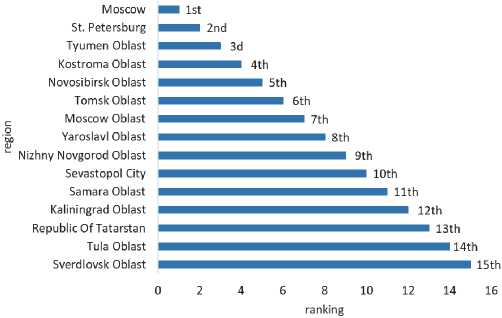
Fig. 4. Top 15 Russian Regions by the Share of Employees in Creative Industries2
The leading positions in Russia’s employment are occupied by the fashion industry (over 30 % of the employed), as well as cultural and leisure activities, music and performing arts (28 % of the employed).
More than 80 % of Russia’s employed popula-ton in creative professions performs their labor activity in organizations that have the status of a legal entity; while 10 % work for private individuals or as part of household businesses, and 8 % are involved in entrepreneurial activities. Notably, only half of the creative professionals are working in positions directly related to their specialty 3 .
It has been found that employers hiring creative professionals primarily focus on practical skills directly related to the job and key digital competencies.
Russia’s creative class is concentrated in Moscow, St. Petersburg (over 40 % in creative employment), millionaire cities (other than Moscow and St. Petersburg) - 14 %; large cities - 16 %, towns -10 %, other Russian cities - about 19 %.
In the course of this study, a workload coefficient for those employed in creative industries was calculated for the period from early 2019 to early 2023, allowing to assess their impact on the employment process. Based on the obtained result, it was found that, on average, for every thousand employed people in Russia, there were 62 individuals employed in creative industries. Furthermore, a significant increase in the coefficient (by 1,3 tmes) was observed at the beginning of 2023 compared to the beginning of 2019, which is related to the increasing number of the employed in creatve industries.
Conclusion
The study concluded that in recent years, the creatve economy has emerged as a highly promising key sector, with creatve industries exertng an increasing influence on various aspects of modern society and playing a significant role in the economic development. The government views creatve industries as a new vector for the growth of Russia’s economy and employment, while the modern business environment is focused on creating commercially successful products that generate profit.
The key trends that allow creatve industries to actvely develop represent a fairly effectve tool that is aimed at the optmal socio-economic development of Russia as a whole and its consttuent enttes in partcular.
Collaboraton between government agencies, representatves of creatve industries, as well as other ecosystem elements of the creatve industry in the country could form the foundaton for the realizaton of significant creatve projects, as well as influence the process of stmulatng and facilitating change across Russia’s economy.
