
Economic Security of Russia’s Northern and Arctic Territories: Problems and Solutions
Journal: Arctic and North @arctic-and-north
Section: Social and economic development
Article in issue: 62, 2026.
Free access
In the context of modern geopolitical instability and increasing competition for Arctic resources, ensuring the economic security of the northern and Arctic regions of the Russian Federation is of strategic importance for strengthening the country’s defense capability and protecting its national interests. This research is aimed at a comprehensive analysis of the factors determining the dynamics of the gross regional product as a key indicator of sustainable growth and competitiveness of the economy, as well as the level of economic security of the northern and Arctic territories of Russia. The purpose of the work is to identify the main problems hindering the sustainable development of the region and to develop scientifically based recommendations aimed at increasing the effectiveness of government support measures and strengthening the economic potential of the region. The research used methods of system and statistical data analysis, as well as expert assessments. An assessment of the effectiveness of existing government support measures was carried out and key factors influencing the economic security of the region were identified. Promising areas for increasing the economic potential of the northern and Arctic territories were identified, including the development of innovative industries, modernization of production and social infrastructure, intensification of entrepreneurial activity, increasing the level of development of entrepreneurial structures and creating conditions for the use of alternative sources of financing entrepreneurship. Based on the results obtained, recommendations have been developed to improve the assessment of the effectiveness of state support measures, and elements of a regional economic security program have been proposed, adapted to the specific conditions and challenges facing northern and Arctic territories. The results obtained can be used by government authorities in developing additional regional measures aimed at stimulating GRP growth and strengthening the economic security of northern and Arctic territories. The materials of the article can also be used in further scientific research devoted to studying the role of the state, development institutions and business in ensuring the economic security of the region.
Similar articles in the section Theory and organization of work. Relations between business firms and employees
Short address: https://sciup.org/148333287
IDS: 148333287 | UDC: 331.1(985)(045) | DOI: 10.37482/issn2221-2698.2026.62.131
Text of the scientific article Economic Security of Russia’s Northern and Arctic Territories: Problems and Solutions
DOI:
In the context of modern geopolitical instability and increasing competition for natural resources, ensuring the economic security of the northern and Arctic territories of the Russian Federation is of paramount importance for the military-economic support of the country’s defense and security. These territories, with their colossal resource potential and strategically important geographic location, are a key element of national sovereignty, requiring a comprehensive ap-
-
∗ © Shikhverdiev A.P., Oganezova N.A., 2026
This work is licensed under a CC BY-SA License proach to management and development. At the International Arctic Forum in Murmansk, Russian President Vladimir Putin noted that “the role and significance of the Arctic for Russia and the world is growing, which is leading to intensification of the geopolitical struggle for positions in this region” 1.
Identifying long-term priorities and thoroughly developing and coordinating mechanisms for their implementation are particularly important in these territories. This necessity is driven by the specific conditions of economic activity, characterized by increased costs and long implementation periods for investment and infrastructure projects, labor shortages, seasonality of work, transport isolation of the territories, and a high dependence on imported equipment and technology [1–3].
Strategic documents of the Russian Federation, such as the Strategy for Developing the Russian Arctic Zone and Ensuring National Security until 2035 2, the National Security Strategy of the Russian Federation 3, and the Economic Security Strategy of the Russian Federation 4, emphasize the need to ensure sustainable socio-economic development of the northern and Arctic territories, strengthen their economic potential, and improve the standard of living of the population [4]. Particular attention is paid to issues of economic diversification, the development of innovative industries, the creation of a favorable investment climate, and the strengthening of international cooperation in the Arctic region.
Ensuring economic security, understood as the state of protection of the country’s economy from external and internal threats, is of paramount importance. Key indicators defined in the Economic Security Strategy of the Russian Federation until 2030 serve as an important tool for assessing the level of economic security. These indicators include the index of physical volume of gross domestic product (hereinafter referred to as GDP), GDP per capita (at purchasing power parity), the share of Russian GDP in global GDP, the share of investment in fixed capital in GDP, the degree of depreciation of fixed assets, the industrial production index, and the labor productivity index. In this regard, and given that GDP is a key macro-economic indicator reflecting the state and dynamics of the national economy, it can be argued that GDP dynamics are the determining factor reflecting the level of economic security of the country.
At the regional level, the analogue of GDP is gross regional product (hereinafter referred to as GRP), which characterizes the economic security of a particular constituent entity of the Russian Federation.
The importance of GDP for ensuring economic security is manifested in the following:
-
• indication of economic progress: GDP growth indicates economic growth, which, in turn, contributes to an increase in the well-being of the population and a decrease in unemployment;
-
• structural analysis of the economy: an analysis of the GDP structure allows identifying imbalances in the country’s economy, which is important for ensuring economic and defense security;
-
• determination of the level of foreign economic security: the ratio of external debt to GDP is an important indicator of a country’s foreign economic stability.
GDP is the main indicator that reflects the country’s overall economic potential and combines the performance of the entire socio-economic system.
One of the main factors determining GDP growth is investment in fixed assets. Global practice shows that in order to ensure sustainable economic growth, the share of investment in fixed capital should be at least 25% of GDP. Otherwise, only simple reproduction is possible, and resources are insufficient for expanded reproduction.
During the Soviet period, when gross fixed capital formation accounted for 35–40% of GDP, the economy demonstrated steady growth. During the transformation crisis of 1991–1998, fixed capital investment fell by a factor of 4.8, reaching 16% of GDP. During the recovery period of 1999– 2008, largely due to rising oil prices, fixed capital investment increased by a factor of 2.8, reaching 22% of GDP. In subsequent years, this indicator fluctuated between 20–22%, while visible fixed capital investment fell to 17–19% [5].
It should be noted that the effective use of fixed capital investment requires a sufficient level of human capital development. Investments in education, healthcare, and workforce development are important factors contributing to GDP growth.
The Economic Security Strategy of the Russian Federation until 2030 stipulates that state and local government bodies, the Central Bank of the Russian Federation, state corporations, companies with a majority stake held by the Russian Federation, and other organizations ensure the implementation of the economic security strategy in accordance with their respective competencies 5. It should be noted that, despite the adoption of the Economic Security Strategy of the Russian Federation until 2030, many of its provisions are not being fully implemented. Thus, no threshold values have been defined for the main economic security indicators, without which the strategy cannot be fully implemented. Furthermore, federal subjects are not fully engaged in the implementation of the economic security strategy 6.
Thus, the development of a regional plan for the implementation of the economic security strategy, including a clear definition of key indicators, their threshold values, the appointment of
SOCIAL AND ECONOMIC DEVELOPMENT
Arif P. Shikhverdiev, Nina A. Oganezova. Economic Security … responsible officials and the establishment of measures of accountability for achieving results, will make it possible to:
-
• firstly, increase the effectiveness of management decisions taken by state and local authorities;
-
• secondly, introduce a system for evaluating the effectiveness of heads of ministries and departments based on the achievement of established threshold values for economic security indicators, which will allow for informed personnel decisions and determine the degree of responsibility;
-
• thirdly, increase the level of responsibility of development institutions for achieving the goals and objectives defined in the economic security strategy;
-
• fourthly, improve the system for training management personnel, which is particularly necessary for effective management in the complex conditions of the North and the Arctic.
Literature review and research materials
Currently, there are a significant number of definitions of “economic security”, differing in their methodological approaches, including substantive, functional, and axiological. This diversity, while entirely justified from a scientific perspective, is due to the differences in the objectives of researchers seeking fundamental or applied, scientific or empirical, and subject-specific or interdisciplinary solutions.
One of the first to introduce the concept of “economic security” was J.M. Keynes during the Great Depression of the 1930s. He emphasized the imperfections of the market economy and related problems such as inflation, economic recession, and unemployment [6].
Representatives of a broader approach to the interpretation of “economic security” consider this concept from different angles. In scientific literature, considerable attention is paid to issues of economic security in the northern and Arctic regions, which is reflected in a variety of approaches to identifying key threats and developing sustainable development strategies [7, pp. 39–40].
G.V. Ivanov focuses on the resource component of economic security, considering the effective development of the mineral resource base as a key factor in increasing the economic sustainability of the region and ensuring the country’s energy security. His works pay particular attention to the introduction of innovative technologies for the extraction and processing of minerals, as well as the creation of a logistics infrastructure to transport resources to domestic and foreign markets [8].
The importance of diversifying the economies of northern and Arctic regions, as well as strategies for developing alternative industries such as tourism, renewable energy and high-tech manufacturing, is emphasized in the work of P.V. Druzhinina and O.V. Potasheva. The authors note that excessive dependence on the extraction and export of natural resources makes the region vulnerable to fluctuations in world prices and creates risks for sustainable development [9].
Another group of researchers focuses on the social aspects of economic security, in particular on issues of food security, improving the standard of living of the population, developing education and healthcare systems, and preserving the cultural heritage and traditions of the indigenous peoples of the North. It is emphasized that achieving economic security in the region is impossible without taking into account the interests and satisfying the needs of its inhabitants.
The development of small and medium-sized businesses in the Arctic, which are an important element in ensuring the region’s economic security, is complicated by various social and natural constraints. Therefore, issues of Arctic urbanization in the context of ensuring sustainable economic activity and a comfortable living environment, unlike the viability and sustainability of cities in the temperate zone, require the development of new concepts and vectors of public policy aimed at minimizing risks, maximizing opportunities for entrepreneurship, and improving the population’s standard of living [10].
Thus, scientific research in the field of economic security in the northern and Arctic regions is characterized by a diversity of approaches and emphases, reflecting the complexity and multifaceted nature of the challenges faced by the region. However, all authors agree that ensuring economic security is a key factor for the sustainable development of the region and the strengthening of national security and defense capabilities.
An analysis of scientific works shows that economic security is understood as the state of protection of the country’s economy, its individual regions and industries from external and internal threats, ensuring sustainable economic growth, social stability, and maintaining the necessary level of defense capability. In the context of the northern and Arctic territories, this concept is particularly relevant, as the region is vulnerable to the impacts of climate change, man-made disasters, and geopolitical risks.
The study of economic security is an important and multifaceted area of research, to which international authors have also made significant contributions. Their works highlight various aspects of the interaction between economics, politics, and global processes.
In his research, W. Hager focuses on the relationship between economic security and global economic processes. He provides an in-depth analysis of how international trade, investment, and financial flows influence national security. The author emphasizes the importance of economic security for sustainable development and social well-being, calling for the integration of these aspects into public policy [11].
-
H . Machovski examines economic security through the prism of national security, highlighting the threats arising in the context of globalization and technological change. His works emphasize the need to create effective mechanisms to protect the state’s economic interests and formulate recommendations for improving national policy in this area [12].
-
H . Maull examines the concept of economic security in the context of international relations and foreign policy. He analyzes the influence of economic factors on the strategic decisions of states and the use of the economy as an instrument of external economic pressure. He also em-
- SOCIAL AND ECONOMIC DEVELOPMENT
Arif P. Shikhverdiev, Nina A. Oganezova. Economic Security … phasizes the importance of integrating economic security into an overall national security strategy, which allows for a more effective response to global challenges [13].
-
C . Murdock focuses on economic security in the context of sustainable development and the environment. His research highlights how environmental threats and climate change can negatively impact the economic stability of countries, especially in vulnerable regions. He proposes strategies for adapting to these challenges, emphasizing the need to ensure the resilience of economic systems [14].
-
J . Yong examines the specifics of economic security in developing countries, with a particular focus on China. He analyzes the impact of internal and external factors, such as corruption and inequality, on economic stability. J. Yong offers recommendations for strengthening economic security through reforms and international cooperation [15].
These authors represent only a small part of the vast field of research in the area of economic security, and each of them makes a unique contribution to understanding the complex interrelationships between economic, political and social factors.
Despite a significant number of scientific studies and strategic documents, issues related to ensuring the economic security of northern and Arctic territories remain underdeveloped. In particular, further study is needed on the assessment of threats to economic security, the development of effective mechanisms to neutralize them, and the formation of a risk management system for activating the region’s potential, taking into account the specific characteristics of northern and Arctic territories.
Study of the main factors ensuring the economic security of the region (using the Republic of Komi as an example)
In order to assess the prospects for GRP growth as a key indicator of the region’s economic security, we will analyze the forecast for the socio-economic development of the Republic of Komi until 2027, presented in Table 1.
Table 1
GRP dynamics for the period 2025–2027
|
Indicator |
2025 |
2026 |
2027 |
|
Gross regional product, billion |
1 154.1 |
1 234.3 |
1 277.3 |
|
Gross regional product growth rate, % |
100.2 |
100.9 |
100.5 |
|
Fixed capital investment, billion |
137.9 |
135.5 |
140.3 |
|
Fixed capital investment growth rate, % |
96 |
94 |
99 |
|
Share of investment in GDP, % |
13 |
12 |
15 |
Overall, the forecast for socio-economic development for 2025 and the period up to 2027 is quite favorable. However, in our opinion, the GRP growth rates are not high enough for a region with enormous economic potential. The projected GRP growth as an indicator of economic security is unrealistic due to the fact that planned investments in fixed capital are insufficient to ensure expanded reproduction and, consequently, GRP growth. According to the forecast for 2025–2027, investments in fixed capital will average only 13% of GRP. It can be concluded that with this level of investment in fixed capital, it will be difficult to ensure not only expanded reproduction and GRP growth, but even simple reproduction. Certainly, there is hope that a high-quality regional investment standard will be implemented and that infrastructure opportunities will be created for the implementation of new, including large-scale, investment projects, as well as an increase in the number of project-oriented enterprises in the region. It is also hoped that opportunities will be created to transform household savings into investment, including through the growth of small and medium-sized enterprises.
It is essential to qualitatively improve all factors influencing GRP growth, as well as to identify areas for activating the region’s potential.
The study conducted by the authors (Fig. 1) shows that the key factors affecting competitiveness, GRP growth and economic security in the region are:
-
• state of the financial system;
-
• quality of infrastructure;
-
• level of entrepreneurial activity;
-
• investment activity of the government and business;
-
• political stability.
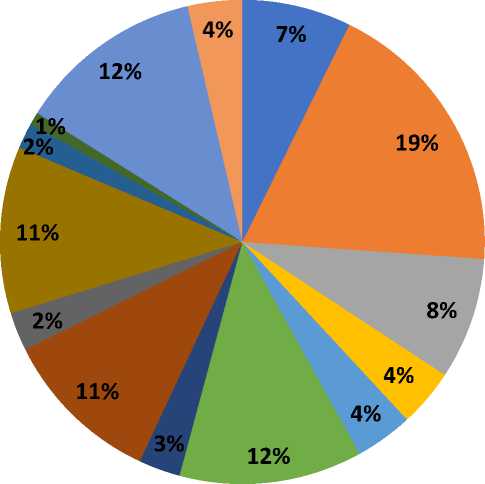
Fig. 1. Key factors influencing the growth of GRP and economic security of a region: 19% — state of the financial system, 12% — quality of infrastructure, 12% — political stability, 11% — investment activity of the state and business, 11% — level of entrepreneurial activity, 8% — accessibility and development of the national credit system, 7% — quality of infrastructure, 4% — existing taxation system, 4% — tariff regulation system, 4% — overcoming corruption, 3% — national education system, 2% — nature of innovation activity, 2% — characteristics of national culture, 1% — volume of research and development work 7.
An analysis of the identified factors affecting the economic security of the northern and Arctic regions reveals the following key issues.
-
7 Source: compiled by the authors.
-
1. The state of the financial system and the availability of financing for entrepreneurship. The business sector faces limited alternative sources of financing, exacerbated by the high cost of credit. The development of the stock market as an effective mechanism for attracting long-term investment is an objective necessity, especially relevant for capital-intensive projects implemented in the northern and Arctic regions.
-
2. The level of entrepreneurial activity and the state of the business support infrastructure. The development of existing businesses and the creation of new ones are hampered by the ineffectiveness of entrepreneurship infrastructure, support mechanisms and business development institutions. Existing and potential entrepreneurs face problems related to imperfect law enforcement practices and entrepreneurship policies.
-
3. Investment activity of the state and businesses and internal factors in the development of entrepreneurial structures. It is important for legislative and executive authorities to identify promising investment projects, including innovative ones, taking into account the potential of the region.
In this regard, it is necessary to:
-
• develop incentive mechanisms for cooperation between large and small businesses in the fuel and energy sector;
-
• ensure incentives for public-private partnership mechanisms to create project-oriented business structures and attract investment resources for the development of entrepreneurship in the region;
-
• intensify support for innovative projects, including start-up projects, and the creation of technology transfer centers;
-
• develop and implement effective tools to stimulate entrepreneurship in the creation of innovative projects and increase the social and environmental responsibility of businesses;
-
• change the approach to the development of investment activity, viewing entrepreneurship as a driver of economic and defense security for the state.
Along with measures aimed at stimulating investment activity, it is important to improve the development of entrepreneurial structures in the region. An analysis conducted by the authors [16] identified the following key factors hindering the development of entrepreneurial structures:
-
• non-compliance of the corporate governance system with international and national standards;
-
• low level of professionalism of personnel, including management, resulting in a lack of innovative ideas and projects, as well as an insufficiently high percentage of project-oriented business structures;
-
• uncertainty in information about the marketing situation in priority markets for goods and services both domestically and internationally;
-
• ineffective interaction with government agencies, entrepreneurship development institutions, and other stakeholders 8;
-
• lack of competencies in risk management, ensuring employee loyalty, improving labor productivity, and creating project-oriented companies;
-
• insufficient competence of management personnel in the field of financial management and increasing the value of the company;
-
• insufficient understanding of opportunities to leverage the company’s innovative potential, including by encouraging a creative approach to developing innovative projects within the company;
-
• difficulties in ensuring conditions for expanded reproduction.
Given the importance of stimulating investment activity, it should be noted that achieving these goals in the region requires not only the creation of favorable external conditions, including increasing the effectiveness of government support, but also improving the quality of internal factors influencing business development, which requires the active participation of both businesses themselves and development institutions.
Another important aspect for the development of entrepreneurship and growth of investment in fixed capital is the analysis of key areas for activating the region’s potential, which can have a positive impact on the development of entrepreneurship and, as a result, on the growth of GRP (Fig. 2).
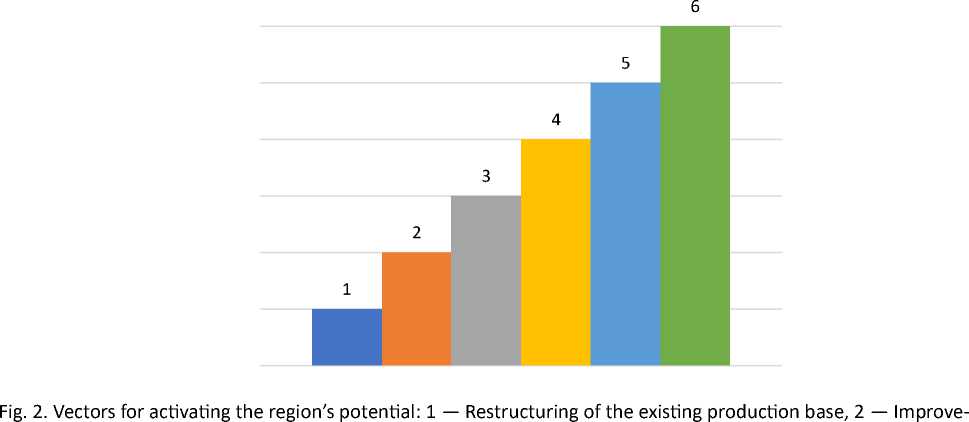
ment of infrastructure: roads, social sphere, energy, 3 — Increasing the creative activity of the population, 4 — Improving access to information and training for project implementation, 5 — New projects on local, regional and federal assets, 6 — Mechanisms for overcoming barriers: legislation, financial, organizational 9.
The analysis shows that the main areas for activating the region’s potential are:
Modernization and restructuring of the existing production base in the region. Restructuring, as a process of structural change, creates conditions for more efficient use of all factors of production in order to improve the financial security of the economic entity and the economic security of the region. Modernization, as a process aimed at qualitatively changing all components of the production process in a broad sense, provides the conditions for expanded reproduction and increased profitability. Restructuring and modernization of production are a complex economic category, and given the importance of these processes for the sustainable development of the region, they should be given priority attention.
Improving the social and industrial infrastructure as a general condition for development . The importance of industrial infrastructure as a sector that creates the general conditions for primary production was noted by Karl Marx. Clearly, the insufficient development of these general conditions hinders not only the development of entrepreneurship, but also the effective use of the region’s potential, which, in turn, negatively impacts the growth of GRP and, consequently, the region’s economic security.
Ensuring the growth of creative activity among the region’s residents . For this purpose, it is important to develop a creative environment and infrastructure for the creative industry in the region. The creative industry, as a synthesis of creativity, culture (including corporate culture), economics, and technology, drives the economy 10.
Preparing residents of the region for creativity and implementation of business ideas through various educational programs . Various educational and acceleration programs for business creation are actively implemented in the region. However, without the proper infrastructure for entrepreneurship development, various training courses are ineffective. In order to realize the region’s potential, it is necessary to intensify the activities of project offices established at the municipal and government levels, aimed at developing and implementing new promising projects that meet the needs of the regions and contribute to their development.
Creating tools to overcome administrative barriers . It is important to monitor the main causes of such barriers. In this regard, it is objectively necessary to improve efforts to balance the interests of entrepreneurs and government agencies, taking into account the state’s interests in ensuring defense security.
It is also important to improve the efficiency of all development institutions, including the Chamber of Commerce and Industry, which is authorized to protect the rights of entrepreneurs. All these institutions are involved in the development of entrepreneurship as a driver of the economy, ensuring the growth of GRP and the economic security of the region.
Ensuring personnel stability in the region is an important task. A key factor is not only the retention of qualified personnel, but also the availability of competent leaders in sectoral ministries with a deep understanding of the region’s economic and human potential. It is desirable that
SOCIAL AND ECONOMIC DEVELOPMENT
Arif P. Shikhverdiev, Nina A. Oganezova. Economic Security … these leaders hold their positions for at least five years, which will allow them to fully realize their potential and make a significant contribution to the region’s development.
Conclusion
The study, which included a comprehensive analysis of socio-economic processes in the Komi Republic as a strategically important territory in the North Arctic zone of the Russian Federation, identified systemic problems that hinder the growth of the gross regional product and pose threats to the sustainability of the region’s economic security. They include: crisis in the financial system, characterized by limited access to credit resources and their high cost; shortage of alternative sources of financing for business initiatives; insufficient investment in fixed capital necessary to ensure expanded reproduction; low level of entrepreneurial activity, exacerbated by the inefficiency of the business support infrastructure; weak implementation of innovation policy, which does not contribute to the modernization and restructuring of the outdated production base; low level of creative activity among the population, lack of a developed creative environment and infrastructure for creative industries; and systemic crisis of personnel stability, which hinders longterm development.
Based on the empirical data obtained and theoretical analysis, a set of strategic recommendations is proposed, aimed at implementing the priority tasks set out in the Economic Security Strategy of the Russian Federation until 2030. In particular, it seems appropriate to develop a regional economic security plan with clearly defined key indicators, thresholds and accountability mechanisms for officials, which will enable rapid risk management and ensure a sustainable path of economic growth. At the same time, it is advisable to initiate the transformation of household savings into productive investments by revitalizing the regional stock market and creating favorable institutional conditions. The revitalization of public-private partnership mechanisms is a key tool for mobilizing investment activity on the part of both the state and business.
The proposed program pays particular attention to stimulating innovation through the development of a comprehensive program for regional innovative development, including the creation of a modern innovation support infrastructure, effective fiscal and non-financial incentive mechanisms, and priority support for youth entrepreneurial initiatives and start-up projects. In this regard, it is advisable to establish regional technology transfer centers with annual monitoring of the needs of large businesses for innovative solutions. Improving the effectiveness of the regional investment standard requires assigning personal responsibility to the region’s top leader, which will emphasize the strategic priority of this area. In addition, it is necessary to improve the effectiveness of business support funds and development institutions — the Chamber of Commerce and Industry, Opora Rossii, Delovaya Rossiya, My Business centers, and business incubators — by involving them in the development of interregional economic ties, the exploration of new markets, and the protection of the interests of business structures.
Finally, a strategically important area is the reform of the management training system, taking into account the specific characteristics of the northern and Arctic territories. It is necessary to implement a targeted program of continuing education covering schoolchildren, students and active entrepreneurs, with an emphasis on the development of critically important competencies: strategic risk management; modern management methods for attracting venture and stock investments; effective approaches to personnel management that ensure loyalty, productivity growth and information security; the formation of a high corporate culture and social responsibility to adequately respond to external challenges; as well as the skills of an effective business owner in an extreme geo-economic environment.
The scientific significance of this study lies in its comprehensive, interdisciplinary approach to diagnosing the factors that determine GRP growth and the level of economic security in the region, taking into account the unique territorial specifics of the Arctic latitudes. The methodological novelty lies in the development of an integrated set of state regulation measures proposed for practical testing within the framework of federal and regional policy. The results obtained have significant applied potential, contributing to the development of additional measures to modernize the production base, develop infrastructure, increase innovation activity and provide human resources for the sustainable economic development of the Komi Republic, and can also serve as a methodological basis for further research in the field of regional economic dynamics and security.
