
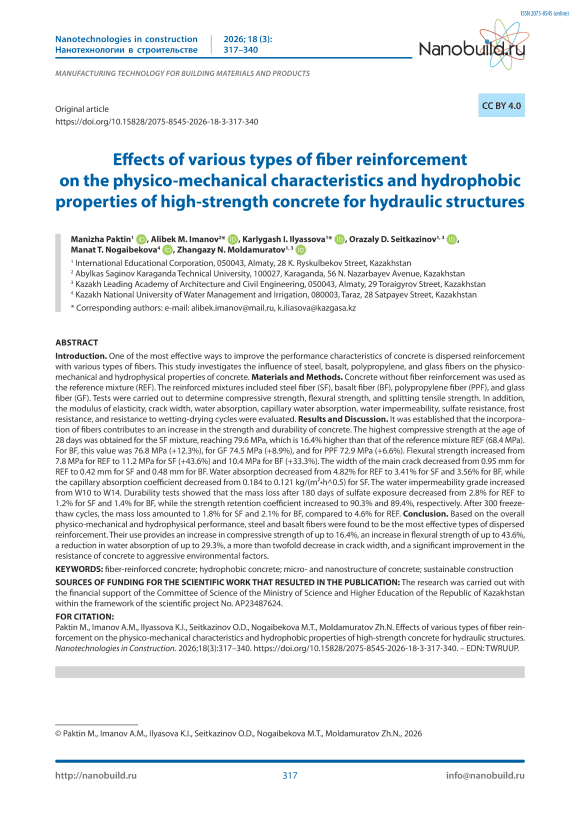
Effects of various types of fiber reinforcement on the physico-mechanical characteristics and hydrophobic properties of high-strength concrete for hydraulic structures
Journal: Nanotechnologies in Construction: A Scientific Internet-Journal @nanobuild-en
Section: Manufacturing technology for building materials and products
Article in issue: 3 Vol.18, 2026.
Free access
Introduction. One of the most effective ways to improve the performance characteristics of concrete is dispersed reinforcement with various types of fibers. This study investigates the influence of steel, basalt, polypropylene, and glass fibers on the physicomechanical and hydrophysical properties of concrete. Materials and Methods. Concrete without fiber reinforcement was used as the reference mixture (REF). The reinforced mixtures included steel fiber (SF), basalt fiber (BF), polypropylene fiber (PPF), and glass fiber (GF). Tests were carried out to determine compressive strength, flexural strength, and splitting tensile strength. In addition, the modulus of elasticity, crack width, water absorption, capillary water absorption, water impermeability, sulfate resistance, frost resistance, and resistance to wetting-drying cycles were evaluated. Results and Discussion. It was established that the incorporation of fibers contributes to an increase in the strength and durability of concrete. The highest compressive strength at the age of 28 days was obtained for the SF mixture, reaching 79.6 MPa, which is 16.4% higher than that of the reference mixture REF (68.4 MPa). For BF, this value was 76.8 MPa (+12.3%), for GF 74.5 MPa (+8.9%), and for PPF 72.9 MPa (+6.6%). Flexural strength increased from 7.8 MPa for REF to 11.2 MPa for SF (+43.6%) and 10.4 MPa for BF (+33.3%). The width of the main crack decreased from 0.95 mm for REF to 0.42 mm for SF and 0.48 mm for BF. Water absorption decreased from 4.82% for REF to 3.41% for SF and 3.56% for BF, while the capillary absorption coefficient decreased from 0.184 to 0.121 kg/(m²•h^0.5) for SF. The water impermeability grade increased from W10 to W14. Durability tests showed that the mass loss after 180 days of sulfate exposure decreased from 2.8% for REF to 1.2% for SF and 1.4% for BF, while the strength retention coefficient increased to 90.3% and 89.4%, respectively. After 300 freezethaw cycles, the mass loss amounted to 1.8% for SF and 2.1% for BF, compared to 4.6% for REF. Conclusion. Based on the overall physico-mechanical and hydrophysical performance, steel and basalt fibers were found to be the most effective types of dispersed reinforcement. Their use provides an increase in compressive strength of up to 16.4%, an increase in flexural strength of up to 43.6%, a reduction in water absorption of up to 29.3%, a more than twofold decrease in crack width, and a significant improvement in the resistance of concrete to aggressive environmental factors.
Similar articles in the section Glass industry. Ceramics. Cement and concrete
Short address: https://sciup.org/142248067
IDS: 142248067 | DOI: 10.15828/2075-8545-2026-18-3-317-340
