
El ejercicio docente en tiempos de inteligencia artificial: Evaluación de la ética educativa y las recomendaciones de uso de ChatGPT propuestas por la UNESCO
Журнал: Centro de Estudios Superiores del Mayo, A.C. @cessumex
Статья в выпуске: 1 vol.1, 2024 года.
Бесплатный доступ
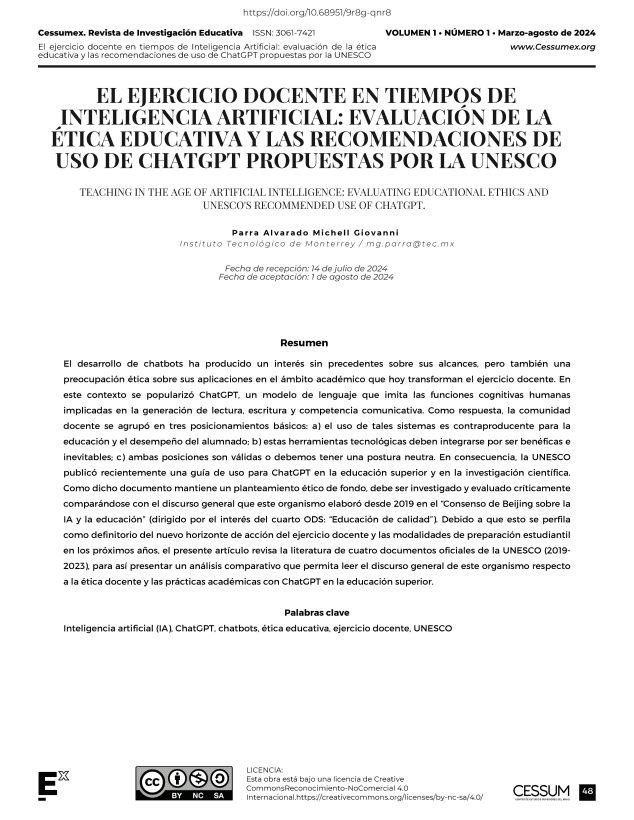
El desarrollo de chatbots ha producido un interés sin precedentes sobre sus alcances, pero también una preocupación ética sobre sus aplicaciones en el ámbito académico que hoy transforman el ejercicio docente. En este contexto se popularizó ChatGPT, un modelo de lenguaje que imita las funciones cognitivas humanas implicadas en la generación de lectura, escritura y competencia comunicativa. Como respuesta, la comunidad docente se agrupó en tres posicionamientos básicos: a) el uso de tales sistemas es contraproducente para la educación y el desempeño del alumnado; b) estas herramientas tecnológicas deben integrarse por ser benéficas e inevitables; c) ambas posiciones son válidas o debemos tener una postura neutra. En consecuencia, la UNESCO publicó recientemente una guía de uso para ChatGPT en la educación superior y en la investigación científica. Como dicho documento mantiene un planteamiento ético de fondo, debe ser investigado y evaluado críticamente comparándose con el discurso general que este organismo elaboró desde 2019 en el “Consenso de Beijing sobre la IA y la educación” (dirigido por el interés del cuarto ODS: “Educación de calidad”). Debido a que esto se perfila como definitorio del nuevo horizonte de acción del ejercicio docente y las modalidades de preparación estudiantil en los próximos años, el presente artículo revisa la literatura de cuatro documentos oficiales de la UNESCO (2019- 2023), para así presentar un análisis comparativo que permita leer el discurso general de este organismo respecto a la ética docente y las prácticas académicas con ChatGPT en la educación superior. Licencia declarada para este artículo: CC BY-NC-SA 4.0 (https://creativecommons.org/licenses/by-nc-sa/4.0/).
Короткий адрес: https://sciup.org/170214014
IDS: 170214014 | DOI: 10.68951/9r8g-qnr8
Teaching in the Age of Artificial Intelligence: Evaluating Educational Ethics and UNESCO’s Recommended Use of ChatGPT
The development of chatbots has sparked an unprecedented interest in their capabilities, but also an ethical concern about their applications in the academic sphere, which are today transforming the practice of teaching. In this context, ChatGPT, a language model that mimics the human cognitive functions involved in the generation of reading, writing, and communicative competence, became popular. As a response, the teaching community has grouped itself into three basic stances: a) the use of such systems is counterproductive for education and student performance; b) these technological tools should be integrated because they are beneficial and inevitable; c) both positions are valid or we should adopt a neutral stance. Consequently, UNESCO recently published a user guide for ChatGPT in higher education and scientific research. As this document maintains an underlying ethical approach, it should be researched and critically evaluated in comparison with the general discourse that this organization has developed since 2019 in the "Beijing Consensus on AI and Education" (driven by the interest of the fourth SDG: "Quality Education"). Because this is shaping up as definitive of the new horizon of action for the teaching profession and the modes of student preparation in the coming years, this article reviews the literature of four official UNESCO documents (2019-2023), to present a comparative analysis that allows reading the general discourse of this organization regarding teaching ethics and academic practices with ChatGPT in higher education.
