
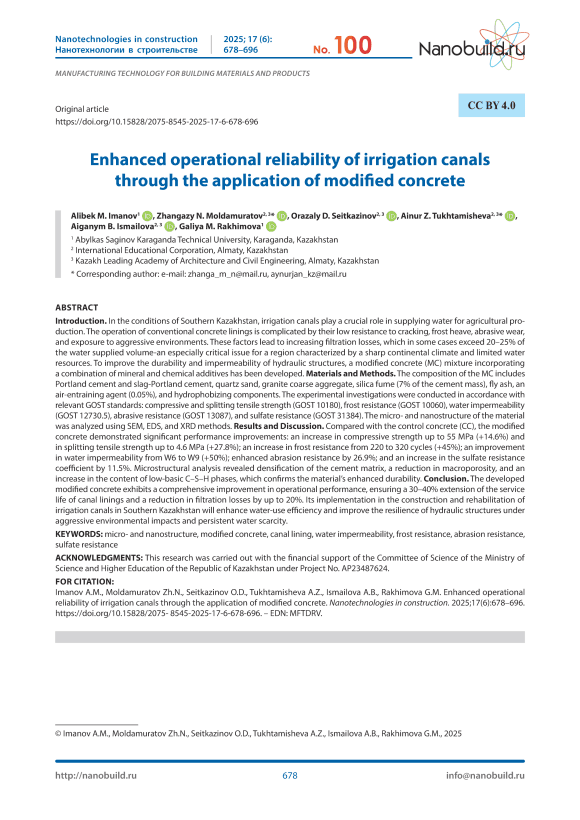
Enhanced operational reliability of irrigation canals through the application of modified concrete
Journal: Nanotechnologies in Construction: A Scientific Internet-Journal @nanobuild-en
Section: Manufacturing technology for building materials and products
Article in issue: 6 Vol.17, 2025.
Free access
Introduction. In the conditions of Southern Kazakhstan, irrigation canals play a crucial role in supplying water for agricultural production. The operation of conventional concrete linings is complicated by their low resistance to cracking, frost heave, abrasive wear, and exposure to aggressive environments. These factors lead to increasing filtration losses, which in some cases exceed 20–25% of the water supplied volume-an especially critical issue for a region characterized by a sharp continental climate and limited water resources. To improve the durability and impermeability of hydraulic structures, a modified concrete (MC) mixture incorporating a combination of mineral and chemical additives has been developed. Materials and Methods. The composition of the MC includes Portland cement and slag-Portland cement, quartz sand, granite coarse aggregate, silica fume (7% of the cement mass), fly ash, an air-entraining agent (0.05%), and hydrophobizing components. The experimental investigations were conducted in accordance with relevant GOST standards: compressive and splitting tensile strength (GOST 10180), frost resistance (GOST 10060), water impermeability (GOST 12730.5), abrasive resistance (GOST 13087), and sulfate resistance (GOST 31384). The micro- and nanostructure of the material was analyzed using SEM, EDS, and XRD methods. Results and Discussion. Compared with the control concrete (CC), the modified concrete demonstrated significant performance improvements: an increase in compressive strength up to 55 MPa (+14.6%) and in splitting tensile strength up to 4.6 MPa (+27.8%); an increase in frost resistance from 220 to 320 cycles (+45%); an improvement in water impermeability from W6 to W9 (+50%); enhanced abrasion resistance by 26.9%; and an increase in the sulfate resistance coefficient by 11.5%. Microstructural analysis revealed densification of the cement matrix, a reduction in macroporosity, and an increase in the content of low-basic C–S–H phases, which confirms the material’s enhanced durability. Conclusion. The developed modified concrete exhibits a comprehensive improvement in operational performance, ensuring a 30–40% extension of the service life of canal linings and a reduction in filtration losses by up to 20%. Its implementation in the construction and rehabilitation of irrigation canals in Southern Kazakhstan will enhance water-use efficiency and improve the resilience of hydraulic structures under aggressive environmental impacts and persistent water scarcity.
Similar articles in the section Glass industry. Ceramics. Cement and concrete
Short address: https://sciup.org/142246525
IDS: 142246525 | DOI: 10.15828/2075-8545-2025-17-6-678-696
