
Enhancing foreign language teaching at Thai Nguyen University through the experiential learning approach
Journal: Forum of Young Scientists @forum-nauka
Article in issue: 8 (108), 2025.
Free access
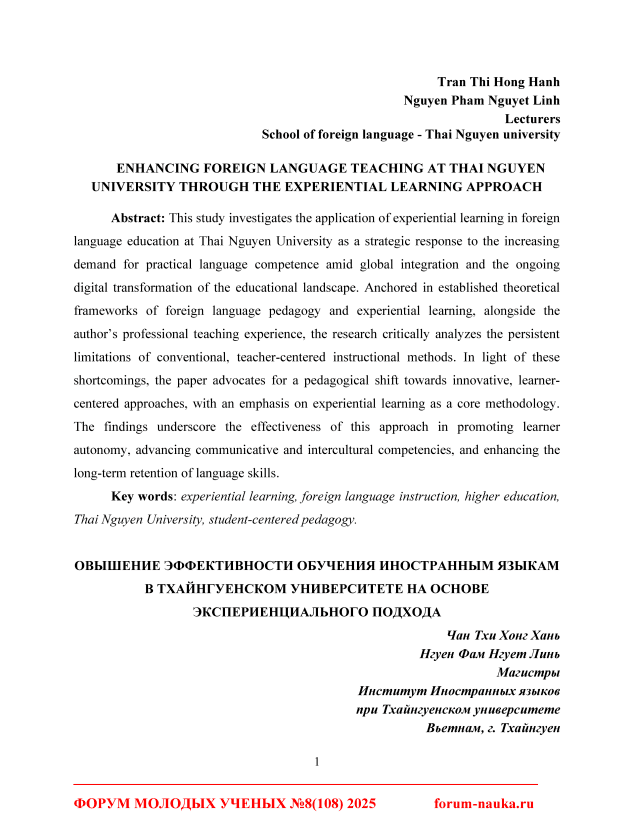
This study investigates the application of experiential learning in foreign language education at Thai Nguyen University as a strategic response to the increasing demand for practical language competence amid global integration and the ongoing digital transformation of the educational landscape. Anchored in established theoretical frameworks of foreign language pedagogy and experiential learning, alongside the author’s professional teaching experience, the research critically analyzes the persistent limitations of conventional, teacher-centered instructional methods. In light of these shortcomings, the paper advocates for a pedagogical shift towards innovative, learner-centered approaches, with an emphasis on experiential learning as a core methodology. The findings underscore the effectiveness of this approach in promoting learner autonomy, advancing communicative and intercultural competencies, and enhancing the long-term retention of language skills.
Similar articles in the section Higher education. Universities. Academic study
Short address: https://sciup.org/140312564
IDS: 140312564
Text of the scientific article Enhancing foreign language teaching at Thai Nguyen University through the experiential learning approach
In the realm of foreign language education, experiential learning encourages students to apply linguistic knowledge in meaningful settings, such as role plays, field interviews, cultural immersion tasks, or collaborative projects. This approach aligns with the communicative and competency-based trends in modern pedagogy and provides a solid theoretical framework for our practical proposals.
Through years of teaching at Thai Nguyen University, we have witnessed the transformative effect of experiential tasks on student learning outcomes. Based on our application of this approach, several pedagogical benefits have emerged:
-
• Authentic Communication Practice: Learners demonstrate increased fluency and confidence when engaging in activities situated in real-life contexts.
-
• Higher Motivation and Active Participation: Experiential tasks naturally stimulate curiosity and reduce passive learning behaviors.
-
• Improved Knowledge Retention: Learning through experience leads to deeper cognitive processing and long-term retention.
-
• Holistic Skill Development: Activities designed with an experiential approach foster critical thinking, collaboration, adaptability, and intercultural awareness.
-
• Contextualized Language Use: Exposure to cultural nuances deepens learners’ understanding of language beyond grammar and vocabulary.
-
3. Current Challenges in Foreign Language Instruction at Thai Nguyen University
Despite institutional support and ongoing curriculum reforms, our teaching experience reveals several persistent obstacles:
-
• Pedagogical Inertia: A segment of faculty members continues to use teachercentered methods with limited communicative interaction.
-
• Insufficient Language Practice Environments: Opportunities for students to use the target language outside the classroom remain scarce.
-
• Heterogeneous Proficiency Levels: Variations in student backgrounds and learning readiness complicate lesson planning.
-
• Resource Constraints: Many instructional materials are outdated or lack relevance to contemporary communication needs.
-
• Learner Motivation Gaps: A portion of students demonstrates minimal intrinsic interest in language acquisition.
-
4. Strategic Recommendations for Experiential Language Teaching
-
4.1. Curriculum and Material Design
-
4.2. Teaching Methodology Innovation
These issues highlight the necessity of adopting innovative strategies that address both cognitive and affective dimensions of language learning.
o Develop modular courses that explicitly embed experiential elements, such as workplace simulations or project-based communication tasks.
o Enrich learning resources with digital tools, multimedia content, and real-world scenarios.
o Assign performance-based projects that require language use in academic, community, or cross-cultural settings.
o Integrate cultural content using films, guest lectures, and intercultural exchanges.
o Offer continuous professional development in experiential pedagogy for faculty.
o Encourage instructors to act as facilitators rather than knowledge transmitters.
o Apply interactive methods such as:
-
• Task-Based Learning
-
• Project-Based Learning
-
• Role-playing and Simulations
-
• Gamification and Language Games
-
• Immersive Technologies (e.g., VR/AR)
-
4.3. Creating Immersive Learning Environments
-
4.4. Competency-Based and Experiential Assessment
o Establish English-speaking zones and student-led language clubs.
o Organize campus-wide events (e.g., English Days, debate contests).
o Promote independent learning through e-portfolios, blogs, and reflective journals.
o Strengthen international partnerships to facilitate student exchange and virtual interaction.
o Employ diverse assessment modes, including presentations, interviews, and group discussions.
o Emphasize formative evaluation with regular, constructive feedback.
o Utilize rubrics that clarify performance expectations and support self-assessment.
Conclusion
Adopting an experiential learning approach in foreign language education is not merely a pedagogical trend—it is a necessity in cultivating adaptive, competent, and globally minded graduates. At Thai Nguyen University, our teaching experience affirms the positive impact of this approach on learner outcomes and engagement.
Nonetheless, the successful implementation of this strategy depends on systemic changes, including institutional support, faculty readiness, and learner empowerment. With a collaborative effort among educators, administrators, and students, experiential learning can become a cornerstone of quality education in the 21st century.
