
Existence and Uniqueness of Solution for Nonlinear Anisotropic Elliptic Dirichlet Problems
Journal: Vladikavkaz Mathematical Journal @vmj-ru
Article in issue: 1 т.28, 2026.
Free access
We consider boundary value problem for nonlinear anisotropic elliptic partial differential equations in bounded open Lipschitz domain and the Dirichlet boundary conditions. We also suppose that the body force function belongs to the natural dual space under certain hypotheses regarding the nonlinear anisotropic operators present on the main side of the proposed problems. We prove the existence and uniqueness of a weak solution in anisotropic Sobolev space for this problem. Our proofs are based on various anisotropic Sobolev inequalities, embedding theorems, and features of pseudo-monotone operators. The functional setting involves anisotropic Lebesgue and Sobolev spaces in the scalar case and their most important properties.
Similar articles in the section Analysis
Short address: https://sciup.org/143185550
IDS: 143185550 | UDC: 517.957 | DOI: 10.46698/c8515-1572-8469-r
Существование и единственность решения для нелинейных анизотропных эллиптических задач Дирихле
Рассматривается краевая задача для нелинейных анизотропных эллиптических дифференциальных уравнений в частных производных в ограниченной открытой липшицевой области и граничными условиями Дирихле. При этом предполагается, что функция внешних сил принадлежит естественному двойственному пространству при определенных гипотезах относительно нелинейных анизотропных операторов, присутствующих в основной части предлагаемых задач. Центральный результат представляет собой доказательство существования и единственности слабого решения в анизотропном пространстве Соболева для этой задачи. Оно основывается на применении различных анизотропных неравенств Соболева, теорем вложения и определенных особенностях псевдомонотонных операторов. Отметим, что функциональная постановка задачи включает анизотропные пространства Лебега и Соболева в скалярном случае и их наиболее важные свойства.
Text of the scientific article Existence and Uniqueness of Solution for Nonlinear Anisotropic Elliptic Dirichlet Problems
Our focus is on establishing both the existence and uniqueness of a weak solution for certain classes of nonlinear anisotropic elliptic equations of the following model:
N NN
- E d i ( \ d i u \ P i - 2 d i u ) - E d i (c i (x, d i u)) + E u | u | p i - 2 = f (x), in ^, 4
* i=1 i=1 i=1 (1)
u = 0, in dQ, where Q is a bounded open Lipschitz domain of RN, N ^ 2, pi > 1, i = 1,... ,N, are real numbers, such that p < N and p+ < p*, (2) where p+ = maxie{1,...,N}pi, p = N(Е^1 p) 1 the harmonic mean of {p1,... ,pn}, with p* = NNpp denotes the Sobolev conjugate of p, f E Wq 1,p (Q) (i. e. belongs to the dual space of Wq’p (Q)), with ~]p = (pi,... ,pn), ~]p‘ = (pl,... ,pN), and pi denotes the Holder conjugate of pi (i. e., pi = pp-iy, i = 1,..., N), Ci : Q x R —> R, i = 1,... ,N, are Caratheodory functions such that, for almost everywhere x E Q, and every £,£' E R, (£,£‘) = (0, 0):
Ci(x,^)^ > ci\i\Pi,
(0 2026 Naceri, M.
Ых,а < c 2 (1 + l e i p i ) 1 pi , (4)
( < P3^ - eTi, if P i > 2 ,
-, — V(х,<)) (e — e) ^ 1^ ' 1 2
[ c4 (I£| + I£‘|)2—Pi ’ if pi ^ (1’ 2), where Cj > 0, j = 1,..., 4.
The anisotropy of the problem is due to the fact that the growth of each partial derivative is controlled by a different power. The interest in studying such operators lies in their application in the mathematical modeling of physical and mechanical processes in anisotropic continua, among them modeling of image processing and electro-rheological fluids; we refer to [1–4] for more details.
Numerous studies have addressed the topic of proving the uniqueness of a weak solution after demonstrating its existence in anisotropic (or isotropic) Sobolev space (i.e., W q ,p (Q) or W qJ^ Q) ) for non-linear elliptic problems with data belonging to the natural dual space and with different conditions. However, these studies were conducted under restrictions on the exponent p (or -→ p ) of Sobolev space. In [5], the uniqueness of the weak solution is demonstrated when at least one p i ^ 2 , i = 1,..., N and when the modulus of continuity of a i , i = 1,..., N (i. e., the coefficients of | d i u | P i - 2 d i U for the main side of the problem) is globally controlled. For the isotropic scalar case, the uniqueness result in [6] to the equation — div (a(x, u, Du)) + Au | u | p - 2 = f, fails for ( p > 2 , A = 0 ), but it holds for ( 1 < p < 2 , A > 0 ) or ( 2 < p < ro , A > 0 ). The study in [7] for the equation — div (a(x,u) |V u | p - 2 V u — ^(u)) = f, also proved the existence only of the weak solution and the failure of the uniqueness when p > 2 . To learn more about the works that studied the uniqueness of the solution; we can refer to [8–10].
In our paper, we have proved the existence and uniqueness of a weak solution to a nonlinear -1.^‘/^i anisotropic elliptic problem with Wq ,p (Q)-data under the above hypotheses. We based our proof on the main theorem on pseudo-monotone operators (Theorem 27.A in [11] and see also [12–14] for the existence and on the various anisotropic Sobolev inequalities for the uniqueness.
The structure of our paper is as follows: Important definitions, characteristics, and ideas pertaining to -→ p -Sobolev spaces are covered in Section 2, along with a review of certain anisotropic Sobolev inequalities. Section 3 contains the main theorem and its proof.
-
2. Preliminaries
The most significant results, basic properties, and embedding theorems pertaining to anisotropic Sobolev spaces in the scalar case will be examined in this section; for that we can refer to [15–19].
Let Q C RN (N ^ 2) be a bounded open Lipschitz domain. Let 1 < pi < ro, i = 1,..., N be real numbers. We set p = (p1’...’pn )’ p+ = max pi’ p- = min pi’ ie{1,...,N } ie{1,...,N } p ■ N ё a
( the harmonic mean of { p i , ... ,p n } ),
p
Np N - p
( the Sobolev conjugate of p(< N )).
The anisotropic Sobolev space W ^ ’p (Q) is defined as follows:
Wj^(Q) = |u g W 0 1 ’ 1 (Q) : d i u G L p (Q), i = 1,...,n} .
It is a reflexive Banach space when endowed with the following norm:
NN lluH^P = ^ HulllP(Q) + ^ PiulLpi(Q).
i=1i=1
The Banach space ( Wj ’p (Q), | • ||p ) is defined as follows
W 0 1 P (Q) = W (Q) П W0 1 , 1 (Q) = C 0 “ (Q) W 1 , P (Q) .
If p < N , then the following embedding (see [18])
Wo1P(Q) ч Lr(Q), is continuous if 1 C r C p* and also compact if 1 C r < p*. In addition, there exists c > 0 dependent on N, pi, i = 1... ,N and |Q|, such that for all u G C0”(Q) and all 1 C r C p*
N 1
HuHLr (Q) C СП Hd uHNPi (Q) - i=1
The relationship between the arithmetic and geometric means makes the previous Sobolev type inequality (8) implies that
N
Ml- (Q) c c£ В uU(Q) - (9)
i =1
If p ^ N , then each of (7), (8), and (9) remains true for all r ^ 1 . The following Poincare type inequality (see [20, 21]) holds true
N llullLPi (Q) C cE HdiuHLPi (Q)- i=1
From (10) and (6) we conclude that
N u ч ^ ||diuHLpi(q) is an equivalent norm to (6) on Wj’p (Q).
i =1
-
3. Existence and Uniqueness of Weak Solution
Definition 1. The function u is a weak solution to the equation (1) in W ^ 'p (Q) if and only if it satisfies for every ф G Wj ’p (Q) the following:
N
E / (|diu|pi i=1 Q
N
Уu | u | p i 2 фdx = { f,ф' ) -
Q
Our main result is the following theorem:
Theorem 1. Let 1 < P i ,...,P n < + го be real numbers, f G W q ’p (Q) , and O i , i = 1,..., N , be Caratheodory functions, such that (2) - (5) holds. Then there exists a unique weak solution to (1) in W q ’^ (Q) .
<1 We consider the operator T : Wg 1’^ (Q) — > W q -1’^ (Q) , such that
T : u ^

N
E \ di i=1Q
N
u | u | p i 2 фd,x
Q
Then we have, for all и,ф G Wg 1 ’^ (Q) ,
N
(T (u),Ф ) =E \ (I d i U l p i i = 1 Q
N
2diU + oi(x, diu))diфdx + E / u|u|pi 2фdx. i=1Q
We will follow a method similar to that in [22–25] to prove the boundedness, coerciveness, and pseudo-monotonicity of T .
Putting T = T i + T 2 , such that
( T i
N
(и),ф ) = E \ (| d i U | P i i = 1 Q
2diU + Oi
(x, diu)) дiф dx,
N
( T 2 (u),ф ) =E / i = 1 Q
u|u|Pi 2фdx.
From (4), (9), and the use of H¨older’s inequality, we obtain
NN
|(T1(u),ф)| С E I|diu|Pi-2diu| |дiф| dx + E / |oi(x,дiu)||diф| dx i=1 Q i=1 Q
С E / d u | P i -W | dx + C 2 E ( (1 + | д u | P i ) 1 i=1 Q i=1 Q
pi | д i ф | dx
N
N
1 | p В ф | » + C2£ | |(1 + | d i u | P i ) 1 i=1
pi l i p .
Pi ф« P i
N
N
С E I / |д i u | P i dx
1-1 pi
1 -
i=1
. Q
+ C 2 1 | Q | + У | д i u | P i dx \ Q
pi
N
E «SiФ«Pi i=1
-→ p
С C (1 + N | Q | + (1 + || u |i p + )) 1
p 1- M# c C ‘ (1 + M’J )1 - ' -
From (10), and using H¨older’s inequality, we obtain
| ( T 2 (u),Ф )|« £ I \ u \ P i - ^ \ ф | dx « £ IK i -W i
N N / NN \P + - 1 \ N
< EiurT l Ф l P i < (i+ Ем» I Sihiu i=1 i=1 у \i=1 / J i =1
« (1 + (Nc H « H ? ) p + - 1 ) (К | ф || ? ) ( C (1 + IK/- 1 ) Н ФК.
So, the boundedness of T is provided by (13) and (14).
After dropping the non-negative term ( T 2 (u),u ) , and using (3), we deduce
( T (u)u ) ЕЛ u | p i + £/ ’ ‘ ( X'8 ‘ u)d , udx с ф U d iul& i (Q)
llull ? x Hull -? x Hull -?
с E min { || d i u H/ (n) , H d i u H L + i (n) } с E I d<- , (П ) - Nc
^ Hull ? x Hull ?
N p- c( N E lldiuHLPi(Q)) - Nc N i=1p -NE.
" H u ll ? N p - H " ? H u ll ?
Hence, (15) implies that T is coercive.
Let (un)n C Wq,P (^) be a sequence, such that un ^ u in Wg^p (Q), limsup (T(un),un — u) < 0.
n →∞
After setting
ФЕ = ( I d i u n | p i - 2 d i u n - | d i u | p i - 2 d i u)(d i u n - d i u),
ФЕ = ( I u n | p i - 2 u n - | u | p i - 2 u)(u n - u), we obtain that
NN
( T (u n ),u n
- u) = £ / ФЕ dx + E \ °i(x, diu)(diun - diu) dx i=1 Qi=1 Q
NN
+ £ \ Ф(2)П) dx + £ \ IdiuIPi-2diu(diun - diu) dx i=1 Q
NN
+ £ / $(E dx + £ / | u | p i - 2 u(u n - u) dx.
i=1 Q
Since u n —> u in L r (Q) , where 1 C r < p * (due (7) and (16)), and the boundedness of ( | u | p i - 2 u) in L p i (Q) , we conclude
N
V/ i =1 Q
| u | p i - 2 u ( u n
— u) dx —^ 0.
Since diUn ^ diu weakly in Lpi (Q), then (7) gives us diun —> diu strongly in Lr (Q), 1 C r < p*. (20)
From (20), and the boundedness of both ( | d i u | p i 2 d i u), a(x,d i u) in L p i (Q) , we get
N
^ / a ifa d i u)(d i u n i =1 ^
— d i u) dx —^ 0,
N
V/ i =1 Q
| d i u | p i 2 d i u(d i u n
— diu) dx —^ 0.
By combining (17), (18), (19), (21), and (22), we deduce that
lim sup п ч + м
NNN
V / Ф (1) , dx + V / Ф (2) x dx + V / Ф (3) x dx |
J (i,n) ] (i,n) J (i,n) I i=1 Q i=1 Q i=1 Q /
C 0.
Let us recall this inequality: for every а, в € R ((а, в ) = (0, 0)) and every p> 1 , we have
(|а | р - 2 а — | в | p - 2 в) (а — в ) >
{ 2 2 - р | а — в | p ,
| α - β | 2
I (Р 1) ( | а | + | в | ) 2- Р ’
if p > 2, if P € (1, 2).
Through (23), (5), and (24), we get lim пч+м
N
V Й1 ), ( i,n )
i =1Q
dx = 0,
N lim V / Ф(2) ddx = 0, ПЧ + м^ / (i,n) ’ i=1Q
lim п ч + м
N
V / ф(3) )
( i,n )
i =1Q
dx = 0 .
Now, we set that
A (i,n) = d i u n — d i u, B ( in ) = I d i u n l + | d i u | .
If p i ^ 2 , then by (5) we get
I IA(in)pi dx < 11 Ф!п dx-
If 1 < p i < 2 , then by (5) and Holder’s inequality we obtain
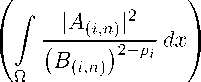
\ A(j „Jp Pi^ - Pi)
|A(,„)lr‘ dx «/ ' 'ilL) (W 2 dx a (B'i.n)) 2
<
<
X

Pi(--Pi)
( B( i,n ))
Pi - Pi)
l Pi (a)
^ max <
X max
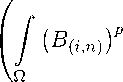

— max <
C 4

p -
\ 2 dx
X max
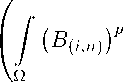
ф '1 1 ( i,n )

l T - pt (a)
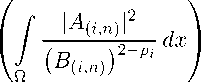
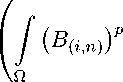
( Ф (1))
( i,n )


a
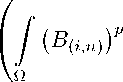
2- p + 2
Since u, un G Wg1’^(^), then thanks to (25) we can pass to the limit when n —> +w in both (28), (29) and thus get lim fv^rpr = 0, i g{i,...,n}. пч+то
a
So, (30) implies, for every i G {1,..., N}, diUn —> diU strongly in Lpi (Q) and a.e. in Q. (31)
We can point out here that in a similar way using (26) and with the help of (24) we can also simply get (31). By (31) we have
NN
^ I a i (x,d i un)d iф — ^2 / Mx, d i u)d i ф.
i =1 b i =1 a
From (32) and (33), we deduce that lim inf n→+∞
N i=1
Qx^x.d,un)(diun
N
- дiф) >52 \ °i(x, diu)(diu - diф). i=1 Ω
With proof steps similar to proof (34), we can easily get lim inf n→+∞
N
^J i=1 Ω
\ d i u n \ p i 2 d i u n (d i U n
-
N
di Ф) ^J i=1 Ω
\diu\Pi 2diu(diu - diф).
In a similar way to proof (31) by using (27) and with the help of (24) we can simply get un —> u strongly in Lpi (Q) and a.e. in Q.
From (36), we deduce that
\ u n \ P i - 2 u n ^ \ u \ p i - 2 u weakly in L p (Q), and a.e. in Q.
and this means that lim inf n→+∞
N
£/
i =1 Ω
\ u n \ p i u n ( u n
-
N
ф) > ^/ i=1 Ω
\u\pi-2u(u - ф).
We also have, for every ф E W 1 ,p (Q)
+
( T (u n ),u n
-
N
ф ) = ^2 / ° i (x,d i u n )(d i u n i =1 Ω
— di ф) dx
N ^ i =1 Ω
\diun\pi 2diun(un
— ф)dx +
N ^ i =1 Ω
\ u n \ p i - 2 u n ( u n
— ф) dx.
By combining (34), (35), (37) and (38),
we get for every ф E Wq^ (Q)
liminf ( T (u n ),u n — ф) > ( T (u),u — ф ) . n →∞
Finally, the pseudo-monotonicity of T is implied by (39). Thus, all conditions of the main theorem on pseudo-monotone operators have been satisfied. Therefore, we have proven that our problem (1) has at least one weak solution.
Now we prove the uniqueness of this solution. Let u 1 , u 2 be two weak solutions of (1). We have
NN
i =1 Ω i =1 Ω
NN
i =1 Ω i =1 Ω
By taking ^ = u i — U 2 as a test function in (40) and in (41), then subtracting the results side by side, we can deduce that
|
^ ( ( | d i u i | p i 2 d i u i — | d i u 2 | p i 2 ди) (d i u i — du) dx i =1 Ω |
|
N + ^2 (a i (x,du) — & i (x,du)) (du — du) dx (42) i =1 Ω |
|
N + У I ( | u i | p i 2 u i — | u 2 | p i 2 u 2 ) (u i — u 2 ) dx = 0. i =1 Ω |
Since (24), we conclude for every i G { 1,... , N } that
(|diui|pi-2diui — |diu2|Pi-2diU2) (diui — diU2) > 0,
(|ui|pi-2ui — |u2|pi-2U2) (ui — U2) > 0.
Also, since (5), we get for all i G { 1, ... ,N } that
(ai(x, diui) — ai(x, diu)) (diui — diU2) > 0.
From (43), (44), (45) and (42), we obtain for all i G { 1,..., N } that
J ( | d i u i | p i 2 diu i — I du I p i 2 du ) (d i u i — d^) dx = 0,
Ω
У (a i (x, d i u i ) — a i (x, d i u 2 )) (d i u i — du) dx = 0, Ω
У ( | u i | p i 2 u i — | u 2 | p i 2 u 2 ) (u i — u 2 ) dx = 0.
Ω
Now, after setting, for every i = 1, . . . , N ,
A i
J ( | d i u i | p i 2 d i u i — I d i u 2 l p i 2diu 2 ) (d i u i — du) dx,
Ω
Ai = diui — di u2 and Bi = Idi ui| + |diu2|, and like the proof steps followed in both (28), (29), thanks to (24) we can obtain, for all i = 1,...,N
J I d i (u i — u 2 ) | p i dx < cA i , (49)
Ω
У | d i (u i — u 2 ) | p i dx
Ω
<
— max < c 4
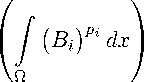
2—p_ 2
/(B i ) p i
Ω

2 —p ।
x max
( pi P+]
A i 2 , A i 2 к
Since u i ,U 2 G Wo^ (^) , (50) implies that
У | d i (u 1 — u 2 ) | p i dx < C max
Ω
pi - pi +
| Л i 2 , Л i 2 к
By combining (49), (51), and (46), we get that
У |di (u1 — u2)|pi dx = 0, i = 1,...,N.
Ω
Then, we conclude that
||di(ui — U2)|l . =0, i = 1,...,N.
p i
Hence, we get that
||ui — «2^ = 0, i = 1,...,N.
Then, (54) implies that u i = U 2 . Thus, Theorem 1 has been proven. >
Remark 1. In a similar way, we can prove the uniqueness of the solution by adopting one of the two equations (47) (with the help of (5)) or (48) (with the help of (24)) instead of (46).
