
Field Preparation, Sampling Protocols, and Pilot Study of Amoebae in Freshwater Bodies
Журнал: Бюллетень науки и практики @bulletennauki
Рубрика: Естественные науки
Статья в выпуске: 10 т.12, 2026 года.
Бесплатный доступ
Free-living amoebae, living in freshwater ecosystems, constitute an important ecological group among microscopic eukaryotic organisms. Various amoebae belonging to the order (Adl et al.) can be used as potential bioindicators in assessing the trophic state, organic matter loading, microhabitat characteristics, and ecological variability of water bodies. Since most of these organisms are microscopic in size, their study requires proper field preparation, standardized sampling, preservation of living material, and laboratory microscopic analysis. Here, the organization of fieldwork for the study of amoebae belonging to the order (Adl et al.) in freshwater bodies, selection of sampling points, collection of water and sediment samples, preparation of field protocols, labeling and transportation of samples, laboratory preparation, initial identification, and conducting a pilot study are presented from a practical perspective.
Короткий адрес: https://sciup.org/14139236
IDS: 14139236 | УДК: 574.52:593.17 | DOI: 10.33619/2414-2948/131/05
Подготовка к полевым работам, протоколы отбора проб и пилотное исследование амёб в пресноводных водоёмах
Свободноживущие амебы, обитающие в пресноводных экосистемах, представляют собой важную экологическую группу среди микроскопических эукариотических организмов. Различные амебы, принадлежащие к отряду Amoebina, могут быть использованы в качестве потенциальных биоиндикаторов для оценки трофического состояния, содержания органического вещества, характеристик микросреды обитания и экологической изменчивости водоемов. Поскольку большинство этих организмов имеют микроскопические размеры, их изучение требует надлежащей полевой подготовки, стандартизированного отбора проб, фиксации и сохранения нативного материала, а также лабораторного микроскопического анализа. В данной работе с практической точки зрения представлена организация полевых работ по изучению амеб, принадлежащих к отряду Amoebina, в пресноводных водоемах, выбор точек отбора проб, отбор проб воды и осадка, подготовка полевых протоколов, маркировка и транспортировка образцов, лабораторная подготовка, первичная идентификация и проведение пилотного исследования.
Текст научной статьи Field Preparation, Sampling Protocols, and Pilot Study of Amoebae in Freshwater Bodies
Бюллетень науки и практики / Bulletin of Science and Practice
UDC 574.52: 593.17
Freshwater bodies are complex ecosystems inhabited by a variety of microorganisms, including free-living amoebae [1, 2].
Amoebae or amoebas can be found in the water column, in bottom sediments, on the surface of aquatic plants, in detritus, and on other organic substrates. Members are microscopic organisms that move mainly by means of pseudopodia, feed on various microorganisms, mainly bacteria, and digest them by phagocytosis. Their distribution may be related to water temperature, pH, dissolved oxygen, organic matter content, substrate properties, vegetation cover, and other environmental factors [3-5].
Amoebae or amoebas are recognized to play an important role in the microbial ecology of these environments. Following the discovery of pathogenic bacteria and giant viruses that are resistant to phagocytosis, there has been a renewed interest in free-living amoebae or amoebas, suggesting that amoebae or amoebas may play a role in the evolution of other microorganisms, including several human pathogens. Recent advances have enabled the acquisition of novel insights into free-living amoebae using molecular methods [6].
Therefore, in the study of amoebae or amoebas, it is not enough to simply prepare a list of species; it is important to standardize the entire process, starting from the field stage of the study [7, 8].
The main objective of the study is to determine the species composition, distribution, and bioecological characteristics of free-living amoebae or amoebas belonging to the order Adl et al. in selected freshwater basins. The main tasks for this are: 1. Selection of water basins to be studied; 2. Determination of sampling points; 3. Collection of water, sediment, and substrate samples; 4. Measurement of field ecological parameters; 5. Coding and documentation of samples; 6. Isolation and observation of amoebae or amoebas in the laboratory; 7. Morphological characterization of live specimens; 8. Preparation of permanent microscopic slides; 9. Taxonomic identification of species; 10. Comparison of seasonal and spatial distribution of species; 11. Optimization of the main research methodology based on a pilot study. The success of fieldwork depends directly on the preparation done before sampling. Water basins with as many different ecological characteristics as possible should be selected for the study, for example: rivers, reservoirs, lakes, canals, and small ponds. If the goal is to compare different ecological conditions, it is more appropriate to select basins subject to both natural and anthropogenic impacts in parallel. It is useful to select at least three main types of sampling points in each watershed:
Point A – inlet area: The part where water enters the watershed or where the flow is higher.
Point B – pelagic zone or open water zone: The point that characterizes the main part of the watershed.
Point C – outlet or riparian area: The area where water outflow, vegetation cover, or anthropogenic impact is greater. This number can be increased in large watersheds.
Before going to the field, all equipment should be checked and prepared according to the sampling protocol. Basic equipment includes: sterile or clean sample containers, 50 ml and 100 ml plastic containers, pipettes, disposable gloves, a glass or plastic spatula, a sediment sample spoon or special sampler, a plankton net (if necessary), a thermometer, a pH meter, a dissolved oxygen meter, an electrical conductivity meter, a GPS or GPS-enabled phone, a camera/phone, a waterproof marker, labels, a field notebook, a cooler bag, ice packs, and disinfectant materials. A separate protocol should be kept for each sample. The following information should be recorded in the sample protocol.
Sample code: AM-NKH-01
Date: day/month/year
Time: hour and minute
Water body: e.g. reservoir
Zone: A, B, or C
GPS coordinates: latitude and longitude
Water temperature: °C pH:
Dissolved oxygen: mg/L
Electrical conductivity: µS/cm
Turbidity: if available
Depth: cm or m
Substrate: sand, silt, stones, plant debris, etc.
Aquatic plant condition: weak/medium/high
Anthropogenic impact: weak/medium/high
Weather conditions:
Sample taker:
Note: additional observations.
Searching for amoebae or amoebas only in the water column may not yield accurate results. Therefore, in addition to water samples, bottom sediments and various substrates should also be examined. When taking a water sample, it is important not to touch the inner surface of the container with your hands: 1. The container is prepared; 2. The sample code is written in advance; 3. A water sample is taken from the selected depth; 4. The mouth of the container is immediately closed; 5. The action is recorded in the field protocol; 6. The sample is placed in a cooler bag (Figure). If observation of live amoebae or amoebas is intended, the sample should be delivered to the laboratory as soon as possible.
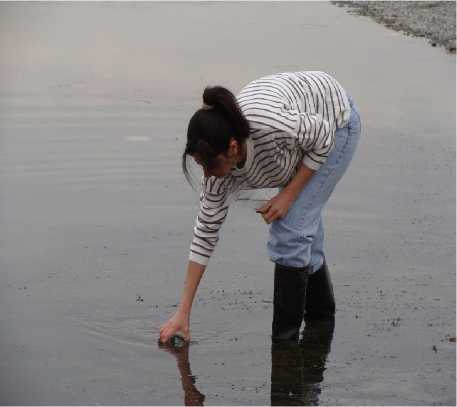
Figure. During sampling
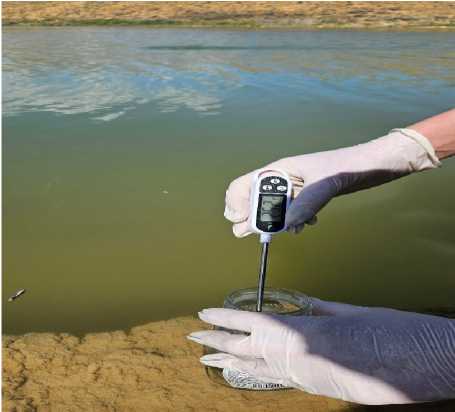
Bottom sediment sampling. A significant number of the taxa described by Adl et al. can be observed in bottom sediments and microhabitats rich in organic detritus. When collecting a sediment sample, accidental mixing of deeper layers with the surface should be avoided. In practice, a small amount of the surface sediment is collected and placed in a sterile or clean container. The type of sediment must be recorded: sandy, clayey, silty, organic-rich, plant-rich, or stony [9].
Sampling of aquatic plants. The surface of aquatic plants can be an important microhabitat for amoebae or amoebas. The following materials can be collected separately: leaf surface, stem, underwater plant remains, algae layer, and organic detritus. Plant samples should be packaged separately and not mixed with the water sample.
Coding of samples. The correct coding of samples is very important for subsequent statistical and taxonomic stages of the study.
For example: AM-NKH-AR-01-S
Here: AM – Amoebina; NKH – Nakhchivan; AR – Araz watershed; 01 – site; S – water sample. For sediment: AM-NKH-AR-01-C
Here, C stands for sediment.
For plant substrate: AM-NKH-AR-01-P
Transport of samples. If the study of live amoebae is planned, the samples should be delivered to the laboratory as soon as possible. Samples must be protected from direct sunlight, kept from overheating, stored in tightly closed containers, clearly labeled with waterproof markers, and handled to prevent mixing [10-12]. The main principle of live observation is to preserve the sample's natural state as much as possible. During the initial laboratory examination, samples are evaluated macroscopically and microscopically, noting the following: 1. appearance, 2. water color, 3. turbidity, 4. amount of sediment, 5. presence of plant detritus, and 6. initial diversity of microscopic organisms. Subsequently, a small amount of material is extracted for microscopic examination. Observation of live amoebae or amoebas is essential for identification. In a living cell, features such as the form of movement, formation of pseudopodia, changes in cell shape, cytoplasmic flow, food vacuoles, contractile vacuoles, and nuclear structure can be observed. These features provide important information for subsequent taxonomic identification.
Slide Preparation. Temporary preparations are used for initial observation. A small drop of the sample is placed on a clean slide and covered with a coverslip. The preparation is observed under a microscope, first at low magnification, then at high magnification [13, 14].
During observation, cell length, width, shape, type of pseudopodia, movement characteristics, vacuoles, nucleus, and cytoplasmic structure can be noted. Permanent slides are especially important for documenting the morphological characteristics of testate amoebae [15, 16]. However, the characteristics of the taxon under study should be taken into account when choosing a fixation method. Since fixation can change the natural shape of the cell, if live observation is possible, photographs and morphological measurements of the live specimen should be recorded first.
Microscopic identification : species identification should not be based solely on general appearance. The following features should be evaluated together during identification: morphological features include the general shape and size of the cell, shape of pseudopodia, number of pseudopodia, characteristics of the nucleus, vacuoles, structure of the cytoplasm, and type of movement. Species identification should be carried out on the basis of modern taxonomic keys and reliable scientific literature.
Photo and video documentation. It is recommended to take a photo of each differentiated morphotype. Video recording is especially useful for documenting the movement behavior of live amoebae.
Purpose of the pilot study. The pilot study tests the methodology before the main study. The main purpose of the pilot phase is to determine: in which habitats amoebae are most common; which sampling method is most effective; whether the time for sample delivery to the laboratory is sufficient; which microscopic preparation method yields better results; and which ecological parameters are important to measure.
Practical pilot study model. For example, three sites could be selected for an initial pilot study in a freshwater basin (see Table).
Table
|
Station |
Characteristics |
Water |
Sediment |
Plant substrate |
|
A |
Inflow zone. |
✓ |
✓ |
✓ |
|
B |
Pelagic zone or Open water zone |
✓ |
✓ |
✓ |
|
C |
Littoral/outlet zone |
✓ |
✓ |
✓ |
Thus, at the initial stage, samples covering different microhabitats are obtained from each site.
Parameters to be measured in pilot studies : It is advisable to determine the following indicators as a minimum: water temperature (°C), pH (unit), dissolved oxygen (mg/L), electrical conductivity (µS/cm), TDS (mg/L), depth (cm or m), transparency (cm), substrate type (description), vegetation (% or description), and anthropogenic impact (weak/medium/high).
Replication of samples: One of the important principles of a pilot study is replication. Taking only one sample from the same site can increase the effect of random variation. Therefore, the following should be compared at the pilot stage for the main study: repeated samples, sites, microhabitats, and seasons. Based on the results of the pilot study, the optimal number of samples for the main study is determined.
Organization of a seasonal study : The study of seasonal changes in the distribution of amoebae can yield important results. The study should cover at least four seasons: spring, summer, autumn, and winter. For a larger study, monthly sampling can also be applied. The main condition is to maintain the same sites and the same sampling protocol throughout all seasons as much as possible.
Species abundance assessment : Relative abundance of species can be determined during the pilot study. For example: + = rare, ++ = occasional, +++ = frequent, ++++ = abundant, +++++ = dominant. However, in the main study, it is more appropriate to use not only the subjective abundance scale but also the standard count or number of individuals per unit volume, if possible. The following measures should be taken to increase the scientific reliability of the study: all samples should be collected using the same methodology; sample codes should not be repeated; microscopic images should be archived; dimensions should be standardized; at least two independent morphological characters should be considered during identification; suspicious samples should be kept separately; and taxonomic identification should be verified by an expert, if possible.
Transition from pilot study to main study: After the pilot study is completed, the methodology should be evaluated. The following questions should be answered: 1. At which site were more amoebae found? 2. Which substrate was more productive? 3. Did the water sample or the sediment yield more taxa? 4. Was the sample delivery time to the laboratory appropriate? 5. Which microscopic magnification was more informative? 6. Which preparation method gave better results? 7. Is the number of replicate samples sufficient? 8. How should the seasonal sampling interval be selected? 9. Which ecological parameters should be included in the main study? Based on the answers to these questions, the main study protocol is developed.
Expected results: As a result of the pilot and main study, the following will be possible: determination of the species composition of the order (following Adl et al.); comparison of species distribution in different water bodies; assessment of the impact of different microhabitats on amoebae diversity; determination of seasonal changes; investigation of the relationship between physicochemical parameters and species diversity; identification of potential indicator species; and the creation of a methodological basis for future biomonitoring.
Conclusion
The study of free-living amoebae classification in freshwater bodies requires a complex field and laboratory approach. The reliability of the study depends not only on the identification of species under a microscope but also on the correct selection of sampling points, the coverage of different microhabitats, the parallel measurement of ecological parameters, the correct coding of samples, and the application of standard protocols. The pilot study is an important stage that forms the methodological basis of the main study. At this stage, sampling methods, sample size, microhabitat selection, laboratory procedures, and observation duration are tested and optimized. Thus, a systematic study of the distribution of amoebae in freshwater basins can provide a deeper understanding of both microbiological biodiversity and the ecological state of aquatic ecosystems.
Such a study allows not only for the preparation of a faunistic list based on Adl et al., but also for the determination of their ecological characteristics, distribution patterns, and potential bioindicator significance. Long-term studies, especially in the rivers, lakes, and reservoirs of Nakhchivan, can yield significant results in terms of a more complete study of the freshwater microfauna of the region.
