
Floristic Analysis of the Genus Lotus L. Range in the Nakhchivan Autonomous Republic
Journal: Bulletin of Science and Practice @bulletennauki
Section: Естественные науки
Article in issue: 6 т.12, 2026.
Free access
This article examines the floristic characteristics of the genus Lotus L., native to the Nakhchivan Autonomous Republic. This region is characterized by rich natural conditions and diverse climatic features. Research shows that there are six species of the genus Lotus in Azerbaijan. Four of these are native to the Nakhchivan Autonomous Republic. These species are found primarily in meadows, valleys, and mountainous areas. Research was conducted in various zones in 2024–2025. The taxonomic characteristics of the species were determined using modern scientific approaches. From an ecological perspective, three species are mesophytes, and one is a xerophyte. This indicates the predominance of plants adapted to humid conditions in the region. The species belong to different geographic regions and have different distribution patterns. Plants of the Lotus genus are used for fodder, ornamental, and medicinal purposes. They also have a positive impact on the ecosystem by increasing soil fertility. As a result, the genus Lotus L., although represented by a small number of species, is of great importance to the flora and economic life of the region. These plants improve soil fertility due to their ability to fix nitrogen. They also play a significant role in preventing soil erosion. Species of the Lotus genus contribute to the formation of various plant communities. The different topographic and climatic conditions of the region influence the distribution of these species. It is noted that future research is needed to further explore this genus.
Similar articles in the section Systematic botany


Short address: https://sciup.org/14138219
IDS: 14138219 | UDC: 582.736.099:57.08:581.6 | DOI: 10.33619/2414-2948/127/09
Флористический анализ рода Lotus L., произрастающего в Нахчыванской Автономной Республике
Рассматриваются флористические характеристики рода Lotus L., распространенного в Нахчыванской Автономной Республике. Этот регион отличается богатыми природными условиями и разнообразными климатическими особенностями. Исследования показывают, что в Азербайджане насчитывается 6 видов рода Lotus. Четыре из них распространены в Нахчыванской Автономной Республике. Эти виды встречаются преимущественно на лугах, в долинах и в горных районах. Исследования проводились в различных зонах в 2024–2025 годах. Таксономические характеристики видов определялись на основе современных научных подходов. С экологической точки зрения, 3 вида являются мезофитами, а 1 — ксерофитом. Это указывает на преобладание в регионе растений, адаптированных к влажным условиям. Виды относятся к различным географическим районам и имеют разные характеристики распространения. Растения рода Lotus используются в кормовых, декоративных и лечебных целях. Они также оказывают положительное влияние на экосистему, повышая плодородие почвы. В результате род Lotus L., хотя и представлен небольшим количеством видов, имеет большое значение для флоры и экономической жизни региона. Эти растения повышают плодородие почвы, поскольку обладают способностью фиксировать азот. Они также играют важную роль в предотвращении эрозии почвы. Виды рода Lotus участвуют в формировании различных растительных сообществ. Различные рельефные и климатические условия региона влияют на распространение этих видов. Отмечается, что будущие исследования должны более глубоко изучить этот род.
Text of the scientific article Floristic Analysis of the Genus Lotus L. Range in the Nakhchivan Autonomous Republic
Бюллетень науки и практики / Bulletin of Science and Practice
The Nakhchivan Autonomous Republic is a region located in southwestern Azerbaijan, distinguished by its rich natural landscape. The region's diverse topography, climate, and ecosystems lend themselves to a wide variety of flora and fauna. One of the most common genera in the Nakhchivan Autonomous Republic's flora is Lotus (Lotus L.), a member of the Fabaceae family. This genus comprises perennial and annual herbaceous plants native to various regions of the world, particularly in mid-mountain zones. The family comprises 46 genera and 262 species. Six species of the genus Lotus have been recorded in Azerbaijan, four of which are present in the Nakhchivan Autonomous Republic. Lotus species are found in various parts of the region and have a wide distribution range. Species of this genus are distinguished by their versatility. They are used in agriculture as forage plants, food sources, ornamentals, and medicinal plants. Considering these characteristics, the study of the taxonomic structure and uses of the genus Lotus L. is considered a relevant and scientifically important topic.
Research material and methodology
The studies were conducted in various natural zones of the Nakhchivan Autonomous Republic during 2024–2025. The research areas mainly covered meadow and valley zones. Plant samples of the genus Lotus L. were selected as the object of study. The species composition of the collected materials was determined; their scientific names and taxonomic positions were checked based on modern systematic approaches. The determination and clarification of the names of species belonging to the genus Lotus L. were based on the works: A. Asarov, “Azerbaijani Plant World”; H. Gasimov, S. Ibadullayeva, M. Seyidov, G. Shiraliyeva, “Wild Vegetable Plants in the Flora of the Nakhchivan Autonomous Republic”; H. Gasimov, S. Ibadullayeva, M. Seyidov, Z. Salayeva, “Flora and Vegetation of the Shahbuz State Nature Reserve”; and Flora of Azerbaijan [1–3].
Discussion and results
The genus Lotus L. (bird's-foot trefoil) occupies a significant place in the floral diversity of the Nakhchivan Autonomous Republic and is considered one of the main components of the region's vegetation. Six species of this genus are known in Azerbaijan, four of which are distributed in the Nakhchivan Autonomous Republic. The taxonomic characteristics, ecological grouping, distribution range, altitudinal range, as well as the flowering and fruiting periods of the species belonging to this genus are systematized in the table below [1-3] (Table).
Table
TAXONOMIC COMPOSITION OF SPECIES BELONGING TO THE GENUS Lotus L.
|
Species name |
Areal class |
Altitude zone |
Environmental groups |
Flowering and fruiting phase |
|
Lotus caucasicus Kuprian. ex Juz. |
Balkan-Asia Minor |
Mid-mountain and subalpine belt |
Mesophyte |
VI-VII;VII-IX |
|
Lotus corniculatus L. |
Western Palearctic |
Mid-mountain and subalpine belt |
Mesophyte |
V-VI;VI-VIII |
|
Lotus gebelia Vent . |
Front Asia |
Middle mountain belt |
Xerophyte |
V-VI;VI-VIII |
|
Lotus tenuis Waldst. & Kit. ex Willd. |
Mediterranean Sea-Iran |
Middle mountain belt |
Mesophyte |
V-VII;VII-IX |
The analyses revealed that species of the genus Lotus L. are represented in different groups based on their ecological characteristics. Three of the four registered species belong to the mesophytic group and are common in environments with relatively sufficient moisture. Only one species is xerophytic, adapted to drier and more arid conditions. Based on these data, the xerophytic species accounts for 25% of the total species composition, while mesophytes predominate and are more widespread in the region's ecological conditions. This fact once again demonstrates that the varying humidity and climatic conditions of the Nakhchivan Autonomous Republic influence the species diversity of the genus Lotus [2].
Conducted research and analysis of existing scientific sources indicate that species of the genus Lotus L. belong to different areal classes. This feature allows us to determine the directions of species distribution and their routes of regional penetration. Assessments based on zonal and regional approaches revealed that the species within the genus are classified into four distinct areal classes. Analyses indicate that each species individually represents a specific areal type and, in this regard, is monotypic. Thus, the species are assigned to the Balkan-Asia Minor, Western Palaearctic, Cis-Asiatic, and Mediterranean-Iranian areal classes. This division is of great importance for studying the biogeographic characteristics and distribution patterns of the genus Lotus.
Lotus L. — Perennial or annual plants. Their leaves are five-petaled; the three upper leaves are pressed towards the upper part of the stem, while the lower pairs are separated from the base of the stem and resemble a stalk. Their flowers are collected one or two in an umbrella-shaped flower group in the axils. The corolla is bell-shaped, five-parted, sometimes two-lipped. The calyx is strongly curved and has a sharp beak. Nine of the stamens are united among themselves by a tube. The pod is linear-cylindrical, multi-seeded, and opens with two valves. There are 6 species of the genus in Azerbaijan and 4 species in the Nakhchivan Autonomous Republic.
Lotus caucasicus Kuprian. ex Juz. is a perennial herb. The stems are numerous, hairy, and 20– 50 cm high. The leaves are ovate or ovate-rhombic in shape. The peduncle is longer than the leaves and bears 3–8 flowers. The calyx is tubular, with lanceolate, sharply toothed lobes and long cilia. The corolla is light yellow. The pod is glabrous, cylindrical, and slightly curved. It is widespread in the meadows and forests of the middle mountain and subalpine zones. The species is used for fodder and soil improvement. This plant, which has the ability to fix nitrogen, increases soil fertility and has a positive effect on the composition of the ecosystem.
Lotus gebelia Vent. Perennial, branching stem 30-40 cm long; leaves obovate-cuneate, pointed. The inflorescence is 1-2-flowered; the stalk is twice as long as the leaf. The corolla is light pink and broadly winged. The seed pods are slightly concave. It is widespread on dry stony slopes of the middle mountain belt. An ornamental plant, rich in vitamin C.
Lotus tenuis Waldst. & Kit. ex Willd. Numerous stems, 20-60 cm high; leaves lanceolate or lanceolate-linear and acute. Inflorescences of (2) 3-4 flowers, longer than the leaves. The calyx is glabrous and linearly toothed. The corolla is yellow. The pods are linear, cylindrical, and many-seeded. It is widespread in the forests of the middle mountain belt and on the banks of water bodies. The species increases the fertility of the soil with its nitrogen-fixing ability. At the same time, it is grown as a fodder and ornamental plant and helps prevent soil erosion.
Lotus corniculatus L. is a perennial plant with a weak, thin stem and a densely branched plant 20–40 cm long. The lower leaves are ovate or lanceolate and curved, and the upper leaves are obovate. The flower stalk is longer than the leaves. The corolla is yellow. The sepals are folded in a rectangular shape. It is widely distributed in the meadows and valley edges of the mid-mountain and subalpine zones. The wide distribution and various uses of this species make it an important plant in both agriculture and ecology [2].
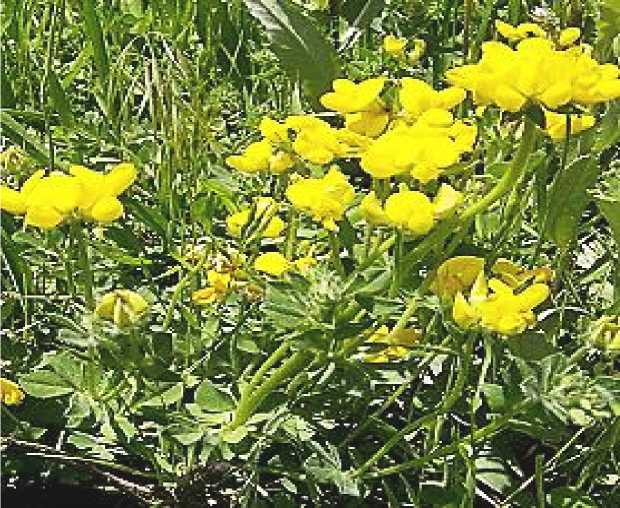
Figure. Lotus corniculatus
Future studies should more broadly examine the genus's species diversity, its distribution patterns, interactions with other plants, and its role in ecosystems. This approach is of great importance for preserving the natural balance in the region and ensuring the sustainability of biological diversity.
Conclusıons
-
1. Based on the results of the studies, it was established that the genus Lotus L. is represented by four species in the flora of the Nakhchivan Autonomous Republic. A study of the use characteristics of these species revealed that they have fodder, food, medicinal, and ornamental value.
-
2. Analysis of the ecological characteristics of the species revealed that the vast majority belong to the mesophyte group. Thus, three of the four species are mesophytes, and only one is a xerophyte plant adapted to arid conditions.
-
3. An analysis of the geographic distribution characteristics revealed that the species included in the genus represent different areal classes. Thus, one species is assigned to the Balkan-Asia Minor range, one to the Western Palearctic, one to the Middle East and Mediterranean (Iran), and another also to the Western Palearctic.
Acknowledgments: We would like to express our gratitude to Professor Dashgin Ganbarov for identifying the studied species
Financing: The research it is financed and supported on the basis of the "Herbari Fund of Biology Department of Nakhchivan State University" project.
