
Formation of cooperative capital – Challenges, legal framework and development potential
Journal: Pravo - teorija i praksa @pravni-fakultet
Section: Articles
Article in issue: 4 vol.42, 2025.
Free access
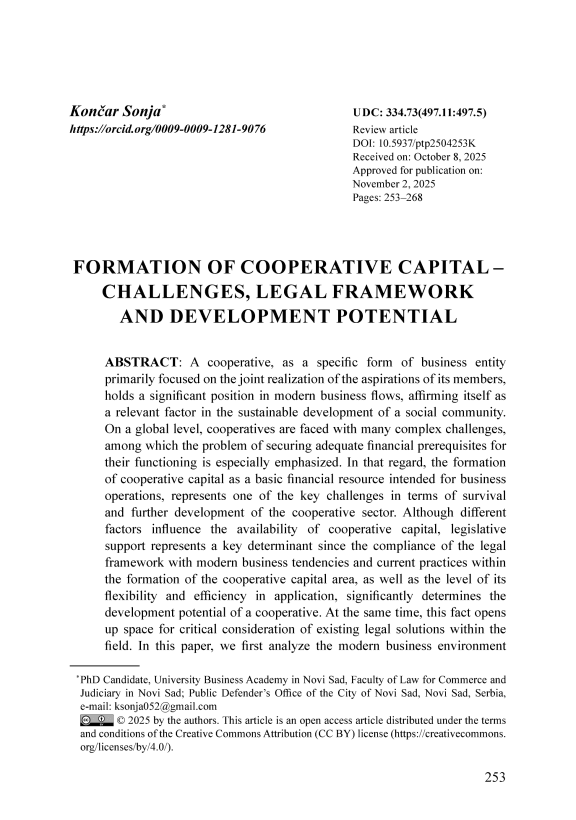
A cooperative, as a specific form of business entity primarily focused on the joint realization of the aspirations of its members, holds a significant position in modern business flows, affirming itself as a relevant factor in the sustainable development of a social community. On a global level, cooperatives are faced with many complex challenges, among which the problem of securing adequate financial prerequisites for their functioning is especially emphasized. In that regard, the formation of cooperative capital as a basic financial resource intended for business operations, represents one of the key challenges in terms of survival and further development of the cooperative sector. Although different factors influence the availability of cooperative capital, legislative support represents a key determinant since the compliance of the legal framework with modern business tendencies and current practices within the formation of the cooperative capital area, as well as the level of its flexibility and efficiency in application, significantly determines the development potential of a cooperative. At the same time, this fact opens up space for critical consideration of existing legal solutions within the field. In this paper, we first analyze the modern business environment and the importance of cooperative capital formation, considering current solutions and development perspectives in this area. Subsequently, using a comparative method to examine the legal frameworks of Serbia and Croatia, the domestic legislation is critically assessed in the segment related to the formation of cooperative capital. The aim of this paper is: 1) to examine whether the existing model of cooperative capital formation within positive legislation enables a cooperative’s competitive market positioning and contributes to its sustainable development, and 2) to offer solutions through de lege ferenda proposals for improving the legislative framework in the field of financing cooperative business operations, in accordance with contemporary economic trends.
Similar articles in the section Forms of organization and cooperation in the economy
Short address: https://sciup.org/170211453
IDS: 170211453 | UDC: 334.73(497.11:497.5) | DOI: 10.5937/ptp2504253K
Formiranje zadružnog kapitala – izazovi, pravni okvir i perspektive razvoja
Zadruga, kao specifičan organizaciono-pravni oblik privrednog subjekta, usmeren pre svega na ostvarivanje zajedničkih aspiracija svojih članova, zauzima značajnu poziciju u savremenim privrednim tokovima i afirmiše se kao relevantan činilac održivog razvoja društvene zajednice. Na globalnom nivou, zadruge se suočavaju sa brojnim i složenim izazovima, među kojima se posebno ističe problem obezbeđivanja adekvatnih finansijskih pretpostavki za njihovo funkcionisanje. U tom kontekstu, formiranje zadružnog kapitala, kao osnovnog finansijskog resursa namenjenog poslovanju, predstavlja jedan od ključnih izazova u pogledu opstanka i daljeg razvoja zadružnog sektora. Iako na dostupnost i stabilnost zadružnog kapitala utiču različiti faktori, legislativna podrška predstavlja ključnu determinantu, budući da usklađenost pravnog okvira sa savremenim privrednim tendencijama i aktuelnim praksama u oblasti formiranja zadružnog kapitala, kao i stepen njegove fleksibilnosti i efikasnosti u primeni u značajnoj meri određuju razvojne potencijale zadruga. Istovremeno, ova činjenica otvara prostor za kritičko razmatranje postojećih zakonodavnih rešenja u predmetnoj oblasti. U radu se najpre, kroz analizu savremenog privrednog ambijenta i značaja formiranja zadružnog kapitala, razmatraju aktuelna rešenja i razvojne perspektive u ovoj oblasti, dok se potom, primenom komparativne metode i upoređivanjem zakonskih okvira Srbije i Hrvatske, kritički sagledava domaća regulativa u segmentu koji se odnosi na formiranje zadružnog kapitala. Cilj istraživanja u ovom radu je: 1) da se ispita da li postojeći model formiranja zadružnog kapitala u pozitivnom zakonodavstvu omogućava konkurentno tržišno pozicioniranje zadruge i doprinosi njenom održivom razvoju, i 2) da se kroz predloge de lege ferenda ponude rešenja za unapređenje zakonodavnog okvira u oblasti finansiranja zadružnog poslovanja, u skladu sa savremenim ekonomskim trendovima.
Text of the scientific article Formation of cooperative capital – Challenges, legal framework and development potential
A cooperative represents an autonomous association of entities joining in voluntarily with the aim of satisfying their economic, social and cultural aspirations through a jointly owned and democratically controlled enterprise. As a specific form of organizational structure, a cooperative’s identity is based on clearly defined social values – self-help, self-responsibility, democracy, equality, fairness and solidarity, while its business operations are based on the application of the voluntary and open membership principle, democratic control by its members, economic participation of its members, autonomy and independence, education, training and information, inner cooperative cooperation and responsibility towards the community (International Cooperative Alliance [ICA], 1995). Special characteristics of cooperative organizing and operations are determined by the mentioned cooperative values and principles (Nikolić, 2014, p. 15).
stability, incentivizing economic growth and increasing employment, while at the same time representing a key factor in the improvement of sustainability and social responsibility (Sudarić, Lončarić & Zmaić, 2019, p. 290). However, a cooperative is also a direct participant in the market competition with other business entities, operating as a financially viable and competitive form of organization, and essentially represents an economic organization since the achievement of business success and economic gain is a necessary prerequisite for its survival (Vitez, 2018, p. 19;
Croatian cooperative system is aligned with European legal standards, which enables insight into different models of securing.
2. Complexity of current business climate and challenges to the cooperative sector
3. Cooperative capital formation models within the modern business context
Most developed countries economies basically rely on privately owned companies, where profit dominates as a key motivator of economical dynamics. Although such approach motivates the maximization of private benefit, it frequently results in the neglect of wider social good and collective interests (Mills, 2009, p. 1). As opposed to privately owned companies, cooperatives represent a business model focusing on the satisfaction of its members, as well as the sustainable development of a wider community. However, although the satisfaction of members and community needs is the imperative of cooperative operations, cooperatives also strive towards the realization of positive business results, continuous growth and preservation of stability and predictability of the socio-economic environment they operate in, which implies the realization of the need for adequate capital. Capital is the basic financial resource of every business entity, since it ensures stability, continuity and business sustainability. In that regard, cooperative capital has a significant role in the financing of main development activities, preservation of liquidity and long-term business operations of the cooperative. The specificity of cooperative capital is reflected in its, two-fold, economic and social dimension which requires a special normative treatment compared to the capital of companies. Namely, cooperative capital is different from the capital of classic business entities because it is directly tied to the cooperative identity, that is, the value and principle base on which the cooperative functions. As per the stated, the method of formation of cooperative capital is, in great measure, determined by basic cooperative self-help values, as well as the principle of democratic control by its members, the economic participation of members, autonomy and independence. Namely, the self-help principle implies that the cooperative members, through their own resources and joint engagement satisfy their aspirations, democratic control by the members ensures that all members participate in the decision making process per the one member – one vote principle, economic participation means that members invest capital into the cooperative and equally participate in the distribution of surplus realized through business operations, while the principle of autonomy and independence implies that cooperatives are to remain independent organization under the control of its members, regardless of their cooperation with external partners or the use of investment resources, supplied by governmental or international institutions (ICA, 2015).
AccordingtoRouseandVonPischke (1997), traditionallyand inaccordance with the cooperative identity, the cooperative capital is gathered from three basic sources: directly from members through cooperative contributions, from retained earnings, and from external sources. The most frequent method of cooperative financing comes directly from its members, where capital in form of cooperative contribution represents a form of dedication of members to the cooperative and a financial share retrieved only when leaving the cooperative. The second important source of capital is the retained earnings, and it represents a collective ownership of the cooperative used for longterm needs such as investments in technology, education and improvement of business operations. Aside from these internal sources of capital, cooperatives are in a position of using external financing sources, including cooperative and commercial banks, suppliers, government and donor agencies, where all assets can be in form of grants, short or long term loans, as well as commercial credits. Nikolić (2018), emphasizes that modern cooperatives, as per their different raising capital models, can be divided into three large groups, where the first group is comprised of traditional cooperatives where capital is formed exclusively through members contributions, as well as the surplus of income the members have decided not to mutually distribute.. The second group is made of new generation cooperatives where part of the capital is formed by member’s contributions, while part can be raised from shares issued by the cooperative. The third group, the most current model present in a large number of European countries since the end of the 1980’s as well as the United States since the beginning of the 21st century, are cooperatives with investors where members can become individuals who are not users of the cooperative services, but have invested capital into the cooperative enabling them to have all the rights the users have, including voting rights. These cooperatives raise capital in part from contributions of their members/users, and in part from external members, where these members only invest into the cooperative but don’t use its services.
4. Legislation for formation of cooperative capital in Serbia and Croatia
In continuation we will show a review of law and regulations, regulating the formation of the cooperative capital sector in Serbia and Croatia.
According to cooperative laws and regulations (Law on cooperatives, 2015), depending on the defined foundation goals and estimated financial needs, cooperatives secure assets for their operations through members contributions or membership fees, in accordance with the establishment agreement and cooperative rules. The share capital is formed based on cooperative member’s contributions and cannot be less than 100 dinars, while the cooperative rules determine the minimum individual contribution of the cooperative member. A member can have just one contribution in the cooperative, where contributions of the members don’t have to be equal. The law states that the member’s contributions can be both cash and non-cash, where the non-cash contributions are considered to be objects and rights expressed in cash value. The share capital of the cooperative can, by decision 260
of the cooperative assembly, be increased only in a traditional manner, as follows: contributions of new members, increasing contributions of existing members or through capitalizing retained earnings, that is, assets available for such purpose. Cooperatives founded without members contributions, ensure the assets for establishing business operations through membership fees, where the fee is established through cooperative rules in an amount equal for all founders as well as those members joining the cooperative after its establishment.
According to Croatian cooperative laws and regulations (Law on cooperatives, 2011) in order to realize the business activity and to service its obligations toward third parties, a cooperative uses members contributions, assets realized through business activities and other cooperative activities, as well as assets gathered through different means. A special place in the structure of assets for the realization of business activities is occupied by the member’s contribution, which can be initial or additional. The initial contribution is a cash amount each member is obliged to contribute during the establishment of the cooperative or when joining an existing cooperative. The amount is determined by decision of the cooperative assembly and is equal for all members, where the law determines the minimum amount. The additional contribution is an additional investment the member can make along with the initial contribution, and the amount is also determined by the cooperative assembly. Although the contribution is almost always introduced as cash, the Croatian cooperative legislation enables the introduction of contributions in objects and rights, the value of which is estimated through court evaluation. Aside from the members, the law states the possibility for the contribution to be introduced into the cooperative by a person who is not a member, but is interested in its operations. In those cases, mutual rights and obligations are subject to a special agreement between the cooperative and the investor, while their contributions are treated separately in bookkeeping. The rules of the cooperative can envision that a representative of an investor, elected in accordance with internal acts, can represent the views of the investor at the assembly, especially when decisions that can impact the safety and feasibility of their contributions are being made. Also, the Croatian cooperative legislation states the possibility of having the rules of the cooperative manage the possibility of having members ensure operational assets through membership fees.
Accordingly, a comparative analysis of legal frameworks of Serbia and Croatia indicates a significant difference when it comes to the inclusion of external investors into the cooperative sector. And while the Serbian legal framework still favors traditional forms of financing, with an accent on initial contributions, membership fees and profit as a mechanism for securing capital, the Croatian legal model enables additional inclusion of external investors, more precisely regulates the types of contributions and envisions an active participation of the investor in the decision making process, under certain conditions, which leads to differences in the level of openness to alternative forms of capital and institutional flexibility when it comes to the structuring of financial instruments. In that regard, we can determine that the Croatian model shows a higher adaptability to modern economic trends, while preserving cooperative identity through membership protection mechanisms and control in decision making processes.
5. Conclusion
In today’s economic environment, cooperatives are facing increasing challenges in securing capital. Traditional sources of funding, such as membership contributions and retained earnings, are no longer sufficient to meet the complex demands of a competitive market and dynamic technological changes. One potential solution is the inclusion of external investors, which enables cooperatives to expand their financial capacity, provided that the cooperative identity is preserved through clearly defined normative control mechanisms.
Differences in the degree of normative openness toward this model can be observed through a comparative analysis of the legal frameworks of Serbia and Croatia. While the Serbian legislative framework maintains a traditional approach and does not recognize the institute of investor membership, the Croatian model allows for the inclusion of external investors under clearly prescribed conditions, types of contributions, and decision-making rights. This approach demonstrates greater adaptability to modern global economic trends and institutional readiness to preserve the cooperative identity through legislative innovations while also enabling cooperatives to remain competitive in a market economy.
Accordingly, it is assumed that the implementation of this model into Serbia’s cooperative legislation would allow for a diversification of capital sources, increase the financial resilience of cooperatives, and strengthen their position within the economy. Starting from the premise that it is the state’s responsibility to create progressive legislation to ensure the development of cooperatives (Vitez, 2010), there is a clear need to design and implement a stimulating legislative framework that will enable the cooperative sector to develop sustainably and to ensure its fair position in the market, equal to that of traditional enterprises.
In this context, current legal provisions should be reconsidered, supplemented, or amended with the following proposed solution, directed at lawmakers as a de lege ferenda proposal.
Therefore, alongside legislative changes, it is necessary to develop institutional support mechanisms and public policies focused on affirming cooperatives as a relevant and competitive form of economic organization in the modern economy. In this regard, promoting the importance of cooperatives and attracting and encouraging investors or other parties interested in the cooperative’s operations, under the condition of fully respecting the cooperative identity, to participate in forming cooperative capital, would be essential prerequisites for the effective and comprehensive application of the proposed legal solutions.
Conflict of Interest
The author declares no conflict of interest.
Končar Sonja
Univerzitet Privredna akademija u Novom Sadu, Pravni fakultet za privredu i pravosuđe u Novom Sadu; Pravobranilaštvo Grada Novog Sada, Novi Sad, Srbija
FORMIRANJE ZADRUŽNOG KAPITALA – IZAZOVI, PRAVNI OKVIR I PERSPEKTIVE RAZVOJA
APSTRAKT : Zadruga, kao specifičan organizaciono-pravni oblik privrednog subjekta, usmeren pre svega na ostvarivanje zajedničkih aspiracija svojih članova, zauzima značajnu poziciju u savremenim privrednim tokovima i afirmiše se kao relevantan činilac održivog razvoja društvene zajednice. Na globalnom nivou, zadruge se suočavaju sa brojnim i složenim izazovima, među kojima se posebno ističe problem obezbeđivanja adekvatnih finansijskih pretpostavki za njihovo funkcionisanje. U tom kontekstu, formiranje zadružnog kapitala, kao osnovnog finansijskog resursa namenjenog poslovanju, predstavlja jedan od ključnih izazova u pogledu opstanka i daljeg razvoja zadružnog sektora. Iako na dostupnost i stabilnost zadružnog kapitala utiču različiti faktori, legislativna podrška predstavlja ključnu determinantu, budući da usklađenost pravnog okvira sa savremenim privrednim tendencijama i aktuelnim praksama u oblasti formiranja zadružnog kapitala, kao i stepen njegove fleksibilnosti i efikasnosti u primeni u značajnoj meri određuju razvojne potencijale zadruga. Istovremeno, ova činjenica otvara prostor za kritičko razmatranje postojećih zakonodavnih rešenja u predmetnoj oblasti. U radu se najpre, kroz analizu savremenog privrednog ambijenta i značaja formiranja zadružnog kapitala, razmatraju aktuelna rešenja i razvojne perspektive u ovoj oblasti, dok se potom, primenom komparativne metode i upoređivanjem zakonskih okvira Srbije i Hrvatske, kritički sagledava domaća regulativa u segmentu koji se odnosi na formiranje zadružnog kapitala. Cilj istraživanja u ovom radu je: 1) da se ispita da li postojeći model formiranja zadružnog kapitala u pozitivnom zakonodavstvu omogućava konkurentno tržišno pozicioniranje zadruge i doprinosi njenom održivom razvoju, i 2) da se kroz predloge de lege ferenda ponude rešenja za unapređenje zakonodavnog okvira u oblasti finansiranja zadružnog poslovanja, u skladu sa savremenim ekonomskim trendovima.
Kljucne reci : zadruga, zadruzni kapital, komparativna analiza, de lege ferenda.
