
Geographical characteristics of perceiving touristrecreational space by coastal regions of Russia
Journal: Modern Problems of Service and Tourism @spst
Section: Пространственная организация туризма и гостеприимства
Article in issue: 1 т.19, 2025.
Free access
For the first time tourist- recreational space of the coastal regions in Russia was assessed by means of text analysis. The relevance of the study determines the need to increase the risk of “over- tourism” in connection with the growth of consumption of the sea regions of Russia. The research aims at assessing regional peculiarities in perceiving tourist- recreational space of the Kaliningrad Region and Primorski Krai from the viewpoint of geographical, componential and time analysis. The main research method is text analysis of big data with the low-code analytical platform PolyAnalyst. The geographical entities which elicit the brightest emotional response were identified from the research. The Russki Island and the Zolotoy Rog Bay in Primorsky Krai got the highest assessment rating, as well as the Island of Kant and the Curonian Spit in the Kaliningrad Region. It is possible to conclude that the infrastructure cannot operate properly at high season, that leads to over tourism, and the tourist image of the territory degrades in the high season. The research results are of interest to the executive power bodies of the government mainly for forming and correcting the strategy of developing tourism in the regions, as well as improving the tourist brand.
Similar articles in the section General geography. Science of geographical factors (systematic geography). Theoretical geography


Short address: https://sciup.org/140313851
IDS: 140313851 | UDC: 911.5/.9 | DOI: 10.5281/zenodo.17112279
Географические особенности восприятия туристско- рекреационного пространства приморских регионов России
Впервые проведена оценка восприятия туристско-рекреационного пространства приморских регионов России с помощью методов текстового анализа. Актуальность исследования обусловлена необходимостью оценки рисков «овертуризма» в связи с ростом посещаемости морских регионов России. Цель настоящего исследования заключается в оценке региональных особенностей восприятия туристско-рекреационного пространства Калининградской области и Приморского края с точки зрения географического, покомпонентного и повременного анализа. Основным методом исследования является текстовый анализ больших данных, осуществленных с помощью low-code аналитической платформы PolyAnalyst. Была выявлена общая тенденция снижения индекса тональности восприятия туристско-рекреационного пространства приморских городов России, а также определены географические сущности, которые вызывают наиболее яркую эмоциональную реакцию. В Приморском крае наиболее высокие оценки получили остров Русский, бухта Золотой Рог, а в Калининградской области – остров Канта и Куршская коса. Можно сделать вывод, что инфраструктура не справляется с обслуживанием, формируются предпосылки для развития овертуризма и ухудшения туристского имиджа территории. Результаты исследования будут востребованы органами исполнительной власти для формирования и корректировки стратегии развития туризма в регионах, совершенствования туристского бренда территории.
Text of the scientific article Geographical characteristics of perceiving touristrecreational space by coastal regions of Russia
To view a copy of this license, visit
The geographical position of Russia is not highly favorable for developing coastal tourism. Russia is a northern country with severe climate and a short heat season. The beach recreation is being developed mostly at the Black sea coast, which is characterized by over tourism in summer that needs to be enhanced to avoid the phenomena. Non-stable weather interferes with developing coastal tourism in sea regions of the moderate climate zone -the Kaliningrad Region and Primorsky Krai-: even in summer it can get cold and rain steadily. Still the Kaliningrad Region and Primorsky Krai consider coastal tourism as a priority of their regional tourist policy. In regional policy physical-geographical properties are considered constant, while peculiarities of space perception represent a dynamic category which can be worked on actively to improve [30].
The research aims at assessing regional characteristics in perceiving tourist-recreational space of the Kaliningrad Region and Primorsky Krai from the viewpoint of geographical, componential, and time analysis using a text analysis tool.
The relevance of the study is due to the need for a timely response from regions to the emergence of over-tourism to enhance sustainable tourism. Growth of tourism to coastal regions of the moderate climatic zone of Russia could help in achieving an optimum tourism potentiality. The first stages of solving the above-mentioned problem is to change the impressions of tourist-recreational space by ensuring they are assessed with the help of big data text analysis. Researching impressions of tourist-recreational space has become an important topic in the age of experience and impression society as far as sustainable tourism is concerned. The over time experience becomes the most important criterion of assessing recreation quality as it results from tourists’ reaction to their interaction with separate components of tourism. The impressions reflect the perceiving tourist-recreational space by one tourist or a group of tourists [11]. We consider TripAdvisor platform as a data source which can be used in analyzing digital trails in research impressions of tourist-recreational space. TripAdvisor is the biggest site on tourism and travelling available in many countries of the world, with a huge audience as users. In this platform, tourists leave text messages commenting on their interaction with components of a real tourist-recreational space. As a rule of thumb, text messages give assessment to the results of interactions, expressed in points or as an emotional comment. This makes it possible to evaluate impression sentiment. What is peculiar about the site is that negative comments are not deleted, so that the assessment procedure is quite objective and unbiased the database.
Literature Review
Climate changes greatly influence coastal tourism to large extent [10; 14; 17]. As for peculiar features of coastal tourism development in different areas [2], in countries with moderate climate sustainable development of tourism takes place through combinations of adjoining kinds of tourism: natural, cultural-educational, et cetera [4; 6]. Excessive anthropogenic impact is a common problem in many ways of tourist-recreational space in coastal regions. It causes over-tourism and increases ecological problems as it causes environmental strain in the locality. Geography is a complex science embracing most issues of developing tourist-recreational space and needs a systemic research to achieve the objective of sustainable development of tourism.
It was recognized that geography has a social character, which contributed to development of its separate branch-from social-economic and human geography [24; 25]. It implies that there is some tourist-recreational space as one of its central objects under study of social-economic and human geography [9]. The definition of the concept of tourist-recreational space, as well as its typology is defined [20; 26; 31]. Nowadays tourist-recreational space of definite regions is being researched with the use of informational and cartographic approaches), as well as a project approach which is topical in the sphere of creating new tourist routes [5; 28; 29].
Content analysis and text analysis are more innovative methods of researching tourist-recreational space [7]. Assessing tourists’ impressions is considered a an important topic way of analysis; digital platforms are the key resource with tools for finding out the patterns, characteristics and peculiarities of tourist-recreational needs [3].
We have started using text analysis of the data in the tourist sphere only recently. The research relied on the approaches of computer-aided instructions which were used in analyzing reviews from the TripAdvisor platform. It was revealed that specialists make segmentation of users, learn how to influence decision-making in choice of destination and hotels, and how to solve other marketing functions [15].
From review it was found out that some researches aim at identifying regional difference in tourist images of cities [16; 23], at assessing the attitude to tourist attractions [1; 8; 12] and revealing the tourist centers of definite countries [19]. As a result of the usage of special programs for researching tourists’ impressions and assessing the attitudes of the reviews it was found out that it is possible to increase the efficiency of tourist destination management [13; 21; 22] and other components of the tourist-recreational complex [18; 27].
The weak point of these methods is the fact that they do not take into account the content of tourists’ reviews, focusing only on their generalized quantitative assessment of separate parts of tourist-recreational space characteristics.
Our research method uses approaches and methods of human geography in stating the essence and structure of tourist-recreational space. We have analyzed digital trails of big data technologies that were used. The extracting bulk data from TripAdvisor and computer-assisted instruction were applied. Data analysis is presented by stating the attitudes and the topic of reviews.
Methodology
We consider that assessing tourist-recreational space perception consists in finding out how objective properties of real tourist-recreational space elements interact with subjective experience of a person. As a rule, its result gets fixed as a combination of experience and digital trails over the platform used. In order to assess people’s impressions one should take into account the structure of a real tourist-recreational space including collective accommodation facilities, cultural-historical objects, catering arrangement, amusement parks, recreational businesses, territory, transportation infrastructure, travel agencies and travel agents, recreational natural zones, and natural tourist objects.
A complex of methods of assessing tourist-recreational space perception includes the following stages:
-
a. The first stage, formation takes place (parsing information from TripAdvisor) and preliminary processing of the database under research. The database consists of structured data in the form of tourists’ and recreants’ reviews from the TripAdvisor platform. The approximate database structure is as follows:
-
1. the object of assessment which has such characteristics as “organization name", “organization address”, “link to the information source", “the section of the platform TripAdvisor", “the section category on the plaform TripAdvisor", “organization type ”.
-
2. the object of assessing includes the following features: “ the number of reviews on the organization", “title", “review (full text)”, “tag”, “assessment (in points)”, “access date”, “date of reviewing on the plaform TripAdvisor”, “number of likes for the review”.
-
3. the subject of assessing includes the following features: “user name”, “profile link on the plaform TripAdvisor", “user age”, “user gender”, “subscriptons number", “subscribers number” “publications number” “number of thanks", “critic level” “number of cities visited”, “residence place”, “registration year".
The database structure allows getting full information on the object of assessment (organization), the subject of assessment (platform user-tourist or recreant), as well as making text analysis of review content ( geographical, structural, social- demographic, organizational, and other parameters).
The original database needs extra processing. First processing includes segmenting the database into regions of respondents’ residence (for example, replacing the name of a settlement in the column by the name of a region - a territorial entity of the RF, or a name of a country). Research database is also prepared for componential (extracting data on separate components of tourist-recreational space from the total research database, such as accommodation facilities, catering organization, transport, places of interest and sights for seeing, tourist routes) and territorial analysis (extracting data on tourist centers of the region, as well as databases of respondents from other regions from the total research database).
-
b. At the second stage the original database is processed for further analysis with the help of embedded tools of the software program PolyAnalyst. This software platform of Megaputer is used for visual development of scripts of data and texts analysis, as well as for making interactive reports. For processing the following nodes are used: columns modification, indexation, spelling check, finding unique notes and texts (Table 1).
Table 1 - Research database characteristics
|
Region |
Kaliningrad Region |
Primorsky Krai |
|
The total number of lines in the table |
65442 |
45531 |
|
The number of lines left after eliminating the ones with zero data |
65442 |
44666 |
|
The number of lines with unique notes |
65369 |
44634 |
|
The number of keywords extracted (Substantives and Adjectives) |
10532 |
5443 |
|
The number of substances extracted |
10729 |
7581 |
The node «columns modification» allows changing the reviews column format from a linear one to a textual one, which allows working with more complex nodes in the future. The node “ indexation ” serves for dividing texts into paragraphs and sentences and attributing each word to a definite part of speech. It improves the working with faster. The procedure of spelling check is obligatory while the confidence threshold for this database is 70 %. The nodes “unique texts” and “unique notes” result in the table from which reviews of the same or similar content have been eliminated. All the necessary procedures make the research database better prepared for data processing.
-
c. At the third stage text analysis of the data takes place with the use of software tools and embedded nodes of the software program PolyAnalyst (Figure 1).
In terms of quick graspin, g the reviews content the tool “ keywords extraction ” is used. Using different settings, it is possible to make a special thesaurus for the work. The tool also includes the tab “ keywords cloud ”; it is used for visualizing the results acquired as clouds of words. Besides, the tool “ terms con-necton ” is used for visualizing the connections between the keywords. It is possible to generate the necessary connection between the terms and to set the connection search within a sentence. Furthermore, it is possible to set the needed distance between words and the connection power. As a result, a connection graph is formed. Herein, the connection power is calculated as a logarithm of probability value of variance between two terms. The more the connection power, the more significant the relations are. The tool of “entity extraction ” aims at solving the function of searching named entities in the text with the help of word succession search algorithms and working with dictionaries. A list of entity types is shown as a result, and graphic entities are of considered. The tool “ sentiment analysis ” helps to assess the reviewer’s attitude to a certain object or situation. Assessment is an emotionally-colored view of a subject (a tourist or recreant) referring to an object (an element of tourist-recreational space). This node is better to place after the tool of “entity extraction”. Therefore, the entities extracted become objects of assessing. In node settings one can choose the research sphere: general, air transport, finance, hospitality, medicine,
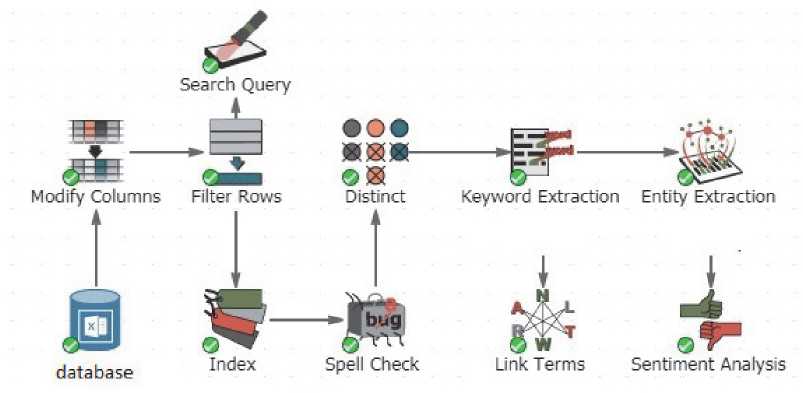
Fig. 1 – The scheme of text analysis of the data with the software
and technologies. The sphere “ hospitality ” was used in researching perception of tourist-recreational space. The in-built algorithms of sentiment analysis determine the number of negative and positive reviews for each object of assessing. In order to achieve this, words are analyzed, usually adjectives correlating with the object of assessing; words are either negative (from -1 to -5) or positive (from +1 to +5) sentiment degree. The correlation of numbers of positive and negative reviews forms the sentiment index. Another item is the node capacity has the possibility to make a graph for visualizing the results acquired of the subject’s attitude to the object. In the graph the grey punch denotes the research aspects (spheres), green color indicates positive tones, red color - negative ones.
-
d. The fourth stage showcases the geographical, componential, and time analysis.
Componential analysis was aiming at finding out the difference in perceiving components of a tourist-recreational space, such as accommodation, entertainment, catering, tourist product, and transport. For each component of tourist-recreational space, we calculated the sentiment index, determined the key perceiving issues, node zones causing the biggest number of emotional responses and chose the most relevant respondent groups.
Geographical analysis consisted in stating the territorial features in distributing sentiment parameters of the reviews, keywords, key issues of cities (tourist territories) and in finding the most popular tourist objects. For stating territorial features the tool “search queries” was used. It helped to filter the reviews and to group them according to places. We found out territorial features of distributing sentiment parameters in reviews, keywords, key problems, the most popular touristic objects.
Time analysis consisted in measuring the sentiment index from year to year (for separate components of tourist-recreational space, for separate most significant regions, forming tourist flows). It helped to find out the change in the key issues of a real tourist-recreational space in dynamics). The seasonal features of sentiment index change were also researched.
Research restrictions:
-
1) few reviews before 2014;
-
2) not all the businesses of tourist-recreational sphere are registered on the platform TripAdvisor.
-
3) As a rule, a digital trail is fixed for the components with which a tourist and recreant deals and which evoke some emotions. Review databases do not include components of tourist-recreational space with which tourists do not directly interact during their trip or recreation (for example, the organizing-managing component). Few reviews concern recreational zones or nature pieces of attraction.
-
4) Geographical analysis of users’ reviews is hindered by users’ anonymity.
The above-mentioned restrictions limit the research time-span and influence the results interpretation as for separate components of tourist-recreational space. Still, we think that it does not hinder achievement of the research goal.
Also statistical analysis of tourism sphere development in the Kaliningrad Region, in Primorsky Krai, and in Krasnodar Krai is made.
In analyzing tourism development in the region the season coefficient is of importance. This coefficient shows demand on the services at a definite period of time, a particular month. The coefficient consists in relation of the value for the month under analysis to the average month value throughout the year (Formula 1).
One more index for analyzing tourism development in a region is the index of calculating the occupancy coefficient. The occupancy coefficient is calculated as a relation of the number of overnight accommodations in collective accommodation facilities to the total number of sleeping accommodations in collective accommodation facilities (Formula 2).
The regional rest period index can be calculated with the help of the index of average accommodation length in collective accommodation facilities (Formula 3).
For illustrative purposes one can make calculations according to the data of a quarter.
Results
It is possible to assess the overall level of tourism development in Primorsky Krai and in the Kaliningrad Region by comparing the indexes of tourism industry with those of the leader region - Krasnodarski Krai. In the course of analyzing the contemporary state of tourism in the regions under research it is necessary to note that in Krasnodarski Krai the number of people accommodated in collective accommodation facilities exceeds the population by 42 % ( Figure 2).
Kseas =
month index average month index for a year
* 100
.- number of overnight accommodations .
Kocc = —---/ “.-------—— * 100 (2)
total number of sleeping accommodations
Average accommodation length =
number of overnight accommodations number of persons accommodated
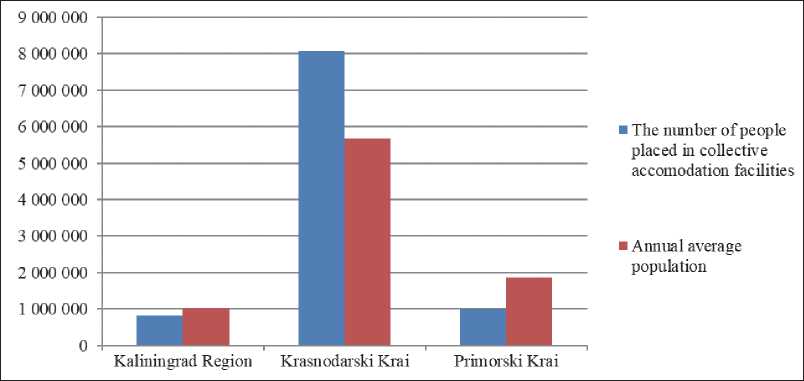
Fig. 2 – Comparison the number of inhabitants average for a year with the number of people accommodated in collective accommodation facilities, 2021.
In 2021 in the Kaliningrad Region, the index of the number of people accommodated exceeded the pre-pandemic index, Primorsky Krai and Krasnodarsky Krai got close to the indices of 2018 (Figure 3).
In order to analyze seasonality, we calculated the index of the volume of paid services to the public, that is, the services of hotel accommodation or of any other accommodation services. According to the calculations, the Kaliningrad Region is the most seasondependent, with the height of the season in July, August, and September. In Primorsky Krai the height of the season is in September. In Krasnodarsky Krai the height of the season is in August, and it is noteworthy that the seasonality index here is the least liable to variations due to development of all-season resorts in Krasnodar ski Krai.
The longest rest period time in Krasno-darsky Krai is in the 2rd and 3rd quarter, which is conditioned by the coastal season (June, July, August) (Table 2).
The same goes for the occupancy index. Among the regions, Krasnodarsky Krai has the highest index in the 3 rd quarter (July, August, September) (Table 3)
Thus, the leader among the coastal regions of Russia is the Krasnodar krai, where signs of over tourism were noted. Considering the relatively low tourist flow to the Kaliningrad Region and Primo sky krait, it can be assumed that there is no over tourism there. However, for all coastal regions in the temperate climate zone, the problem of seasonality is relevant, which can cause «overstrain» of the tourist infrastructure in a limited period of time, thereby contributing to the emergence of signs of over tourism which lead to degradation. Using methods of text data analysis, the problem of identifying the prerequisites for the emergence of signs of over tourism
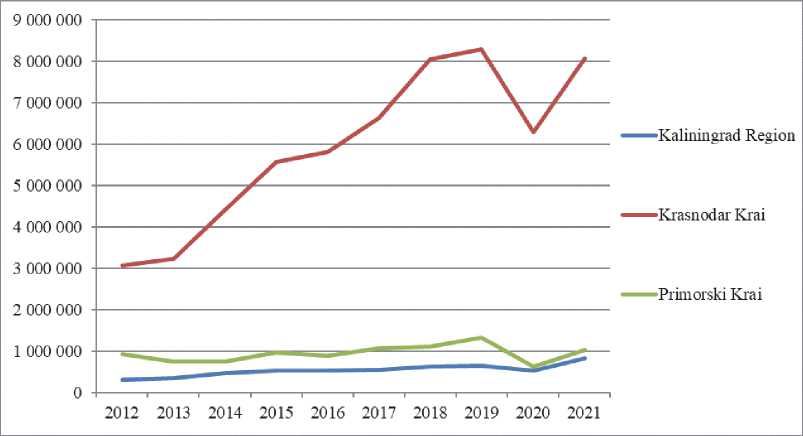
Fig. 3 – Dynamics of the number of people accommodated in public accommodation facilities, 2012–2021
Table 2 – The average time of accommodation in collective accommodation facilities in the regions of Russia, 2021
In conditions of information-oriented society, the choice of decision to a trip and tourist destination is made on the basis of a mental image and tourist’s subjective experience rather than on the basis of one’s knowledge of some real territorial tourist-recreational potential. Image assessment takes place through analyzing digital trails of a traveler in the form of reviews, comments, likes, photos, and videos on special platforms or in social networking sites.
We worked out methods of assessing impressions on tourist-recreational space of Russia coastal regions. With the help of the text analysis platform PolyAnalyst we made geographical, componential, and time analysis of 110,973 reviews of those who had visited the Kaliningrad Region and Primorsky Krai. After analyzing the overall database, we got almost the same sentiment indices for the two regions (Figure 4). In order to determine the difference in perceiving the basic components of tourist-recreational space we made componential analysis. The basic components of tourist-recreational space are accommodation facilities, catering facilities, and tourist resources. The biggest number of reviews on TripAdvisor considers catering facilities (Table 4).
A number of reviews considering catering facilities is determined by the fact that they were made both by tourists and local inhabitants. Besides, the process of food consuming is connected with emotions (both positive or negative), which stimulates the consumers to make a review. On the whole, the proportion of reviews is one negative review to 5.6 positive ones in Primorsky Krai, and to 4.2 positive ones in the Kaliningrad Region. Negative reviews have both objective and subjective reasons. Objective reasons include complaints on the technical state or interior decorations, serving time and high prices. Subjective reasons are conditioned by personal dislikes of the food. It is noteworthy that the maximum number of reviews on public catering facilities on TripAdvisor considers restaurants with unique conceptions of decoration, those specializing in local cuisine or the ones located within the hotel premises.
Sentiment index of tourist resources is higher, on the average, as compared with other components. Still, as for different tourist objects, their perception varies (Table 5).
The main attraction resource which draws tourists to the Kaliningrad Region and Primorsky Krai is represented by the Baltic Sea and the Sea of Japan, accordingly. Still the most positively people percepieve resting on the Island of Kant or the Risky Island.
Table 3 – Occupancy coefficient of collective accommodation facilities in regions of Russia, 2021
|
Region |
1 quarter |
2 quarter |
3 quarter |
4 quarter |
|
RF |
15.8 |
26.8 |
41.8 |
21.4 |
|
Kaliningrad Region |
19.3 |
49.1 |
57.9 |
37 |
|
Krasnodarski Krai |
13.5 |
36.6 |
73.1 |
13 |
|
Primorski Krai |
10.0 |
16.4 |
26 |
10 |
Table 4 – Distribution of tourists’ reviews according to components of tourist- recreational space
|
Components of tourist recreational space |
Primorski Krai |
Kaliningrad Region |
|
Public catering facilities |
54.7 % |
47.1 % |
|
Tourist resources |
27.5 % |
37.5 % |
|
Accommodation facilities |
17.8 % |
15.4 % |
Table 5 – Assessment of perceiving the most popular tourist objects
|
Geographical entities |
overall number of lines |
positive |
negative |
sentiment index |
|
Kaliningrad Region |
||||
|
All the geographical entities |
10729 |
23589 |
4765 |
5,0 |
|
the Baltic Sea |
4772 |
5451 |
931 |
5,9 |
|
the Curonian Spit |
1128 |
4454 |
708 |
6,3 |
|
the Island of Kant |
953 |
4216 |
577 |
7,3 |
|
the Dancing forest |
910 |
881 |
148 |
6,0 |
|
Primorski Krai |
||||
|
All the geographical entities |
7581 |
13458 |
3109 |
4,3 |
|
the Sea of Japan |
2446 |
2753 |
574 |
4,8 |
|
the Russky Island |
707 |
672 |
73 |
9,2 |
|
the Zolotoy Rog Bay |
577 |
540 |
80 |
6,8 |
|
the Amur Bay |
295 |
395 |
112 |
3,5 |
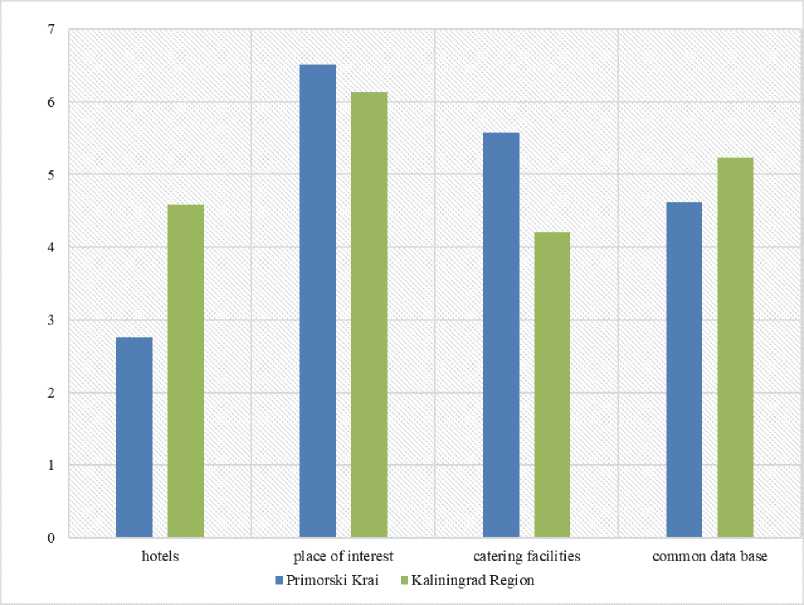
Fig. 4 – Sentiment index of components of tourist- recreational space of Primorsky Krai and the Kaliningrad Region (over the years)
Russky Island is located in the Peter the Great Bay, near the city of Vladivostok. Until the 90s of the 20th century it was closed to the public because there is a military base.
After eliminating the restrictions and launching the Russky Bridge it got open for tourism. The main kind of recreation there are beach recreation. In attitude, kinds of recreation are as follows: visiting the Primorski oceanarium, visiting a campus of the Far East Federal University, excursions to the Novak Bay. It is known because of an ancient defensive fortification and a branch of the Pacific Fleet Museum. Visiting the above-mentioned objects gives mostly positive emotions (sentiment index is 9.2). Here is an example of positive review on the Island Risky:
“In soviet times the Island Risky was a closed territory, only military men and inhabitants of the island could get there. Now everything has changed and from the time of APEC summit in Vladivostok the island has become one of growth centers both in the Far East and in the whole country. The main attraction of the island is the bridge connecting the island with the continent. To drive along the bridge is a rare treat! A huge campus for students of the Far East Federal University, as well as the pieces of wildlife, is of great interest. It is doubtless that any traveler should visit this place” .
At the same time, they started developing tourism on the Risky Island not long ago, so there are negative reviews connected mostly with the quality of tourist infrastructure and service. See a negative review example on the Island Risky:
«I visited the island as a participant of the EEF. Evidently it lacks infrastructure, the prices in the local restaurants are unreasonably huge. But good investments could contribute to making a wonderful eco-resort on the island”.
The Island of Kant in the Kaliningrad Region is situated in the bed of the Prego river. It is famous due to a strikingly beautiful Cathedral and the German philosopher Immanuel Kant, his grave is situated near one of the walls of the Cathedral. There is a dendrologi-cal garden on the island, a park of sculptures, routes for walking and rest. The Island of Kant is connected with the German heritance of Kaliningrad Region and it is included into a set of regional tourist products. The overall sentiment of reviews is 7.3 points. Among negative reviews the ones on service organization prevail.
The least useful for the analysis of perceiving a tourist-recreational space are reviews on accommodation facilities. As a rule, such reviews are given by tourists from other regions of Russia and other countries. The issue of perceiving hotel accommodation negatively is characteristic mostly of Primorsky Krai. One tourist in three is not contented with the quality of service and equipment of hotels in Primorsky Krai. Here is example of negative review:
“The personnel are awful, unfriendly, and rude. We offered an apartment with one big bed, it took them hours to make the bed, they said they had had to move the bed. We will never cross the threshold of this hotel! Would not recommend it to anyone. Have not seen such awful service!»
Though the proportion of negative and positive reviews on hotels of the Kaliningrad Region is more favorable, still it is also quite low-4.6 points.
So, according to the componential analysis, notwithstanding the fact that average sentiment indices are almost similar, with all the components of tourist-recreational space of the two regions taken into account, there is a considerable difference in perceiving such components as accommodation facilities and catering facilities.
The geographical analysis consisted in finding out territorial features of perceiving tourist-recreational space of the cities of the Kaliningrad Region and Primorsky Krai as tourist centers. Perceiving tourist-recreational space of six cities in Primorsky Krai was considered.
The cities are characterized by the different level of tourism development and differ in touristic specialization.
Sentiment indices differ considerably from 8.5 of the city of Arsenyev to 3.2 of the town Bolshoi Komen (Figure 5). Thus, the difference in perceiving tourist-recreational space of the cities is 2.7 times. This territorial disparity is conditioned by the quality of tourist infrastructure and their specialization services. For instance, in Arsenyev accommodation facilities specialize in business tourists and offer high service standards. At the same time, Bolshoi Komen lacks any tourist specialization. Besides, it is situated in close vicinity to Vladivostok, so that the most excursion groups visit the town without staying for the night.
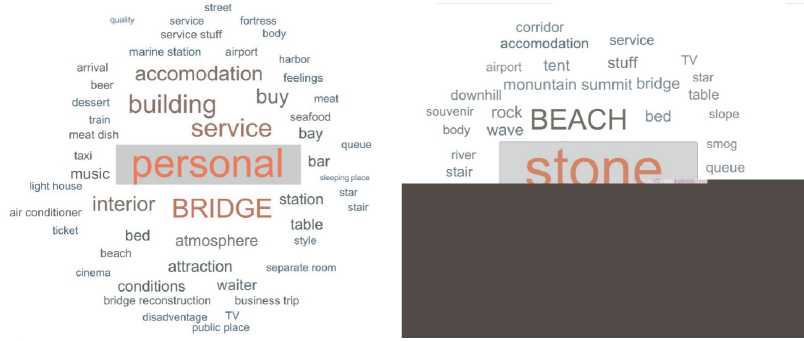
Taking into account tourist specialization of the cities, there is a considerable difference not only in the sentiment index, but also in keywords and objects with which tourists interact and which evoke the strongest emotions (these entities are most often mentioned in texts of reviews) (Figure 6).
The cities and towns of the Kaliningrad Region have a more signified specialization in coastal tourism and rest.
The territorial difference of sentiment index of the cities and towns of the Kaliningrad Region is less prominent than that of the cities
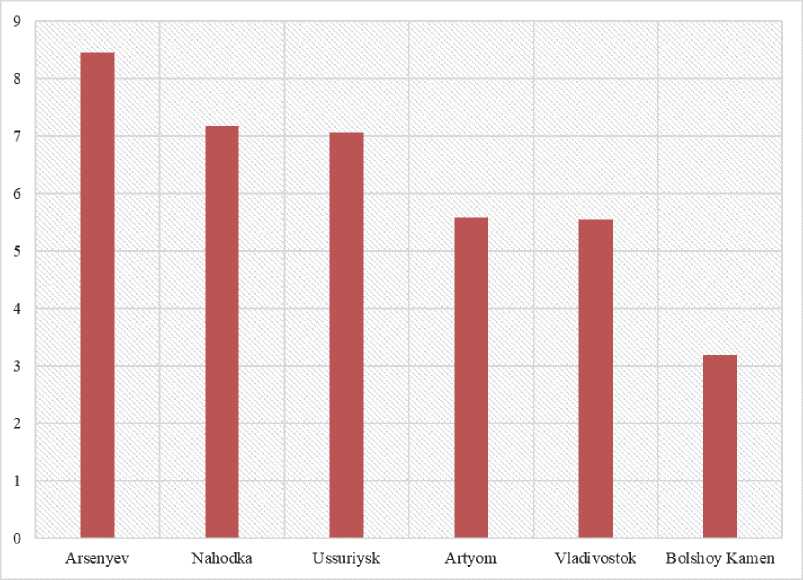
Fig. 5-Sentiment index of perceiving tourist-recreational space of the cities and towns of Primorsky Krai
Word cloud of Vladivostok
Word cloud of Bolshoy Kamen
Fig. 6 - Word clouds of cities and towns of Pimorski Krai (according to the reviews analysis with the help of the node “entity extraction")
and towns of Primorsky Krai. The disparity between the Kaliningrad and Svetlogorsk is just 1.7 times (Figure 7).
Kaliningrad has the best tourist image, it is positioned and promoted as “German”, “old, ancient ”, “historical” ( Figure 8 ).
The main associations with Baltiysk are connected with the naval theme, which refleets its near-border location. The entities and the space perception of two resort-towns of the Kaliningrad Region, Zelenogradsk and Svetlogorsk, are similar. Their perception is quality
street service fortress service stuff body
arrival beer dessert train meat dish
marine station airport accomodation
building
harbor
feelings
buy meat
service
seafood bay
corridor accomodation service airport tent stuff TV , .„monuntain summit bridge downhill table souvenir rock ррдр|_| bed slope body wave LOLrAk^ri
taxi music light house
personal
queue bar
air conditioner ticket
interior BRIDGE station
bed atmosphere beach
table style
cinema
attraction
separate room
conditions waiter bridge reconstruction business trip disadvantage TV public place
star stair
Word cloud of Bolshoy Kamen
Word cloud of Vladivostok
Fig. 6 - Word clouds of cities and towns of Pimorski Krai (according to the reviews analysis with the help of the node “entity extraction”)
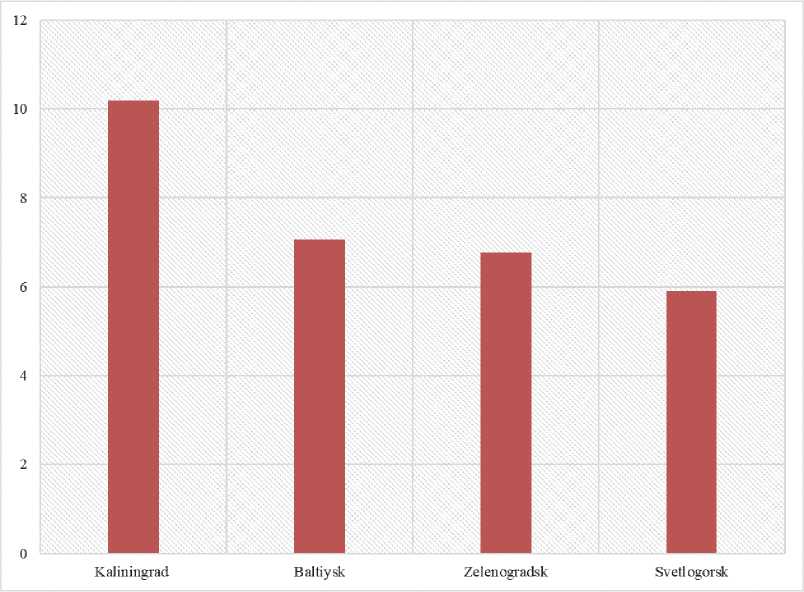
Fig. 7-Sentiment index of perceiving tourist-recreational space of the cities and towns of Kaliningrad Region
based in the objects of coastal infrastructure, restaurants, and services.
An example of a review:
“I was choosing between Svetlogorsk and Zelenogradsk for a long time, wanted sea and comfort, and also fish (a huge juicy sea bream, a super-fresh pike-perch…). Was mistaken. Got accommodated in Svetlogorsk. There is nothing of the kind there… Just walk, listen to organ music, and jog back along the endless seashore”.
Thus, geographic heterogeneity of tourist-recreational space of the regions is reflected in difference in perception of the space of the two parts.
Time analysis of perception of tourist-recreational space allows stating the trend in the change of the sentiment index. The time span of the data analyzed is from 2013 to 2021. Both the total database and its consumer segments, such as inhabitants of the region, were analyzed. The Federal District residents, Moscow residents, as well as foreign residents, were assessed. On the average, the sentiment index trend for Primorsky Krai and the Kaliningrad Region is negative. Still, there are some differences in the character of the trend line.
Till 2018 in Primorsky Krai the trend of perception of the tourist-recreational space was on the rise, and in 2019 the deteriorated (Figure 9). In 2020–2021 it got worse; it was the time when restrictions for tourists were in effect at all the tourism infrastructure objects, throughoughout Russia and across the world. Due to complicated procedure of booking hotel rooms, the necessity of wearing masks, increase in the cost of services resulting from the need of carrying out extra sanitary and hygienic measures in organizations the number of negative reviews grew in all the consumer groups. So in 2021 each third tourist left a negative review after visiting Primorsky Krai. Groups of tourists from Moscow and from foreign countries (mostly from China) were no exception, they were very apprehensive of the restrictions in effect then and kept from expressing their negative emotions on this account.
In the Kaliningrad Region the sentiment index was lowering gradually and not that abruptly (Figure 10).
For some period of time the change in the sentiment index of foreigners had been out of trend, some of them reacted positively to the tourist brand shift of the Kaliningrad Region from the soviet ways and culture to western ones. A good example of shift in the general tourist strategy is represented by implementing the project of creating the tourist cluster “Raushen” in the territory of Svetr-logorsk in 2017. However, after and during the COVID –19 pandemic, its consequences lead to negative change in perception of tourist-recreational space of the region by consumers of all geographical segments.
pedestrian |fivia|
^ narrow direa
upper
numeric
experienced
federal
postwar
europian memorable unitary
close
western from street
full
another
touristic
informative
marine
similar
rich free
з picturesque so °P®n
military former
poromount
fishy catolic right
о
artistic
Ф
o'
Ш гмЯгхборинг stormy
tasty
urban
german
modern
old
weekend museum
magical horrible
expensive
eastern
northern
before war ..
ordinary musical prominent defensive
virtualy
madievial
co
О
CD
small
unique
only
longtime
ст = cu
И
luxurious
showy stunning working
evening
majestic
family posible
fascinating ideal
romantic popular cultural
arcitectural prolonged
wooden
own french
useful
enough visible metal early
ideal stunning
next last
common spacious й :
baltic history cal
sovet union
long
modest late
tall cheap memorable
situated greene south
wild
summer young £ marine . . '"< loyal
tasty
marine
sr °
wide
ordinary
direct
Ф
CD
solid
a qj
polite
Ортходоь close horrible mMdl® urban
military
expensive
от
О
western
visible o, former J f domestic §
working well-groomed central for children
local combat
calm
only strict
renowned concrete
Sweden lon9
о
Word cloud of Kaliningrad
Word cloud of Baltiysk
Fig. 8 - Word clouds of cities and towns of the Kaliningrad Region (according to the reviews analysis with the help of the node “entity extraction”)
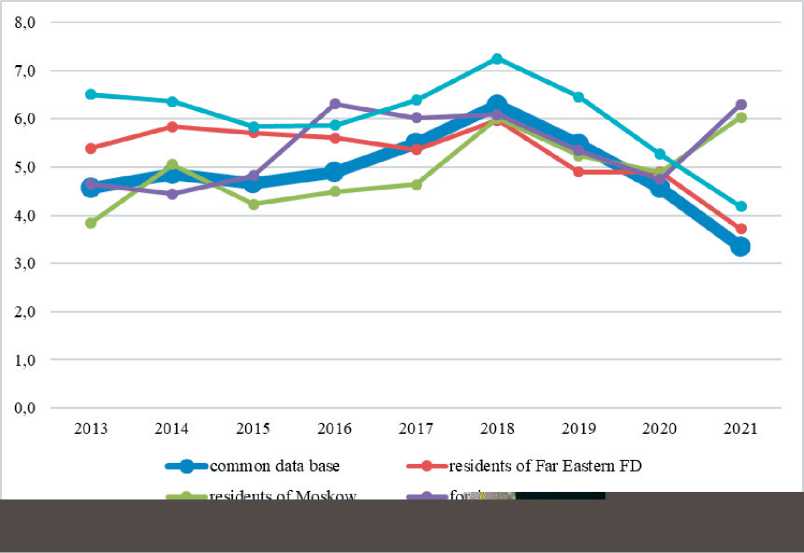
Fig. 9 - Change in the sentiment index year by year (the category of Primorsky Krai target groups)
Fig. 10 - Change in the sentiment index year by year (the category of the Kaliningrad Region target groups)
The sentiment index value depends on the season. Primorsky Krai has the highest sentiment index is off-season characteristic. November and February are the main off-season representation (Figure 11). After that, the tourist flow is the lowest in these months. This leads to the reduction in load of the personnel. In addition, the accommodation prices get lowertourists’ needs are fulfilled quicker and better. Therefore, there are no other negative signs of over tourism.
In the Kaliningrad Region tourist stream is evenly distributed between seasons, so that changes in the index are insignificant throughout the year (Figure 12).
The maximum amplitude of fluctuations in perceiving tourist-recreational space is characteristic of local residents.
So the time analysis of perceiving tourist-recreational space showed the trends formed in the two regions and revealed seasonal fluctuations of the sentiment index in different geographical consumer groups.
Discussion and Conclusion
It is not possible to give complex assessment of tourist-recreational space without finding out the peculiarities of its perception by tourists and recreants. Till recent times assessment of perceiving space was interfered with by labor-consuming nature of data harvesting and lack of tools for big data analysis. With advances in informational technology and spread of Internet more and more tourists are eager to share their experience and impressions of the trip, with photos, reviews, and comments in social networks. A so-called digital trail is being formed, and the whole of digital trails forms a huge database. The advantage of text databases consists in the fact that it is possible to state the emotional coloring of the review by assessing the sentiment index. Databases characteristics allow calculating either the sentiment index of the region on the whole or of separate components of its tourist-recreational space. They also allow analyzing peculiar features of change of the sentiment index according to years and months and finding difference in perceiving tourist-recreational space of separate target markets.
Complex methods of assessing tourist-recreational space embrace accommodation and catering facilities, tourist resources, and the territory on the whole. The assessment algorithm consists in step-by-step text analysis of tourists’ reviews and finding out the emotional component. Text analysis is made in geographical, componential, and time spheres.
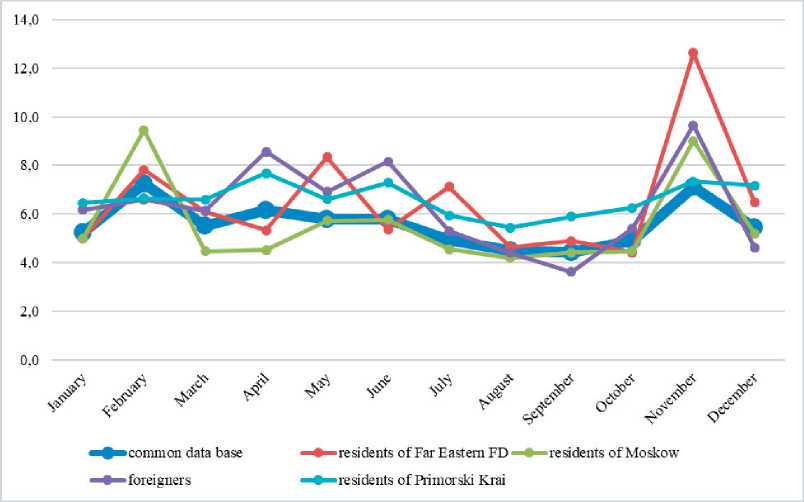
Fig. 11- Seasonal changes in the sentiment index (the category of Primorsky Krai target groups)
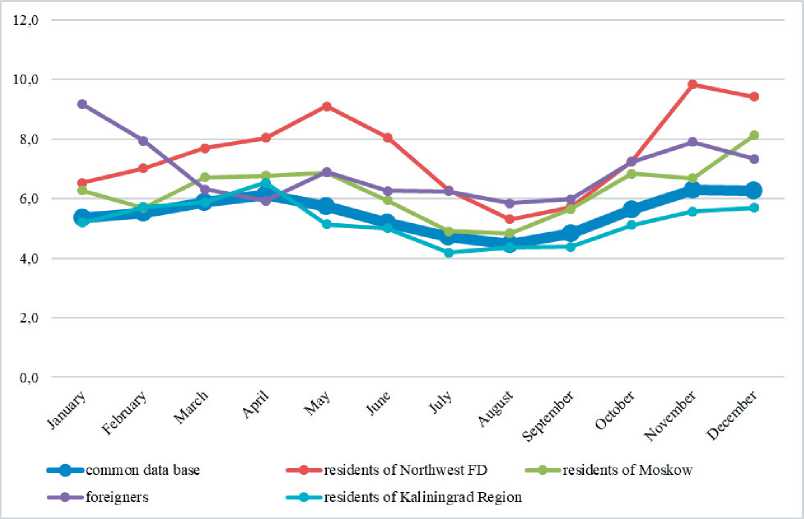
Fig. 12. Seasonal changes in the sentiment index (the category of Kaliningrad Region target groups)
The database covered the period from 2013 to 2021 and consisted of 110 973 reviews. Using the data of the platform TripAdvisor as a database source is quite reasonable, as tourists’ reviews are stored in the original, and each review has information on social and demographic background of the respondent. Signs of over tourism were found in both coastal regions from the research.
The analysis of tourism sphere in coastal regions of Russia was made with the use of statistical methods. In these methods, the coefficients of seasonality, occupancy and average length of stay was calculated.
Componential analysis showed difference in perceiving components of tourist-recreational space of the Kaliningrad Region and Primorsky Krai. In the Kaliningrad Region the most positive assessment was recorded to hotels while in Primorsky Krai it was awarded mostly to restaurants. Among objects of tourist interest, the most positively assessed ones are the Island of Kant in the Kaliningrad Region and the Risky Island in Primorsky Krai. A high share of positive reviews characterizes them as potential tourist dominants.
In course of geographical analysis peculiar features in perceiving tourist-recreational space of certain cities and towns of Primorsky Krai and the Kaliningrad Region were found out. The tone index depends on tourist specialization of the cities and on the level of development of tourist infrastructure. The highest mark is characteristic of cities with a large share of business tourists in the whole tourist flow. The entities which are most often found out in the process of text analysis can serve as the basis for working out the tourist brand of the region.
Time analysis showed that decrease in the sentiment index for the observed period is a common tendency for the both coastal regions. The sentiment index of Primorsky Krai reduced 1.4 times and of the Kaliningrad Region 1.6 times (Figure 12,13). A more detailed research showed that decrease in the sentiment index of Primorsky Krai is caused by local inhabitants and inhabitants of neighboring regions, while reviews by inhabitants ofthe capital (Moscow) and by foreigners are most often positive. In the Kaliningrad Region increase of negative reviews of tourist-recreational space was caused by representatives of all the geographical consumer segments. The analysis of the sentiment index according to season showed that the share of negative reviews increases at high season and reduces at offseason.
The research results are of use to executive government for correcting regional strategies of tourist development and forming a more positive tourist image.
