
Грамматические способы маркирования темы высказывания в тувинском языке
Журнал: Вестник Новосибирского государственного университета. Серия: История, филология @historyphilology
Рубрика: Языки разных систем в аспекте языковой сложности
Статья в выпуске: 9 т.16, 2017 года.
Бесплатный доступ
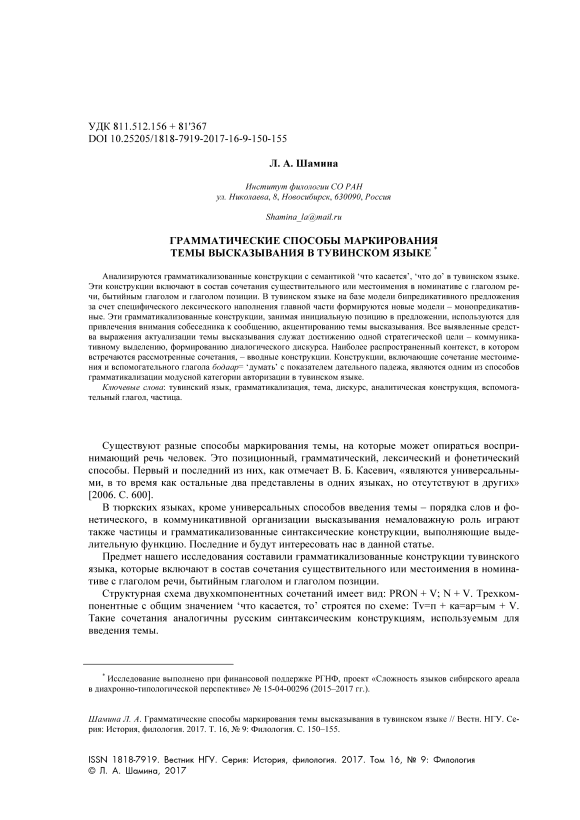
Анализируются грамматикализованные конструкции с семантикой ‘что касается’, ‘что до’ в тувинском языке. Эти конструкции включают в состав сочетания существительного или местоимения в номинативе с глаголом речи, бытийным глаголом и глаголом позиции. В тувинском языке на базе модели бипредикативного предложения за счет специфического лексического наполнения главной части формируются новые модели - монопредикативные. Эти грамматикализованные конструкции, занимая инициальную позицию в предложении, используются для привлечения внимания собеседника к сообщению, акцентированию темы высказывания. Все выявленные средства выражения актуализации темы высказывания служат достижению одной стратегической цели - коммуникативному выделению, формированию диалогического дискурса. Наиболее распространенный контекст, в котором встречаются рассмотренные сочетания, - вводные конструкции. Конструкции, включающие сочетание местоимения и вспомогательного глагола бодаар = ‘думать’ с показателем дательного падежа, являются одним из способов грамматикализации модусной категории авторизации в тувинском языке.
Похожие статьи в разделе Урало-алтайские, японский, корейский, айнский, палеосибирские, эскимосско-алеутские, дравидские, китайско-тибетские языки

Короткий адрес: https://sciup.org/147219845
IDS: 147219845 | УДК: 811.512.156 | DOI: 10.25205/1818-7919-2017-16-9-150-155
Grammatical means of theme marking in Tuvan language
The article offers an overview of constructions with such words and combinations as ‘regarding’, ‘as regards’, etc., in the Tuvan language. We know various theme-marking devices that the reader / listener may rely upon, namely positional, grammatical, lexical, and phonetic devices. The first and the last are thought to be universal. In Turkic languages, the main theme-marking devices are particles and word order. Normally the main information is presented via words or word combinations in the initial position. Aside from universal theme-marking devices, an important role in the communicative organization of a sentence is played by grammaticalized syntactic construction possessing the emphasizing function. The article studies the grammaticalized constructions in the Tuvan language which involve nouns or pronouns combined with speech verbs, existential verbs and position verbs. The structure scheme of 2-component combinations is the following: 1) PRON + V; 2) N + V; 3-component: 3) Tv=п + ка=ар=ым + V with a generalized meaning of ‘regarding’. Such combinations are similar to Russian syntactic constructions used as theme markers. The problem of syntactic interpretations of such constructions in the Russian language hasn’t yet been solved. The grammatical tradition views them as solid phraseological constructions with clearly defined lexical and grammatical composition and analyzes them along with complex sentences. Only V. A. Beloshapkova comments on the fact that these constructions contain theme-marking devices. She notes that in the Russian language, these constructions serve as «special emphasizing function words» and are built by the following model: ‘ что касается + Gen (Noun) + то + predicative construction of any type” [Beloshapkova 1977: 152]. In the Tuvan language, new monopredicative models are formed on the basis of bipredicative models due to special lexical content of the main part. These grammaticalized constructions, filling the initial position of a sentence, are used to attract the listener’s attention to the message, to accentuate the theme of the sentence. These structures are viewed as parenthetical theme-marking constructions ‘regarding [X], [it is…]’. Such meanings are realized via grammaticalized constructions, the first components of which are nouns or pronouns, and the second ones are auxiliary verbs. The wide variety of theme-marking devices serves one strategic goal, namely the communicative marking and formation of dialogic discourse. Topical-noun clauses serve as the most common contexts for such constructions. This is one of the types of grammaticalization of modal authorization category in the Tuvan language.
Список литературы Грамматические способы маркирования темы высказывания в тувинском языке
- Белошапкова В. А. Современный русский язык. Синтаксис. М., 1977. 247 c.
- Грамматика русского языка. М., 1954. Т. 2: Синтаксис. 702 с.
- Дмитриев Н. К. Сложноподчиненное предложение // Строй тюркских языков. М., 1962. 608 с.
- Касевич В. Б. Труды по языкознанию. Семантика. Синтаксис. Морфология. СПб., 2006. 880 с.
- Кошкарева Н. Б. Делиберативная скрепа о том, что и модель изъяснительных сложноподчиненных предложений // Вестн. НГУ. Серия: История, филология. 2015. Т. 14, вып. 9. С. 126-137.
- Русская грамматика. М.: Наука, 1980. 709 с.
- Черемисина М. И., Скрибник Е. К. Глагольные грамматикализованные конструкции в алтайских языках // Языки народов СССР / Под ред. М. И. Черемисиной. Новосибирск: Изд-во Новосиб. ун-та, 1988. С. 5-20.
- Шамина Л. А. Полипредикативные синтетические предложения в тувинском языке. Новосибирск: Сибирский хронограф, 2001. 250 с.
