
Hydraulic lime with the use of pozzolanic additives
Journal: Nanotechnologies in Construction: A Scientific Internet-Journal @nanobuild-en
Section: Construction materials science
Article in issue: 1 Vol.18, 2026.
Free access
Introduction. In the past, air and hydraulic lime were primary materials in building constructions. Due to the limited production of hydraulic lime in Russia, it is of interest to study the possibility of replacing natural hydraulic lime NHL in plaster mortars with artificial hydraulic lime HL, which is not inferior in its properties to natural NHL. Materials and methods. Artificial hydraulic lime HL was obtained by mixing air lime with a pozzolan additive. Diatomite from the Inzenskoye deposit, condensed, uncompacted microsilicon MK-85, and highly active metakaolin VMK-45 were used as pozzolan additives in the work. Results. It has been established that the most effective pozzolan supplement is metakaolin. The introduction of metakaolin into a lime binder in an amount of 10–50% by weight entails an increase in the compressive strength of the solution samples at the age of 28 days by 2.8–12.83 times compared with the sample without the additive. The highest strength value is achieved when 50% metakaolin is added to lime to the binder – after 28 days of hardening, the strength is 1.01 MPa. Conclusion. It has been established that the use of metakaolin in the amount of 40–50% of the mass of air lime makes it possible to obtain artificial hydraulic lime. The developed compositions of artificial hydraulic lime are proposed to be used for the restoration of buildings of historical buildings, as well as the finishing of newly erected facilities.
Similar articles in the section Glass industry. Ceramics. Cement and concrete
Short address: https://sciup.org/142247064
IDS: 142247064 | DOI: 10.15828/2075-8545-2026-18-1-15-21
Text of the scientific article Hydraulic lime with the use of pozzolanic additives
Review article
Логанина В.И, Зайцева М.В., Мажитов Е.Б. Гидравлическая известь с применением пуццолановых добавок. Нанотехнологии в строительстве. 2026;18(1):15–21. – EDN: XOFMTM.
Lime mortars are widely used for the restoration of cultural heritage sites and the finishing of facades of new buildings due to their compatibility with existing materials and their ability to allow air to pass through the structures [1]. Despite their historical significance, lime mortars have certain disadvantages, such as pronounced porosity and limited strength in the early stages, which can potentially affect the effectiveness of restoration. These disadvantages can impact the outcome of the restoration. The low operational resistance of lime plaster mortars determines the introduction of various modifying additives into their formulation, which contribute to the formation of a structure capable of resisting environmental influences [2–6]. To increase the service life of air-blown lime mortars, Portland cement is added to the formulation, but the Portland cement content should not exceed 30% of the total binder content. Natural or artificial pozzolans, such as burnt clay, fly ash or slag, and microsilica, are widely used in the formulation of lime mortars. Natural pozzolans are siliceous or siliceous and aluminum materials that, by themselves, have little or no cementitious properties. However, they are finely dispersed and, in the presence of moisture, react chemically with calcium hydroxide at room temperature, forming compounds with cementitious/binding properties [7].
The use of ternary systems (lime:pozzolana:cement) in lime mortars improves the early strength, adhesion, and durability of the finishing layer. Since the 1990s, these triple binder systems have been widely used in restoration projects. The hydraulic components of the plaster layer contribute to increased strength, moisture resistance, and improved weather resistance.
Among the most important factors affecting the durability of lime-based finishing coats are the pore size distribution and the strength of the binder matrix [8]. Lime mortars are susceptible to destruction during cyclic freezing and thawing. To prevent destruction from the action of freezing and thawing of the finishing layer based on lime solutions, air-entrapping additives are introduced into the formulation to optimize porosity [9].
Natural hydraulic lime NHL is used abroad for the restoration of historical buildings [10–14]. The advantages of using hydraulic lime are the vapor permeability of plaster solutions, the absence of efflorescences on the surface, moisture resistance, strength (the material retains its strength even in contact with water), environmental friendliness (the product is safe for the environment, does not emit harmful substances) [15, 16]. Mortars based on natural hydraulic lime are compatible with old masonry, have low shrinkage deformation, resistance to salt and frost, as well as higher deformability and vapor permeability.
EN 459 distinguishes three classes of hydraulic lime (NHL2, NHL3.5, and NHL 5). According to the Russian standard GOST 9179-2018, hydraulic lime is classified as highly hydraulic and weakly hydraulic.
Hydraulic lime as a mineral binder has found wide application in North American and Western European restoration projects due to its rapid setting compared to air-lime based mortars and high vapor permeability.
Given the low volume of hydraulic lime production in Russia, it is of interest to study the possibility of replacing natural hydraulic lime NHL in plaster mortars with artificial hydraulic lime HL, which is not inferior in its properties to natural NHL [17–19].
The aim of the work is to develop the composition of artificial hydraulic lime used for the restoration of buildings of historical buildings and decoration of newly constructed facilities.
When developing the formulation of the decorative plaster composition, the recommendations of national and international regulatory documents were taken into account. In accordance with DIN 18550, the minimum compressive strength of plaster cement mortars must be at least 10 MPa. Mortars based on hydraulic and highly hydraulic lime should have a minimum compressive
Nanotechnologies in construction
Нанотехнологии в строительстве
2026; 18 (1): 15–21
Nanob
CONSTRUCTION MATERIALS SCIENCE
strength of 1.0 and 2.5 MPa, respectively. There are no requirements for compressive strength for plaster solutions based on air lime.
METHODOLOGY
To develop the composition of artificial hydraulic lime, grade 2 air slaked lime was used in the work.
Artificial hydraulic lime HL was obtained by mixing air lime with a pozzolan additive. As a pozzolan additive, diatomite from the Inzenskoye deposit, condensed, uncompacted microsilicon MK-85 (Sud = 24,000 m2/kg), wt. %: SiO2 – 92; Al2O3 – 0.9; C – 1.6; CaO – 0.85; MgO – 0.4; (YDD Corporation LLP, Kazakhstan), highly active metakaolin VMK-45 (Sud = 1700 m2/kg) with the content (in% by weight): SiO2 – 53; Al2O3 – 42 and pozzolan activity of 1210 mg/g (Synergo LLC, Russian Federation).
The chemical composition of the diatomite, performed on a Thermo Scientific spectrometer, is shown in Table 1.
A study of the granulometric composition of diatomite carried out using an automatic Analysette 22 laser analyzer showed that with a specific surface area of Sd = 10982.58 cm2/g, the particle size distribution is two-modal, the average particle diameter is 14.63 microns, the particle size in the range of 5–10 microns – 25.16% and 10–20 microns – 28.12% prevails, while more than 99% They consist of particles with a size less than or equal to 66.64 microns. The particle content in the range of 0.05–1 microns is 2.13%, and in the range of 50–100 microns – 4.79%.
The results of a quantitative chemical analysis performed on the CPM 25 spectrometer showed that the silica content is up to 82%, with about 33–36% in amorphous form. The average particle size according to laser granulometry (MASTERSISER laser microanalyzer) for metakaolin was 19.7 microns.
Table 1 . Chemical composition of diatomite
|
Oxides |
Weight, % |
|
SiO2 |
60–63 |
|
Al 2 O 3 |
25.0–26.5 |
|
Fe 2 O 3 |
2–3.3 |
|
TiO2 |
0.2–0.3 |
|
K2O |
1.1–1.3 |
|
Na2O |
0.1–0.3 |
|
CaO |
0.2–0.4 |
|
MgO |
0.2–0.4 |
|
Calcination losses (1000 °C) |
6.27–7.5 |
Sursky quartz sand of 0.14–0.315 fraction with a binder ratio was used as a filler. : sand = 1 : 3. The sand density was 1527 kg/m3. Samples were made-beams measuring 40 × 40 × 160 mm, stored in molds during the first day at a temperature of 20 °C and relative humidity of 90–100%. After extraction from the molds, the samples were kept in air-dry conditions at a relative humidity of 65±5% and a temperature of 18–20 °C, then tested for strength.
For comparison, natural hydraulic lime “Tamasli” NHL5 was used in the work. The hydraulic modulus of lime is M = 2.69. The mineralogical composition of hydraulic lime is presented in Table 2.
The compressive strength of the samples was determined using an IR 5057-50 type testing machine and calculated using the formula:
R com = P / F , (1)
where P is the destructive force, H;
F is the cross–sectional area of the sample before the test, m2.
RESULTS AND DISCUSSION
The results of the studies are presented in Table 3, 4 and on Fig. 1, 2.
Analysis of the data presented in Fig. 1 shows that the introduction of pozzolanic additives into the lime binder increases the compressive strength of limestone. Thus, with a microsilica content of 20% of the lime mass, the compressive strength is 0.99 MPa, with a diatomite content – 0.64 MPa, while the strength of the control samples based on air-dried lime is 0.13 MPa. The most effective pozzolanic additive is metakaolin. With an equal content of pozzolanic additives, the use of metakaolin contributes to a higher increase in the compressive strength of limestone, amounting to 1.34 MPa. Increasing the metakaolin content to 40% of the lime mass leads to an increase in compressive strength to 1.71 MPa.
Table 3 shows the compressive strength values of samples of lime-based mortar with pozzolanic additives.
The introduction of metakaolin into a lime binder in an amount of 10–50% by weight entails an increase in the compressive strength of the solution samples at the age of 28 days by 2.8–12.83 times compared with the sample without the additive. The highest strength value is achieved when 50% metakaolin is added to lime to the binder – after 28 days of hardening, the strength is 1.01 MPa.
The addition of flask and diatomite in the binder increases the compressive strength of the solution, but not as significantly as with the addition of metakaolin. The increase in compressive strength is 1.85–3.58 times when using diatomite as a pozzolan additive and 2.09– 3.82 times when using silica.
Nanotechnologies in construction
Нанотехнологии в строительстве
CONSTRUCTION MATERIALS SCIENCE
2026; 18 (1): 15–21
Nanob
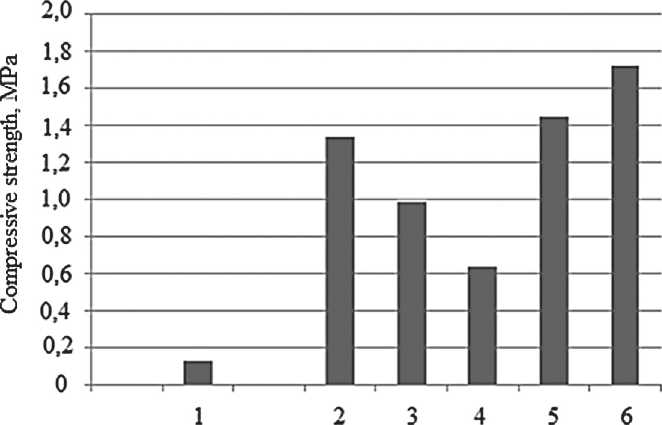
Fig. 1. Compressive strength of limestone: 1 – without additives; 2 – metakaolin content 20%; 3 – microsilica content 20%; 4 – diatomite content 20%; 5 – metakaolin content 30%; 6 – metakaolin content 40%
Table 2. The mineralogical composition of lime
|
Name |
Chemical formula |
Values |
|
Calcium carbonate not calcined |
СаСO3 |
0.1 |
|
Dicalcium silicate |
2CaSiO2 |
48.7 |
|
Calcium hydroxide (free slaked hydrated lime) |
Са(OН)2 |
5.3 |
|
Calcium sulfate (gypsum) |
CaSO4 |
35.8 |
|
Calcium oxide (quicklime) |
СаO |
0.6 |
|
Magnesium oxide |
MgO |
1.7 |
|
Magnesium carbonate |
MgCO3 |
1.1 |
|
Magnesium-calcium carbonate dolomite |
СаMg(CO3)2 |
4.7 |
|
Tricalcium aluminate |
Ca3 Al2O6 |
1,5 |
|
Calcium aluminoferrite (ferrite) |
Ca2 Fe2O5 |
0.5 |
|
Iron disulfide |
FeS2 |
Table 3. Compressive strength of lime mortars
|
The name of the binder |
Name of the pozzolan additive |
Pozzolan additive content (by weight) |
The lime ratio : sand |
Compressive strength, MPa |
|
Hydraulic lime |
– |
– |
1 : 3 |
1.22 |
|
Air lime |
diatomite |
10 |
1 : 2.9 |
0.15 |
|
Air lime |
diatomite |
20 |
1 : 2.8 |
0.21 |
|
Air lime |
diatomite |
30 |
1 : 2.7 |
0.29 |
|
Air lime |
microsilica |
10 |
1 : 2.9 |
0.17 |
|
Air lime |
microsilica |
20 |
1 : 2.8 |
0.25 |
|
Air lime |
microsilica |
30 |
1 : 2.7 |
0.31 |
|
Air lime |
metakaolin |
10 |
1 : 2.9 |
0.2 4 |
|
Air lime |
metakaolin |
20 |
1 : 2.8 |
0.39 |
|
Air lime |
metakaolin |
30 |
1 : 2.7 |
0.78 |
|
Air lime |
metakaolin |
50 |
1 : 2.5 |
1.01 |
|
Air lime |
– |
– |
1 : 3 |
0.081 |
Nanotechnologies in construction
Нанотехнологии в строительстве
2026; 18 (1): 15–21
Nanob
CONSTRUCTION MATERIALS SCIENCE
Time, hour
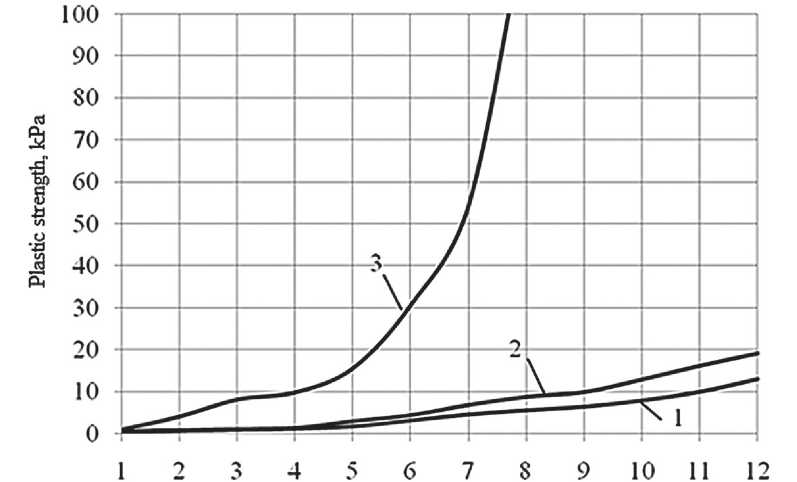
Fig. 2. Change in the plastic strength of the lime mixture: 1 –control composition based on lime binder;
2 – composition based on lime binder using diatomite; 3 – composition based on lime binder using metakaolin
The compressive strength values of calcareous stone and mortar based on air lime with pozzolan additives indicate that the use of metacaolin in an amount of 40–50% of the mass of air lime makes it possible to obtain artificial hydraulic lime, since in accordance with GOST 91792018, the strength of hydraulic lime at the age of 28 days of hardening should be at least 1.7 MPa.
The results obtained coincide with the data of scientific and technical literature. According to [20, 21], the addition of metakaolin (MK) to lime mortars significantly increases the flexural, compressive, and cohesive strength of the mortar. Mortar with a 3.0% MK content met or exceeded the strength standard of European natural hydraulic lime NHL5. A powder based on fired clay brick possesses similar properties. A sample with a 9.0% MK content demonstrates optimal strength for restoration purposes, providing adequate mechanical properties without compromising the structural integrity of historic buildings.
It has been revealed that mortar mixtures based on artificial hydraulic lime have a faster set of plastic strength. Thus, the plastic strength of the composition based on air lime with the use of diatomite in an amount of 20% of the lime weight is 7.29 kPa at the age of 7 hours from the moment of mixing, and with the use of metakaolin in an amount of 50% of the lime weight – 55kPa (Fig. 2).
In lime-metakaolin pastes, C–S–H gel is detected 1–2 days after the onset of interaction [23]. It has been established that at high dosages, metakaolin stimulates the hydration of Portland cement [1]. The presence of a pozzolanic reaction between the binder and the poz-zolanic additive helps to ensure lower overall porosity and, consequently, also contributes to the durability of air-lime-pozzolanic mortars [24]. In addition, early hardening conditions ensure the transport of CO2 for further carbonation reactions, which contributes to a synergistic effect and guarantees the level of early strength in lime-pozzolanic systems [25].
In [26], it is noted that, according to the results of X-ray diffraction analysis, the main phases of the lime sample on days 28 and 56 of hardening consisted of Ca(OH)2, CaCO3, SiO2, and C–S–H. The intensity of the C–S–H diffraction peak increased, while that of Ca(OH)2 weakened as the MC content increased. This is explained by the fact that active SiO2 and Al2O3 directly react with lime,
Table 4. Water absorption values for capillary suction (DIN 52617)
|
Compound |
Water absorption coefficient, kg/(m2 h0.5) |
|
Control composition |
0.95 |
|
Composition using diatomite |
0.93 |
|
Composition using microsilica |
0.924 |
|
Composition based on artificial hydraulic lime using metakaolin |
0.908 |
Nanotechnologies in construction
Нанотехнологии в строительстве
2026; 18 (1): 15–21
Nanob
CONSTRUCTION MATERIALS SCIENCE
consuming Ca(OH)2 and promoting binder hydration. The hydration process was largely complete by day 28, and the subsequent increase in CaCO3 concentration is explained by carbonation.
The test results show that the capillary water absorption coefficient of the composite based on artificial hydraulic lime using metakaolin is lower than that of the composite using diatomite and microsilica (Table 4).
CONCLUSION
A composition of HL artificial hydraulic lime has been developed, including second-grade air-blown lime and the pozzolanic additive metakaolin at a rate of 40% of the lime weight. The developed artificial hydraulic lime compositions are proposed for use in the restoration of historic buildings, as well as for finishing new construction.
