
Impact of family financial pressure on voluntary work performances OCB & CWBs: Mediating role of family motivation and self-control
Журнал: Digital Social Sciences.
Статья в выпуске: 1 vol.1, 2024 года.
Бесплатный доступ
This study aims to highlight the determinants and pathways that trigger employee functional and detrimental voluntary work performances i.e. OCB & CWBs. It is unclear whether family financial pressure is functional or nonfunctional for generating voluntary work behaviors. This study spotlights the paradoxical nature of family financial pressure. We theorize that family financial pressure is a double-edged sword that can produce positive OCB and negative CWBs employee voluntary work behaviors. We have collected data from manufacturing and service sector employees working in different organizations in Pakistan. This study found that family financial pressure is the salient determinant that can generate both functional voluntary work performance OCB and counterproductive voluntary work performance CWBs through unique pathways i.e. family motivation, state self-control failure. Family motivation acts as a partial mediator between family financial pressure and OCB and state self-control failure also partially mediated the link between family financial pressure and CWBs. The practical and theoretical implications are also discussed in this study.
Короткий адрес: https://sciup.org/170213824
IDS: 170213824 | DOI: 10.69971/gdft0s72
Текст научной статьи Impact of family financial pressure on voluntary work performances OCB & CWBs: Mediating role of family motivation and self-control
Copyright: © 2024 by the authors. This article is licensed under a Creative Commons Attribution 4.0 International License. To view a copy of this license, visit
are working to live not only gratify their personal needs but also their family members’ needs, so they can identify their behavior accordingly. Money has an impact on helping behaviors (OCB) (Tang et al. 2008). Family roles may facilitate, opportunities for career advancement and promotion (Gould and WerbeL 1983). Due high importance of family role research calls to investigate the impact of employee financial requirements on employees' reactions to their work (George and Brief 1990) and organizations should effectively address the delicate expected reciprocity in the organizational citizenship behaviors (Tang et al. 2008, Hui et al. 2000).
Despite the importance that the family domain can configure individual work, non-work behaviors and attitudes (Paustian-Un-derdahl et al. 2016, Thompson et al. 2017, Thompson et al. 2020, Courtright et al. 2016, Liu et al. 2020), surprisingly little research studies have explored the family as a source of motivation (Yaqoob et al. 2023, Menges et al. 2017, Tariq and Ding, 2018, Zhang et al. 2019). Previously literature more focused on the negative consequences of the family domain for the work domain, such as distraction from the work (e.g. WIF/FIW) (Greenhaus and Beutell 1985). Family and work roles are complementary and reinforcing effects on each other (Gould and Werbel 1983). Family configuration plays a central role in comprehending employee’s reactions toward their work, for example, employee who is the sole supporter of their family may be specifically more sensitive to the instrumentality of their jobs (George and Brief 1990). Previously Grant and Mayer (2009) proposed that the prosocial motive and impression motive are the strong predictors of OCB. This study suggests that along with prosocial and impression motive, family motive (family motivation) is the potential cause to demonstrate functional voluntary work behaviors such as OCB, because they consider it worthwhile for their work family facilitation (Reizer et al. 2019), in terms of direct and indirect rewards (Haworth and Levy 2001). Many employees with family financial pressure are more motivated to support their family financial needs (Zhang et al. 2019). In many cultures individuals are bound to respect the social expectations of their family members (loved ones), even Laws are established for the fulfillment of family financial needs (Liu et al. 2020).
Self-control has a critical position in organizational life (Lian et al. 2017). Self-control is relatively less investigated in organizational behaviors as compared to other disciplines although employees and employers regularly experience situations that require the exertion of self-control (Lian et al. 2017). Failure of Self-control caused a heavy cost to the organization and organizational members through its nasty workplace outcomes such as deception (Welsh and Ordonez, 2014), cheating (Christian and Ellis 2011), unethical behaviors (Gino et al. 2011, Yam et al. 2014) and abusive behaviors (Barnes et al. 2015, Liang et al. 2016). So, employers are more concerned about investigating, why failure of self-control happens at the workplace (Lian et al. 2017).
This study is the first to contribute to the knowledge gap in the existing literature on organizational behaviors, by integrating the family and work domains simultaneously and proposing that family financial pressure has a dynamic nature, acts as a double edge sword that leads employees towards functional voluntary work behaviors such as OCB and dysfunctional voluntary work behaviors such as CWBs through different underlying mechanisms such as motivational pathway and strain pathway. In the motivational pathway employee family motivation is the underlying cause through which employees who experience family financial pressure as a challenge are more engaged in functional voluntary work behaviors such as organizational citizenship behaviors (OCB). In the strain pathway, this study suggests that failure of self-control is the underlying mechanism through which employees experience Family financial pressure as a taxing produces dysfunctional voluntary work behaviors such as counterproductive work behaviors (CWBs).
Overview of Theoretical framework
Do employees who are facing family financial pressure can perform voluntary work behaviors (CWBs and OCB)? This study introduces the motivational and strain pathways, through which the experience of family financial pressure produces different voluntary work behaviors as presented in Figure 1.
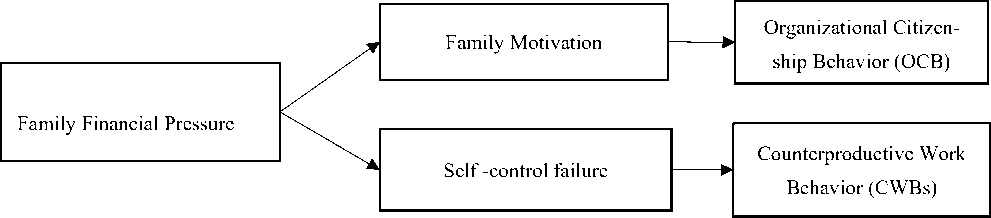
Figure 1 . Conceptual model
In the motivational pathway, demands may generate positive experiences for individuals (Chan et al. 2017). Employees may be receptive to role demands or seem indifferent because they perceive themselves as a part of both domain roles (Boyar et al. 2007). Under the motivational pathway employees who experience family financial pressure as challenging are more motivated and energetic to support their family needs (Zhang et al. 2019). Many individuals primarily work for the gratification of their family needs (Menges et al. 2017, Yaqoob et al. 2023). This makes their financial concerns more salient in the workplace because one’s family's financial demands are inextricably associated with one’s work. Researchers noted that individuals with financial precarity effectively accumulate their resources and move out of poverty, which increases their self-respect and earns respect from others (Narayan et al. 2009). Employees will likely be engaged in voluntary work performance (such as OCB) which they perceive as valuable for the compensation of their family's financial pressure. Because employees and their dependent ones’ (families) financial requirements are associated with the economic instrumentality of their work, an economic outcome of work facilitates essential functions of individuals' lives (George and Brief 1990). Along with the prosocial motive and impression management motive (Grant and Mayer, 2009), the family motive is also a strong reason to enact citizenship behavior because of the expected reciprocating belief as giving me forward (Korsgaard et al. 2010) or showing responsible citizenship behavior (Zhang et al. 2011), as they believe that employer provides them the opportunities to realize their motive to meet the financial needs of their and their families. Those employees, who perceive that involving in extra role work behaviors (OCB) would help them to get the promotion (indirectly facilitate family), tend to perform more voluntary these behaviors (Hui et al. 2000). Bolino (1999) said that engaging in OCB benefits the employees, they will perform more voluntary OCB.
In the strain pathway, role demands are the source of pressure (stress), experienced by individuals, when seeking to sustain the balance between both domains (e.g. Work and Family) responsibilities (Voydanoff 2004). Greenhaus and Beutell (1985) reported demands to have a negative experience and to generate work-family interference. For many employees having family demands causes distraction from work, and depletes their resources such as time, energy, and attention, that are otherwise spent on the work domain (Greenhaus and Beutell 1985). “Human behavior is extensively motivated and regulated by the ongoing exercise of self-influence” (Bandura, 1991). Regulatory resources (self-control) are finite, in case of depletion workplace aggression is likely to happen, because of self-control failure (Courtright et al. 2016). Due to facing high stress while competing family and work demands simultaneously causes employees to expend their energy resources such as “focusing attention on the self and exercising self-control, which consumes energy, a process that psychologists refer to as ego depletion” (Rothbard 2001). Vohs and Baumeister (2016) stated self-regulation (self-control) has a profound impact on individuals' everyday activities, as the failure of self-control predicts personal and social problems (e.g. crimes and violence) that affect a large number of communities. Gottfredson and Hirschi (1990) provide an influential model about self-control and crimes, in which they placed self-control capacities at the heart of acts of crimes, and suggest that almost all criminal behaviors are triggered by the failure of self-control, and individuals motivated to commit these behaviors to gratify their instant desires although short term benefits associated with long term costs. Self-control failure is too common in the firms (Lian et al. 2017). Employers are bearing higher costs due to the consequences of failure of self-control (crimes, violence, bullying, deviant behaviors, aggression, revenge, etc.). So, one of the major objectives of firms is to comprehend why self-control failure happens. (Lian et al. 2017). This study suggests that non-work demands such as family financial pressure are the potential antecedents of self-control failure. Many employees experience family financial pressure as stressful and taxing, which drains their energy resources (Hobfoll and Shirom 2001), or depletes their self-regulation resources (Welsh and Ordonez 2014), for example, employees are unable to focus (concentrate) properly due to cognitive exhaustion, feel low willpower, therefore, most likely commit the unethical behaviors such as counterproductive work behaviors because they are unable to restraint from undesirable impulses (Vohs and Baumeister 2016). A previously growing body of research declared that self-control failure is the underlying reason for numerous unethical behaviors (Gino et al. 2011, Yam et al. 2014), workplace deviance (Christian and Ellis 2011), abusive behaviors (Barnes et al. 2015, Liang et al. 2016).
Hypothesis 1: There is a positive relationship between employee experience of family financial pressure and their Organizational Citizenship Behavior (OCBO & OCBI).
In this study, we posit that family financial demands experience as taxing of resources (e.g. self-control failure). The scarcity approach conferred that the overdemanding nature of multiple roles causes the draining/exhaustion of energy resources (Marks 1977). Both Resource Drain theory (Edward and Rothbard 2000, Marks 1977) and Spending theories (Marks 1977), postulated that our energy resources are finite, and can easily drain up altogether. Employees should maintain a balance between different roles (Marks 1977). Similarly, Conservation of resource theory posited that people are more sensitive to resource loss as compared to resource gain (Hobfoll 2001, Hobfoll et al. 2018). So, when employees feel that their work is hampered by the negative experience of family financial pressure, their resource bundles (energy, attention, commitments etc) are depleted, and they realize insufficient resources left to meet the demands of regular work roles (Nohe et al. 2014). Employees who experience Family financial pressure as a taxing of their resources, most likely exhibit dysfunctional voluntary work behavior such as counterproductive work behavior as a coping strategy to conserve the existing resources from further resource loss spiral (Hobfoll 2001), because acting civilly people need a pool of executive control and efforts (Anderson and Pearson 1999). Employees opted for Counterproductive behaviors as a behavioral response strategy to release the negative feelings that come with this stressful situation (Hobfoll et al. 2018, Taylor et al. 2017). Employees are motivated to conserve further resource loss by venting negative frustration (caused by family financial pressure) with this attribution that harms the organization (Taylor et al. 2017). They perform counterproductive activities directly by stealing/damaging firms’ property (products) or indirectly such as ignoring or withholding information from other organizational members (Hobfoll and Shirom 2001, Spector and Fox 2005). Although somehow voluntary activities consume resources, employees are justified by blaming their immediate employers because employers have a significant impact on the employee’s financial well-being (Meuris and Leana 2018). So, this study suggests that,
Hypothesis 2: There is a positive relationship between employee experience of family financial pressure and their Counterproductive work behaviors (CWBs towards interpersonal and organization).
By integrating the COR theory (Hobfoll 2002) with the expectancy theory (Vroom 1964), this study introduces the mediating role of family motivation in the relationship between family financial pressure and organizational citizenship behaviors. Family motivation can expand the energy resources and serve as a buffering role against the stress (Menges et al. 2017) that is caused by the family demands (family financial pressure) to hinder the work performance. Vroom (1964) said that backing the individuals who matter the most to them, energizes their efforts at work. The importance or desirability to support one’s family will likely increase their motivation to engage in those extra-role activities at work which helps them to reduce their family's financial pressure. Conservation of Resource theory suggests that individuals struggle to, obtain, retain, preserve, foster, and protect those resources they centrally value (Hobfoll et al. 2018). Generally, the most precious resources are those that hold both personal and societal values (Halbesleben et al. 2014). Hal-besleben et al. (2014) stated that humans are motivated to defend their existing resources (conservation) and obtain new resources (Acquisition). Freund and Riediger (2001) proposed that investing resources for the sake of resource acquisition is equally important as investing resources in the protection and counteraction of losses.
This study suggests that individuals who possess key motivational resources such as family motivation “might be more capable of selecting, altering, and implementing other resources to meet stressful demands” (Hobfoll 2002). So, they are engaging in extra-role work activities such as citizenship behaviors for which they perceive the valuable benefits that help them to sustain their family life. As economic circumstances have a greater impact on employees’ work (Brett et al. 1995, Doren et al. 1991) non-work attitudes and behaviors (Brief et al. 2006). This study expects that in case of family financial pressure employees will adhere to perform those extra role work behaviors (such as OCB), which will help them to sustain their family life (Menges et al. 2017, Reizer et al. 2019). An individual values a job as, “Something you have to do to earn the living” (Shepard 1972). Thus, it is consistent with their motivational orientation (family motivation) about engaging in OCB (Haworth and Levy, 2001, Hui et al. 2000). Family motivations make it more rationale for employees to engage in those extra role work behaviors (Such as OCB), to reduce the family financial pressure. Employees who have family motivation (Menges et al. 2017), particularly sensitive to their resources investment to bring the desirable outcomes (Hagger 2015). Previously scholars have spotlighted the benefits of performing organizational citizenship behaviors to work-family facilitation (Reizer et al. 2019), and many other personal privileged benefits or personal gains (Bolino and Grant 2016). Based on the above logic this study suggests that employees experiencing family financial pressure will likely demonstrate OCB, due to their family motivation because they perceive that engaging in OCB brings valued outcomes, which will facilitate effectively in terms of family configuration.
Hypothesis 3: There is a positive relationship between employee experience of family financial pressure and their family motivation.
Hypothesis 4: There is a positive relationship between employee family motivation and Organizational Citizenship Behaviors (OCBO & OCBI).
Hypothesis 5: Employee's family motivation mediates the relationship between their experience of family financial pressure and performance of Organizational Citizenship Behaviors (OCBO & OCBI).
-
2.5 Mediating Role of Self-Control Failure (Self-Regulation Depletion)
-
3. Research Methods3.1 Sample and procedures
Drawing on the conservation of resource theory and self-regulation perspectives, this study introduces self-control failure (Self-Regulatory Depletion) stemming from family financial pressure as an underlying mechanism to address, why employees, who have family financial pressure (family demands) exhibit counterproductive work behavior at the workplace. Self-regulatory resources are the inner set of psychological restraints that operate to control undesirable (e.g. aggressive) impulses to translate into override subsequent behavioral actions (Baumeister and Vohs. 2007, Courtirght et al 2016).
According to self-regulation theory, persons own limited self-regulatory resources that “inhibit . . . responses that may arise because of physiological processes, habit, learning, or the press of the situation” (Schmeichel and Baumeister 2004). As self-regulatory resources are finite if the resources that regulate self-control are depleted, individuals struggle to constrain their urges and engage in unethical behaviors (Fennis et al. 2009, Courtirght et al. 2016). Due to the critical role of self-regulatory resources for self-control, researchers have focused on investigating, why self-control failure happens (Baumeister and Heatheron 1996, Mawritz et al. 2017). This study suggests that when employees juggle family and work demand simultaneously, they may face loss of self-control (self-regulatory depletion) and are more likely to engage in counterproductive activities. In this Regard principle (1st and 4th) of Conservation of resource theory (Hobfoll et al. 2018 2011), resources loss, presents a strong theoretical ground of the negative family-work dynamics as an important driver of self-regulation depletion. When Employees are facing a stress-inducing environment (such as family financial pressure), this situation is so upsetting for them, which drains their energy resources available to perform their job responsibilities (Anand et al. 2015). The depletion argument suggests that humans have a fixed amount of psychological and physiological resources to expend to satisfy the demands of family and work roles, which depletes their resources (Rothbard 2001). During the family financial hardship, employees’ resource is chronically outstretched/exhausted, to address the issues of both domains of life (Work and Family), and they end up with depleted self-regulatory resources (standard, monitoring, strength, etc.) (Baumeister and Vohs 2007) and they may adopt strategically defensive (conservation of resources/not to invest further resources) or alternative coping strategy (Hobfoll et al. 2018). Subsequently behave aggressively or irrationally (Hobfoll et al. 2018) at the workplace such as counterproductive work behavior. They may experience a loss of self-control for undesirable impulses (Aggressive), which is essential to restrain them, from unethical behaviors (Baumeister and Vohs 2007, Courtirght et al. 2016). Baumeister et al. (1998) contend that individuals engage in violation action due to their depleted resources (energy). Moreover, excessive self-regulation may also cause the depletion of resources (such as mental or physical exhaustion), and lessen the ability of individuals to be available for or meet the demands of another role (Rothbard 2001).
However, this counterproductive behavior represents withholding of resources from their respective employer and the organizational members (supervisor, colleagues etc) or employees making an effort not to invest resources that would help to improve the progress of the organization and organizational members. They may harm directly or indirectly to the organization and its members, such as colleagues or supervisors (Skarlicki and Folger 1997, Townsend et al. 2000). Scholars propounded that “the enactment of CWBs is frequently an attempt to cope with a feeling of over taxation, “the sense that work demands exceed the resources available to invest” (Taylor et al. 2017). Thus, employees may respond to the organization adversely via engaging in deviant activities, for example wasting organizational material and resources, gossiping about their supervisor, and withholding valuable information from their colleagues (Mackey et al. 2017, Skarlicki et al. 1999). Thus, this study proposed that,
Hypothesis 6: There is a positive relationship between employee experience of family financial pressure and self-control failure (Self-regulation depletion).
Hypothesis 7: There is a positive relationship between employee self-control failure (Self-regulation depletion) and their counterproductive work behavior (CWBs towards interpersonal and organization).
Hypothesis 8: Employee Self-control failure (Self-regulation depletion) mediates the relationship between their experience of family financial pressure and their counterproductive work behavior (CWBs towards interpersonal and organization).
This study was conducted in the natural work environment, through a questionnaire. The data was collected from the manufacturing and service sector of Pakistani firms located in Lahore. Data was collected from respondents (n=150) through personal or peer contact at the workplace to ensure them the confidentiality of their responses. This is a time-lagged study so data is collected by threetime lagsT1, T2, and T3. This study Unit of analysis is the employees working in the manufacturing and service sector of Pakistan. Participation in this survey consisted of only volunteer participations and we did not offer any fee for the study participants so they could quiet their involvement in the research survey at any stage of the research process. The participant's average age were 45 years, mostly have 16 years of education. We collected data from both males and females working in the selected organization.
For collecting the responses of the respondents, the convenient sampling technique was most suitable. Primary data was collected from the full-time employees of the manufacturing and service sector of Pakistan, especially from frontline, lower, and middle-rank employees of the different firms. Data on employee experience of Family financial pressure and family motivation was collected from employees in first-time lag (T1). Data on Employees' Self-control and their perceived instrumentality beliefs about extra role work behavior were collected from employees in second-time lag (T2). Data on Functional voluntary behaviors such as Organizational citizenship behaviors and dysfunctional work behaviors such as Counterproductive work behavior was collected from employees in third-time lag (T3).
Measures
Independent Variables: Family financial pressure. It consists of 3- items adapted from Conger et al. (1999). Likert-type scale ranges from Strongly disagree to strongly agree for response rating. Sample items of this scale are “My family has difficulty paying its monthly bills” and “My family can hardly make ends meet.” (α= .77).
Mediating Variables
State Self-Control Capacity scale (Self-regulation depletion): State Self-Control adapted from Christian and Ellis (2011). It consists of 25 items having a good reliability (α= .79). The sample items include “ I feel worn out” and “I feel mentally exhausted”. Likert scale range from Strongly disagree to strongly agree was used for response collection.
Family motivation: The family motivation scale consists of 5- items adapted from Menges et al. (2017). Sample items of this scale are “I want to have a positive impact on my family” and “My family benefits from my job” (α=0.80). Likert scale range from Strongly disagree to strongly agree was used for response record.
Dependent Variables
Organizational citizenship behavior. Organizational Citizenship behaviors consist of 16- items adapted from Lee and Allen (2002). The sample items are “Help others who have been absent “Assist others with their duties” (α=0.80). Likert scale range from Strongly disagree to strongly agree was used for response record.
Counterproductive work behavior: The counterproductive work behavior scale consists of 10 -items adapted from Spector et al. (2010). Sample items are “Came to work late without permission”, and “Purposely wasted your employer’s materials/supplies” (α=0.82). Likert scale range from Never to Every day was used for response rating.
Control variables
A one-way ANOVA test is applied to check the effects of demographics on the mediators and job outcomes. This study has used the following demographics i.e. number of family members, status, age, tenure, gender, work experience, and qualification as a control variable for this study but we found number of family members had significant effects on family motivation (mediator), status has a significant effect on the state of self-control failure (mediator) and work experience has a positive impact on voluntary work performances i.e. OCB and CWBs (dependent variables).
-
4. Results
-
4.1 Descriptive statistics
-
-
4.2 Regression analysis
Table 1 indicates the descriptive statistics i.e. mean, standard deviation, correlation among study variables, and their alpha reliabilities. Family financial pressure is positively correlated with family motivation (r= 0.494), OCB (r=.510), state self-control failure (r=.400), and CWBs (r=.423). Family motivation and OCB (r=.454), self-control failure and CWBs (r=.489) and other variables correlation are mentioned in the table.1
Table 1. Correlation, Mean, S.D, alpha reliabilities of study main measures
|
Variables |
mean |
s. d |
1 |
2 |
3 |
4 |
5 |
6 |
7 |
8 |
9 |
|
|
1 |
Family financial pressure |
3.67 |
.795 |
(.77) |
||||||||
|
2 |
Family motivation |
3.77 |
.656 |
.494** |
(.80) |
|||||||
|
3 |
State self-control |
3.65 |
.842 |
.400** |
.572** |
(.79) |
||||||
|
4 |
OCB |
3.73 |
.887 |
.510** |
.454** |
.587** |
(.80) |
|||||
|
5 |
CWBs |
3.68 |
.784 |
.423** |
.442 |
.489* |
.322 |
(.82) |
N=150
This study also analyzed the main effects of proposed hypotheses (H1, H2, H3, H4, H6, H7) through multiple linear regression analysis in SPSS 25 (as mentioned in Table 2). The H1 hypothesis is “There is a positive relationship between employee experience of family financial pressure and their Organizational Citizenship Behavior (OCBO and OCBI)”. The result supports our first hypothesis. Employee experience of family financial pressure positively predicted organizational citizenship behavior (B 0.16, p<0.00, R2=0.14). The findings of this study also supported the H2 claim (B= 0.20, p<0.00, R2=0.28), as employee experiences of family financial pressure tended to involve them in counterproductive work behaviors. The result of the third hypothesis (H3) is also confirmed by our study findings (i.e. B= 0.30 p<0.00, R2=0.14), As experience of family financial pressure motivates individuals towards their family to spend their efforts to fulfill their family requirement. Similarly, we confirmed our fourth hypothesis (H4) (i.e. B= 0.20 p<0.00, R2=0.19), As employees are motivated due to their family they tend to engage more in citizenship behavior to secure their job. Also, hypothesis H6, and hypothesis H7 are also supported by our research findings (B= 0.20 p<0.00, R2=0.28, B= 0.16, p<0.00, R2=0.29 respectively) as represented by Table.2 below.
Table 2. Main Effects
|
Predictors Control variables for family motivationa, self-controlb, OCBc and CWBsd |
Family motivation |
Self-control (Failure) |
OCB |
CWBs |
||||||||
|
β |
R2 0.01 |
∆R2 |
ß |
R2 0.01 |
∆R |
β |
R2 0.13 |
∆R2 |
β |
R2 0.25 |
∆R2 |
|
|
Family financial pressure |
0.30 |
0.14 |
0.13 |
0.22 |
0.16 |
0.15 |
0.16 |
0.14 |
0.02 |
0.20 |
0.28 |
0.03 |
|
Control variables for OCB c |
0.13 |
|||||||||||
|
Family motivation |
0.20 |
0.19 |
0.06 |
|||||||||
|
Control variables for CWBsd |
0.25 |
|||||||||||
|
State self-control (failure) |
0.16 |
0.29 |
0.03 |
|||||||||
N=150, Control variables for “a” number of family members
Control variables for “b” status
Control variables for “c” work experience
Control variables for “d” work experience
For mediating hypotheses analysis (H5 andH8) we used the Preacher and Hayes (2004) Macro Process Model 4 in SPSS.25, which is the most easy and suitable method to identify the presence of mediational effects in the conceptualized model. Table 3 demonstrates the mediation effects of family motivation between family financial pressure and organizational citizenship behavior and the mediating effect of self-control failure between family financial pressure and counterproductive work behaviors. Our research findings successfully confirmed the hypothesis H5 (Boot effect = 0.06, Boot S. E= 0.02, LLCI=0.02, ULCI= 0.05, P<0.01), which stated the presence of partial mediation effect of family motivation between family financial pressure and product voluntary work performance (OCB). Hypothesis H8 confirmed by our study results (Boot effect = 0.04, Boot S. E= 0.03, LLCI=0.01, ULCI= 0.04, P<0.01), which stated the presence of partial mediation of self-control failure between the relationship of family financial pressure and counterproductive work behaviors.
Table 3. Mediating effect of family motivation and state self-control between family financial pressure and voluntary work performance
Notably, research has largely ignored the potential consequences of employee family financial concerns at the workplace, this study proposed that employees who are facing financial issues can act differently depending on their, self-control abilities (self-regulation capacity) and motivational orientation (Family motivation). The employees see the family demand (family financial pressure) as an energizing motivational resource and effectively regulate their abilities to propel them towards functional voluntary work behaviors such as OCB. Penner et al. (1997) consider it as proactive behavior, in which employees intentionally engage to gratify their certain needs and other specific motives. Korsgarrd et al. (2010) suggested that rewarded or unrewarded organizational citizenship behaviors are based on the notion of, paying you back or paying me forward. When employees see that performing OCB brings benefits (facilitates family), then they perform more citizenship behaviors (Bolino, 1999). Haworth and Levy (2001) suggest that beliefs that performing OCB is worthwhile, can be boosted by providing direct or indirect rewards. This conferred the importance of making sure that workers and employers are clearly and effectively communicated about the standards of successful performance (Haworth and Levy 2001). Organizations should develop plans to encourage and reward organizational citizenship behaviors and monitor contextual performance in some situations (Tang et al. 2008). If the employees OCB are not recognized and rewarded then employees may be reluctant to engage in future OCB performance behaviors, due to a breach of their expected reciprocity beliefs (Wilke and Lanzetta, 1970). Supervisors should effectively address this delicate reciprocity of citizenship behaviors in the exchange process (Tang et al. 2008).
Employers and employees regularly experience self-control failure in the workplace (Lian et al. 2017) that produces heavy cost to the organization in the form of counterproductive work behaviors such as deviance (Christian and Ellis 2011) abusive supervision (Barnes et al. 2015, Liang et al. 2016), as deception (Welsh and Ordonez 2014), cheating (Christian and Ellis 2011), unethical behaviors (Gino et al. 2011, Yam et al.2014). A broad range of bad outcomes such as crimes, violence, health problems (obesity, eating disorder), attention-deficit/ hyperactivity disorder, excessive spending, and drug abuse (e.g. cigarette, smoking, alcoholism) are all associated with the lack of self-control ((Vohs and Baumeister 2016). So, the organization should provide training in cognitive reappraisal tactics to reduce the aggressive interpretation of the demanding situation. Past literature spotlights the key role of practice in the improvement of self-control (Muraven et al. 1999, Gailliot et al. 2007). Moreover, Employers can help the employees by introducing family-friendly interventions in the organization such as residential facilities, children's tuition fees, and spouse jobs which can reduce the financial burden of the employees. For the reduction of counterproductive work behaviors, employers should identify/select candidates for the job who have good self-control capacity.
This research has some limitations as well that offer opportunities for forthcoming researchers. The first limitation is the crosssectional barrier for our research so future researchers should test the same mode with longitudinal perspective. As the families grow and their expenses are also increased so may be the results vary with time. The second limitation is the small sample size (n=150) for more accurate authentic and results generalization the researcher should increase their sample diversity and size as well. Mostly family work demonstrated the negative side (Isac et al. 2024, Zhang et al. 2020, Liu et al. 2020), only a handful researchers (Lin et al. 2024, Yaqoob et al. 2023, Menges et al. 2017) depicted its positive side. Moreover, our research highlighted the need to explore other motivational and depletion pathways that relate the voluntary work performance (OCB and CWBs) and its antecedents. Licensing mechanisms should be introduced between voluntary work performance and determinants as well (e.g. Yaqoob and Shahzad 2024).
6. Conclusions
Thus, this study proposes that employees who are facing family financial demands act in voluntary work behaviors either positively (OCB) or negatively (CWBs). Those employees who have family motivation are more committed, and more control and take this situation more challenging, they expand their energy resources due to strong family motivation and use their energy to handle the challenging situation effectively, subsequently showing more positive voluntary work behavior such as organizational citizenship behavior in the workplace because, in this way, they can get more resources (extrinsic rewards, relational or promotions) that can facili-tate/enrich their family wellbeing. On the other side in strain pathways employees feel more stress due to family financial pressure, in this case, employees experience the taxing of resources, continually face the distraction from the family domain, and are unable to draw from this situation due to failure of their self-control. Subsequently unable to handle the work demands properly with insufficient attention and cognitive energy resources. Under this threatening situation, they used the coping strategy (avoiding) and acted voluntarily on work behavior that is detrimental to the organization and their colleagues such as counterproductive work behavior for venting their negative frustration.In addition, it is necessary to highlights the post pandemic financial challenges and threats for families in under developed countries like Pakistan. With respect to boundary condition our research limited to answer that, under what condition the proposed model would be more viable in the workplace, so the future researcher should identify suitable individual moderators such as employee resilience or contextual moderators (i.e. family-supportive policies, etc.) for the same conceptualized model.
