
Influence of delayed ettringite formation on the durability of mortars: the importance of thermal control
Journal: Nanotechnologies in Construction: A Scientific Internet-Journal @nanobuild-en
Section: The results of the specialists’ and scientists’ researches
Article in issue: 3 Vol.18, 2026.
Free access
Introduction. This study is part of a broader investigation into the phenomenon of delayed ettringite formation (DEF) in concrete and its consequences on the durability of concrete–mortar systems. The objective of the research is to analyze the influence of the initial thermal conditions of fresh concrete on the development of internal sulfate reaction (ISR), the mechanical properties of concrete, and the behavior of mortar applied to the surface after hardening. Materials and Methods. Three concrete mixtures, designated BP1, BP2, and BP3, were produced and subjected to DEF testing on cubic specimens, including continuous temperature monitoring. The temperature of fresh concrete was intentionally varied in order to evaluate its influence. The experimental program was carried out in Africa, specifically in Benin. Compressive and tensile strength tests were performed. After verifying that the concrete was suitable, mortar was applied to the concrete surface. The behavior of the mortar was then monitored over a period of 90 days through visual observation of the mortar surface. It was particularly interesting to observe the evolution of the mortar surface over time. Results and Discussion. The results has shown that for concretes BP1 and BP2, when the initial temperature was below 35 °C, the thermal behavior during the DEF test was stable, and the maximum temperature did not exceed 80 °C. Under such conditions, appropriate mechanical properties and a uniform coating of mortar were obtained without any visible cracking or surface damage. Nevertheless, for concrete BP3 with initial temperature higher than 35 °C, the thermal behavior became unstable, but the maximum temperature remained lower than the critical one. It was observed that this instability negatively affected the mechanical properties and reduced the durability performance of the material. Conclusion. The control of the initial thermal conditions of fresh concrete is a key parameter for limiting the development of DEF, preserving the mechanical properties of concrete, and ensuring the durability of applied mortars. In particular, the initial temperature of fresh concrete should not exceed 35 °C, since higher temperatures may promote the development of internal sulfate reaction (ISR) within the concrete itself.
Similar articles in the section Glass industry. Ceramics. Cement and concrete
Short address: https://sciup.org/142248070
IDS: 142248070 | DOI: 10.15828/2075-8545-2026-18-3-363-378
Text of the scientific article Influence of delayed ettringite formation on the durability of mortars: the importance of thermal control
Original article
Зомахун К.В., Хоуану К.А., Содомон М., Самченко С.В. Влияние позднего образования эттрингита на долговечность растворов: важность термического контроля. Нанотехнологии в строительстве. 2026;18(3):363–378. – EDN: NYYMFH.
In African countries, particularly in Benin, climatic conditions are characterized by high temperatures, which frequently exceed 30 °C and may rise even higher depending on the season. These thermal conditions constitute an important environmental factor influencing the behavior of construction materials, especially concrete and mortar.
High temperatures during the early stages of concrete hardening or during mortar application may alter the me- chanical and physicochemical properties of these materials. Numerous studies have shown that elevated temperatures (above 25 °C) accelerate cement hydration reactions [1–3]. An increase in temperature during concrete curing disrupts the internal microstructure and promotes the development of defects in concrete, including internal sulfate reaction (ISR).
Delayed ettringite formation (DEF) is a concrete anomaly first identified in real structures at the end of the 1980s. Some researchers reported cases in which precast elements subjected to heat curing subsequently
Nanotechnologies in construction
Нанотехнологии в строительстве
2026; 18 (3): 363–378
Nanob
THE RESULTS OF THE SPECIALISTS’ AND SCIENTISTS’ RESEARCHES
experienced deterioration, leading to a reduction in their mechanical properties [4].
Delayed ettringite formation (DEF) was first identified in precast reinforced concrete elements in the late 1980s [4]. Subsequently, numerous case studies and expert reports were published in the literature, including [5] and [6], describing cases involving the simultaneous occurrence of alkali–silica reaction and delayed ettringite formation [7–9]. In France, internal sulfate reaction was identified in several dozen massive concrete structures [10–13], as well as in precast reinforced concrete elements [14].
Sulfate attacks represent a major durability problem for concrete structures. These attacks damage concrete by degrading its mechanical properties. In particular, internal sulfate reaction leads to delayed ettringite formation, which causes expansion within the concrete and the development of network cracking [15].
When a structure is affected, it is essential to accurately diagnose the development of defects, assess its serviceability, predict the mechanical evolution of the structure, and apply appropriate repair methods. Achieving these objectives requires a thorough understanding of the consequences of DEF at both the microstructural and macrostructural levels. Numerous experimental and theoretical studies have been carried out to identify the physicochemical mechanisms and parameters influencing delayed ettringite formation (DEF). However, the complexity of the underlying processes makes it difficult to directly extrapolate this knowledge in order to explain structural-scale effects. Therefore, macroscopic approaches may provide additional insights based on the knowledge already available in the literature [2].
The development of defects also affects mortar coatings applied to concrete substrates, thereby degrading the visible surface quality, whereas the actual cause of cracking and other observed damage lies in the DEF occurring within the concrete itself. Such deterioration generally appears after several years or even decades, making both the study of this anomaly and the selection of appropriate repair strategies aimed at extending the service life of damaged structures particularly difficult [3].
The objective of this work is to evaluate, under real environmental conditions, the risk of delayed ettringite formation (DEF) in concrete, and then to analyze the behavior of coatings applied to this substrate in order to assess the long-term evolution and surface condition of the mortar.
To achieve this objective, the adopted methodology was based on the following main aspects:
-
• Evaluation of temperature rise in accordance with the IFSTTAR guidelines (October 2017) [16];
-
• Conducting a test on a 1 m cubic specimen equipped with thermally insulated sensors (semi-adiabatic conditions), using the concrete mixture exhibiting the highest temperature rise;
-
• Conducting a test on a 1.6 m cubic specimen equipped with non-insulated sensors, using the concrete mixture exhibiting the highest temperature rise;
-
• Application of a plaster coating onto the corresponding concrete using mortars reinforced with jute fibers, in order to monitor the surface condition of the mortar over a period of 90 days.
MATERIALS AND METHODS
Research Equipment
During the experimental program, laboratory equipment complying with current standards for the analysis of the mechanical and physical properties, as well as the durability of materials, was used. All the equipment employed was certified and recognized within standardized protocols, thereby ensuring the reliability and reproducibility of the obtained results.
Materials
The materials used in this work are as follows:
-
• 0/4 sand from Cocotomey in southern Benin.
-
• Crushed stone (0/5, 5/15, and 15/25) from Setto in central Benin.
-
• Admixtures from SIKA Chemical Corporation (Sika ViscoFlow 800 POWER, Sika ViscoFlow 200 TIMER, and SikaTard 300 SLS).
-
• CEM III/B 42.5N cement from NOCIBE Benin (New Cement Plant of Benin).
-
• The mixing water comes from SONEB (Benin National Water Corporation).
-
• The jute fibers come from jute bags from the Dantopka market (Benin).
Methods
The tests performed on the concrete and mortar were carried out in accordance with the applicable regulations regarding the constituents and performance of concrete. They are primarily based on harmonized European standards (NF EN) adopted by AFNOR, as well as on French standards from the NF P series and national normative documents such as fascicule de documentation.
Tests related to delayed ettringite formation (DEF) were conducted following standardized and widely recognized protocols for evaluating this type of concrete pathology. In particular, the experimental procedures were carried out in accordance with the IFSTTAR (French Institute of Science and Technology for Transport, Development and Networks) recommendations aimed at preventing and identifying ISR-related disorders.
To ensure the reliability and statistical robustness of the results, each test was repeated six (6) times. The re-
Nanotechnologies in construction 2026; 18 (3):
Нанотехнологии в строительстве 363–378
Nanob
THE RESULTS OF THE SPECIALISTS’ AND SCIENTISTS’ RESEARCHES
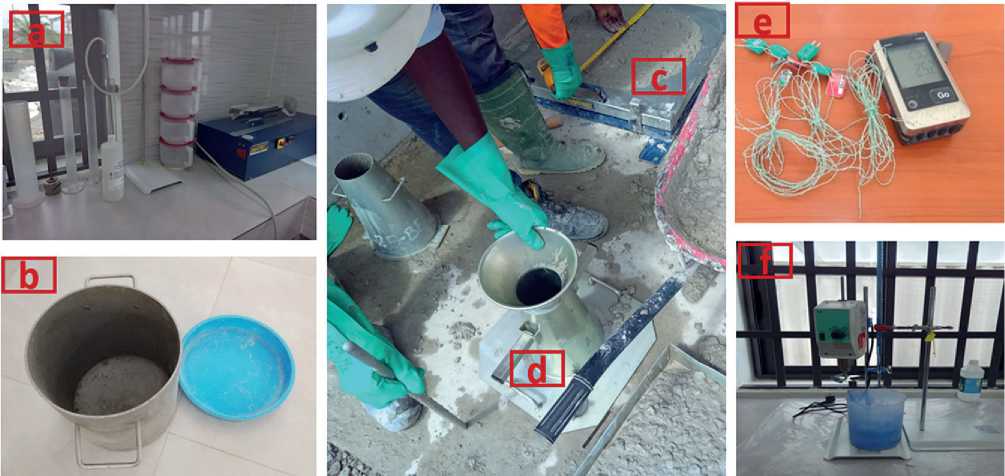
Fig. 1. a – Sand equivalent test apparatus; b – Free bleeding test apparatus; c – Flow table; d – Slump test (Abrams cone test); e – Thermocouple; f – Methylene blue value test apparatus
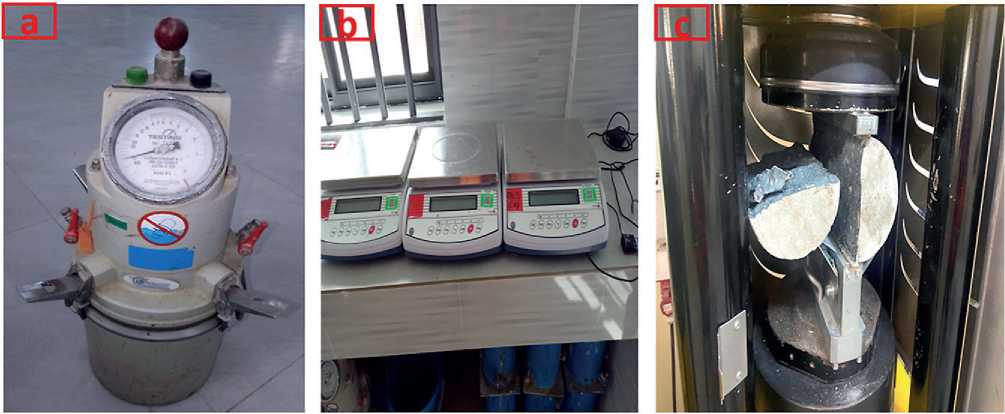
Fig. 2. a – Hydrometer ; b – Balances ; c – Tensile testing machine
sults presented correspond to the average of the measurements obtained, which helps minimize the influence of experimental uncertainties and improves the scientific significance of the conclusions.
RESULTS
Material Characterization
Sand
The measured characteristics are summarized in the table above and are compared with the standard speci- fications. According to the results, the sand gradation complies with the requirements.
The measured values show that the 0/4 sand from Cocotomey (Benin) can be classified under Code A, according to Article 10 of standard NF P 18-545 (2021). It therefore meets the requirements and is considered suitable for use in concrete.
Crushed aggregate
Crushed aggregate 15/25
The measured values show that the 15/25 fraction can be classified under code A according to Article 10
Nanotechnologies in construction 2026; 18 (3):
Нанотехнологии в строительстве 363–378
Nanob
THE RESULTS OF THE SPECIALISTS’ AND SCIENTISTS’ RESEARCHES
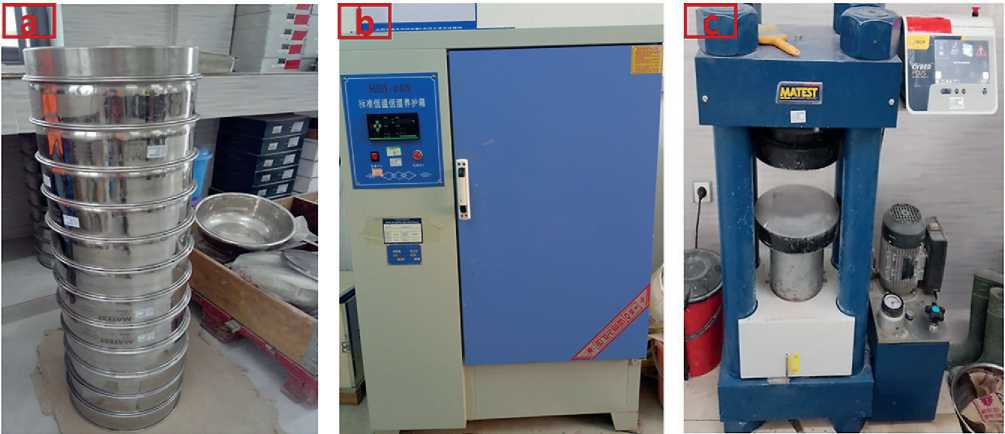
Fig. 3. a – Series of sieves; b – Oven; c – Compression testing machine
Table 1. Results of the particle size analysis of the sand
|
Sieve (mm) |
5.6 |
4 (2*D) |
2.8 (1.4*D) |
2 |
1 |
0.50 |
0.250 |
0.125 |
0.063 |
|
|
Unit – Method |
Cumulative passer (%) – NF EN 933-1 (2012) |
|||||||||
|
Values found |
100 |
100 |
100 |
99 |
96 |
72 |
30 |
6 |
1.0 |
|
|
Limit values |
Max |
– |
100 |
100 |
100 |
100 |
– |
50 |
- |
10 |
|
Min |
– |
100 |
95 |
90 |
60 |
– |
0 |
- |
0 |
|
Table 2. Summary of the test results on sand
|
Parameter |
Method |
Unit |
Average Value |
Specification |
|
Real density |
NF EN 1097-6 (2022) |
Mg/m3 |
2,62 |
Declared value |
|
Water absorption coefficient |
% |
0,5 |
≤ 2,5 AbA ≤ 5,0 AbB |
|
|
Fineness modulus (FM) |
NF EN 12620 + A1 (2008) |
– |
1,97 |
1,5 ≤ FM ≤ 4 |
|
Fines content |
NF EN 933-1 (2012) |
% |
1,0 |
≤ 10 fA ≤ 16 fB |
|
Sand equivalent (SE) |
NF EN 933-8 (2015) |
% |
77 |
≥ 65 PA ≥ 60 P B |
|
Friability coefficient (FS) |
NF P 18-576 (2013) |
% |
18 |
– |
|
Methylene blue value (MB) |
NF EN 933-9+A1 (2022) |
g/kg |
1,0 |
≤ 1,5 (PA et PB) |
|
Prohibited impurities |
XP P 18-546 (2020) |
<0,01 |
≤0,1 |
|
|
Water-soluble chlorides |
NF EN 1744-1+A1 (2014) |
% |
0,004 |
To declare |
|
Total sulfur |
NF EN 1744-1+A1 (2014) |
% |
0,12 |
≤ 1 (S A et S B ) |
|
Acid-soluble sulfates |
NF EN 1744-1+A1 (2014) |
% |
0,04 |
≤ 0,2 (SA et SB) |
|
Humic substances |
NF EN 1744-1+A1 (2014) |
– |
Absent |
Absent |
|
Soluble active alkalis |
XP P 18-544 (2015) |
%Na2Oeq |
0,0300 |
Declared value |
|
Alkali-reaction |
FD P 18-542 (2023) |
– |
NR |
To declare |
Nanotechnologies in construction 2026; 18 (3):
Нанотехнологии в строительстве 363–378
THE RESULTS OF THE SPECIALISTS’ AND SCIENTISTS’ RESEARCHES
Nanob
of standard NF P 18-545 (2021). Therefore, this material is considered suitable for use in concrete mixes with a 14/22.4 grading, corresponding to particle size classes: series 1 and series 2 (the 15/25 fraction is not recognized in standard NF EN 12620 (2008)).
Crushed aggregate 5/15
The measured values show that the 0/5 aggregate can be classified under Code A in accordance with Article 10 of standard NF P 18-545 (2021). Consequently, this material is considered suitable for use in concrete mix designs with a 0/5.6 grading, corresponding to a granular
class: base series + series 1 (the 0/5 size fraction is not recognized in NF EN 12620 (2008)).
Crushed aggregate 0/5
The measured values show that the 0/5 aggregate can be classified under Code A in accordance with Article 10 of standard NF P 18-545 (2021). Consequently, this material is considered suitable for use in concrete mix designs with a 0/5.6 grading corresponding to a particle size class: basic series + series 1 (the 0/5 size fraction is not recognized in standard NF EN 12620 (2008))
Table 3. Results of the particle size distribution analysis of the 15/25 crushed aggregate
|
Sieve (mm) |
31.5 (1.4*D |
25 |
22.4 (D) |
20 |
16 |
14 (d) |
12.5 |
6.3 (d/2) |
0.063 |
|
|
Unit – Method |
Cumulative passer (%) – NF EN 933-1 (2012) |
|||||||||
|
Values found |
100 |
99 |
94 |
84 |
39 |
11 |
4 |
2 |
0.8 |
|
|
Limit values |
Max |
100 |
– |
99 |
– |
– |
20 |
– |
5 |
1.5 |
|
Min |
98 |
– |
90 |
– |
– |
0 |
– |
0 |
0 |
|
Table 4. Summary of test results on the 15/25 crushed aggregate
|
Parameter |
Method |
Unit |
Average Value |
Specification |
|
Real density |
NF EN 1097-6 (2022) et 9 (2014) |
Mg/m3 |
2.76 |
Declared value |
|
Water absorption coefficient |
% |
0.4 |
≤ 2,5 AbA ≤ 5,0 AbB |
|
|
Flakiness Index (FI) |
NF EN 933-3 (2012) |
% |
11 |
≤ 20 FIA ≤ 35 FIB |
|
Alkali-reaction |
FD P 18-542 (2023) |
% |
NR |
To declare |
Table 5. Results of the particle size distribution analysis of the 15/25 crushed aggregate
|
Sieve (mm) |
20 (1.4*D) |
16 |
14 (D) |
11.2 |
10 (D/1.4) |
8 |
5.6 (d) |
4 |
3.15 (d/2) |
0.063 |
|
|
Unit – Method |
Cumulative passer (%) – NF EN 933-1 (2012) |
||||||||||
|
Values found |
100 |
100 |
93 |
69 |
54 |
30 |
8 |
3 |
3 |
1.2 |
|
|
Limit values |
Max |
100 |
– |
99 |
– |
70 |
– |
20 |
– |
5 |
1.5 |
|
Min |
98 |
– |
80 |
– |
25 |
– |
0 |
– |
0 |
0 |
|
Table 6. Summary of test results on the 5/15 crushed aggregate
|
Parameter |
Method |
Unit |
Average Value |
Specification |
|
Real density |
NF EN 1097-6 (2022) et 9 (2014) |
Mg/m3 |
2.77 |
Declared value |
|
Water absorption coefficient |
% |
0.4 |
≤ 2,5 AbA ≤ 5,0 AbB |
|
|
Flakiness Index (FI) |
NF EN 933-3 (2012) |
% |
14 |
≤ 20 LI A ≤ 35 FIB |
|
Fragmentation resistance |
NF EN 1097-2 (2020) et 5 (2008) |
% |
27 |
≤ 20 LA A ≤ 40 LA B |
|
Micro-Deval coefficient |
NF EN 1097-1 (2023) |
% |
16 |
Declared value |
|
Total sulfur content |
NF EN 1744-1 + A1 – 11.1 (2014) |
% |
0.08 |
≤1 |
|
Water-soluble sulfates |
NF EN 1744-1 + A1 – 12 (2014) |
% |
0.03 |
≤ 0.2 |
Nanotechnologies in construction 2026; 18 (3):
Нанотехнологии в строительстве 363–378
THE RESULTS OF THE SPECIALISTS’ AND SCIENTISTS’ RESEARCHES
Nanob
Table 7. Results of the particle size distribution analysis of the 0/5 crushed aggregate
|
Sieve (mm) |
12.5 |
11.2 (2D) |
7.1 (1.4D) |
5.6 (D) |
4 |
2 |
1 |
0.5 |
0.25 |
0.125 |
0.063 |
|
|
Unit - Method |
Cumulative passer (%) – NF EN 933-1 (2012) |
|||||||||||
|
Values found |
100 |
100 |
100 |
100 |
85 |
57 |
40 |
30 |
24 |
16 |
9.4 |
|
|
Limit values |
Max |
100 |
100 |
100 |
100 |
90 |
– |
60 |
– |
– |
– |
11 |
|
Min |
100 |
100 |
95 |
90 |
50 |
– |
20 |
– |
– |
– |
1 |
|
Table 8. Summary of test results on the 0/5 crushed aggregate
|
Parameter |
Method |
Unit |
Average Value |
Specification |
|
Real density |
NF EN 1097-6 (2022) et 9 (2014) |
Mg/m3 |
2.76 |
Declared value |
|
Water absorption coefficient |
% |
0.4 |
≤ 2,5 AbA ≤ 5,0 AbB |
|
|
Fine content |
NF EN 933-1 (2012) |
% |
9.4 |
≤ 11 |
|
Methylene blue value |
NF EN 933-9 + A1 (2022) |
g/kg |
0.2 |
≤ 1.5 (PAet PB) |
|
Water-soluble chloride |
NF EN 1744-1+A1 (2014) |
% |
< 0.002 |
To declare |
|
Humic substances |
NF EN 1744-1+A1 – 15.1 (2014) |
– |
Absent |
Absent |
|
Water-soluble active alkalis |
XP P 18-544 (2015) |
%Na2Oeq |
0.0174 |
Declared value |
|
Alkali-reaction |
FD P 18-542 (2023) |
– |
NR |
To declare |
Le cement
Table 9. Chemical and Physical Characteristics of CEM III 42.5 Cement
|
Analyses |
Unit |
Result |
|
Chemical Properties of Hydraulic Binders |
||
|
Siliceous constituents (P) |
% |
0.00 |
|
Calcareous constituents (C) |
% |
0.00 |
|
Setting regulator (R) |
% |
3.70 |
|
Clinker content (K) |
% |
30.80 |
|
Slag content (L) |
% |
65.51 |
|
Al₂O₃ (XRF) |
% m/m |
10.38 |
|
CaO (XRF) |
% m/m |
48.04 |
|
Fe₂O₃ (XRF) |
% m/m |
1.31 |
|
K₂O (XRF) |
% m/m |
0.35 |
|
MgO (XRF) |
% m/m |
5.17 |
|
Mn₂O₃ (XRF) |
% m/m |
0.18 |
|
Na₂O (XRF) |
% m/m |
0.29 |
|
SiO₂ (XRF) |
% m/m |
28.26 |
|
TiO₂ (XRF) |
% m/m |
0.54 |
|
Na₂O equivalent (XRF) |
% m/m |
0.52 |
|
SiO₂ + Al₂O₃ + Fe₂O₃ (XRF) |
% m/m |
39.95 |
Nanotechnologies in construction 2026; 18 (3):
Нанотехнологии в строительстве 363–378
THE RESULTS OF THE SPECIALISTS’ AND SCIENTISTS’ RESEARCHES
Nanob
Jute fibers
The jute fibers used in the cement mortar are short jute fibers with a maximum length of 5 mm. They were obtained through the preparation and treatment process described in [17] . This procedure, which has already been experimentally validated, ensured good fiber dispersion within the cementitious matrix, thereby providing a homogeneous mixture, as demonstrated in the referenced study.
– Prevention level
For our study, the structural category is Category II. The exposure class is XH3, as the concrete structure is regularly exposed to water splashing.
According to the matrix above, the corresponding exposure class is Cs.
– Precautions related to the prevention level
For this level of prevention, the risk of distress with regard to delayed ettringite formation (DEF) shall be taken into account through one of the following two precautionary measures, designated 1 and 2:
-
1. The maximum temperature reached within the concrete shall remain below 70 °C.
-
2. If the maximum temperature reached within the concrete cannot be maintained below 70 °C, it shall re-
main below 80 °C, and at least one of the following six conditions shall be satisfied:
-
• Thermal curing shall be properly controlled (Note 1); the duration during which the concrete temperature exceeds 70 °C shall not exceed 4 hours, and the active equivalent alkali content of the concrete shall be less than 3 kg/m³;
-
• Use of a cement complying with standard NF P 15-319 (ES), or a sulfate-resisting (SR) cement in accordance with standard NF EN 197-1 (except CEM I SR3 and SR5 cements), for concretes subjected to temperatures above 70 °C for periods exceeding 10 hours. CEM I SR3 and SR5 cements are permitted where the duration above 70 °C is less than 10 hours, provided that the active equivalent alkali content of the concrete is lower than 3 kg/m³;
-
• Use of a CEM I SR3 or SR5 cement bearing the NF Hydraulic Binders certification mark and qualified in accordance with the methodology specified in Annex 5, where the duration above 70 °C exceeds 10 hours;
-
• Use of cements not complying with NF P 15-319 (ES), of types CEM II/B-V, CEM II/B-Q, CEM II/B-M (S-V) with more than 20% fly ash, CEM III/A or CEM V, provided that all these cements have an SO3
Сontinuation of the Table 9
|
Analyses |
Unit |
Result |
|
MnO (XRF) |
% m/m |
0.16 |
|
Loss on ignition at 950 °C |
% m/m |
2.45 |
|
Mechanical Properties of Hydraulic Binders |
||
|
Analyses |
Unit |
Result |
|
Average compressive strength (2 days) |
MPa |
14.2 |
|
Average compressive strength (7 days) |
MPa |
35.1 |
|
Average compressive strength (28 days) |
MPa |
49.8 |
|
Propriétés physiques des liants hydrauliques |
||
|
Analyses |
Unit |
Result |
|
Soundness |
mm |
0 |
|
Water content for standard consistency |
% |
35.0 |
|
Specific surface (Blaine) |
cm²/g |
5350 |
|
Specific surface (Blaine) |
m²/kg |
535 |
|
Initial setting time |
min |
250 |
|
Average density |
g/cm³ |
2.80 |
Table 10. Chemical characterization of jute fibers [16]
|
Designation |
Alpha Cellulose (%) |
Hemicellulose (%) |
Lignin (%) |
Ash (%) |
Density (g/cm³) |
pH |
|
Average value |
45.50 |
23.0 |
3.9 |
0.58 |
1.46 |
5.63 |
Table 11. Constituent components of the sprayed concrete mix design
|
Sprayed Concrete Constituent |
Dosage (kg/m³) |
Specification (kg/m³) |
|
CEM III/B 42.5 N – NOCIBE |
420 |
≥380 |
|
Lagoon sand 0/4 |
633 |
– |
|
Crushed aggregate 0/5 |
293 |
– |
|
Crushed aggregate 5/15 |
480 |
– |
|
Crushed aggregate 15/25 |
339 |
– |
|
Sika ViscoFlow 800 Power |
3.36 (0.80% of C) |
– |
|
Sika ViscoFlow 200 Timer |
1.47 (0.35% of C) |
– |
|
Sika SikaTard 300 SLS |
1.26 (0.30% of C) |
– |
|
Effective water |
180.0 |
– |
|
Theoretical density |
2317 |
– |
Table 12. Calculation performed in accordance with the IFSTTAR recommendations
|
Constituent |
Sprayed concrete |
|
Concrete thickness |
1.02 m |
|
Maximum temperature for Cs level |
80 °C |
|
Concrete density (kg/m³) |
2317 |
|
Cement content CEM III/42.5N – NOCIBE |
420 |
|
Cement compressive strength at 2 days (MPa) |
13 |
|
Cement compressive strength at 28 days (MPa) |
47 |
|
Q41h cement (J/g) |
178 |
|
Q120h cement (J/g) |
194 |
|
Qm/Q41 |
1.39 |
|
Effective water (kg) |
180 |
|
Effective water / Equivalent binder |
0.43 |
|
Impact E/C-α |
0.98 |
|
Adiabatic temperature rise ΔT (without heat dissipation) |
39.5 °C |
|
Thermal loss R |
0.492 |
|
Temperature rise with heat dissipation ΔT |
19.4 °C |
|
Maximum initial temperature of the concrete |
60.2 °C |
Nanotechnologies in construction 2026; 18 (3):
Нанотехнологии в строительстве 363–378
THE RESULTS OF THE SPECIALISTS’ AND SCIENTISTS’ RESEARCHES
Nanob
Table 13. Mechanical and physical properties of fresh and hardened concrete
|
Parameter |
Specification |
Test Results on Fresh Concrete |
|||
|
BP 1 |
BP 2 |
BP 3 |
|||
|
Cube DEF |
1 x 1 x1m |
1.6 x 1.6 x 1.6 m |
1.6 x 1.6 x 1.6 m |
||
|
Fresh concrete density (kg/m3) |
2418 |
2381 |
|||
|
Entrapped air (%) |
1.0 |
1.3 |
1.1 |
||
|
Bleeding (ml/min) |
0 |
0 |
0 |
||
|
Ambient temperature (°C) |
32.0 |
32.5 |
32.0 |
||
|
Concrete temperature (°C) |
≤ 35 |
34.2 |
33.6 |
38 |
|
|
Slump (mm) |
210±30 |
220 |
223 |
230 |
|
|
Inverted cone (s) |
≤ 4 |
2.8 |
2.8 |
2.0 |
|
|
Impact mark (mm) |
600±50 |
600 |
600 |
620 |
|
|
Test Results on Hardened Concrete |
|||||
|
Compression MPA |
7 days |
41.5 |
45.9 |
35.3 |
|
|
28 days |
≥ 49 |
51.9 |
55.2 |
42.6 |
|
|
Tensile strength MPA |
28 days |
≥ 2.7 |
2.9 |
3.4 |
2.34 |
Nanotechnologies in construction
Нанотехнологии в строительстве
2026; 18 (3): 363–378
Nanob
THE RESULTS OF THE SPECIALISTS’ AND SCIENTISTS’ RESEARCHES
content not exceeding 3% and are manufactured from clinker with a C3A content not exceeding 8%;
Use, in combination with CEM I or CEM II/A cement, of fly ash complying with NF EN 450-1, ground granulated blast furnace slag complying with NF EN 15167-1, silica fume complying with NF EN 132631, or metakaolin complying with NF P 18-513. Their proportion in the binder (cement + additions) shall be at least 20% for fly ash, 35% for ground granulated blast furnace slag, 10% for silica fume (Note 2), and 20% for metakaolin. The binder used shall meet the following requirements: C3A (relative to clinker) < 8% and SO₃ (relative to binder) < 3%;
Verification of concrete durability with regard to DEF by means of a performance test and compliance with the decision criteria.
Due to the use of an SR cement in accordance with NF EN 197-1, the maximum permissible temperature during concrete setting is 80 °C.
– Evaluated mix design
In order to assess the risk of delayed ettringite formation (DEF), a mix design leading to the highest temperature rise, with a high cement content, will be adopted.
The composition of the investigated mix, designated “BPS XA2-XA3 C35/45 Cl 0.65 210 ± 30 mm”, hereafter referred to as “Sprayed Concrete”, is presented in the Table 11.
– Estimation of temperature rise
The calculation carried out in accordance with the provisions of the DEF guidelines is presented in the Table 12.
The maximum concrete temperature at the time of placement must be lower than 60.2 °C in order to prevent the risk of internal sulfate reaction. Since the maximum permitted concrete temperature at the time of casting is 35 °C, this requirement will be met.
BP1: cubic specimen with dimensions of 1×1×1 m.
BP2: cubic specimen with dimensions of 1.6×1.6×1.6 m.
BP3: cubic specimen with dimensions of 1.6×1.6×1.6 m.
– Thermal test
A 1 m³ cube insulated with 10 cm of polystyrene on all six faces and two cubes measuring 1.6 m on each side were cast. The specimens were instrumented with three thermocouples (one at the top, one at the center, and one at the bottom). A fourth thermocouple was used to record the ambient temperature near the element. The cube was monitored over seven consecutive days.
– Thermal test on the 1 × 1 × 1 m cube (BP1)
The curves recorded by the three probes embedded in the concrete are similar, and the maximum temperature is maintained for several hours.
The maximum temperature rise recorded during the test was 31.2 °C (65.2 - 34.0). Given that the maximum concrete temperature at placement was 34.2 °C, the maximum temperature that could be reached during setting is therefore 66.2 °C. Since this temperature is below the 80 °C threshold associated with prevention level Cs, the concrete is considered compliant.
– Thermal test on the 1.6 × 1.6 × 1.6 m cube (BP2)
The curves recorded by the three probes embedded in the concrete are similar, and the maximum temperature is maintained for several hours.
The maximum temperature rise recorded during the test was 31.4 °C (63.4-32.0). Given that the maximum temperature of the concrete during placement was 35 °C, the maximum temperature that could have been reached during the setting process is 66.4 °C. Since this temperature is below the threshold value of 80 °C associated with the Cs prevention level, the concrete meets the requirements.
– Essai thermique au cube 1.6 x 1.6 x 1.6 m (BP3)
As shown in Figure 6, the temperature exhibits unstable behavior due to the high temperature of the fresh concrete. This instability is particularly evident in the temperature curve of the lower part of the concrete, where, after the concrete reaches its peak temperature—corresponding to the maximum recorded value—successive phases of temperature rise and fall can be clearly observed.
Applying Mortar to Concrete
The mortar was applied on the concrete to test the effect of the concrete on the mortar. To test whether the compliant concrete would have any effect on the mortar. No cracks or sudden changes were seen in the mortar after 90 days.
No cracks were observed on the mortar after its application on the compliant concrete up to 90 days.
DISCUSSION
As in the case of mixtures BP1 and BP2, the temperature of fresh concrete remained below 35 °C, which is considered a favorable condition for the proper progress
Nanotechnologies in construction 2026; 18 (3):
Нанотехнологии в строительстве 363–378
Nanob
THE RESULTS OF THE SPECIALISTS’ AND SCIENTISTS’ RESEARCHES
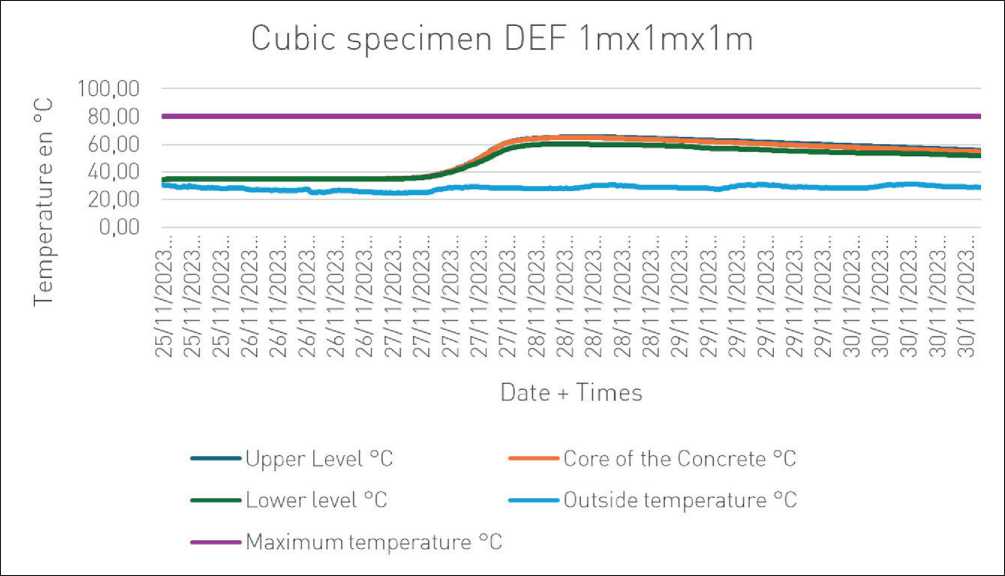
Fig. 4. Temperature evolution in the BP1 cubic specimen
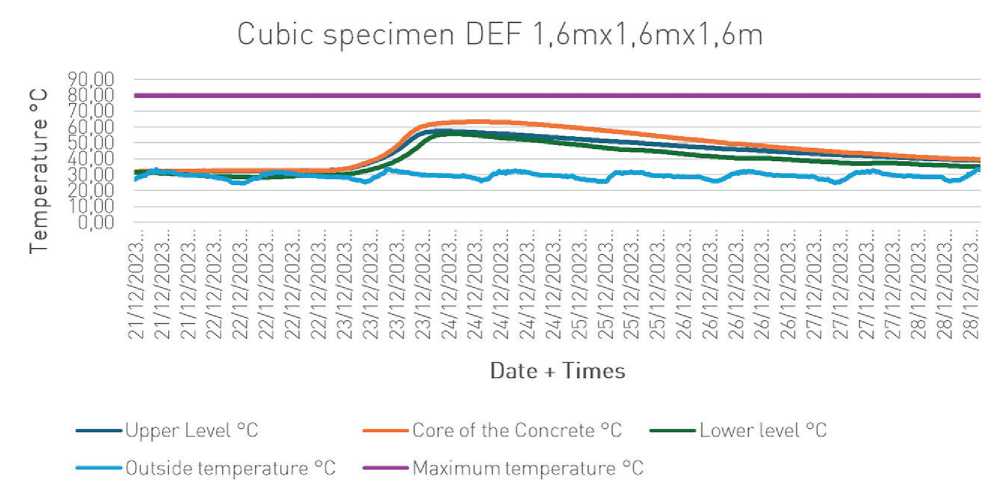
Fig. 5. Temperature evolution in the BP2 cubic specimen
of hydration reactions and the optimal development of mechanical properties. During the delayed ettringite formation (DEF) test on the cubic specimens, the thermal behavior remained normal, characterized by a gradual increase in temperature followed by a cooling phase, while the maximum temperature did not exceed 80 °C.
Such control of the thermal regime ensured mechanical properties that complied with standard requirements in both compression and tension. The results clearly show that controlling the temperature of fresh concrete is essential for obtaining good mechanical properties after hardening. Without temperature control, the mechani-
Nanotechnologies in construction 2026; 18 (3):
Нанотехнологии в строительстве 363–378
Nanob
THE RESULTS OF THE SPECIALISTS’ AND SCIENTISTS’ RESEARCHES
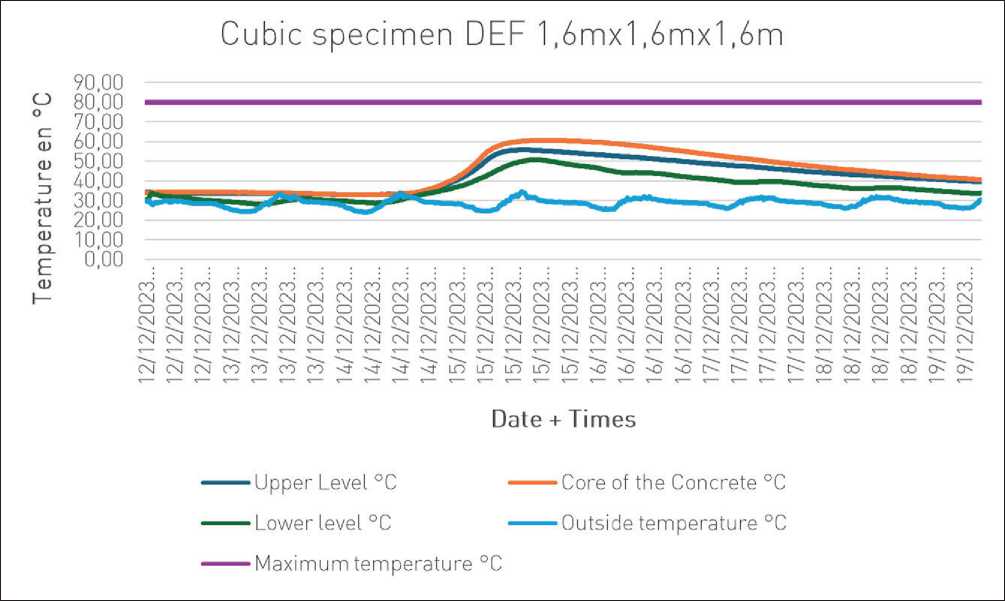
Fig. 6. Temperature evolution in the BP3 cubic specimen
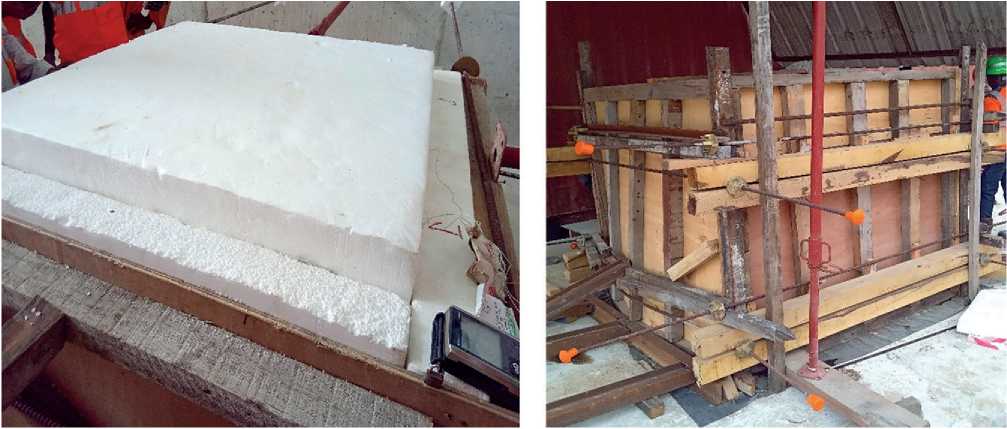
Fig. 7. On the left: DEF cube 1×1×1 m³, and on the right: DEF cube 1.6×1.6×1.6 m³
cal performance becomes poorer. Hydration reactions themselves generate heat, and massive structures tend to heat up more rapidly and cool down more slowly [18–22]. The observations made in this study are fully consistent with the conclusions reported by the authors in the literature.
For specimen BP3, the temperature of fresh concrete exceeded 35 °C, and this immediately affected the behav- ior of the material. During the internal sulfate reaction (ISR) test, the thermal behavior became unstable, with repeated phases of temperature increase and decrease, although the maximum temperature still remained below 80 °C. This thermal instability led to poor mechanical properties. The material exhibited weaker performance in both compression and tension. In our opinion, this case clearly demonstrates that the higher the temperature
2026; 18 (3): 363–378
Nanob
THE RESULTS OF THE SPECIALISTS’ AND SCIENTISTS’ RESEARCHES

Table 14. Summary of mortar application on concrete
Days
