
Influence of hydrophobic terminal groups on mobility of polydimethylsiloxane chains: molecular dynamics simulation
Журнал: Вестник Южно-Уральского государственного университета. Серия: Химия @vestnik-susu-chemistry
Рубрика: Краткие сообщения
Статья в выпуске: 3 т.18, 2026 года.
Бесплатный доступ
Polydimethylsiloxane-based materials can exhibit self-healing properties, most often at increased temperatures. To reduce the self-healing temperature, introduction of copolymer blocks engaging in additional reversible interactions is commonly used. However, this type of modification can significantly alter the functionally important physicochemical features of the original polymer. In this study, molecular dynamics simulations were used to test the idea of a milder modification which implies altering only one of the terminal groups of polymeric chains. This modification was expected to affect the migration dynamics of these groups between ionic aggregates, which we had revealed in previous studies. Indeed, in the resulting molecular dynamics simulations, a slight increase in the hydrophobicity of the terminal chain fragments ensures more active migration even at room temperature. However, an excessive hydrophobicity increase of the terminal groups reduces their chemical affinity to ionic aggregates. Thus, according to the molecular dynamics data, decrease of the self-healing temperature could be achieved by increasing the hydrophobicity of one of the terminal groups of the polydimethylsiloxane chains.
Короткий адрес: https://sciup.org/147255284
IDS: 147255284 | УДК: 544.144 | DOI: 10.14529/chem260310
Влияние гидрофобных концевых групп на подвижность цепей полидиметилсилоксана: молекулярно-динамическое моделирование
Материалы на основе полидиметилсилоксанов могут обладать свойством самовосстановления, чаще всего при повышенных температурах. Для снижения температуры самовосстановления обычно прибегают к прививанию сополимерных блоков, участвующих в дополнительных обратимых взаимодействиях. Однако, такого рода модификация может существенно изменить функционально важные физико-химические свойства исходного полимера. В данной работе методами молекулярной динамики была апробирована идея более мягкой модификации с изменением только одной из терминальных групп цепей. Ожидалось, что эта модификация должна была повлиять на динамику миграции этих групп между ионными агрегатами, выявленную нами в предыдущих исследованиях. Действительно, в полученных молекулярно-динамических моделях слабое увеличение гидрофобности концевых фрагментов цепей обеспечивает активный процесс такой миграции даже при комнатной температуре. При этом чрезмерное увеличение гидрофобности концевых групп снижает их химическое сродство к ионным агрегатам. Таким образом, согласно молекулярно-динамическим моделям, снижение температуры самозалечивания может быть достигнуто за счет повышения гидрофобности одной из концевых групп цепей полидиметилсилоксана.
Текст научной статьи Influence of hydrophobic terminal groups on mobility of polydimethylsiloxane chains: molecular dynamics simulation
Self-healing polymeric materials are able to significantly extend the service life of numerous devices due to their ability to autonomously repair various types of occurring defects in them. Polydimethylsiloxane (PDMS) based materials combine several beneficial properties: high self-healing efficiency due to interactions between reaction centers of mobile chains, hydrophobicity, chemical inertness, and biocompatibility, which provide a broad area of their application [1–5]. The main challenge for self-healing materials is the inverse relationship between the autonomy of self-healing and the mechanical performance. Generally, the higher is the mechanical performance, the stronger heating they require for effective self-healing [6]. This is explained by the fact that self-healing requires redistribution of certain interactions within the polymer material. However, overly low barriers of this redistribution make the chains too mobile relative to each other, which results in deterioration of mechanical properties.
PDMS chains have two different terminal groups: one, negatively charged, undergoes a “siloxane equilibration” reaction [7]. The other carries no formal charge. Our previous study by molecular dynamics demonstrated that the electroneutral terminal groups also undergo reversible interactions: they are concentrated on the surface of ionic aggregates formed from residual amounts of the initiator.
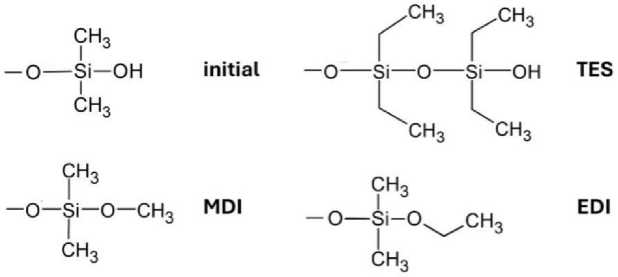
In this study, we assessed how modifications of the neutral terminal groups affect PDMS chain mobility and the dynamics of their migration between ionic aggregates. Several modifications of these groups (Fig. 1) aimed at increasing their hydrophobicity were proposed.
сн3
— O-Si-SH SSI
СН3
Fig. 1. Formulas of residues of the initial and modified neutral terminal groups of PDMS chains investigated by MD simulations and their designations
о—сн3
-O-Si-O-CH3 TOI о—сн3
Experimental
To study the chain dynamics, we employed the potential of structural modeling using molecular dynamics simulations and our developing procedure for generating structural models of polymer systems [8]. Using a custom Python script, cubic cells of systems with 64 PDMS chains and 30% initiator efficiency (containing 177 OH- and 253 K+, remaining in the material from the KOH initiator) were generated; the ratio of reagents was taken from the synthesis procedure [9].
Makarova T.M., Lisovenko M.A., Bartashevich E.V.
Influence of hydrophobic terminal groups on mobility of polydimethylsiloxane chains: molecular dynamics simulation
The cell components were then mixed upon NVT dynamics at high temperature (1073 K) and then gradually cooled down to the room temperature at constant pressure to form a condensed phase. Details of the force field and the simulation protocol for such systems are described in [10]. The resulting condensed phase structure was used as a starting system for 500 ns NPT molecular dynamics simulations, which were analyzed in regard of the terminal group mobility between hydrophilic aggregates formed in the PDMS modelled system. All molecular dynamics simulations were performed using the GROMACS 2019.4 package and auxiliary custom bash and Python scripts.
Results and discussion
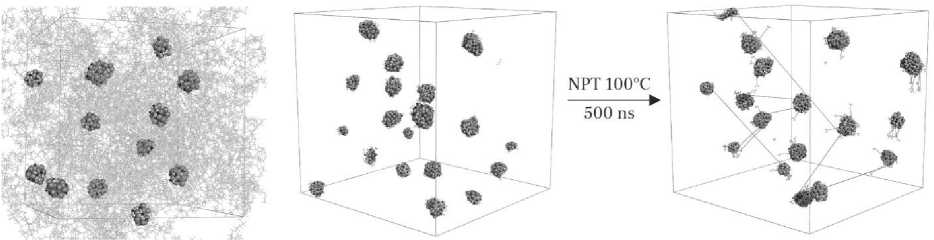
Previous simulations of PDMS-based materials revealed the presence of hydrophilic ionic aggregates consisting of K+ ions, OH– counterions, and water molecules (Fig. 2a). These aggregates coordinated both neutral and negatively charged terminal groups of the polymer, and this coordination was reversible. However, for the original polymer, migration of terminal groups from one aggregate to another was observed only at temperatures above 100°C – the experimentally observed self-healing temperature [9].
а)
b)
Fig. 2. a) Ionic aggregates in the PDMS model; b) an illustration of migration of terminal PDMS chain fragments between ionic aggregates, where each line represents one chain terminal residue transferred from one aggregate to another (bulk polymer chains are hidden)
The increased hydrophobicity of the neutral terminal group (Fig. 1) make possible the migration of both types of terminal fragments between aggregates even at 25°C in the simulation (see Table 1).
Table 1
Event rates in systems with different PDMS terminal groups during molecular dynamics simulation in NPT ensemble at 25°C for 500 ns
|
Neutral terminal group |
Ionic aggregate divisions |
Neutral terminal group migrations |
Charged terminal group migrations |
Total terminal group migrations |
Percentage of neutral terminal groups interactions with aggregates |
|
initial |
2 |
0 |
0 |
0 |
98 |
|
EDI |
3 |
3 |
1 |
4 |
76 |
|
MDI |
2 |
3 |
2 |
5 |
68 |
|
TES |
1 |
1 |
0 |
1 |
83 |
|
TOI |
5 |
3 |
7 |
10 |
58 |
|
SSI |
3 |
3 |
3 |
6 |
90 |
Mobility increase of both terminal fragments potentially improves self-healing: while migration of the neutral terminal group increases overall chain mobility, migration of the negatively charged terminal group also increases the probability of the “siloxane equilibration” reaction. However, the introduction of extremely hydrophobic terminal groups creates a risk of significant reduction of the chemical affinity of the modified chain terminal group to ionic aggregates. This significantly decreases the network density of the intermolecular interactions in the multicomponent polymer, which should affect its mechanical properties and reduce the number of redistributable reaction centers that impart self-healing properties of the material. The SSI residue – dimethyl(sulfanyl)silanolate – appears to be the most balanced in this regard. With a slight decrease in the percentage of residues associated with aggregates, it demonstrates a high intensity of terminal group migration between the surfaces of ionic aggregates.
Conclusion
Molecular dynamics simulations demonstrated that even a slight increase in the hydrophobicity of the terminal fragments of PDMS chains can facilitate their detachment from ionic aggregates, ensuring their active migration between the aggregates even at room temperature, while the system with initial PDMS terminal neutral groups did not demonstrate this ability over a 500 ns trajectory. However, excessive enhancement of hydrophobicity can disrupt significant part of the interactions between the chain terminal groups and ionic aggregates, putatively affecting the material mechanical properties.
