
Intercensal Dynamics of the Komi Population in the Regions of Russia since 1970: Trends and Factors
Журнал: Arctic and North @arctic-and-north
Рубрика: Northern and arctic societies
Статья в выпуске: 64, 2026 года.
Бесплатный доступ
The Komi are among the indigenous peoples of Russia’s republics with the fastest-declining populations, yet they are characterized by a high level of concentration within their own republic. The aim of this study is to identify trends and the main factors influencing changes in the concentration of the Komi people in the regions of Russia during the intercensal periods from 1970 to 2021. The study primarily relies on a statistical and cartographic research method. From 1970 to 1989, the dynamics of Komi concentration in the regions of Russia were influenced by the positive natural increase of the Komi in their republic, which served as a source for their migratory distribution to other regions. Leningrad and Moscow, along with their surrounding regions, acted as the main centers of migration attraction for the Komi, but in the 1980s, the direction of migration through the Volga region to the South of Russia became evident. The concentration of the Komi people declined in Southern Siberia, where they had previously been represented by fairly large groups. In the post-Soviet period, assimilation processes, accompanied by a natural decline in the population of this ethnic group, began to influence the dynamics of Komi concentration across the country’s regions to a greater extent. Their concentration levels decreased in most regions located outside the Komi’s main area of habitation. Komi migration in the post-Soviet period no longer played as significant a role in their distribution across the country as it had during the Soviet era, but St. Petersburg and Moscow retained their role as centers of migration attraction for the Komi.
Короткий адрес: https://sciup.org/148334392
IDS: 148334392 | УДК: [314:311.1](470.13)(045) | DOI: 10.37482/issn2221-2698.2026.64.275
Текст научной статьи Intercensal Dynamics of the Komi Population in the Regions of Russia since 1970: Trends and Factors
DOI:
The peoples of the Finno-Ugric group within the Uralic language family, who live in the European part of Russia, are characterized by a centuries-long history of contact with the Slavic population and a traditional religion — Orthodox Christianity — which they share with the Russian population and which has shaped many common elements of their material and spiritual culture. This cultural proximity is one of the main reasons why these peoples are currently subject to processes of assimilation, leading to a rapid decline in their numbers. Among the titular peoples of the Finno-Ugric republics, the Komi are second only to the Karelians in terms of population decline during the last intercensal period within their republic and the Russian Federation as a whole. However, they currently exceed the Karelians in terms of their share of the republic’s population.
∗ © Manakov A.G., Vladykin B.A., 2026
This work is licensed under a CC BY-SA License
At the same time, the Komi have the highest concentration of their population within their national-territorial entity among the titular peoples of the Finno-Ugric republics of Russia. Only 11.4% of the Komi currently live outside their republic, and a significant portion of them are concentrated in regions neighboring the Komi Republic, where Komi ethno-areal groups are present (in the Murmansk Oblast, the Nenets, Yamalo-Nenets, and Khanty-Mansi Autonomous Okrugs). This largely explains why the characteristics of the Komi people’s territorial distribution outside their main area of residence, as well as the dynamics of the Komi population at the regional level in Russia during various intercensal periods, remain poorly studied.
The aim of this study is to identify trends and the main factors influencing changes in the concentration of the Komi people in the regions of Russia during the intercensal periods from 1970 to 2021.
Research prerequisites
First of all, it is necessary to note previously conducted studies, in which the demographic trends of the Komi population over a long period (from 1897 or from 1926) have been examined within the current borders of the Komi Republic. This analysis is carried out either when researching the ethnic structure of the population of the republic as a whole (Rozhkin, 2012), or when studying the dynamics of various ethnic groups with a significant presence in the republic, such as natives of the Caucasus (Zherebtsov, Fauzer, 2023; Zherebtsov, Fauzer, 2025). Issues of differences in the natural movement of Komi and Russians living in the Komi Republic are also addressed (Zherebtsov, Rozhkin, 2012).
Changes in the ethnic structure of the population within the Komi Republic over the period from 1926 to 2021 were considered in the study (Vladykin, Alekseeva, Terenina, 2024). Furthermore, based on the concept of ethno-contact zones, an analysis of ethnic dynamics in the postSoviet period was carried out at the level of the republic’s municipalities (Manakov, Terenina, Vladykin, 2024; Terenina, Ivanov, Vladykin et al., 2024). In the second study, the object of research was the contact zone between the Slavic and Finno-Ugric populations in the north-east of European Russia, including the territory of the Komi Republic.
When discussing changes in the population of the Komi within the borders of the Russian Federation, researchers usually refer to studies on the demographic dynamics of the country’s contemporary Finno-Ugric peoples (Fauser, 2011; Loginova, Rebrova, 2013; 10, Loginova, Kildishova, Semina et al., 2013; Myasnikova, 2015). These dynamics are usually examined over a
NORTHERN AND ARCTIC SOCIETIES
Andrey G. Manakov, Bogdan A. Vladykin. Intercensal Dynamics of the Komi Population … long time interval, but greater attention is paid to analyzing changes in population size during the most recent intercensal period, that is, from 2010 to 2021.
However, there are relatively few studies that focus specifically on the population dynamics of the Komi living outside their republic. Such an analysis is presented, for example, in the work of A.R. Khamidullin (Khamidullin, 2024), which examines, from this perspective, the Komi-Izhma and the Komi in general living in the Murmansk Oblast and the Nenets, Yamalo-Nenets and Khanty-Mansi Autonomous Okrugs. In essence, this study is a continuation of the monograph by N.D. Konakov and O.V. Kotov (Konakov, Kotov, 1991), which is devoted to the formation and current state of the Komi ethno-areal groups. In this regard, it is also worth noting the article by V.P. Krivonogov (Krivonogov, 2023), which discusses contemporary ethnic processes among the Komi-Izhma people of the Kola Peninsula.
In our view, in order to analyze changes in the Komi population across intercensal periods at the level of all regions of Russia, we need an indicator that would allow these dynamics to be visualized on a map. Z.A. Trifonova, in one of her works (Trifonova, 2008), proposed an indicator which she termed the ethnic concentration coefficient (ECC). In another publication (Trifonova, Lobastova, Rostovtseva et al., 2016), this indicator is used to assess the settlement patterns of the Chuvash people in Russia and neighboring states from 1926 to 2010. The essence of the ECC is to identify the share of each region of the country in the total number of representatives of a certain ethnic group. We tested this indicator when analyzing the ethno-demographic dynamics of the titular ethnic groups of the republics of Russia from 1939 to 2010 (Manakov, 2022).
However, it should be noted that the analysis of ethnic concentration is based on various indicators, which are typically used to address issues relating to the assessment of ethnic heterogeneity within a population (Sokolov, 2025). For example, a similar term, namely the ethnic concentration coefficient (ECC), is used to describe an indicator proposed by D.V. Zhitin (Zhitin, 2024) to assess the localization of ethnic groups in different districts of St. Petersburg. In the author’s earlier work, this indicator is referred to as the ethnic localization coefficient (Zhitin, Krasnov, 2015). This indicator is calculated as the ratio of the proportion of a particular ethnic group in the population of an urban district to the proportion of that ethnic group in the city’s population, which is quite different from the essence of the ECC proposed by Z.A. Trifonova.
In international academic research, the concept of ethnic concentration is usually applied when studying the patterns of immigrant settlement in developed countries (Gang, Rivera-Batiz, Yun, 2002; de Graaff, de Groot, 2004; Guerra, Patuelli, Maggi, 2012) and is often associated with issues of ethnic segregation (Johnston, Manley, Jones, 2016; de Bézenac, Clark, Olteanu et al., 2022). Various indicators are used in these studies to examine ethnic concentration, for example, the Herfindahl-Hirschman index (Guerra, Patuelli, Maggi, 2012), the segregation index (Johnston, Manley, Jones, 2016), etc.
In order to avoid confusion, in our study, the indicator proposed by Z.A. Trifonova (Trifonova, Lobastova, Rostovtseva et al., 2016) is not designated as either a coefficient or an index. In the works of S.Ya. Sushchiy, devoted to the geodemographic dynamics of Russians in neighbouring countries (Sushchiy, 2020) and Armenians in southern Russia (Sushchiy, 2018), the full formulation of the indicator is used, which, without the introduction of special terms, reflects its fairly simple essence. This is the proportion (share) of individual regions in the total population of a particular ethnic group in Russia. The same formulation will be used in this article.
Research methodology
The study is based primarily on a statistical and cartographic research method. The proportion of regions in the total Komi population living within the current (since 2022) borders of Russia was calculated using data of all population censuses from 1970 to 2021. The maps present the indicator in per mille; this is due to the high proportion of the Komi Republic (88.6% in 2021) in the total population of this ethnic group, and consequently the low proportion of other regions, as well as the relatively insignificant dynamics of this indicator, which are more conveniently analyzed at the tenth of a percent level.
The year 1970 was chosen as the baseline for this study. It should be noted that there have been no significant changes in the administrative-territorial division of Russia since 1959, which is important for calculating the dynamics of this indicator, as this should be carried out within territorial units with unchanging boundaries. However, during the 1959 census, the Komi were not included in the list of the registered ethnic groups in most regions of Russia. Therefore, the calculation of the indicator’s dynamics was carried out starting from 1970, for which complete ethnic statistics are available for all regions of the country.
In the second stage of the work, the dynamics of the share of each region in the total Komi population in Russia were calculated for all five intercensal periods from 1970 to 2021. However, we present the results of the statistical and cartographic analysis for four intervals characterized by similar trends in the share of the Komi Republic and other regions within the total Komi population living in Russia. Thus, during the periods from 1970 to 1979 and from 1989 to 2010, a positive trend in this indicator was observed in the Komi Republic, while from 1979 to 1989 and from 2010 to 2021, a negative trend was recorded.
Results and discussion
According to the results of the 2021 population census, 143,500 Komi people lived in the Russian Federation, of whom 127,000 lived in the Komi Republic, representing 88.6% of the total Komi population in the country. Outside the Komi Republic, the top three regions in terms of the proportion of Komi people within their total population were neighboring autonomous okrugs (Fig. 1): Yamalo-Nenets (2.4%), Nenets (1.7%), and Khanty-Mansi (1.1%). The top five regions for this indicator included the Murmansk Oblast (0.8%) and St. Petersburg (0.6%). The proportion was relatively high (over 0.2%) in the Arkhangelsk, Kirov, Leningrad, Moscow, and Tyumen Oblasts, the Perm and Krasnodar Krais, and in Moscow.
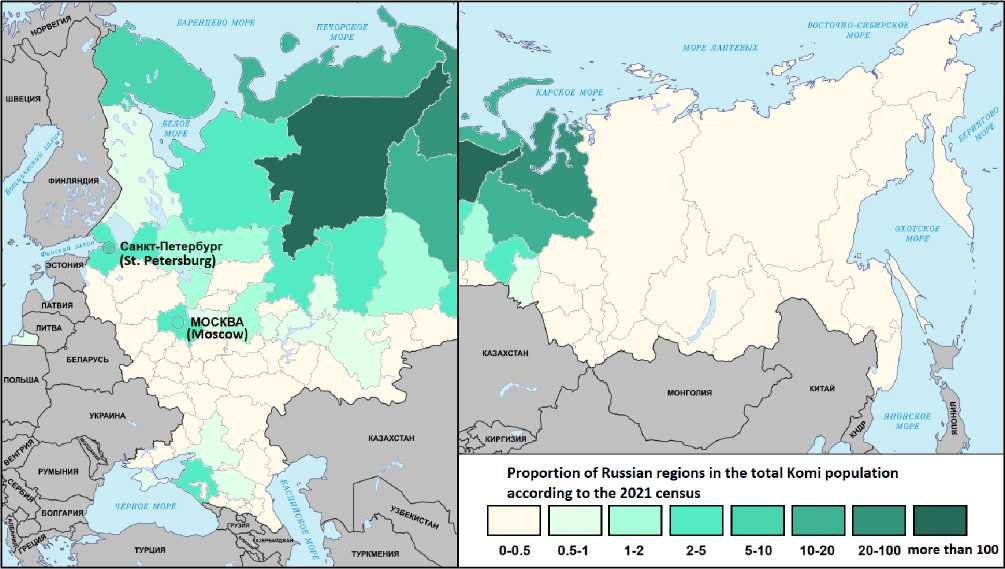
Fig. 1. Proportion of Russian regions in the total Komi population according to the 2021 census3.
Changes in the Komi population within the modern territory of Russia and the Komi Republic (Fig. 2) are characterized by an increase during the late Soviet period (between the 1959 and 1989 censuses) and a decline during the post-Soviet period (between 1989 and 2021). From 1959 to 1989, their population in Russia increased by 19.6%, in the Komi Republic — by 19%, indicating a slight increase in their proportion in other regions (from 13.3% to 13.8%). Between the 1989 and 2021 censuses, the decline in the Komi population in their republic was slower than in the country as a whole, as a result of which the share of other regions of Russia in the total Komi population fell to 11.4%.
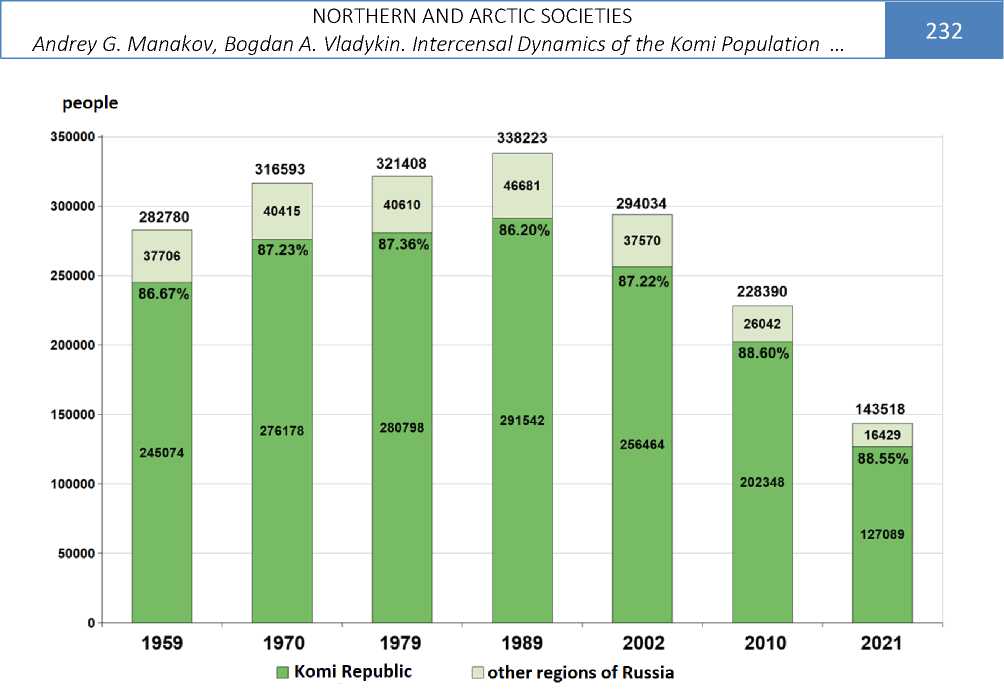
Fig. 2. Dynamics of the Komi population within the modern territory of Russia and the Komi Republic, as well as their concentration in their republic (in %), based on the results of the 1959, 1970, 1979, 1989, 2002, 2010, and 2021 cen-suses4.
The dynamics of the share of Russian regions in the total Komi population from 1970 to 1989 is presented in Fig. 3. Between the 1970 and 1979 censuses, there was a significant increase in the concentration of the Komi people in the Komi ASSR and the Moscow Oblast, with less significant increases in the Arkhangelsk, Murmansk, Leningrad, Yaroslavl, Vladimir, and Irkutsk Oblasts, as well as in Leningrad, the Tatar ASSR, and the Yamalo-Nenets Autonomous Okrug. In a number of other regions, there was a slight increase in the concentration of the Komi population. Nevertheless, regions with a declining Komi population predominated in Russia, among which the following were particularly notable: the Nenets Autonomous Okrug, which neighbors the Komi ASSR, the Perm and Sverdlovsk Oblasts and the Khanty-Mansi Autonomous Okrug, as well as the Omsk, Novosibirsk and Kemerovo Oblasts, the Altai Krai in southern Siberia, and the Chita and Kamchatka Oblasts in the Far East. In the south of European Russia, the concentration of the Komi people in the Krasnodar Krai decreased slightly.
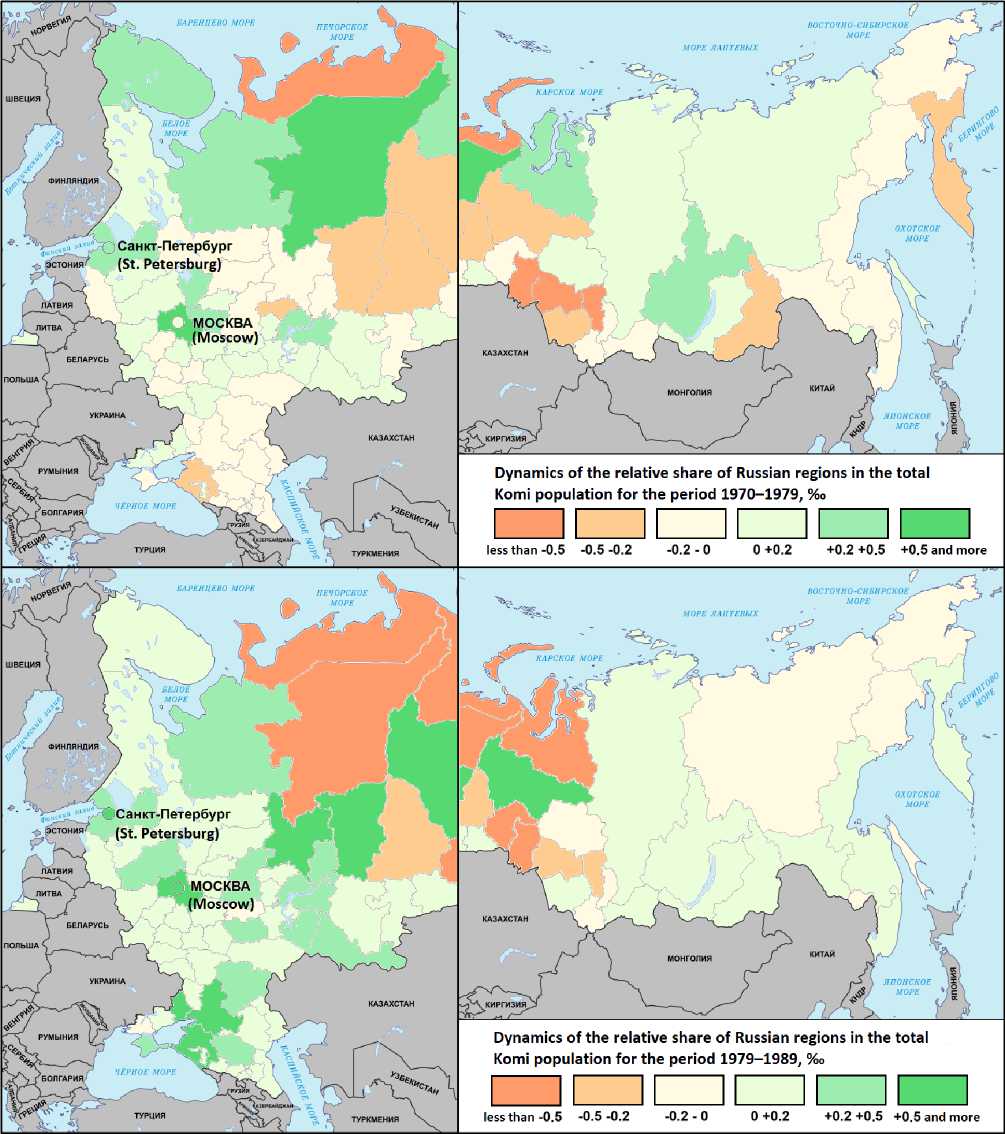
Fig. 3. Dynamics of the relative share of Russian regions in the total Komi population for the periods 1970–1979 and 1979–1989, ‰5.
Overall, this trend indicates the existence of several regions that act as centers of migration attraction for the Komi people, primarily Moscow, Leningrad and the surrounding regions. It should be noted that during this period, there was a relatively high natural increase in the Komi ASSR (Zherebtsov, Rozhkin, 2012), which may explain, on the one hand, the growing concentration of Komi people within their own republic and, on the other hand, the availability of resources enabling their migration to other regions of Russia. At the same time, the Asian part of Russia was
NORTHERN AND ARCTIC SOCIETIES
Andrey G. Manakov, Bogdan A. Vladykin. Intercensal Dynamics of the Komi Population … dominated by regions with declining Komi populations, which is most likely the result of assimilation processes rather than migration outflow.
Between 1979 and 1989, there was a significant decrease in the concentration of the Komi people within their republic, and, to a lesser extent, in two neighboring autonomous okrugs (Nenets and Yamalo-Nenets), as well as in a number of regions forming a single belt from the Middle Urals to Kuzbass. At the same time, a clear southward trend in Komi migration flows emerged, starting from the Kirov and Perm Oblasts, through the multi-ethnic Volga region, to the regions of southern Russia. In the second half of the 1980s, there was a sharp fall in the birth rate in the Komi ASSR (Zherebtsov, Rozhkin, 2012). This, coupled with the continued migration outflow of the titular ethnic group from their republic to other regions of the country, resulted in a decline in the republic’s share of the total Komi population in Russia.
The dynamics of the proportion of the Komi population living in different regions of Russia during the post-Soviet period are presented in Fig. 4. Between the 1989 and 2010 censuses, the Komi Republic and the Yamalo-Nenets Autonomous Okrug experienced significant growth in this indicator, while the Murmansk Oblast and the Nenets Autonomous Okrug observed a less noticeable increase. However, in most regions of the country, the indicator showed a decline, with the most significant decrease occurring in the Arkhangelsk and Sverdlovsk Oblasts, which border the Komi Republic, in the Perm Krai, and in a number of other regions. The most probable reason for the increase in the concentration of Komi people within their republic and in the adjacent territories of their traditional residence (which include three neighboring autonomous okrugs and the Murmansk Oblast) is the accelerated assimilation of the Komi in the rest of the country. During this period, there was a sharp decline in the share of Komi in the total number of regions located in the Urals, southern and central Siberia, southern European Russia, as well as Moscow and St. Petersburg.
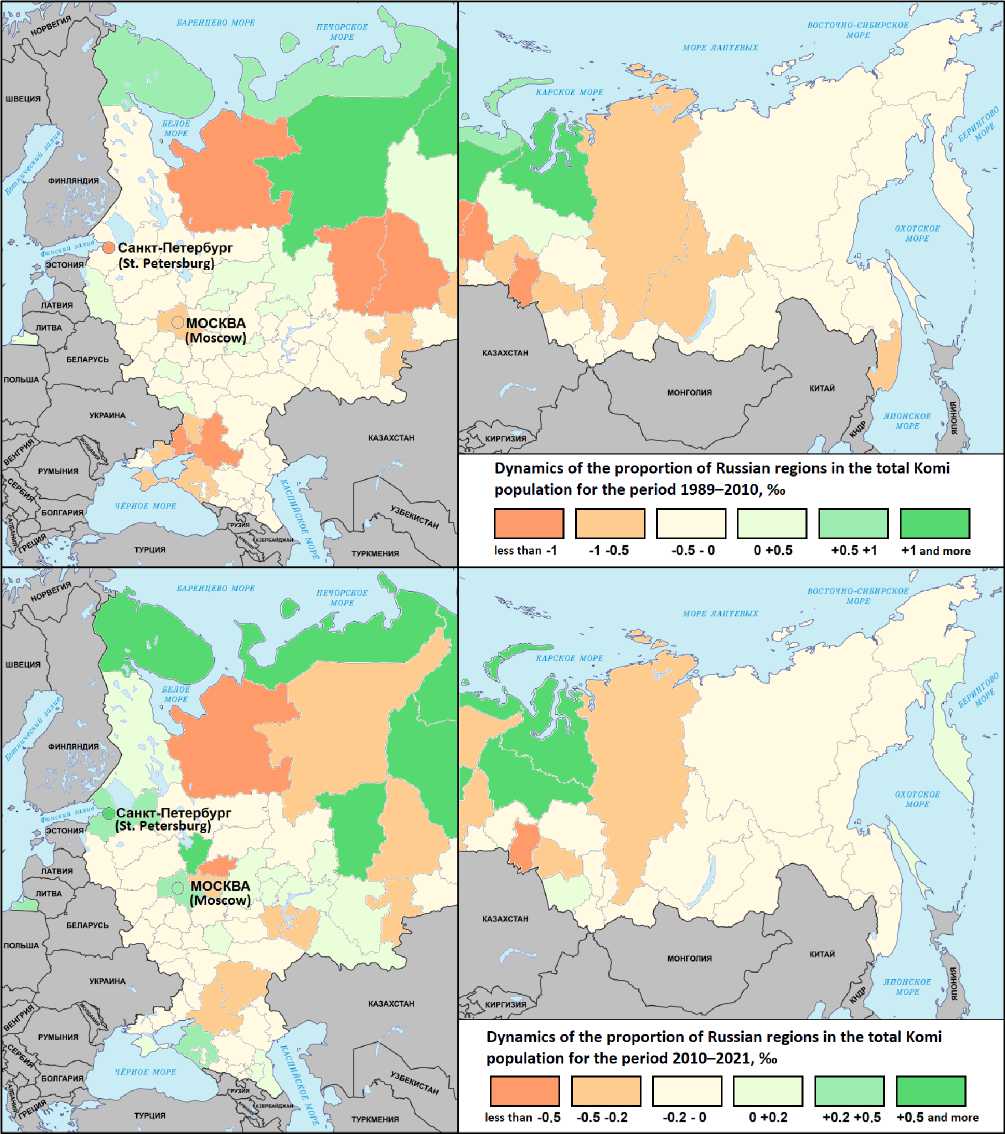
Fig. 4. Dynamics of the proportion of Russian regions in the total Komi population for the periods 1989–2010 and 2010–2021, ‰ 6.
The period between the 2010 and 2021 censuses was characterized by a decline in the concentration of the Komi people within their republic, but, as in the previous period, the decrease was more pronounced in the Arkhangelsk Oblast. The concentration of the Komi people increased in areas where they have long been settled — in the three autonomous okrugs neighboring the Komi Republic and in the Murmansk Oblast. Overall, the number of regions in Russia showing positive trends in this indicator increased. Specifically, this type of trend returned to Perm
Krai, St. Petersburg, Moscow, and the Moscow Oblast. Nevertheless, in most regions of the country, the decline in the concentration of the Komi population continued, which is fully explained by assimilation processes.
Three main factors can be identified as contributing to the significant decline in the Komi population during the post-Soviet period, which also influenced the specific dynamics of their concentration across Russia’s regions. Firstly, there is the natural movement of the Komi people, primarily within their republic, where members of the indigenous ethnic group live predominantly in rural areas. In the last decade of the 20th century, there was a downward trend in the birth rate in rural settlements of the Komi Republic; at the same time, the death rate rose significantly, and the natural increase of the republic’s titular ethnic group shifted from positive to negative (Zherebtsov, Rozhkin, 2012). Thus, natural decline became one of the key reasons for the sharp decrease in the Komi population, both within their republic and in Russia as a whole.
Secondly, there are the processes of assimilation, which, in our view, were the main cause of the Komi population falling by more than half over the three post-Soviet decades. A comparative assessment of the susceptibility of different ethnic groups to assimilation by the Russian population can be made using an indicator calculated by the ethno-demographer E.L. Soroko on the basis of the frequency of ethnically mixed marriages between members of different ethnic groups (Soroko, 2014; Soroko, 2018). This indicator, which E.L. Soroko referred to as “inter-ethnic distances”, was proposed by N.K. Terenina to be termed the ethnic contrast index (ECI) or the So-roko coefficient (SC) (Terenina, 2023).
Using microdata from the 2010 census and in accordance with E.L. Soroko’s methodology, we calculated the ECI (SC) for pairs of major ethnic groups across all regions of the Russian Federation. Notably, in pairs formed by Russians and titular peoples of the Finno-Ugric republics of Russia, the Komi were approximately on par with the Karelians and significantly lower than the Mari, Mordvins, and Udmurts. This indicates lower barriers to the formation of marital couples between the Komi and Russians compared with other titular peoples of the Finno-Ugric republics (with the exception of the Karelians). It indirectly confirms the Komi’s high predisposition to assimilation in the post-Soviet period. In the regions neighboring the Komi Republic, the most common interethnic marriages are between Komi and Russians living in the Arkhangelsk Oblast (which explains the sharp decline in the concentration of Komi people in that region during the post-Soviet period). Such marriages are significantly less common in the Yamalo-Nenets and Khanty-Mansi Autonomous Okrugs, and extremely rare in the Nenets Autonomous Okrug.
Thirdly, a factor that was particularly relevant in light of the 2021 census results is the high proportion of the population without a stated ethnicity. According to the 2021 census, 22.8% of the population in the Komi Republic did not specify their nationality for various reasons (28.5% in urban areas, 3.1% in rural areas). A similar situation has developed in the regions neighboring the Komi Republic: 15.7% of the population of the Arkhangelsk Oblast (19.6% in urban settlements, 2.5% in rural areas), 9.9% of the population of the Nenets Autonomous Okrug (13.1% and 0.9%,
NORTHERN AND ARCTIC SOCIETIES
Andrey G. Manakov, Bogdan A. Vladykin. Intercensal Dynamics of the Komi Population … respectively), 21.3% of the population of the Yamalo-Nenets Autonomous Okrug (24.3% and 4.9%), 26.4% of the population of the Khanty-Mansi Autonomous Okrug (28.2% and 5.6%).
However, it should be taken into account that the majority of Komi in their republic and other noted regions, except for the Arkhangelsk Oblast, live in rural areas (62.6% in the Komi Republic, 56.9% in the Nenets Autonomous Okrug, 67.3% in the Yamalo-Nenets Autonomous Okrug, and 61.4% in the Khanty-Mansi Autonomous Okrug). Since the nationality of the majority of the rural population in these regions was recorded in 2021, this factor is unlikely to be the primary cause of the decline in the Komi population between the 2010 and 2021 censuses (Fauser, 2023). Nevertheless, some Komi, particularly those living in towns, could not avoid being categorized as “people without specified ethnicity” (for example, in the case of accounting based on administrative sources). Therefore, it is possible to suggest that the Komi population has been undercounted in their republic and across Russia in the official results of the 2021 census (Khamidullin, 2024). This may well be the reason for the decrease, albeit a slight one, in the Komi concentration rate within their republic between 2010 and 2021.
The redistribution of population between regions, which also determines the dynamics of the ethnic concentration indicator, is the result of migration. While during the Soviet period migration played a significant role in the settlement of the Komi people across Russia, in the postSoviet period there were no longer any regions in the country with a growing Komi population, i.e., regions clearly experiencing an inflow of Komi migrants. If such an influx occurred, it was immediately “neutralized” by assimilation, which became the dominant factor in the dynamics of the Komi population both within the Komi Republic itself and beyond. Even during the Soviet period, the impact of migration on changes in the Komi population in most regions of Russia was minor, as the increase in the concentration rate in many of them was achieved through natural growth of the Komi population (and, consequently, an increase in their numbers) against a backdrop of lower growth or even a slight decline in the Komi population, initially in some regions neighboring the Komi ASSR (between the 1970 and 1979 censuses), and then in the republic itself (between the 1979 and 1989 censuses).
Conclusion
The study revealed that the main trends in Komi concentration at the regional level in Russia during the intercensal periods of the Soviet era, more specifically from 1970 to 1979 and from 1979 to 1989, were largely determined by the positive natural increase in the Komi population in Russia, and especially within their republic, which created resources for the migratory distribution of Komi across other regions of Russia. The main destinations for Komi migration from their main area of residence were Leningrad and Moscow along with their surrounding regions; however, in the 1980s, a distinct southward migration trend emerged — through the Volga region towards the south of European Russia.
At the same time, in the middle of the last Soviet decade, there was a dramatic decline in the Komi birth rate within their main area of residence. This, coupled with continued Komi migration to other regions, led to a decrease in their concentration in the Komi ASSR and neighboring regions (especially in the Nenets and Yamalo-Nenets Autonomous Okrugs). There was also a decrease in Komi concentration in some Asian regions of Russia, particularly in southern Siberia, where there were relatively large Komi populations. Most likely, the main reason for this was not the outflow of Komi, but the processes of their assimilation that had already begun during Soviet times.
In the post-Soviet period, assimilation processes emerged as the leading factor influencing the dynamics of the Komi population’s concentration across the country’s regions, becoming more significant than the natural decline of the number of members of this ethnic group. This affected, to a greater extent, regions located outside the main Komi settlement area, most of which experienced a decline in the concentration of the Komi people. However, within this area, the concentration of the Komi population continued to grow from 1989 to 2010, and only in the second decade of the 21st century, a decrease in the concentration of the titular ethnic group in the Komi Republic became evident. Komi migration in the post-Soviet period no longer played as significant a role in their distribution across the country as it did during the Soviet period, but it is worth noting that St. Petersburg and Moscow remained centers of attraction for Komi migrants.
It is also necessary to highlight a factor that became fully evident only during the 2021 census, and which therefore influenced the dynamics of the Komi population and its concentration across Russia’s regions during the intercensal period from 2010 to 2021. The official results of the most recent All-Russian Population Census revealed an extremely high proportion of people who did not specify their ethnicity. Moreover, some regions within the main Komi settlement area were among the country’s leaders in terms of the proportion of the population without a stated ethnicity. Although rural areas, where the majority of the Komi people live, were more fully covered by the census, some Komi people, particularly those living in towns, may have fallen into this category, thereby slightly undercounting the official figures for the Komi population in the Komi Republic and, consequently, the republic’s share of the total Komi population in Russia.
References de Bézenac C., Clark W.A.V., Olteanu M., Randon-Furling Ju. Measuring and Visualizing Patterns of Ethnic Concentration: The Role of Distortion Coefficients. Geographical Analysis. 2022; 54 (1): 173– 196.
de Graaff T., de Groot H.L.F. Ethnic Concentration and Human Capital Formation. Tinbergen Institute Discussion Paper No. TI 04-081/3. 2004.
Fauzer V.V. The Finno-Ugric People in the Modern World. Yearbook of Finno-Ugric Studies . 2011; 3: 111–125.
Fauzer V.V. The Komi Republic at the Turn of the Century: Demography, Migration, and Settlement . Izhevsk, Print Publ.; 2023. 308 p. (In Russ.)
Gang I.N., Rivera-Batiz F., Yun M. Economic Strain, Ethnic Concentration and Attitudes Towards Foreigners in the European Union. IZA Discussion Paper No. 578 . 2002.
Guerra G., Patuelli R., Maggi R. Ethnic Concentration, Cultural Identity and Immigrant Self-Employment in Switzerland. In: Migration Impact Assessment: New Horizons. Publisher, Edward Elgar; 2012: 147– 171.
Johnston R., Manley D., Jones K. Spatial Scale and Measuring Segregation: Illustrated by the Formation of Chicago's Ghetto. GeoJournal. 2016; 83 (1): 73–85.
Khamidullin A.R. The Subregional Identity of the Izhma Komi as an Aspect of its Ethnodemographic Dynamics. Etnografiya. 2024; 2 (24): 195–213. (24)-195-213
Konakov N.D., Kotov O.V. Ethnoareal Groups of the Komi: Formation and Current Ethnocultural State . Moscow, Nauka Publ.; 1991. 228 p. (In Russ.)
Krivonogov V.P. Modern Ethnic Processes among the Komi-Izhma People of the Kola Peninsula. Proceedings of the Komi Science Centre, Ural Branch, Russian Academy of Sciences. Series “Historical Demography”. 2023; 8 (66): 117–124.
Loginova N.N., Kildishova N.A., Semina I.A., Folomeykina L.N. Changes in Dynamics of the Modern Demographic Processes of the Finno-Ugric People of Russia. Science and World . 2013; 4 (4): 271–273.
Loginova N.N., Rebrova T.P. Population Dynamics of the Finno-Ugric Peoples in Russia. Finno-Ugric World . 2013; 3 (16): 89–97.
Manakov A.G. Title Peoples of the Republics of Russia: Ethno-Demographic Trends since 1939. Pskov Journal of Regional Studies. 2022; 18 (2): 43–64.
Manakov A.G., Terenina N.K., Vladykin B.A. Dynamics of Ethno-Contact Zones in the Finno-Ugric Republics of the Urals and Volga Region in the Post-Soviet Period. Proceedings of Voronezh State University. Series: Geography. Geoecology. 2024; 4: 60–70.
Myasnikova A.B. Demographic Losses in Finno-Ugric World in Late XX — Early XXI Century. Vestnik Chuvashskogo Universiteta . 2015; 2: 96–101.
Rozhkin E.N. Ethnic Dynamics of the Composition and Structure of the Population of the Komi Republic in the Second Half of the 20th — Early 21st Centuries. Trends and Patterns. Historical Demography . 2012; 2 (10): 36–40.
Sokolov A.S. Mathematic and Cartographic Methods of Ethnic Heterogeneity Assessment (On the Example of Belarus). Bulletin of the Pskov State University. Series “Natural and Physical and Mathematical Sciences” . 2025; 18 (1): 53–75.
Soroko E. How the Methods of Natural Sciences Can Help in the Studies of Ethnically Mixed Families? Journal of Physics: Conference. Ser. 2: Computer Simulations in Physics and Beyond (CSP2017). 2018; 955: 012035.
Soroko E.L. Ethnically Mixed Families in the Russian Federation. Demographic Review. 2014; 1 (4): 96– 123.
Sushchiy S. Armenians of Russia: Geo-Demographic Trends of the Past, Modern Realities and Prospects. Demographic Review. 2018; 5 (5): 85–106.
Sushchiy S.Ya. The Russian Population of the Near Abroad: Geodemographic Dynamics of the PostSoviet Period. Demographic Review . 2020; 7 (2): 6–30.
Terenina N.K. Calculation of the Ethnic Contrast Coefficient on the Example of the Republic of the Ural-Volga Region. Pskov Journal of Regional Studies . 2023; 19 (4): 81–94.
Terenina N.K., Ivanov I.A., Vladykin B.A., Alekseeva O.S. Dynamics of the Contact Zone between Slavic and Finno-Ugric Peoples in the North-East of European Russia in the 2010s. Pskov Journal of Regional Studies. 2024; 20 (4): 68–83.
Trifonova Z.A. Patterns of Ethnic Groups Distribution in Russia (1926-2002). Lomonosov Geography Journal . 2008; 2: 62–67.
Trifonova Z.A., Lobastova O.A., Rostovtseva M.M., Viktorov O.N. The Dynamics of the Chuvashs Migration in Russia and Neighboring States between 1926 and 2010. Vestnik Chuvashskogo Universiteta . 2016; 4: 146–153.
Vladykin B.A., Alekseeva O.S., Terenina N.K. Changes in the Ethnic Fractionalization of the Finno-Ugrian Republics of the Cis-Ural and Volga Region from 1926 to 2021. Bulletin of the Pskov State University.
Series “Natural and Physical and Mathematical Sciences” . 2024; 17 (2): 108–126.
Zherebtsov I.L., Fauzer V.V. 2021 All-Russian Population Census on the Settling of the Peoples of the Caucasus in the Komi Republic. Proceedings of the Komi Science Centre, Ural Branch, Russian Academy of Sciences. Series “Historical Demography” . 2025; 10 (76): 60–70.
Zherebtsov I.L., Fauzer V.V. The Caucasian Component in the Population Dynamics of the European North and the Komi Republic. Proceedings of the Komi Science Centre, Ural Branch, Russian Academy of Sciences. Series “Historical Demography” . 2023; 8 (66): 98–106.
Zherebtsov I.L., Rozhkin E.N. Regional and Ethnic Characteristics of Fertility and Mortality in the Komi Republic at the End of the 20th — Beginning of the 21st Century (Towards the Formulation of the Problem). Historical Demography . 2012; 2 (10): 41–44.
Zhitin D.V. Spatial Characteristics of Ethnic Group Localisation in St. Petersburg. Baltic Region. 2024; 16 (3): 163–186.
Zhitin D.V., Krasnov A.I. Territorial Concentration of Ethnic Groups in St. Petersburg. Regional Research of Russia. 2015; 5 (4): 340–348.
Contribution of the authors: A.G. Manakov — formulation of the research problem, development of the research methodology, interpretation of results, writing the main body of the text, manuscript preparation and formatting; B.A. Vladykin — data collection, data processing, creation of maps and diagrams, statistical-cartographic analysis of data, and writing the analytical section of the text.
The authors declare no conflict of interest
Arctic and North. 2026. No. 64
