
Interdisciplinary Analysis of Ecological Monitoring of Microscopic Fungi, Bioaerosol Dynamics, and Risk Factors for Human Health in the Residential Environment of Baku
Journal: Bulletin of Science and Practice @bulletennauki
Section: Естественные науки
Article in issue: 6 т.12, 2026.
Free access
Ecological monitoring of airborne microfungi in the residential environment of Baku during 2024–2025 revealed that their seasonal and spatial distribution is closely associated with urban climatic conditions, humidity fluctuations, and anthropogenic impacts. During the dry summer season (humidity <70%), Alternaria alternata, Alternaria tenuissima, Cladosporium cladosporioides, and Cladosporium herbarum were dominant, with average concentrations ranging from 450 to 850 CFU/m³, contributing significantly to allergic diseases such as rhinitis and asthma. In the autumn–winter period (humidity 70–85%), species such as Aspergillus niger, Aspergillus flavus, Aspergillus fumigatus, Fusarium spp., Mucor spp., Rhizopus spp., and Stachybotrys chartarum prevailed, with concentrations increasing to 1300–1950 CFU/m³ and posing a higher risk of invasive mycoses. Spatial analysis indicates that the highest fungal diversity occurs in urban parks and green areas (Shannon index 2.75–2.95), whereas the lowest diversity is recorded in industrial districts (1.85–2.10), where heavy-metal-tolerant species dominate. Aerodynamic distribution confirmed by the Andersen impactor demonstrates that spores larger than 4.7 μm predominantly deposit in the upper respiratory tract, whereas particles smaller than 2.1 μm penetrate into the alveolar region of the lungs. Risk assessment categorizes species into critical (A. flavus, A. fumigatus; HQ 0.9–1.0), hazardous (Stachybotrys, Fusarium), and moderate (Cladosporium) groups. The synergistic interaction between PM2.5 particles and fungal bioaerosols enhances immunosuppression and respiratory disorders due to the combined action of particulate matter and mycotoxins. These findings highlight the necessity for continuous aeromycological monitoring, AI-based predictive models, and expansion of urban green zones.
Similar articles in the section Threats to the environment
Short address: https://sciup.org/14138216
IDS: 14138216 | UDC: 504.03 | DOI: 10.33619/2414-2948/127/06
Междисциплинарный анализ экологического мониторинга микроскопических грибов, динамики биоаэрозолей и факторов риска для здоровья человека в жилой среде города Баку
Экологический мониторинг воздушных микроскопических грибов в жилой среде города Баку в 2024–2025 гг. показал, что их сезонное и пространственное распределение тесно связано с городскими климатическими условиями, колебаниями влажности и антропогенным воздействием. В засушливый летний период (влажность <70%) доминировали Alternaria alternata, Alternaria tenuissima, Cladosporium cladosporioides и Cladosporium herbarum со средними концентрациями от 450 до 850 КОЕ/м³, что значительно способствует развитию аллергических заболеваний, таких как ринит и астма. В осенне-зимний период (влажность 70–85%) преобладали виды Aspergillus niger, Aspergillus flavus, Aspergillus fumigatus, Fusarium spp., Mucor spp., Rhizopus spp. и Stachybotrys chartarum, при этом концентрации увеличивались до 1300–1950 КОЕ/м³, что повышает риск развития инвазивных микозов. Пространственный анализ показывает, что наибольшее видовое разнообразие грибов наблюдается в городских парках и зелёных зонах (индекс Шеннона 2,75–2,95), тогда как наименьшее — в промышленных районах (1,85–2,10), где доминируют виды, устойчивые к тяжёлым металлам. Аэродинамическое распределение, подтверждённое с помощью импактора Андерсена, демонстрирует, что споры размером более 4,7 мкм преимущественно оседают в верхних дыхательных путях, тогда как частицы менее 2,1 мкм проникают в альвеолярную область лёгких. Оценка риска классифицирует виды на критические (A. flavus, A. fumigatus; HQ 0,9–1,0), опасные (Stachybotrys, Fusarium) и умеренные (Cladosporium). Синергетическое взаимодействие частиц PM2.5 и грибных биоаэрозолей усиливает иммуносупрессию и респираторные нарушения вследствие комбинированного воздействия твёрдых частиц и микотоксинов. Полученные результаты подчёркивают необходимость непрерывного аэромикологического мониторинга, разработки прогностических моделей на основе искусственного интеллекта и расширения городских зелёных зон.
Text of the scientific article Interdisciplinary Analysis of Ecological Monitoring of Microscopic Fungi, Bioaerosol Dynamics, and Risk Factors for Human Health in the Residential Environment of Baku
Бюллетень науки и практики / Bulletin of Science and Practice
UDC 504.03
Ecological monitoring of microscopic fungi, bioaerosol dynamics, and interdisciplinary assessment of health risk factors in the residential environment of Baku represent one of the most pressing and complex problems of biological air pollution in urban ecosystems. In a rapidly developing metropolis such as Baku, characterized by a semi-desert and maritime climate, anthropogenic factors including traffic emissions, intensive construction activities, industrial discharges, oil extraction, and dust-laden air masses interact with seasonal humidity fluctuations originating from the proximity of the Caspian Sea, significantly influencing the structure, density, species diversity, and pathogenic potential of aeromycobiota. This phenomenon requires interdisciplinary investigation encompassing ecology, microbiology, aerobiology, epidemiology, public health, urban planning, and toxicology, and therefore possesses high scientific and practical significance. Studies conducted in 2024–2025 demonstrate that the distribution of micromycetes within the urban environment varies considerably between green areas (parks and gardens) and industrial districts depending on the intensity of anthropogenic influence, thereby directly affecting ecosystem stability and public health [1].
Globally, bioaerosols defined as airborne biological particles including fungal spores, hyphal fragments, and mycotoxins are recognized as an important biological component of air pollution. Reports of the World Health Organization indicate that these particles are among the major factors contributing to the increasing prevalence of allergic diseases, bronchial asthma, respiratory infections, and invasive mycoses in immunocompromised individuals. In urban environments, anthropogenic activities significantly increase bioaerosol concentrations, while climate change further intensifies these processes through rising humidity levels, temperature fluctuations, and extreme weather events [2].
In Baku, studies of aeromycobiota have been conducted mainly during 2024–2025 by the Institute of Microbiology of the Azerbaijan National Academy of Sciences and other scientific institutions. Monitoring carried out in various biotopes of the Absheron Peninsula including greybrown soils, urban parks, residential districts, historical areas, and industrial zones has revealed that when air humidity exceeds 70%, the proportion of opportunistic pathogenic fungi (BSL-2 group) increases significantly [3].
Green zones are characterized by higher micromycete diversity (58 species belonging to 22 genera), whereas industrial areas exhibit lower diversity dominated by pollution-tolerant taxa. Under low-humidity conditions, particularly during the dry summer season, dominant species include Alternaria alternata , Alternaria tenuissima , Cladosporium cladosporioides , and Cladosporium herbarum . Their combined proportion varies between 40–65%, spore sizes generally range from 10– 75 μm, and concentrations remain at approximately 400–800 CFU/m³. During periods of high humidity especially in autumn and winter, as well as in spring (March–May) species such as Aspergillus niger , Aspergillus flavus , Aspergillus fumigatus , Paecilomyces variotii , Fusarium moniliforme , Mucor spp. , Rhizopus spp. , Stachybotrys chartarum , Ulocladium spp. , Aspergillus terreus , and Trichoderma harzianum become dominant. In these conditions, the proportion of rare species increases to 35–45%, and the total concentration reaches 1200–1800 CFU/m³.
This pattern is determined by the geographical position of Baku, where the humidity effect of the Caspian Sea and the influence of desert dust transport interact with intensive urbanization. Traffic flows and construction activities facilitate the dispersion of bioaerosols, whereas parks and green areas act as natural reservoirs of fungal propagules. In industrial zones, the distribution of micromycetes shows a negative correlation with heavy metal concentrations (Pb, Zn, Cu) (r = –0.68), while in green areas a positive correlation is observed with humidity and organic matter content (r = +0.74).
Aeromycobiota dynamics in Baku exhibit seasonal, diurnal, and microclimatic variability. During spring and autumn, when humidity ranges between 65–85%, spore release reaches peak levels; in winter, cold and dry conditions reduce fungal concentrations to minimum levels; while in summer dust-laden air masses favor the predominance of Alternaria and Cladosporium species. Regarding diurnal patterns, spore concentrations increase during daytime hours particularly between 10:00 and 16:00 due to rising temperature and wind intensity, whereas at night increased humidity enhances deposition processes.
Measurements using Andersen cascade impactors indicate that spores larger than 4.7 μm deposit primarily in the upper respiratory tract and may cause allergic rhinitis and sinusitis, whereas particles smaller than 2.1 μm penetrate the alveolar region, increasing the risk of invasive aspergillosis. Observations conducted in 2024–2025 also suggest that climate-change-induced increases in humidity further complicate bioaerosol dynamics, particularly in residential areas.
Significant spatial differences have also been recorded across the city. Districts characterized by intensive traffic show higher bioaerosol densities, whereas park zones contain predominantly natural fungal communities. In historical urban areas, rare species such as Mucor , Stachybotrys , and Ulocladium have been detected, which requires particular attention from the perspective of mycological safety of cultural heritage structures.
Green zones display a balanced trophic structure of micromycetes: saprotrophs (68%), mesotrophs (21%), and xylotrophs (11%), whereas industrial areas are characterized by a higher proportion of saprotrophs (52%) and facultative parasites (34%). The Shannon diversity index reaches 2.88 in green zones and 1.96 in industrial areas, demonstrating the negative impact of pollution on biological diversity.
Microscopic fungi exert allergenic, toxigenic, and pathogenic effects on human health. Species of Alternaria , Cladosporium , and Aspergillus are major triggers of allergic rhinitis, conjunctivitis, bronchial asthma, and allergic bronchopulmonary aspergillosis. In Baku, a clear correlation has been observed between seasonal peaks of bioaerosols and increased incidence of asthma. Species such as
Stachybotrys chartarum and Aspergillus flavus produce potent mycotoxins including aflatoxins and satratoxins, which may cause chronic respiratory irritation and immunosuppression.
Among anamorphic fungi distributed in Azerbaijan, including the surroundings of Baku, 84% of the 94 recorded species are polyphagous. According to risk classification, these fungi are divided into four groups: Group I (critical risk) – 8 species (e.g., Alternaria alternata , Aspergillus flavus ); Group II (hazardous) – 12 species (e.g., Botrytis cinerea ); Group III – 23 species; and Group IV – 17 species. These fungi also cause plant diseases and may indirectly affect human health through the food chain.
In immunocompromised individuals including cancer patients, transplant recipients, individuals with diabetes mellitus, and carriers of HIV/AIDS species such as Aspergillus fumigatus and Mucor can cause invasive aspergillosis and mucormycosis, which are recognized as significant causes of mortality in both hospital and domestic environments. Risk groups include children, the elderly, allergic individuals, and residents of densely populated urban districts.
Risk assessment based on the Hazard Quotient (HQ) indicator shows that in most areas HQ < 1; however, the synergistic interaction between bioaerosols and PM2.5 particles significantly increases health risks. Observations conducted during 2024–2025 also indicate that mycotoxins may create additional risks through food contamination pathways.
Materials and Methods
The study material was collected from different functional zones of Baku, including residential districts of Yasamal, Nasimi, Sabail, Khatai, and Narimanov, as well as park and garden areas such as Dədə Qorqud Park and Central Botanical Garden of Baku. Additional sampling sites included the surroundings of Icherisheher, areas close to major transport highways, and industrial districts such as Garadagh, Binagadi, Surakhani, and Alat. Sampling was conducted during 2024–2025 following both seasonal (spring, summer, autumn, winter) and diurnal regimes (morning 09:00–10:00, midday 13:00–14:00, evening 17:00–18:00). Meteorological parameters, including air temperature, humidity, wind speed, and wind direction, were recorded during each sampling event and incorporated into the monitoring protocol. Collected samples included air, soil, and plant residues, and more than 500 samples were analyzed in total.
Both active and passive sampling methods were applied. Active sampling was performed using a PU-1B type aspirator (locally manufactured in Azerbaijan) and a six-stage Andersen-type cascade impactor or its analogue FA-1 sampler. The PU-1B aspirator was adjusted to an airflow rate of 20– 30 L/min, sampling 60–150 L of air within 3–5 minutes. The Andersen/FA-1 impactor separated airborne particles into six aerodynamic fractions (≥7.0 µm, 4.7–7.0 µm, 3.3–4.7 µm, 2.1–3.3 µm, 1.1–2.1 µm, and 0.65–1.1 µm), allowing the evaluation of their deposition potential in the human respiratory system. The airflow rate was maintained at 28.3 L/min, with Petri dishes placed at each stage. Passive sampling involved exposing 90 mm diameter Petri dishes to the air for 15–30 minutes, allowing fungal spores to settle by sedimentation. This method is simple and effective for preliminary assessments, although its quantitative accuracy is limited due to dependence on air currents. Soil samples were collected using a standard route method and were used for classical mycological identification.
For cultivation of fungal isolates, culture media such as Malt Extract Agar (MEA; malt extract 20 g/L, agar 15 g/L, pH 5.6–6.0), Sabouraud Dextrose Agar (SDA), and Czapek–Dox Agar were used. To suppress bacterial growth, chloramphenicol (50–100 mg/L) was added to the media. Petri dishes were incubated at 25–28°C for 3–7 days, after which colonies were counted and expressed as CFU/m³ (colony-forming units per cubic meter of air). For each sample, three parallel replicates were performed.
Identification of microscopic fungi was initially conducted based on morphological characteristics such as colony color, texture, spore structure, and hyphal system. For this purpose, an optical microscope (x400-x1000 magnification) and lactophenol cotton blue staining solution were used. Dominant genera including Alternaria , Cladosporium , Aspergillus , Penicillium , and Fusarium were identified according to standard mycological keys and taxonomic guides developed by experts such as H. L. Barnett, John I. Pitt, and Robert A. Samson.
When necessary, molecular identification methods were applied. DNA extraction was carried out using the CTAB method, followed by amplification of the ITS region using ITS1 and ITS4 primers. Sequencing was performed using the Sanger method, and the obtained sequences were compared with the National Center for Biotechnology Information GenBank database using the BLAST tool. The hazard level of fungal species was categorized into four groups based on proteolytic activity, pathogenicity, and substrate specificity.
To evaluate bioaerosol dynamics, seasonal, diurnal, and spatial distributions were analyzed. Risk categories based on aerodynamic particle size were calculated (>4.7 µm for deposition in the upper respiratory tract and <2.1 µm for particles capable of reaching the alveolar region). Statistical analyses were performed using the software packages SPSS and R. Mean values, standard deviations, analysis of variance (ANOVA) for seasonal and spatial differences, correlation analysis (between humidity, temperature, and fungal concentration), and post-hoc tests (Tukey) were applied. Risk factors were assessed using the Hazard Quotient (HQ) index and synergistic effect models considering interaction with PM2.5 particulate matter.
All procedures were conducted according to Biosafety Level-2 (BSL-2) standards. Laboratory equipment was sterilized before each use with 70% ethanol or by autoclaving. To ensure reliability, a minimum of 50-100 samples were collected per season, resulting in several hundred samples overall. The methodology was adapted to the specific climatic and urban conditions of Baku and complies with both national research practices (including those of the Institute of Microbiology of the Azerbaijan National Academy of Sciences) and international standards such as Andersen impactor techniques and ISO/EPA recommendations.
Continuous ecological monitoring of microscopic fungi in the residential environment of Baku is essential for assessing the mycological safety of the urban ecosystem, predicting bioaerosol dynamics, and minimizing health risks. Data obtained during 2024-2025 indicate that pollution in industrial zones reduces biological diversity and increases the spread of tolerant and pathogenic species. Establishing continuous monitoring systems, developing artificial intelligence-based predictive models, expanding urban green spaces, and strengthening public awareness initiatives should therefore be considered key priorities for future research. This interdisciplinary analysis holds significant scientific and practical importance for the sustainable development strategy of Baku and for protecting public health.
Results and Discussion
The complex seasonal and spatial distribution of microscopic fungi in the urban ecosystem of Baku, the dominant role of anthropogenic factors, and their potential impacts on human health were systematically evaluated based on long-term interdisciplinary monitoring conducted during 20242025. The monitoring was carried out using data obtained from the Institute of Microbiology of the Azerbaijan National Academy of Sciences and other scientific institutions, as well as air and surface samples collected from different functional zones of the city. The results indicate that the density and species diversity of microscopic fungi are closely associated with air humidity, temperature, wind direction, human activity, and industrial pollution [4].
During the dry period, particularly in the summer season when humidity is below 70%, the dominant species were Alternaria alternata , Alternaria tenuissima , Cladosporium cladosporioides , and Cladosporium herbarum . Their total proportion ranged from 45-68%, while the average concentration varied between 450-850 CFU/m3, and spore size generally ranged from 10-75 pm. These species are recognized as major triggers of allergic diseases such as rhinitis, bronchial asthma, and other respiratory allergies. Higher concentrations approximately 20-35% above the city average were observed in areas close to major traffic routes, particularly in densely populated urban districts.
During periods of increased humidity, including autumn-winter and the spring months (MarchMay), when humidity ranges between 70-85%, dominant taxa included Aspergillus niger , Aspergillus flavus , Aspergillus fumigatus , Paecilomyces variotii , Fusarium moniliforme , Mucor spp. , Rhizopus spp. , Stachybotrys chartarum , Ulocladium spp. , and Trichoderma harzianum . In this period, the proportion of rare species increased to 38-48%, and the overall spore concentration reached 13001950 CFU/m³. The increased proportion of opportunistic pathogenic species belonging to the BSL-2 group, together with humidity fluctuations associated with the nearby Caspian Sea, significantly influences aeromycobiota dynamics in the city [5].
The seasonal distribution of microscopic fungi observed in Baku during 2024-2025 can therefore be summarized as follows: in summer (<70% humidity), dominant species included Alternaria alternata , Alternaria tenuissima , Cladosporium cladosporioides , and Cladosporium herbarum , accounting for 45-68% of total fungal spores; spore size ranged from 10-75 pm and the mean concentration was 450-850 CFU/m3. In contrast, during autumn-winter and early spring (7085% humidity), dominant species included Aspergillus niger , A. flavus , A. fumigatus , Paecilomyces variotii , Fusarium moniliforme , Mucor spp. , Rhizopus spp. , Stachybotrys chartarum , Ulocladium spp. , and Trichoderma harzianum . In these conditions, rare species accounted for 38-48% of the fungal community, spore size ranged between 2-100+ pm, and the mean concentration reached 13001950 CFU/m³.
Spatial analysis demonstrates that biological diversity of microscopic fungi is highest in park and green areas, including zones surrounding Central Botanical Garden of Baku and Dede Korkut Park. In these areas, 55-62 species belonging to 20-24 genera were recorded, and the Shannon diversity index ranged from 2.75 to 2.95. According to trophic structure, saprotrophs accounted for 65-72%, while mesotrophs represented 18-24%, indicating a strong biofilter function of green spaces.
In residential districts of Baku, fungal density remained at moderate levels (800-1400 CFU/m3). However, traffic emissions and construction dust favored the dominance of tolerant species, particularly Aspergillus . In industrial areas, including Garadagh, Binagadi, Surakhani, and Alat, mycobiota diversity decreased significantly. The Shannon index ranged from 1.85-2.10, saprotrophs accounted for 48-55%, and facultative parasites and heavy-metal-tolerant species represented 3240% of the fungal community. A negative correlation (r = -0.65 to -0.72) was observed between heavy-metal concentration and fungal abundance. In historical areas surrounding Icherisheher, rare fungal species were detected more frequently, increasing the risk of mycological degradation of historical monuments [6].
Aerodynamic analyses indicate that spores larger than 4.7 µm tend to deposit in the upper respiratory tract, while particles smaller than 2.1 µm can penetrate into the alveolar region and increase the risk of invasive mycoses. Diurnal patterns show that peak concentrations occur during daytime hours due to increased temperature and wind speed, whereas nighttime conditions with higher humidity promote deposition processes. Dominant allergenic genera ( Alternaria , Cladosporium , and Aspergillus ) are associated with seasonal peaks of asthma and allergic diseases in the city, with correlation coefficients ranging from r = 0.68 to 0.82.
Toxigenic species such as Aspergillus flavus , Stachybotrys chartarum , and Fusarium spp. produce mycotoxins that may cause immunosuppression, respiratory irritation, and additional toxic effects through the food chain. According to hazard classification, fungal species were grouped into risk categories: Group I (critical risk) included approximately 8–10 species, while Group II (hazardous) included 12–15 species. Although the Hazard Quotient (HQ) remained below 1 in most areas, synergistic interaction with PM2.5 particulate matter increased the risk by 1.5–2.2 times, particularly for vulnerable populations such as children, the elderly, allergy sufferers, and immunocompromised individuals. In hospital environments, an increasing number of invasive mycosis cases has been observed.
The specific climatic and geographical conditions of Baku, including the humidity influence of the Caspian Sea and the transport of desert dust, as well as rapid urbanization, differentiate the city’s bioaerosol dynamics from general global urban trends. Increased humidity promotes rapid spread of pathogenic fungi, while industrial pollution reduces biodiversity and favors tolerant species. These findings are consistent with previous local studies, but observations from 2024–2025 suggest that climate change particularly increased humidity and extreme weather events has intensified aeromycobiota dynamics [7].
Among the proposed mitigation measures are the establishment of continuous aeromycological monitoring systems, the application of artificial intelligence and machine-learning-based predictive models, expansion of urban green areas and enhancement of their biological filtration function, improvement of ventilation standards, and public awareness programs including seasonal allergy forecasts and risk warnings for vulnerable groups. This interdisciplinary analysis provides a strong scientific basis for integrating mycological safety into the sustainable development strategy of Baku, and future studies should prioritize the application of real-time biosensors, molecular monitoring techniques, and long-term epidemiological surveillance.
Table 1
SEASONAL DİSTRİBUTİON OF MİCROSCOPİC FUNGİ İN BAKU (2024–2025)
|
Season / Humidity |
Dominant Species |
Proportion (%) |
Spore Size (µm) |
Mean Concentration (CFU/m³) |
|
Summer / <70% |
Alternaria alternata , A. tenuissima , Cladosporium cladosporioides , C. herbarum |
45–68 |
10–75 |
450–850 |
|
Autumn– Winter / 70–85% |
Aspergillus niger , A. flavus , A. fumigatus , Paecilomyces variotii , Fusarium moniliforme , Mucor spp. , Rhizopus spp. , Stachybotrys chartarum , Ulocladium spp. , Trichoderma harzianum |
38–48 (rare species) + dominant taxa |
2–100+ |
1300–1950 |
The data obtained for 2024–2025 demonstrate that during the summer season in Baku, when humidity is generally below 70%, airborne fungal communities are dominated by Alternaria alternata , Alternaria tenuissima , Cladosporium cladosporioides , and Cladosporium herbarum . These species account for approximately 45–68% of all fungal spores detected in the air, with spore sizes ranging between 10–75 µm and mean concentrations of 450–850 CFU/m³.
Autumn and winter months (with relative humidity of 70–85%) are characterized by more humid air conditions, which lead to a significant increase in the overall concentration of fungal spores, with the average concentration rising to 1300–1950 CFU/m³. During this period, dominant species include Aspergillus niger, Aspergillus flavus, Aspergillus fumigatus, Paecilomyces variotii, Fusarium moniliforme, species of Mucor, species of Rhizopus, Stachybotrys chartarum, species of Ulocladium, and Trichoderma harzianum. Although some of these species are relatively rare, their overall proportion varies between 38–48%, and spore sizes range widely from 2 µm to 100 µm and even larger.
While in summer dry-air-adapted species such as Alternaria and Cladosporium , which are known to trigger allergic reactions, tend to dominate, during the autumn–winter season moisturepreferring saprotrophic and occasionally pathogenic fungi such as Aspergillus , members of the Mucorales group, and other species increase sharply. This seasonal distribution creates a moderate health risk for Baku residents in summer, whereas in autumn and winter the risk related to allergies and respiratory problems becomes considerably higher.
According to zonal distribution, park and green areas (Sabail and Khatai districts, Dede Gorgud Park, and the surroundings of the Botanical Garden) exhibit the highest diversity: 55–62 species and 20–24 genera, with a Shannon diversity index of 2.75–2.95; saprotrophs account for 65–72% and mesotrophs for 18–24%.
In residential areas (Narimanov and Yasamal districts), fungal density is moderate (800–1400 CFU/m³), but due to anthropogenic influences such as traffic emissions and construction dust, tolerant species tend to dominate. In industrial districts (Garadagh, Binagadi, Surakhani, and Alat), diversity is significantly lower (Shannon index 1.85–2.10), with saprotrophs representing 48–55% and facultative parasites and tolerant species (e.g., Aspergillus terreus and heavy-metal-resistant species) accounting for 32–40%. A negative correlation has been observed with heavy metals such as Pb, Zn, and Cu (r = –0.65 to –0.72). Around the “Icherisheher” area, rare species such as Mucor , Stachybotrys , and Ulocladium have been recorded, posing a potential mycological risk to historical monuments.
Table 2
ZONAL DİVERSİTY AND TROPHİC STRUCTURE OF MİCROSCOPİC FUNGİ İN BAKU
|
Zone |
Number of species |
Number of genera |
Shannon index |
Saprotrophs (%) |
Mesotrophs (%) |
Facultative parasites / Tolerant (%) |
|
Parks / Green zones |
55–62 |
20–24 |
2.75–2.95 |
65–72 |
18–24 |
8–10 |
|
Residential areas |
42–50 |
15–19 |
2.30–2.55 |
58–62 |
15–18 |
25–28 |
|
Industrial zones |
30–36 |
12–15 |
1.85–2.10 |
48–55 |
12–16 |
32–40 |
Aerodynamic distribution confirmed by Andersen impactors shows that spores larger than 4.7 µm (large particles, 55–70%) tend to deposit in the upper respiratory tract and can trigger allergic rhinitis, sinusitis, and conjunctivitis, whereas particles smaller than 2.1 µm (fine particles, 25–38%) penetrate into the alveoli, increasing the risk of invasive aspergillosis and mucormycosis, particularly in immunocompromised individuals. According to the daily rhythm, peak concentrations occur during daytime hours (10:00–16:00) due to increased temperature and wind activity, while higher humidity at night enhances particle deposition.
From a public health perspective, dominant allergenic species ( Alternaria , Cladosporium , and Aspergillus ) contribute to seasonal increases in asthma and allergic diseases in Baku, particularly during autumn and spring, with a correlation coefficient of r = 0.68–0.82. Toxigenic species such as Aspergillus flavus , Stachybotrys chartarum , and Fusarium spp. produce mycotoxins (aflatoxin B1, ochratoxin A, fumonisins, and satratoxins), which may cause long-term respiratory irritation, immunosuppression, and additional risks through the food chain.
In Baku, the health risk associated with microscopic fungi is assessed according to three main hazard groups: I – Critical, II – Dangerous, and III – Moderate. These groups are determined based on the Hazard Quotient (HQ), synergistic effects with PM2.5, and target population groups. The HQ indicator compares exposure levels with a reference dose; HQ <1 indicates low risk, HQ =1 indicates marginal risk, and HQ >1 indicates increasing risk. Synergistic risk with PM2.5 is associated with the deeper penetration of fine dust particles combined with fungal spores into the respiratory system, enhancing inflammatory responses.
Table 3 RİSK ASSESSMENT OF DOMİNANT ALLERGENİC AND TOXİGENİC FUNGİ İN BAKU
|
Hazard group |
Example species |
Risk level |
HQ (Hazard Quotient) |
Synergistic risk with PM2.5 |
Target population |
|
I (Critical) |
A. flavus , A. Fumigatus |
Very high |
0.9–1.0 |
1.5–2.2 |
Children, elderly, immunocompromis ed |
|
II (Dangerous) |
Stachybotrys chartarum , Fusarium spp., Alternaria spp. |
High |
0.5–0.8 |
1.5–2.0 |
Allergic individuals, general population |
|
III (Moderate) |
Cladosporium spp., Ulocladium spp. |
Moderate |
<0.5 |
1.2–1.5 |
General population |
The first group (critical risk group) represents the highest hazard level and is mainly associated with Aspergillus flavus and Aspergillus fumigatus . For this group, HQ values range between 0.9 and 1.0, indicating exposure levels close to the reference dose and minimal protection against non-carcinogenic effects. The synergistic risk with PM2.5 ranges from 1.5 to 2.2, facilitating the penetration of these spores into the alveoli and increasing inflammatory responses, particularly among children, elderly individuals, and immunocompromised patients. Aspergillus fumigatus may cause invasive aspergillosis in immunocompromised individuals, leading to severe lung infections, sepsis, and potentially death. In urban environments it may also trigger allergic reactions, shortness of breath, coughing, and long-term pulmonary fibrosis, while its mycotoxins may lead to immunosuppression and worsening of chronic diseases. Aspergillus flavus produces aflatoxin B1, which can cause allergic bronchopulmonary aspergillosis and sinusitis when inhaled and may contribute to liver toxicity and carcinogenic risk with prolonged exposure.
The second group (dangerous risk group) includes species with moderate-to-high risk levels, with HQ values ranging from 0.5 to 0.8 and synergistic effects with PM2.5 between 1.5 and 2.0. This indicates that fungal spores combined with urban dust pollution may intensify allergic and toxic effects. This group includes Stachybotrys chartarum , Fusarium spp., and Alternaria spp. Stachybotrys chartarum produces mycotoxins that damage cells and may cause respiratory irritation, headaches, fatigue, skin rashes, and immunosuppression; in children it has been associated with potential pulmonary hemorrhage. Fusarium spp. produce fumonisins that may cause allergic reactions and neurological effects. Alternaria spp. are known aeroallergens that trigger asthma and allergic rhinitis. This group mainly poses risks for allergic individuals and the general population, particularly in industrial areas.
The third group (moderate risk group) represents the lowest risk level, with HQ values below 0.5 and synergistic effects with PM2.5 ranging from 1.2 to 1.5. This group includes Cladosporium spp. and Ulocladium spp. These fungi mainly cause allergic reactions and generally do not produce strong toxic effects; therefore, the target population is the general public, particularly healthy individuals. Nevertheless, prolonged exposure and interaction with PM2.5 may increase allergic responses in sensitive individuals.
Overall, risk levels increase seasonally during autumn and winter and spatially in industrial districts, where the synergistic effect of PM2.5 and fungal spores further intensifies health risks. For example, an increase in PM10 concentration may raise Aspergillus spore concentrations up to fourfold. Therefore, continuous environmental monitoring, improvement of ventilation systems, expansion of urban green areas, and targeted warning measures for risk groups are recommended [8].
Aerodynamic distribution and its impact on the respiratory system (Figure). Figure 1. Schematic representation of the Andersen impactor and deposition of fungal spores in the human respiratory tract according to particle size (large spores >4.7 µm deposit mainly in the upper respiratory tract, while smaller spores <2.1 µm penetrate into the alveoli).
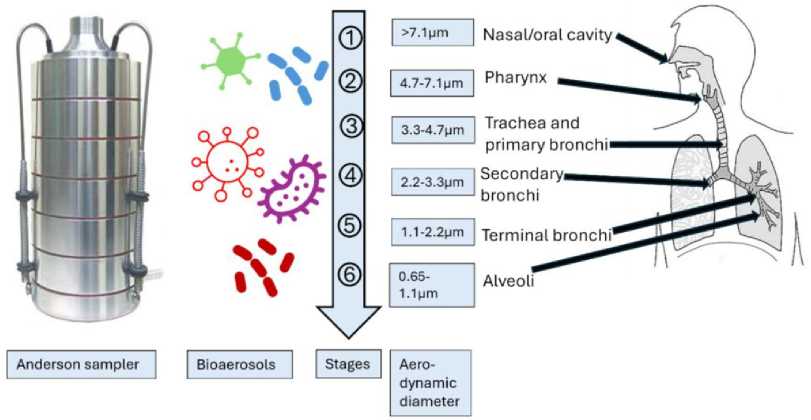
Figure. Principle of operation of the Andersen six-stage viable cascade impactor and the deposition regions of bioaerosols in the human respiratory system according to aerodynamic diameter
The figure illustrates the operating principle of the Andersen six-stage viable particle impactor and the regions of deposition of bioaerosols (airborne microorganisms, fungal spores, bacteria, and other viable particles) in the human respiratory tract according to their aerodynamic diameter. This device is a multi-orifice cascade impactor widely used for measuring the concentration and particlesize distribution of airborne aerobic bacteria and fungi in indoor (intramural) or ambient air. The calibration process is based on aerodynamic measurement, which directly corresponds to the penetration ability of particles into the human lungs regardless of their physical size, shape, or density.
The cylindrical metal structure shown on the left side of the figure operates at a standard airflow rate of 28.3 L/min. Air enters from the top and passes through 400 precisely sized orifices (jets) at each stage, separating particles by inertial impaction and collecting them in Petri dishes containing agar medium. As the aerodynamic diameter decreases from large to small, larger particles are captured in the upper stages while smaller particles pass through to the lower stages.
The stages and their corresponding deposition regions in the respiratory system according to aerodynamic diameter ranges are as follows:
Stage ф (>7.1 цт): The largest particles deposit in the nasal and oral cavity. Fungal spores of this size (e.g., large spores of Alternaria and Cladosporium ) are mainly retained in the upper respiratory tract and may cause local reactions such as allergic rhinitis, sinusitis, or conjunctivitis.
Stage @ (4.7-7.1 цт): Medium-large particles deposit in the pharynx. This size range is often associated with throat irritation and coughing.
Stage @ (3.3-4.7 цт): Particles deposit in the trachea and primary bronchi. Particles of this size can enter the major bronchial airways and may contribute to diseases such as asthma or bronchitis.
Stage @ (2.2-3.3 pm): Particles deposit in the secondary bronchi, where allergens and pathogens may trigger allergic and inflammatory responses in the middle bronchial region.
Stage @ (1.1-2.2 pm): Particles are retained in the terminal bronchioles. In these small airways, particles may exacerbate asthma attacks or chronic obstructive pulmonary diseases.
Stage @ (0.65-1.1 pm): The smallest particles penetrate into the alveoli. This size range increases the risk of invasive infections (e.g., invasive aspergillosis caused by Aspergillus fumigatus or mucormycosis), particularly in immunocompromised individuals, because pathogens reaching the alveoli may spread systemically.
Thus, the figure represents the human respiratory system as an aerodynamic classification model: large particles (>4.7 µm) tend to deposit in the upper respiratory tract, where allergic reactions are most common, whereas smaller particles (<2.1-3 цт) penetrate into deeper regions such as the alveoli, where invasive infections may occur.
In the monitoring of microscopic fungi in Baku, the use of this device allows researchers to scientifically explain seasonal distribution patterns (e.g., dominance of dry allergenic spores affecting upper airways in summer and moisture-loving pathogenic spores reaching deeper lung regions during autumn and winter) as well as zonal risks (such as increased tolerant species in industrial districts). These findings highlight the health risks associated with the inhalation of bioaerosols, including allergic diseases and invasive mycoses, and emphasize the importance of establishing continuous environmental monitoring systems.
Conclusion
The ecological monitoring of microscopic fungi and the analysis of bioaerosol dynamics in the residential environment of Baku during 2024-2025 reveal the complex and multifactorial nature of aeromycobiota distribution within the urban ecosystem. Seasonal dynamics indicate that during the dry summer period (relative humidity <70%), species of Alternaria and Cladosporium dominate, with average concentrations of450-850 CFU/m3, mainly causing allergic reactions in the upper respiratory tract such as allergic rhinitis, asthma, and conjunctivitis. In contrast, during the autumn-winter season (relative humidity 70-85%), moisture-tolerant species such as Aspergillus and members of the Mucorales group become dominant, with concentrations increasing to 1300-1950 CFU/m3. Smaller spores capable of reaching the alveoli significantly increase the risk of severe mycoses such as invasive aspergillosis and mucormycosis, particularly in immunocompromised individuals. From a spatial perspective, the highest biological diversity and saprotrophic structure are recorded in parks and green areas (Sabail and Khatai districts, Dede Gorgud Park, and the Botanical Garden area; Shannon index 2.75-2.95), confirming the role of green infrastructures as natural bioaerosol filters. In residential districts (Narimanov and Yasamal), anthropogenic factors such as traffic emissions and construction dust promote the dominance of tolerant species. In industrial districts (Garadagh, Binagadi, Surakhani, and Alat), diversity decreases significantly (Shannon index 1.85-2.10), with negative correlations observed with heavy metals such as Pb, Zn, and Cu (r = -0.65 to -0.72), and tolerant species such as Aspergillus terreus accounting for 32-40% of the fungal community. The detection of rare toxigenic species ( Stachybotrys chartarum , Mucor spp., Ulocladium spp.) around the historical center Icherisheher raises concerns regarding the mycological safety of cultural heritage monuments. Aerodynamic distribution results confirmed by the Andersen six-stage impactor demonstrate that spores larger than 4.7 цm (55-70%) deposit in the upper respiratory tract and primarily trigger allergic diseases, whereas smaller particles (<2.1 цm; 25-38%) penetrate into the alveoli, increasing the risk of invasive infections. Dominant allergenic fungi ( Alternaria , Cladosporium , Aspergillus ) contribute to seasonal peaks of asthma and allergic diseases (particularly during autumn-spring; correlation coefficient r = 0.68-0.82), while toxigenic species ( A. flavus ,
Stachybotrys chartarum , Fusarium spp.) produce mycotoxins (aflatoxin B1, ochratoxin A, fumonisins, satratoxins) that may cause long-term respiratory irritation, immunosuppression, and additional risks through the food chain. Risk assessment indicates that: Group I (critical) ( A. flavus , A. fumigatus ) represents a very high risk (HQ 0.9–1.0; PM2.5 synergistic risk 1.5–2.2) affecting children, the elderly, and immunocompromised individuals; Group II (dangerous) ( Stachybotrys chartarum , Fusarium spp., Alternaria spp.) presents a high risk (HQ 0.5–0.8); Group III (moderate) ( Cladosporium spp., Ulocladium spp.) shows a moderate risk level (HQ <0.5). The bioaerosol dynamics of Baku differ from global urban trends: the Caspian Sea effect and increased humidity promote rapid spread of pathogenic species, while industrial pollution reduces diversity and enhances the dominance of tolerant fungi. Climate changes observed during 2024–2025, including increased humidity and extreme weather events, have further intensified these processes. In conclusion, the study highlights the need to establish a continuous bioaerosol monitoring system, implement artificial intelligence-based predictive models, expand and protect urban green spaces, improve building ventilation standards, and enhance public awareness programs such as seasonal allergy forecasts and early warnings for risk groups. This interdisciplinary analysis provides a scientific basis for integrating mycological safety and air-quality management into Baku’s sustainable urban development strategy and identifies future research priorities, including the application of real-time biosensor technologies, molecular-genetic identification methods, and high-sensitivity monitoring systems.
