
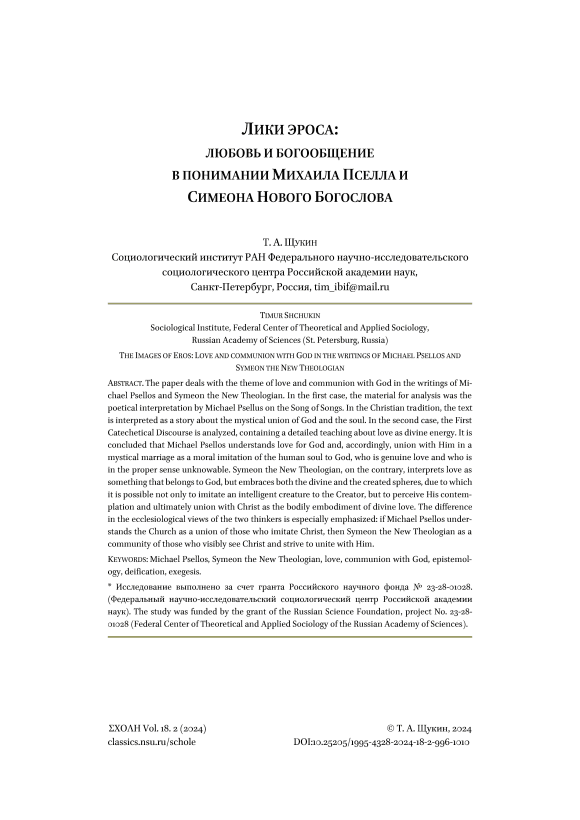
Лики эроса: любовь и богообщение в понимании Михаила Пселла и Симеона Нового Богослова
Журнал: Schole. Философское антиковедение и классическая традиция @classics-nsu-schole
Рубрика: Статьи
Статья в выпуске: 2 т.18, 2024 года.
Бесплатный доступ
В статье рассматривается тема любви и богообщения в трудах Михаила Пселла и Симеона Нового Богослова. В первом случае материалом для анализа послужило поэтическое толкование Михаила Пселла на библейскую книгу «Песнь Песней». В христианской традиции данный текст обычно интерпретируется как рассказ о мистическом единении Бога и человеческой души. Во втором случае анализируется Первое огласительное слово Симеона Нового Богослова, содержащее подробное учение о любви как божественной деятельности. Делается вывод, что Михаил Пселл понимает любовь к Богу и, соответственно, союз с Ним в мистическом браке как нравственное подражание человеческой души Богу, который есть подлинная любовь и который в собственном смысле непознаваем. Симеон Новый Богослов, напротив, трактует любовь как нечто принадлежащее Богу, но охватывающее как божественную, так и тварную сферы, благодаря чему возможно не только подражание разумного существа Творцу, но и непосредственное Его созерцание и, в конечном счете, соединение со Христом как телесным воплощением божественной любви. Особенно подчеркивается разница в екклезиологических взглядах двух мыслителей: если Михаил Пселл понимает Церковь как объединение тех, кто подражает Христу, то Симеон Новый Богослов - как сообщество тех, кто ощутительно видит Христа и стремится соединиться с Ним.
Похожие статьи в разделе Религия. Богословие
Короткий адрес: https://sciup.org/147245825
IDS: 147245825 | DOI: 10.25205/1995-4328-2024-18-2-996-1010
The images of Eros: love and communion with god in the writings of Michael Psellos and Symeon the New Theologian
The paper deals with the theme of love and communion with God in the writings of Michael Psellos and Symeon the New Theologian. In the first case, the material for analysis was the poetical interpretation by Michael Psellus on the Song of Songs. In the Christian tradition, the text is interpreted as a story about the mystical union of God and the soul. In the second case, the I Catechetical Discourse is analyzed, containing a detailed teaching about love as divine energy. It is concluded that Michael Psellos understands love for God and, accordingly, union with Him in a mystical marriage as a moral imitation of the human soul to God, who is genuine love and who is in the proper sense unknowable. Symeon the New Theologian, on the contrary, interprets love as something that belongs to God, but embraces both the divine and the created spheres, due to which it is possible not only to imitate an intelligent creature to the Creator, but to perceive His contemplation and ultimately union with Christ as the bodily embodiment of divine love. The difference in the ecclesiological views of the two thinkers is especially emphasized: if Michael Psellos understands the Church as a union of those who imitate Christ, then Symeon the New Theologian as a community of those who visibly see Christ and strive to unite with Him.
Список литературы Лики эроса: любовь и богообщение в понимании Михаила Пселла и Симеона Нового Богослова
- Кривошеин, В., архиеп. (1996) Симеон Новый Богослов. Нижний Новгород: Издательство братства во имя святого князя Александра Невского.
- Погодин, А., архим. (1998) Михаил Пселл. Богословские сочинения. Санкт-Петербург: Изд. РХГИ, Летний Сад, Журнал «Нева».
- Щукин, Т. А. (2018) “Гармония или спасение. Толкование Михаила Пселла на Песн. 2:6 и ревизия византийской экзегетической традиции в XI веке”, ESSE: Философские и теологические исследования 3.1, 252–286.
- Щукин, Т. А. (2021) “Ангелология Михаила Пселла и позднеантичные споры о природе небес”, Платоновские исследования 14.1, 99–121.
- Щукин, Т. А. (2023) “Учение Михаила Пселла о внешнем уме (θύραθεν νοῦς) в поздневизантийском контексте”, Платоновские исследования 19.2, 159–186.
- Coakley, S. (2018) “Gregory of Nyssa on Spiritual Ascent and Trinitarian Orthodoxy: a Reconsideration of the Relation between Doctrine and Askesis”, in Gregory of Nyssa: In Canticum Canticorum. Analytical and Supporting Studies. Proceedings of the 13th International Colloquium on Gregory of Nyssa (Rome, 17–20 September 2014). Leiden; Boston: Brill, 360–375.
- D’Ambrosi, М. (2013) “The Icon of the Three Holy Hierarchs at the Pantokrator Monastery and the Epigramms of Theodore Prodromos on Them”, in The Pantokrator Monastery in Constantinople, ed. by S. Kotzabassi. Boston; Berlin: Walter de Gruyter, 143–151.
- Darrouzès, J., ed. (1966) Syméon le Nouveau Théologien, Traités théologiques et éthiques (Sources chrétiennes 122). Paris: Éditions du Cerf.
- Krivochéine B., ed. (1965) Syméon le Nouveau Théologien, Catéchèses, Actions de Grâces 1-2. Paris: Éditions du Cerf.
- Laird, M. (1999) “Gregory of Nyssa and the Mysticism of Darkness: A Reconsideration”, The Journal of Religion 79 (4), 592–616.
- Laird, M. (2002), “Under Solomon’s tutelage: the education of desire in the Homilies on the Song of Songs”, Modern Theology 18 (4), 507–525.
- Langerbeck H., ed. (1960) Gregorii Nysseni opera. Vol. VI: Gregorii Nysseni Commentarius in Canticum Canticorum. Leiden: Brill.
- Lauritzen, F. (2012), “Psellos the hesychast: a neoplatonic reading of the Transfiguration on Mt Tabor”, Byzantinoslavica 70, 167-180.
- Leanza, S. (1995), “L’esegesi poetica di Michele Psello nel Canto di Cantici”, in La poesia bizantina: atti della terza Giornata di studi bizantini sotto il patrocinjio della Associazione Italiana di Studi Bizantini (Macerata, 11–12 maggio 1993). Napoli: Istituto Universitario Orientale, 143–166.
- Maspero, G., Brugarolas, M., Vigorelli, I., eds. (2018) Gregory of Nyssa: In Canticum Canticorum. Analytical and Supporting Studies. Proceedings of the 13th International Colloquium on Gregory of Nyssa (Rome, 17–20 September 2014). Leiden; Boston: Brill.
- Noble, I. (2002), “The Apophatic Way in Gregory of Nyssa”, in Philosophical Hermeneutics and Biblical Exegesis, ed. by P. Pokorný, J. Roskovec. Tübingen: Mohr Siebeck, 323–339.
- Walter, D. (2017) Michael Psellos: Christliche Philosophie in Byzanz. Berlin: de Gruyter.
- Westerink, L. G., ed. (1992) Michael Psellus. Poemata. Stuttgart; Leipzig: B. G. Teubner.
