
Marketing predictors of ethical dimensions in predicting satisfaction and intention to buy again in cadet football players
Journal: Sport Mediji i Biznis @journal-smb
Article in issue: 3 vol.11, 2025.
Free access
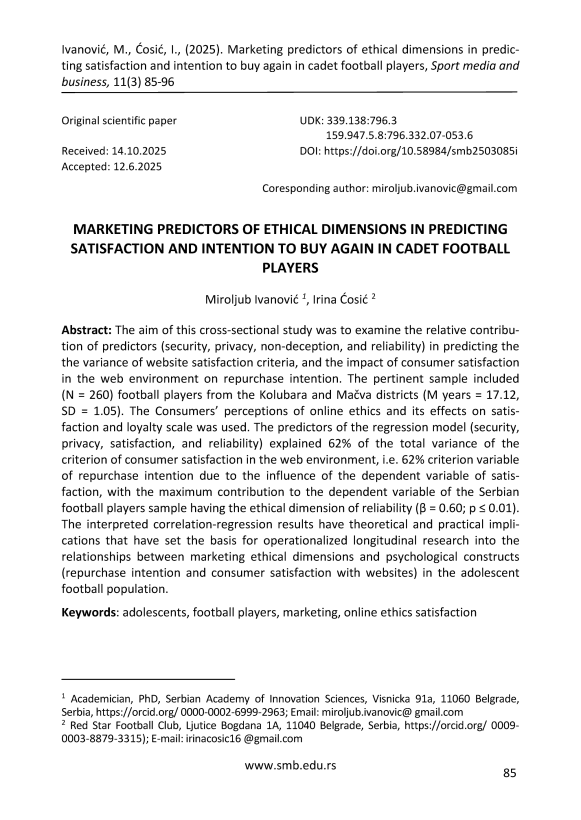
The aim of this cross-sectional study was to examine the relative contribution of predictors (security, privacy, non-deception, and reliability) in predicting the the variance of website satisfaction criteria, and the impact of consumer satisfaction in the web environment on repurchase intention. The pertinent sample included (N = 260) football players from the Kolubara and Mačva districts (M years = 17.12, SD = 1.05). The Consumers’ perceptions of online ethics and its effects on satisfaction and loyalty scale was used. The predictors of the regression model (security, privacy, satisfaction, and reliability) explained 62% of the total variance of the criterion of consumer satisfaction in the web environment, i.e. 62% criterion variable of repurchase intention due to the influence of the dependent variable of satisfaction, with the maximum contribution to the dependent variable of the Serbian football players sample having the ethical dimension of reliability (β = 0.60; p ≤ 0.01). The interpreted correlation-regression results have theoretical and practical implications that have set the basis for operationalized longitudinal research into the relationships between marketing ethical dimensions and psychological constructs (repurchase intention and consumer satisfaction with websites) in the adolescent football population.
Similar articles in the section General questions of trade and commerce. Market
Short address: https://sciup.org/170211431
IDS: 170211431 | UDC: 339.138:796.3; 159.947.5.8:796.332.07-053.6 | DOI: 10.58984/smb2503085i
Text of the scientific article Marketing predictors of ethical dimensions in predicting satisfaction and intention to buy again in cadet football players
DOI:
At the beginning of the 21st century, modern information and communication technologies contributed to an increase in the number of online sellers and consumers. With the growth of online stores and sellers, dilemmas have emerged about the ethics of advertising, unethical practices of retailers, e.g. lack of protection of personal and financial data, different selling and purchasing prices, non-delivery of purchased products with numerous defects, etc. (Ebrahimi et al., 2023; Dašić et al., 2023). Also, the internet is an environment that is still conducive to ethical transgressions. Current ethical behaviors of online retailers are generating increasing consumer attention, and can form positive perceptions about the ethics of online sellers. Therefore, ethical practices of online sellers can contribute to consumer behavior, resulting in positive reactions to transactions and their increased purchasing tendencies (Enaifoghe et al., 2023). The relationship between online seller ethics and perceptions of the ethicality of digital marketing activities and the ethicality of online seller websites is relative to positive consumer experience and satisfaction. Digital marketing involves the use of information and communication technologies to support marketing activities to meet consumer needs (Saleh & Zeebaree, 2025). Digital marketing, along with market globalization, rapid technological development, and modern dynamic business models, has transformed the business environment of sports clubs, which affects the instability, uncertainty, and competitiveness of the business environment (Salehipour et al., 2025). The aforementioned authors believe that this current business reality presents numerous challenges for sports clubs.
Sports marketing encompasses all activities undertaken by a sports club to attract consumers to its products or services through high-quality and personalized messages (Izadi et al., 2021; Qiumei & Wei, 2025). The goal of such marketing is to deliver personal value to potential customers a long-term presentation of product value, intensify brand loyalty and finally increase sales (Agha et al., 2023; Mehdi & Hossei, 2021). The scientific discipline of ethics refers to a specific that help people make their life decisions (Lamberton et al., 2025; Wajdi & Soliyah, 2024). In his work (Hammerton, 2025) he classifies four basic categories of ethics: small ethics, normative, descriptive and applied ethics.
In the last two decades of the 21st century, numerous studies have been conducted in the field of ethics of digital marketing activities, primarily those related to consumer perception and ethical issues that sports clubs encounter when creating digital marketing strategies (Feng & Yang, 2024; Mohammad et al., 2023). They conclude that sports consumers are predominantly more satisfied with online shopping, with a significant number of them encountering certain ethical issues and the use of unethical marketing tools. Research findings (Delarestaghi et al., 2019; Qinan & Qin-qin, 2024) show that ethics play a significant role in digital marketing activities, where in the modern era of globalization, the online shopping experience is more important to sports consumers than privacy and personal data protection. According to the results of the study (Abdaoui et al., 2024; Ghasemi et al., 2021), the predictors: non-deception, security and reliability are relevant indicators of satisfaction with the online shopping website, while the independent variable privacy is in correlation with the criterion of loyalty. At the same time, an intense interaction was found between ethical online behavior and marketing, i.e. their perception of satisfaction in the sports club. The authors drew attention to the fact that the predictors – privacy and security – have a greater contribution to the trust of athletes than the variables fulfillment/reliability and repurchase intention (Karimi et al., 2023). This suggests that an e-consumer cannot form constant relations and resistance to transformations if he does not trust the e-service providers.
Given the undeniable importance of the research problem and the lack of empirical studies on the relationships of predictor variables (security, privacy, non-deception, reliability and satisfaction) in predicting the variance of consumer satisfaction criteria in the web environment and repurchase intention based on consumer satisfaction in the web environment in the cadet football population, the aim of this crosssectional study was to check the relative influence of the aforementioned predictor variables psychological constructs (consumer satisfaction in the web environment and their repurchase intention). Based on the theoretical assumptions and the presented results of previous studies and the aim of the research, two alternative hypotheses were tested: A positive and significant co-dependence between reliability and consumer satisfaction in the web environment is assumed ( H 1 ). A positive and statistically significant mutual influence between consumer satisfaction in the web environment and repurchase intention is expected ( H 2 ).
The findings obtained in this empirical study can be the basis for various intervention programs aimed at identifying the influence of independent variables (security, privacy, non-deception, reliability) in predicting the dependent variable of website satisfaction, as well as the contribution of consumer satisfaction in the web environment (as a predictor) to the criterion variable of repurchase intention.
Methods
Participants and procedure
A cross-sectional study was conducted on a pertinent sample of 260 cadet football players from five clubs of the Kolubara-Mačva League: FK “Budućnost-Krušik 2014” (Valjevo), FK “Radnički” (Valjevo), FK “Jedinstvo” (Ub), FK “Železničar” (Lajkovac) and FK “Mačva” (Šabac) 17.12 (± 1.05). All participants had at least two years of systematic and organized training at least three times a week. The testing was carried out in November 2025. Before the start of the anonymous group survey, members of the youth sports teams were given brief information about the purpose of the research, research aim, and the procedure for collecting and storing data. Before the start of the research, with the approval of their parents and club management, the participants signed a consent form for voluntary participation. They were also informed that they could quit the survey at any time and whenever they wished and not answer any questions if they did not wish to do so for any reason. The average time required for the testing was approximately 30 minutes.
Measurement instruments
The Consumers’ perceptions of online ethics and its effects on satisfaction and loyalty scale
The online measurement instrument (Limbu et al., 2011) is presented on a five-point Likert-type scale, with 19 items arranged in six subscales ranging from 1 = I strongly disagree to 5 = I strongly agree), where for each item, participants selected the value that corresponds to their level of agreement. Examples of items of participants' attitudes on websites: security subscale – “The security policies of the websites I visit are clear” (1), “The websites I visit clearly display online transactions before making a purchase” (2), “The websites I visit offer secure payment methods” (3), “The websites I visit have suitable security features” (4); privacy subscale – “The websites I visit clearly explain how consumer data is used” (1), “When making a transaction on the websites, I only had to provide personal data” (2); “Information about displayed on the websites I visit”; non-deception subscale – “The websites I visit do not exaggerate the advantages and features of their offer” (1), “The websites I visit do not exploit the in order to induce them to make a purchase” (2), “The websites I visit do not tend to persuade consumers to buy products that are not necessary.”; reliability subscale – “The prices displayed on the websites I visit represent the actual prices charged” (1), “When making a purchase on the websites, I received what I ordered” (2), “The websites I visit fulfill their promises.”; satisfaction subscale – “I am happy that I made a purchase via the website” (1), “My choice to purchase via the website was a wise decision” (2), “I am satisfied via the website” (3).
Results
Table 1. Shows the basic descriptive indicators of all examined variables in this research.
Table 1. Descriptive parameters of participants' attitudes on websites
|
Variables |
M |
SD |
Sk |
Ku |
α |
|
Security |
4.03 |
0.70 |
0.26 |
0.92 |
0.78 |
|
Privacy |
3.83 |
0.87 |
0.85 |
0.34 |
0.80 |
|
Non-deception |
3.22 |
0.89 |
0.36 |
0.81 |
0.90 |
|
Reliability |
3.98 |
0.80 |
0.74 |
0.66 |
0.82 |
|
Satisfaction |
4.03 |
0.76 |
0.43 |
0.72 |
0.87 |
|
Repurchase intention |
4.30 |
0.78 |
0.69 |
0.91 |
0.93 |
Legend . M = arithmetic mean; SD = standard deviation; Sk = skewness; Ku = kurtosis; Standard error of estimate ( SE ) of indicator Sk is 0.11, and of Ku is 0.22; α = Cronbach’s alpha coefficient
The obtained mean values of ethical dimensions in the descriptive matrix show that participants achieve the maximum score on the variable (M repurchase intention = 4.30), and the minimum mean value is achieved on the variable (M non-deception = 3.22). The calculated internal consistency coefficients range from 0.78 to 0.93, which suggests satisfactory reliability of the six subscales used (Muthén et al., 2025).
Testing the normality of the distribution scores revealed that the values of the standardized coefficients of skewness and kurtosis are acceptable because they are within the limits of standard values, in the range of ±2 (Kline, 2023). The obtained coefficients of the symmetry measure indicate good sensitivity of all examined variables, and that there are no extreme values and statistically significant variations in the score distribution from the reference values of the Gaussian probability curve, which is a prerequisite for implementing further parametric procedures in statistical analysis.
In order to define the correlation between the variables of ethical dimensions, a correlation analysis was conducted (Table 2).
Table 2. Pearson correlation coefficient
|
Variables |
1 |
2 |
3 |
4 |
5 |
|
1. Security |
‒ |
||||
|
2. Privacy |
0.80 |
‒ |
|||
|
3. Non-deception |
0.39 |
0.50 |
‒ |
||
|
4. Reliability |
0.60 |
0.52 |
0.45 |
‒ |
|
|
5. Satisfaction |
0.51 |
0.40 |
0.38 |
0.70 |
‒ |
Annotation . The correlation is significant at the 0.01 level.
By inspecting the cells of the correlation matrix, it is observed that the values of statistically significant linear correlation coefficients of the measured variables range between low and moderate intensity, ranging from 0.38 to 0.80. The obtained mutual dependence is low to moderately high. The maximum statistically significant positive bivariate positive correlation was obtained between , while the minimum significant positive association was obtained between the variables (Non-deception and Customer Satisfaction in the Web Environment).
In order to determine predictor/independent variables of ethical dimensions: security, privacy, non-deception and reliability to participants' satisfaction with websites, a multiple regression analysis was conducted (Table 3).
Table 3. For predicting consumer satisfaction in the web environment
|
Variables |
β |
SE |
|
Security |
0.19* |
0.05 |
|
Privacy |
-0.13* |
0.03 |
|
Non-deception |
0.38** |
0.08 |
|
Reliability |
0.60** |
0.02 |
|
R = 0.70 R2 = 0.52 |
||
Legend. β = standard partial beta regression coefficient (ponder); SE = standard error of estimate β ; R = coefficient of multiple correlation; R2 = coefficient of multiple determination; * p ≤ 0.05, ** p ≤ 0.01.
Inspection of the cells of the regression matrix shows that the four analyzed ethical dimensions (security, privacy, satisfaction, and reliability) explained or predicted a total of 62% of the variance of the criterion of consumer satisfaction in the web environment. Maximum contribution to the dependent variable is made by the predictor reliability (β = 0.60; p ≤ 0.01), and the minimum by the predictor privacy (β = 0.13; p ≤ 0.05).
In Table 4, a multiple regression analysis was conducted to determine the contribution of the satisfaction construct to repurchase intention.
Table 4. Multiple linear regression model in predicting repurchase intentions
|
Variables |
β |
SE |
|
Constant |
4.96 |
0.03 |
|
Satisfaction |
0.68 |
0.05 |
|
R = 0.80 |
||
|
R2 = 0.59 |
Legend. β = standard partial beta regression coefficient (ponder); SE = standard error of estimate β ; R = coefficient of multiple correlation; R2 = coefficient of multiple determination; * p ≤ 0.05, ** p ≤ 0.01.
The obtained coefficient of determination suggests that 59% of the variance of repurchase intention is due to the influence of the independent variable of satisfaction with the web environment. This shows that more than ½ of the variability in repurchase intention can be predicted (explained) by the variable of environment.
The regression findings obtained in this paper confirmed both tested alternative hypotheses: H 1 – Positive and significant interdependence of reliability and consumer satisfaction in the web environment. H 2 – Mutual influence of consumer satisfaction in the web environment and repurchase intentions.
Discussion and conclusion
From a theoretical perspective, the conducted research contributes to a more complete identification. This is relevant to the quality of their relationships and business success, repurchase intention, and overall consumer satisfaction with online shopping. Despite the fact that a large number of studies have been published in the last 20 years regarding consumers' perceptions of the ethics of marketing activities sellers, this study is a groundbreaking study on a Serbian sample that examines sellers among consumers in the Republic of Serbia. Managerial perspective, the study provides marketing experts and online retailers with a system of practical solutions that help form quality and long-lasting relationships with consumers, as such relationships are essential for the competitiveness of sellers. Online retailers should primarily guarantee the security and privacy of their consumers, as the aforementioned standards have emerged motives for online transactions and repurchase intentions. This shop online if they trust that they will be granted the privacy and security of their information. It is also necessary for online retailers to prevent intrusion into the privacy of their customers and to clearly state their privacy policies on shopping websites. In general, the independent variables reliability and non-deception are correlated with the exact presentation on websites, as well as the timely delivery of ordered products.
Finally, based on the correlations found in the work, a significant number of participants use the Internet every day for shopping, and when selecting websites for shopping, personal data, as well as trust in online sellers, are particularly relevant to them. At that time, the aforementioned predictors have a significant contribution to the perceived ethics of consumers, their satisfaction and intention to purchase again. According to the aforementioned findings, suggestions for improving ethics in the online environment arise. First of all, online sellers should continue to implement a positive policy of security features and take care of the protection of individual consumer data. Online sellers need to explain to consumers more precisely the method and purpose of using their personal data and not use manipulative practices to persuade consumers to purchase unnecessary products.
The findings obtained with cadet-age study confirmed two of the five alternative hypotheses tested. More precisely, the ethical dimension of reliability is positively and statistically significantly correlated with consumer satisfaction in the web environment, and consumer satisfaction in the web environment positively and significantly interacted with repurchase intention. The correlation results show that the ethical dimensions of 17-year-old football players (security, privacy and non-deception) are not statistically significant, i.e. are not positively and significantly correlated with consumer satisfaction in the web environment.
Despite the fact that the empirical study provided valid insights, it had methodological limitations related to the short time period of the survey, the characteristics of the sample, and the approach to the research variables. Therefore, future research should be conducted on a larger number of participants of different cultures, genders, and ages. Another methodological limitation is the approach to the variables, and it is necessary for future operationalized research to include variables from different perspectives and dimensions, as this can achieve efficiency, effectiveness, and reliability of the data, or provide a more complete insight.
Conflict of interests :
The authors declare no conflict of interest.
Author Contributions
